Volcano Articles

Volcano Articles


Mount Popo

Mexico City - May 11, 1999 - Nando News

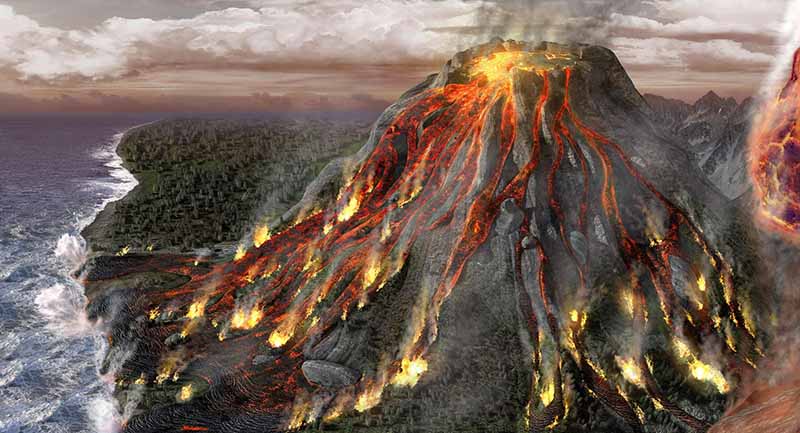
Immense plumes of ash and smoke billow from Mexico's famous Popocatepetl volcano within view of millions of people. It rumbles often and occasionally hurls out bursts of glowing rock.

But more than four years after the volcano began a new cycle of eruptions, scientists and officials are ever so cautiously growing less nervous - not that anyone ever takes an explosive, 17,925-foot mountain for granted. Seismologists map its every quiver. Chemists study the gases and debris it burps out. Television cameras and radar keep constant watch on the crater, and a video image of the mountain is updated every minute on the Internet.

Trying to determine what occurs miles underground, geologists from Mexico and the University of Miami are turning to the skies, expanding a satellite monitoring system for the volcano.

All of that effort "has been able to give, little by little, a more complete and realistic vision of the risks for those in civil defense," said Roberto Meli, head of the national Center for the Prevention of Disasters, which is in charge of monitoring Popocatepetl.

Some 20 million people live within 50 miles of the volcano. That has attracted attention to Popocatepetl's threat, but Meli says it also blurs the fact that a far smaller number of people living much closer to the volcano are at greatest risk.

Popocatepetl is capable of immense eruptions - the last occurred about 800 years ago. It covers the ruins of two earlier volcanoes on the same site. Far more common, however, have been bursts of smoke, steam and ash recorded periodically since the 14th century.

Keeping watch on the volcano can be costly and tiresome. Gasping for breath in the thin air, scientists struggle up steep, sand-like slopes to build and maintain small monitoring stations near the fuming crater. Helicopters are sometimes pressed into duty to ferry equipment. Airplanes are used to check gas emissions. He said there are plans to install pressure meters to record the force of Popocatepetl's outbursts and new monitors to measure expansion or contraction of the volcano's surface.

At a recent conference of volcano experts in Mexico City, investigators showed photographs of solar cells on recording stations peppered by volcanic debris - and a yards-wide hole blasted by a piece of rock hurled from the crater.

In 1995, five hikers were found dead near Popocatepetl's crater, possibly due to volcanic gases. Officials now warn people to stay at least four miles from the crater.

Most scientists believe that somewhere below the volcano is a chamber of magma, fed by flows from deeper within the Earth and vented to the surface at the volcano's crater.

Earthquake studies indicate the chamber is deep below the surface - perhaps six miles beneath the crater, much deeper than the chambers of volcanoes like Mount St. Helens.

If a chamber is shallow, a relatively small increase in pressure "could really weaken the walls and cause an immense explosion, such as occurred at Mount St. Helens," said seismologist Carlos Valdes of Mexico's National Autonomous University.

The chamber beneath Popocatepetl "gives us security. If it is found further below, the pressure of the weight of the rock keeps it stable," he said.

Valdes' monitors also show a remarkably small number of earthquakes deep within the volcano - indicating that when magma flows, it seems to do so without meeting much blockage, so there may be less buildup of pressure.

Three Mexican states and Mexico City have mapped out plans to rapidly evacuate hundreds of thousands of people if the volcano some 40 miles southeast of Mexico City shows signs of a more dangerous eruption.

Residents of nearby villages have refused suggestions to relocate. Some of the Indian residents worship the volcano, yearly hiking up its slopes to a dark outcrop known as "the bellybutton" to leave offerings to "Don Goyo," an affectionate and respectful nickname.

A large eruption could lead to fast-moving mudslides of volcanic ash that could swamp parts of some towns. Much of the sloping terrain to the east of the volcano is formed from such debris.

A huge, explosive eruption of the sort the volcano experiences every millennium or so could cause a blast of volcanic material that would destroy almost everything in its path.

Some villages were briefly evacuated in 1994 shortly after the volcano began its latest eruption cycle.

Mexican volcanologist Servando de la Cruz said that with what scientists know now, that evacuation might have been avoided. Officials fear people will lose confidence in emergency measures if evacuations seem unwarranted.

What would alarm him? "An activity completely different from what we have seen until now," something that might leave investigators baffled about what the volcano is doing, and what dangers it might pose.


Evidence found of largest lava flow in history; eruption may have split continents

WASHINGTON - April 22, 1999 - AP

Recently discovered volcanic rocks in Brazil indicate an eruption 200 million years ago produced the most widespread lava flow in Earth's history, splitting apart North and South America, Europe and Africa. Scientists say it may have caused a massive extinction at the same time.

A previously unrecognized area of ancient lava flow covering about 965,000 square miles in the Amazon basin turns out to be related to lava flows on three other continents, researchers say in Friday's issue of the journal Science.

The eruption occurred at the same time and had the same origin as lava flows found in North America, Africa and Europe, said Paul Renne of the University of California, Berkeley, who led the international team that conducted the research.

And, he added in a telephone interview, an early mass extinction at the same time seems likely to have been connected to the huge magma flow. The giant dinosaurs made popular in recent movies developed after this period and were killed off in another mass extinction.

The great eruption, which occurred over a few million years, tore apart the ancient continent of Pangea, opening up what is now the Atlantic Ocean, the scientists reported. The lava field it produced has been named the Central Atlantic Magmatic Province, or CAMP. With the addition of the newly found Brazilian flow, it totals some 2.7 million square miles, Renne said, adding, "We don't really know for sure that we've got it all yet." Perhaps the best known portion of CAMP for Americans are the palisades, towering along the Hudson River.

By comparison, the next largest known lava flows are the Deccan Traps in India and the Siberian Traps, each just under half the size of CAMP. Because different parts of CAMP are located on different continents they had been studied separately, Renne said, so no one previously recognized the region's full extent. He likened it to several blind people touching different parts of an elephant and trying to describe the animal.

The eruptions would have released a variety of gases into the atmosphere and thus were probably a factor in the extinction of much sea life and early reptiles that occurred at the time, known as the boundary between the Triassic and Jurassic periods.

"This is the best example of flood basalts associated with an extinction," Renne said. "Some of the best stratigraphic evidence of the mass extinction occurs in exactly the same site in which you find the flood basalts - they sit right smack on top of one another."

There have been at least four mass extinctions in Earth's history and their causes spark sharp debate among scientists. Giant lava flows are suspected in some cases, while meteors striking the Earth are viable candidates for the cause of others.


Huge Antarctic eruptions 25 million years ago likely changed climate, drillings indicate

Wellington -November 6, 1998

Scientists drilling into the Antarctic seabed have reported finding evidence of huge volcanic eruptions 25 million years ago. The borings suggest a past fiery enough to alter the global environment of the time. Scientists made the unexpected discovery while drilling into the floor of the Ross Sea, off Victoria Land near Cape Roberts, the Antarctica New Zealand research center said on Friday.

Layers of pumice and other volcanic debris up to 4 feet thick were found, suggesting eruptions would have had a major impact on the global environment at the time, it said. For the past two Antarctic research seasons, a team of scientists from Australia, Britain, Germany, Italy, New Zealand and the United States have been drilling the Antarctic sea floor.

The main debris layer points to an eruption that generated an ash cloud reaching 31 to 44 miles into the stratosphere, the Christ church-based center said. "The debris was supplied by voluminous eruptions from a nearby source, but the exact location and characteristics of that source are still unknown," it said.

"The thickest distinct layer of volcanic debris is 1.2 meters thick, which suggests an eruption as dramatic as that of Krakatau in 1883." Indonesia's Mount Krakatau, between Java and Sumatra islands, erupted in 1883 and triggered tidal waves that killed more than 36,000 people. Modern examples such as Mount Pinatubo -- a comparatively much smaller eruption in the Philippines in 1991 -- cooled the world climate by 0.5 degrees Celsius for a year.


Authorities Ignore Poison Gas Danger

October 13, 1998 (AP)

Authorities across the country are failing to adequately warn hikers about dangerous volcanic gases emitted near natural beauty spots, according to a government survey.

Officials in two-thirds of 57 regions where poisonous gases are released into the air have taken no measures to warn hikers of the risks associated with the emissions, the survey found.

The study was conducted by the Environment Agency and the Ministry of International Trade and Industry's Geological Survey of Japan. The results were announced at a meeting of the Volcanic Society of Japan in Yamagata last week.

Shigeru Suto, of the Geological Survey of Japan, said hikers must be made fully aware of potential danger spots to prevent fatal accidents. Last year, poisonous volcanic gases killed three hikers on Mount Hakkoda in Aomori Prefecture, four on Mount Adatara in Fukushima Prefecture and two on Mount Aso in Kumamoto. Since 1950, a total of 49 people have died from inhaling toxic substances released from the ground, Suto said.

The most recent deaths prompted the government survey of safety measures being adopted by local governments in volcanic regions. The survey revealed that toxic substances such as hydrogen sulfide, sulfur dioxide and carbon dioxide were emitted from 50 active volcanoes. These dangerous gases were also detected at seven other risky spots, such as hot springs.

Sixteen of the surveyed regions have posted warnings at the start of hiking trails or fenced off dangerous areas, many of which have been the scenes of accidents.

At a danger spot on Mount Kusatsu-Shirane in Gunma Prefecture, an automatic alarm goes off when emissions of hydrogen sulfide reach a potentially harmful level.

And in six of the regions, climbers are prohibited from going near the mouths of volcanoes or to mountaintops. The summit of Mount Asama, on the border of Gunma and Nagano prefectures, is one such restricted zone.

But no preventative measures have been taken in the remaining 35 surveyed regions, many of which are in the mountains of Hokkaido and Kyushu. In some of these places so much foul-smelling gas is being emitted at certain spots that hikers notice the danger without having to be warned, Suto said. But in other locations where the danger is less obvious the need for warning notices at the foot of risky hiking trails has been overlooked, he added. Some local governments do not have a single member of staff charged with keeping track of volcanic emissions in areas of concern, which reveals a shocking level of ignorance about the gases' dangers, according to Suto. Based on the survey's findings, the Environment Agency has published a pamphlet that advises climbers on how to avoid accidents related to volcanic gases. Suto said he hopes the government survey will lead to more preventative measures being taken.


Volcanic Ash May Have Caused a Worldwide Winter

Sept. 11, 1998 --BBC World news

About 70,000 years ago mankind came close to being wiped out by a 'volcanic winter'. --A new hypothesis about recent human evolution suggests that humans came close to extinction because of a 'volcanic winter' that occurred 71,000 years ago. Some scientists estimate that there may have been as few as 15,000 humans alive at one time.

The 'volcanic winter' lasted about six years. It was followed by 1,000 years of the coldest Ice Age on record. It brought widespread famine and death to human populations around the world. It also affected subsequent human evolution.

This was because of the 'bottleneck' effect. The rapid decrease, in our ancestors' populations, in turn, brought about the rapid 'differentiation' - or genetic divergence - of the surviving populations. The idea is being advocated by Professor Stanley Ambrose of the University of Illinois. He believes that the eruption of Mount Toba in Sumatra caused the bottleneck.

Geneticists have thought for some time that humans passed through a recent evolutionary bottleneck but they had little idea what may have caused it. Scientists believe that an eruption of Toba caused a volcanic winter that lasted six years and significantly altered global climate for the next 1,000 years.

During those six years there was substantial lowering of global temperatures, drought and famine. No more than 15,000 people survived. When better conditions returned the human population was able to grow once more and develop the genetic diversity we see today.


Lake Taupo Eruptions

August 1998

By Stan and Holly Deyo

There are other scientists besides Stan who are very concerned about Lake Taupo possibly erupting (pronounced Tow, rhymes with "how", and po "long" 'o' - Tau'po).

The reefs are the site of the huge Taupo eruption of 181AD, acknowledged as the world's most violent eruption in the past 5000 years. It produced about 50 cubic kilometres of ash and pumice and a 50km-high eruption column. Immediately after the 181AD event the eruption vent was plugged up by solid rock. But surrounding the vent is a large area of pumice and soft sediments about 3km deep.

Scientists To Explore Taupo Lakebed in a Sub

August 1, 1998

Scientists are going to explore the bottom of Lake Taupo in a submersible to find out more about Taupo's violent volcanic history and a geothermal system under the lakebed. It will be the first time a submersible has been used for research in Lake Taupo.

The Institute of Geological & Nuclear Sciences Limited has gained approval for the project from the Tuwharetoa Maori Trust Board, the owner of the study area. The agreement between the Institute and the Board cements a joint working relationship for the project.

The agreement also covers the future relationship between the two groups with provision for closer partnerships in areas of mutual interest such as environmental issues, geological hazards, and geothermal energy.

Weather permitting, the two-person German submersible will make two four-hour dives a day over four days in October. Its dive target area will be the Horomatangi Reefs on the eastern side of the lake.

'The reefs are the site of the huge Taupo eruption of 181AD, acknowledged as the world's most violent eruption in the past 5000 years. It produced about 50 cubic kilometres of ash and pumice and a 50km-high eruption column. Immediately after the 181AD event the eruption vent was plugged up by solid rock. But surrounding the vent is a large area of pumice and soft sediments about 3km deep. The area has puzzled scientists for decades, but as it is one of the deepest parts of the lake at 160m, it is accessible only in a submersible.

Scientists are fairly sure the area contains an active geothermal field, including hot water jets possibly gushing out of hydrothermal "chimneys" -- the submarine equivalents of geysers like those in Rotorua. It is also possible metal-rich minerals might occur around these hydrothermal vents as they commonly do at hot-spots on the seabed off the Bay of Plenty coast and a number of other areas worldwide.

Results will be compared with similar analyses of seawater-dominated thermal vents near White Island, off the Bay of Plenty coast, and with on-land geothermal fields such as Wairakei. Scientists anticipate the information will help in improving the understanding of the evolution of New Zealand's geothermal fields. It should also provide new insights into the 1800-year-old Taupo eruption.

The sub, known as JAGO, has a maximum operating depth of 400m. Its two large acrylic windows give the crew excellent visability and it is equipped with a large hydraulic arm for retrieving samples and manipulating objects. Typical applications include photo documentation and collection of organisms, sea-bottom surveys, salvage and recovery, and environmental studies.

Dr Cornel de Ronde Email Minerals Geologist Institute of Geological & Nuclear Sciences Limited


Lava From the Deep Plagued Early Life

July 29, 1998

Siberian volcanic eruptions spewing lava from deep within the planet for thousands of years may have wiped out up to 95 percent of existing species some 250 million years ago.

The massive die-off, which predated the extinction of the dinosaurs by about 185 million years, was the result not only of the direct destruction caused by the lava, but also of the enormous amounts of greenhouse gas spewed into the atmosphere, according to a study in a recent issue of Geophysical Research Letters.

Asish Basu, a geochemist at the University of Rochester, and his colleagues say the volcanic eruptions resulted when light rock bubbled up from 1,800 miles below the Earth's surface. Like "smoke from a chimney stack," says Basu, the rock, heated by the Earth's molten iron core, rose to between 30 and 60 miles below the surface. Then, in a process known as decompressional melting, the hot lava, which is much lighter than the surrounding crust, rose through it, he says.

Basu and his colleagues analyzed the lava from Siberia and found that chemically it matched rock found deep in the Earth's mantle. "The lava covered maybe 2 million square kilometers (1.6 million square miles)," says Basu.

Termed the "granddaddy of all extinctions" by Harvard paleontologist Steven Jay Gould, the carnage occurred at the boundary between the Permian and Triassic Eras, well before the dinosaurs vanished.

Some scientists attribute that deadly event to an asteroid or comet slamming into the Earth and spewing millions of tons of debris into the air, obscuring the life-giving rays of the sun and cooling the planet. But Basu and his team note that a similar series of volcanic eruptions 65 million years ago in India coincided precisely with the dinosaurs' extinction.

The gas chiefly responsible for the extinction linked to the lava flows is carbon dioxide, says Dewey McLean, professor emeritus of geology at Virginia Tech. The eruptions "would have liberated vast amounts of carbon dioxide into the atmosphere," says McLean, raising the blood temperature of animals enough to kill developing embryos.

By Harvey Black, Discovery Channel Online News


Greatest Mass Extinction Linked to Lava Flow, Not Asteroids

Rochester, N.Y. -July 23, 1998

By Steve Brandt, The American Reporter

Scientists have linked some of the greatest mass extinctions the world has ever known with rock that originated near the Earth's core and crept upward, lying in wait just beneath the surface before dousing the Earth with scalding lava.

Researchers at the University of Rochester and Harvard University have now gained the clearest picture yet of the underpinnings of these most catastrophic of eruptions by analyzing the chemical composition of lava disgorged in one such massive period of volcanism in Siberia 250 million years ago.

The findings by geochemists Asish Basu, Robyn Hannigan, and Stein Jacobsen, published in a recent issue of Geophysical Research Letters, indicate that the lava that erupted at the time arose from the pristine lower mantle, material that harks back to the birth of our solar system.

Scientists believe this particular volcanic outpouring played a role in the greatest mass extinction the world has even seen. Up to 95 percent of all plant and animal species were wiped out; a similar series of eruptions 65 million years ago in India coincided precisely with the sudden extinction of the dinosaurs.

The work plays into a long-running debate among geologists about the floods of flaming rock that sporadically well up and burn through the Earth's crust, oftentimes with disastrous consequences worldwide. Scientists have long debated whether flood basalts, the vast expanses of rock that result from such volcanic outpourings, have their origins in rumblings deep within the Earth or closer to its surface.

By studying the lava's major chemical components, such as sodium, magnesium, and iron, as well as rare isotopes of neodymium, strontium, lead, and helium, Basu and Jacobsen have found that the Siberian flood basalt's chemical composition matches that of magma found deep within the Earth.

This indicates beyond any doubt that the lava that's now hardened into the Siberian flood basalt originated far beneath the Earth's surface, between the lower mantle and the molten iron core.

The work, funded by the National Science Foundation, is the latest in a series of findings by Basu and other geologists that point to the lower mantle as the source of such volcanism in Siberia and other parts of the world. Three years ago in the journal Science, Basu and colleagues suggested that the presence of an unusual concentration of helium-3, an ancient gas common deep within the Earth, could serve to trace the Siberian flood basalt's lineage to the lower mantle.

Members of the opposing school, which held that the flood basalts arose from the melting of lithospheric rock right under the Earth's crust, weren't persuaded by those results These geochemists said that while it was possible that a portion of the rock came from deep within theEarth, the majority of the rock probably wasn't formed that way. They discounted the helium-3, suggesting that it may have been recycled from cosmic dust falling to Earth and making its way into the rocks.

Jacobsen and Basu say the current research, which examined the distribution of more than a half-dozen chemical elements and rare isotopes found throughout the basalts, should put those theories to rest. The team analyzed rocks culled from the Siberian flood basalt for compounds that are rare on the Earth's surface but common in parts of the lower mantle that originated soon after the birth of our solar system.

The two scientists also drew upon experiments conducted at other institutions where researchers melted rocks in the lab, much as happens deep within the Earth's interior. They found that the Siberian flood basalt arose from super-heated, buoyant rock that rose in a narrow column from a depth of 1,800 miles into a huge mushroom- shaped mass of hot rock just 40 to 50 miles below present-day Siberia. Then, some 250 million years ago, 12 to 16 percent of this rock suddenly melted and broke through the Earth's crust, resulting in a vast flood of lava.

These overwhelming periods of flood basalt volcanism make ordinary volcanoes look like child's play, releasing up to a million times the material belched out by an eruption such as that of Mount St. Helens. In fact, the one million cubic kilometers of molten volcanic rock that bubbled up to the surface -- now a Siberian plateau the size of California -- would be enough lava to cover the entire Earth to a depth of 10 feet. "This was, almost unquestionably, the most catastrophic volcanism in last half-billion years of the Earth's history," Basu notes.


VOLCANO INDEX PHYSICAL SCIENCES PLANET EARTH INDEX


ALPHABETICAL INDEX OF ALL FILES

CRYSTALINKS MAIN PAGE

CRYSTALINKS MAILING LIST, NEWSLETTER, UPDATES

PSYCHIC READING WITH ELLIE


Google