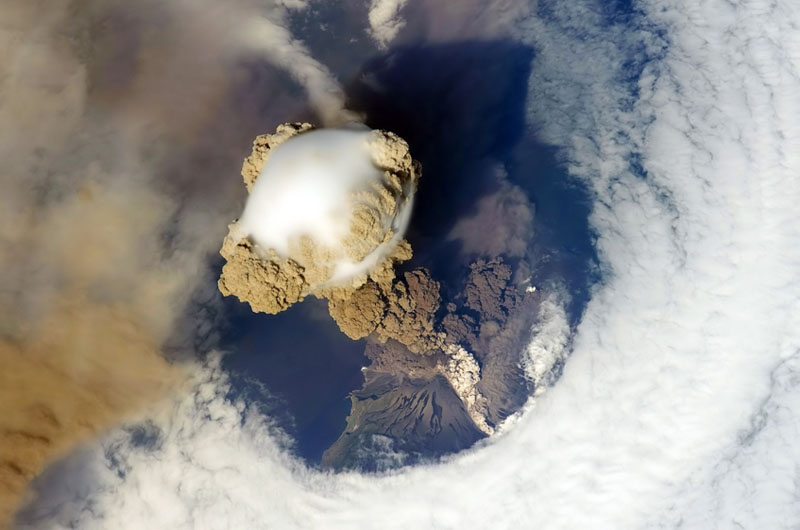
View from Space
View from Space
When a supervolcano erupts it blogs the sun and can cause an ice age, or partial ice age. There are thousands of volcanoes on the planet or beneath the oceans, that can erupt any time even if dormant for centuries. It is the supervolcanoes that need to be watched.
A volcano is an opening, or rupture, in a planet's surface or crust, which allows hot, molten rock, ash, and gases to escape from below the surface. Volcanic activity involving the extrusion of rock tends to form mountains or features like mountains over a period of time.
Volcanoes are generally found where tectonic plates are diverging or converging. A mid-oceanic ridge, for example the Mid-Atlantic Ridge, has examples of volcanoes caused by "divergent tectonic plates" pulling apart; the Pacific Ring of Fire has examples of volcanoes caused by "convergent tectonic plates" coming together. By contrast, volcanoes are usually not created where two tectonic plates slide past one another. Volcanoes can also form where there is stretching and thinning of the Earth's crust (called "non-hotspot intraplate volcanism"), such as in the African Rift Valley, the Wells Gray-Clearwater volcanic field and the Rio Grande Rift in North America and the European Rhine Graben with its Eifel volcanoes.
Volcanoes can be caused by "mantle plumes". These so-called "hotspots" , for example at Hawaii, can occur far from plate boundaries. Hotspot volcanoes are also found elsewhere in the solar system, especially on rocky planets and moons.
Volcanoes are described as active, dormant, or extinct. The soil resulting from decomposition of volcanic materials is extremely fertile, and the ash itself is a good polishing and cleansing agent.
Active volcanoes are not scattered over the Earth randomly; instead, most occur in belts, especially in the island arcs and mountain ranges bordering the Pacific Ocean. The concept of seafloor spreading and, more broadly, the theory of plate tectonics offer a logical explanation for the location of most volcanoes.
Lava is molten rock that erupts on the earth's surface, either on land or under the ocean, by a volcano or through a fissure. It solidifies into igneous rock that is also called lava. Before reaching the Earth's surface, the mixture of solid and liquid rock, and gases, is known as magma. Lavas are composed chiefly of silica and the oxides of aluminum, iron, magnesium, calcium, sodium, and potassium. Silica, with soda and potash, predominates in the light-colored, acid felsites; iron oxides, lime, and magnesia, in the dark-colored, basic basalts . Rock froth forms on the upper part of a lava flow if bubbles solidify before the gas can escape. Light-colored, glassy froth is pumice ; dark, cindery or slaggy froth, of a coarser texture than pumice, forms what is known as scoriae.
Lava flows which solidify as a mass of blocks and fragments with a rough surface are called block lava, or aa; those which solidify with a smooth, ropy, billowy surface are known as corded lava, or pahoehoe. Lava can sometimes cover wide regions through great fissures in the earth's surface, as in the ancient Columbia River plateau of the NW United States, where it is spread over 30,000 sq mi (77,700 sq km) and is up to 5,000 ft (1,524 m) deep. Other such regions are found in the Deccan plateau of India, in E Brazil, and in Iceland.
Submarine lavas develop through volcanic activity along the mid-oceanic ridges and plate boundaries, where the mid-oceanic ridges produce more lava than any continental eruptions. Such underwater eruptions also harbor rich fauna unique to the vent area, such as red tube worms and giant clams, whose food supply is based on the hydrogen sulfide abundant in the vent waters.
Unique features include black smokers, or hot springs of mineral-rich water that belch out from the ocean ridge where it is most active. In many instances the reasons for the heat and liquidity of magma, its exact source, and the causes of its rise in the earth are not clearly known, though the volcanic activity is often related to seafloor spreading. Other volcanic areas also lie along colliding plate boundaries and around rising magma hot spots. See plate tectonics.
Volcanoes are found in association with midocean ridge systems, seafloor spreading, and along convergent plate boundaries, such as around the Pacific Ocean's Ring of Fire, the ring of plate boundaries associated with volcanic island arcs and ocean trenches surrounding the Pacific Ocean. Continental volcanoes are also associated with converging plate boundaries, such as the volcanoes of the Cascade Range along the W coast of the United States. Isolated volcanoes also form in the midocean area of the Pacific apparently unrelated to crustal plate boundaries. These sea mounts and volcanic island chains, such as the Hawaiian chain, may form from rising magma regions called hot spots.
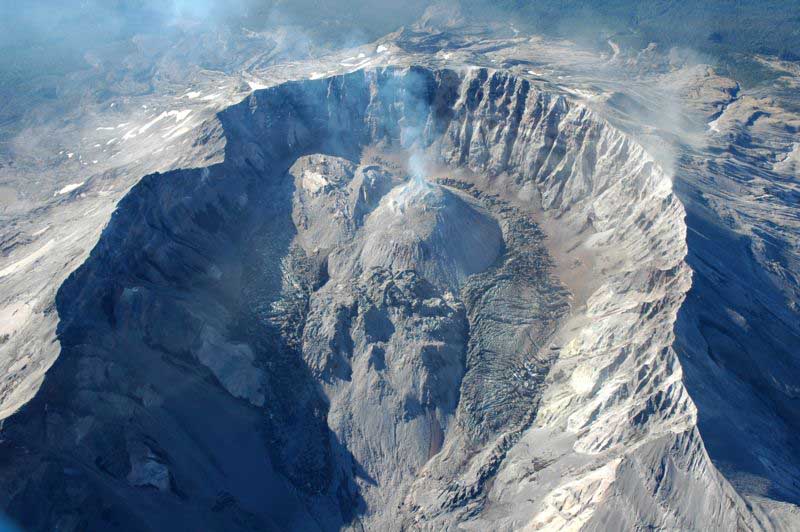
In volcanology, a lava dome or plug dome is a roughly circular mound-shaped protrusion resulting from the slow eruption of felsic lava (usually rhyolite or dacite) from a volcano, or from multiple lava episodes of different magma types. The characteristic dome shape is attributed to high levels of silica in the magma, causing the magma to be quite viscous and thick. The viscosity of the lava prevents it from flowing far from the vent that it extrudes from, causing it to solidify quickly and build on previous volcanic extrusions, creating a dome-like shape.
Domes may reach heights of several hundred meters, and can grow slowly and steadily for months or years. The sides of these structures are composed of unstable rock debris. Due to the possibility of the building up of gas pressure, the dome can experience more explosive eruptions over time. When part of a lava dome collapses while it still contains molten rock and gases, it can produce a pyroclastic flow, one of the most lethal forms of a volcanic event. Other hazards associated with lava domes are the destruction of property, forest fires, and lahars triggered by pyroclastic flows near snow and ice. Lava domes are one of the principal structural features of many stratovolcanoes worldwide.
Characteristics of lava dome eruptions include shallow, long-period and hybrid seismicity, which is attributed to excess fluid pressures in the contributing vent chamber. Other characteristics of lava domes include their spherical dome shape, cycles of dome growth over long periods, and sudden onsets of violent explosive activity. The average rate of dome growth may be used as a rough indicator of magma supply, but it shows no systematic relationship to the timing or characteristic of lava dome explosions.
Some of the world's most famous active lava domes include those at Mount Merapi in central Java of Indonesia, Soufri¸re Hills in Montserrat, and Mount St. Helens in Washington. Lassen Peak in northern California is one of the largest lava domes in the world and has the distinction of being the only other Cascade volcano besides Mount St. Helens to erupt (1914-1921) in the 20th century.
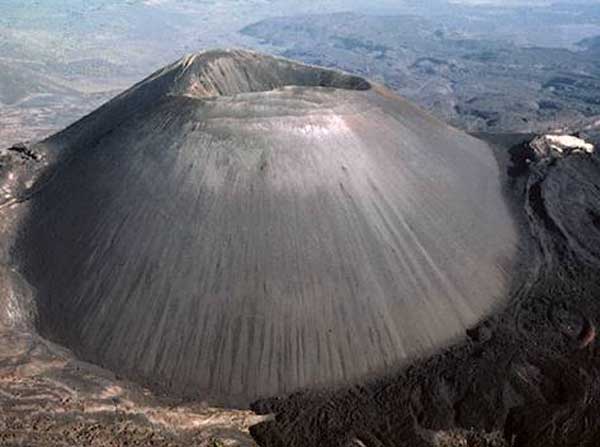
Shapes of volcanoes include composite cones, or stratovolcanoes, with steep concave sides such as Mt. St. Helens in the W United States; shield cones have gentle slopes and can be relatively large such as the Hawaiian Islands; and cinder cones as Paricutin in Mexico, with steep slopes made of cinderlike materials. Explosive eruptions build up steep-sided cones, while the nonexplosive ones usually form broad, low lava cones. Cones range in height from a few feet to nearly 30,000 ft (9 km) above their base.
Usually the cone has as its apex a cavity, or crater, which contains the mouth of the vent. Such craters are typically less than 1 mi (1.6 km) across, but larger craters, called calderas, ranging in diameter from 3 mi to - in a few instances - 50 mi (5-80 km), are formed by particularly large eruptions.
Craters are circular, bowl-shaped depression on the earth's surface. Simple craters are bowl-shaped with a raised outer rim. Complex craters have a raised central peak surrounded by a trough and a fractured rim.
Many of the largest craters are formed by the impact of meteorites . Impacting at speeds in excess of 10 mi/sec (16 km/sec), a meteorite creates pressures on the order of millions of atmospheres, producing shock waves that blast out a circular hole and often destroy the meteorite. Meteor, or Barringer, Crater, near Winslow, Arizona, c. 34 mi (1 15 km) in diameter and 600 ft (180 m) deep, is probably the best-known crater of this type.
Of the more than 120 impact craters identified on earth, the largest are at Manicouagan, Canada; Vredefort, South Africa; and Chicxulub (off the coast of the Yucatan peninsula), Mexico. Others include Chubb Crater, Quebec; Lake Bosumtwi, Ghana; and Brent Crater, Ontario. Two major impact events have occurred in the 20th cent., both in Siberia. In 1908 in the Tunguska Basin near Lake Baykal one occurred that caused vast destruction of timber from its blast, and the other in 1947 at Sikhote-Alin also caused great damage. Craters that have been obliterated by erosion over thousands of years, leaving only a circular scar on the earth's surface, are called astroblemes .
Craters are also commonly formed at the surface opening, or vent, of erupting volcanoes , particularly of the type called cinder cones, where the lava is extruded rather explosively. Virtually all volcanoes display a crater, called a sink, around the vent; this is believed to be a collapse feature caused by molten lava subsiding as an eruption phase diminishes. Volcanic craters formed in these ways are relatively small, usually less than 1 mi (1.6 km) in diameter, and represent only a small fraction of the cone's diameter at the base.
A caldera is a much larger crater, typically ranging from 3 to 18 mi (5-30 km) in diameter, and represents a considerable fraction of the volcano's basal diameter. In a few instances, however, tremendous volcanic eruptions have left calderas 50 mi (80 km) or so, such as that that forms much of Yellowstone National Park or the basin of Lake Toba, Sumatra, Indonesia. Most calderas are formed by the collapse of the central part of a cone during great eruptions. A few small calderas have been formed by explosive eruptions in which the top of a volcano was blown out. Some volcanic craters are created by a combination of these events. Formed thousands of years ago, the caldera that contains Crater Lake, Oreg., is 6 mi (9.7 km) in diameter. In recent times, caldera-producing eruptions occurred at Krakatoa, Indonesia, in 1883 and Katmai, Alaska, in 1912.
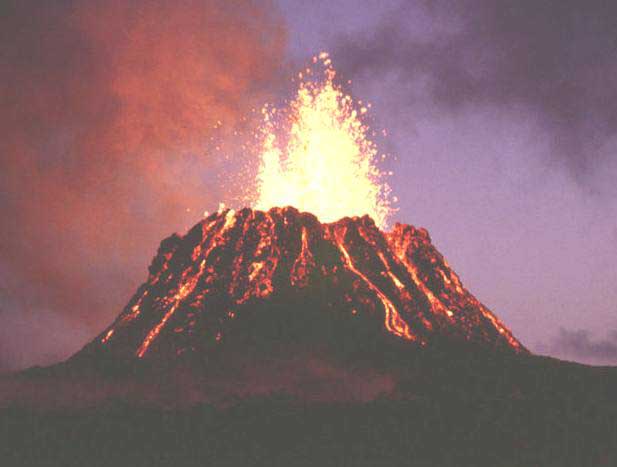
More than 500 volcanoes are known to have erupted on the earth's surface since historic times, and many more have erupted on the ocean floor unobserved by humans. Fifty volcanoes have erupted in the United States, which ranks third, behind Indonesia and Japan, in the number of historically active volcanoes. Of the world's active volcanoes, more than half are found around the perimeter of the Pacific, about a third on midoceanic islands and in an arc along the south of the Indonesian islands, and about a tenth in the Mediterranean area, Africa, and Asia Minor.
Evidence of extraterrestrial volcanic activity also has been found. Space probes have detected the remnants of ancient eruptions on earth's moon, Mars (which has the largest volcano in the solar system, Olympus Mons, 340 mi/550 km across and 15 mi/24 km high), and Mercury; these probably originated billions of years ago, since these bodies are no longer capable of volcanic activity.
Triton (a satellite of Neptune), Io (a satellite of Jupiter), and Venus are the only bodies in the solar system besides earth that are known to be volcanically active. The volcanic processes that occur in the outer portion of the solar system are very different from those in the inner part. Eruptions on earth, Venus, Mercury, and Mars are of rocky material and are driven by internal heat. Io's eruptions are probably sulfur or sulfur compounds driven by tidal interactions with Jupiter. Triton's eruptions are of very volatile compounds, such as methane or nitrogen, driven by seasonal heating from the sun.
Terrestrial volcanic eruptions may take one or more of four chief forms, or phases, known as Hawaiian, Strombolian, Vulcanian, and Peleean. In the Hawaiian phase there is a relatively quiet effusion of basaltic lava unaccompanied by explosions or the ejection of fragments; the eruptions of Mauna Loa on the island of Hawaii are typical. The Strombolian phase derives its name from the volcano Stromboli in the Lipari, or Aeolian, Islands, N of Sicily. It applies to continuous but mild discharges in which viscous lava is emitted in recurring explosions; the ejection of incandescent material produces luminous clouds.
A more explosive volcanic eruption is the Vulcanian, where the magma (lava before emission) accumulates in the upper level of the vent but is blocked by a hardened plug of lava that forms between consecutive explosions. When the explosive gases have reached a critical pressure within the volcano, masses of solid and liquid rock erupt into the air and clouds of vapor form over the crater.
The Peleean, derived from Mt. Pelee, is the most violent, emitting fine ash; hot, gas-charged fragments of lava; and superheated steam in an incandescent 'cloud' that travels downhill at great speed. Eruptions are often accompanied by torrential rains caused by the condensation of steam. The erupted fragments vary in size, including minute particles of volcanic dust and ash, lapilli (cinders or pellets), bombs (rounded or ellipsoidal masses of hardened magma), and huge masses called blocks.
The most common perception of a volcano is of a conical mountain, spewing lava and poisonous gases from a crater at its summit. This describes just one of many types of volcano, and the features of volcanoes are much more complicated. The structure and behavior of volcanoes depends on a number of factors. Some volcanoes have rugged peaks formed by lava domes rather than a summit crater, whereas others present landscape features such as massive plateaus. Vents that issue volcanic material (lava, which is what magma is called once it has escaped to the surface, and ash) and gases (mainly steam and magmatic gases) can be located anywhere on the landform. Many of these vents give rise to smaller cones such as Pu'u 'O'o on a flank of Hawaii's Kilauea.
Other types of volcano include cryovolcanoes (or ice volcanoes), particularly on some moons of Jupiter, Saturn and Neptune; and mud volcanoes, which are formations often not associated with known magmatic activity. Active mud volcanoes tend to involve temperatures much lower than those of igneous volcanoes, except when a mud volcano is actually a vent of an igneous volcano.
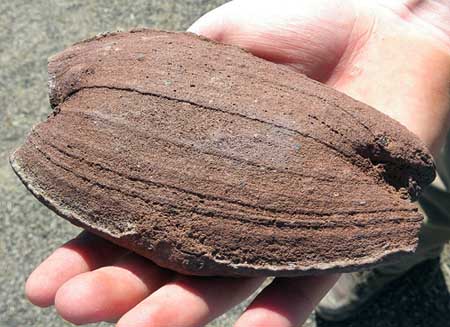
A volcanic bomb is a mass of molten rock (tephra) larger than 65 mm (2.5 inches) in diameter, formed when a volcano ejects viscous fragments of lava during an eruption. They cool into solid fragments before they reach the ground. Because volcanic bombs cool after they leave the volcano, they do not have grains making them extrusive igneous rocks. Volcanic bombs can be thrown many kilometres from an erupting vent, and often acquire aerodynamic shapes during their flight.
Bombs can be extremely large; the 1935 eruption of Mount Asama in Japan expelled bombs measuring 5-6 m in diameter up to 600 m from the vent. Volcanic bombs are a significant volcanic hazard, and can cause severe injuries and death to people in an eruption zone. One such incident occurred at Galeras volcano in Colombia in 1993; six people near the summit were killed and several seriously injured by lava bombs when the volcano erupted unexpectedly.
Volcanic bombs are known to occasionally explode from internal gas pressure as they cool, but contrary to some claims in popular culture (specifically, the 1997 film Volcano), explosions are rare; in most cases most of the damage they cause is from impact. Bomb explosions are most often observed in 'bread-crust' type bombs.
79 AD: Vesuvius, in Italy
1815: Tambora, in Indonesia, where between 30 and 50 cu mi (125-210 cu km) of molten and shattered rock were blown into the air
1883: Krakatoa, near Java, material from which was sent 17 mi (27 km) into the atmosphere
1943: Paricutin, in Mexico, the volcano that began in a cornfield
1948: Hibok Hibok, on Camiguin island in the Philippines, which killed 84 people
1956: Besymianny, in Kamchatka, where 2 cu mi (8 cu km) of material were hurled into the air
1963: Agung, in Bali, which killed 1,100 people
1980: Mt. St. Helens in Washington, which exploded with an energy equivalent to 10 million tons of TNT, killing 35, with 25 missing
1982: El Chichon in Mexico, which expelled about 500 million tons of ash and gas
1991: Mt. Pinatubo in the Philippines, killed over 500 people and ejected over 2 cu mi (8 cu km) of material
Other notable volcanoes are Cotopaxi and Chimborazo (Ecuador), Iztaccihuatl and Popocatepetl (Mexico), Lassen Peak and Katmai (United States), and Etna (Sicily).
Mauna Loa (Hawaii) is the world's largest active volcano, projecting 13,677 ft (4,170 m) above sea level and over 29,000 ft (8,850 m) above the ocean floor; from its base below sea level to its summit, Mauna Loa is taller than Mt. Everest.
In 1963 the birth of the volcanic island Surtsey near Iceland was observed. In November of that year events began with a submarine eruption along the Mid-Atlantic Ridge. Eruption followed eruption until June, 1967, by which time the island stood 492 ft (150 m) above sea level and covered an area of almost 2 sq mi (3 sq km). The island has not grown since the last eruption, and it is presently volcanically quiet.
List of Volcanoes This is a list of lists of active and extinct volcanoes sorted by country. There are separate lists of Antarctic, submarine, and extraterrestrial volcanoes.