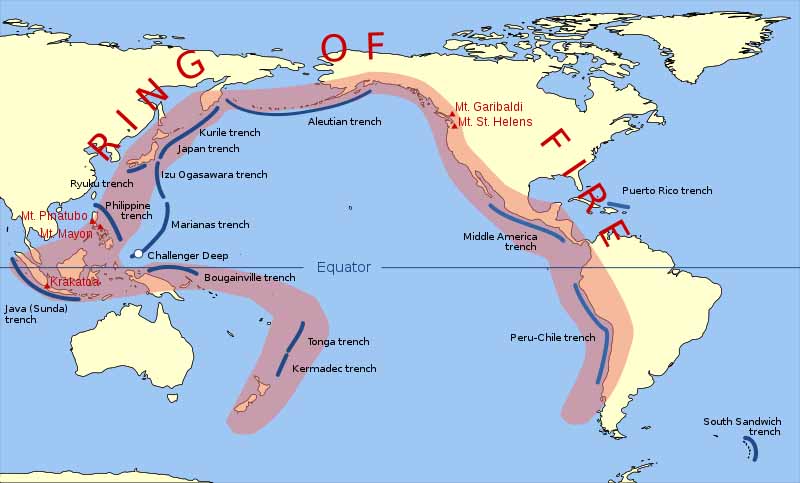
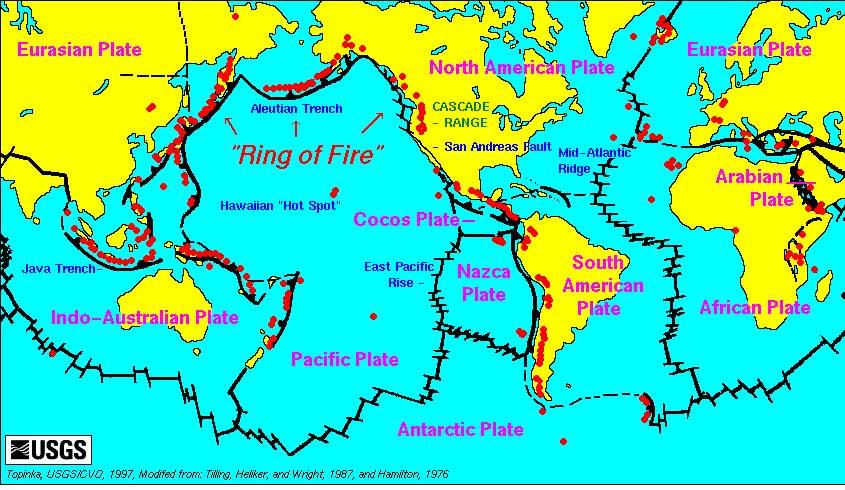
The Ring of Fire (also known as the Pacific Ring of Fire, the Rim of Fire, the Girdle of Fire or the Circum-Pacific belt) is a tectonic belt of earthquakes and volcanoes. It is about 40,000 km (25,000 mi) long and up to about 500 km (310 mi) wide, and surrounds most of the Pacific Ocean.
The Ring of Fire contains between 750 and 915 active or dormant volcanoes, around two-thirds of the world total. The exact number of volcanoes within the Ring of Fire depends on which regions are included. About 90% of the world's earthquakes, including most of its largest, occur within the belt.
The Ring of Fire is not a single geological structure. It was created by the subduction of different tectonic plates at convergent boundaries around the Pacific Ocean. These include: the Antarctic, Nazca and Cocos plates subducting beneath the South American plate; the Pacific and Juan de Fuca plates beneath the North American plate; the Philippine plate beneath the Eurasian plate; and a complex boundary between the Pacific and Australian plate.
The interactions at these plate boundaries have formed oceanic trenches, volcanic arcs, back-arc basins and volcanic belts. The inclusion of some areas in the Ring of Fire, such as the Antarctic Peninsula and western Indonesia, is disputed.
The Ring of Fire has existed for more than 35 million years but subduction has existed for much longer in some parts of the Ring; many older extinct volcanoes are located within the Ring.
More than 350 of the Ring of Fire's volcanoes have been active in historical times, while the four largest volcanic eruptions on Earth in the Holocene epoch all occurred at volcanoes in the Ring of Fire.
Most of Earth's active volcanoes with summits above sea level are located in the Ring of Fire. Many of these subaerial volcanoes are stratovolcanoes (e.g. Mount St. Helens), formed by explosive eruptions of tephra alternating with effusive eruptions of lava flows.
Lavas at the Ring of Fire's stratovolcanoes are mainly andesite and basaltic andesite but dacite, rhyolite, basalt and some other rarer types also occur. Other types of volcano are also found in the Ring of Fire, such as subaerial shield volcanoes and submarine seamounts. Read more

Powerful 7.4 magnitude earthquake hits Colombia - the strongest to hit the country in the last decade CNN - August 11, 2026
The epicenter is located near San Jose del Palmar in the western department of Choco. This is a critical industrial and agricultural zone deeply integrated into Colombia's famed coffee region.
The quake lasted a long time as earthquakes go - over one minute with aftershocks expected.
This tragedy is not an isolated incident - it represents a continuation of extreme seismic volatility across the Pacific Ring of Fire. Just weeks prior on June 24, 2026, neighboring Venezuela was ravaged by a rare "seismic doublet" - two massive back-to-back earthquakes striking a mere 39 seconds apart.
The catastrophe presents an immediate structural test for Colombia's political landscape. President Abelardo de la Espriella was just sworn into office on Friday. Fresh to the position, he has declared a state of national disaster and mobilized emergency military committees. Early updates indicate his administration is mounting a swift, coordinated response as initial damage reports filter out of the western cordillera.
This tragic event is part of the predicted natural disasters in the Pacific Ring of fire, which are accelerating exponentially as we have come to recognize. This goes along with increases in climate events including flooding, wildfires, drought, record setting heat waves, more destructive tornadoes, and other events outside of what was considered the norm in the past.
Celestial Influences - August 2026
We are currently navigating the powerful wake of a New Moon in Leo in two days - August 12, 2026. These celestial energies exert influence roughly three days before and three days after the peak, directly enveloping today's timeline.
While it is too early to factor in the cosmic weight of the looming total solar eclipse at the time of the New Moon - the temporal synchronization of these events hints at a deeper blueprint. At the end of the day, the shifting tectonic plates, the climate anomalies, and the astrological alignments are entirely interconnected - markers of a closing matrix moving toward its inevitable finale.

2025 Kamchatka Peninsula Earthquake Wikipedia
Tsunami waves hit US shores after 8.8 magnitude quake strikes Russia's far east - 6th most powerful ever recorded CNN - July 30, 2025
The region is known for seismic activity due to its location in the Pacific Ring of Fire - a belt in the Pacific where the world's most active volcanoes are located. Russian volcano explodes in 'powerful' eruption, likely intensified by 8.8 magnitude earthquake Live Science - July 30, 2025
Aftershocks are expected to continue for some time, though decreasing in frequency and magnitude.
Climate change and natural disasters continue to accelerate exponentially as we move to closure. This summer has seen unprecedented global flooding and extreme heat. All of the tectonic plates are broken or fractured highlighted with the Pacific Plate.
The 8.8 pacific earthquake could have affected this predicted event ... Undersea Volcano Off The US West Coast Predicted To Erupt In 2025
Maps reveal new details about New Zealand's lost underwater continent CNN - June 23, 2020
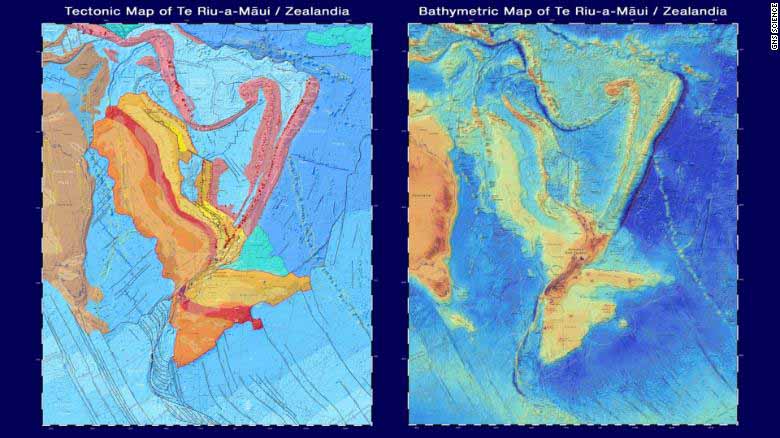
Millions of years later, the world's tectonic plates - pieces of the Earth's crust - began reorganizing themselves, in a period of dramatic geological change that also created the Pacific 'Ring of Fire,' a belt in the Pacific where the world's most active volcanoes are located.
PLATE TECTONICS
CONTINENTAL DRIFT
LAND BRIDGE
ZEALANDIA