Throughout history, primitive peoples have made use of caves for shelter, burial, or as religious sites. Since items placed in caves are protected from the climate and scavenging animals, which means caves are an archaeological treasure house for learning about indigenous people.
Cave paintings are of particular interest. One example is the Great Cave of Niah, in Malaysia which contains evidence of human habitation dating back 40,000 years. The main cave is one of the largest limestone caves in the world. The cave system is an important prehistorical site with human remains dating to 40,000 years ago. Painted Cave has rock paintings dated at 1200 years. The caves are also well known for the birds' nest collection.
Caves are also important for geological research because they can reveal details of past climactic conditions in speleothems and sediment layers.
The word 'cave' is sometimes a metaphor for the mind, hidden within is sacred knowledge that yearns to be discovered.
Caves around the world contain information in various forms about the ancient history of planet Earth as if markers in time. Hidden within caves we find:
Chambers
Tablets - Artifacts - Scrolls - Texts - Crystals
Paleontology - Evidence and Fossils
Inter-dimensional Portals - Indwell and Outwells of Energies - Electromagnetic Energy Vortexes

Paleontologists Discover a Lost World: Ancient Cave Preserves Life From 1 Million Years Ago SciTech Daily - February 13, 2026
Deep within a cave on New ZealandÕs North Island, scientists have uncovered a long-lost record of life from a million years ago. In a cave system near Waitomo on AotearoaÕs North Island, scientists have uncovered a packed deposit of ancient bones that captures New Zealand at a moment the fossil record rarely preserves. The find is the first time researchers have recovered such a large set of fossils from around one million years ago, and it includes a surprise: an early relative of the kakapo - the famously hefty parrot that today cannot fly.
Who Were The Cro-Magnon People who were responsible for some of the oldest recorded cave art created by anatomically modern humans in Europe? IFL Science - November 8, 2024
Human evolution is complex and fascinating, but it is filled with various terms and names related to past humans and hominin species that can get quite confusing. One example of this is the famous Cro-Magnon people who lived in Europe around the time of the last Ice Age (c. 40,000 to 10,000 years ago). Although they were initially named after the Cro-Magnon rock shelter in France where their skeletons were discovered in during the 1860s, scientists now refer to these people as Early Modern Humans (EMH) or Anatomically Modern Humans (AMH). So, who were they?
During this early research, scientists compared the skeletons to those of Neanderthals that had been discovered at sites in England and later in France. Through this comparison, they came to the conclusion that the Cro-Magnon specimens were distinct enough from these archaic humans to warrant their own designation. However, advances in anthropology and a shift in our understanding of human evolution and genetics eventually established that these people were fully modern humans and were indistinguishable from people today.

How we calculated the age of caves in the Cradle of Humankind - and why it matters PhysOrg - November 23, 2018
Researchers dated 29 flowstones, from eight caves, and found that the flowstones all date to the same six narrow time windows. For example, 2 million years ago, all the important cave sites across the Cradle were closed - nothing was being washed into them - with flowstone forming inside them. We also know that flowstones can only form during times when it rains more. So by dating the flowstones, we are picking out these times in the past. For the first time we know our early human ancestors lived through big changes in the local climate. The sediments with the fossils in them inside the caves, are all sandwiched between flowstones. We interpret this pattern, flowstone-sediment-flowstone, as a signal of these changing climates, with the sediments representing drier times. This means that all the fossils from the Cradle, hominin and other animal, accumulated during drier times.
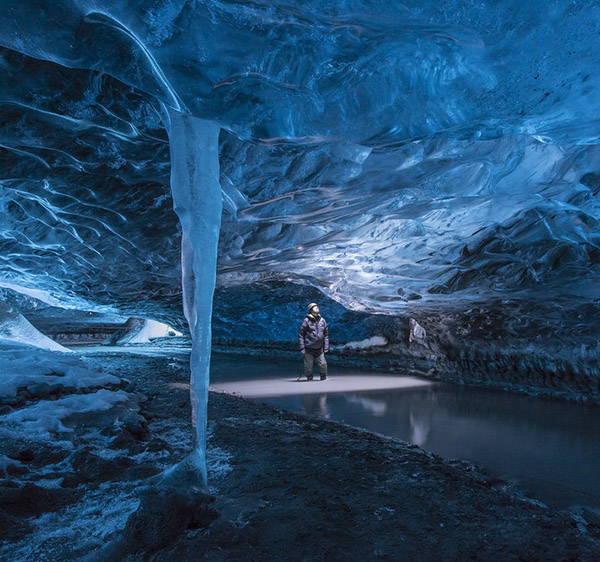
27 Amazing Glacial And Ice Caves From Around The World
Mysterious Symbols Could Represent The Earliest Writing Ever Found Live Science - January 12, 2023
Researchers say they have discovered what they call a "proto-writing system" embedded in 20,000-year-old cave paintings, making it the earliest form of some sort of writing we've ever found. Hunters from the Upper Palaeolithic era would have used the symbols daubed on the walls to pass on essential survival information: The researchers suggest they show a record of animal mating seasons, organized by the lunar months. It's a significant finding because it pushes back the earliest form of Homo sapiens writing by around 14,000 years. Although we're not looking at letters and sentences here, these markings do represent "a complete unit of meaning"

Paper links ancient drawings and the origins of language PhysOrg - February 21, 2018
When and where did humans develop language? To find out, look deep inside caves, suggests an MIT professor. More precisely, some specific features of cave art may provide clues about how our symbolic, multifaceted language capabilities evolved. A key to this idea is that cave art is often located in acoustic "hot spots," where sound echoes strongly, as some scholars have observed. Those drawings are located in deeper, harder-to-access parts of caves, indicating that acoustics was a principal reason for the placement of drawings within caves.
The drawings, in turn, may represent the sounds that early humans generated in those spots. In the new paper, this convergence of sound and drawing is what the authors call a "cross-modality information transfer," a convergence of auditory information and visual art that, the authors write, "allowed early humans to enhance their ability to convey symbolic thinking." The combination of sounds and images is one of the things that characterizes human language today, along with its symbolic aspect and its ability to generate infinite new sentences.
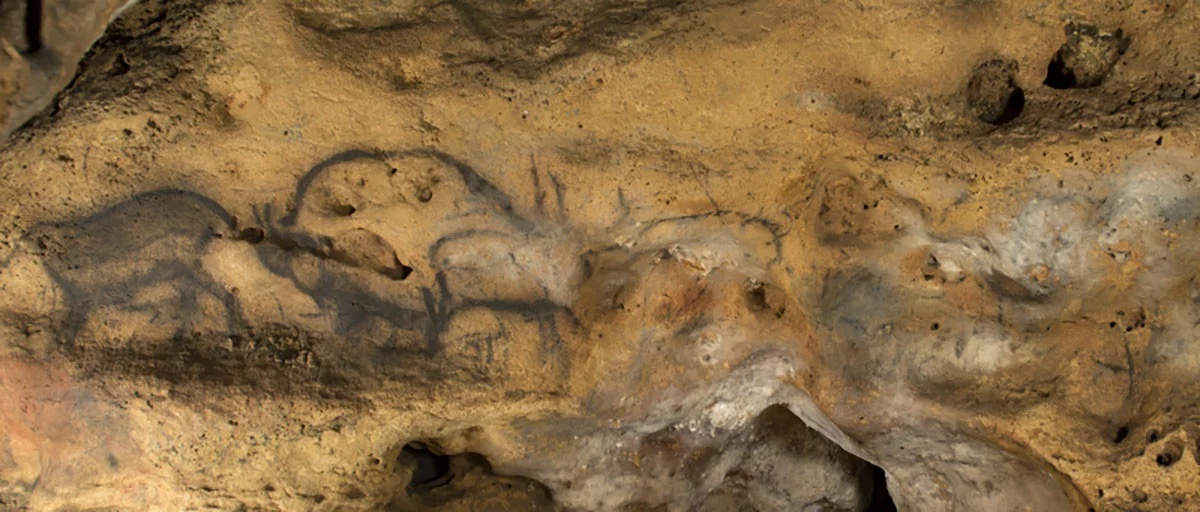
Scientists Finally Solve a 100-Year Mystery About France's Famous Ice Age Cave Paintings SciTech Daily - June 25, 2026
A new analysis detected hidden charcoal in black cave paintings at Font-de-Gaume, allowing scientists to accurately date the artworks for the first time. For more than a century, the spectacular cave paintings of France's Dordogne region have captivated archaeologists, yet one basic question remained unanswered: exactly how old are they? Now, researchers have achieved a breakthrough by directly dating paintings in the UNESCO-listed Font-de-Gaume cave for the first time, opening a new chapter in the study of Paleolithic art.
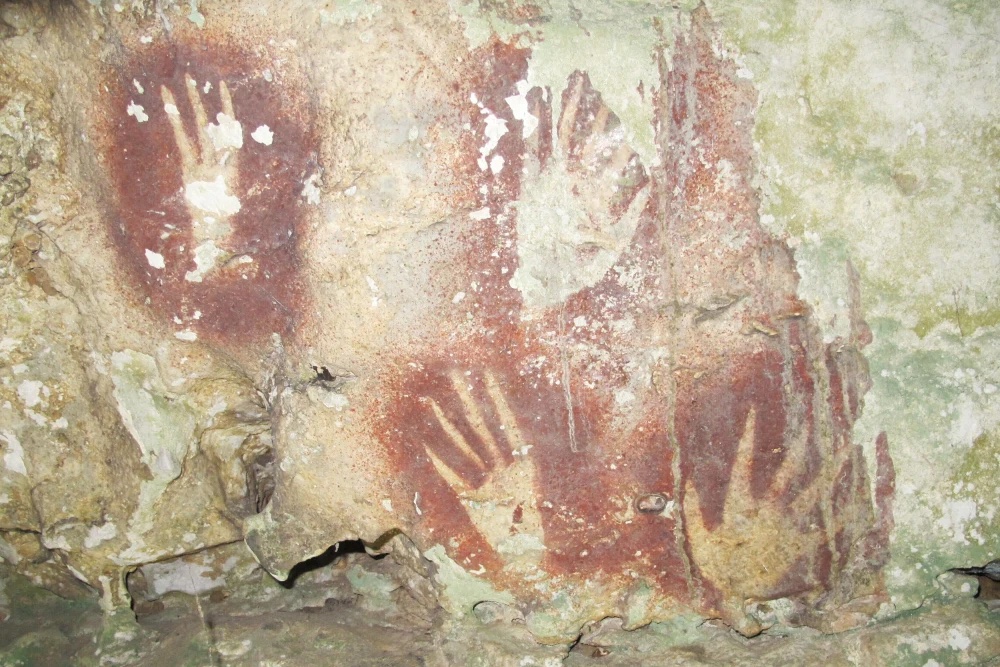
Hand stencil made almost 68,000 years ago is the oldest cave art ever found
NBC - January 22, 2026
The world's oldest known example of cave art, dating back at least 67,800 years, has been discovered by researchers studying handprints in Indonesia. The find, along with others recently made in the Southeast Asian nation, helps scientists trying to determine when and where early humans first learned to make art, and at what point their art became more complex. /Users/elliecrystal/Desktop/index.html

World's Oldest Known Cave Art Was Made by Neanderthals
Science Alert - November 5, 2025
However, at present, all of the Neanderthal evidence is non-figurative - they have no depictions of animals, including humans. This latter form of art was perhaps exclusive to Homo sapiens. Instead, the Neanderthal examples consist of hand stencils, made by blowing pigment over the hand, finger flutings Ð where the fingers were pressed into a soft surface - and geometric markings. Neanderthals inhabited western Eurasia from about 400,000 years ago until their extinction about 40,000 years ago and have often been caricatured as the archetypal "cavemen".
Did art exist before modern humans? New discoveries raise big questions
Live Science - February 3, 2024
Scientists are finding ever-earlier examples of artistic expression in the archaeological record that reshape what we know about the cognitive abilities of our archaic human relatives, such as Neanderthals. For centuries, the "Unicorn Cave," or "Einhornhohle," in central Germany has been famous for its many thousands of bones. In medieval times, people thought the bones came from unicorns.
But a few years ago, archaeologists excavating the cave unearthed an unusual object: a toe bone from a giant deer. The material itself was noteworthy: Although giant deer were once prey for Europe's prehistoric hunters, the animals usually roamed much farther north, indicating this bone had been brought from afar. And it was clearly different from others in the cave: Several large grooves had been carved at angles into the bone's upper surface, creating a prominent chevron-like pattern. Even more extraordinary was its age: Radiocarbon dating of the bone showed that the deer lived around 51,000 years ago, when the Unicorn Cave was occupied by Neanderthals, our extinct human relatives.
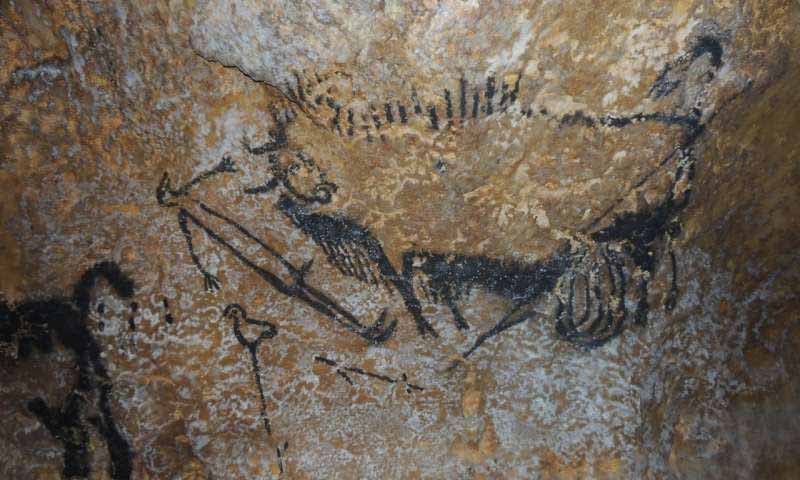
Prehistoric cave art reveals ancient use of complex astronomy
Live Science - November 27, 2018
Some of the world's oldest cave paintings have revealed how ancient people had relatively advanced knowledge of astronomy. The artworks, at sites across Europe, are not simply depictions of wild animals, as was previously thought. Instead, the animal symbols represent star constellations in the night sky, and are used to represent dates and mark events such as comet strikes, analysis suggests. They reveal that, perhaps as far back as 40,000 years ago, humans kept track of time using knowledge of how the position of the stars slowly changes over thousands of years.
The findings suggest that ancient people understood an effect caused by the gradual shift of Earth's rotational axis. Discovery of this phenomenon, called precession of the equinoxes, was previously credited to the ancient Greeks. Around the time that Neanderthals became extinct, and perhaps before mankind settled in Western Europe, people could define dates to within 250 years, the study shows. The findings indicate that the astronomical insights of ancient people were far greater than previously believed. Their knowledge may have aided navigation of the open seas, with implications for our understanding of prehistoric human migration.
Researchers studied details of Paleolithic and Neolithic art featuring animal symbols at sites in Turkey, Spain, France and Germany. They found all the sites used the same method of date-keeping based on sophisticated astronomy, even though the art was separated in time by tens of thousands of years. They clarified earlier findings from a study of stone carvings at one of these sites - Gobekli Tepe in modern-day Turkey - which is interpreted as a memorial to a devastating comet strike around 11,000 BC. This strike was thought to have initiated a mini ice-age known as the Younger Dryas period.
They also decoded what is probably the best known ancient artwork - the Lascaux Shaft Scene in France. The work, which features a dying man and several animals, may commemorate another comet strike around 15,200 BC, researchers suggest. The team confirmed their findings by comparing the age of many examples of cave art - known from chemically dating the paints used - with the positions of stars in ancient times as predicted by sophisticated software.

Forensic technique reveals sex of prehistoric hand stencil artists PhysOrg - December 13, 2016
Prehistoric ancestors creating human hand stencils in caves 40,000 years ago can now be identified as male or female with more than 90% accuracy. Techniques used in modern forensics were applied to the stencils - found frequently alongside Paleolithic cave art at sites around the world - as part of a collaborative research project between biologists, anthropologists and archaeologists. Hand stencils are created by blowing, spitting or stippling pigment onto a hand while it is held against a rock surface, leaving a negative impression on the rock in the shape of the hand. Stencils found in Sulawesi, Indonesia have been dated back 40,000 years, and those discovered in Europe are estimated to be around 37,000 years old, a period known as the Upper Paleolithic.

Prehistoric cave art reveals ancient use of complex astronomy
Live Science - November 27, 2018
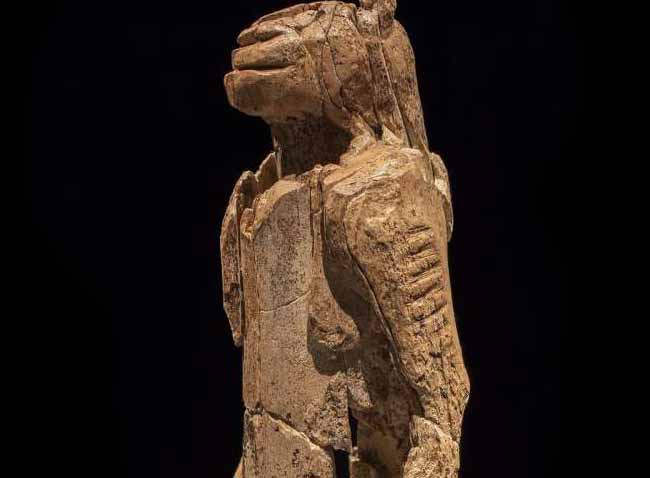
Lion-Man of Hohlenstein-Stadel Cave, from 38,000 BC
Some of the world's oldest cave paintings have revealed how ancient people had relatively advanced knowledge of astronomy. The artworks, at sites across Europe, are not simply depictions of wild animals, as was previously thought. Instead, the animal symbols represent star constellations in the night sky, and are used to represent dates and mark events such as comet strikes, analysis suggests. They reveal that, perhaps as far back as 40,000 years ago, humans kept track of time using knowledge of how the position of the stars slowly changes over thousands of years.
The findings suggest that ancient people understood an effect caused by the gradual shift of Earth's rotational axis. Discovery of this phenomenon, called precession of the equinoxes, was previously credited to the ancient Greeks. Around the time that Neanderthals became extinct, and perhaps before mankind settled in Western Europe, people could define dates to within 250 years, the study shows. The findings indicate that the astronomical insights of ancient people were far greater than previously believed. Their knowledge may have aided navigation of the open seas, with implications for our understanding of prehistoric human migration.
Researchers studied details of Paleolithic and Neolithic art featuring animal symbols at sites in Turkey, Spain, France and Germany. They found all the sites used the same method of date-keeping based on sophisticated astronomy, even though the art was separated in time by tens of thousands of years. They clarified earlier findings from a study of stone carvings at one of these sites - Gobekli Tepe in modern-day Turkey - which is interpreted as a memorial to a devastating comet strike around 11,000 BC. This strike was thought to have initiated a mini ice-age known as the Younger Dryas period.
They also decoded what is probably the best known ancient artwork - the Lascaux Shaft Scene in France. The work, which features a dying man and several animals, may commemorate another comet strike around 15,200 BC, researchers suggest. The team confirmed their findings by comparing the age of many examples of cave art - known from chemically dating the paints used - with the positions of stars in ancient times as predicted by sophisticated software.
Mammoth Cave National Park In Kentucky Is Home To The World's Longest Cave System IFL Science - March 7, 2024
Kentucky's Mammoth Cave National Park is bursting at the seams with natural delights. From rolling hills and deep river valleys to the worldÕs longest known cave system and a surprising number of sharks, the UNESCO World Heritage Site has much to offer. Located in south-central Kentucky, the park spans over 52,000 acres (21,000 hectares), primarily in Edmonson County. Perhaps its most famous feature is the colossal cave system that extends for hundreds of miles beneath the woodlands - itÕs not named Mammoth Cave for nothing.
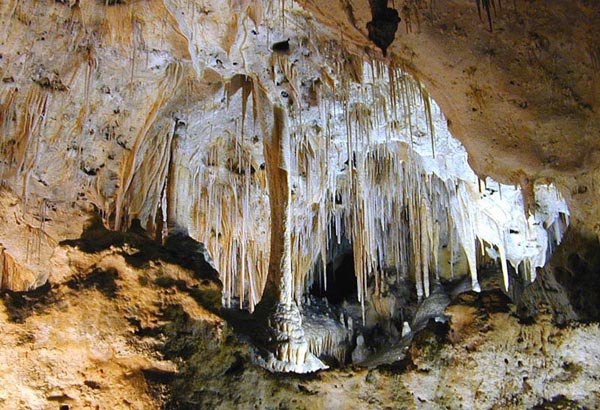
Carlsbad Caverns
Carlsbad Caverns National Park is a United States National Park in the Guadalupe Mountains in southeastern New Mexico. The primary attraction of the park is the show cave, Carlsbad Cavern. The park contains over 117 caves.
Largest known cave art images in US by Indigenous Americans discovered in Alabama Live Science - May 5, 2022
Archaeologists in Alabama have discovered the longest known painting created by early Indigenous Americans, a new study finds. Indigenous Americans crafted this 1,000-year-old record-breaking image - of a 10-foot-long (3 meters) rattlesnake - as well as other paintings, out of mud on the walls and ceiling of a cave, likely to depict spirits of the underworld, the researchers said. The cave has hundreds of cave paintings and is considered the richest place for Native American cave art in the American Southeast, the researchers said. To investigate its historic art, the team turned to photogrammetry, a technique that involves taking hundreds of digital images in order to build a virtual 3D model. Using this method, the researchers spotted five previously unknown giant cave paintings, known as glyphs.

Big Four Ice Caves
Big Four Mountain is a mountain in the Cascade Range of Washington, located 21 miles (34 km) east of Granite Falls. The mountain is about 6,180 ft (1,880 m) high. At the bottom of its steep, 4,200 ft (1,300 m) high north face, debris piles form from avalanches and are able to remain there year round because of the continuous shade provided by the mountain. At an elevation between 2,450 ft (750 m) and 1,950 ft (590 m), this ice forms the lowest-elevation glacier in the lower 49 states. During the summer, snow-melt streams flow beneath the debris piles and cause caves to be formed in the ice.

For the first time in five years, intrepid visitors to the Apostle Islands National Lakeshore can make the icy trek along the frozen waters of Lake Superior to glimpse the millions of icicles - some several stories tall - that embellish the region's incredible ice caves. The Apostle Islands National Lakeshore is made up of 22 islands in Lake Superior, located off the coast of northern Wisconsin. The area boasts some of the most impressive sea caves in the Great Lakes region, and during warmer months, visitors can paddle along the sculpted shorelines and navigate through the caves' scenic passageways and arched chambers. But, during the winter, witnessing the caves' icy transformation is much trickier. This year, however, the ice on Lake Superior is thick enough for people to reach the ice caves - for the first time since 2009, according to officials at the U.S. Department of the Interior.
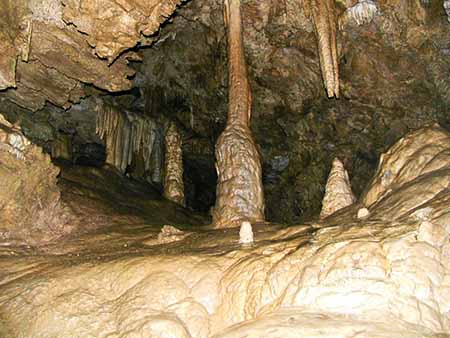
Scientists have found a stalagmite in an Oregon cave that tells the story of thousands of winters in the Pacific Northwest. Most other ways of estimating past climate, like tree ring data, only tell us about summers, when plants are growing. But understanding ancient winters is also important for regions like western North America, where chilly conditions are critical for determining water resources. For their study, Ersek and his colleagues examined a stalagmite that started forming 13,000 years ago in a cavern in what is now Oregon Caves National Monument. During the region's damp winters, water from the ground seeped through the cave's ceiling and trickled onto the floor, with the drips slowly forming the stalagmite over time.
The Naica Mine of Chihuahua, Mexico, is a working mine that is known for its extraordinary crystals. Naica is a lead, zinc and silver mine in which large voids have been found, containing crystals of selenite (gypsum) as large as 4 feet in diameter and 50 feet long. The chamber holding these crystals is known as the Crystal Cave of Giants, and is approximately 1000 feet down in the limestone host rock of the mine.

'Trash' found deep inside a Mexican cave turns out to be 500-year-old artifacts from a little-known culture Live Science - May 28, 2025
While investigating a cave high in the mountains of Mexico, a spelunker thought she had found a pile of trash from a modern-day litterbug. But upon closer inspection, she discovered that the "trash" was actually a cache of artifacts that may have been used in fertility rituals more than 500 years ago. I looked in, and it seemed like the cave continued. "You had to hold your breath and dive a little to get through, speleologist," Katiya Pavlova said. "That's when we discovered the two rings around the stalagmites."
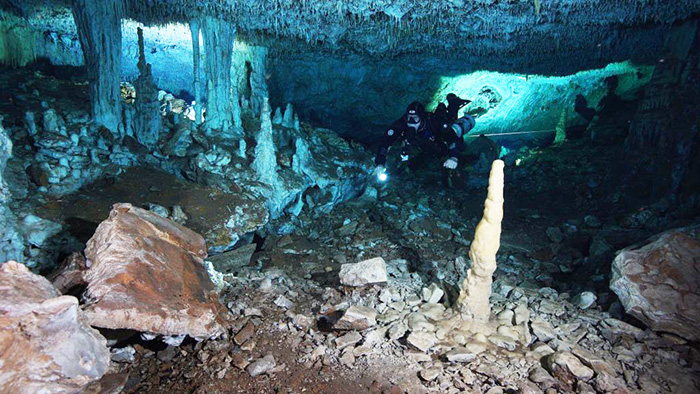
Ice age mining camp found 'frozen in time' in underwater Mexican cave Live Science - July 8, 2020
At the end of the last ice age, Indigenous miners in what is now the Yucatan Peninsula, Mexico risked life and limb - venturing into pitch dark caves illuminated only by fire - to extract a prized mineral, a new study finds. That mineral wasn't gold or diamonds, but red ochre, a valuable crayon-like pigment that prehistoric people used for both ritualistic and everyday activities, including rock paintings, burials and possibly even insect repellent. No one knows, however, how the Indigenous people of the Yucatan Peninsula used ochre. After Indigenous people mined the caves, between about 12,000 and 10,000 years ago, the caves flooded as the ice age ended and sea levels rose. But the still water in the caves preserved the miners' camps - even the charred remains of their fires - allowing archaeologists to see exactly how the mineral was extracted.
Ancient 12,000-Year-Old Mine Discovered in Underwater Caves on Mexican Coast Science Alert - July 7, 2020
The underwater caves along Mexico's Yucatan Peninsula contain within them a sprawling labyrinth of archaeological relics perhaps unlike anywhere else on Earth. Preserved in a vast network of flooded caverns, these inundated cenotes hold a treasure trove of Maya secrets - but as a new discovery shows, you can also find ancient artifacts dating back to much more distant episodes of prehistory. In a new study, researchers report the finding of what could be the oldest known mine in the Americas (alongside other claims to the title), uncovering the remains of a subterranean ochre mine dating back to 12,000 years ago.
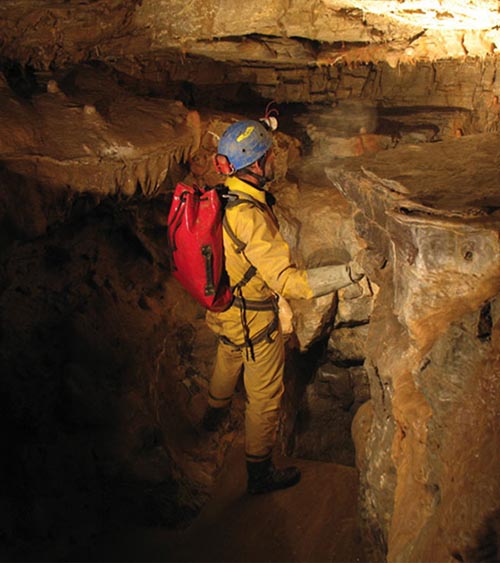
Veteran cave explorer Bill Stone has announced that in 2017, he'll lead an expedition into the Cheve Cave system, a sprawling underground complex in the Oaxaca region of Mexico, which water flow suggests may descend nearly 1.6 miles into the Earth. If that turns out to be true, Cheve would earn the title of the world's deepest cave, taking away the distinction currently held by Krubera Cave in the Western Caucasus mountains in Georgia, which is about 1.36 miles deep. But scientists say that even if Cheve sets a new depth record, it may not last. Geological data leads them to believe there are numerous undiscovered caves across the globe, and that some of of those subterranean passageways may reach vastly deeper into the planet. Given the limits of the technology used for detection, though, finding those caves may be a challenge, and exploring them even more so.
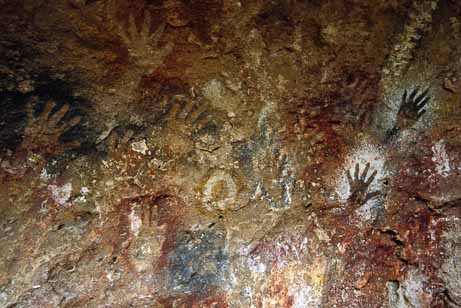
Hand Stencils Through Time
Clusters of hand stencils dating back 2,500 years cover the walls of Argentina's Cueva de las Manos - Cave of the Hands in Patagonia. Clusters of hand stencils dating back 2,500 years cover the walls of Argentina's Cueva de las Manos in Patagonia. Prehistoric handprints and stencils span all continents and began appearing on rock walls around the world at least 30,000 years ago.

The Cave of Tayos is a natural cave located on the eastern slopes of the Andes mountains in the Morona-Santiago province of Ecuador.
The cave was popularized by Erich von Daniken's 1973 book The Gold of the Gods, in which he wrote that Juan Moricz had claimed to have explored Cueva de los Tayos in 1969 and discovered mounds of gold, unusual sculptures and a metallic library. These items were said to be located within artificial tunnels that had been created by a lost civilization with help from extraterrestrial beings. Von Daniken had previously stirred public imagination by suggesting that extraterrestrials were involved in ancient civilizations in his popular book Chariots of the Gods.
As a result of the claims published in von Daniken's book, an investigation of Cueva de los Tayos was organized by Stan Hall from Britain in 1976. One of the largest and most expensive cave explorations ever undertaken, the expedition included over a hundred people, including experts in a variety of fields, British and Ecuadorian military personnel, a film crew, and former astronaut Neil Armstrong. The team also included eight experienced British cavers who thoroughly explored the cave and conducted an accurate survey to produce a detailed map of the cave. There was no evidence of Von Daniken's more exotic claims, although some physical features of the cave did approximate his descriptions and some items of zoological, botanical and archaeological interest were found.
In the 20th century, a Roman Catholic missionary named Father Carlo Crespi helped the local Indians, the Shuar culture, who gave him some unique gifts that often took the form of elaborately carved artifacts some made of gold or other precious metals. Many of these artifacts feature elaborate carvings and symbols not know to be associated with the Shuar people. One of the presents was metal tablet with 36 symbols that no one could translate.
In 1991, an Ecuadorian manned named Patronio Jaramillo who claimed to have entered the cave through a secret entrance back in 1946 as a teenage boy. He claimed that he had to dive into the water, swim through an underwater tunnel then came up. He described wandering through chamber after chamber of ancient relics, including a vast room of books made from gold and other metals - books with unrecognizable writing possibly like those in Father Crespi's collection - symbols of unknown origin. Jaramillo died before he could show anyone where the cave was located.
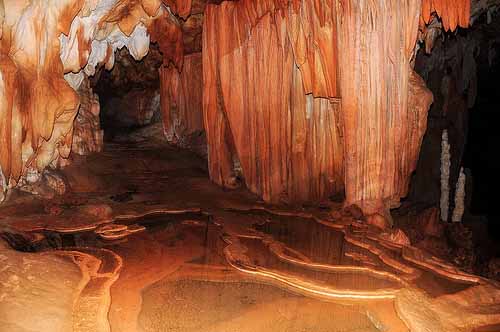
Xibalba, roughly translated as "place of fear", is the name of the underworld in Maya mythology, ruled by the Maya death gods and their helpers. In 16th-century Verapaz, the entrance to Xibalba was traditionally held to be a cave in the vicinity of Coban, Guatemala. According to some of the K'iche' Maya presently living in the vicinity, the area is still associated with death. Cave systems in nearby Belize have also been referred to as the entrance to Xibalba. Another physical incarnation of the road to Xibalba as viewed by the K'iche' is the dark rift which is visible in the Milky Way.

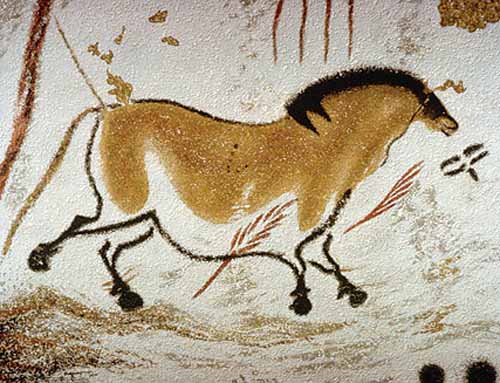
Cave at Lascaux, France
Lascaux is a complex of caves in southwestern France famous for its cave paintings. The original caves, located near the village of Montignac. They contain some of the earliest known art, dating back to somewhere between 13,000 and 15,000 BCE, or as far back as 25,000 BCE.
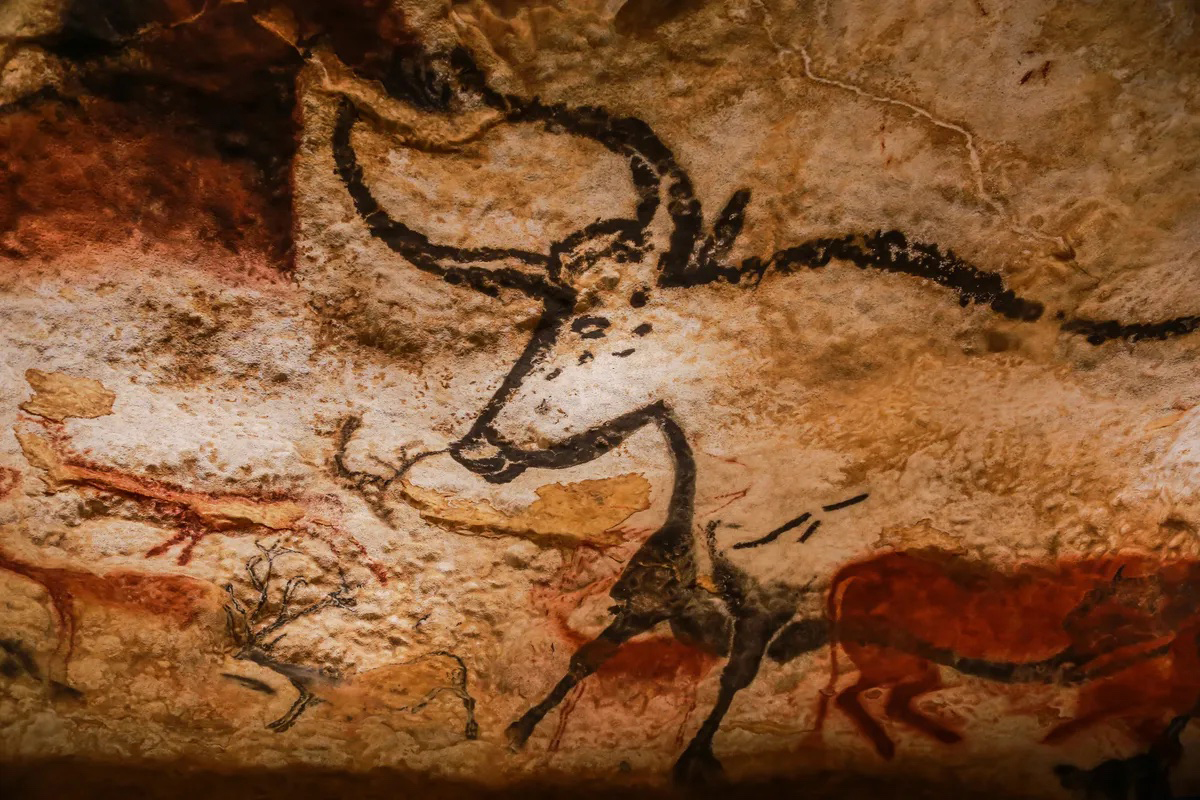
First Prehistoric Charcoal Cave Art Discovery In France's Dordogne Could Be Revelatory In Dating Other Finds IFL Science - December 20, 2023
The Dordogne region of southern France is home to some of the oldest known artworks in the world. Across the walls and ceilings of over 200 caves in the region are an array of colorful paintings created by our ancient ancestors. But despite their significant age, it is not completely clear just how old they are. Now researchers have a way to date these spectacular Paleolithic creations with greater precision.
Nerja cave in southern Spain has been continuously visited by humans for over 40,000 years IFL Science - April 26, 2023
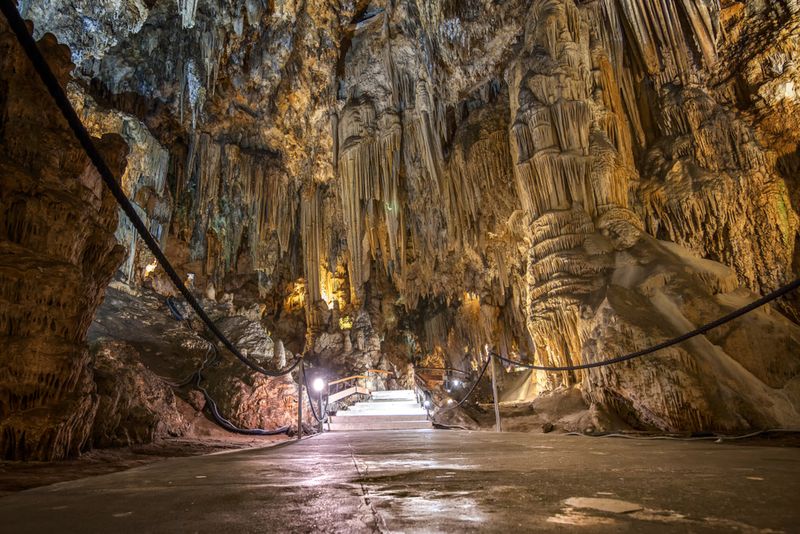
Located in the province of Malaga, the Nerja Cave is famous for the paleolithic art that has been left on its walls by various generations of prehistoric inhabitants. Ranging from simple dots and lines to more complex zoomorphic designs, the drawings reflect the cognitive, cultural, and technological capacities of the different humans to have entered the cave, and point to a long history of use spanning thousands of years.
Cave art: Etchings hailed as 'Iberia's most spectacular' BBC - October 14, 2016
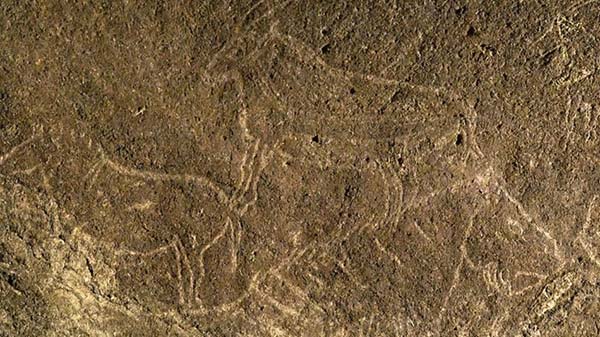
Cave art as much as 14,500 years old has been pronounced "the most spectacular and impressive" ever discovered on the Iberian peninsula. About 50 etchings were found in the Basque town of Lekeitio. They include horses, bison, goats and - in a radical departure from previously discovered Palaeolithic art in the Biscay province - two lions. Some depictions are also much bigger than those found previously - with one horse about 150cm (4ft 11in) long.
Red dot becomes 'oldest cave art' BBC - June 14, 2012
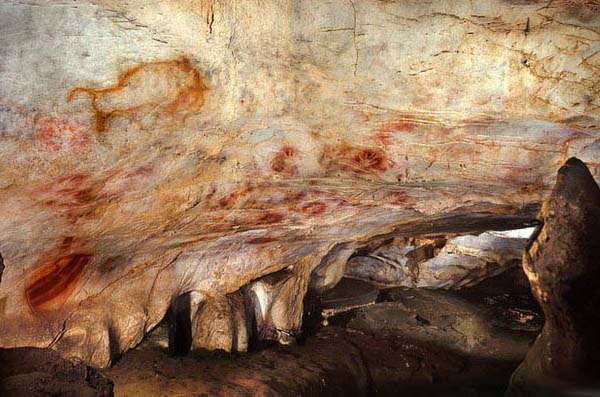
The El Castillo Cave in Spain - The refined dating shows these paintings to be far older than anyone thought. Red dots, hand stencils and animal figures represent the oldest examples yet found of cave art in Europe. The symbols on the walls at 11 Spanish locations, including the World Heritage sites of Altamira, El Castillo and Tito Bustillo have long been recognized for their antiquity. But researchers have now used refined dating techniques to get a more accurate determination of their ages. One motif - a faint red dot - is said to be more than 40,000 years old.
When archaeologists tried out a new technique to determine the age of Spain's most famous Paleolithic cave paintings, they were surprised to discover that the paintings were thousands of years older than previously thought - so old that it's conceivable they were painted by Neanderthals. The technique just might change the way we think about the paintings, and the way we think about our long-extinct, long-maligned Neanderthal cousins as well.
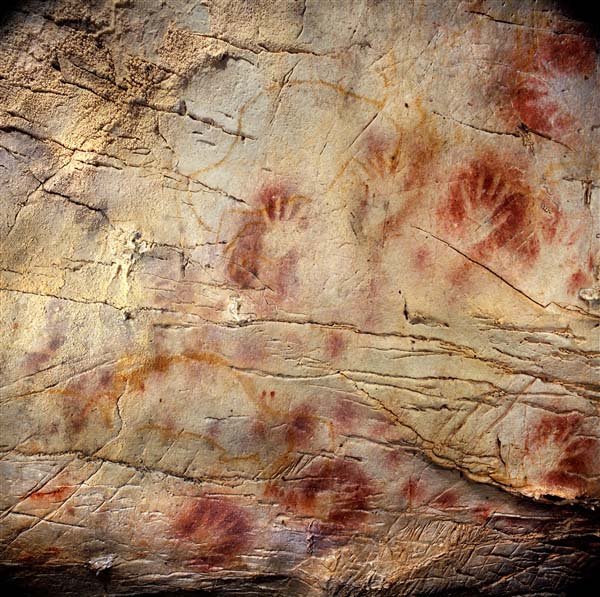
Hand stencils and the outlines of animals dominate "The Panel of Hands" in Spain's El Castillo cave. One of the stencils has been dated to earlier than 37,300 years ago, and a red disk goes back at least 40,800 years, making them the oldest cave paintings in Europe.
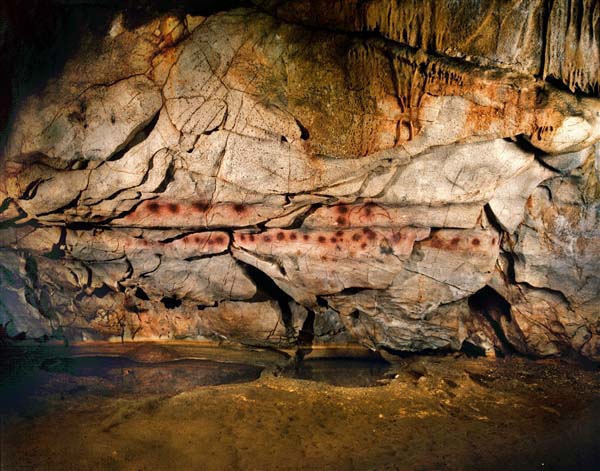
The "Corredor de los Puntos" lies within Spain's El Castillo cave. Red disks here have been dated to between 34,000 and 36,000 years ago, and elsewhere in the cave to 40,800 years ago, making them examples of Europe's earliest cave art.
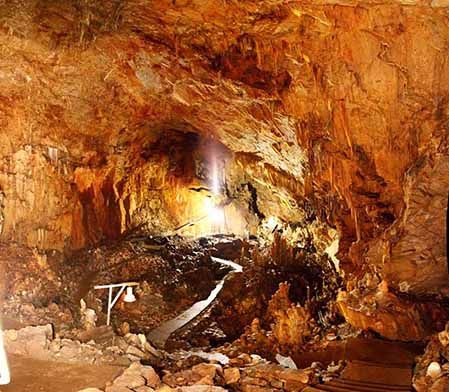
Killer Cave May Have Inspired Myth of Hades Live Science - November 29, 2012
A giant cave that might have helped serve as the inspiration for the mythic ancient Greek underworld Hades once housed hundreds of people, potentially making it one of the oldest and most important prehistoric villages in Europe before it collapsed and killed everyone inside, researchers say. The complex settlement seen in this cave suggests, along with other sites from about the same time, that early prehistoric Europe may have been more complex than previously thought. The cave, located in southern Greece and discovered in 1958, is called Alepotrypa, which means "foxhole."
BBC Video: Bulgaria's 7000 year old cave paintings BBC - September 3, 2024
The rocks and caves of Belogradchik in northwestern Bulgaria are a natural wonder. One of them, Magura Cave, is a natural habitat for bats, but humans have also left their mark here. Digital archaeologist Kristina Ilieva has spent months studying the cave's prehistoric drawings, made using a surprising material.
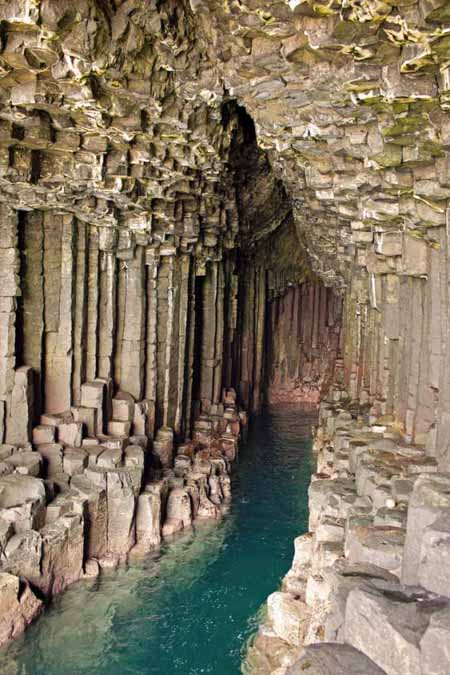
Fingal's Cave: Nature's 60-Million-Year Old Cathedral Is Brimming With Hexagons
IFL Science - January 29, 2024
A dramatic sight awaits anyone drifting near the shores of the Isle of Staffa where a unique sea cave is carved into the rugged coastline. Known as Fingal's Cave, its name comes from an Irish myth in which Fionn MacCumhaill, nicknamed Fingal for 'white stranger', migrated to Scotland from Ireland. Fingal was believed to be the creator of the Giant's Causeway, which boasts a similarly hexagonal esthetic.
The Isle of Staffa is small and uninhabited, but it attracts lots of tourists each year who are drawn to its peculiar, hexagonal-shaped basalt columns. Most of the columns are true hexagons with six sides, but five-sided and seven-sided columns can also be found, according to the Scottish Geology Trust.
Fingal's hexagons were stacking up around 60 million years ago at a time when the Atlantic Ocean was still taking shape. They're the result of what unfolds when molten lava cools and contracts, breaking apart in an orderly fashion Ð which is more than can be said for us under pressure.
Hexagons are just one of the many patterns that we see in nature, and the uniform magic of Fingal's Cave is a reminder that you can't hide from math - not even in a decaying shrub. Resembling a giant honeycomb, the gridded geometric pillars stretch to heights of 22 meters (72 feet). Some say it also resembles a cathedral, which leads us to another quirk of Fingal's Cave.
It has a funky sound as well as appearance thanks to its remarkable acoustic properties. The unique shape of its columns means sound reverberates unusually, creating an otherworldly auditory experience that's earned the cave the nickname 'nature's cathedral'. It's also known in Gaelic as 'An Uamh Binn', meaning 'the cave of music'.
Fingal's Cave inspired ÒHebrides OvertureÓ by composer Felix Mendelssohn, who visited the cave in 1829. As it happens, there are a few natural caves that have proven to be a hit with musicians, just ask the glow worms in New Zealand's Waitomo Cave.
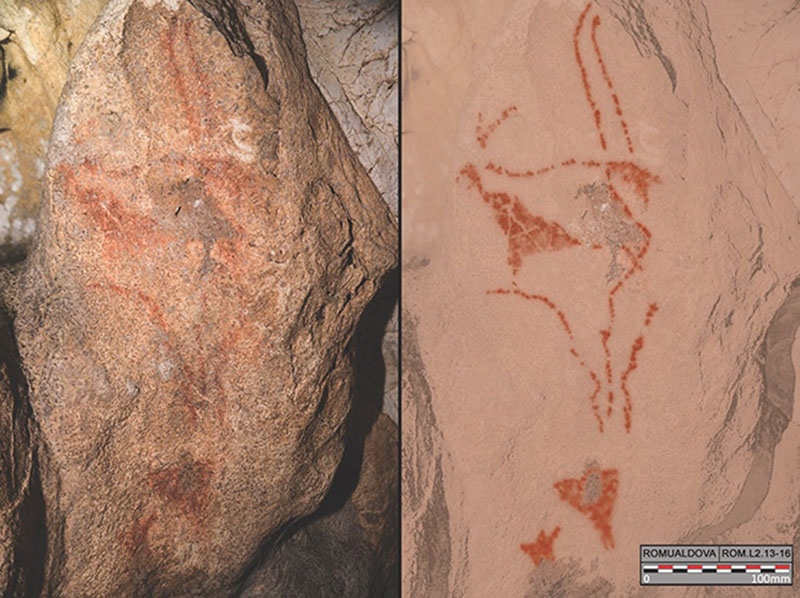
A HREF="https://www.livescience.com/65209-cave-paintings-discovered-croatia.html">The First Cave Art from the Balkans May Date Back 30,000 Years Live Science - April 11, 2019
Inside of a cave overlooking the blue-green waters of Croatia's northern coast, archaeologists have found wall paintings that date back to the Upper Paleolithic period. While prehistoric cave art is plentiful in western Europe, the discovery marks the first time cave art of this age has been documented in the Balkans. The reddish paintings, which depict a bison and ibex, could have been created more than 30,000 years ago, scientists reported Wednesday (April 10) in the journal Antiquity. "It is quite an important discovery, mostly because it is in a region where no cave art had been known up to now," said Jean Clottes, a French prehistorian, who wasn't involved in the new study. "From the photos there is no doubt about their belonging to the Upper Paleolithic."
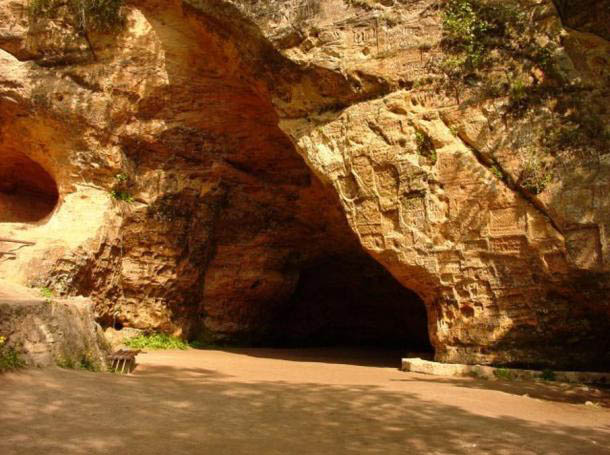
Gutman's Cave is the widest and highest cave in the Baltic countries, located on the Gauja River in the National Park of Sigulda, Latvia. It started forming more than 10 000 years ago when meltwater eroded the sandstone rock after the Ice Age. It is the oldest tourist attraction in Latvia. On the walls of the cave are inscriptions from the 17th century. The legend of the Rose of Turaida began in this cave. Read more
The Gutmana Ala: The Legendary Cave of the Good Man and the Rose of Turaida Ancient Origins - September 10, 2015
The Gutmana Ala, or Gutman's (Good Man's) cave in English, is today located in the Sigulda region of the Gauja National Park in Latvia. Apart from Sigulda, this national park extends over several other regions, including Amata, Cesis Incukins and Ligatne. Within the boundaries of this national park lie a third of all Latvia's natural reserves, as well as over 500 cultural and historical monuments. Despite the richness of the Gauja National Park, the Gutmana Ala is one of the park's most impressive and popular tourist attractions.

Oldest Art Even Older: New Dates from Geibenklosterle Cave Show Early Arrival of Modern Humans, Art and Music Science Daily - May 24, 2012
Researchers from Oxford and Tubingen have published new radiocarbon dates from the from Geibenklosterle Cave in Swabian Jura of Southwestern Germany in the Journal of Human Evolution. The new dates use improved methods to remove contamination and produced ages between began between 42,000 43,000 years ago for start of the Aurignacian, the first culture to produce a wide range of figurative art, music and other key innovations as postulated in the Kulturpumpe Hypothesis. The full spectrum of these innovations were established in the region no later than 40,000 years ago.
Hranice Abyss: The deepest freshwater cave on Earth in the Czech Republic and a conduit to a 'fossil' sinkhole Live Science - October 5, 2024
The Hranice Abyss - or "Hranicka propast," in Czech is the deepest known freshwater cave in the world. Geologists think it could extend more than half a mile (1 kilometer) below Earth's surface, which is more than twice as deep as the world's next-deepest freshwater cave. The Hranice Abyss challenges a long-held scientific belief that deep caves open from the bottom up, with warm, acidic groundwater rising and dissolving the bedrock. According to a 2020 study in the Journal of Geophysical Research: Earth Surface, that's not how the abyss formed. Instead, evidence shows water carved the cave from the top down.
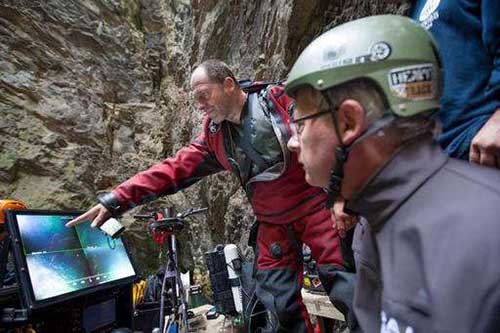
World's deepest underwater cave found in the Czech Republic PhysOrg - September 30, 2016
A team of explorers say they've discovered that a cave in the eastern Czech Republic is the world's deepest flooded fissure, going at least 404 meters (1,325 feet) deep. Polish explorer Krzysztof Starnawski, who led the team, told The Associated Press on Friday that he felt like a "Columbus of the 21th century" to have made the discovery near the Czech town of Hranice. Starnawski, 48, determined that the flooded limestone Hranicka Propast, or Hranice Abyss, which divers, including him, have explored for decades in its upper parts, was at least 404 meters deep. He scuba dived to a narrow slot in the rock formation at 200 meters down, then sent a remotely operated underwater robot, or ROV, that went to the depth of 404 meters, or the length of its cord, but still did not hit the bottom.
At least 51,200 years ago, in what is now the island of Sulawesi, Indonesia, humans ground up some pigment and daubed pigs and people on the walls of a cave Science Alert - July 3, 2024

Using cutting edge techniques, scientists have now determined that these ancient depictions could include the oldest known figurative, and narrative, examples of art in the world. They date back to at least 51,200 years ago - older than previous record-holders by thousands of years.
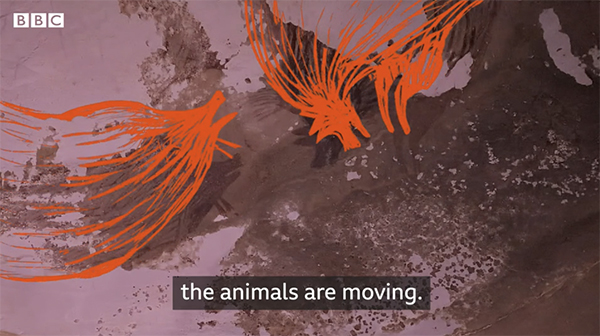
Video: Inside the Indonesian cave where oldest animal art was found BBC - October 25, 2021
Video: Life-size painting of a warty pig dating back 45,500 years is found in a cave in Indonesia and could be the 'world's oldest-known figurative artwork' Daily Mail - January 15, 2021
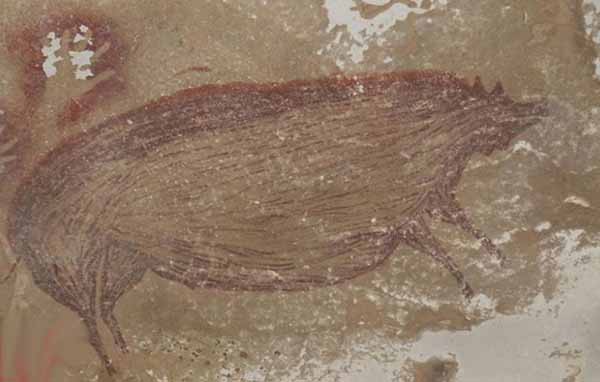
An image of a warty pig painted onto the wall of an Indonesian cave some 45,500 years ago may be the 'world's oldest-known figurative artwork', a study has claimed. Researchers from Australia and Indonesia found the painting of the native wild boar on the rear wall of the Leang Tedongnge cave in the south of the island of Sulawesi. The team said that the life-size image provides the earliest evidence for the presence of anatomically modern humans on Sulawesi.
Indonesia: Archaeologists find world's oldest animal cave painting BBC - January 17, 2021
Archaeologists have discovered the world's oldest known animal cave painting in Indonesia - a wild pig - believed to be drawn 45,500 years ago.
Humanity's Oldest Cave Art Shows Shape-Shifting Supernatural Hunters Live Science - December 11, 2019
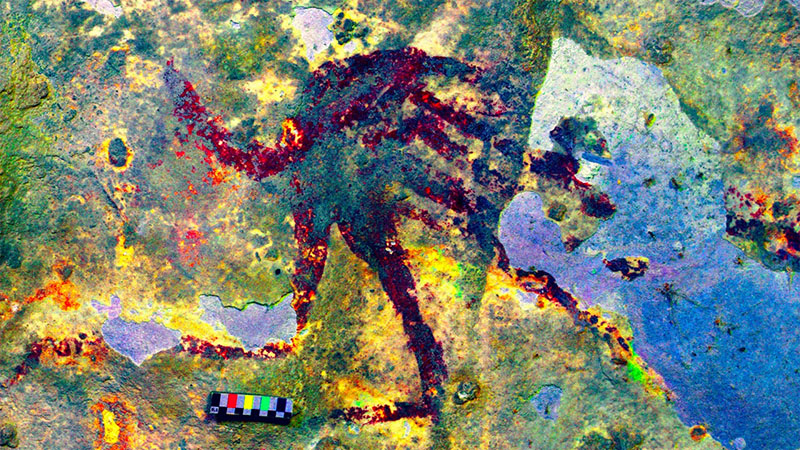
Researchers discovered cave paintings depicting what may be part-animal, part-human figures - decked out with animal snouts - hunting wild pigs and dwarf buffaloes in Indonesia. These may be the oldest known examples of rock art, a new study finds. The 44,000-year-old artwork may also be the oldest evidence for the human ability to imagine the existence of supernatural beings, scientists added. The ancient painting was discovered in the limestone cave of Leang Bulu' Sipong 4 in the Indonesian island of Sulawesi in 2017. During a survey for rock art, study co-author Pak Hamrullah noticed what appeared to be the entrance to a cave located high up in a limestone cliff face, and he climbed several meters up a fig tree vine to investigate it.
Videos: Cave paintings change ideas about the origin of art BBC - October 8, 2014
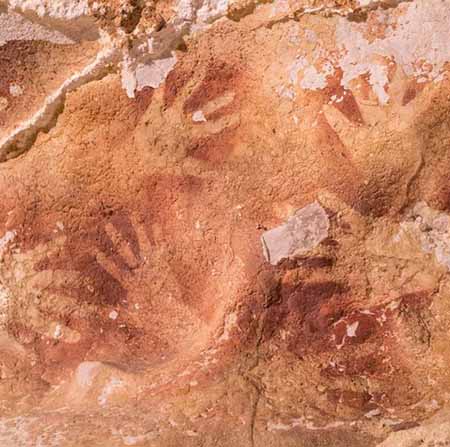
The artworks are in a rural area on the Indonesian Island of Sulawesi. Until now, paintings this old had been confirmed in caves only in Western Europe. Researchers found the Indonesian discovery transforms ideas about how humans first developed the ability to produce art. Australian and Indonesian scientists have dated layers of stalactite-like growths that have formed over colored outlines of human hands. Early artists made them by carefully blowing paint around hands that were pressed tightly against the cave walls and ceilings. The oldest is at least 40,000 years old.
The earliest known painting of an animal has been identified in a cave on the island of Borneo.
BBC - November 7, 2018
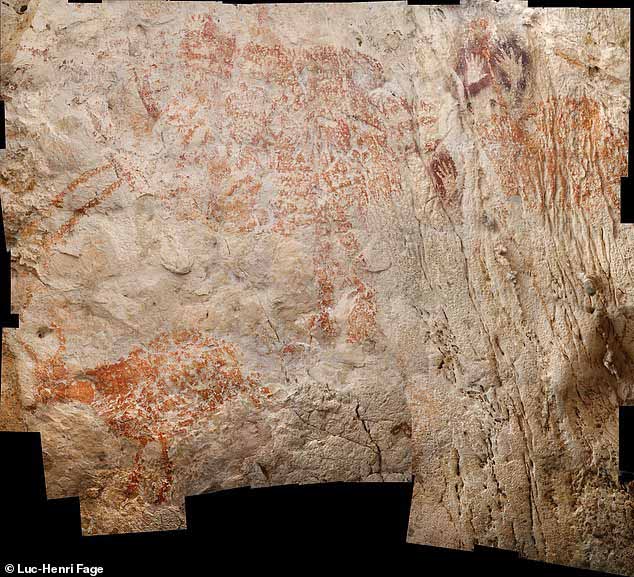
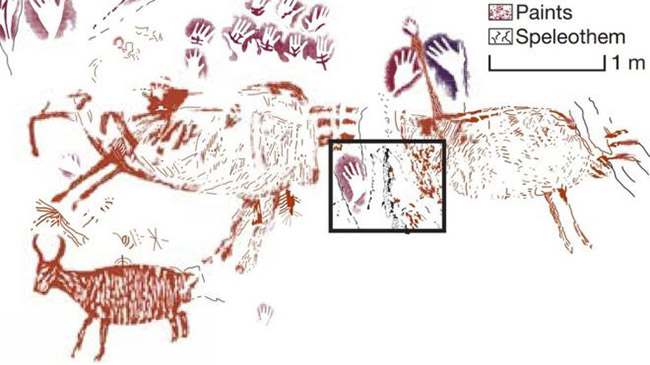
The artwork, which is at least 40,000 years old, is thought to be the oldest example of figurative painting - where real objects are depicted rather than abstract shapes. The researchers aren't certain what animal it represents, but their hunch is that it's a banteng, a type of wild cow that lives in the area today. The painting was found in a system of caves in the remote and rugged mountains of East Kalimantan, an Indonesian province on Borneo. The caves contain thousands of other prehistoric paintings, drawings and other imagery, including hand stencils, animals, abstract signs and symbols.
World's Oldest Animal Drawing, Discovered in Borneo Cave, Is a Weird Cow Beast Live Science - November 7, 2018
A 40,000-year-old painting of a mysterious, wild cow-like beast discovered in a Borneo cave is the oldest human-made drawing of an animal on record, a new study finds. The discovery indicates that figurative cave art - one of the most significant innovations in human culture - didn't begin in Europe as many scientists thought, but rather in Southeast Asia during the last ice age, the researchers said.
A very old master: Cave art created in Borneo 40,000 years ago is the world's oldest figurative art, scientists reveal Daily Mail - November 7, 2018
Using high-tech methods which measure radioactive decay they dated the limestone crusts that have grown over the art. This allows them to estimate the minimum age of the art found underneath. Some of the hand stencils at the cave, Lubang Jeriji Sale, are even older - dating to 51,800 years ago.
A Tang Dynasty inscription records that the first cave in the Mogao Grottoes was made in 366 A.D. The United Nations Educational, Scientific and Cultural Organization (UNESCO) listed the Mogao Grottoes on the World Heritage List in 1987. According to archaeologists, it is the greatest and most consummate repository of Buddhist art in the world. Despite erosion and man-made destruction, the 492 caves are well preserved, with frescoes covering an area of 45,000 square metres, more than 2,000 colored sculptured figures and five wooden eaves overhanging the caves.
Kizil Caves - China's Ancient Buddhist Legacy Is An Architectural Time Capsule
IFL Science - December 8, 2023
Peacock Cave

The Kizil Caves consist of 236 Buddhist rock-cut caves that reveal an amazing intercultural history for China's ancient past. Of these, 135 are still relatively intact. The earliest caves are dated, based in part on radioactive carbon dating, to around the year 300. Most researchers believe that the caves were probably abandoned sometime around the beginning of the 8th century,
The Ajanta Caves in India are 29 rock-cut cave monuments which date from the 2nd century BCE. The caves include paintings and sculptures considered to be masterpieces of both Buddhist religious art (which depict the Jataka tales) as well as frescos which are reminiscent of the Sigiriya paintings in Sri Lanka. The caves were built in two phases starting around 200 BCE, with the second group of caves built around 600 CE.
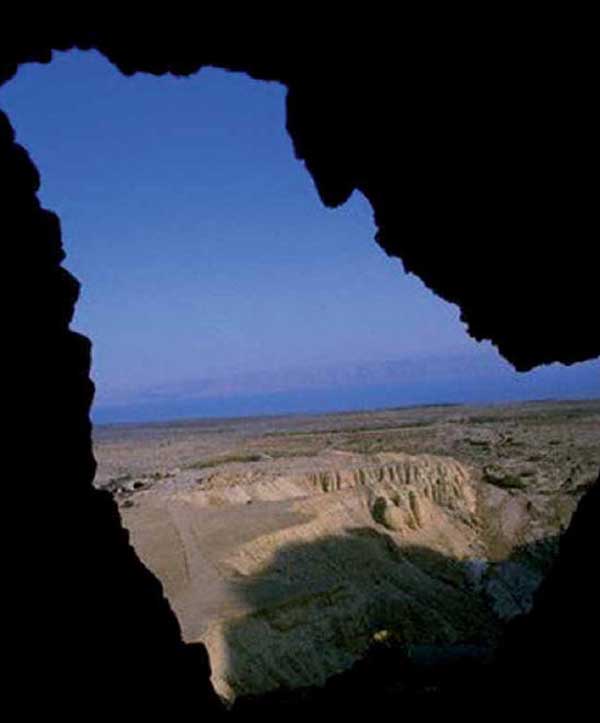
Quamran Caves - Dead Sea Scrolls
northwest shore of the Dead SeaThe settlement of Qumran is 1 km inland from the northwest shore of the Dead Sea. The scrolls were found in eleven caves nearby, between 125m (Cave 4) and 1 km (Cave 1) away. None were found within the settlement, unless it originally encompassed the caves. In the winter of 1946-47, Palestinian Muhammed edh-Dhib and his cousin discovered the caves, and soon afterwards the scrolls.
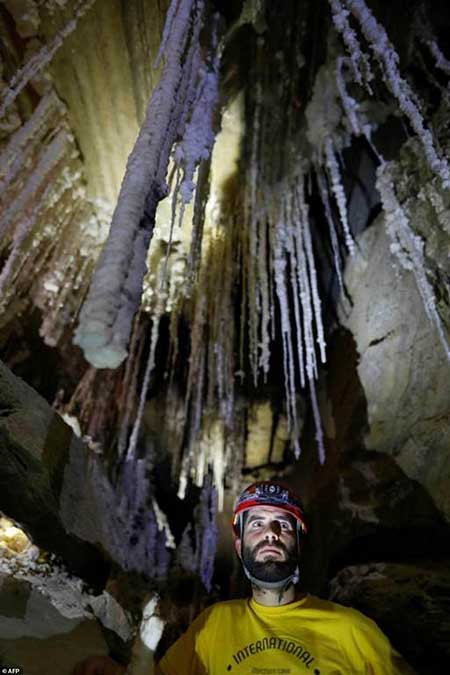
'It is like another planet': Six-mile-long Malham salt cave is named world's longest as incredible images reveal labyrinth of stalactites and crystals snaking underneath Mount Sodom Daily Mail - March 28, 2019
The world's longest salt cave has been discovered under Mount Sodom in Israel, and researchers say it is slowly growing. Measuring 6.25 miles (10 kilometres) long, the labyrinth of stalactites - known as Malham cave - spills out at the adjacent Dead Sea. Salt forms twisted rods which descend from the ceiling and salt crystals sparkle along many of the walls, while some of the stalactites have visible droplets of water at the bottom of the fragile formations.

Mount Sedom Hides the Longest Salt Cave on Earth Live Science - March 28, 2019
An Israeli-led research team believes that Malham Cave in the Negev Desert is the longest salt cave in the world, measuring more than 6 miles (10 kilometers) in total length. "Salt cave" is a literal term here: Malham sits under Mount Sedom, just southwest of the salty Dead Sea, and its walls are made out of the same sort of salt on your kitchen table. Radiocarbon dating suggests it's about 7,000 years old, its many passages carved by the very occasional rain storms that pass through the region. Even now, Malham continues to grow when water flows in and dissolves more of the salt, according to a statement.

Earliest Oil Paintings Found in Famed Afghan Caves

National Geographic February 7, 2008 - Buddhist murals from Afghanistan's famed Bamiyan caves are the world's earliest known oil paintings, according to a new chemical analysis. They dated to around the 7th century A.D., predate the origins of similar sophisticated painting techniques in medieval Europe and the Mediterranean by more than a hundred years.
Afghan caves hold world's first oil paintings: expert ABC - January 15, 2008
Forget Renaissance Europe. The world's first oil paintings go back nearly 14 centuries to murals in Afghanistan's Bamiyan caves, a Japanese researcher says. Buddhist images painted in the central Afghan region, dated to around 650 AD, are the earliest examples of oil used in art history, says Yoko Taniguchi, an expert at Japan's National Research Institute for Cultural Properties. A group of Japanese, European and US scientists are collaborating to restore damaged murals in caves in the Bamiyan Valley, famous for its two gigantic statues of the Buddha which were destroyed by the Taliban in 2001.

Iraq: The Skeletons of Shanidar Cave Smithsonian - March 2010
1n 1856, laborers working in a limestone quarry in the Neander Valley near Dusseldorf, Germany, dug up some unusual-looking bones. Subsequent study revealed that they belonged to a previously unknown species of humans, similar to, but distinct from our own species, Homo sapiens. The newly discovered hominid was named Neanderthal - thal is Old German for valley - and has fascinated anthropologists ever since.
It was first thought that Neanderthals may have resembled apes - with stooped posture and bent knees - more closely than modern humans. Then, in the 1950s, Smithsonian anthropologist Ralph Solecki, a team from Columbia University and Kurdish workers unearthed the fossilized bones of eight adult and two infant Neanderthal skeletons - spanning burials from 65,000 to 35,000 years ago -at a site known as the Shanidar cave, in the Kurdistan area of northern Iraq. The discovery changed our understanding of Neanderthals.
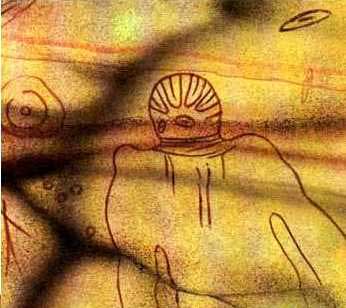
Tassili n'Ajjer, Sahara Desert, North Africa
Sahara rock art is a significant area of archaeological study focusing on the precious treasures carved or painted on the natural rocks found in the central Sahara desert. There are over three thousand sites discovered that have information about Saharan rock art. From the Tibesti massif to the Ahaggar Mountains, the Sahara is an impressive open-air museum containing numerous archaeological sites.
Tassili n'Ajjer (meaning "Plateau of the Rivers") is noted for its prehistoric rock art and other ancient archaeological sites, dating from Neolithic times when the local climate was much moister, with savannah rather than desert. The art depicts herds of cattle, large wild animals including crocodiles, and human activities such as hunting and dancing. The art has strong stylistic links to the pre-Nguni Art of South Africa and the region, executed in caves by the San Peoples before the year 1200 BCE.
The range's exceptional density of rock art paintings-pictograms and engravings-petroglyphs, and the presence of many prehistoric vestiges, are remarkable testimonies to Neolithic prehistory. From 10,000 BCE to the first centuries CE, successive peoples left many archaeological remains, habitations, burial mounds and enclosures which have yielded abundant lithic and ceramic material. However, it is the rock art (engravings and paintings) that have made Tassili world famous as from 1933, the date of its discovery. 15,000 petroglyphs have been identified to date.
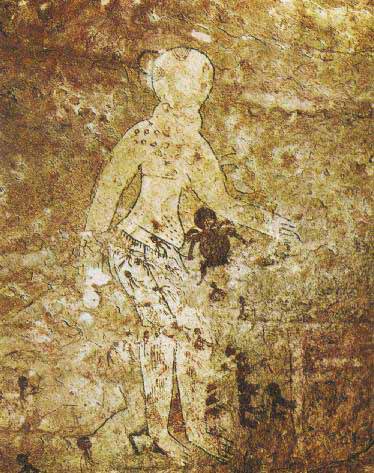
Some of the painting have bizarre depictions of what appear to be spacemen wearing suits, visors, and helmets. resembling modern day astronauts. This takes us to the west African tribe - the Dogon whose legends say they were guided to the area from another part of Africa that was drying up - by fish gods called the Nommo who came in huge ships from the sky. Google Images
'Unique' cave art discovered in Madagascar hints at connections with ancient Egypt and Borneo Live Science - December 20, 2023
The art is the first ancient pictorial art, which depicts images of nature with human-like and animal-like figures, to be found in Madagascar an island country lying off the southeastern coast of Africa.
New light shed on South African cave art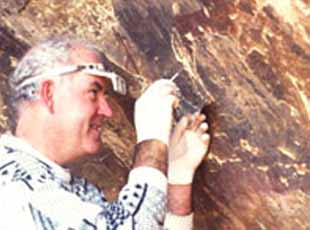
BBC - February 7, 2004
A huge collection of rock paintings in South Africa is far older than previously thought, research has found. Archaeologists using the latest radio-carbon dating technology found that the Ukhahlamba-Drakensberg paintings are 3,000 years old. Earlier findings by researchers had indicated that the paintings by San hunters-gatherers were 1,000 years old. The latest research was carried out by the Britain's Newcastle University and Australian National University. There are more than 40,000 rock paintings at the site in South Africa.

Bushmen Cave Paintings
Blue Holes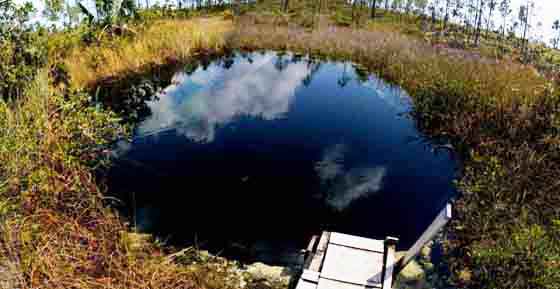
A blue hole is a cave (inland) or underwater sinkhole. They are also called vertical caves. There are many different blue holes located around the world, typically in low-lying coastal regions. The best known examples can be found in Belize, the Bahamas, Guam, Australia (in the Great Barrier Reef), and Egypt (in the Red Sea).
Life Beyond Earth? Underwater Caves in Bahamas Could Give Clues Science Daily - January 27, 2012
Discoveries made in some underwater caves by researchers in the Bahamas could provide clues about how ocean life formed on Earth millions of years ago, and perhaps give hints of what types of marine life could be found on distant planets and moons.

Subterranean Civilizations