May 27, 2026
Europe is renowned for its historic charm, stunning architecture, and deep cultural heritage. However, the continent's infrastructure was built for a climate that no longer exists.
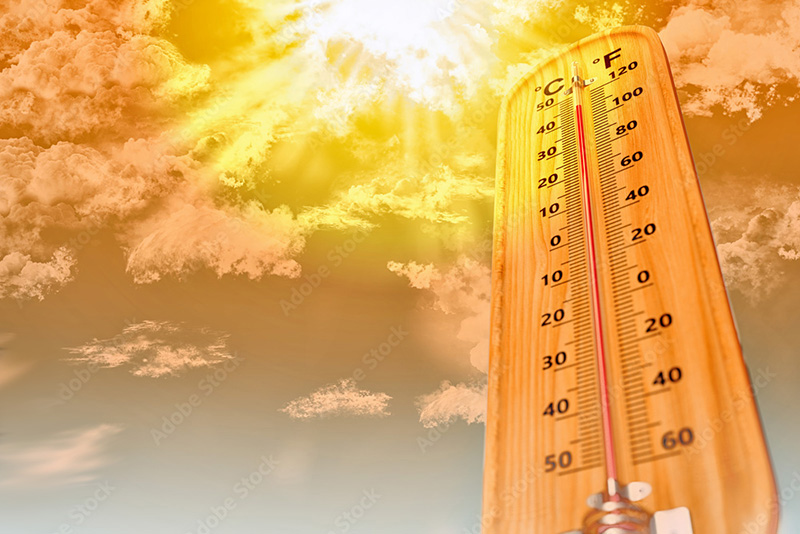
As the world's fastest-warming continent, Europe now faces severe summer heatwaves that last for weeks. Air conditioning, once considered an American luxury, has become a life-saving necessity for at least four months of the year. Retrofitting historic masonry buildings with central air conditioning is structurally disruptive and often legally prohibited by preservation laws.
Unlike regions in North America or Asia where energy infrastructure grew alongside the adoption of widespread air conditioning, Europe's electrical grids face unique structural vulnerabilities when demand spikes. Local power lines and neighborhood transformers in older cities were not engineered to handle the massive, simultaneous electrical load of millions of compressors running at peak hours.
Reality Check: Climate change and extreme weather events are no longer temporary anomalies - they are permanent, escalating realities that demand immediate structural adaptation. To believe that these intense heatwaves, grid failures, and natural disasters are just fleeting "moments in time" that will pass - is to misunderstand the fundamental shift in our global climate system.
Europe's struggle with extreme heat proves that societies can no longer rely on historical weather patterns to guide their infrastructure, energy planning, or safety measures. The world must actively prepare for a permanently harsher environment rather than waiting for a return to the old norm.
As we head into the summer of 2026, the stakes rise along with the heat and humidity.
A powerful, looming Super El Nino in the tropical Pacific is shifting atmospheric patterns globally, threatening to shatter previous temperature records and test the absolute limits of aging infrastructures stretching from the historic streets of Europe to the sprawling power grids of North America.
Simply put, there is no going back. Planet Earth will no longer be suspect sustainable in the near future.
Please be as prepared as you can be and never say, "I never thought this would happen to me." This is the exact phrase that loops through the minds of millions of people every year after a sudden disaster strikes - when an historic heatwave buckles the neighborhood power grid, a flash flood sweeps through a town that has never flooded before, a tornado destroys a city in minutes, or a wildfire sparks on the edge of a city - and the illusion of safety is instantly shattered.
The reality of living in a world dominated by a Super El Nino and accelerating climate shifts is that there is no longer any such thing as a "zero-risk" zone. Historical weather patterns no longer protect us. The boundaries of where disasters can happen have permanently expanded.
Prepare as best you can. Let your back-up plan have a back up plan because you never know when the unexpected will become your immediate reality.
According to scientific history, Earth has experienced five major mass extinctions often called the "Big Five - periods when enormous percentages of life disappeared due to catastrophic environmental change. These include events such as volcanic activity, climate shifts, asteroid impacts, ocean collapse, and changing atmospheric conditions. The most famous event is the extinction that ended the age of the dinosaurs about 66 million years ago.
From a symbolic or metaphysical perspective, some people interpret these extinction events differently - not only as geological catastrophes, but as transitions between phases of existence, consciousness, or what you describe as 'inserts' in a larger simulation. In that framework, each extinction becomes less an ending and more a reset point where the rules, dominant life forms, and direction of evolution changed dramatically.
There's an interesting parallel in how history appears layered. Entire ecosystems vanish, new species emerge, continents reshape, climates transform, and life begins again under different conditions - almost like successive versions of a program updating over immense spans of time.
Whether that reflects literal "simulation inserts" is philosophical speculation at this level of human conscious awareness rather than scientific fact, but it resonates with how many people intuitively experience cycles in nature, civilization, and consciousness itself.
Science explains extinction through observable physical processes. Simulation theory, meanwhile, explores the possibility that reality itself could be constructed or programmed in some deeper way. The two viewpoints approach the same history from different lenses - one empirical, one interpretive. Either way, the pattern remains striking - Earth's history is not linear stability, but cycles of collapse, adaptation, and renewal ... until now.
The simulation has created, experienced, and recorded far more than the five known cycles as it learns along the way. This may seem like millennia from the perspective of human consciousness - but it is all happening simultaneously.
From any perspective - this is the final version, insert, cycle in time, or however you conceptualize reality. If you don't get it yet - you will in the near future.
For now, always stay prepared as you wander through the matrix of realities - past, present, and future. It's all there for the taking.