
It not a UFO (UAP).

It not a UFO (UAP).
3I/ATLAS is an interstellar comet discovered by the Asteroid Terrestrial-impact Last Alert System (ATLAS) station at Rio Hurtado, Chile on July 1, 2025 by the Asteroid Terrestrial-impact Last Alert System (ATLAS) station. The comet follows an unbound, hyperbolic trajectory past the Sun, and passed by Earth at 1.8 AU, posing no threat.
The prefix "3I" designates it as the third confirmed interstellar object passing through the Solar System, after 1I/'Oumuamua and 2I/Borisov.
3I/ATLAS is an active comet consisting of a solid icy nucleus and a coma, which is a cloud of gas and icy dust escaping from the nucleus. The Sun is responsible for the comet's activity because it heats up the comet's nucleus to sublimate its ice into gas, which out-gasses and lifts up dust from the comet's surface to form its coma.
Images taken by the Hubble Space Telescope and various interplanetary spacecraft suggest that the diameter of 3I/ATLAS's nucleus is less than 1 km (0.62 mi).
Observations by the James Webb Space Telescope (JWST) have shown that 3I/ATLAS is unusually rich in carbon dioxide, and contains a small amount of water ice, water vapor, carbon monoxide, carbonyl sulfide, and methane.
Observations by the Very Large Telescope have also shown that 3I/ATLAS is emitting cyanide gas and atomic nickel vapor, at concentrations similar to those seen in Solar System comets.
The comet came to solar conjunction on October 21, 2025, and it came closest to the Sun on October 29, 2025, at a distance of 1.36 AU (203 million km; 126 million mi) from the Sun, which is between the orbits of Earth and Mars.
The comet appears to have originated from either the Milky Way's thin disk, or thick disk; if 3I/ATLAS originated from the thick disk, the comet could be at least 7 billion years old - older than the Solar System. Read more ...
31Atlas reignited fascination among astronomers, UFO researchers, dreamers, and those who wonder whether the universe may hold forms of intelligence or histories we have yet to understand. Its unusual trajectory revealed that it was not gravitationally bound to the Sun, confirming its origin from another stellar system.
What makes interstellar objects so captivating is that they are 'time capsules' from alien worlds. Every fragment of ice, dust, and rock carries chemical signatures from environments humanity has never seen directly.
Studying them offers rare clues about how planetary systems form across the galaxy - and perhaps how common the ingredients for life may truly be.
For UFO enthusiasts and cosmologists objects such as 'Oumuamua, 2I/Borisov, and now 3I/ATLAS inspire deeper questions. Are these simply natural travelers shaped by gravity and time? Or could some interstellar visitors represent technologies, probes, or artifacts from civilizations far older than our own? Mainstream science currently finds no evidence supporting artificial origins, yet the mystery itself continues to spark imagination worldwide.
In many ways, 3I/ATLAS reminds us that Earth is not isolated. Our solar system exists within a vast galactic system through which ancient objects silently drift. Occasionally, one crosses our path - offering humanity a fleeting glimpse into regions of space we may never otherwise reach.
May 2026 - The gradual dissemination of information about UFOs is starting to speed up - more clues, that awaken humanity allowing it to remember who they are and why they are here. The arrival of interesting objects from space is part of the process. Reality is all about timing timing so on we go to the next ...
In truth all three objects - and other archetypes that will follow - are inserts in the simulated reality in which we experience.

Simulation Theory - Holographic Universe
Interstellar Visitor 3I/ATLAS Is Bursting With an Unexpected Chemical SciTech Daily - June 24, 2026
New observations of comet 3I/ATLAS using the Atacama Large Millimeter/submillimeter Array (ALMA) have revealed a chemical surprise: the comet is extraordinarily rich in methanol, an organic molecule found in comets but rarely in such abundance. The discovery could provide fresh clues about the conditions in a distant planetary system unlike our own.
Dual spacecraft capture both hemispheres of interstellar comet 3I/ATLAS at once PhysOrg - May 13, 2026
The Southwest Research Institute-led Ultraviolet Spectrograph (UVS) instruments aboard ESA's Jupiter Icy Moons Explorer (Juice) spacecraft and NASA's Europa Clipper made unique observations of interstellar comet 3I/ATLAS in late 2025. SwRI leads the UVS instruments on both spacecraft, simultaneously imaging both hemispheres of the comet and detecting the comet's ultraviolet emissions. Only the third recognized interstellar object, 3I/ATLAS, entered our solar system in July of 2025.
Interstellar Comet 3I/ATLAS Came From a Place Nothing Like Our Solar System SciTech Daily - May 11, 2026

A comet from beyond our solar system is giving astronomers a rare look at how alien planetary systems may form under conditions very different from those that shaped our own cosmic neighborhood. 3I/ATLAS was discovered less than a year ago as it traveled through our solar system. Although scientists still do not know exactly where it originated, new research suggests the comet formed in an extremely cold region of space.
Interstellar comet 3I/ATLAS contains strange water never seen in our solar system. It has remarkably high content of deuterium Science Daily - May 8, 2026
Scientists Traced Interstellar Comet 3I/ATLAS to an Extremely Cold Origin Science Alert - April 24, 2026
The comet that rambled past us from another star last year likely originated in a cold, isolated corner of the galaxy that had yet to gel into its own solar system, astronomers reported . Comet 3I/ATLAS is only the third interstellar visitor to be confirmed and quite possibly the oldest. Scientists estimate it could be up to 11 billion years old, more than twice as old as the Sun.
'Interstellar messenger' 3I/ATLAS could be nearly as old as the universe itself, James Webb telescope observations reveal Live Science - March 12, 2026
Researchers knew from the comet's speed and trajectory that it was potentially the oldest comet ever seen. Previous estimates put the comet's age at somewhere between 3 billion and 11 billion years old. The new findings further narrowed down the comet's age and origin by looking at isotope measurements taken by JWST when the comet flew past Earth in December 2025. 3I/ATLAS' isotopic composition is very different from solar system comets and suggest that it likely formed 10-12 billion years ago In other words, 3I/ATLAS formed in a stellar environment different from ours, not only somewhere else in space, but also at a much earlier time in the history of the Milky Way.
Comet 3I/ATLAS continues to make astonishing headlines - new research reveals it is packed with an unusually large amount of the organic molecule methanol - more than almost all known comets in our own solar system PhysOrg - March 9, 2026
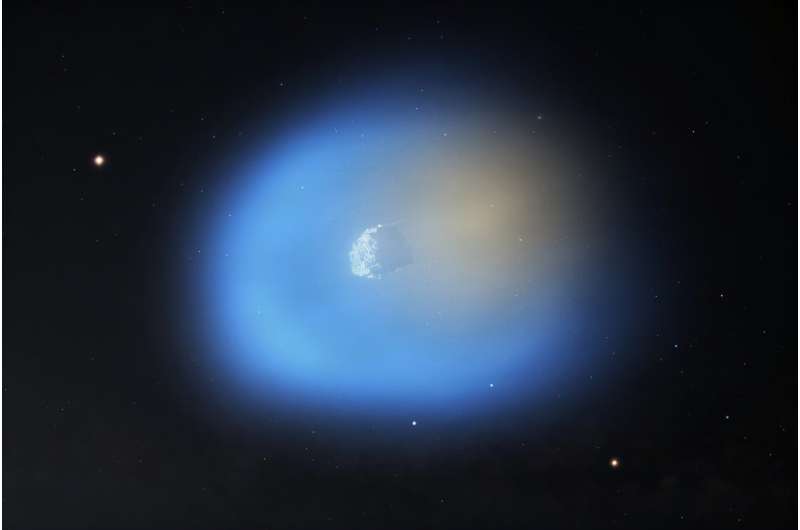
NASA telescope spots the building blocks for life spewing out of comet 3I/ATLAS Live Science - February 13, 2026

Interstellar comet 3I/ATLAS makes closest pass of Earth. Where's it heading next? Live Science - December 20, 2025
Comet 3I/ATLAS whizzed past Earth last night as astronomers worldwide continue to gather data on the interstellar visitor. The comet made its closest approach at around 1 a.m. EST on Friday (Dec. 19), coming within about 168 million miles (270 million kilometers) of our planet. When you consider the vastness of space, 168 million miles is a relatively short distance, but even at the comet's nearest point to us, 3I/ATLAS was still almost twice as far away as the sun. Last night was far from our last chance to see the comet. It will remain observable in the pre-dawn sky with a small telescope until spring, according to NASA. If you don't have a telescope, then the best way to see comet 3I/ATLAS is online.
Researchers have identified a distinctive ultraviolet signature of water in the interstellar comet 3I/ATLAS SciTech Daily - December 18, 2025
For millions of years, a fragment of ice and dust drifted between the stars - like a sealed bottle cast into the cosmic ocean. This summer, that bottle finally washed ashore in our solar system and was designated 3I/ATLAS, only the third known interstellar comet ever observed. When scientists at Auburn University aimed NASA's Neil Gehrels Swift Observatory at the object, they detected something never seen before in this kind of visitor: hydroxyl (OH) gas, which is a clear chemical marker of water. Swifts' space-based telescope was able to capture a faint ultraviolet signal that cannot be detected from the ground, because Earth's atmosphere blocks most ultraviolet light before it reaches the surface.
Interstellar comet 3I/ATLAS reveals signs of metal, carbon, and possible cryovolcanism Watchers - December 7, 2025
New analyses of interstellar comet 3I/ATLAS show that this rare visitor is a carbon-rich, metal-bearing body with an unusually bright coma dominated by carbon dioxide, suggesting a complex chemistry possibly linked to catalytic and cryovolcanic processes.
3I/ATLAS Isn't an Alien Death Probe, But It Is Wildly Unusual Science Alert - November 13, 2025
Reports that interstellar comet 3I/ATLAS is breaking apart have been greatly exaggerated - and radio signals received don't mean the object is an alien probe. In fact, quite the opposite is true: Every piece of evidence collected about 3I/ATLAS to date is consistent with a natural, cometary origin - a highly weird comet, to be sure, but a comet nevertheless. And, actually, that's really interesting and cool, without needing the assistance of imaginary aliens to make it so. What is unusual about 3I/ATLAS is what it's made of. Observations with large telescopes reveal that it has a lot of nickel, a larger-than-usual proportion of carbon dioxide, and not a lot of common carbon-chain molecules.
Where did the interstellar comet 3I/ATLAS come from? PhysOrg - September 12, 2025
Comet 3I/ATLAS is the third ISO ever detected. It was discovered by the Asteroid Terrestrial-impact Last Alert System (ATLAS) station on 1 July 2025. It's traveling through the inner solar system at about 220,000 km/h and will make its closest approach to the sun in late October. Multiple telescopes have observed it, including the JWST, and will continue to observe it. Interplanetary missions like the Jupiter Icy Moons Explorer (JUICE) and Mars Express will also get a crack at it in the future. NASA's Juno may even observe it from its mission to the Jovian System.
What 3I/ATLAS tells us about other solar systems PhysOrg - September 11, 2025
The earliest images of 3I/ATLAS, newly uncovered by Michigan State University, reveal how the interstellar object evolved as it traveled through our solar system - and how other distant solar systems might be different from our own. Even before the comet was discovered in early July, it was hiding among the stars, too faint to be noticeable. In a new paper published in the Astrophysical Journal Letters, MSU researchers combed through images from NASA's Transiting Exoplanet Survey Satellite, or TESS, and found evidence of 3I/ATLAS as early as May.
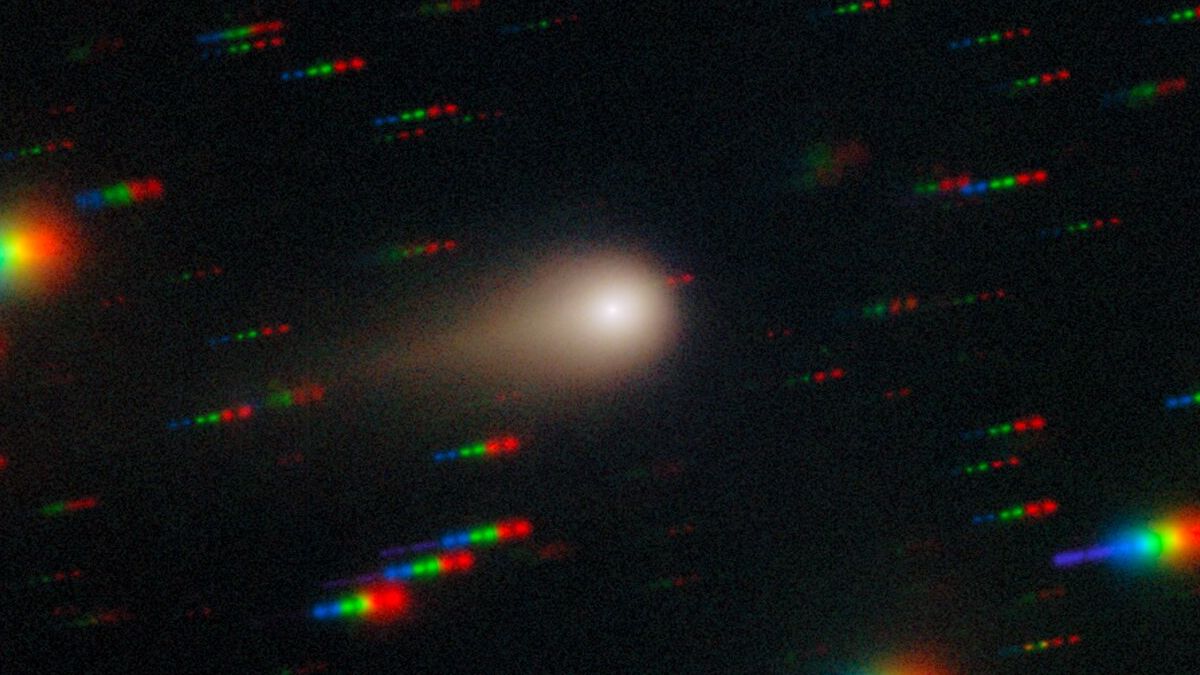
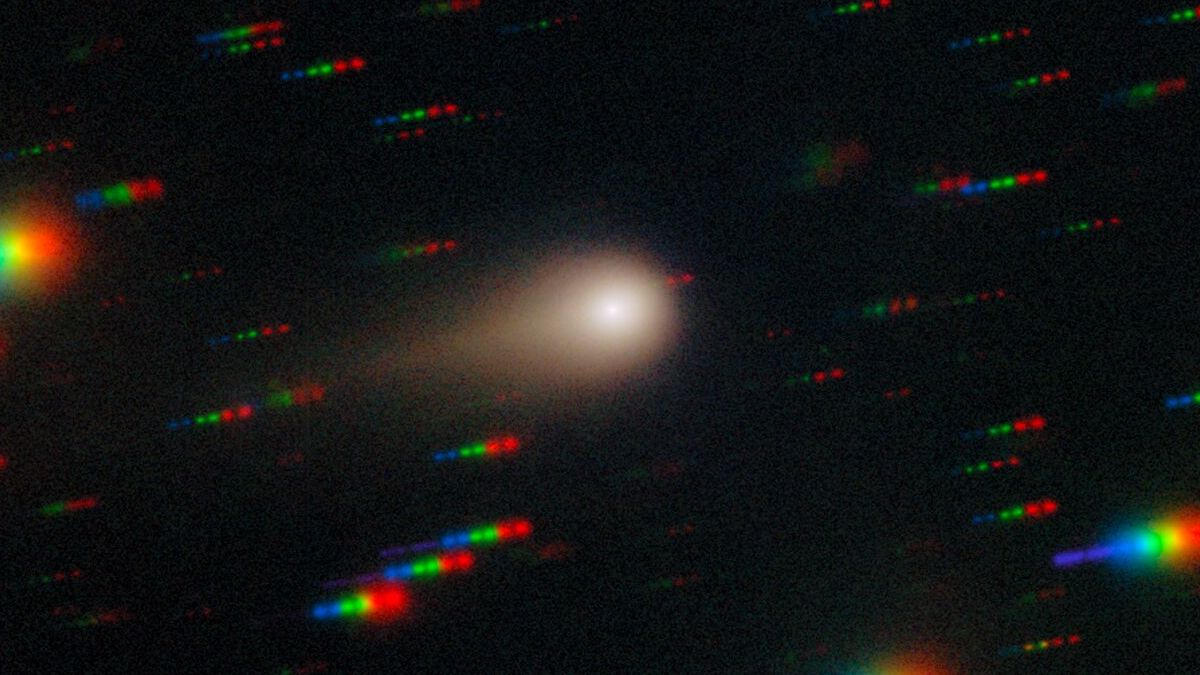
Interstellar comet 3I/ATLAS transforms into a giant 'cosmic rainbow' in trippy new telescope image Science Alert - July 17, 2025
The newly discovered interstellar visitor 31/ATL can be seen shining like a rainbow colored string of cosmic pearls in a trippy new time-lapse image, captured by a telescope in Hawaii. Initial observations also suggest that it could be up to 3 billion years older than the solar system, potentially making it the oldest comet ever seen,
New paper by Abraham (Avi) Loeb the Baird Professor of Science and Institute director at Harvard University suggests comet 3I/ATLAS might be alien tech Watchers - July 23, 2025

Could comet3I/ATLAS be a piece of alien technology? A question that might sound straight out of a sci-fi movie is now being brought to the front of the space table by Abraham (Avi) Loeb the Baird Professor of Science and Institute director at Harvard University. One might joke that 3I/ATLAS is a spaceship watching us from a safe distance like the Orville watching us from a distance, or maybe it's the ship of an alien coming to attack us like in the Predator.