
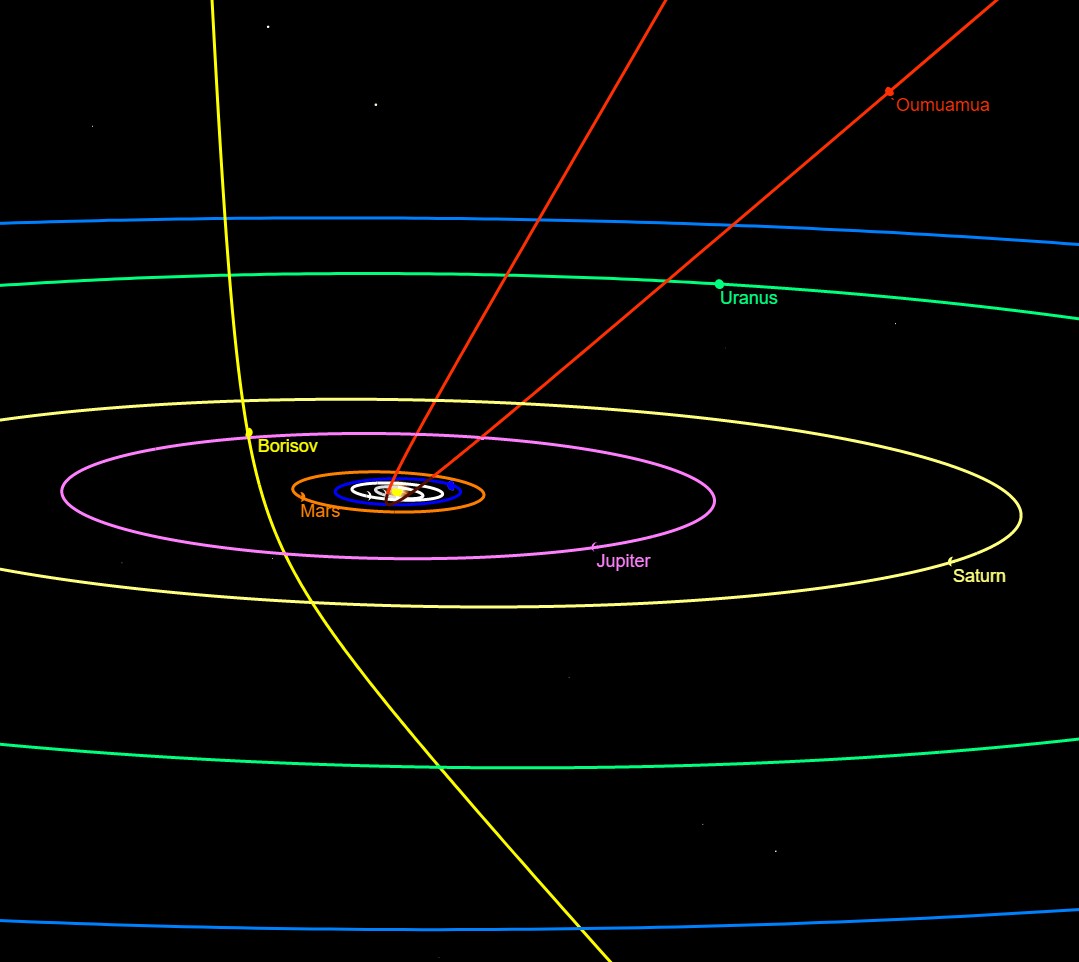
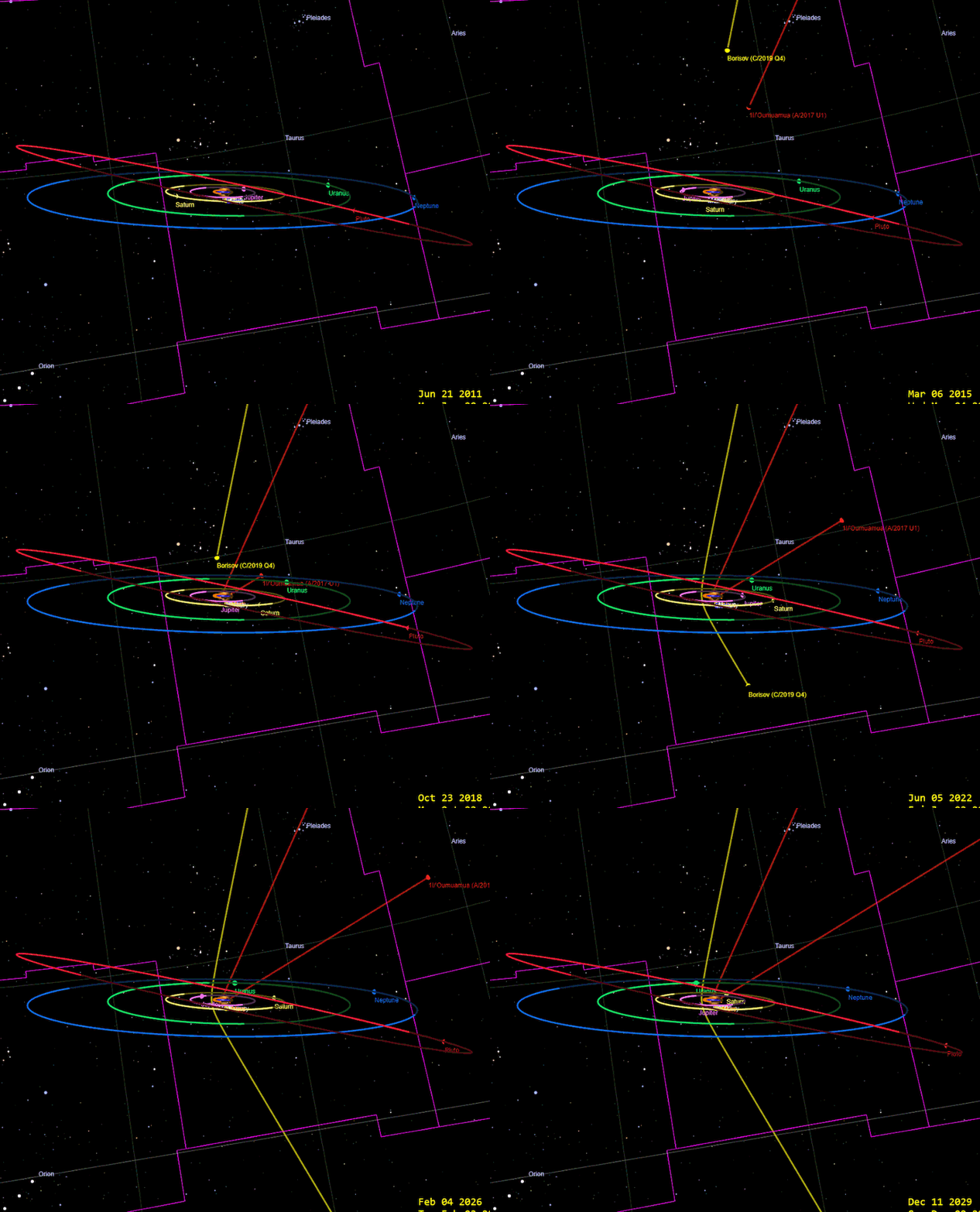
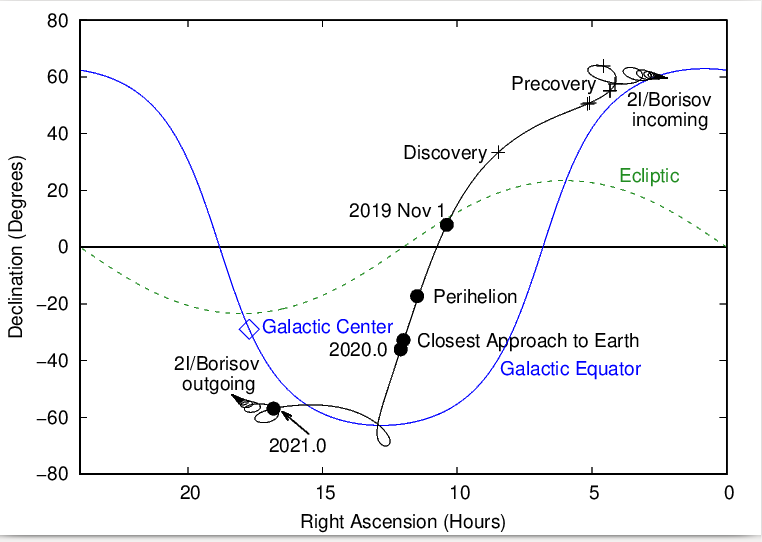
2I/Borisov, originally designated C/2019 Q4 (Borisov), is the first observed rogue comet and the second observed interstellar interloper, after ʻOumuamua. It was discovered by the Crimean amateur astronomer and telescope maker Gennadiy Borisov on 29 August 2019 in MARGO Observatory.
Unlike ʻOumuamua, which had an asteroidal appearance, 2I/Borisov's nucleus was surrounded by a coma, a cloud of dust and gas. Read More ...
2I/Borisov was more than just a comet - it was a messenger from another solar system, racing through our cosmic neighborhood carrying secrets older than Earth itself. The icy traveler became the first confirmed interstellar comet ever observed by humanity that we know of.
Unlike the mysterious ʻOumuamua, which appeared rocky and elusive, Borisov behaved like a classic comet glowing with a dusty tail and releasing frozen gases as it approached the Sun. Yet its chemistry revealed something extraordinary: unusually high levels of carbon monoxide, suggesting it formed in a frigid alien star system far colder than our own.
For astronomers, Borisov was like holding a piece of another galaxy's history in the palm of their hands. Every observation became a reminder that planetary systems are not unique to us that somewhere beyond our Sun, other worlds, other skies, and perhaps even other forms of life may exist amid the same cosmic dust that created us.
For UFO enthusiasts and those fascinated by the unknown, 2I/Borisov quickly became more than an interstellar comet. Its arrival sparked theories that it might be an artificial object - perhaps even a spacecraft sent from another civilization, another dimension, or another era in time itself. Moving through our solar system at extraordinary speed, the object seemed almost symbolic: a visitor appearing from deep space with no warning and no explanation.
Some speculated that Borisov was a probe, intentionally directed toward Earth to observe humanity during a pivotal point in history. Others imagined it as a relic from a long-lost civilization, wandering between stars for millions of years before finally crossing our path. Theories ranged from extraterrestrial intelligence to time travel - the idea that perhaps the object originated not from another world, but from humanity’s own distant future.
Scientists, however, observed that Borisov behaved very much like a natural comet, ejecting gas and dust in familiar ways. Yet that did little to quiet the imagination. In many ways, the fascination surrounding Borisov reflected something deeply human: our desire to believe the universe may contain messages, visitors, or signs that we are not alone.
Whether viewed through the lens of astronomy or speculation, 2I/Borisov became part of a larger cultural conversation about cosmic mysteries, unidentified phenomena, and the possibility that the universe may hold truths far stranger than we currently understand. Sometimes the most compelling aspect of these objects is not what they are - but the questions they inspire.
Comet 21/Borisov crossed our solar system at nearly 110,000 miles per hour before vanishing back into interstellar darkness, unlikely ever to return again. But for a brief moment, humanity watched an object born around another star blaze across our heavens - a fleeting visitor reminding us that the universe is vast, connected, and still filled with mysteries waiting to arrive from the stars.
Comet 21/Borisov ignited fascination among astronomers, UFO researchers, dreamers, and those who wonder whether the universe may hold forms of intelligence or histories we have yet to understand. Its unusual trajectory revealed that it was not gravitationally bound to the Sun, confirming its origin from another stellar system.
What makes interstellar objects so captivating is that they are 'time capsules' from alien worlds. Every fragment of ice, dust, and rock carries chemical signatures from environments humanity has never seen directly.
Studying them offers rare clues about how planetary systems form across the galaxy - and perhaps how common the ingredients for life may truly be.
For UFO enthusiasts and cosmologists objects such as 'Oumuamua, 2I/Borisov, and 3I/ATLAS inspire deeper questions. Are these simply natural travelers shaped by gravity and time? Or could some interstellar visitors represent technologies, probes, or artifacts from civilizations far older than our own? Mainstream science currently finds no evidence supporting artificial origins, yet the mystery itself continues to spark imagination worldwide.
In many ways, 3I/ATLAS reminds us that Earth is not isolated. Our solar system exists within a vast galactic system through which ancient objects silently drift. Occasionally, one crosses our path - offering humanity a fleeting glimpse into regions of space we may never otherwise reach.
May 2026 - The gradual dissemination of information about UFOs is starting to speed up - more clues, that awaken humanity allowing it to remember who they are and why they are here. The arrival of interesting objects from space is part of the process. Reality is all about timing timing so on we go to the next ...
In truth all three objects - and other archetypes that will follow - are inserts in the simulated reality in which we experience.

Simulation Theory - Holographic Universe