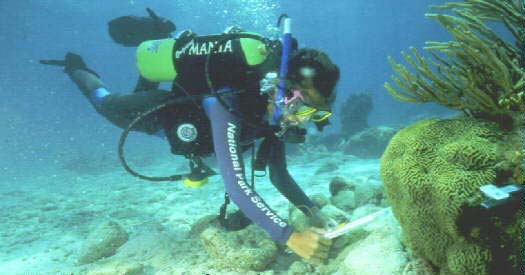
Underwater archaeology is archaeology practiced underwater. As with all other branches of archaeology, it evolved from its roots in pre-history and in the classical era to include sites from the historical and industrial eras. Its acceptance has been a relatively late development due to the difficulties of accessing and working underwater sites, and because the application of archaeology to underwater sites initially emerged from the skills and tools developed by shipwreck salvagers.
As a result, underwater archaeology initially struggled to establish itself as bona fide archaeological research. The situation changed when universities began teaching the subject and when a theoretical and practical base for the sub-discipline was firmly established. Underwater archaeology now has a number of branches including, after it became broadly accepted in the late 1980s, maritime archaeology: the scientifically based study of past human life, behaviors and cultures and their activities in, on, around and (lately) under the sea, estuaries and rivers. This is most often effected using the physical remains found in, around or under salt or fresh water or buried beneath water-logged sediment.
In recent years, the study of submerged WWII sites and of submerged aircraft in the form of underwater aviation archaeology have also emerged as bona fide activity.
Though often mistaken as such, underwater archaeology is not restricted to the study of shipwrecks. Changes in sea level because of local seismic events such as the earthquakes that devastated Port Royal and Alexandria or more widespread climatic changes on a continental scale mean that some sites of human occupation that were once on dry land are now submerged.
At the end of the last ice age, the North Sea was a great plain, and anthropological material, as well as the remains of animals such as mammoths, are sometimes recovered by trawlers. Also, because human societies have always made use of water, sometimes the remains of structures that these societies built underwater still exist (such as the foundations of crannogs, bridges and harbors) when traces on dry land have been lost. As a result, underwater archaeological sites cover a vast range including: submerged indigenous sites and places where people once lived or visited that have been subsequently covered by water due to rising sea levels; wells, cenotes, wrecks (shipwrecks; aircraft); the remains of structures created in water (such as crannogs, bridges or harbors); other port-related structures; refuse or debris sites where people disposed of their waste, garbage and other items, such as ships, aircraft, munitions and machinery, by dumping into the water.
Underwater archaeology is often complementary to archaeological research on terrestrial sites because the two are often linked by many and various elements including geographic, social, political, economic and other considerations. As a result, a study of an archaeological landscape can involve a multidisciplinary approach requiring the inclusion of many specialists from a variety of disciplines including prehistory, historical archaeology, maritime archaeology, and anthropology.
There are many examples. One is the wreck of the VOC ship Zuytdorp lost in 1711 on the coast of Western Australia, where there remains considerable speculation that some of the crew survived and, after establishing themselves on shore, intermixed with indigenous tribes from the area. The archaeological signature at this site also now extends into the interaction between indigenous people and the European pastoralists who entered the area in the mid-19th century.
A variety of archaeological sciences are used in underwater archaeology. Dendrochronology is an important technique especially for dating the timbers of wooden ships. It may also provide additional information, including the area where the timber was harvested (i.e. likely to be where the ship was built) and whether or not there are later repairs or reuse of salvaged materials. Because plant and animal material can be preserved underwater, archaeobotany and archaeozoology have roles in underwater archaeology. For example, for submerged terrestrial sites or inland water, identification of pollen samples from sedimentary or silt layers can provide information on the plants growing on surrounding land and hence on the nature of the landscape. Information about metal artifacts can be obtained through X-ray of concretions. Geology can provide insight into how the site evolved, including changes in sea-level, erosion by rivers and deposition by rivers or in the sea.
Artifacts recovered from underwater sites need stabilization to manage the process of removal of water and conservation.The artifact either needs to be dried carefully, or the water replaced with some inert medium (as in the case of The Mary Rose). Artifacts recovered from salt water, particularly metals and glass need be stabilized following absorption of salt or leaching of metals. In-situ conservation of underwater structures is possible, but consideration needs to be given to the dynamic nature of the site. Changes to the site during intrusive investigation or removal of artifacts may result in scouring which exposes the site to further deterioration.
There are many reasons why underwater archaeology can make a significant contribution to our knowledge of the past. In the shipwreck field alone individual shipwrecks can be of significant historical importance either because of the magnitude of loss of life (such as the Titanic), or circumstances of loss (Housatonic was the first vessel in history sunk by an enemy submarine).
Shipwrecks, such as The Mary Rose, can also be important for archaeology because they can form a kind of accidental time capsule, preserving an assemblage of human artifacts at the moment in time when the ship was lost.
Sometimes it is not the wrecking of the ship that is important, but the fact that we have access to the remains of it, especially where the vessel was of major importance and significance in the history of science and engineering (or warfare), due to being the first of its type of vessel.
The development of submarines, for example, can be traced via underwater archaeological research, via the Hunley which was the first submarine to sink an enemy ship (Hunley also had unique construction details not found in previous vessels and was one of the only historic warships ever raised intact), the Resurgam II, the first powered submarine, and Holland 5, which provides insight into the development of submarines in the British Navy.
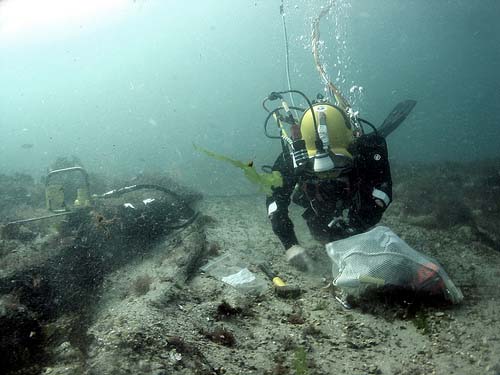
Underwater sites are inevitably difficult to access, and more hazardous, compared with working on dry land. In order to access the site directly, diving equipment and diving skills are necessary. The depths that can be accessed by divers, and the length of time available at depths, are limited. For deep sites beyond the reach of divers, submarines or remote sensing equipment are needed.
For a marine site, while some form of working platform (typically a boat or ship) is often needed, shore-based activities are common. notwithstanding, all creates logistics problems. A working platform for underwater archeology needs to be equipped to provide for the delivery of air for example, recompression and medical facilities, or specialist remote sensing equipment, analysis of archaeological results, support for activities being undertaken in the water, storage of supplies, facilities for conservation for any items recovered from the water, as well as accommodation for workers.
Equipment used for archaeological investigation, including water dredge and air lifts create additional hazards and logistics issues. Moreover, marine sites may be subject to strong tidal flows or poor weather which mean that the site is only accessible for a limited amount of time. Some marine creatures also pose a threat to diver safety.
Underwater sites are often dynamic, that is they are subject to movement by currents, surf, storm damage or tidal flows. Structures may be unexpectedly uncovered, or buried beneath sediments. Over time, exposed structures will be eroded, broken up and scattered. The dynamic nature of the environment may make in-situ conservation infeasible, especially as exposed organics, such as the wood of a shipwreck, are likely to be consumed by marine organisms such as piddocks.
In addition, underwater sites can be chemically active, with the result that iron can be leached from metal structures to form concretions. The original metal will then be left in a fragile state.
Underwater sites do not provide good outreach possibilities and access for the general public.
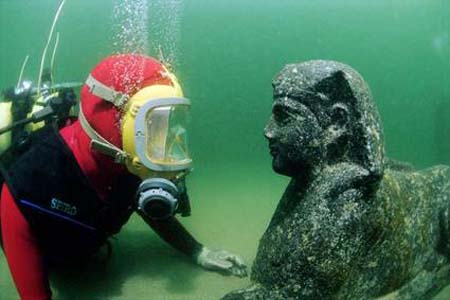
An important aspect of project design is likely to be managing the logistics of operating from a boat and of managing diving operations. Archaeological techniques and equipment applicable to underwater sites include:
Remote sensing. Sensitive sonar, especially side-scan sonar may be used to image an underwater site. Magnetometry can be used to locate metal remains such as metal shipwrecks, anchors and cannons. Sub-bottom profiling utilizes multi-beam sonar to detect structures buried beneath sediment.
Remotely Operated Vehicle (ROV). Where it is not practical or safe for divers to physically visit a site, video cameras can be steered from the surface.
3D survey. Three dimensional surveying is typically undertaken using depth gauges and tape measurements.
Photography and Photomontage or Photomosaic. Cameras, including video cameras can be provided with special housings that enables them to be used underwater. A series of photographs can be taken at adjacent points and then combined into a single image of the whole site.
Underwater Excavation. Where intrusive excavation is appropriate, silts and sediments can be removed from an area of investigation using a water dredge or air lift. When used correctly, these devices have an additional benefit in tending to improve the visibility in the immediate vicinity of the investigation.
Scale drawing can be undertaken underwater. Pencils will write underwater on permatrace, plastic dive slates, or matt laminated paper.
Archaeological Science. Dendrochronology is an important technique for dating the timbers of wooden ships. It may also provide additional information, including the area where the timber was harvested (i.e. likely to be where the ship was built) and whether or not there are later repairs or reuse of salvaged materials. Because plant and animal material can be preserved underwater, archaeobotany and archaeozoology have roles in underwater archaeology. For example, identification of pollen samples from sedimentary or silt layers can provide information on the plants growing on surrounding land and hence on the nature of the landscape. Information about metal artefacts can be obtained through X-ray of concretions. Geology can provide insight into how the site evolved, including changes in sea-level, erosion by rivers and deposition by rivers or in the sea.
Conservation . Artifacts recovered from underwater sites need stabilization to manage the process of removal of water. The artifact either needs to be dried carefully, or the water replaced with some inert medium (as in the case of The Mary Rose). Artifacts recovered from salt water, particularly metals and glass need to be stabilized following absorption of salt or leaching of metals. In-situ conservation of underwater structures is possible, but consideration needs to be given to the dynamic nature of the site. Changes to the site during intrusive investigation or removal of artifacts may result in scouring which exposes the site.
Divers Found a Lost 600-Year-Old City at the Bottom of a Chinese Lake, and It's Still Remarkably Intact Daily Galaxy - April 22, 2026


A 600-year-old city is sitting almost untouched beneath the waters of Qiandao Lake in eastern China. Known as Shi Cheng, or Lion City, it has been compared to Atlantis because of how well it has survived underwater.
Archaeologists Working of the Northwest Shore of Kyrgyzstan's Lake Issyk-Kul Found an Atlantis-Like Metropolis Hidden Beneath One of Earth's Deepest Lakes Daily Galaxy - April 19, 2026
Beneath a mountain lake's shallow waters, divers found brick streets no one knew existed and a cemetery stretching fourteen acres across the lakebed. The pattern kept reappearing under the shifting sand. Divers working off the northwest shore of Kyrgyzstan's Lake Issyk-Kul would watch currents expose straight lines of fired brick, then heavy stone shapes, then wooden beams lying in the same zones. Natural lakebeds do not arrange themselves that way. In November 2025, an expedition confirmed what the repeating geometry suggested a medieval city sits intact just meters below the surface.
Scientists Find a 'Yellow Brick Road' in a Never-Before-Seen Spot of The Pacific Ocean Science Alert - December 21, 2022
An expedition to a deep-sea ridge, just north of the Hawaiian Islands, has revealed an ancient dried-out lake bed paved with what looks like a yellow brick road. The eerie scene was chanced upon by the exploration vessel Nautilus earlier this year, while surveying the Lili'uokalani Ridge within Papahanaumokuakea Marine National Monument (PMNM).
USOs - UNIDENTIFIED SUBMERGED OBJECTS