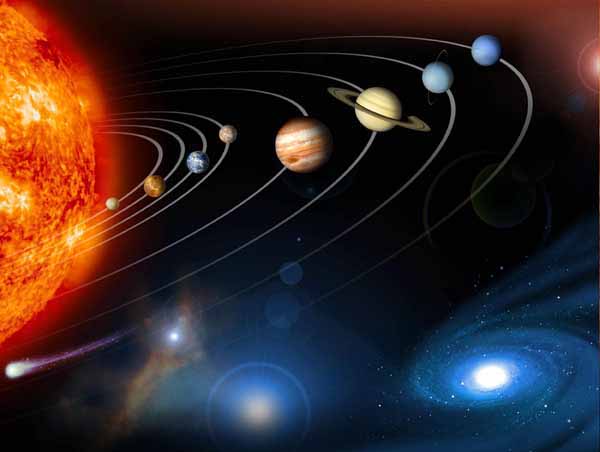
The Solar System consists of the Sun and the astronomical objects bound to it by gravity, all of which formed from the collapse of a giant molecular cloud approximately 4.6 billion years ago. Of the many objects that orbit the Sun, most of the mass is contained within eight relatively solitary planets whose orbits are almost circular and lie within a nearly flat disc called the ecliptic plane.
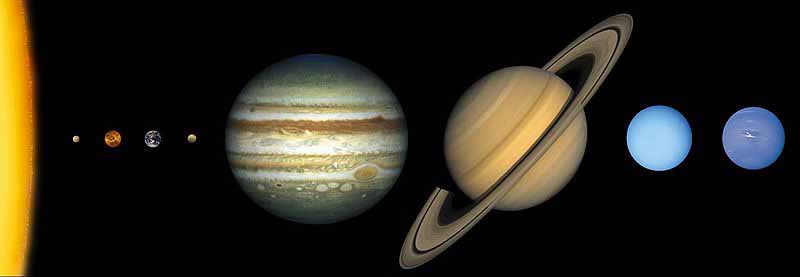
The four smaller inner planets, Mercury, Venus, Earth, and Mars, also called the terrestrial planets, are primarily composed of rock and metal.
The four outer planets, the gas giants, are substantially more massive than the terrestrials. The two largest, Jupiter and Saturn, are composed mainly of hydrogen and helium; the two outermost planets, Uranus and Neptune, are composed largely of ices, such as water, ammonia and methane, and are often referred to separately as "ice giants".
The Solar System is also home to two regions populated by smaller objects. The asteroid belt, which lies between Mars and Jupiter, is similar to the terrestrial planets as it is composed mainly of rock and metal. Beyond Neptune's orbit lie trans-Neptunian objects composed mostly of ices such as water, ammonia and methane.
Within these two regions, five individual objects, Ceres, Pluto, Haumea, Makemake and Eris, are recognized to be large enough to have been rounded by their own gravity, and are thus termed dwarf planets. In addition to thousands of small bodies in those two regions, various other small body populations, such as comets, centaurs and interplanetary dust, freely travel between regions.
The solar wind, a flow of plasma from the Sun, creates a bubble in the interstellar medium known as the heliosphere, which extends out to the edge of the scattered disc.
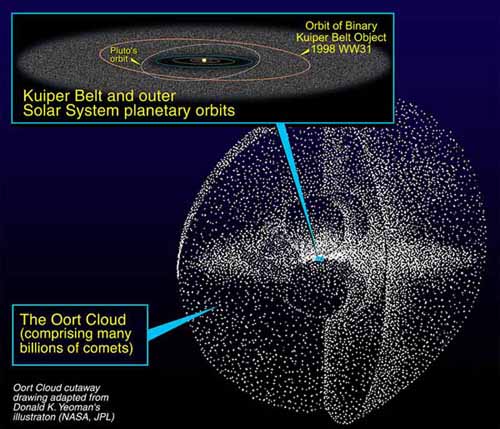
The hypothetical Oort cloud, which acts as the source for long-period comets, may also exist at a distance roughly a thousand times further than the heliosphere.
Six of the planets and three of the dwarf planets are orbited by natural satellites, usually termed "moons" after Earth's Moon. Each of the outer planets is encircled by planetary rings of dust and other particles.
Eight of the nine planets are named after or derived from gods and goddesses from Greco-Roman mythology.
For millennia, humanity, with a few notable exceptions, did not recognize the existence of the Solar System. People believed the Earth to be stationary at the center of the universe and categorically different from the divine or ethereal objects that moved through the sky.
Although the Greek philosopher Aristarchus of Samos had speculated on a heliocentric reordering of the cosmos, Nicolaus Copernicus was the first to develop a mathematically predictive heliocentric system.
His 17th-century successors, Galileo Galilei, Johannes Kepler and Isaac Newton, developed an understanding of physics that led to the gradual acceptance of the idea that the Earth moves around the Sun and that the planets are governed by the same physical laws that governed the Earth.
In more recent times, improvements in the telescope and the use of unmanned spacecraft have enabled the investigation of geological phenomena such as mountains and craters, and seasonal meteorological phenomena such as clouds, dust storms and ice caps on the other planets.
The Solar System formed from the gravitational collapse of a giant molecular cloud 4.568 billion years ago. This initial cloud was likely several light-years across and probably birthed several stars.
As the region that would become the Solar System, known as the pre-solar nebula, collapsed, conservation of angular momentum made it rotate faster. The centre, where most of the mass collected, became increasingly hotter than the surrounding disc.
As the contracting nebula rotated, it began to flatten into a spinning protoplanetary disc with a diameter of roughly 200 AU and a hot, dense protostar at the centre. At this point in its evolution, the Sun is believed to have been a T Tauri star. Studies of T Tauri stars show that they are often accompanied by discs of pre-planetary matter with masses of 0.001Ð0.1 solar masses, with the vast majority of the mass of the nebula in the star itself. The planets formed by accretion from this disk.
Within 50 million years, the pressure and density of hydrogen in the centre of the protostar became great enough for it to begin thermonuclear fusion. The temperature, reaction rate, pressure, and density increased until hydrostatic equilibrium was achieved, with the thermal energy countering the force of gravitational contraction. At this point the Sun became a full-fledged main sequence star.
The Solar System as we know it today will last until the Sun begins its evolution off of the main sequence of the HertzsprungÐRussell diagram. As the Sun burns through its supply of hydrogen fuel, the energy output supporting the core tends to decrease, causing it to collapse in on itself. This increase in pressure heats the core, so it burns even faster. As a result, the Sun is growing brighter at a rate of roughly ten percent every 1.1 billion years.
Around 5.4 billion years from now, the hydrogen in the core of the Sun will have been entirely converted to helium, ending the main sequence phase. As the hydrogen reactions shut down, the core will contract further, increasing pressure and temperature, causing fusion to commence via the helium process. Helium in the core burns at a much hotter temperature, and the energy output will be much greater than during the hydrogen process. At this time, the outer layers of the Sun will expand to roughly up to 260 times its current diameter; the Sun will become a red giant. Because of its vastly increased surface area, the surface of the Sun will be considerably cooler than it is on the main sequence (2600 K at the coolest).
Eventually, helium in the core will exhaust itself at a much faster rate than the hydrogen, and the Sun's helium burning phase will be but a fraction of the time compared to the hydrogen burning phase. The Sun is not massive enough to commence fusion of heavier elements, and nuclear reactions in the core will dwindle. Its outer layers will fall away into space, leaving a white dwarf, an extraordinarily dense object, half the original mass of the Sun but only the size of the Earth. The ejected outer layers will form what is known as a planetary nebula, returning some of the material that formed the Sun to the interstellar medium.
According to their location, the objects in the solar system are divided into three zones: the inner solar system, including terrestrial planets and the Main belt of asteroids; a middle region including the giant planets, their satellites and the centaurs, and the outer solar system, comprising the area of the Trans-Neptunian objects including the Kuiper Belt, the Oort cloud, and the vast region in between. This region is occasionally referred to as the solar system's "third zone".
The area beyond Neptune, or the "trans-Neptunian region", is still largely unexplored. It appears to consist overwhelmingly of small worlds (the largest having a diameter only a fifth that of the Earth and a mass far smaller than that of the Moon) composed mainly of rock and ice. This region is sometimes known as the "outer Solar System", though others use that term to mean the region beyond the asteroid belt.
The Kuiper belt, the region's first formation, is a great ring of debris similar to the asteroid belt, but composed mainly of ice. It extends between 30 and 50 AU from the Sun. Though it contains at least three dwarf planets, it is composed mainly of small Solar System bodies. However, many of the largest Kuiper belt objects, such as Quaoar, Varuna, and Orcus, may be reclassified as dwarf planets. There are estimated to be over 100,000 Kuiper belt objects with a diameter greater than 50 km, but the total mass of the Kuiper belt is thought to be only a tenth or even a hundredth the mass of the Earth. Many Kuiper belt objects have multiple satellites, and most have orbits that take them outside the plane of the ecliptic.
The Kuiper belt can be roughly divided into the "classical" belt and the resonances. Resonances are orbits linked to that of Neptune (e.g. twice for every three Neptune orbits, or once for every two). The first resonance begins within the orbit of Neptune itself. The classical belt consists of objects having no resonance with Neptune, and extends from roughly 39.4 AU to 47.7 AU. Members of the classical Kuiper belt are classified as cubewanos, after the first of their kind to be discovered, (15760) 1992 QB1, and are still in near primordial, low-eccentricity orbits.
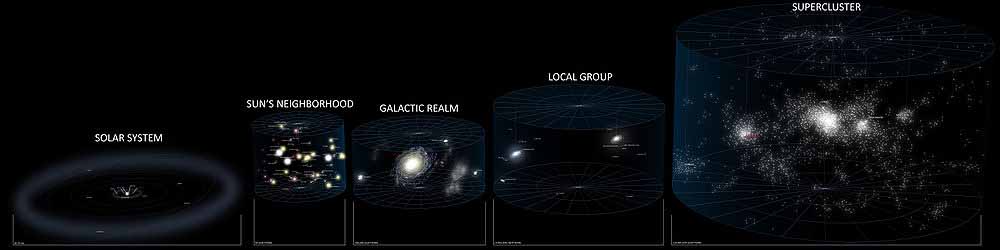
The immediate galactic neighborhood of the Solar System is known as the Local Interstellar Cloud or Local Fluff, an area of denser cloud in an otherwise sparse region known as the Local Bubble, an hourglass-shaped cavity in the interstellar medium roughly 300 light years across. The bubble is suffused with high-temperature plasma that suggests it is the product of several recent supernovae.
There are relatively few stars within ten light years (95 trillion km) of the Sun. The closest is the triple star system Alpha Centauri, which is about 4.4 light years away. Alpha Centauri A and B are a closely tied pair of Sun-like stars, while the small red dwarf Alpha Centauri C (also known as Proxima Centauri) orbits the pair at a distance of 0.2 light years. The stars next closest to the Sun are the red dwarfs Barnard's Star (at 5.9 light years), Wolf 359 (7.8 light years) and Lalande 21185 (8.3 light years).
The largest star within ten light years is Sirius, a bright main sequence star roughly twice the Sun's mass and orbited by a white dwarf called Sirius B. It lies 8.6 light years away. The remaining systems within ten light years are the binary red dwarf system Luyten 726-8 (8.7 light years) and the solitary red dwarf Ross 154 (9.7 light years).[99] Our closest solitary sun-like star is Tau Ceti, which lies 11.9 light years away. It has roughly 80 percent the Sun's mass, but only 60 percent its luminosity.
The closest known extrasolar planet to the Sun lies around the star Epsilon Eridani, a star slightly dimmer and redder than the Sun, which lies 10.5 light years away. Its one confirmed planet, Epsilon Eridani b, is roughly 1.5 times Jupiter's mass and orbits its star every 6.9 years.
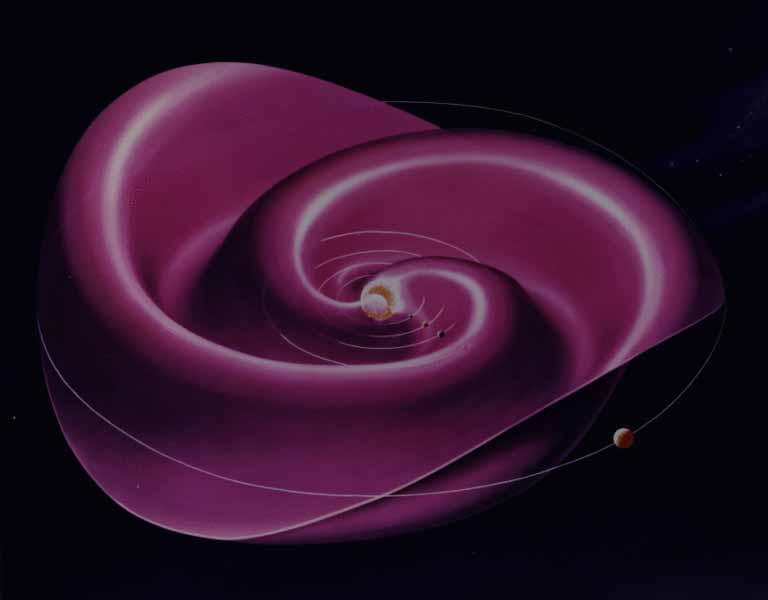
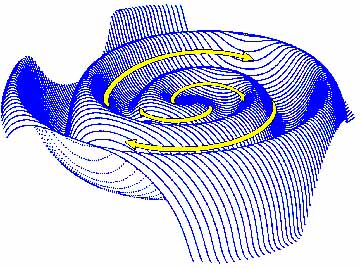
The environment in which the solar system resides is called the interplanetary medium. The Sun radiates a continuous stream of charged particles, a plasma known as solar wind, which forms a very tenuous "atmosphere" (the heliosphere), permeating the interplanetary medium in all directions into space. Small quantities of dust are also present in the interplanetary medium and are responsible for the phenomenon of zodiacal light. Some of the dust is likely interstellar dust from outside the solar system. The influence of the Sun's rotating magnetic field on the interplanetary medium creates the largest structure in the solar system, the heliospheric current sheet.
Study Traces Our Solar System's Journey Through a Massive Galactic Wave Science Alert - March 12, 2025

Our Solar System is in motion and cruises at about 200 kilometres per second relative to the center of the Milky Way. During its long journey, it has passed through different parts of the galaxy. Research shows that the Solar System passed through the Orion star-forming complex about 14 million years ago.
The Shape of The Solar System Has Changed Dramatically, Scientists Say Science Alert - June 30, 2024

The shape of the Solar System was once a little more on the doughy side. Before it arranged itself into a flattened disk, the distribution of dust and rocks had more in common with a donut than a pancake. This is the conclusion scientists reached after studying iron meteorites from the outer Solar System, finding that they can only be explained if the Solar System's shape was once toroidal.
We've Never Found Anything Like Our Solar System. Is It a Freak in Space? Science Alert - January 2, 2024

We've learnt many things from this vast catalogue of alien worlds orbiting alien stars. But one small detail stands out like a sore thumb. We've found nothing else out there like our own Solar System.
Multiple Interstellar Objects Have Entered Our Solar System, Study Finds Science Alert - May 19, 2023
When Oumuamua travelled through our Solar System back in 2017, people around the world paid attention. It was the first Interstellar Object (ISO) astronomers had ever identified. Then in August 2019, Comet 2I Borisov travelled through our Solar System, becoming the second ISO to cruise through for a visit. Together, the visiting ISOs generated a wave of inquiry and speculation. There's bound to be more ISOs than just those two, and a new study says our Solar System has probably captured some of these interstellar visitors, though they don't stay for long. Although ISOs are rare, the Solar System is old, and many have likely visited. Astronomers think that some of these objects can be captured in solar orbits. This study takes a closer look at ISO capture and tests the idea that some ISOs could be captured in near-Earth orbits rather than solar orbits. The researchers behind the work say that there could be a steady population of ISOs in near-Earth orbit.
A Ghostly Glow of Light Surrounds The Solar System, And Nobody Can Explain It Science Alert - December 9, 2022
A new analysis of Hubble data has clinched it: There's too much light in the space around the Solar System. Not much extra light, to be sure. Just a subtle, ghostly glow, a faint excess that can't be accounted for in a census of all the light-emitting objects. All the stars and galaxies surrounding the Solar System - and zodiacal light, aka dust on the Solar System's plane - none of these can explain what astronomers are now calling "ghost light".
Hubble detects ghostly glow surrounding our solar system PhysOrg - December 8, 2022
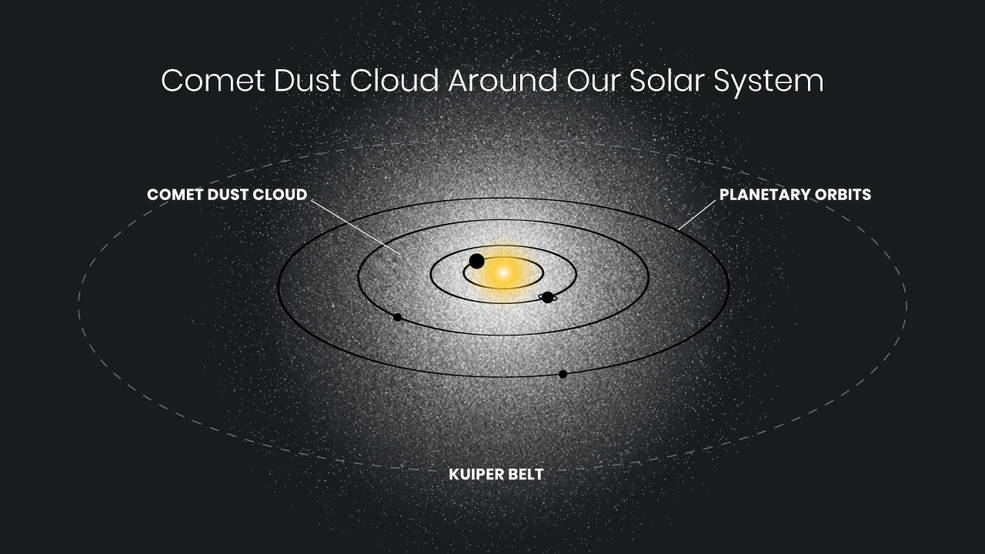
Imagine walking into a room at night, turning out all the lights and closing the shades. Yet an eerie glow comes from the walls, ceiling, and floor. The faint light is barely enough to see your hands before your face, but it persists. Where's that coming from?
Mesmerizing Animation Reveals Our Entire Solar System Doesn't Exactly Orbit The Sun Science Alert - July 27, 2020
It's common knowledge that the Sun is the centre of the Solar System. Around it, the planets orbit Ð along with a thick belt of asteroids, some meteor fields, and a handful of far-traveling comets.
Astronomers discover largest solar system BBC - January 27, 2016
Astronomers have discovered the largest known solar system, consisting of a large planet that takes nearly a million years to orbit its star. The gas giant is one trillion kilometres away, making its orbit 140 times wider than Pluto's path around our Sun. Only a handful of extremely wide pairs of this kind have been found in recent years.
Ever feel like you live in a bubble? You do. We all do. CNN - August 28, 2014
Our whole solar system appears to, say space scientists, who published work last month corroborating its existence. And, oh, what a bubble it is: About 300 light years long (about 1,764,000,000,000,000 miles), and its walls are made of hot gas. How hot? About a million degrees. It's called the "Local Bubble" or "local hot bubble" and is shaped a little like a peanut. Scientists believe it was formed by supernovas, the largest explosions in space, as NASA calls them, that occur when a large star blows up.
Mysterious Energy Ribbon at Solar System's Edge a 'Cosmic Roadmap' Live Science - February 14, 2014
A strange ribbon of energy and particles at the edge of the solar system first spotted by a NASA spacecraft appears to serve as a sort of "roadmap in the sky" for the interstellar magnetic field, scientists say. By comparing ground-based studies and in-space observations of solar system's mysterious energy ribbon, which was first discovered by NASA's Interstellar Boundary Explorer (IBEX) in 2009, scientists are learning more details about the conditions at the solar system's edge. The study also sheds light into the sun's environment protects the solar system from high-energy cosmic rays.