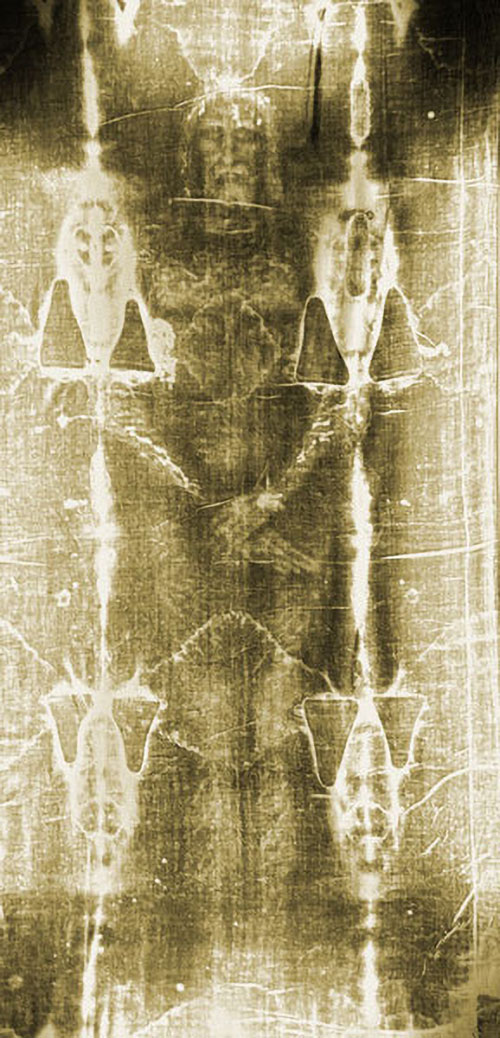
The Shroud of Turin (Italian: Sindone di Torino), also known as the Holy Shroud - is a length of linen cloth that bears a faint image of the front and back of a naked man. Because details of the image are consistent with traditional depictions of Jesus of Nazareth after his death by crucifixion, the shroud has been venerated by Christians for centuries, especially by members of the Catholic Church, as Jesus's shroud upon which his image was miraculously imprinted.
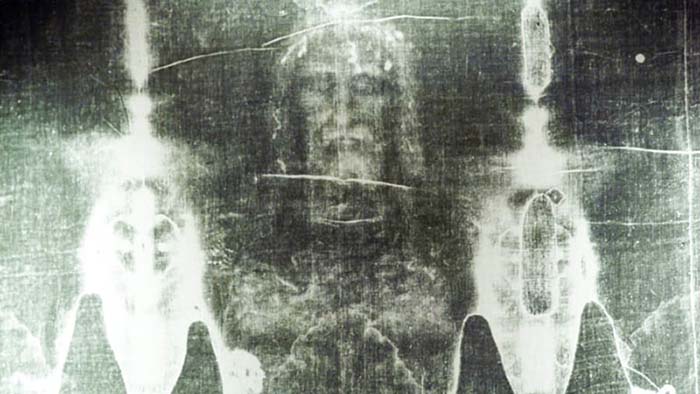
The human image on the shroud can be discerned more clearly in a black-and-white photographic negative than in its natural sepia color, an effect discovered in 1898 by Secondo Pia, who produced the first photographs of the shroud. This negative image is associated with a popular Catholic devotion to the Holy Face of Jesus.
The documented history of the shroud dates back to 1354, when it began to be exhibited in the new collegiate church of Lirey, a village in north-central France.
The shroud was denounced as a forgery by the bishop of Troyes, Pierre d'Arcis, in 1389.
It was acquired by the House of Savoy in 1453 and later deposited in a chapel in Chambéry, where it was damaged by fire in 1532.
Te Savoys moved the shroud to their new capital in Turin, where it has remained ever since.
In 1694, it was moved to the altar in the Chapel of the Holy Shroud, which was designed for that purpose by the architect Guarino Guarini and which is connected to both the royal palace and the Turin Cathedral.
It remained there until 1993, when it was moved to the cathedral. Ownership of the shroud passed from the House of Savoy to the Catholic Church after the death of the former king Umberto II of Italy in 1983.
The microscopist and forensic expert Walter McCrone found, based on his examination of samples taken in 1978 from the surface of the shroud using adhesive tape, that the image on the shroud had been painted with a dilute solution of red ochre pigment in a gelatin medium. McCrone also found that the apparent bloodstains were painted with vermilion pigment, also in a gelatin medium.McCrone's findings were disputed by other researchers, and the nature of the image on the shroud continues to be debated.
In 1988, radiocarbon dating by three independent laboratories established that the shroud dates back to the Middle Ages, between 1260 and 1390.
The nature and history of the shroud have been the subjects of extensive and long-lasting controversies in both the scholarly literature and the popular press.
Although the radiocarbon dating of the shroud is accepted as valid by experts, it continues to generate significant public debate.
Defenders of the authenticity of the shroud have questioned the radiocarbon results, usually on the basis that the samples tested might have been contaminated or taken from a repair to the original fabric. Such fringe theories, which have been rejected by most experts, include the medieval repair theory, the bio-contamination theories and the carbon monoxide theory.
Currently, the Catholic Church neither endorses nor rejects the authenticity of the shroud as a relic of Jesus. Read more ...
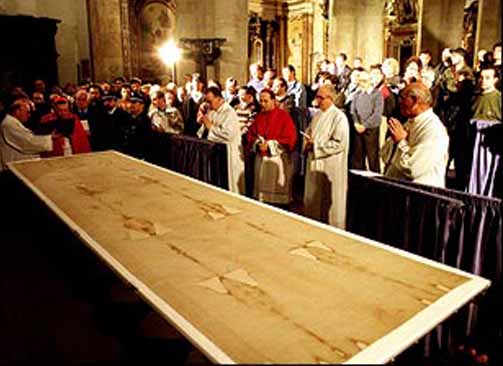
The shroud is rectangular, measuring approximately 4.4 x 1.1 m (14.3 x 3.7 ft). The cloth is woven in a herringbone twill and is composed of flax fibrils entwined with cotton fibrils. It bears the image of a front and dorsal view of a naked man with his hands folded across his groin. The two views are aligned along the midplane of the body and pointing in opposite directions. The front and back views of the head nearly meet at the middle of the cloth. The views are consistent with an orthographic projection of a human body.
The "Man of the Shroud" has a beard, moustache, and shoulder-length hair parted in the middle. He is well-proportioned and muscular, and quite tall (1.75 m or roughly 5 ft 9 in) for a man of the first century (the time of Jesus' death) or for the Middle Ages (the time of the first uncontested report of the shroud's existence, and the proposed time of possible forgery). Dark red stains, either blood or a substance meant to be perceived as blood, are found on the cloth, showing various wounds:
on at least one wrist, apparently by piercing. (The second wrist is hidden behind the first.)
on his side, apparently from piercing
around his forehead
scores of times on his torso and legs, apparently from scourging
At approximately 175 cm (5' 9"), the physical stature of the man is quite large - both for the 1st century, the time the shroud is purported to be from, and for the Middle Ages, the time of its purported fabrication.
On May 28, 1898 an amateur Italian photographer, Secondo Pia, photographed the shroud and was startled by the resulting undeveloped negative. The negative gave the appearance of a positive image, seemingly indicating that the shroud image itself is a negative (perhaps, wondered the faithful, produced upon the cloth by some luminous event at the moment of resurrection?).
The detail and heft of the man on the shroud was greatly enhanced in the photographic negative, leading to renewed speculation on its miraculous origin. The realistically rendered three-dimensionality of the man and his anatomically perfect depiction have inspired believers and fascinated critics, for no known artist, ancient, medieval or even later up to the advent of photography, approached this degree of fidelity to life, with the possible exception of a few ancient Greek and Italian renaissance sculptors. Even then, the transference of the image of a masterwork sculpture or a human model onto a flat surface while retaining its three-dimensional characteristics seems beyond any pre-20th-century process.
Scientists Reveal Hidden DNA Traces in the Shroud of Turin SciTech Daily - August 2, 2026
Analysis of DNA embedded in the linen provides the most detailed account yet of the biological traces deposited through repeated human handling and environmental exposure. The analysis uncovered several human mitochondrial DNA lineages and a diverse microbiome that included bacteria, fungi, and microorganisms adapted to salty conditions. Researchers also detected genetic material from cultivated plants, domesticated animals, and Mediterranean red coral, reflecting the wide range of people and surroundings encountered by the Shroud during its history.
The Shroud of Turin, which some people claim is Jesus' burial cloth, contains the DNA of multiple people along with a huge array of other species including carrots, melons and red coral. Live Science - April 5, 2026

Shroud of Turin discovery places burial cloth at time of Jesus' death Daily Mail - April 5, 2026
Plants found in dust samples were only grow in southern Israel, western Jordan, and the Sinai. Dust from the feet area of the Shroud contained a specific calcium carbonate from travertine aragonite limestone, similar to dust taken from a tomb in Jerusalem. Remaining pollen species trace the shroud's documented journey over the past 2,000 years, suggesting it originated in Jerusalem before traveling through Europe to its current home in Italy.
Shroud of Turin wasn't laid on Jesus' body, but rather a sculpture, modeling study suggests Live Science - August 1, 2025
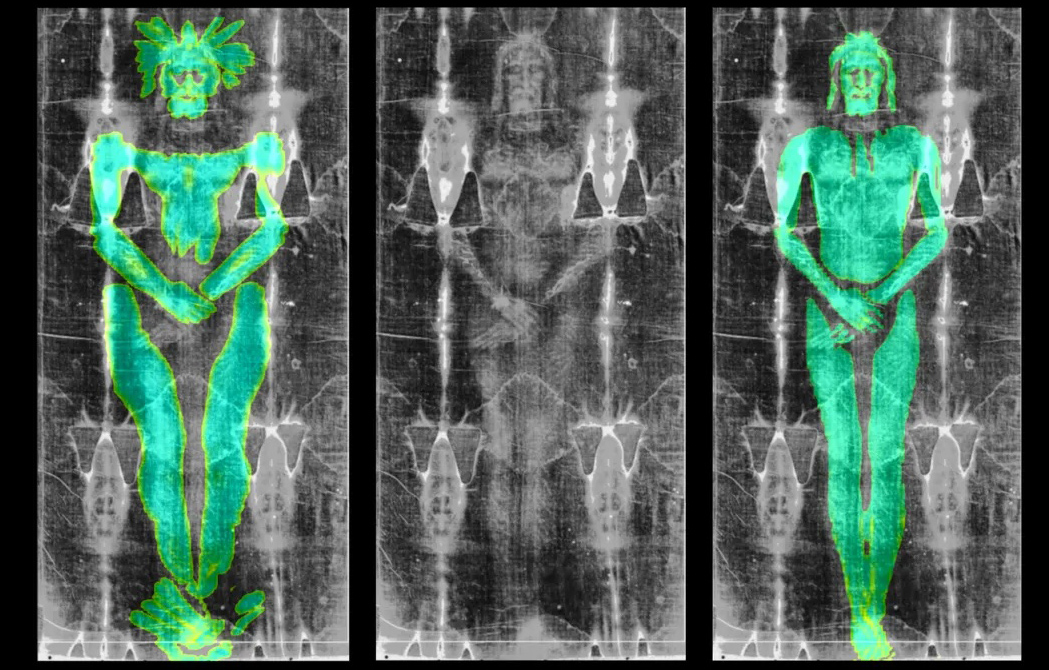
A 3D analysis comparing the way fabric falls on a human body versus a low-relief sculpture shows that the Shroud of Turin was not based on a real person. The Shroud of Turin, famously claimed to be Jesus' original burial covering, could not have been created on a three-dimensional human body, a new study finds. It is much more likely that the image is an imprint of a low-relief sculpture, according to a graphics expert.

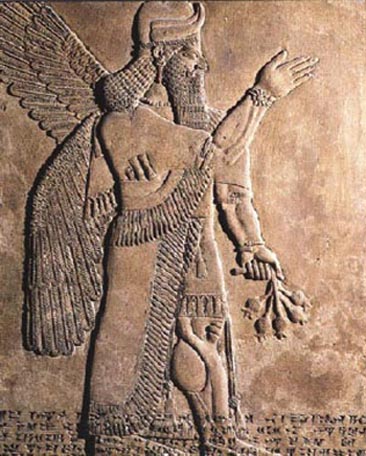
Does the shroud portray Jesus wearing an Anunnaki wrist device (teleportation, communication, creation, simulation manipulation, more) which makes him part of Zoroaster's bloodline - or are they one and the same soul in different roles and timelines? Are they who we envision as extraterrestrial?