Bathing played a major part in ancient Roman culture and society. Bathing was one of the most common daily activities in Roman culture, and was practiced across a wide variety of social classes. Though many contemporary cultures see bathing as a very private activity conducted in the home, bathing in Rome was a communal activity.
Some of the earliest descriptions of western bathing practices came from Greece. The Greeks began bathing regimens that formed the foundation for modern spa procedures. These Aegean people utilized small bathtubs, wash basins, and foot baths for personal cleanliness. The earliest such findings are the baths in the palace complex at Knossos, Crete, and the luxurious alabaster bathtubs excavated in Akrotiri, Santorini; both date from the mid-2nd millennium BC. They established public baths and showers within their gymnasium complexes for relaxation and personal hygiene.
Greek mythology specified that certain natural springs or tidal pools were blessed by the gods to cure disease. Around these sacred pools, Greeks established bathing facilities for those desiring healing. Supplicants left offerings to the gods for healing at these sites and bathed themselves in hopes of a cure. The Spartans developed a primitive vapor bath.
At Serangeum, an early Greek balneum (bathhouse, loosely translated), bathing chambers were cut into the hillside from which the hot springs issued. A series of niches cut into the rock above the chambers held bathers' clothing. One of the bathing chambers had a decorative mosaic floor depicting a driver and chariot pulled by four horses, a woman followed by two dogs, and a dolphin below. Thus, the early Greeks used the natural features, but expanded them and added their own amenities, such as decorations and shelves. During later Greek civilization, bathhouses were often built in conjunction with athletic fields.
The Romans emulated many of the Greeks bathing practices, Romans surpassed the Greeks in the size of their baths. As in Greece, the Roman bath became a focal center for social and recreational activity. As the Roman Empire expanded, the idea of the public bath spread to all parts of the Mediterranean and into regions of Europe and North Africa. With the construction of the aqueducts, the Romans had enough water not only for domestic, agricultural, and industrial uses, but also for their leisurely pursuits. The aqueducts provided water that was later heated for use in the baths. Today, the extent of the Roman bath is revealed at ruins and in archaeological excavations in Europe, Africa, and the Middle East.
These Roman baths varied from simple to exceedingly elaborate structures, and they varied in size, arrangement, and decoration. In taking a Roman bath, the bather induced sweating by gradually exposing himself to increasing temperatures. To accommodate this ritual, all Roman bathhouses contained a series of rooms which got progressively hotter. Most contained an apodyterium - a room just inside the entrance where the bather stored his clothes. Next, the bather progressed into the frigidarium (cold room) with its tank of cold water, the tepidarium (warm room), and finally the caldarium (hot room).
The caldarium, heated by a brazier underneath the hollow floor, contained cold-water basins which the bather could use for cooling. After taking this series of sweat and/or immersion baths, the bather returned to the cooler tepidarium for a massage with oils and final scraping with metal implements. Some baths also contained a laconium (a dry, resting room) where the bather completed the process by resting and sweating.
The layout of Roman baths contained other architectural features of note. Because wealthy Romans brought slaves to attend to their bathing needs, the bathhouse usually had three entrances: one for men, one for women, and one for slaves. The preference of symmetry in Roman architecture usually meant a symmetrical facade, even though the women's area was usually smaller than the men's area because of fewer numbers of patrons.
Usually solid walls or placement on opposite sides of the building separated the men's and women's sections. Roman bathhouses often contained a courtyard, or Palaestra, which was an open-air garden used for exercise. In some cases the builders made the palestra an interior courtyard, and in other cases the builders placed the palestra in front of the bathhouse proper and incorporated it into the formal approach. Sometimes the palestra held a swimming pool. Most often a colonnade outlined the palestra's edges.
Republican bathhouses often had separate bathing facilities for women and men, but by the 1st century AD mixed bathing was common and is a practice frequently referred to in Martial and Juvenal, as well as in Pliny and Quintilian. However, gender separation was restored by Emperor Hadrian.
Roman bathhouses offered amenities in addition to the bathing ritual. Ancillary spaces in the bathhouse proper housed food and perfume-selling booths, libraries, and reading rooms. Stages accommodated theatrical and musical performances. Adjacent stadia provided spaces for exercise and athletic competitions. Inside the bathhouses proper, marble mosaics tiled the elegant floors. The stuccoed walls frequently sported frescoes of trees, birds, and other pastoral images. Sky-blue paint, gold stars, and celestial imagery adorned interior domes. Statuary and fountains decorated the interior and exterior.
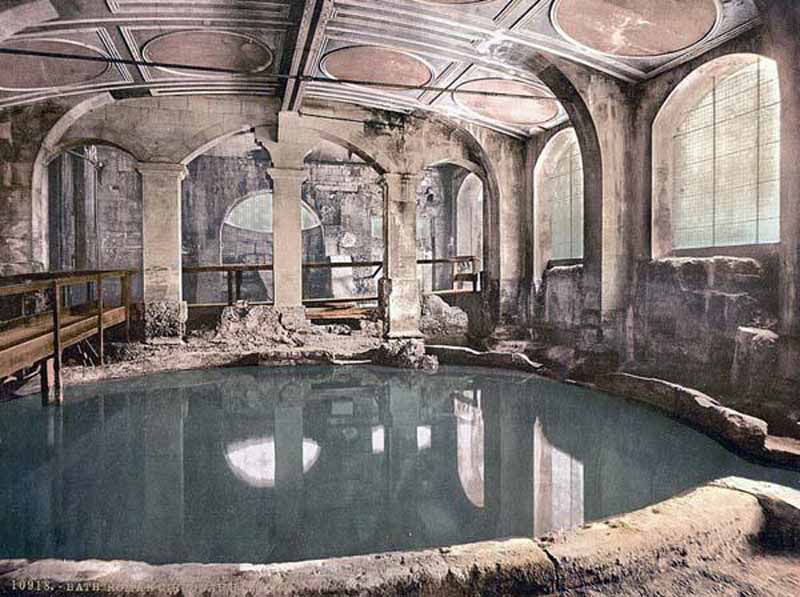
The Romans also developed baths in their colonies, taking advantage of the natural hot springs occurring in Europe to construct baths at Aix and Vichy in France, Bath and Buxton in England, Aachen and Wiesbaden in Germany, Baden, Austria, and Aquincum, Hungary, among other locations. These baths became centers for recreational and social activities in Roman communities. Libraries, lecture halls, gymnasiums, and formal gardens became part of some bath complexes. In addition, the Romans used the hot thermal waters to relieve their suffering from rheumatism, arthritis, and overindulgence in food and drink.
Thus, the Romans elevated bathing to a fine art, and their bathhouses physically reflected these advancements. The Roman bath, for instance, included a far more complex ritual than a simple immersion or sweating procedure. The various parts of the bathing ritual,(undressing, bathing, sweating, receiving a massage, and resting), required separated rooms which the Romans built to accommodate those functions.
The segregation of the sexes and the additions of diversions not directly related to bathing also had direct impacts on the shape and form of bathhouses. The elaborate Roman bathing ritual and its resultant architecture served as precedents for later European and American bathing facilities. Formal garden spaces and opulent architectural arrangement equal to those of the Romans re-appeared in Europe by the end of the eighteenth century. Major American spas followed suit a century later.
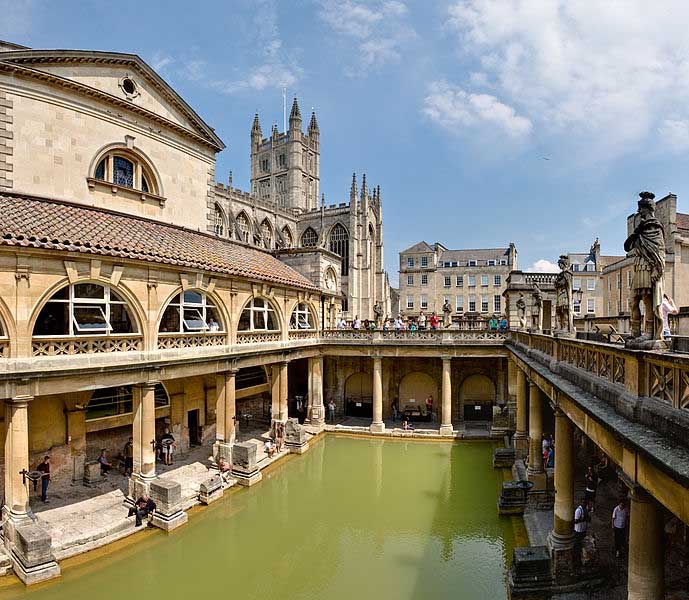
In ancient Rome, thermae were facilities for bathing. Thermae usually refers to the large imperial bath complexes, while balneae were smaller-scale facilities, public or private, that existed in great numbers throughout Rome. Balneae might be privately owned, but they were public in the sense that they were open to the populace for a fee. Thermae, were owned by the state and often covered several city blocks. The largest of these, the Baths of Diocletian, could hold up to 3,000 bathers. Fees for both types of baths were quite reasonable, within the budget of most free Roman males.
After a morning's work, most Romans enjoyed spending the afternoon at the thermae or public bath. They were a social meeting place. Men and women enjoyed coming to the baths not only to get clean but to meet with friends, exercise, or read at the library. The baths had hot and cold pools, towels, steam rooms, saunas, exercise rooms, and hair cutting salons. They had reading rooms and libraries, as among the freeborn, who had the right to frequent baths, the majority could read. Children were not permitted.
Most Roman cities had at least Thermae, if not many, such buildings, which were centers not only for bathing, but socializing. Roman bath-houses were also provided for private villas, town houses, and forts. They were supplied with water from an adjacent river or stream, or more normally, by an aqueduct. The water could be heated from a log fire before being channeled into the hot bathing rooms. The design of baths is discussed by Vitruvius in De Architectura.
In some ways, thermae resembled modern-day spas. The Romans raised bathing to a high art as they socialized in these communal baths. Courtship was conducted, as well as sealing business deals, as they built lavish baths on natural hot springs. Such was the importance of baths to Romans that a catalogue of buildings in Rome from 354 AD documented 952 baths of varying sizes in the city.
Although wealthy Romans might set up a bath in their town houses or in their country villas, heating a series of rooms or even a separate building especially for this purpose, and soldiers might have a bathhouse provided at their fort (as at Chesters on Hadrian's Wall, or at Bearsden fort), they still often frequented the numerous public bathhouses in the cities and towns throughout the empire.
Small bathhouses, called balneum (plural balnea),
A public bath was built around three principal rooms: the caldarium (hot bath), the tepidarium (warm bath) and the frigidarium (cold bath). Some thermae also featured steam baths: the sudatorium, a moist steam bath, and the laconicum, a dry steam bath much like a modern sauna.
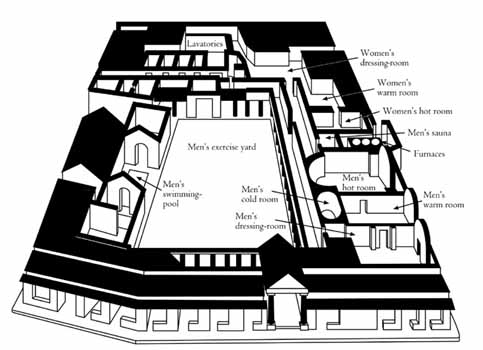
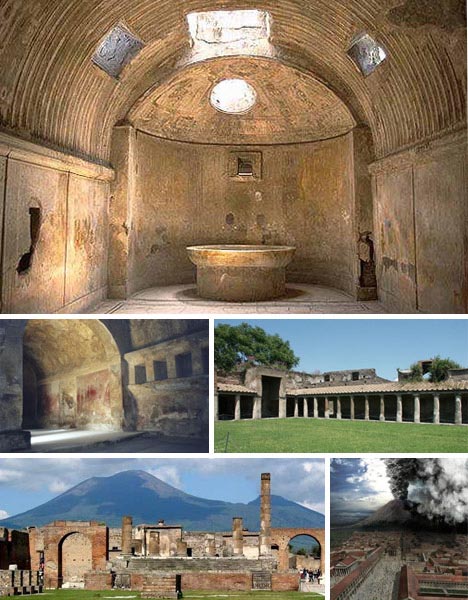
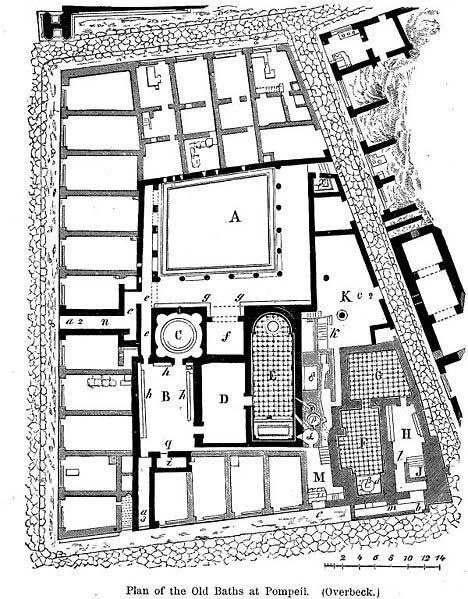
By way of illustration, this article will describe the layout of Pompeii's Old Baths adjoining the forum, which are among some of the best-preserved Roman baths. The references are to the floor plan pictured to the right.
The whole building comprises a double set of baths, one for men and the other for women. It has six different entrances from the street, one of which (b) gives admission to the smaller women's set only. Five other entrances lead to the men's department, of which two (c and c2), communicate directly with the furnaces, and the other three (a3, a2, a) with the bathing apartments.
Atrium
Passing through the principal entrance, a, which is removed from the street by a narrow footway surrounding the building and after descending three steps, the bather finds a small chamber on his left (x) which contained a water closet (latrina), and proceeds into a covered portico (g, g), which ran round three sides of an open court (atrium, A). These together formed the vestibule of the baths (vestibulum balnearum), in which the servants waited.
Use of the atrium
This atrium was the exercise ground for the young men, or perhaps served as a promenade for visitors to the baths. Within this court the keeper of the baths (balneator), who exacted the quadrans paid by each visitor, was also stationed. The room f, which runs back from the portico, might have been appropriated to him; but most probably it was an oecus or exedra, for the convenience of the better classes while awaiting the return of their acquaintances from the interior. In this court, advertisements for the theatre, or other announcements of general interest, were posted up, one of which, announcing a gladiatorial show, still remains. At the sides of the entrance were seats (scholae).
Apodyterium and Frigidarium
A passage (e) leads into the apodyterium (B), a room for undressing in which all visitors must have met before entering the baths proper. Here, the bathers removed their clothing, which was taken in charge by slaves known as capsarii, notorious in ancient times for their dishonesty. The apodyterium was a spacious chamber, with stone seats along two sides of the wall (h, h). Holes are still visible on the walls, and probably mark the places where the pegs for the bathers' clothes were set. The chamber was lighted by a glass window, and had six doors. One of these led to the tepidarium (D) and another to the frigidarium (C), with its cold plunge-bath (referred to as loutron, natatio, natatorium, piscina, baptisterium or puteus; the terms "natatio" and "natatorium" suggest that some of those baths were also swimming pools). The bath in this chamber is of white marble, approached by two marble steps.
Tepidarium
From the frigidarium the bather who wished to go through the warm bath and sweating process entered the tepidarium (D). It did not contain water either at Pompeii or at the baths of Hippias, but was merely heated with warm air of an agreeable temperature, in order to prepare the body for the great heat of the vapour and warm baths, and, upon returning, to prevent a too-sudden transition to the open air. In the baths at Pompeii this chamber also served as an apodyterium for those who took the warm bath. The walls feature a number of separate compartments or recesses for receiving the garments when taken off. The compartments are divided from each other by figures of the kind called Atlantes or Telamones, which project from the walls and support a rich cornice above them.
Three bronze benches were also found in the room, which was heated as well by its contignity to the hypocaust of the adjoining chamber, as by a brazier of bronze (foculus), in which the charcoal ashes were still remaining when the excavation was made. Sitting and perspiring beside such a brazier was called ad flammam sudare.
The tepidarium is generally the most highly ornamented room in baths. It was merely a room to sit in and be anointed in. In the Old Baths at Pompeii the floor is mosaic, the arched ceiling adorned with stucco and painting on a colored ground, the walls red.
Anointing was performed by slaves called unctores and aliptae. It sometimes took place before going to the hot bath, and sometimes after the cold bath, before putting on the clothes, in order to check the perspiration. Some baths had a special room (destrictarium or unctorium) for this purpose.
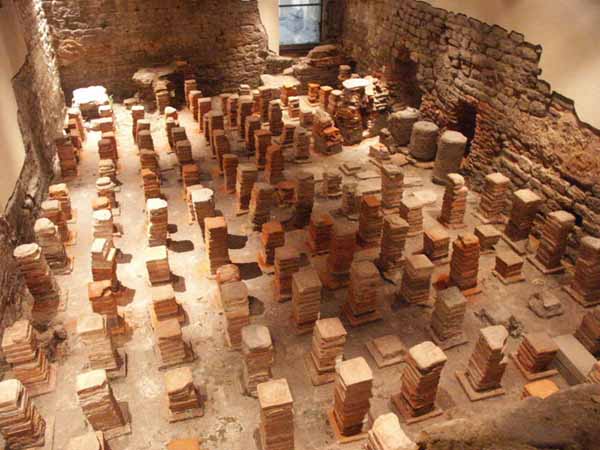
From the tepidarium a door opened into the caldarium (E), whose mosaic floor was directly above the furnace or hypocaust. Its walls also were hollow, forming a great flue filled with heated air. At one end was a round basin (labrum), and at the other a quadrangular bathingplace (puelos, alveus, solium, calida piscina), approached from the platform (schola) by steps. The labrum held cold water, for pouring upon the bather's head before he left the room. These basins are of marble in the Old Baths, but we hear of alvei of solid silver. Because of the great heat of the room, the caldarium was but slightly ornamented.
Here they sat and perspired, scraping their skin with a strigil, a curved metal tool. Attendants would serve them snacks and drinks. Finally came a dip in the calidarium (hot bath) and a quick dip in the frigidarium (cold bath). After swimming, the bather might enjoy a massage where he might have oils and perfumes rubbed into his skin. Feeling clean and relaxed, the Roman might drift through the beautiful gardens decorated with mosaics and colossal sculptures or enjoy athletic events in a theater like rotunda.
Laconicum
The Old Baths have no laconicum, which was a chamber still hotter than the caldarium, and used simply as a sweating-room, having no bath. It was said to have been introduced at Rome by Agrippa and was also called sudatorium and assa.
Service Areas
The apodyterium has a passage (q) communicating with the mouth of the furnace (r), called praefurnium or propigneum; and, passing down that passage, we reach the chamber M, into which the praefurnium projects, and which is entered from the street at c. It was assigned to the fornacatores, or persons in charge of the fires. Of its two staircases, one leads to the roof of the baths, and one to the boilers containing the water.
There were three boilers, one of which (caldarium vas) held the hot water; a second, the tepid (tepidarium); and the third, the cold (frigidarium). The warm water was turned into the warm bath by a pipe through the wall, marked on the plan. Underneath the hot chamber was set the circular furnace d, of more than 7 ft. in diameter, which heated the water and poured hot air into the hollow cells of the hypocaustum.
It passed from the furnace under the first and last of the caldrons by two flues, which are marked on the plan. The boiler containing hot water was placed immediately over the furnace; and, as the water was drawn out from there, it was supplied from the next, the tepidarium, which was raised a little higher and stood a little way off from the furnace. It was already considerably heated from its contiguity to the furnace and the hypocaust below it, so that it supplied the deficiency of the former without materially diminishing its temperature; and the vacuum in this last was again filled up from the farthest removed, which contained the cold water received directly from the square reservoir seen behind them.
The boilers themselves no longer remain, but the impressions which they have left in the mortar in which they were imbedded are clearly visible, and enable us to determine their respective positions and dimensions. Such coppers or boilers appear to have been called miliaria, from their similarity of shape to a milestone. Behind the boilers, another corridor leads into the court or atrium (K) appropriated to the servants of the bath.
Women's Bath
The adjoining, smaller set of baths were assigned to the women. The entrance is by the door b, which conducts into a small vestibule (m) and from there into the apodyterium (H), which, like the one in the men's bath, has a seat (pulvinus, gradus) on either side built up against the wall. This opens upon a cold bath (J), answering to the natatio of the men's set, but of much smaller dimensions. There are four steps on the inside to descend into it.
Opposite to the door of entrance into the apodyterium is another doorway which leads to the tepidarium (G), which also communicates with the thermal chamber (F), on one side of which is a warm bath in a square recess, and at the farther extremity the labrum. The floor of this chamber is suspended, and its walls perforated for flues, like the corresponding one in the men's baths. The tepidarium in the women's baths had no brazier, but it had a hanging or suspended floor.
Purpose
The baths often included, aside from the three main rooms listed above, a palaestra, or outdoor gymnasium where men would engage in various ball games and exercises. There, among other things, weights were lifted and the discus thrown. Men would oil themselves (as soap was still a luxury good and thus not widely available), shower, and remove the excess with a strigil (cf. the well known Apoxyomenus of Lysippus from the Vatican Museum). Often wealthy bathers would bring a capsarius, a slave that carried his master's towels, oils, and strigils to the baths and then watched over them once in the baths, as thieves and pickpockets were known to frequent the baths. The changing room was known as the apodyterium (Greek apodyterion, apo + duo "to take off" here of clothing).
Cultural Significance
In many ways, baths were the ancient Roman equivalent of community centers. Because the bathing process took so long, conversation was necessary. Many Romans would use the baths as a place to invite their friends to dinner parties, and many politicians would go to the baths to convince fellow Romans to join their causes. The thermae had many attributes in addition to the baths. There were libraries, rooms for poetry readings, and places to buy and eat food. The modern equivalent would be a combination of a library, art gallery, mall, restaurant, gym, and spa.
The Romans believed that good health came from bathing, eating, massages, and exercise. The baths, therefore, had all of these things in abundance. Since some citizens would be bathing multiple times a week, Roman society was surprisingly clean.
When asked by a foreigner why he bathed once a day, a Roman emperor is said to have replied "Because I do not have the time to bathe twice a day."
Emperors often built baths to gain favor for themselves and to create a lasting monument of their generosity. If a rich Roman wished to gain the favor of the people, he might arrange for a free admission day in his name. For example, a senator hoping to become a Tribune might pay all admission fees at a particular bath on his birthday to become well known to the people of the area.
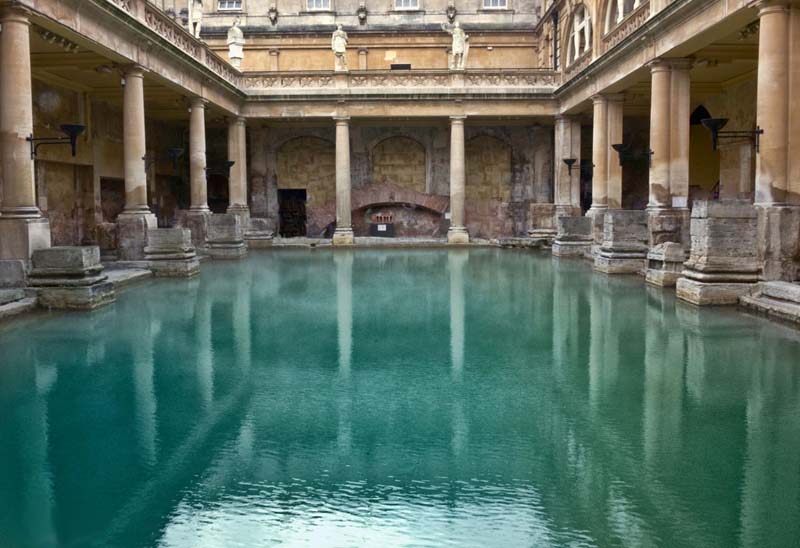
A number of Roman public baths survive, either as ruins or in varying degrees of conservation. Among the more notable are the Roman baths of Bath in England as well as the Baths of Caracalla, of Diocletian, of Titus, of Trajan in Rome and the baths of Varna.
Visitors to the bath house could also play on the playing grounds, look at books from the libraries, visit the exhibition halls, and admire the covered walkways with fountains and landscaped gardens. They could go to the barber for a trim, the beautician for a relaxing afternoon, the gym for a quick workout, or get a snack.
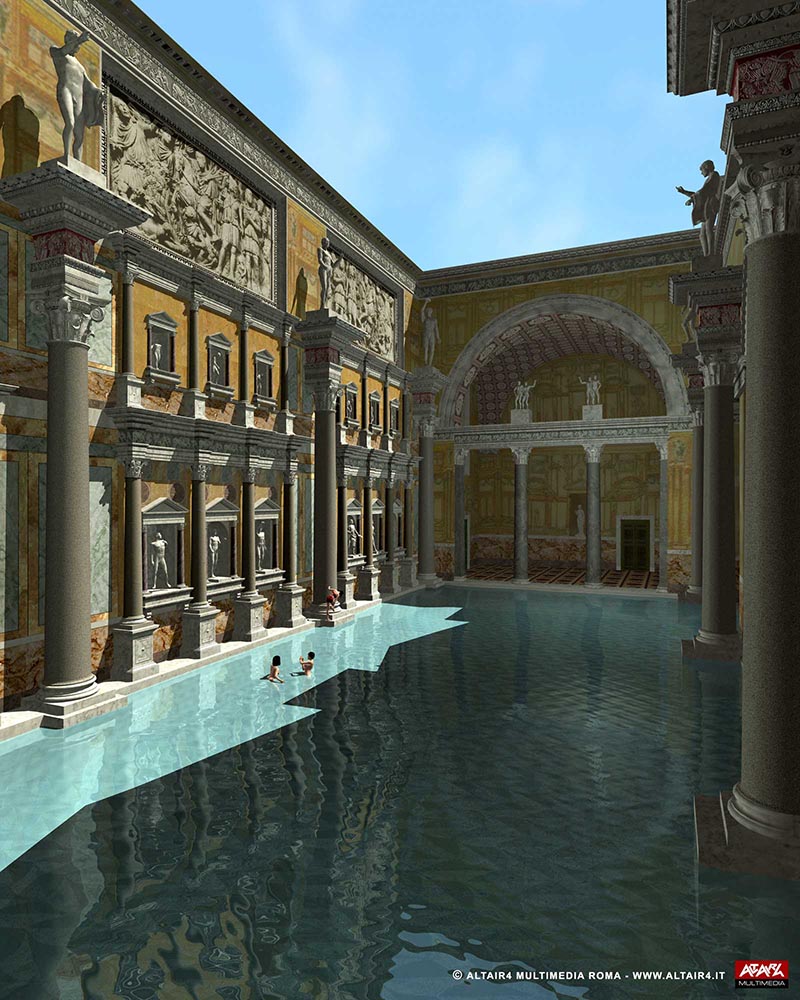
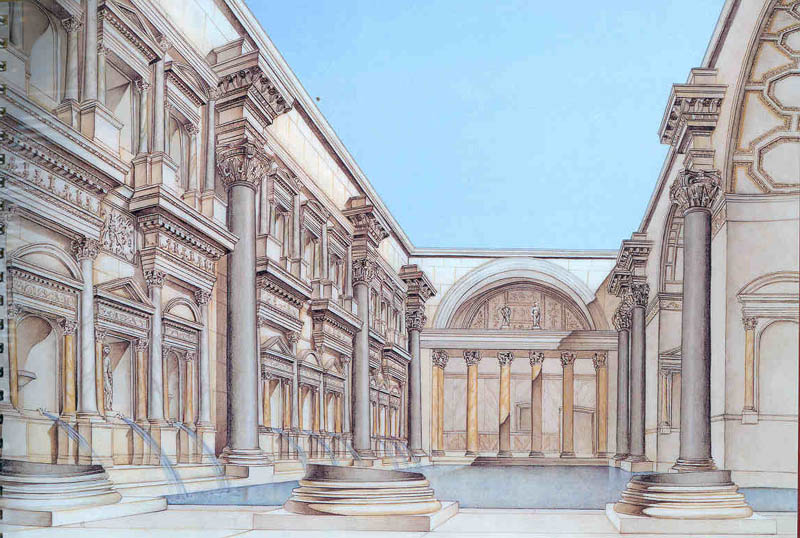
The Baths of Caracalla, the second largest baths complex in ancient Rome, were built between 212 and 219 A.D. by the emperor Marcus Aurelius Antoninus, better known by his nickname Caracalla. By the 3rd century A.D. the Romans had built many baths, in Rome and elsewhere, and had acquired great skill in designing functional, fully integrated complexes. The water supply and drainage system, in particular, required careful planning to ensure an adequate flow to and from the numerous hot and cold basins: it has been calculated that the baths used 15-20,000 cubic meters of water per day.
The baths were fed by a branch of the Aqua Marcia aqueduct, which brought pure water to Rome from springs in the hills near Subiaco, over 90 km away. The water flowed into a huge cistern, divided into 18 separate chambers for easy maintenance and with a total capacity of 10,000 cu. m. From here it went by gravity flow through pipes underneath the gardens to the main building.Inside the main building a complicated distribution system carried the water directly to the cold pools or to boilers over wood fires where it was heated for the warm and hot baths.
Outlets from each basin and in the floor of each room led to the drains, which ran below the level of the distribution pipes and took the waste water to the municipal drain in the valley. Both distribution and drainage pipes were housed in tunnels providing easy access for inspection and maintenance. A third network of tunnels was used to store the enormous amounts of wood required to fuel the furnaces (praefurnia): there were at least fifty of these, some to heat the water and others to heat the rooms by a hot air system beneath the floor (hypocausta).
The heated rooms were on the south-western side of the building. The hottest room of all, the calidarium, projected beyond the line of the building to take full advantage of the sun's rays. Hollow terracotta tubes ran inside the walls to provide insulation and channel hot air. Sixteen hundred people could bathe here at the same time. There were rooms for cold, hot and warm baths, splendid ceilings, porticoes, pillared halls, gymnasiums, where the rarest marbles, the most colossal columns, and the finest statues were admired by the people; even the baths were of basalt, granite, alabaster.
The Caracalla bath complex of buildings was more a leisure centre than just a series of baths. The baths were the second to have a public library within the complex. Like other public libraries in Rome, there were two separate and equal sized rooms or buildings; one for Greek language texts and one for Latin language texts. The libraries were located in exedrae on the east and west sides of the bath complex. The entire north wall of the complex was devoted to shops. The reservoirs on the south wall of the complex were fed with water from the Marcian Aqueduct.
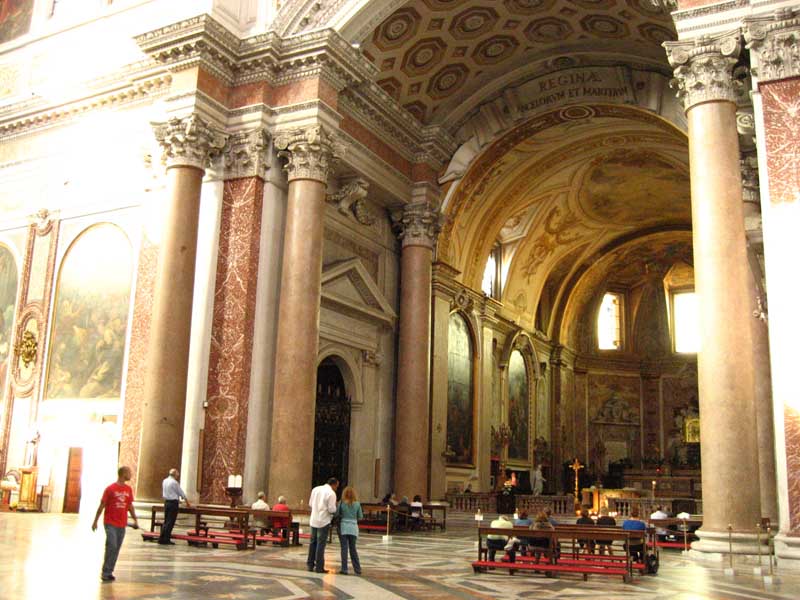
The Baths of Diocletian (Thermae Diocletiani) in Rome were the grandest of the public baths, or thermae built by successive emperors. Diocletian's Baths, dedicated in 306, were the largest and most sumptuous of the imperial baths. The baths were built between the years 298 AD and 306 AD. The project was originally commissioned by Maximian upon his return to Rome in the autumn of 298 AD and was continued after his and Diocletian's abdication under Constantius, father of Constantine. Although many baths in and around Rome had the same elements, the Baths of Diocletian are unique by their size.
The Baths were commissioned by Maximian in honor of co-Emperor Diocletian in 298 AD, the same year he returned from Africa. Evidence of this can be found in bricks from the main area of the baths, which distinctly show stamps of the Diocletianic period. These, according to the ancient guidebook Mirabilia Urbis Romae, were known as "Palatium Diocletiani". This evidence shows the effect of the massive project on the brick industry in that all work by them was redirected and under control of the emperor. Building took place between the year it was first commissioned and was finished sometime between the abdication of Diocletian in 305 c.e. and the death of Constantius in July 306 AD.
The Baths occupy the high-ground on the northeast summit of the Viminal, the smallest of the Seven hills of Rome, just inside the Agger of the Servian Wall. They served as a bath for the people residing in the Viminal, Quirinal, and Esquiline quarters of the city. The Quadrigae Pisonis, a second-century monument with various reliefs, some private homes, and a relief representing the temple of Quirinus once stood at the site but were demolished to build the baths. The water supply was provided by the Aqua Marcia, an aqueduct that had long served the city of Rome since the early 2nd century. To properly supply the baths, the supply of water to the city was increased under the order of Diocletian. The baths may have also been supplied by the Aqua Antoniniana, which was originally positioned to supply Caracalla's baths in the early 3rd century.
The frigidarium consisted of a pool and a host of smaller baths connected to the main room. Water entering the room would come from a pipe or cistern and would exit through a drain within the pool. The water from the pool was thought to have been reused to flush latrines within the complex. The frigidarium was used mainly as a swimming pool or a cold-water bath, depending on the time. Normally, one would continue on to the frigidarium after using the hot-water baths or after exercising in the palaestra. Noting the massive size of the room, it was believed to have also been used as a social room. This idea is supported by the presence of statues and elaborate niches along the walls. On each end of the frigidarium are large shallow pools that were made to be open-air bathing pools.
The caldarium was rectangular in shape with many octagonal rooms found near it in the corner of the structure. The area seemed to be referencing the older baths of Nero and Titus in its initial design. What set this caldarium apart was the sheer scale of the room compared to its predecessors. It continued a basilica-like theme from the frigidarium with a cross-vaulted middle bay and three projecting apses. These architectural techniques created the feeling of a more open space for the patron. Dressing rooms, also known as apodyteria, were located on either side of the calderium. Along the sides of the caldarium were private rooms that are believed to have had multiple functions, including private baths, poetry readings, rhetoricians, etc. Other areas attached to the caldarium were a garden, lounging rooms, gymnasiums, and small halls and semicircular exedrae used as lecture and reading rooms.
A rectangular halls connected to the hemicycle have been suggested to be libraries because of their similar set-up to those in the Baths of Caracalla. Historians, to support this theory, have demonstrated that these halls with their niches could properly house books from that day. References to the presence of libraries within the baths of Diocletian both confirm and contradict themselves, such as the case of the author of the life of Probus. In it, he mentions that part of the Bibliotheca Ulpia, which are found in the Forum of Trajan, are being housed within the baths; a statement he later contradicts when later referencing the Bibliotheca Ulpia. However, with the presence of similar rooms that suggest that they were libraries found in the Baths of Caracalla and the Baths of Trajan, it is not a stretch to theories to propose that the baths of Diocletian contained a library.
Within the frigidarium, the use of external buttresses for the cross vaults were considered by some to be the first example of the scientific system of thrusts and counter-thrusts in architecture. Concerning the baths as a whole, it has been described as evoking the Imperial style, or a "Classical" image, which is the style of "manipulation of space". To manipulate the space within this style, the forms of the building were simple and give the impression of a vast amount of open space. The builders of the baths used different techniques to create this effect. The exterior walls of the bath were encrusted with stucco to give the impression of stonework. This technique was quite common within the structures built during the Imperial style of Roman architecture, e.g., The baths of Constantine, the Basilica Nova, and parts of the Sessorian bridge. The interior parts of the bath were supported by vaulting ceilings and arches to create curvilinear lines. The structure of the roof is an excellent example of Classical design. Architects used sloped forms to cover curved extrados (the outer surface of the arch) of the vaulted halls.
The Baths of Trajan were a massive thermae, a bathing and leisure complex, built in ancient Rome starting from 104 AD and dedicated during the Kalends of July in 109. Commissioned by Emperor Trajan, the complex of baths occupied space on the southern side of the Oppian Hill on the outskirts of what was then the main developed area of the city, although still inside the boundary of the Servian Wall.
The architect of the complex is said to be Apollodorus of Damascus. After being utilized mainly as a recreational and social center by Roman citizens, both men and women, for many years, the baths, in use as late as the early fifth century seem to have been deserted at the time of the siege of Rome by the Goths in 537; with the destruction of the Roman aqueducts, the thermae were abandoned, as was the whole of the now-waterless Mons Oppius.
Prior to the construction of the Baths, their location on the Oppian Hill was occupied by the ornate Palace of Nero (Domus Aurea). After Nero's suicide, subsequent emperors Vespasian, Titus, and Domitian chose to build over his palace with other forms of architecture. Emperor Trajan covered up the last of the palace with a platform upon which the Baths were built. Because they served as a model for bath complexes built throughout the Roman world during the Imperial period, these Baths would come to be recognized as a highly notable example of early Imperial Roman architecture.
The baths were erected on the Oppian Hill, a southern extension of the Esquiline Hill. Built on a platform that had itself been built over Nero's Palace, the bath complex was immense by ancient Roman standards, covering an area of approximately 330 by 215 meters. The complex rested on a northeast-southwest axis, with the main building attached to the northeast wall. This was contrary to the more widely used north-south axis of many buildings in the vicinity. It is suggested that this unorthodox orientation was chosen by the architects to reduce the bathers' exposure to the wind, while also maximizing exposure to the sun.
Within the complex, the building was surrounded by a large grassy area. The baths themselves consisted of pools, including a tepidarium (warm area and, it is presumed, first room visited in the baths), a caldarium (hot pool and dry, sauna-like area), frigidarium (cool pools used after those previously mentioned), and also gymnasia, and apodyteria (changing rooms). In addition to the facilities of the bath complex used by the public, there was a system of subterranean passageways and structures used by slaves and workers to service and maintain the facilities. Also underground, the massive cistern, surviving today as the Sette sale, the "seven rooms", stored much of the water used in the baths. It was capable of storing no less than 8 million liters. There were also several exedrae on the eastern and western sides of the building. After archaeological analysis performed after excavation in 1997, it is thought that at least one of these exedra served as a sort of library and a holding place for scrolls and manuscripts.
The archaeological excavations of 1997 also led to the discovery of a large (about 10 square meters) frescoed bird's-eye view of a walled port city, a unique survivor of such a subject, in a buried gallery or cryptoporticus beneath the baths, which predated their construction, but postdated Nero's Domus Aurea. Whether it represents the reorganization of an actual port or an idealized one remains an open question.
Additionally, the discovery of a 32 feet (9.8 m) mosaic was announced in July 2011, with more still to be excavated, in what is believed to be a Musaeum, a place dedicated to the goddesses who inspire the creation of the arts, featuring a nymphaeum (fountain room).