Drainage
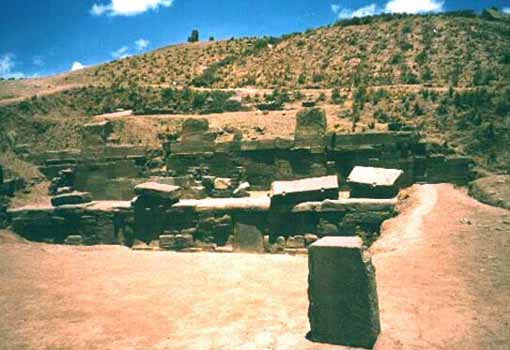
The 59-foot-tall Akapana resembles a large natural hill more than a pyramid. Closer inspection shows walls and columns sticking out from the base and carved stones on its summit and tumbling down the sides. The somewhat amorphous shape of this tremendous pyramid is the result of centuries of looting and quarrying of its stones for colonial churches and even for a railway built in the 1900s. New research shows that this pyramid was never quite finished in antiquity.
At Tiwanaku we seem to have an interesting situation where the city's previous infrastructure was razed and completely redone just before the city was suddenly abandoned. It seems that around A.D. 700, three centuries into the existence of Tiwanaku as a monumental and powerful city, there was a sudden change to direct all construction efforts toward building what was the largest structure in the Andes. The previous monuments of the city were torn down and their stones reused to build the Akapana pyramid. The effort was too great, and the pyramid lay unfinished when the city was abandoned. One Spanish chronicler said of Tiwanaku, "They build their monuments as if their intent was never to finished them."
Around the rising pyramid, the arrangement of small single homes was replaced by large square compounds--also using the scavenged remains of previous monuments--serving perhaps as ritual places for powerful families or ethnic groups. What this change represents is unknown at the present. This could represent the rise of a powerful king, a popular religious movement, or the formation of a multicultural city. Whatever the cause behind this massive transformation, it didn't last long. By A.D. 950 all monumental construction suddenly ends with stones in various stages of dressing scattered around the partially built monuments.
Bolivian pyramid makeover disappoints MSNBC - October 19, 2009

Jose Luis Paz, who was appointed in June to assess damage at the site, says the state National Archeology Union, UNAR, erred in choosing to rebuild the pyramid using adobe, when it is clear to the naked eye that the original was built of stone. "They decided to go free-hand with the (new) design ... There are no studies showing that the walls really looked like this," Paz told Reuters as he stood before the pyramid in the Tiwanaku archeological site, some 40 miles north of Bolivia's administrative capital of La Paz. According to Paz, who now heads excavation at the site, the town of Tiwanaku hired the UNAR to renovate Akapana to make it "more attractive for tourists," regardless of how the pyramid may have originally looked like.
Thousands of tourists visit Tiwanaku every year and pay about $10 to enter the site, but the village of Tiwanaku, which manages the park, thought a better-looking pyramid would attract even more visitors, he said. Culture Minister Pablo Groux dismissed some of the criticism and said the renovation was long called for. "The UNAR has restored the original form the pyramid had. If we look at pictures from five years ago, there was just a hill there. What we can see now is something close to what the construction originally looked like," he told Reuters. Still, Paz said the controversy is not only about aesthetics.
The archeologist said lower decks are slightly tilted because of the extra weight of the adobe walls, which could lead to the collapse of the pyramid. The United Nations Educational, Scientific and Cultural Organization, or UNESCO, is due to visit Tiwanaku shortly and if it decides Akapana has been excessively tampered with, it may drop Tiwanaku from its list of World Heritage Sites. In 2000, UNESCO decided that Tiwanaku deserved to be in the list because its ruins "bear striking witness to the power of the empire that played a leading role in the development of the Andean pre-Hispanic civilization."
The Tiwanaku civilization, which flourished around Lake Titicaca, was one of the precursors of the Inca empire, the largest pre-Columbian civilization in the Americas. Groux believes that Tiwanaku will not lose its World Heritage status because the government halted the reconstruction project earlier this year, as soon as UNESCO told them to. "The inclusion in the list of World Heritage Sites involves regular checks, because some places may lose the essence of why they were included in the list. In the case of Tiwanaku losing that title is unlikely," he said.
Looting of Akapana's carved stones and ceramics started soon after the Spanish conquest and the structure was later used as a quarry, from which stones were extracted to build a rail line and a Catholic church near-by. Its size and the still-standing lower decks suggest that Akapana was once a remarkable building, but as a result of the ransacking and the extreme temperatures and strong winds in the Andean plateau, some 12,500 feet above sea level, the pyramid looks rundown.
Treasures found inside Bolivian Pyramid MSNBC - May 2, 2007

Archaeologists have uncovered the 1,300-year-old skeleton of a ruler or priest of the ancient Tiwanaku civilization, together with precious jewels inside a much-looted pyramid in western Bolivia. The bones are in very good condition and belong to either a ruler or a priest, Roger Angel Cossio, the Bolivian archaeologist who made the discovery, told Reuters on Wednesday. He said the tomb containing a diadem and a fist-sized carved pendant of solid gold survived centuries of looting by Spanish invaders and unscrupulous raiders who depleted Tiwanaku of many precious treasures.
"After so much looting ... miraculously this has stayed to tell us the history," Cossio said. "Itıs a complete body... next to it are jewels, offerings and a llama." The llama may have been a status symbol or a source of food for the journey to the afterlife, archaeologists said. The corpse was found in a niche carved inside the 15-yard-high (15-meter-high) Akapana pyramid, which was built around 1200 B.C. and is described by experts as one of the biggest pre-Columbian constructions in South America. At its peak, the city of Tiwanaku stretched over 1,480 acres (600 hectares) and had a population of more than 100,000, according to chief archaeologist Javier Escalante, who presented the findings on Wednesday at a news conference near the pyramid.
The Tiwanaku civilization spread throughout southwestern Bolivia and parts of neighboring Peru, Argentina and Chile from around 1500 B.C. to A.D. 1200. Although experts still have to do carbon dating to determine the age of the remains, archaeologists estimate they were buried 1,300 years ago, during the decline of the Tiwanaku empire. Cossio believes the remains belong to someone of importance in the Tiwanaku society. "Not just anyone would be buried under the Akapana pyramid," he said. In the 1900s, workers used the base of the pyramid as a quarry from which they extracted stones to build a rail line connecting the neighboring town of Guaqui with La Paz.
SACRED PLACES AND TEACHINGS INDEX
ALPHABETICAL INDEX OF ALL FILES