
The Primordial Soup Theory suggest that 3.8 billion to 3.55 billion years ago life began in a pond or ocean as a result of the combination of chemicals from the atmosphere and some form of energy to make amino acids, the building blocks of proteins, which would then evolve into the first species on Earth.
Primordial soup is a term introduced by the Soviet biologist Alexander Oparin. In 1924, he proposed the theory of the origin of life on Earth through the transformation, during the gradual chemical evolution of molecules that contain carbon in the primordial soup. Biochemist Robert Shapiro has summarized the "primordial soup" theory of Oparin and Haldane in its "mature form" as follows:
2. This atmosphere, exposed to energy in various forms, produced simple organic compounds ("monomers").
3. These compounds accumulated in a "soup", which may have been concentrated at various locations (shorelines, oceanic vents etc.).
4. By further transformation, more complex organic polymers - and ultimately life - developed in the soup.
One of the most important pieces of experimental support for the "soup" theory came in 1953. A graduate student, Stanley Miller, and his professor, Harold Urey, performed an experiment that demonstrated how organic molecules could have spontaneously formed from inorganic precursors, under conditions like those posited by the Oparin-Haldane Hypothesis. The now-famous "Miller-Urey experiment" used a highly reduced mixture of gases - methane, ammonia and hydrogen - to form basic organic monomers, such as amino acids. This provided direct experimental support for the second point of the "soup" theory, and it is around the remaining two points of the theory that much of the debate now centers.
Apart from the Miller-Urey experiment, the next most important step in research on prebiotic organic synthesis was the demonstration by Joan Oro that the nucleic acid purine base, adenine, was formed by heating aqueous ammonium cyanide solutions.
In support of abiogenesis in eutectic ice, more recent work demonstrated the formation of s-triazines (alternative nucleobases), pyrimidines (including cytosine and uracil), and adenine from urea solutions subjected to freeze-thaw cycles under a reductive atmosphere (with spark discharges as an energy source).
The spontaneous formation of complex polymers from abiotically generated monomers under the conditions posited by the "soup" theory is not at all a straightforward process. Besides the necessary basic organic monomers, compounds that would have prohibited the formation of polymers were formed in high concentration during the Miller-Urey and Oro experiments. The Miller experiment, for example, produces many substances that would undergo cross-reactions with the amino acids or terminate the peptide chain.
More fundamentally, it can be argued that the most crucial challenge unanswered by this theory is how the relatively simple organic building blocks polymerize and form more complex structures, interacting in consistent ways to form a protocell. For example, in an aqueous environment hydrolysis of oligomers/polymers into their constituent monomers would be favored over the condensation of individual monomers into polymers. Read more ...
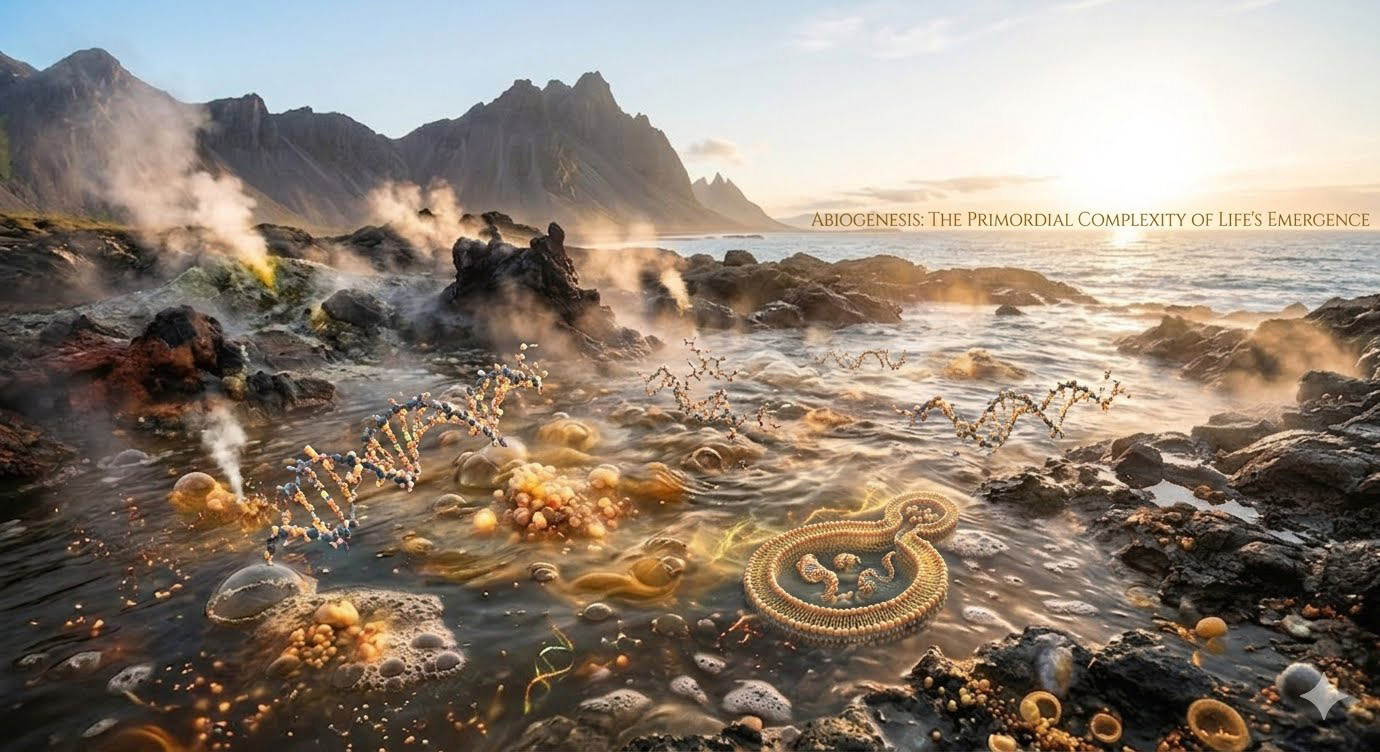
Abiogenesis or biopoiesis is the natural process by which life arises from inorganic matter. The earliest known life on Earth existed between 3.9 and 3.5 billion years ago, during the Eoarchean Era when sufficient crust had solidified following the molten Hadean Eon.
Scientific hypotheses about the origins of life may be divided into several categories. Most approaches investigate how self-replicating molecules or their components came into existence. For example, the Miller-Urey experiment and similar experiments demonstrated that most amino acids, often called "the building blocks of life", can be racemically synthesized in conditions thought to be similar to those of the early Earth. Several mechanisms have been investigated, including lightning and radiation. Other approaches ("metabolism first" hypotheses) focus on understanding how catalysis in chemical systems in the early Earth might have provided the precursor molecules necessary for self-replication. Read more ...

If life as we experience it today is a virtual simulation in which humans interact to study emotions, then indeed, there have been endless iterations of the human design with corresponding theories about their origins. Primordial soup would be just one of many.
Scientists find evidence for two origins of life on Earth Science Daily - August 12, 2026


Where and how did life first emerge on Earth? Now, an international team led by biologists has reported new findings in Science Advances that shed light on the chemical reaction network used by the earliest cells to produce the basic ingredients of life, as well as the energy sources that powered those reactions. By tracing the origins of enzymes during the earliest split between bacteria and archaea, the researchers found evidence that free-living cells may have originated independently twice.
Did Cellular Life Begin Twice? New Study Points to Two Independent Origins SciTech Daily - August 12, 2026
Early metabolism may have begun as a mix of metal and enzyme catalysis before bacteria and archaea independently evolved into free-living cells
Power behind primordial soup discovered PhysOrg - April 4, 2013
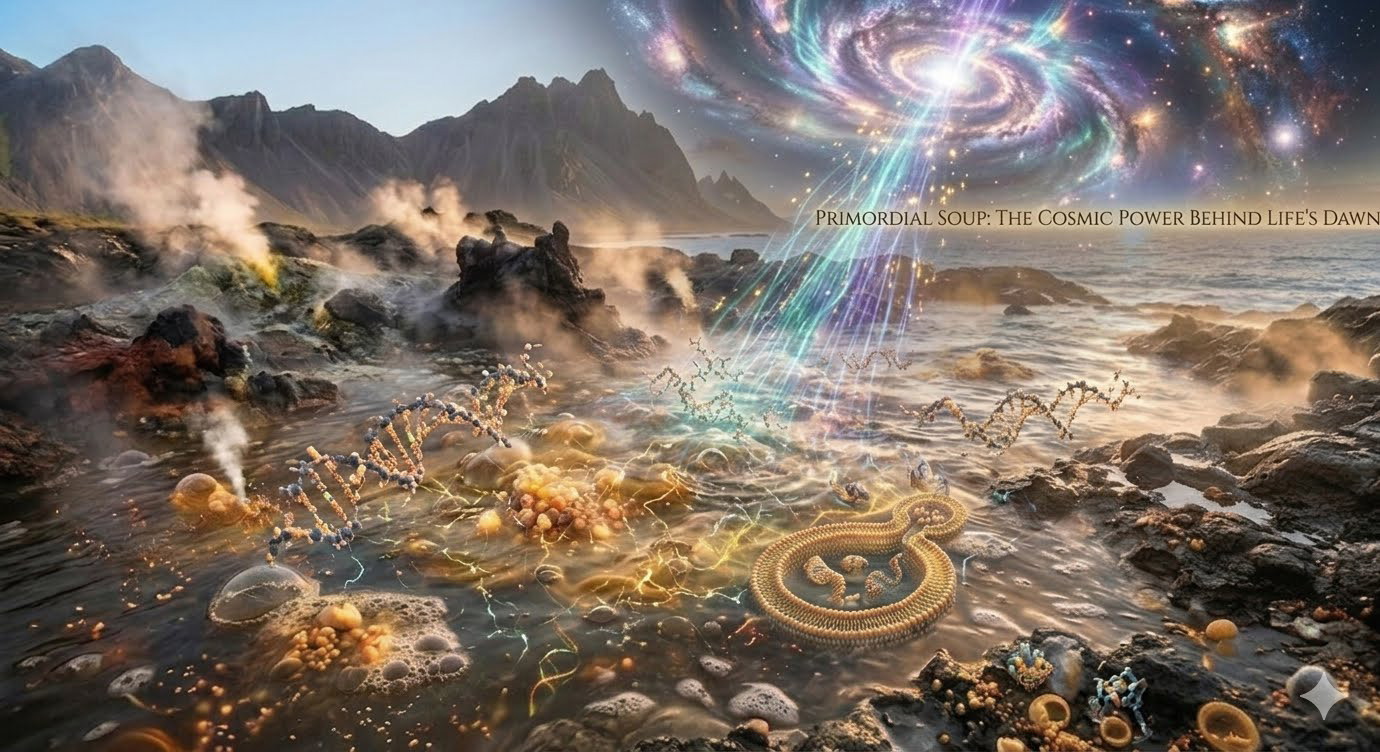
Researchers at the University of Leeds may have solved a key puzzle about how objects from space could have kindled life on Earth. While it is generally accepted that some important ingredients for life came from meteorites bombarding the early Earth, scientists have not been able to explain how that inanimate rock transformed into the building blocks of life.
This new study shows how a chemical, similar to one now found in all living cells and vital for generating the energy that makes something alive, could have been created when meteorites containing phosphorus minerals landed in hot, acidic pools of liquids around volcanoes, which were likely to have been common across the early Earth.