Pre-Inca Civilization

Tiahuanaco, was the capital of the Pre-Inca Civilization.
It is also spelled Tiwanaku.

The Inca Civilizations was an aboriginal American Indian culture that evolved in the Andean region (western South America) prior to Spanish exploration and conquest in the 16th century. The pre-Columbian civilization was extraordinary in its developments of human society and culture, ranking with the early civilizations of Egypt, Mesopotamia.

There are several myths about Pre-Inca Civilizations. As with all ancient civilizations, legends and ancient stone carvings and monuments speak of creation by gods who came from the skies, yet no one is certain how any of these civilizations came into being. Many just seem to spring up as if out of no where.

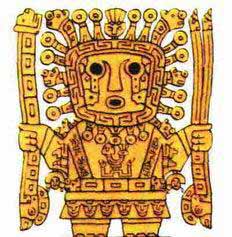
There is a pre-Incan legend that speaks of Viracocha who is depicted in many forms. There is a duality about this deity, which is not unlike gods in other civilizations - the good god and the warrior side to his personality. We see him as he enlightened god in the white robes who brings knowledge and the warrior god with staves in his hands and a sun symbol around his head, not unlike the sun god Ra in ancient Egypt. As we third dimension is a duality - all things have good and evil charactistics - including the gods of all myths. Viracocha - as duality is depicted as the sun god of creation [wearing a sun crown] and the moon god.

Viracocha, as the feathered serpent god, is one of the great mysteries of ancient American cultures. He was called Kukulkan by the Mayas, Quetzalcoatl by the Aztecs, Viracocha by the Incas, Gucumatz in central America, Votan in Palenque and Zamna in Izamal.

Pre-Inca religions centered in Tiahuanaco City which is where we first learn of a cult of a sky and thunder god named Viracocha. Gods with thunder bolts link with Zeus the main god of ancient Greece.

Viracocha was generally depicted as having staves in both of his hands and an aureole around his head. The aureole suggests the qualities of a sun god, represented on the bas-relief in the upper part of the famous Sun Gate in Tiahuanaco as well as on ceramic.

The staves, on the other hand, suggest Viracocha's distant ancestry from the nearly thousand years older Chaviacuten sky god in North Peru. His attendants were ranking deities in the shapes of cougar, condor, falcon and snake. Viracocha was worshipped as the main god in Huari as well. There his characteristics were apparently more militant. A head of Tiahuanaco state functioned both as a king and the arch-priest and he was revered as Viracocha's embodiment on Earth.

Viracocha - and in some cases his 'men - was described as being a Caucasian, bearded man in some writings, with white skin, hair on the face and beautiful emerald eyes in others wearing long white robes and sandals, carrying a staff, with a cougar lying at his feet. He was a kind and peace-loving god.

The idea might refer to the Tiahuanaco's peaceful mission among the distant warrior cultures of Peru. According to the legend, however, evil people in short clothes came to the sacred lake and forced Viracocha to leave to north. On his departure they mocked and taunted him for his long robe and lenient disposition. Eventually, he had descended from the highlands to the coast and left over the ocean, promising to return some day.

Viracocha, as a good deity, came to the Andes to restore civilization, culture and knowledge after the Flood. As with nearly all ancient peoples, Inca legend claims that the original people were flood survivors who by hiding in a hollow up on a very high mountain peak, were saved and repopulated the Earth.

Viracocha is depicted by a water symbol that of the serpent or snake. This is not unlike other myths which mention aquatic gods who came from the heavens, went into the seas, then moved forth from the seas and created civilizations.

Viracocha was said to use holy relics - four skulls of wisdom. When brought together in ceremonial rites, these four skulls delivered enlightenment to the worthy. The power of the skulls was also used to vanquish their enemies by bringing fire from the skies. This sounds a lot like crystal skulls many of which are found in south and central America - or Ancient Ancestors who visited planet Earth in huge spaceships and created civilizations

Legends of the Aymara Indians say that the Creator God Viracocha rose from Lake Titicaca during the time of darkness to bring forth light. Viracocha was a storm god and a sun god who was represented as wearing the sun for a crown, with thunderbolts in his hands, and tears descending from his eyes as rain. He wandered the earth disguised as a beggar and wept when he saw the plight of the creatures he had created, but knew that he must sustain them. Viracocha made the earth, the stars, the sky and mankind, but his first creation displeased him, so he destroyed it with a flood and made a new, better one, taking to his wanderings as a beggar, teaching his new creations the rudiments of civilization, as well as working numerous miracles. Viracocha eventually disappeared across the Pacific Ocean (by walking on the water), setting off near Manta Ecuador, and never returned. It was thought that Viracocha would re-appear in times of trouble. References are also found of a group of men named the suncasapa or bearded ones - they were the mythic soldiers of Viracocha, aka the 'angelic warriors of Viracocha'.

The famous carved figure on the decorated archway in the ancient (pre-Incan) city of Tiahuanaco, known as the "Gateway of the Sun," most likely represents Viracocha, flanked by 48 winged effigies, 32 with human faces and 16 with condor's heads. This huge monument is hewn from a single block of stone, and some believe that the strange symbols might represent a calendar, the oldest in the world. A huge monolithic figure, facing east in the direction of sunrise, stands as silent witness to an unknown civilization established around 2200 years ago.


Across from the ruins of Ollantaytambo in the Urubamba Valley stands a sacred mountain believed to have the profile of Viracocha, the Inca sun god, carved into the stone.

[I see not only the head of Viracocha, but long robes and a lamb at the bottom just above the trees [metaphor for Tree of Life.]

He also appears to be riding a horse - Revelation - Revolution -
That which revolves in the Cycles of Time.

Metaphors carved in stone - The Lion and the Lamb - a time of revelation. Gods who went to sacred mountains for answers. Age of Leo - approximately 12,000 = years ago - Precession of the equinoxes. The Lion - Leo - Light - symbology found in ancient Egypt.

When the sun strikes this profile of Viracocha during the winter solstice, the mineral content of the mountain reflects and refracts the rays. The Inca believed that this was a sign verifying the deity of Viracocha. The solstices were sacred days for the Inca since so much of their culture was based on planting seasons.

The buildings to the right and to the left were constructed by the Inca to store corn as food for winters and as offerings to Viracocha.

While the Incas share similarities with the ancient Egyptians, there are also marked differences. The empire of the Incas was the largest state-level society in the New World prior to the arrival of the Europeans. Their civilization is also the most famous of the numerous pre-Columbian societies of the Andes, with sites like Machu Picchu and Cuzco drawing many thousands of tourists every year to see the impressive stone architecture the Incas erected among spectacular scenery. This too is not unlike ruins. left as monuments in time by ancient civilizations, in places like Mexico, Egypt, Greece and Italy. These are all major grid points of energy on the planet, and often visited by those seeking their ancient bloodlines and past life connection.

All myths and legends are filled with metaphors and have some basis in fact. One has only to read behind the symbolism of the creational story - then compare it to other creational myths to see how they are all similar in design. In almost all cases - creational gods - or those who represent them even Jesus - promise to return one day. that day is usually associated with the dawning of a Golden Age when humanity finds peace and moves to another level of consciousness.

The Legend of Creation - 1- Myths about the Ayar brothers

Four pairs of brothers-sisters, created by Viracocha to rule the world, left the cave of Mountain Pacariqtambo. The whole world was living in an uncivilized and ignorant manner. The newcomers began by organizing the mankind and divided people into ten large communities.

Leading the tribes the brothers set off in search of enough fertile land to sustain themselves. They carried Sunturpaucar, a long staff adorned with colorful feathers, a cage with a sun-bird who could give good advice and other sacred objects in front of them.

Making shorter and longer stops they moved towards Cuzco. In the course of the long journey the group became smaller: the rivaling brothers confined one of their companions to a cave, two others wished to break away but were turned into stones. The only surviving brother, Ayar Manco, also known as Manco Capak, accompanied by his sister and wife Mama Ocllo and his brothers' wives, founded the city of World Pole in the name of Viracocha the Creator and Inti the Sun God, and settled there with his people.

The Legend of Creation - 2 - Myth of Manco Capak and Mama Ocllo

A long time ago when the world was filled with savages, misery and poverty, a brother and a sister, who were also a married couple - Manco Capak and Mama Ocllo - left Lake Titicaca.

Inti, the sun god sent them to refine the surrounding peoples. Inti gave them a golden stick for testing the land for cultivation and then settling in a suitable place.

The journey took a long time. Eventually, in the Cuzco Valley the golden stick disappeared into the ground, and they could start with their mission.

Manco Capak taught his people the cultivation and irrigation of land and handicrafts. Mama Ocllo taught the women spinning, weaving and sewing. The tribe of Manco Capak was called Hanan Cuzco (Higher Cuzco). The relatives of Mama Ocllo were called Hurin Cuzco (Lower Cuzco).

[This is not unlike upper and lower Egypt - united by the early pharaohs.]

The city and the state was founded in the name of Viracocha and Inti the sun god.


PRE-INCA PATHEON OF DEITIES

Viracocha

At the head of the Incan celestial table stood the all-mighty Viracocha. The supreme creator-god, he was the progenitor of the Incan pantheon and preserver of the Inca race. A mythological hero of epic proportions, he was accredited with saving the empire when it was threatened by the Chanca barbarians, with wandering the countryside instructing people on how to live prosperously, and with ascending to the heavens where he would father a race of protector gods. While he is revered as the most powerful deity in Incan lore, he was only worshipped by the priestly elites and the emperor. His very name was taboo for the masses.

Apu Inti (Sun God)

Originally acknowledged by Manco Capac, the first Inca, Apu Inti became the keystone in the Incan pantheon of earth-oriented deities. He was the most magnificent creation of Viracocha and the mythological father of the royal Inca line (proposed by Manco Capac, one may surmise, to achieve a status of heavenly mandate). Honored in an array of temples spanning the empire, Apu Inti was worshipped with sacrifice (animal and human) and prayers to golden idols. Ceremonies were conducted in his praise at sunrise and sunset, with fear sweeping the empire during solar eclipses. The Incas, receiving his gift of light and life, referred to themselves as children of the sun.

Manco Capac is sometimes referred to in legend as the Mythical Father of the Incas. According to the most frequently told story, four brothers, Manco Capac, Ayar Anca, Ayar Cachi, and Ayar Uchu, and their four sisters, Mama Ocllo, Mama Huaco, Mama Cura (or Ipacura), and Mama Raua, lived at Paccari-Tampu [tavern of the dawn], several miles distant from Cuzco. They gathered together the tribes of their locality, marched on the Cuzco Valley, and conquered the tribes living there. Manco Capac had by his sister-wife, Mama Ocllo, a son called Sinchi Roca (or Cinchi Roca).

Authorities concede that the first Inca chief to be a historical figure was called Sinchi Roca (c.1105?c.1140). Thus the foundation for an empire was laid. Another legend relates that the Sun created a man and a woman on an island in Lake Titicaca. They were given a golden staff by the Sun, their father, who bade them settle permanently at whatever place the staff should sink into the earth. At a hill overlooking the present city of Cuzco the staff of gold disappeared into the earth. They gathered around them a great many people and founded the city of Cuzco and the Inca state.

Chiqui Illapa (Thunder God)

Second only to Apu Inti, Chiqui Illapa was a magnanimous figure in Incan lore. Hailing rain down from the celestial river (the Milky Way), Illapa fed the empire. Incan legend asserts that he would crack his sister's water jug with a slingshot, reverberating the echoes of thunder as aqueous elixir spilled forth from the sky, showering the parched lands below. He was associated with Keypachu, the upper kingdom of heaven, and was worshipped throughout the growing season. Interestingly, any male child born during a thunderstorm was declared a priest of Chiqui Illapa, an exalted position in Incan society and within the priestly class itself.

Mamaquilla (Mother Moon)

First acknowledged by Inca Yapanqui, successor of Manco Capac, Mamaquilla was wife of the sun and timekeeper of the heavens. As the Incan calendar revolved around the lunar month, she was critical to the maintenance of a calendrical system that would ensure proper adherence to planting and harvesting seasons. She was represented with idols of silver, complementing the gold of her luminary husband.

Yakumama (Mother Water)

Yakumama was believed to control subterranean and mountain streams, blessing the fields with nourishment and springing fresh water from the earth. The complement of Chiqui Illapa, she was associated with ukupacha, the lower kingdom of heaven.

Mamacocha (Mother Sea)

A regional deity, Mamacocha was important to ayllus of the Peruvian coast, where she maintained the fertility of the sea. She was honored with conch shells, which were more valuable in this region than gold or silver.

Pachakama (Earth Mother)

Pachakama was also a regional deity, important to the Andean highlanders. She was ascribed the role of ensuring the fertility of soil and seed in the harsh mountain climates.

Stars

In the tradition of celestial deities, stars were thought to possess spirits that breathed life into earthly beings. Several constellations were also recognized as bearing agricultural import, such as the Pleiades, the "Seven Sisters" who preserved the seed, and the "Great Lizard", who appeared in the west during planting season and buried his head in the east at harvest time.

Waca

Waca were the family gods, or, synonymously, the shrines in which the family gods were worshipped. They were honored with more regularity than any deity of the state-recognized pantheon, as they wielded direct control over the prosperity of the ayllu. Wacas took a variety of forms, the most common being mountains, streams, caves, trees, or roads. Idols appropriate to their form were worshipped on a daily basis to appease them and avert the evocation of manevolence. Curiously, oddities such as twins, abnormal plants, and disfigured animals were also considered Wacas. In addition to the Waca of the kin group, individuals also had a personal guarding spirit of similar significance.


The first great conquest of Andean space began some 10,000 years ago when the descendants of the original migrants who crossed the land bridge over what is now the Bering Straits between the Asian and American continents reached northern South America. Over the next several millennia, hunter-gatherers fanned out from their bridgehead at Panama to populate the whole of South America. By about 2500 B.C., small villages inhabited by farmers and fishermen began to spring up in the fertile river valleys of the north coast of Peru.

These ancient Peruvians lived in simple adobe houses, cultivated potatoes and beans, fished in the nearby sea, and grew and wove cotton for their clothing. The catalyst for the development of the more advanced civilizations that followed was the introduction of a staple annual crop--maize (corn), and the development of irrigation, both dating from around the thirteenth century B.C. The stabilization of the food supply and ensuing surplus formed the foundation for the development of the great civilizations that rose and fell across the Andes for more than a thousand years prior to the arrival of the Europeans.

The Incas, were the most recent of these highly developed native American cultures to evolve in the Andes. The earliest central state to emerge in the northern highlands (that is, a state able to control both highland and coastal areas) was the Kingdom of Chavín, which emerged in the northern highlands and prospered for some 500 years between 950 B.C. and 450 B.C. Although it was originally thought by Julio C. Tello, the father of Peruvian archaeology, to have been "the womb of Andean civilization," it now appears to have had Amazonic roots that may have led back to Mesoamerica

Over the course of 1400 years, pre-Inca cultures settled along the Peruvian coast and highlands. The power and influence of some civilizations was to hold sway over large swaths of territory, which during their decline, gave way to minor regional centers. Many of them stood out for their ritual pottery, their ability to adapt and superb management of their natural resources; a vast knowledge from which later the Inca empire was to draw.

The first Peruvian civilization settled in Huantar, Ancash in around 1000 BC. The power of the civilization, based on a theocracy, was centered in the Chavin de Huantar temple, whose walls and galleries were filled with sculptures of ferocious deities with feline features.

Chavín was probably more of a religious than political panAndean phenomenon. It seems to have been a center for the missionary diffusion of priests who transmitted a particular set of ideas, rituals, and art style throughout what is now north central Peru. The apparent headquarters for this religious cult in all likelihood was Chavín de Huantar in the Ancash highlands, whose elaborately carved stone masonry buildings are among the oldest and most beautiful in South America. The great, massive temple there, oriented to the cardinal points of the solstice, was perceived by the people of Chavín to be the center of the world, the most holy and revered place of the Chavín culture. This concept of God and his elite tied to a geographical location at the center of the cosmos--the idea of spatial mysticism--was fundamental to Inca and pre-Inca beliefs.

A after the decline of the Chavín culture around the beginning of the Christian millennium, a series of localized and specialized cultures rose and fell, both on the coast and in the highlands, during the next thousand years. On the coast, these included the Gallinazo, Mochica, Paracas, Nazca, and Chimú civilizations. Although each had their salient features, the Mochica and Chimú warrant special comment for their notable achievements.

The Paracas culture (700 BC) rose to power along the south coast, and was to craft superb skills in textile weaving.

The north coast was dominated by the Mochica civilization (100 AD). The culture was led by military authorities in the coastal valleys, such as the Lord of Sipan. The Moche pots which featured portraits, and their iconography in general were surprisingly detailed and showed great skill in design.

The Mochica occupied a 136-kilometer-long expanse of the coast from the Río Moche Valley and reached its apogee toward the end of the first millennium A.D. They built an impressive irrigation system that transformed kilometers of barren desert into fertile and abundant fields capable of sustaining a population of over 50,000. Without benefit of the wheel, the plough, or a developed writing system, the Mochica nevertheless achieved a remarkable level of civilization, as witnessed by their highly sophisticated ceramic pottery, lofty pyramids, and clever metalwork.

In 1987 near Sipán, archaeologists unearthed an extraordinary cache of Mochica artifacts from the tomb of a great Mochica lord, including finely crafted gold and silver ornaments, large, gilded copper figurines, and wonderfully decorated ceramic pottery. Indeed, the Mochica artisans portrayed such a realistic and accurately detailed depiction of themselves and their environment that we have a remarkably authentic picture of their everyday life and work.

Whereas the Mochica were renowned for their realistic ceramic pottery, the Chimú were the great city-builders of pre-Inca civilization. As loose confederation of cities scattered along the coast of northern Peru and southern Ecuador, the Chimú flourished from about 1150 to 1450. Their capital was at Chan Chan outside of modern-day Trujillo. The largest pre-Hispanic city in South America at the time, Chan Chan had 100,000 inhabitants. Its twenty square kilometers of precisely symmetrical design was surrounded by a lush garden oasis intricately irrigated from the Río Moche several kilometers away. The Chimú civilization lasted a comparatively short period of time, however. Like other coastal states, its irrigation system, watered from sources in the high Andes, was apparently vulnerable to cutoff or diversion by expanding highland polities.

The highlands saw the rise of the Tiahuanaco culture (200 AD), based in the Collao region (which covered parts of modern-day Bolivia and Chile). The Tiahuanaco were to bequeath a legacy of agricultural terracing and the management of a variety of ecological zones.

The Nazca culture (300 AD) were able to tame the coastal desert by bringing water through underground aqueducts. They carved out vast geometric and animal figures on the desert floor, a series of symbols believed to form part of an agricultural calendar which even today baffles researchers.

In the highlands, both the Tiwanaku (Tiahuanaco) culture, near Lake Titicaca in Bolivia, and the Wari (Huari) culture, near the present-day city of Ayacucho, developed large urban settlements and wide-ranging state systems between A.D. 500 and A.D. 1000. The Wari culture (600 AD) introduced urban settlements in the Ayacucho area and expanded its influence across the Andes.

Each exhibited many of the aspects of the engineering ingenuity that later appeared with the Incas, such as extensive road systems, store houses, and architectural styles. Between A.D. 1000 and 1450, however, a period of fragmentation shattered the previous unity achieved by the Tiahuanaco-Wari stage. During this period, scores of different ethnic-based groups of varying sizes dotted the Andean landscape. In the central and southern Andes, for example, the Chupachos of Huánuco numbered some 10,000, while the Lupacas on the west bank of Lake Titicaca comprised over 100,000.

The refined Chimu culture (700 AD) crafted gold and other metals into relics and built the mud-brick citadel of Chan Chan, near the northern coastal city of Trujillo.

The Chachapoyas culture (800 AD) made the best possible use of arable land and built their constructions on top of the highest mountains in the northern cloud forest. The vast Kuelap fortress is a fine example of how they adapted to their environment.


TIAHUANACO AND THE DELUGE

By Helmut Zettl

Cradled in the basin of the Peruvian-Bolivian altiplano, the Titicaca region is currently densely populated by the Aymara Indians, who eke out an agricultural existence, subsisting primarily on maize, frozen potatoes, and chicha, a fermented alcoholic beverage made of cornmeal.

But there is evidence that such was not always the case. Just 12 miles southward of the southernmost tip of Lake Titicaca lie the remains of Tiahuanaco, the site of a technologically advanced culture considered by many archaeologists (romantic not orthodox) to be the oldest ruins in the world. Although some misguided scholars have attributed the buildings of Tiahuanaco to the Incas, it has now been established that the city was already in ruins when the first Incas came upon the scene.

In 1540 the Spanish chronicler, Pedro Cieza de Leon, visited the area and his description of the statues and monoliths compares very closely to what we see today.

The site is at an altitude of 13,300 feet, which places it some 800 feet above the present level of Lake Titicaca.

Most archaeologists agree that in the distant past Tiahuanaco was a flourishing port at the edge of the lake, which means that the water has receded almost 12 miles and has dropped about 800 feet since then. All concur that the lake is shrinking, due mainly to evaporation, since no rivers flow from it.

The Tiahuanaco culture, as it is called, is unique in its sculpture and its style of stone construction.

The figures depicted in the statuary have a rather square head with some covering like a helmet; they have square eyes and a rectangular mouth.

The stone works at the ruins consist of such structures as the Gate of the Sun, a portal carved from a single block of stone weighing 15 tons.

The stone steps of the Kalasasaya, each of which is a rectangular block of stone about 30 feet wide.

The so-called idols, which are giant about 23 feet tall representatives of unusual looking beings with typical Tiahuanaco head and trace, and the enormous monolithic stone blocks, many of which appear to have been cast rather than carved, are some of these unusual features.

At the area called Puma Punku, which is about 1 mile distant from the principal part of the ruins, the gigantic stones are bluish-gray in color and appear to have been machined, and they have a metallic ring when tapped by a rock.

There is also a reddish rust or oxidation covering many of the stones. Many of these enormous stone blocks probably have not been moved since they fell thousands of years ago. Archaeologists however speculate that the stones were dressed, but never erected that the construction for which they were intended was interrupted.

It is equally valid, however, to assume that the buildings were completed and then toppled by some natural catastrophe, such as the eruption of the Andes mountain chain or a world-wide deluge.

It is interesting to observe the archaeological excavation work, which is under way at the site. At this altitude of 13,300 feet some of the remains are found at a level 6 feet below the earth's surface. The mountain ranges which surround the area are not high enough to permit sufficient runoff of water or wind erosion to have covered the ruins to such a depth.

This remains a mystery to this day.

Legends have persisted over the centuries that there are stone structures beneath the waters of Lake Titicaca, much the same kind as can be found on the lake's shore.

The Indians of that legion have frequently recounted this tradition, but until recently there has been no proof of such structures.

In 1968 Jacques Cousteau, the French underwater explorer, took his crew and equipment there to explore the lake and search for evidence of underwater construction.

Although severely hampered in their activities by the extreme altitude, the divers spent many days searching the lake bottom, in the vicinity of the islands of the Sun and Moon, but found nothing man-made. Cousteau concluded the legends were a myth.

In November 1980, however, the well known Bolivian author and scholar of pre-Columbian cultures, Hugo Boero Rojo, announced the finding of archaeological ruins beneath Lake Titicaca about 15 to 20 meters below the surface off the coast of Puerto Acosta, a Bolivian port village near the Peruvian frontier on the northeast edge of the lake.

Based upon information furnished by Elias Mamani. a native of the region who is over 100 years old, Boero Rojo and two Puerto Ricans cinematographers, Ivan and Alex Irrizarry, were able to locate the ruins after extensive exploration of the lake bottom in the area, while filming a documentary on the nearby Indians.

Rojo stated, "We can now say that the existence of pre-Columbian constructions under the waters of Lake Titicaca is no longer a mere supposition or science-fiction, but a real fact. The remnants found show the existence of old civilizations that greatly antecede the Spanish colonization. We have found temples built of huge blocks of stone, with stone roads leading to unknown places and flights of steps whose bases were lost in the depths of the lake amid a thick vegetation of algae. Boero Rojo described these monumental ruins as being of probable Tiahuanaco origin."

Polish-born Bolivian archaeologist Arturo Posnansky has concluded that the Tiahuanaco culture began in the region at about 1600 B.C. and flourished until at least 1200 A.D.

His disciple, Professor Hans Schindler-Bellamy, believed Tiahuanaco to have reached back 12,000 years before the present era, although a more conservative Peruvian archaeologist.

What happened to the advanced ancient culture, however, has not yet been determined.

Rojo's discovery nevertheless may prove to create more problems than it solves. If, over the past 3 or 4000 years Lake Titicaca has slowly receded, as appears to be the case-as all scientists agree, then how can we explain the existence of stone temples, stairways, and roads still under water'?

The only answer is that they were built before the lake materialized.

We must go back, then, to the remnants of Tiahuanaco and re-examine the more than 400 acres of ruins, only 10 percent of which have been excavated.

We have pointed out that dirt covers the ancient civilization to a depth of at least 6 feet.

The only explanation for this accumulation is water.

A large amount of water had to have inundated the city. When it receded it left the silt covering all evidence of an advanced civilization, leaving only the largest statues and monoliths still exposed.

It is logical to conclude, therefore, that Tiahuanaco was built before the lake was created, and not as a port on its shore. As the waters today continue to recede, we should be able to find more evidence of the city's remote peoples.

Scientists theorize that the area of Lake Titicaca was at one time at sea level, because of the profusion of fossilized marine life which can be found in the region.

The area then lifted with the Andean upheaval and a basin was created which filled in to form the lake. No one has suggested the marine life might have been brought to the altiplano by sea waters which were at flood stage.

Peruvian legends clearly relate a story of world-wide flood in the distant past.

Whether it was the biblical flood of Noah, or another one, we cannot say, but there is ample physical evidence of a universal inundation, with the world-wide deluge described in more than a hundred flood-myths.

Along with Noah's flood were the Babylonian Utnapischtim of the Gilgamesh epic, the Sumerian Ziusudra, the Persian Jima, the Indian Manu, the Maya Coxcox, the Colombian Bochica, the Algonkin's Nanabozu, the Crows' Coyote, the Greek Deukalion and Pyrrha, the Chinese Noah Kuen, and the Polynesian Tangaloa. It is evident there was a world-wide deluge 19,000 years ago.

(Global doomsdays are conspicuous in the Hopi Indian legends, the Finnish Kalevala epic, the Mayan Chilam Balam and Popol Vuh, and in the Aztec calendar, the last of which predicts that our present civilization will be destroyed by "nahuatl Olin" or "earth movement," that is, devastation by earthquake.

Due to Aztec cyclic theory this will become the fifth doomsday after the "death of the Jaguars," "the death of the Tempests," "the death of the Great Fire" (vulcanism), and the 'Great Deluge.'

If a flourishing advanced civilization existed on the Peruvian altiplano many thousands of years ago and was reached by the flood waters, many problems would be solved, such as the existence of Tiahuanaco's ruins under 6 feet of earth at an elevation of 13,300 feet.

The presence of stone structures still under the lake's waters and the existence of marine life at an impossible altitude would also make sense.

In my 1978 and 1984 trips to Peru I was impressed by agricultural terracing on the sides and very tops of the steep peaks.

These appear to be the oldest - and now unused-portions of the terracing. As you look down the mountains you see more and more terraces of more recent origin.

We are told that only the Inca (specifically the Sapai Inca, i.e. the ruler) could use the lower portions and the fertile valleys. The peons had to climb to the very peaks to cultivate the soil for their own subsistence.

This seems highly unlikely in what we know to have been a pure communistic-theocratic society.

Pondering the logistics involved, I see no problem with the spring planting.

It would not be difficult to carry a sack of seed to the mountain tops, scratch out some of the soil, and plant them.

But then, I wondered, it must have been very tough in the fall to carry the harvest 2 to 3000 feet down to the valley floor.

Then it struck me.

If there really had been a world-wide deluge covering most of the earth's surface - leaving only mountain tops protruding in the sunlight - then the two remaining survivors of the deluge would naturally plant their seeds on mountain tops.

They had no problem getting produce down, because they lived at the top.

Also, they used boats to move from one peak to another.

As the flood waters receded the terracing began to creep down the mountain sides, as can be seen today, with the ones near the bottom being the freshest.

As Boero Rojo stated, "The discovery of Aymara structures under the waters of Lake Titicaca could pose entirely new theses on the disappearance of an entire civilization, which, for some unknown reason, became submerged.

The Tiahuanacans could have been victims of world-wide flood, their civilization all but wiped out when their homes and structures were covered with sea water.

Because of the basin-like geography of the area the flood waters that became Lake Titicaca could not run off and have only gradually evaporated over the centuries.

Professor Schindler-Bellamy as a disciple of Posnansky and Horbiger (who created the world famous Glacial-Cosmogony theory in the1930's - has worked dozens of years in the Tiahuanaco area and has written books on the subject.

According to him the large monolithic Sun Gate of Tiahuanaco was evidently originally the centerpiece of the most important part of the so-called Kalasasaya, the huge chief temple of Tiahuanaco. Its upper part is covered with a stupendously intricate sculpture in flat bas relief.

This has been described as a "calendar" almost as long as the monolithic gateway has been known to exist; thus the Sun Gate has also been called 'the Calendar Gate'.

This calendar sculpture, though it undoubtedly depicts a "solar year," cannot however be made to fit into the solar year as we divide it at present.

After many futile attempts had been made, by employing a Procrustean chopping off of toes or heels to make the calendar work, the sculpture - which indeed has a highly decorative aspect-was eventually declared generally to be nothing but an intricate piece of art.

Professor Schindler-Bellamy and the American astronomer Allen have nevertheless continued to insist the sculpture was a calendar, though one of a special kind, designed for special purpose, and, of course, for a special time.

Hence it must refer exclusively to the reckoning of that time, and to certain events occurring then. Consequently we cannot make the calendar "speak" in terms of our own time, but let it speak for itself - and listen to what it says and learn from it. When we do so we gain an immense insight into the world of the people of that era, into the manner of thinking of their intellectuals, and generally into the way their craftsmen and laborers lived and worked.

To describe these things in detail would make a long story; it took l) R. Allen and Professor Schindler-Bellamy and their helpers many years of hard work to puzzle out the Tiahuanaco system of notation and its symbology, and to make the necessary calculations (before the age of computers). The result was a book of over 400 pages, The Calendar of Tishuanaco,published in 1956.

Thorough analysis of the Sun (Sate sculpture revealed the astonishing fact that the calendar is not a mere list of days for the "man in the street" of the Tiahuanaco of that time, telling him the dates of market days or holy days; it is actually, and pre-eminently a unique depository of astronomical, mathematical, and scientific data- the quintessence of the knowledge of the bearers of Tiahuanacan culture.

The enormous amount of information the calendar has been made to contain-and to impart to anyone ready and able to read it is communicated in a way that is, once the system of notation has been grasped, singularly lucid and intelligible, "counting by units of pictorial or abstract form.

The different forms of those units attribute special, very definite and important additional meanings to them, and make them do double or multiple duty. By means of that method "any number" can be expressed without employing definite "numerals" whose meaning might be difficult, if not impossible, to establish.

"It is only necessary to recognize the units and consider their forms, and find their groupings, count them out, and render the result in our own numerical notation.

Some of the results seem to be so unbelievable that superficial critics have rejected them as mere arrant nonsense. But they are too well dove-tailed and geared into the greater system (and in some cases supported by peculiar repetitions and cross-references) to be discarded in disgust; one has to accept them as correct.

Whoever rejects them, however, also accepts the onus of offering a better explanation, and Professor Schindler-Bellamy has the "advantage of doubt," at any rate.

The "solar year" of the calendar's time had very practically the same length as our own, but, as shown symbolically by the sculpture, the earth revolved more quickly then, making the Tiahuanacan year only 290 days, divided into 12 "twelfths" of 94 days each, plus 2 intercalary days.

Tilese groupings (290, 24, 12, 2) are clearly and unmistakably shown in the sculpture. The explanation of 290 versus 3651/4 days cannot be discussed here.

At the time Tiahuanaco flourished the present moon was not yet the companion ol our earth but was still an independent exterior planet.

There was another satellite moving around our earth then, rather close-5.9 terrestrial radii, center to center; our present moon being at 60 radii. Because of its closeness it moved around the earth more quickly than our planet rotated.

Therefore it rose in the west and set in the east (like Mars' satellite Phobos), and so caused a great number of solar eclipses, 37 in one "twelfth," or 447 in one "solar year " of course it caused an equal number of satellite eclipses. These groupings (37, 447) are shown in the sculpture, with many Corroborating cross-references. Different symbols show when these solar eclipses, which were of some duration, occurred: at sunrise, at noon, at sunset.

These are only a small sample of the exact astronomical information the calendar gives. It also gives the beginning of the year, the days of the equinoxes and solstices, the incidence of the two intercalary days, information on the obliquity of the elliptic (then about 16.5 degrees; now 23.5) and on Tiahuanaco's latitude (then about 10 degrees; now 16.27), and many other astronomical and geographical references from which interesting and important data may be calculated or inferred by us.

Tiahuanacan scientists certainly knew, for instance, that the earth was a globe which rotated on its axis (not that the sun moved over a flat earth), because they calculated exactly the times of eclipses not visible at Tiahuanaco but visible in the opposite hemisphere (One wonders whether they were actually able to travel around the world, and speculate in what sort of vessel ! )

A few more facts revealed in the calendar are both interesting and surprising As indicated by an arrangement of "geometrical" elements we can ascertain that the Tiahuanacans divided the circle factually astronomically, but certainly mathematically} into 264 degrees (rather than 360).

Also, they determined-ages before Archimedes and the Egyptians the ratio of pi, the most important ratio between the circumference of the circle and its diameter, as 22/7, or, in our notation, 3.14+. They could calculate squares (and hence, square roots).

They knew trigonometry and the measuring of angles (30, 60, 90 degrees) and their functions- They could calculate and indicate fractions, but do not seem to have known the decimal system nor did they apparently ever employ the duodecimal system though they were aware of it.

(For a still unknown reason, however, the number 11 and its multiples occur often.) They were able to draw absolutely straight lines and exact right angles, but no mathematical instruments have yet been found.

We must take notice of the evident parallels with the markings of the Nazca Plain. We do not know the excellent tools they must have used for working the glass-hard andesine stone of their monuments, cutting, polishing, and incising.

They must have employed block and tackle for lifting and transporting great loads (up to 200 tons) over considerable distances and even over expanses of water from the quarries to the construction sites.

It is difficult to see how all the calculations, planning, and design work involved in producing the great city of Tiahuanaco could have been done without some form of writing, and without a system of notation different from the "unit" system of the calendar sculpture.

If they had such a system they must have used it only on perishable materials.

(One is Tempted to think all these Nasca markings had been constructed by Atlanteans who fled to the altiplano before or after the destruction of their island continent 12,000 years ago.)

I have so far dealt with some of the aspects of the Tiahuanacan world, namely those connected with the calendar as a monument of what Schindler-Bellamy describes as "fossilized science."

But the calendar science-sculpture, and similar slightly older ones also found at the site, must also be regarded and appreciated from an aesthetic point of view, a great artistic achievement in design and execution-and an absolute masterpiece of arrangement and layout.

The most tantalizing fact of all is that the Tiahuanaco culture has no roots in that area. It did not grow there from humbler beginnings, nor is any other place of origin known. It seems to have appeared practically full blown suddenly.

Only a few "older" monuments, as can be inferred from the "calendrical inscriptions" they bear, have been found, but the difference in time cannot have been very great.

The different-much lower cultures discovered at considerable distances from Tiahuanaco proper, addressed as "Decadent Tiahuacan" or as "Coastal Tiahuanaco," are only very indirectly related to the culture revealed by the Calendar Cate. Some of their painted symbols are somehow somewhat related to the calendar symbols, but they make no sense whatever; they are, if anything, purely ornamental.

Tiahuanaco apparently remained for only a very short period at its acme of perfection (evidenced by the Calendar Gate) and perished suddenly, perhaps through the cataclysmic happenings connected with the breakdown of the former "moon."

We have at present no means of determining when Tiahuanaco rose to supreme height. or when its culture was obliterated, and naturally, the calendar itself can tell us nothing about that.

It will certainly not have been in the historical past but well back in the prehistoric.

It must indeed have occurred before the planet Luna was captured as the earth's present moon, about 12,000 years ago.

The capture of the satellite and its later fall to the surface on our planet imposed great stresses on the earth. The gravitational pull caused floods and earthquakes until the moon settled into a stable orbit one-fifth of today's distance.

Hence the "moon" draws the oceans into a belt or bulge around the equator, drowning the equatorial region but leaving the polar lands high and dry.

When the satellite approached within a few thousand miles gravitational forces broke it up; according to the Roche formula each planetoid or asteroid disintegrates when approaching the critical distance of 50 to 60,000 kms.

The fragments shattered down on earth; the oceans, released from the satellite's gravity, flowed back toward the continents, exposing tropical lands and submerging polar territories. This is the simple explanation of the Horbiger theory, and it seems to me the most logical one.

Thus the approach of the "moon" caused a world-wide deluge, effecting changes of climate and provoking earthquakes accompanied by volcanic eruptions.

The "ring" left by the satellite after breaking into fragments caused a sudden drop in temperature of at least 20 degrees, which geologists recognize as its decline" in temperature. It is evident, for example, in the discovery of frozen mammoths in the Siberian tundra.

Possibly gravity-and therefore physical weight - was also changed on earth, and with it biological growth: this would explain the widespread construction of huge megalithic monuments as well as the presence of giants-man and animal-in fossil strata, tombs, and myths.

According to Horbiger four moons fell on earth, producing four Ice Ages; our present moon, the fifth one, will similarly be drawn into the critical configuration of one-fifth of its present distance (380,000 kms.) and will cause the fifth cataclysm. (Remember the Aztec calendar's prediction of doomsday by earthquake!)

The theory of a falling moon has recently been substantiated by Dr. John O'Keefe, a scientist at the Coddard Laboratory for Astronomy in Maryland. Dr. O'Keefe claims that the fragments of a moon's collision formed a ring around our planet that could have kept the sun's rays from penetrating to earth, thus causing world-wide decline of temperatures.

After a while the fragments showered down on earth, breaking into smithereens known as tectites.

These tectites O'Keefe believes were fragments of the fallen moon, thus proving Horbiger 's World-lce-Cosmology.

The Calendar Gate shows that a far-advanced culture made a substantial attempt to plant its society at Tiahuanaco, wanting to revitalize this region which had already been devastated by floods caused by a close satellite.

Their attempt eventually miscarried, because they had underestimated certain dangerous developments that ultimately happened contrary to all expectations and calculations.

Such world-wide cataclysms appear in myth:

  • the Egyptian Papyrus Ipuwer ("The sun set where it rose")
  • the tomb of Senmut (showing Orion-Sirius painted in reverse position)
  • the Finnish Kalevala ("the earth turned round like a potter's wheel"),
  • the Popol Vuh (describing fire showering down from heaven)

    This indicates that our planet more than once has suffered world-wide catastrophe.


    INCA CIVILIZATION EVOLVES


    INCAN CIVILIZATION


    ANCIENT CIVILIZATIONS INDEX


    CRYSTALINKS MAILING LIST, NEWSLETTER, UPDATES

    ALPHABETICAL INDEX OF ALL FILES

    CRYSTALINKS MAIN PAGE


    Google