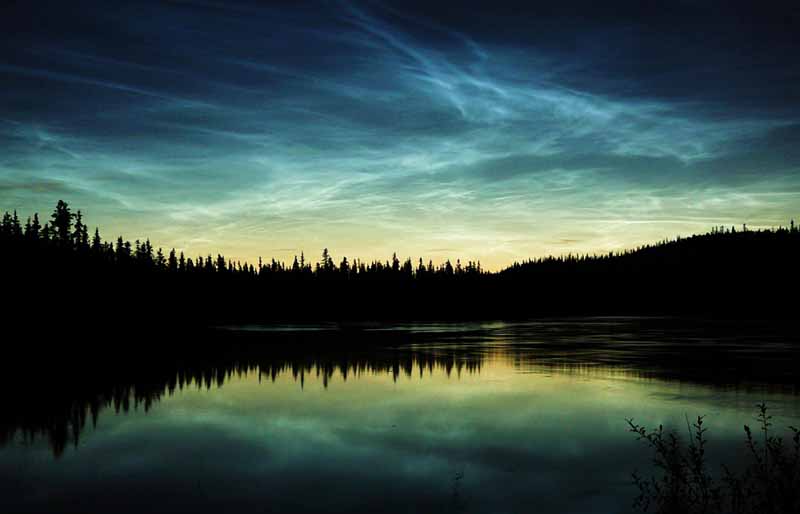
Noctilucent clouds, also known as polar mesospheric clouds are bright cloud-like atmospheric phenomena visible in a deep twilight. The name means roughly "night shining" in the Latin language. They are most commonly observed in the summer months at latitudes between 50¡ and 60¡ north and south of the equator.
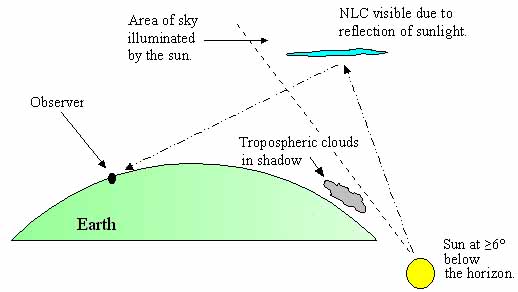
They are the highest clouds in the Earth's atmosphere, located in the mesosphere at altitudes of around 85 kilometres, and are visible only when illuminated by sunlight from below the horizon while the ground and lower layers of the atmosphere are in the Earth's shadow; otherwise they are too faint to be seen.
Noctilucent clouds are not fully understood, as under most understood meteorological concepts, clouds generally are not able to reach such high altitudes, especially under such thin air pressures.
As an explanation, it was once proposed that they were composed of volcanic or meteoric dust, but they are now known to be primarily composed of water ice (confirmed by UARS). They appear to be a relatively recent phenomenon - they were first reported in 1885, shortly after the eruption of Krakatoa - and it has been suggested that they may be related to climate change.
At least one researcher, Dr. Michael Stevens of the United States Naval Research Laboratory, believes space shuttle exhaust may contribute to the formation of noctilucent clouds.
Noctilucent clouds can be studied from the ground, from space, and in situ by sounding rockets; they are too high to be reached by weather balloons.
The AIM satellite mission, scheduled for launch in 2006, is dedicated to research into noctilucent clouds.
In and around the Arctic Circle, stunning multicolor clouds have been shining in the sky for days on end Live Science - December 23, 2023
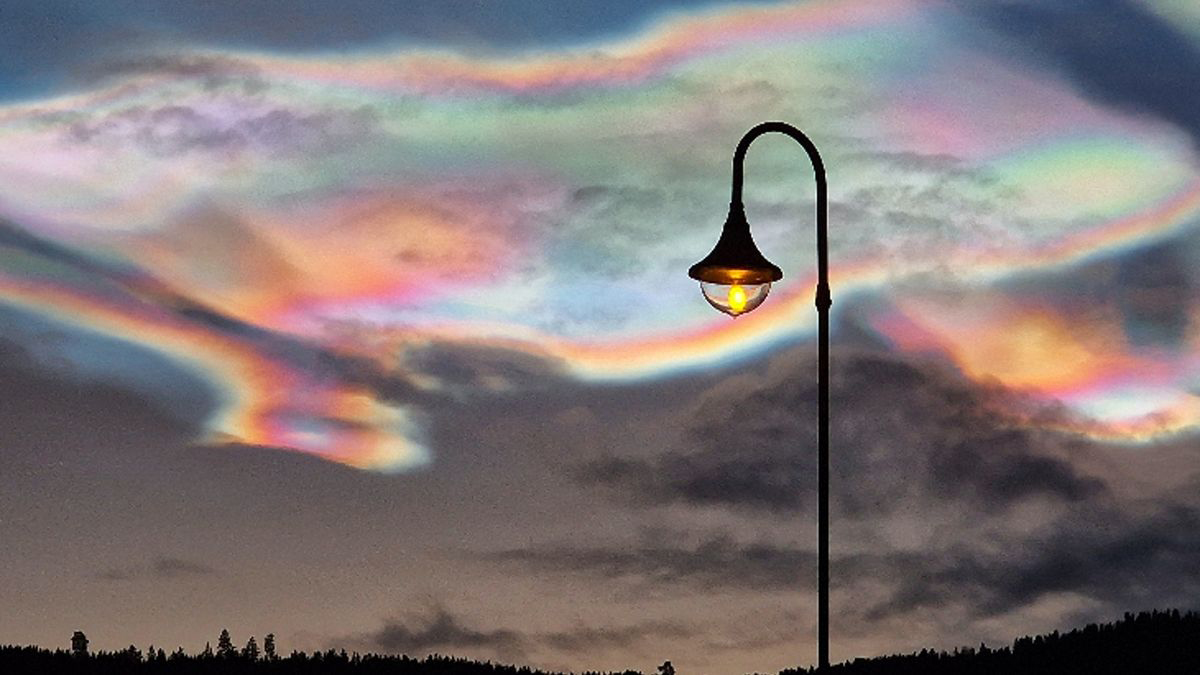
It is very unusual to see so many of these vibrant clouds over such a long period.
Climate change is making night-shining clouds more visible PhysOrg - July 2, 2018
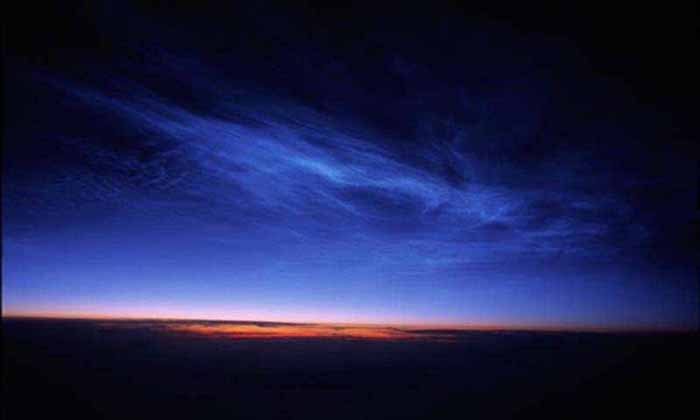
Increased water vapor in Earth's atmosphere due to human activities is making shimmering high-altitude clouds more visible, a new study finds. The results suggest these strange but increasingly common clouds seen only on summer nights are an indicator of human-caused climate change. Noctilucent, or night-shining, clouds are the highest clouds in Earth's atmosphere. They form in the middle atmosphere, or mesosphere, roughly 80 kilometers (50 miles) above Earth's surface. The clouds form when water vapor freezes around specks of dust from incoming meteors. Watch a video about noctilucent clouds here.
Humans first observed noctilucent clouds in 1885, after the eruption of Krakatoa volcano in Indonesia spewed massive amounts of water vapor in the air. Sightings of the clouds became more common during the 20th century, and in the 1990s scientists began to wonder whether climate change was making them more visible.
In a new study, researchers used satellite observations and climate models to simulate how the effects of increased greenhouse gases from burning fossil fuels have contributed to noctilucent cloud formation over the past 150 years. Extracting and burning fossil fuels delivers carbon dioxide, methane and water vapor into the atmosphere, all of which are greenhouse gases. The study's results suggest methane emissions have increased water vapor concentrations in the mesosphere by about 40 percent since the late 1800s, which has more than doubled the amount of ice that forms in the mesosphere. They conclude human activities are the main reason why noctilucent clouds are significantly more visible now than they were 150 years ago.
Secrets of Mysterious 'Night-Shining' Clouds Unlocked by NASA's AIM Satellite and Models Science Daily - December 16, 2009
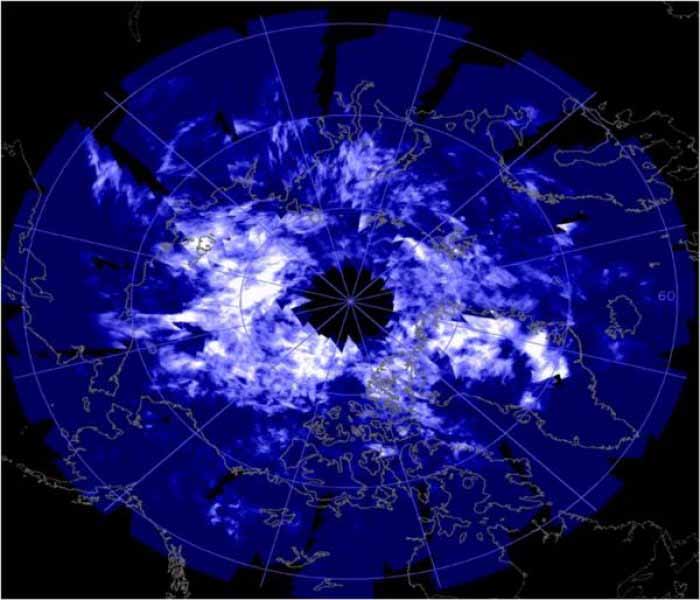
NASA's Aeronomy of Ice in the Mesosphere (AIM) satellite has captured five complete polar seasons of noctilucent (NLC) or "night-shining" clouds with an unprecedented horizontal resolution of 3 miles by 3 miles. Results show that the cloud season turns on and off like a "geophysical light bulb" and they reveal evidence that high altitude mesospheric "weather" may follow similar patterns as our ever-changing weather near the Earth's surface.
Noctilucent Cloud Storm Panorama NASA - July 11, 2009
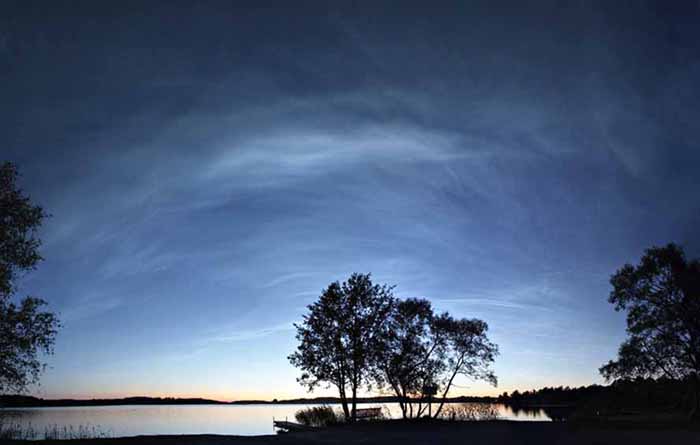
Noctilucent Clouds Over Germany NASA - June 24, 2009
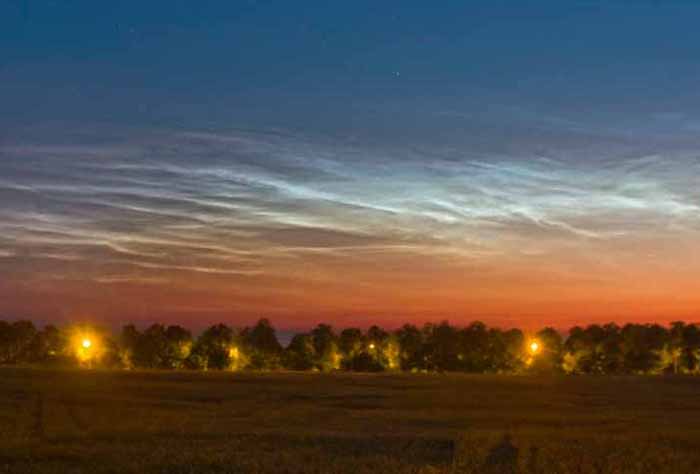
Mysterious Clouds More Common Due to Climate Change? - National Geographic - December 12, 2007
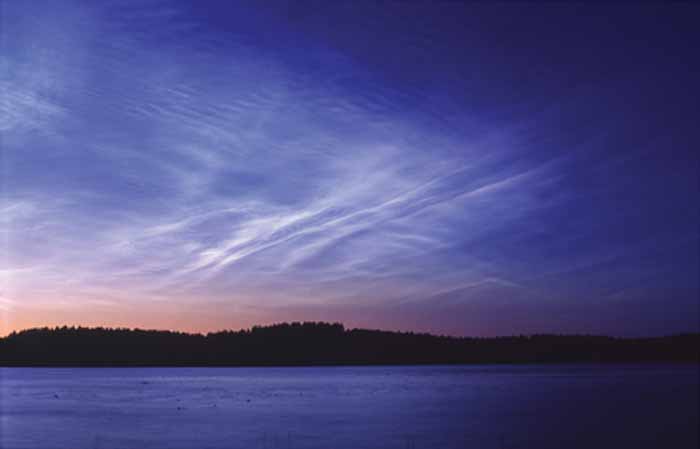
Mysterious "night-shining clouds" that light up the polar skies have become more luminous and frequent in recent years and climate change may be the culprit. So-called noctilucent clouds, which streak across the sky in vibrant colors during polar summers, are ten times brighter than previously believed, according to recent data from NASA's Aeronomy of Ice in the Mesosphere (AIM) satellite. The data, collected during two polar cloud seasons, also suggest the formations appear daily, are more widespread, and have started to form at lower latitudes than before.
Spacecraft chases highest clouds BBC - December 11, 2007
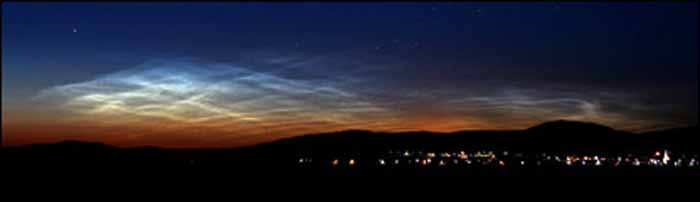
Remarkable new images of Earth's highest and most mysterious clouds have been captured by a Nasa spacecraft. Noctilucent, or "night-shining", clouds appear as thin bands in twilight skies, some 80km (50miles) above the surface. The AIM probe has now returned the first truly global pictures of these phenomena which appear to be increasing in frequency and extent. Scientists say their observations show how the clouds alter rapidly, hour by hour and day by day. They hope their studies will reveal the key triggers to the clouds' formation and why these triggers appear to be undergoing long-term change.
Mission to target highest clouds BBC - May 26, 2006 - June 13, 2006
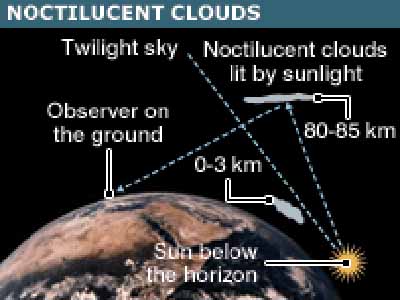
Noctilucent, or "night-shining", clouds appear as thin bands in twilight skies, some 80km (50miles) above the surface. Recent records suggest they have become brighter, more frequent and are being seen at lower latitudes than usual