Cloud cover has been seen on most other planets in the solar system. Venus's thick clouds are composed of sulfur dioxide (due to volcanic activity) and appear to be almost entirely stratiform. They are arranged in three main layers at altitudes of 45 to 65 km that obscure the planet's surface and can produce virga. No embedded cumuliform types have been identified, but broken stratocumuliform wave formations are sometimes seen in the top layer that reveal more continuous layer clouds underneath. On Mars, noctilucent, cirrus, cirrocumulus and stratocumulus composed of water-ice have been detected mostly near the poles. Water-ice fogs have also been detected on Mars.
Both Jupiter and Saturn have an outer cirriform cloud deck composed of ammonia, an intermediate stratiform haze-cloud layer made of ammonium hydrosulfide, and an inner deck of cumulus water clouds. Embedded cumulonimbus are known to exist near the Great Red Spot on Jupiter. The same category-types can be found covering Uranus, and Neptune, but are all composed of methane.
Saturn's moon Titan has cirrus clouds believed to be composed largely of methane. The CassiniĞHuygens Saturn mission uncovered evidence of polar stratospheric clouds and a methane cycle on Titan, including lakes near the poles and fluvial channels on the surface of the moon.
Some planets outside the solar system are known to have atmospheric clouds. In October 2013, the detection of high altitude optically thick clouds in the atmosphere of exoplanet Kepler-7b was announced, and, in December 2013, in the atmospheres of GJ 436 b and GJ 1214 b.
Outer space, or just space, is the expanse that exists beyond the Earth and between celestial bodies. Outer space is not completely empty - it is a hard vacuum containing a low density of particles, predominantly a plasma of hydrogen and helium as well as electromagnetic radiation, magnetic fields, neutrinos, dust, and cosmic rays. There is also gas, plasma and dust, small meteors, and several dozen types of organic molecules discovered to date by microwave spectroscopy. A cloud of interplanetary dust is visible at night as a faint band called the zodiacal light.
Large regions of higher density matter known as molecular clouds allow chemical reactions to occur, including the formation of organic polyatomic species. Much of this chemistry is driven by collisions. Energetic cosmic rays penetrate the cold, dense clouds and ionize hydrogen and helium, resulting, for example, in the trihydrogen cation. An ionized helium atom can then split relatively abundant carbon monoxide to produce ionized carbon, which in turn can lead to organic chemical reactions. Read more
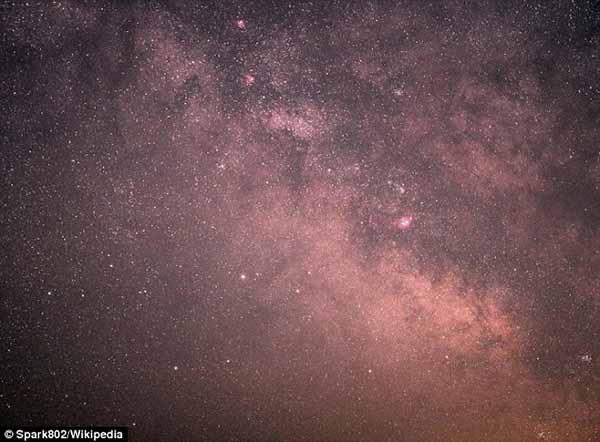
Did life's building blocks form in interstellar ice?
Cosmic rays can create molecules in frozen dust clouds between stars
Daily Mail - July 4, 2016
Some of the key building blocks for life could have formed in ice in interstellar space in chemical reactions driven by cosmic rays. They say such reactions could occur in frigid molecular clouds of dust and gas such as Sagittarius B2 close to the centre of the Milky Way The study also raises hopes that such interstellar balls of ice could have helped life to form on other planets. Interstellar ice forms in cold molecular clouds where particles of silicate or carbon rich material are so cold that atoms that collide with them stick to the surface. This builds up icy layers of water, carbon dioxide, ammonia, methane and other material around the grains.Sagittarius B2 is a giant molecular cloud of gas and dust about 390 light years from the centre of the Milky Way.
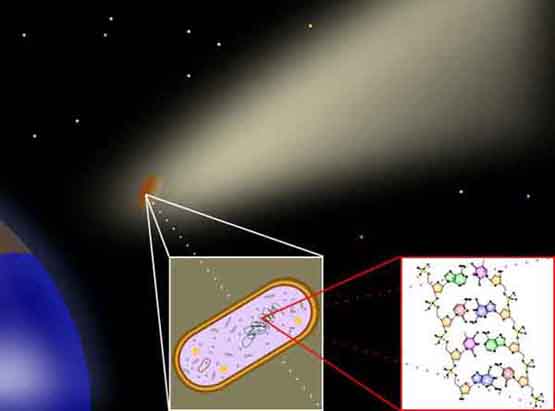
Theory of Panspermia
Did life on Earth begin in a rudimentary form in outer space,
brought to Earth billions of years ago?
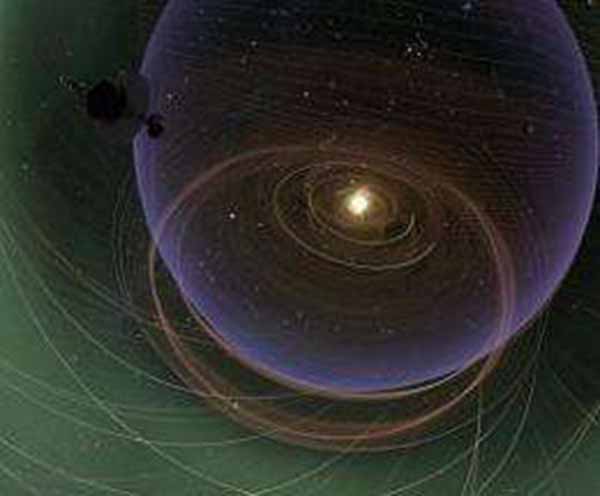
Voyager makes an interstellar discovery
The solar system is passing through an interstellar cloud that physics says should not exist
The discovery has implications for the future when the solar system will eventually bump into other, similar clouds in our arm of the Milky Way galaxy. Astronomers call the cloud we're running into now the Local Interstellar Cloud or "Local Fluff" for short. It's about 30 light years wide and contains a wispy mixture of hydrogen and helium atoms at a temperature of 6000 C. The existential mystery of the Fluff has to do with its surroundings. About 10 million years ago, a cluster of supernovas exploded nearby, creating a giant bubble of million-degree gas. The Fluff is completely surrounded by this high-pressure supernova exhaust and should be crushed or dispersed by it.
The Fluff is held at bay just beyond the edge of the solar system by the sun's magnetic field, which is inflated by solar wind into a magnetic bubble more than 10 billion km wide. Called the "heliosphere," this bubble acts as a shield that helps protect the inner solar system from galactic cosmic rays and interstellar clouds. The two Voyagers are located in the outermost layer of the heliosphere, or "heliosheath," where the solar wind is slowed by the pressure of interstellar gas.
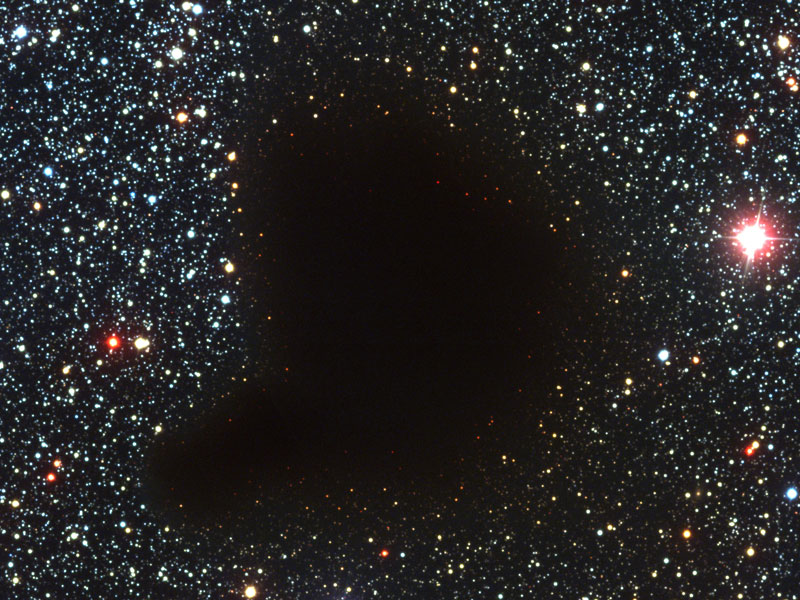
Molecular Cloud Barnard 68
March 23, 2008Credit: FORS Team, 8.2-meter VLT Antu, ESO
Where did all the stars go? What used to be considered a hole in the sky is now known to astronomers as a dark molecular cloud. Here, a high concentration of dust and molecular gas absorb practically all the visible light emitted from background stars. The eerily dark surroundings help make the interiors of molecular clouds some of the coldest and most isolated places in the universe. One of the most notable of these dark absorption nebulae is a cloud toward the constellation Ophiuchus known as Barnard 68, pictured above. That no stars are visible in the center indicates that Barnard 68 is relatively nearby, with measurements placing it about 500 light-years away and half a light-year across. It is not known exactly how molecular clouds like Barnard 68 form, but it is known that these clouds are themselves likely places for new stars to form. It is possible to look right through the cloud in infrared light.
Discovery - September 2004
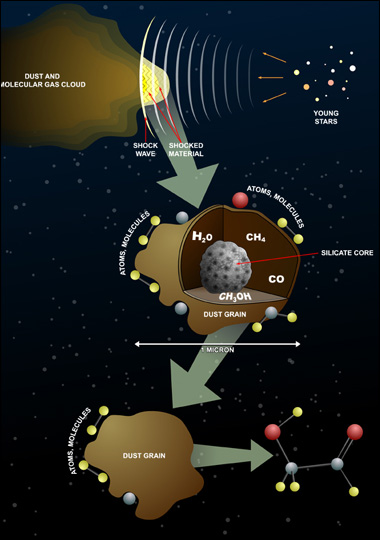
Astronomers have found a sweet spot in a sublimely cold and vast interstellar cloud. An eight-atom called glycolaldehyde has been found residing at eight degrees above absolute zero in the Sagittarius B2 dust cloud, some 26,000 light-years from Earth. The sugar is just a few steps from ribose, an essential ingredient of DNA. The cloud is too cold for (the sugar) to have formed in that environment. Some sort of additional energy was needed to throw simpler molecules together to make the sugar.
What probably provided the sugar-making oomph was a shock wave from an exploding star. A shock wave would heat up pre-existing simpler molecules; water, ammonia, formaldehyde, methane, ammonia or carbon dioxide; so they could react and build the sugar. Once the reactions occurred, the molecules dispersed and cooled. The simpler molecules are thought to form on the surfaces of dust particles.
This is the second detection of glycolaldehyde in space, said Jewell, the first being in 2000, but a much warmer sugar, less revealing and a weaker signal. The glycolaldehyde was found using the Robert C. Byrd Green Bank Telescope in West Virginia to detect a radio signal emitted at a narrow and precise frequency when the sugar molecules rotate. The sugar is a relatively complex molecule, The whole issue of complex molecules in interstellar space was thought in the 1970s to be impossible. It was thought impossible because space between stars in our galaxy is rife with various forms of radiation that tend to knock apart large clumps of atoms.
Today astronomers know that the gigantic dust and gas clouds within the Milky Way provide shelter from radiation for molecules. There are regions in space that are protected from all this radiation. The discovery hints of a rich molecular soup floating in the clouds between stars, said Churchwell, in the very places where they are most likely to find their way onto new planets. Clouds like Sagittarius B2 are where stars, and their planets, are born, he said.