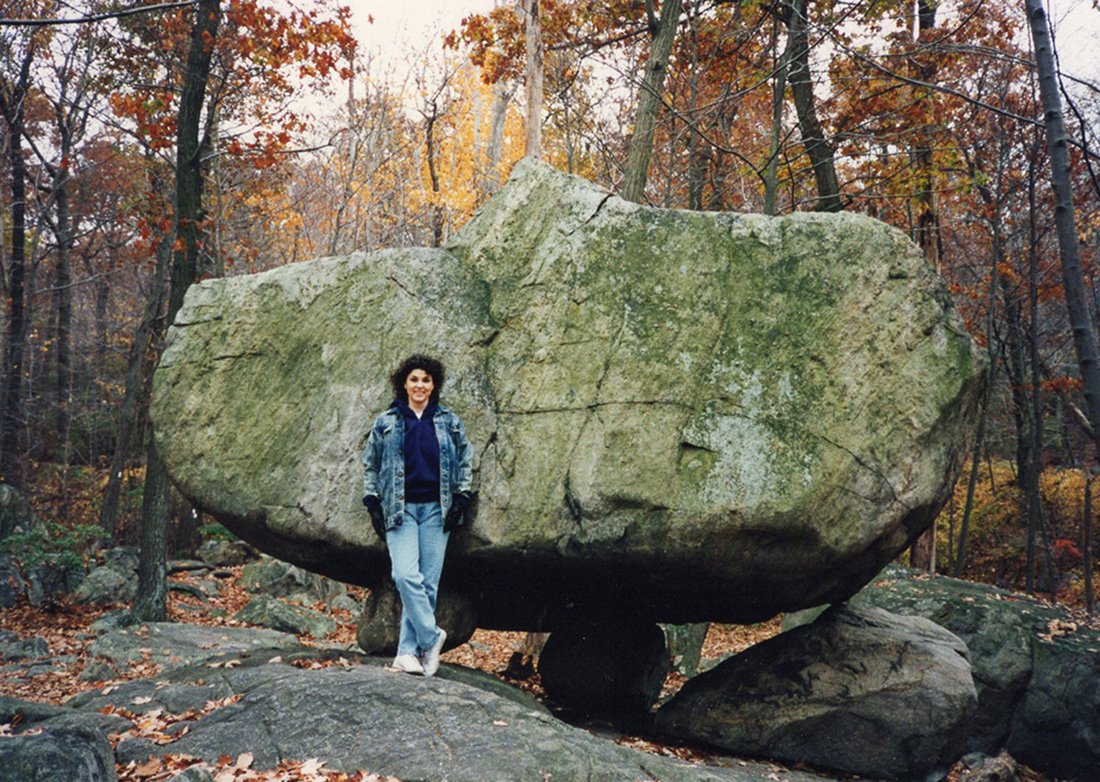
Humans investigate megalithic monuments (sites) as if doorways to the past that might lead them to understand who they are, how they got here, and what comes next. They are associated with mythology and ancient aliens which are one and the same. They are generally found on major planetary grid points - often indwells and out wells of energy or perhaps portals.
A megalithic monument, in archaeology, is a construction involving one or several roughly hewn stone slabs of great size; it is usually of prehistoric antiquity. These monuments are found in various parts of the world, but the best known and most numerous are concentrated in Western Europe, including Brittany, the British Isles, Iberia, S France, S Scandinavia, and N Germany. Aside from the standing stones and stone heaps that are still raised occasionally as boundary marks or memorials of personal and public events, most megalithic monuments seem to have been erected for funerary and religious purposes.
The Western European megaliths were constructed during the Neolithic and the Bronze Age and are believed to range in date from c.4000 B.C. to 1100 B.C. Most chamber tombs were probably built during the 4th millennium B.C., and the stone circles generally date somewhat later. Megalithic monuments may be divided into four categories: the chamber tomb, or dolmen; the single standing stone, or menhir; the stone row; and the stone circle. Chamber tombs were usually covered with earth mounds, forming a barrow.
Menhirs sometimes stood alone near the entrance of a tomb or on top of the mound. Sometimes they were set in long rows called alignments, as at Carnac in Brittany; in other places they were arranged in a circle, the most elaborate of which is Stonehenge in England (these are known as cromlechs outside Britain). The individual stone slabs may reach 65 ft (20 m) in length and 100 tons (90 metric tons) in weight. Such massive structures testify to the engineering feats possible with the concerted efforts of relatively ill-equipped peoples. Read more
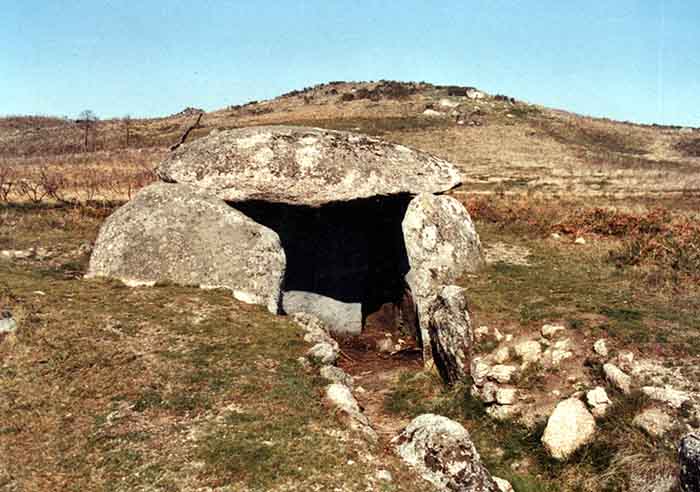
The most common type of megalithic construction in Europe is the dolmen - a chamber consisting of upright stones (orthostats) with one or more large flat capstones forming a roof. A dolmen, also known as a portal tomb, portal grave, or quoit, is a type of single-chamber megalithic tomb, usually consisting of three or more upright stones supporting a large flat horizontal capstone. Most date from the early Neolithic period (4000 to 3000 BCE). Dolmens were usually covered with earth or smaller stones to form a barrow, though in many cases that covering has weathered away, leaving only the stone "skeleton" of the burial mound intact. Dolmen are found in Europe, Korea, India, the Middle East, and South America.
It remains unclear when, why, and by whom the earliest dolmens were made. The oldest known dolmen are found in Western Europe, where they were set in place around 7000 years ago. This would date them alongside the ancient civilizations of Egypt, India and the Middle East. Archaeologists still do not know who erected these dolmens, which makes it difficult to know why they did it. The most widely accepted theory is that all dolmen are tombs or burial chambers. Human remains, sometimes accompanied by artifacts, have been found in or close to them, which allowed a scientific dating. There is however no firm evidence that even this theory is correct. It has been impossible to prove that these remains date back to the time when the stones were set in place.
Many of these, though by no means all, contain human remains, but it is debatable whether use as burial sites was their primary function. Though generally known as dolmens, many local names exist, such as anta in Portugal, stazzone in Sardinia, hunebed in the Netherlands, Hunengrab in Germany, dysse in Denmark, and cromlech in Wales. It is assumed that most dolmens were originally covered by earthen mounds.
The second most common tomb type is the passage grave. It normally consists of a square, circular or cruciform chamber with a slabbed or corbeled roof, accessed by a long, straight passageway, with the whole structure covered by a circular mound of earth. Sometimes it is also surrounded by an external stone kerb. Prominent examples include the sites of Bru na Boinne and Carrowmore in Ireland, Maes Howe in Orkney, and Gavrinis in France.
The third tomb type is a diverse group known as gallery graves. These are axially arranged chambers placed under elongated mounds. The Irish court tombs, British long barrows and German Steinkisten belong to this group. Another type of megalithic monument is the single standing stone, or menhir. Some of these are thought to have an astronomical function as a marker or foresight, and in some areas long and complex alignments of such stones exist - for example at Carnac in Brittany.
In parts of Britain and Ireland the best-known type of megalithic construction is the stone circle, of which there are hundreds of examples, including Stonehenge, Avebury, Ring of Brodgar and Beltany. These too display evidence of astronomical alignments, both solar and lunar. Stonehenge, for example, is famous for its solstice alignment. Examples of stone circles are also found in the rest of Europe. They are normally assumed to be of later date than the tombs, straddling the Neolithic and the Bronze Age.
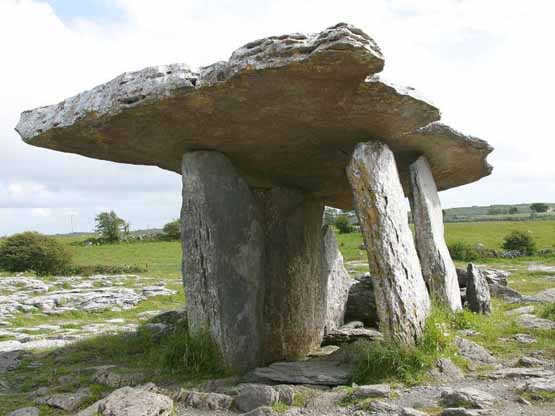
Megalithic tombs are aboveground burial chambers, built of large stone slabs (megaliths) laid on edge and covered with earth or other, smaller stones. They are a type of chamber tomb, and the term is used to describe the structures built across Atlantic Europe, the Mediterranean and neighboring regions, mostly during the Neolithic period, by Neolithic farming communities. They differ from the contemporary long barrows through their structural use of stone.
There is a huge variety of megalithic tombs. The free-standing single chamber dolmens and portal dolmens found in Brittany, Denmark, Germany, Ireland, Netherlands, Sweden, Wales and elsewhere consist of a large flat stone supported by three, four or more standing stones. They were covered by a stone cairn or earth barrow. Examples with outer areas, not used for burial, are also known.
The Court Cairns of south west Scotland and northern Ireland, the Severn-Cotswold tombs of south west England and the Transepted gallery graves of the Loire region in France share many internal features although the links between them are not yet fully understood. That they often have antechambers or forecourts is thought to imply a desire on the part of the builders to emphasize a special ritual or physical separation of the dead from the living. The Passage graves of Orkney, Ireland's Boyne Valley, and north Wales are even more complex and impressive, with cross shaped arrangements of chambers and passages. The workmanship on the stone blocks at Maeshowe for example is unknown elsewhere in north west Europe at the time.
Megalithic tombs appear to have been used by communities for the long-term deposition of the remains of their dead and some seem to have undergone alteration and enlargement. The organization and effort required to erect these large stones mean that the societies concerned must have placed great emphasis on the proper treatment of their dead. The ritual significance of the tombs is supported by the presence of megalithic art carved into the stones at some sites. Hearths and deposits of pottery and animal bone found by archaeologists around some tombs also implies some form of burial feast or sacrificial rites took place there.
Further examples of megalithic tombs include the stalled cairn at Midhowe in Orkney and the passage grave at Bryn Celli Ddu on Anglesey. Despite its name, the Stone Tomb in Ukraine was not a tomb but rather a sanctuary.
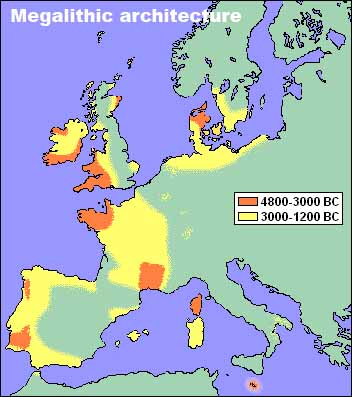
In Western Europe and the Mediterranean, megaliths are generally constructions erected during the Neolithic or late stone age and Chalcolithic or Copper Age (4500-1500 BC). Perhaps the most famous megalithic structure is Stonehenge in England, although many others are known throughout the world.
The French Comte de Caylus was the first to describe the Carnac stones. Legrand d'Aussy introduced the terms menhir and dolmen, both taken from the Breton language, into antiquarian terminology. He interpreted megaliths as gallic tombs.
In Britain, the antiquarians Aubrey and Stukeley conducted early research into megaliths. In 1805, Jacques Cambry published a book called Monuments celtiques, ou recherches sur le culte des Pierres, precedees d'une notice sur les Celtes et sur les Druides, et suivies d'Etymologie celtiques, where he proposed a Celtic stone cult. This completely unfounded connection between druids and megaliths has haunted the public imagination ever since.
In Belgium there is a megalithic site at Weris, a little town situated in the Ardennes. In the Netherlands, megalithic structures can be found in the north-east of the current, mostly in the province of Drenthe. Knowth is a passage grave of the Bru na Boinne neolithic complex in Ireland, dating from c.3500-3000 BC. It contains more than a third of the total number of examples of megalithic art in all Western Europe, with over 200 decorated stones found during excavations.
8,000-year-old rock carvings in Arabia may be world's oldest megastructure blueprints Live Science - May 18, 2023
Stars and lines engraved in rocks on the Arabian Peninsula may represent nearby hunting traps, making these carvings the first scale-plan diagrams in human history, according to a new study that reveals humans' sophisticated understanding of space around 8,000 years ago.
Archaeologists first noticed these structures, known as desert kites, about 100 years ago, when aerial photography began taking off with airplanes. Kites are large areas of land bordered by low stone walls, sometimes with pits scattered on the inside near the edges.
Found primarily in the Middle East and Central Asia, kites are thought to have functioned like pens or traps for animals. Hunters would herd animals, like gazelle, into the kite through a long, narrow passage, where the game would be unable to escape the walls or the pits, making them easier to kill.
Because of their massive size - averaging close to the square footage of two football fields - kites cannot be seen in their entirety from the ground. But the advent of publicly available, high-resolution satellite images, such as those from Google Earth, has jump-started the study of desert kites in the past decade.
8,000-Year-Old Engravings Could Be The Oldest Examples of Construction Plans Science Alert - May 17, 2023
Archaeologists have described what could be the oldest examples of construction plans in human history, chiseled into ancient stones in Jordan and Saudi Arabia between 7,000 and 8,000 years ago.
Engraved geometric patterns have been matched with neighboring desert megastructures built long before the pyramids of Giza, leading an international team of researchers to conclude they represent some kind of early blueprint guiding their creation.
From the view of a passing plane or satellite, the huge, ancient stone constructions form discernible shapes that utilize parts of the natural landscape. Those shaped like arrows are known as 'kites', and archaeologists suspect they represent massive hunting traps, designed to funnel wild herds into enclosures or even off of cliffs.