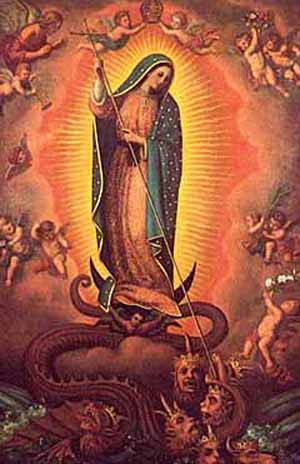
Our Lady Of Guadalupe Day

December 12 or 12/12

The origin of the name "Guadalupe," in the American context, is something of a mystery. According to a report at the time, the Virgin identified herself that way in a later apparition to Juan Diego's uncle, Juan Bernardino.

Those who doubt the story of Juan Diego and the apparitions argue that the 1533 church was dedicated to the Spanish Our Lady of Guadalupe , with the American version developing later.

Others have suggested that the name is a corruption of a Nahuatl name "Coatlaxopeuh", which has been translated as "Who Crushes the Serpent". In this interpretation, the serpent referred to is Quetzalcoatl , one of the chief Aztec gods, whom the Virgin Mary "crushed" by inspiring the conversion of the natives to Catholicism.

This explanation has been adopted by some who hold that the motive of the Catholic Church in the Americas was to harshly wipe out native beliefs. It is believed that Our Lady used the Aztec Nahuatl word of 'Coatlaxopeuh' which is pronounced "Quatlasupe" and sounds remarkably like the Spanish word Guadalupe. 'Coa' meaning serpent, 'tla' being the noun ending which can be interpreted as "the", while 'Xopeuh' means 'to crush or stamp out.' So Our Lady must have called herself the one "who crushes the serpent." was the Serpent-god of the Aztec.

Our Lady of Guadalupe, (La Virgen de Guadalupe) a Roman Catholic icon, is the title given to the Virgin Mary after appearing to Saint Juan Diego Cuauhtlatoatzin, an Aztec convert to Catholicism, on Tepeyac Hill near Mexico City in 1531. The icon is currently located behind the main altar of the Basilica of Guadalupe. Less famously, the same name also refers to a statue of Mary that dating from 1326, found in the city of Guadalupe in Spain.

Origin of the Mexican Lady of Guadalupe

According to the story generally accepted by Catholics, Juan Diego was walking between his village and Tolpetlac, near Mexico City), where the Catholic mission was headquartered, on Saturday December 9, 1531. Along the way, on Tepeyac Hill, the Virgin Mary appeared, speaking to him in his native Nahuatl language. She called him Juanito, the dimunitive form of his name. "Juanito, my son, where are you going?" "Noble lady", he murmured, I am on my way to the church in Tlatelolco to hear Mass."

The lady smiled and said:"Know for certain, dearest of my sons, that I am the perfect and perpetual Virgin Mary, Mother of the True God, through whom everything lives, the Lord of all things, who is Master of Heaven and Earth. I ardently desire a teocalli (temple) to be built for me where I will show and offer all my love, my compassion, my help and my protection to the people. I am your merciful Mother, the Mother of all who live united in this land, and of all mankind, of all those who love me, of those who cry to me, of those who have confidence in me.

Here I will hear their weeping and their sorrows, and will remedy and alleviated their sufferings, necessities and misfortunes. Therefore, in order to realise my intentions, go to the house of the Bishop of Mexico City and tell him that I sent you and that it is my desire to have a teocalli built here. Tell him all that you have seen and heard. Be assured that I shall be very grateful and will reward you for doing diligently what I have asked of you. Now that you have heard my words, my son, go and do everything as best you can."

When Juan Diego spoke to the Spanish bishop, Juan de Zumárraga, the bishop did not believe him, asking for a miraculous sign. The Virgin told Juan Diego to gather flowers from a hill, even though it was winter, when no plants bloom. He found Castilian roses and presented these to the bishop.

When the roses fell from his tilma (a kind of apron) an icon of the Virgin remained imprinted on the cloth.

Despite disputes as to the veracity of claims about the image, the Virgin of Guadalupe has proved very popular in Mexico over the years. A church was built in 1533, dedicated to Our Lady of Guadalupe.

Thereafter, Spanish missionaries used the story of her appearance to help convert millions of indigenous people in what had been the Aztec Empire.

Our Lady of Guadalupe still underpins the faith of Catholics in Mexico and the rest of Latin America, and she has been recognised as patron saint of Mexico City since 1737, with her patronage extended piece by piece until it included all of America by 1946.

Much of the recent increase in Marianism in the Catholic Church, including the call to recognise Mary as co-redemptrix, stems from the cult of Guadalupe.

Today many make the pilgrimage to the Basilica of Guadalupe, on the Cerro of Tepeyac, some crawling on their knees for kilometres, or even from their homelands in other cities, or even states, to pray to the Virgin of Guadalupe.

It is said that she can cure almost any sickness. Also, many problem drinkers, instead of going to Alcoholics Anonymous or similar programmes, go there to promise her that they will never drink again, or abstain for a certain period; it is reported that the majority of these find the strength to fulfill their promise. That can illustrate how much love Mexicans pay to their Virgencita, the affectionate diminutive by which she is called.

The apron containing her image has been hung in the church built on the spot through the building's various versions, including today's Basilica of Guadalupe.

The picture is of a woman with olive skin, rather than the white skin of European iconography, that appealed to both indigenous Mexicans and their mestizo descendants as one of them. Similarly, the man to whom she is supposed to have appeared, Juan Diego, was an Indian, not a Spaniard.

The image of Our Lady of Guadalupe has been used by advocates of indigenous rights throughout Mexico's history, most recently by the Zapatista movement.

Replicas can be found in thousands of churches throughout the world, including Notre Dame Cathedral in Paris, and numerous parishes bear her name. Devotion to Our Lady of Guadalupe today is widespread among Catholics in every part of the globe.

María Guadalupe or just Lupe is a frequent female name in the Spanish language.


Mother Mary as Our Lady of Gaudalupe

Quatlasupe is the feminine balance for QuetZalcoatl
Serpent symbolizes spiraling=DNA.
'Crushing the serpent' is not unlike 'bursting the bubble' to fly free.


Roses - Rose Bloodline - Jesus - Sarah and Alexander - Flower of Life

Guadalupe Day, December 12, - 12/12 - is Mexico's most important religious holiday. On this day people from all over Mexico travel to the chapel Tepayac Hill in Mexico City, where the mother of Jesus is said to have appeared before an Indian peasant named Juan Diego back in 1531.

Mary told Juan to go to the bishop and ask that a church be built on the hill so she could be close to her people. The bishop, needing proof of this vision, asked Juan to have a miracle performed by Mary.

Juan returned to Tepayac Hill and found roses growing where there had only been cacti. Juan wrapped the roses in his tilma (cape) along with a picture of Mary to show the bishop. He was convinced and the chapel was built.

Huge fiestas are held all over Mexico and Central America to honor the day of Our Lady of Guadalupe. Throughout the day, people come to the church to pray. Many of them pin milagros (which means miracles) near the statue of the Virgin of Guadalupe. These small silver or tin objects are shaped like hearts, arms, or legs, and symbolize the giver's thanks for a cure.

To celebrate this holiday, second graders made the traditional items that would be a part of the fiesta. The children enjoyed corn cakes and candy sticks as well as the paper roses and milagros that they made for their fiesta. Each child decorated a Mexican boy or girl in typical costume and watched a video reenacting Juan and his vision.

Our Lady of Guadalupe - Apparition - Symbol of Mexico Wikipedia


RELATED FILES
BETHLEHEM
  STAR OF BETHLEHEM
CHRISTIANITY
CHRISTMAS
EASTER
HOLY GRAIL
JESUS OF NAZARETH
MARION APPARITIONS
MARY MAGDALENE
MIRACLES - BLEEDING, WEEPING ICONS
MOTHER MARY
PRIEURE DE SION
RENNES LE CHATEAU - THE MEROVIAN KINGS
REVELATIONS
RELIGOUS ART - JESUS - UFOS
ROMAN RELIGION
SPIRIT PHOTOS


ALPHABETICAL INDEX OF ALL FILES

CRYSTALINKS MAIN PAGE


SEARCH : OUR LADY OF GUADALUPE

Google
Search crystalinks.com Search web