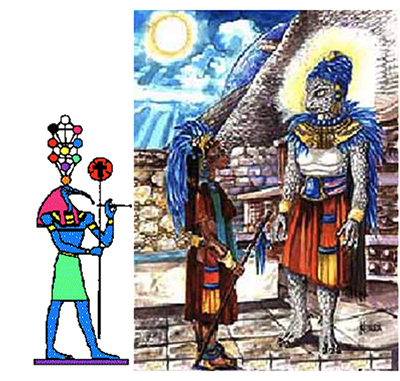
Pantheons of gods and goddesses were all played by the same "character" throughout mythology following the same algorithm. They came from the sky - stayed to seed the human race - then left to return one day at the end of the cycle called time. They wore masks and costumes - left behind artifacts, calendars and landmarks and most importantly encoded message within human DNA to be activated when Time ran out. By any name they were our progenitors.
Quetzalcoatl is depicted in many ways usually as the feathered serpent though sometimes as a - Shining One - looking nothing like the Mesoamerican people who worshipped him. Feathers represent the ascension of human consciousness back to its origins - while 'serpent' represents human DNA in physical reality.
The Anunnaki God - Ningshiidza allegedly took on the role of Egyptian God Thoth creating civilizations replete with monuments and artifacts depicting their alleged time on Earth. Thoth allegedly flew across the planet founding the Mesoamerican Civilization where he became known as Quetzalcoatl.
Other stops along the way in the matrix of experiences on planet Earth - included the ancient civilizations of Asia, Africa, North America, and other parts of the world that no longer exist today - many sunk due to cataclysmic changes. They are all part of the simulation in the story of humanity in the bipolar (physical) realms of The Human Experiment. It's all just a story set in linear time to experience emotions with gods who will never return as the story Fades to Black when Time runs out.
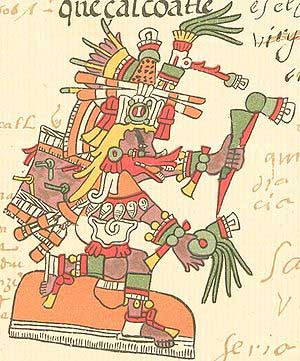
Quetzalcoatl - Codex Telleriano
Quetzalcoatl is a Mesoamerican deity whose name comes from the Nahuatl language and has the meaning of "feather-serpent".
The worship of a feathered serpent deity is first documented in Teotihuacan in the Late Preclassic through the Early Classic period (400 BCE - 600CE) of Mesoamerican chronology - "Teotihuacan arose as a new religious center in the Mexican Highland, around the time of Christ..." -- whereafter it appears to have spread throughout Mesoamerica by the Late Classic (600 - 900 CE) (Ringle et al.).
In the Postclassic period (900 - 1519 CE) the worship of the feathered serpent deity was centered in the central Mexican religious center of Cholula. It is in this period that the deity is known to have been named "Quetzalcoatl" by his Nahua followers.
In the Maya area he was known as Kukulcan or Ququmatz, names that also translate as "feathered serpent" in different Mayan languages. In the era following the 16th-century Spanish Conquest a number of sources were written that describe the god "Quetzalcoatl" and relates him to a ruler of the mythico-historic city of Tollan called by the names "Ce Acatl", "Topiltzin", "Nacxitl" or "Quetzalcoatl".
It is a matter of much debate among historians to which degree, or whether at all, these narratives about this legendary Toltec ruler Topiltzin Ce Acatl Quetzalcoatl describe actual historical events. Furthermore early Spanish sources written by clerics tend to identify the god-ruler "Quetzalcoatl" of these narratives with either Hernan Cortes or St. Thomas - an identification which is also a source of diversity of opinions about the nature of "Quetzalcoatl".
Among the Aztecs, whose beliefs are the best-documented in the historical sources, Quetzalcoatl was related to gods of the wind, of Venus, of the dawn, of merchants and of arts, crafts and knowledge. He was also the patron god of the Aztec priesthood, of learning and knowledge.
Quetzalcoatl was one of several important gods in the Aztec pantheon along with the gods Tlaloc, Tezcatlipoca and Huitzilopochtli.
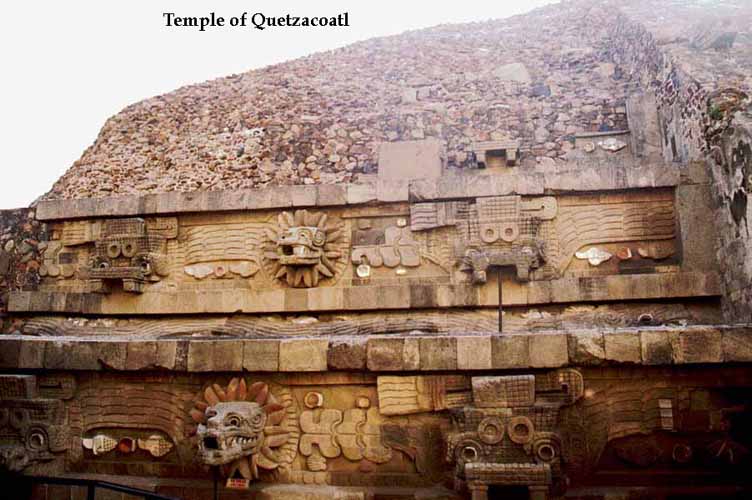
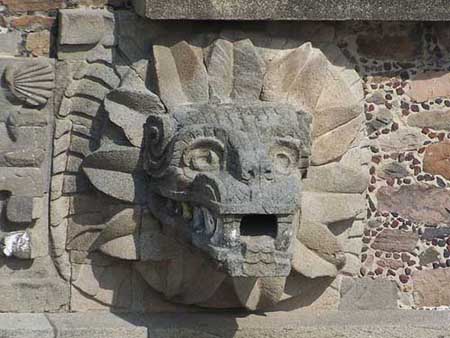
Feathered Serpent head at the Ciudadela complex in Teotihuacan
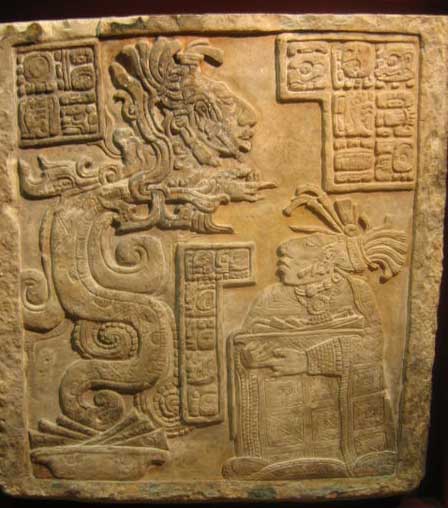
Vision Serpent depicted on lintel 15 from Yaxchilan.
A feathered Serpent deity has been worshipped by many different ethno-political groups in Mesoamerican history. The existence of such worship can be seen through studies of iconography of different mesoamerican cultures, in which serpent motifs are frequent. Based on the different symbolic systems used in portrayals of the feathered serpent deity in different cultures and periods scholars have interpreted the religious and symbolic meaning of the feathered serpent deity in Mesoamerican cultures.
The earliest representations of feathered serpents appear in the Olmec culture (circa 1400-400 BCE). It is believed that Olmec supernaturals such as the feathered serpent were the forerunners of many later Mesoamerican deities, although experts disagree on the feathered serpent's importance to the Olmec. The Olmec feathered serpent is generally shown as a crested rattlesnake, sometimes with feathers covering the body, and often in close proximity to humans. Several Olmec representations have survived including La Venta Monument 19 and a painting in the Juxtlahuaca cave.
The pantheon of the people of Teotihuacan (200 BCE - 700 CE) also featured a feathered serpent, shown most prominently on the Temple of the Feathered Serpent (dated 150-200 CE). Several feathered serpent representations appear on the building, including full-body profiles and feathered serpent heads.
Buildings in Tula, the capital of the later Toltecs (950-1150 CE), also featured profiles of feathered serpents.
Quetzalcoatl is the Aztec incarnation of the Feathered Serpent deity, known from several Aztec codices such as the Florentine codex, as well as from the records of the Spanish conquistadors. Quetzalcoatl was a bringer of knowledge, the inventor of books, and associated with the planet Venus.
The feathered serpent was rare in the Classic era Maya civilization.
Along with the feathered serpent deity, several other serpent gods existed in the pantheon of Mesoamerican gods with similar traits.
The earliest iconographic depiction of the deity is believed to be found on Stela 19 at the Olmec site of La Venta, depicting a serpent rising up behind a person probably engaged in a shamanic ritual. This depiction is believed to have been made around 900 BC, although probably not exactly a depiction of the same feathered serpent deity worshipped in classic and post-classic periods it shows the continuity of symbolism of feathered snakes in Mesoamerica from the formative period and on, for example in comparison to the Mayan Vision Serpent shown below.
The first culture to use the symbol of a feathered serpent as an important religious and political symbol was Teotihuacan. At temples such as the aptly named "Quetzalcoatl temple" in the Ciudadela complex, feathered serpents figure prominently and alternate with a different kind of serpent head. The earliest depictions of the feathered serpent deity were fully zoomorphic, depicting the serpent as an actual snake, but already among the Classic Maya the deity began acquiring human features.
In the iconography of the classic period Maya serpent imagery is also prevalent: a snake is often seen as the embodiment of the sky it self, and a vision serpent is a shamanic helper presenting Maya kings with visions of the underworld.
The archaeological record shows that after the fall of Teotihuacan that marked the beginning of the epi-classic period in Mesoamerican chronology around 600 AD, the cult of the feathered serpent spread to the new religious and political centers in central Mexico, centers such as Xochicalco, Cacaxtla and Cholula. Feathered serpent iconography is prominent at all of these sites. Cholula is known to have remained the most important center of worship to Quetzalcoatl, the Aztec/Nahua version of the feathered serpent deity, in the postclassic period.
During the epi-classic period a dramatic spread of feathered serpent iconography is evidence throughout Mesoamerica, and during this period begins to figure prominently at cites such as Chichen Itza, El Tajin, and throughout the Maya area. Colonial documentary sources from the Maya area frequently speak of the arrival foreigners from the central Mexican plateau often lead by a man whose name translates as "Feathered Serpent", it has been suggested that these stories recall the spread of the feathered serpent cult in the epiclassic and early postclassic periods.
In the postclassic Nahua civilization of central Mexico (Aztec) the worship of Quetzalcoatl was ubiquitous. The most important center was Cholula where the world's largest pyramid was dedicated to his worship. In Aztec culture depictions of Quetzalcoatl were fully anthropomorphic. Quetzalcoatl was associated with the winded god Ehecatl and is often depicted with his insignia: a beak like mask.
Based on the Teotihuacan iconographical depictions of the feathered serpent, archaeologist Karl Taube has argued that the feathered serpent was a symbol of fertility and internal political structures contrasting with the War Serpent symbolizing the outwards military expansion of the Teotihuacan empire.
Historian Enrique Florescano also analysing Teotihuacan iconography shows that the Feathered Serpent was part of a triad of agricultural deities: the Goddess of the Cave symbolizing motherhood, reproduction and life, Tlaloc, god of rain, lightning and thunder and the feathered serpent, god of vegetational renewal. The feathered serpent was furthermore connected to the star venus because of this star's importance as a sign of the beginning of the rainy season. To both Teotihuacan and Mayan cultures Venus was in turn also symbolically connected with warfare.
While not usually feathered, classic Maya serpent iconography seems related to the belief in a sky, venus, creator, war and fertility related serpent deity. In the example from Yaxchilan the Vision Serpent has the human face of the young maize god, further suggesting a connection to fertility and vegetational renewal, the Mayan Young Maize god was also connected to Venus.
In Xochicalco depictions of the feathered Serpent is accompanied by the image of a seated, armed ruler and the hieroglyph for the day sign 9 Wind. The date 9 wind is known to be associated with fertility, venus and war among the Maya and frequently occurs in relation to Quetzalcoatl in other Mesoamerican cultures.
Based on the iconography of the feathered serpent deity at sites such as Teotihuacan, Xochicalco, Chichen Itza, Tula and Tenochtitlan combined with certain ethnohistorical sources, historian David Carrasco has argued that the preeminent function of the feathered serpent deity throughout Mesoamerican history was as the patron deity of the Urban center, a god of culture and civilization.
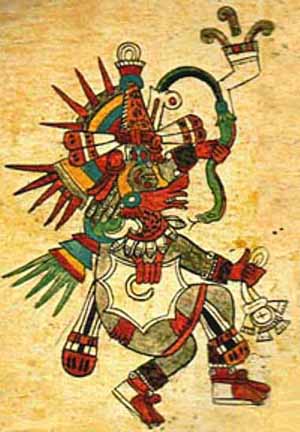
Quetzalcoatl as depicted in the Codex Borbonicus.
The worship of Quetzalcoatl sometimes included animal sacrifices, and in colonial traditions Quetzalcoatl was said to oppose human sacrifice.
Mesoamerican priests and kings would sometimes take the name of a deity they were associated with, so Quetzalcoatl and Kukulcan are also the names of historical persons.
One noted Post-Classic Toltec ruler was named Quetzalcoatl; he may be the same individual as the Kukulcan who invaded Yucatan at about the same time. The Mixtec also recorded a ruler named for the Feathered Serpent. In the 10th century a ruler closely associated with Quetzalcoatl ruled the Toltecs; his name was Topiltzin Ce Acatl Quetzalcoatl. This ruler was said to be the son of either the great Chichimeca warrior, Mixcoatl and the Culhuacano woman Chimalman, or of their descent.
It is believed that the Toltecs had a dualistic belief system. Quetzalcoatl's opposite was Tezcatlipoca, who, in one legend, sent Quetzalcoatl into exile. Alternatively, he left willingly on a raft of snakes, promising to return.
The Aztecs turned him into a symbol of dying and resurrection and a patron of priests. When the Aztecs adopted the culture of the Toltecs, they made twin gods of Tezcatlipoca and Quetzalcoatl, opposite and equal; Quetzalcoatl was also called White Tezcatlipoca, to contrast him to the black Tezcatlipoca. Together, they created the world; Tezcatlipoca lost his foot in that process.
Along with other gods, such as Tezcatlipoca and Tlaloc, Quetzalcoatl was called "Ipalnemohuani", a title reserved for the gods directly involved in the creation, which means "by whom we live". Because the name Ipalnemohuani is singular, this led to speculations that the Aztec were becoming monotheistic and all the main gods were only one. While this interpretation cannot be ruled out, it is probably an oversimplification of the Aztec religion.
The exact significance and attributes of Quetzalcoatl varied somewhat between civilizations and through history. Quetzalcoatl was often considered the god of the morning star, and his twin brother Xolotl was the evening star (Venus). As the morning star he was known by the title Tlahuizcalpantecuhtli, meaning "lord of the star of the dawn." He was known as the inventor of books and the calendar, the giver of maize (corn) to mankind, and sometimes as a symbol of death and resurrection. Quetzalcoatl was also the patron of the priests and the title of the Aztec high priest.
Most Mesoamerican beliefs included cycles of suns. Usually, our current time was considered the fifth sun, the previous four having been destroyed by flood, fire and the like. Quetzalcoatl allegedly went to Mictlan, the underworld, and created fifth-world mankind from the bones of the previous races (with the help of Chihuacoatl), using his own blood, from a wound in his penis, to imbue the bones with new life.
His birth, along with his twin Xolotl, was unusual; it was a virgin birth, to the goddess Coatlicue. Alternatively, he was a son of Xochiquetzal and Mixcoatl.
One Aztec story claims that Quetzalcoatl was seduced by Tezcatlipoca into becoming drunk and sleeping with a celibate priestess, and then burned himself to death out of remorse. His heart became the morning star.
It has been widely believed that the Aztec Emperor Moctezuma II initially believed the landing of Hernan Cortes in 1519 to be Quetzalcoatl's return. This has been questioned by some ethnohistorians, like Matthew Restall, who argues that the Quetzalcoatl-Cortes connection is not found in any document that was created independently of post-Conquest Spanish influence, and that there is little proof of a pre-Hispanic belief in Quetzalcoatl's return. Most documents expounding this theory are of entirely Spanish origin, such as Cortes' letters to Charles V of Spain, in which Cortes goes to great pains to present the naive gullibility of the Aztecs in general as a great aid in his conquest of Mexico.
Much of the idea of Cortes being seen as a deity can be traced back to the Florentine Codex written down some 50 years after the conquest. In the codex's description of the first meeting between Moctezuma and Cortes, the Aztec ruler is described as giving a prepared speech in classical oratorial Nahuatl, a speech which, as described verbatim in the codex (written by Sahagun's, Tlatelolcan informants), included such prostrate declarations of divine or near-divine admiration.
Subtleties in, and an imperfect scholarly understanding of, high Nahuatl rhetorical style make the exact intent of these comments tricky to ascertain, but Restall argues that Moctezuma politely offering his throne to Cortes (if indeed he did ever give the speech as reported) may well have been meant as the exact opposite of what it was taken to mean: politeness in Aztec culture was a way to assert dominance and show superiority. This speech, which has been widely referred to, has been a factor in the widespread belief that Moctezuma was addressing Cortes as the returning god Quetzalcoatl.
Other parties have also propagated the idea that the Native Americans believed the conquistadors to be gods: most notably the historians of the Franciscan order such as Fray Geronimo de Mendieta. Some Franciscans at this time held millennarian beliefs and the natives taking the Spanish conquerors for gods was an idea that went well with this theology. Bernardino de Sahagun, who compiled the Florentine Codex, was also a Franciscan.
Some scholarship still maintains the view that the Aztec Empire's fall may be attributed in part to the belief in Cortes as the returning Quetzalcoatl. However, a number of Mesoamericanist scholars (such as Matthew Restall (2003), James Lockhart (1994), Susan D. Gillespie (1989), Camilla Townsend (2003a, 2003b), Louise Burkhart, and Michael E. Smith (2001) among others) consider the "Quetzalcoatl/Cortes myth" as one of many myths about the Spanish conquest which have risen in the early post-conquest period. (Knight 2004)
Some scholars have noted a resemblance of the Quetzalcoatl legend with that of the myth of the Pahana held by the Hopis of northern Arizona. Scholars have described many similarities between the myths of the Aztecs and those of the American Southwest, and posit a common root. The Hopi describe the Pahana as the "Lost White Brother," and they expected his eventual return from the east during which he would destroy the wicked and begin a new era of peace and prosperity. Hopi tradition maintains that they at first mistook the Spanish conquistadors as the Pahana when they arrived on the Hopi mesas in the 16th century.
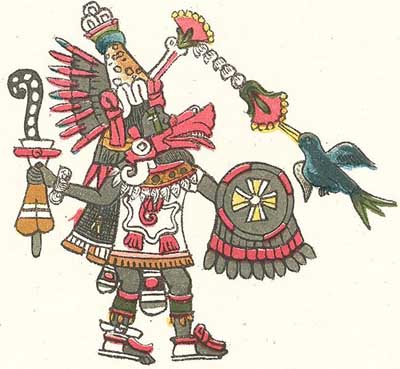
Quetzalcoatl and Hummingbird
(Rebirth)
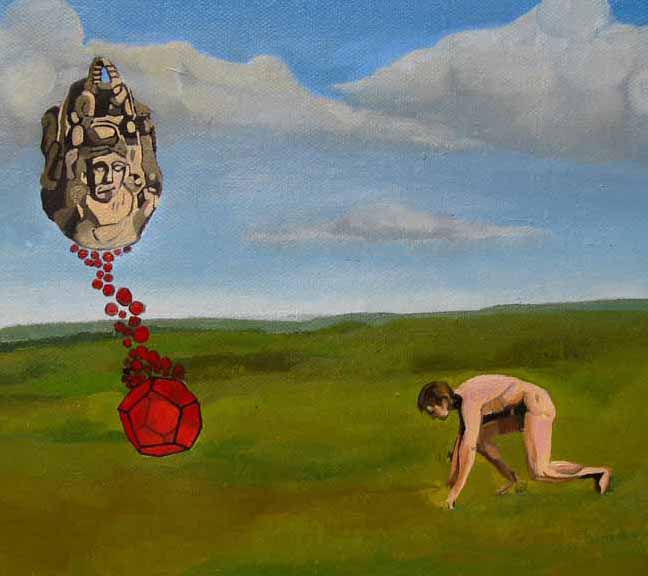
One theory of the Hollow Earth Hypothesis states that Quetzalcoatl disappeared on a UFO for 8 days. He visited the inner worlds beneath the sea, returning to create man, leaving messages in the Sacred Geometry of his design to be found at the end of time.
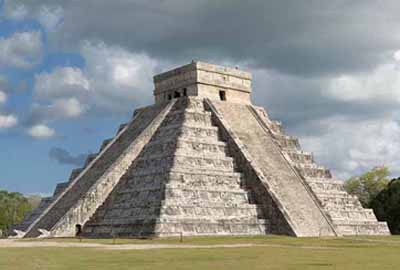
Pyramid of Kulkan at Chichen Itza - Quetzal Bird