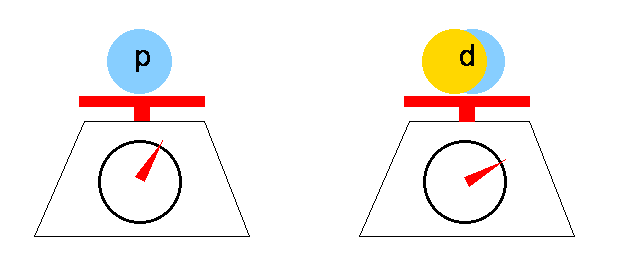
The hydrogen atom usually consists of a nucleus of single proton and its electron. There is an form of hydrogen called deuterium which has a proton and a neutron in its nucleus. Deuterium exists naturally, however only in a very small amount. All around us, only 0.015% of hydrogen atoms are deuterium. As the proton and neutron are almost equal in weight, the deuterium atom weighs about twice as much as the hydrogen atom. One often refers to the deuterium nucleus as a deuteron.
Water molecules are composed of two hydrogen atoms and one oxygen atom (H2O). If the hydrogen atoms of a water molecule are replaced by deuterium atoms, the result is heavy water (D2O).
An oxygen atom is about 16 times heavier than a hydrogen atom. So a water molecule is about 16+1+1=18 times heavier than a hydrogen atom, and a heavy water molecule is 16+2+2=20 times heavier than a hydrogen atom. In other words, heavy water is 20/18=1.11 times heavier than ordinary water.
CRYSTALINKS MAILING LIST, NEWSLETTER, UPDATES