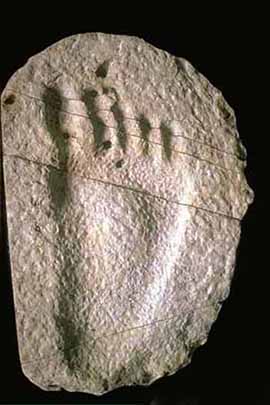
In North America Verified At 23,000 Years Old - Footprints in New Mexico suggest that people were making steps in North America during the Ice Age IFL Science - October 6, 2023
Two years ago, when a team of archaeologists made the mind-blowing claim that they had identified 23,000 to 20,000-year-old human footprints in New Mexico, many were surprised but not everyone was convinced. However, new research has affirmed this dating, indicating that people were wandering around North America during the Ice Age.
Footprints have been preserved as fossils and provide evidence of prehistoric life. Known as "ichnites", these trace fossils can give clues to the behavior of specific species of dinosaur. The study of such fossils is known as ichnology and the footprints may be given scientific names (ichnospecies). Grallator is one example of an ichnogenus based on ichnites. Strictly speaking, an ichnospecies is the name of the trace fossil, not of the animal that made it.
For example, an international team's discovery of a set of 1.5 million-year-old human ancestor footprints in Ileret, Kenya has shown the earliest direct evidence of a modern human style of upright walking. The team believe that the prints were probably formed by the species Homo erectus.
Other footprint findings:
Siwa Oasis Ð World's oldest hominid footprint discovered, over 3 million years old.
Laetoli Ð human footprints from the Pliocene era (3.7 million years ago) preserved in volcanic ash.
Koobi Fora Ð 1.5 million hominin footprints in Kenya showing essentially modern bipedal locomotion.
Acahualinca Ð 2,100 year old human footprints fossilized in volcanic ash and mud in Nicaragua.
Uskmouth Ð human footprints carbon dated to 4200BC preserved in clay.
Hawaii Volcanoes National Park Ð Footprint impressions found in the KaÕu Desert ash within Hawaii Volcanoes National Park.
Footprints of Eve Ð the oldest known footprints of an anatomically modern human.
1790 Footprints - a set of footprints on the island of Hawaii
The appearance of footprints, or marks interpreted as footprints, have led to numerous myths and legends. Some locations use such imprints as tourist attractions.
Examples of footprints in myth and legend include:
The Devil's Footprints Ð an unexplained series of hoof-like marks that appeared in Devon, England on 8 February 1855 after a light snowfall during the night.
Golden calf Ð in Islam dust from the hoofprints of Haizum, the winged horse of archangel Gabriel, is used to animate the Golden calf.
Moso's Footprint Ð a 1m by 3m rock enclosure in Samoa made when the giant Moso stepped over to Samoa from Fiji, and the other footprint can be found on Viti Levu, the largest island of Fiji.
Footprints of Bigfoot, a cryptozoological animal, are said to give proof to its existence.
Sri Pada, or Adam's Peak, a mountain in Sri Lanka, has a large footprint-shaped impression in the rock at its summit, said by various religious adherents to be that of the Buddha, Shiva or Adam.
The reputed print of the right foot of Jesus is preserved in the Mosque of the Ascension in Jerusalem.
A set of Jesus's footprints, according to legend, are preserved at the Church of Domine Quo Vadis outside of Rome.
A mark in stone of the paving of the Munich Frauenkirche is known as the Teufelstritt ("Devil's Footstep").
Confirmed: New Mexico Footprints Rewrite Timeline of Humans in America Science Alert - June 24, 2025

Ancient seas left an expanse of rolling gypsum dunes known as White Sands in New Mexico, and within this surreal landscape lies evidence that humans have roamed the Americas for at least 20,000 years. While most of White Sands is protected as a national park, the US army controls part of it as a missile range. It was within this section that researchers found clay footprints, preserved below the gypsum, that have rewritten the timeline of human presence in the Americas. Previously, we thought humans arrived in North America around 13,200 to 15,500 years ago. A new study combines evidence from mud, Ruppia seeds and pollen found in layers above and below the trace fossils, to date the footprints as being between 20,700 and 22,400 years old.
A set of footprints found at the site of Koobi Fora in Kenya reveals that our ancestor Homo erectus coexisted with a now-extinct bipedal hominin, Paranthropus boisei, 1.5 million years ago. Live Science - November 29, 2024
The tracks hint that the species may have interacted, raising new questions about the behavior of our ancestors.
Archaeologists Found 23,000-Year-Old Footprints That Rewrite the Story of Humans in America Science Alert - May 16, 2024

Studying preserved footprints in New Mexico continues to provide insight into the first human movements in North America. A research team believes the footprints are more than 23,000 years old, confirming an earlier study that dates the prints to 10,000 years older than previously believed. Tracking the footsteps provides modern scientists a view into ancient life.
90,000 Years Ago, Humans Walked on a Moroccan Beach. We Just Found Their Footprints Science Alert - February 7, 2024
Archaeologists in Morocco have unearthed more than 80 human footprints dating back around 100,000 years and believed to be the oldest in North Africa. The footprints, probably left by five Homo sapiens, including children, were discovered on the coast of Larache, a city 90 kilometres (55 miles) south of Tangier, by archaeologists from Morocco, Spain, France, and Germany.
In North America Verified At 23,000 Years Old - Footprints in New Mexico suggest that people were making steps in North America during the Ice Age IFL Science - October 6, 2023
Two years ago, when a team of archaeologists made the mind-blowing claim that they had identified 23,000 to 20,000-year-old human footprints in New Mexico, many were surprised but not everyone was convinced. However, new research has affirmed this dating, indicating that people were wandering around North America during the Ice Age.
World's Oldest Known Human Footprint Identified in South Africa Science Alert - June 16, 2023
Today the African tally for dated hominin ichnosites (a term that includes both tracks and other traces) older than 50,000 years stands at 14.
153,000-year-old footprints from South Africa are the oldest Homo sapiens tracks on record Live Science - May 31, 2023
Archaeologists in South Africa have discovered the footprints of Homo sapiens dating to 153,000 years ago, the oldest known tracks attributed to our species, a new study finds. The record-breaking finding is one of many unearthed in Africa over the past few decades. Since the report of 3.66 million-year-old footprints at the site of Laetoli in Tanzania over 40 years ago, paleoanthropologists have found more than 100 walking trails preserved in rocks, ash and mud left by our hominin ancestors, the group that includes modern and extinct humans as well as
Oldest Human Footprints In Germany Reveal Life In Saxony 300,000 Years Ago IFL Science - May 15, 2023
Around 300,000 years ago, a family of early humans visited a lake bordered by open forest. We don't know if they came there to drink, swim, or forage, but hunting the herds of giant beasts found there was probably not on their agenda. Their footprints not only record their presence, but place them in an ecosystem we can reconstruct from other clues.
Oldest Human Footprint in Americas May Be This 15,600-Year-Old Mark in Chile Live Science - May 1, 2019
The earliest human footprint on record in the Americas wasn't found in Canada, the United States or even Mexico; it was found much farther south, in Chile, and it dates to an astonishing 15,600 years ago, a new study finds. The finding sheds light on when humans first reached the Americas, likely by traveling across the Bering Strait land bridge in the midst of the last ice age. This 10.2-inch-long (26 centimeters) print might even be evidence of pre-Clovis people in South America, the group that came before the Clovis, which are known for their distinctive spearheads, the researchers said. The find suggests that pre-Clovis people were in northern Patagonia (a region of South America) for some time, as the footprint is older than archaeological evidence from Chile's Monte Verde, a site about 60 miles (100 kilometers) south containing artifacts that are at least 14,500 years old.
Footprint found in Chile is 'oldest' in Americas: scientists PhysOrg - April 29, 2019
Scientists in Chile say they have found a footprint dating from at least 15,600 years ago, making it the earliest such sign of man's presence in the Americas.The footprint was found at the Pilauco excavation in the city of Osorno (820 kilometers, or 500 miles, south of Santiago), where scientists have been digging since 2007. Archeologists from the Austral University of Chile said the footprint was first spotted in 2011 next to a house. It took years for paleontologist Karen Moreno and geologist Mario Pino to reliably confirm that the print was human.
Fossil footprints tell story of human origins BBC - December 14, 2016

Footprints made by early humans millions of years ago have been uncovered in Tanzania close to where similar tracks were found in the 1970s. The impressions were made when some of our distant relatives walked together across wet volcanic ash. Their makers, most likely Australopithecus afarensis, appear to have had a wide range of body sizes. Scientists say this gives clues to how this ancient species of human lived. Australopithecus afarensis is one of the longest-lived and best-known early human species. The fossil of "Lucy", a young adult female who lived in Ethiopia 3.2 million years ago, is perhaps the most famous individual. The newly discovered footprints may have been made by a male walking with smaller females.
Scientists find 800,000-year-old footprints in UK (Update) PhysOrg - February 7, 2014
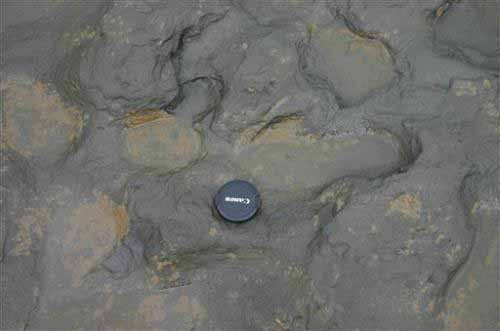
Archaeologists announced Friday that they have discovered human footprints in England that are between 800,000 and 1 million years oldÑthe most ancient found outside Africa, and the earliest evidence of human life in northern Europe. Preserved in layers of silt and sand for hundreds of millennia before being exposed by the tide last year, the prints give a vivid glimpse of some of our most ancient ancestors. They were left by a group, including at least two children and one adult male. They could have been be a family foraging on the banks of a river scientists think may be the ancient Thames, beside grasslands where bison, mammoth, hippos and rhinoceros roamed.
Earliest footprints outside Africa discovered in Norfolk BBC - February 7, 2014
In 2014 the oldest human footprints outside of Africa, being more that 800,000 years old, were reported to have been discovered on the beach. Scientists have discovered the earliest evidence of human footprints outside of Africa, on the Norfolk Coast in the East of England. The footprints are more than 800,000 years old and were found on the shores of Happisburgh. They are direct evidence of the earliest known humans in northern Europe. The footprints are one of the most important discoveries, if not the most important discovery, that has been made on these shores. Such discoveries are very rare. The Happisburgh footprints are the only ones of this age in Europe and there are only three other sets that are older, all of which are in Africa.
Discovery of oldest footprints gives clues to Mexico's climate PhysOrg - January 2, 2014
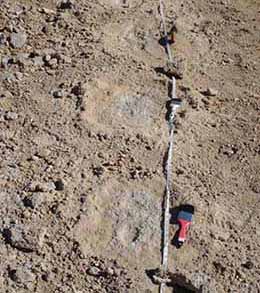
The oldest human footprints in North America have been dated for the first time and could help scientists to understand what Mexico's climate was like 7000 years ago. The new climate data comes from two sets of footprints found in the Chihuahuan desert in north-eastern Mexico. At 10.5 thousand years old, the museum footprints pre-date the oldest evidence of humans previously known in the area - a 9000 year old piece of human feces.
Nevada: Oldest 'Footprints' on Earth Found Live Science - October 5, 2008
The oldest-known tracks of a creature apparently using legs have been discovered in rock dated to 570 million years ago in what was once a shallow sea in Nevada. Scientists think land beasts evolved from ancient creatures that left the sea and evolved lungs and legs. If the new finding is real - the discoverer anticipates skepticism - it pushes the advent of walking back 30 million years earlier than any previous solid finding.
The aquatic creature left its "footprints" as two parallel rows of small dots, each about 2 millimeters in diameter. Scientists said today that the animal must have stepped lightly onto the soft marine sediment, because its legs only pressed shallow pinpoints into that long-ago sea bed.
The tracks were made during what is called the Ediacaran period, which preceded the Cambrian period, the time when most major groups of animals first evolved. Scientists had once thought only microbes and simple multicellular animals existed prior to the Cambrian, but that notion is changing, said Ohio State University Professor Loren Babcock. "We keep talking about the possibility of more complex animals in the Ediacaran soft corals, some arthropods, and flatworms, but the evidence has not been totally convincing," Babcock said. "But if you find evidence, like we did, of an animal with legs, an animal walking around then that makes the possibility much more likely. We came on an outcrop that looked like it crossed the Precambrian-Cambrian boundary, so we stopped to take a look at it. We just sat down and started flipping rocks over. We were there less than an hour when I saw it."
Little can be gleaned about what sort of creature it was, but Babcock is "reasonably certain - not 100 percent" that it was an arthropod, such as one resembling a centipede or millipede, or by a leg-bearing worm. It might have been about as wide as a pencil and may have had multiple, spindly legs.
In 2002, other researchers reported a similar fossil trail from Canada that dated back to the middle of the Cambrian period, about 520 million years ago. Another set of tracks found in South China date back to 540 million years ago. At approximately 570 million years old, this new fossil not only provides the earliest suggestion of animals walking on legs, but it also shows that complex animals were alive on Earth before the Cambrian.
Oldest Identifiable Footprints Found Live Science - September 12, 2007
Two reptile-like animals living 290 million years ago are the oldest creatures to have their footprints positively identified after a fortuitous discovery allowed scientists to match fossils to preserved trackways. Fossils of Diadectes absitus and Orobates pabsti were recently found in the Tambach Formation in central Germany. Nearby and in the same sediment layer, scientists found well-preserved footprints made by creatures that plodded through the region's soft sediments long ago. The footprints turned out to be a match for the fossil animals. The work, detailed in the latest issue of the Journal of Vertebrate Paleontology, marks the first footprints of the Paleozoic Era, a time before the dinosaurs that lasted from 540 to 240 million years ago, to be associated with the animals that made them. It could also force scientists to rethink how the ancient creatures moved.
Ancient human footprints found in Australia NBC - July 28, 2006
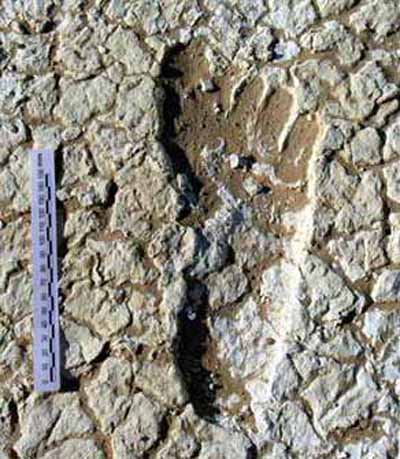
Researchers believe prints were made approximately 20,000 years ago when humans trekked along the margins of a shallow lake in Australia, leaving behind records of their passage in the soft, wet sand. In 2003, an aboriginal woman who is likely a descendant of those early Australians stumbled across dozens of timeworn footprints in the same area. Excavations of the site have since uncovered hundreds more. The discovery, detailed in a recent issue of the Journal of Human Evolution, represents the largest collection of Pleistocene human footprints in the world, and the only footprints from that era ever found in Australia. In total, 457 footprints have now been uncovered. The Pleistocene stretched from about 2 million to 12,000 years ago. Highlights from the era:
The extinction of Neanderthals and large land mammals - including mammoths, giant sloth and saber toothed cats;
The rise of modern humans.
Humans weren't the only ones that passed through the area. The prints from two kangaroo hind paws are visible, as are the tracks of a baby emu, a large flightless bird similar to an ostrich. The emu prints might be an important clue about when the human footprints were made.
Footprints of 'first Americans' BBC - July 5, 2005
Human settlers made it to the Americas 30,000 years earlier than previously thought, according to new evidence. A team of scientists came to this controversial conclusion by dating human footprints preserved by volcanic ash in an abandoned quarry in Mexico. They say the first Americans may have arrived by sea, rather than by foot. The traditional view is that the continent's early settlers arrived around 11,000 years ago, by crossing a land bridge between Siberia and Alaska. The footprints were preserved as trace fossils in volcanic ash along what was the shoreline of an ancient volcanic lake. They were soon covered in more ash and lake sediments and, when water levels rose, became as solid as concrete.
Oldest human footprints found - 350,000 years ago BBC - March 2003
The oldest human footprints have been found in volcanic ash in Italy. They were made by individuals scrambling down the flanks of an active volcano about 350,000 years ago. Italian scientists, who identified three separate fossilized trackways, say the people that made them walked on two feet using their hands only to steady themselves on a difficult descent.
AP - June 11, 1999 - Paris
A young boy walking inside a cave 25,000 to 27,000 years ago left what French archaeologists believe may be the oldest human footprints in Europe. French archaeologists discovered the four footprints while exploring the so-called Chauvet cave, which already boasts the world's oldest reliably dated wall paintings, in the southern Ardeche region. Scientists studying the site said there was no way to precisely date the prints in the damp clay, but that carbon datings nearby in the cave strengthen their case. The cave, discovered five years ago by an amateur spelunker, contains 300 prehistoric wall paintings, considered the world's oldest. The radiocarbon datings of the paintings, as well as campfire remains, range from 23,000 to 32,000 years.
The footprints were discovered by a team of 15 scientists who joined those already studying the paintings in May. The markings, which measure 8.3 inches long, are thought to have been made by a boy 8 to 10 years old. If the scientists are correct, the footprints are the oldest known in Europe, belonging to Cro-Magnon man. The Chauvet cave's walls are adorned with animals of the glacial era and the floors littered with campfires, flints and the bones of bears.

Sacred Caves