The Human Experiment is ending. With that - an insert in the simulation of reality creates a flood story - (symbolic flow of the collective unconsciousness as all is virtual) - moving to another insert of experience. The current insert is the finale in the multi-faceted Human Experiment in Time.
A flood myth or deluge myth is a symbolic narrative in which a great flood is sent by a deity, or deities, to destroy civilization in an act of divine retribution. Parallels are often drawn between the flood waters of these myths and the primeval waters found in certain creation myths, as the flood waters are described as a measure for the cleansing of humanity, in preparation for rebirth.
There are many flood myths. It is a theme widespread among most cultures, though it is perhaps best known in modern times through the biblical and Quranic account of Noah's Ark, the Hindu Puranic story of Manu, through Deucalion in Greek mythology, or Utnapishtim in The Story of Gilgamesh which takes us to the beginning - Anunnaki.
Most flood myths contain a culture hero, who strives to ensure a rebirth. The flood myth motif is widespread among many cultures as seen in the Mesopotamian flood stories, the Puranas, Deucalion in Greek mythology, the Genesis flood narrative, and in the lore of the K'iche' and Maya peoples of Central America, the Lac Courte Oreilles Ojibwa tribe of Native Americans in North America, and the Muisca people in South America.
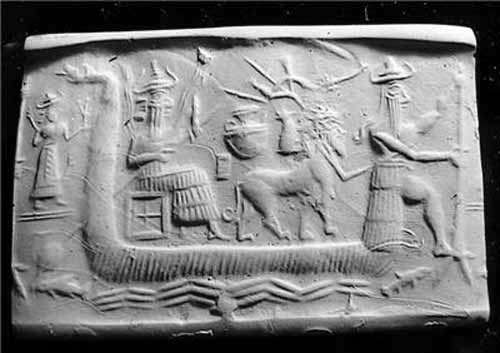
Parallels are often drawn between the flood waters of these myths and the primeval waters found in some creation myths since the flood waters are seen to cleanse humanity in preparation for rebirth. Most flood myths also contain a culture hero who strives to ensure this rebirth.
Could Noah's Ark and other 'ships' that allegedly saved specific bio-genetically encoded humans, have been UFO's? This implies aliens, or a consciousness force, create program after program - based on the same algorithm in its various iterations - or consciousness holograms of different races of humans through which they study, monitor, and learn.
Adrienne Mayor's The First Fossil Hunters and Fossil Legends of the First Americans promoted the hypothesis that flood stories were inspired by ancient observations of seashells and fish fossils inland and on mountains.
The ancient Greeks, Egyptians, Romans, and Chinese all wrote about finding such remains in these locations, and the Greeks hypothesized that Earth had been covered by water several times, noting seashells and fish fossils found on mountain tops as evidence. Native Americans also expressed this belief in their early encounters with Europeans, though they had not written it down previously.
However, Leonardo da Vinci postulated that an immediate deluge could not have caused the neatly ordered strata he found in the Italian Apennines.
Some geologists believe that quite dramatic, unusually great flooding of rivers in the distant past might have influenced the legends. One of the latest, and quite controversial, hypotheses of this type is the Ryan-Pitman Theory, which argues for a catastrophic deluge about 5600 BC from the Mediterranean Sea into the Black Sea. This has been the subject of considerable discussion, and a news article from National Geographic News in February 2009 reported that the flooding might have been "quite mild".
There also has been speculation that a large tsunami in the Mediterranean Sea caused by the Thera eruption, dated about 1630-1600 BC geologically, was the historical basis for folklore that evolved into the Deucalion myth. Although the tsunami hit the South Aegean Sea and Crete it did not affect cities in the mainland of Greece, such as Mycenae, Athens, and Thebes, which continued to prosper, indicating that it had a local rather than a region wide effect.
Another theory is that a meteor or comet crashed into the Indian Ocean around 3000 - 2800 BC, created the 30 kilometres (19 mi) undersea Burckle Crater, and generated a giant tsunami that flooded coastal lands.
It has been postulated that the deluge myth may be based on a sudden rise in sea levels caused by the rapid draining of prehistoric Lake Agassiz at the end of the last Ice Age, about 8,400 years ago.
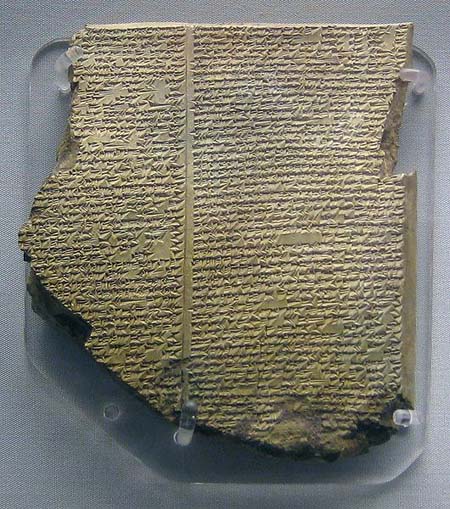
Fragment of a clay tablet from the library of Ashurbanipal at Nineveh, with an Assyrian account of the Flood. Some of the most famous cuneiform tablets are the 'Code of Hammurabi'. Hammurabi was a Babylonian king who lived long before the time of Moses. The tablets reveal intimate details of everyday life in the Near East and shed light on many obscure customs mentioned in Old Testament. Some tell the story of the Creation, the Fall, and the Flood. They do much to verify the truth of the Biblical record.
This tablet is perhaps the most famous of all cuneiform tablets. It is the eleventh tablet of the Gilgamesh Epic, and describes how the gods sent a flood to destroy the world. Like Noah, Utnapishtim was forewarned and built an ark to house and preserve living things. After the flood he sent out birds to look for dry land. Read more ...
Greek Myth
Zeus sent a flood to destroy the men of the Bronze Age. Prometheus advised his son Deucalion to build a chest. All other men perished except for a few who escaped to high mountains. The mountains in Thessaly were parted, and all the world beyond the Isthmus and Peloponnese was overwhelmed. Deucalion and his wife Pyrrha (daughter of Epimetheus and Pandora), after floating in the chest for nine days and nights, landed on Parnassus. When the rains ceased, he sacrificed to Zeus, the God of Escape. At the bidding of Zeus, he threw stones over his head; they became men, and the stones which Pyrrha threw became women. That is why people are called laoi, from laas, "a stone." [Apollodorus 1.7.2]
An older version of the story told by Hellanicus has Deucalion's ark landing on Mount Othrys in Thessaly. Another account has him landing on a peak, probably Phouka, in Argolis, later called Nemea. [Gaster, p. 85]
The Megarians told that Megarus, son of Zeus, escaped Deucalion's flood by swimming to the top of Mount Gerania, guided by the cries of cranes. [Gaster, p. 85-86]
An earlier flood was reported to have occurred in the time of Ogyges, founder and king of Thebes. The flood covered the whole world and was so devastating that the country remained without kings until the reign of Cecrops. [Gaster, p. 87]
"Many great deluges have taken place during the nine thousand years" since Athens and Atlantis were preeminent. Destruction by fire and other catastrophes was also common. In these floods, water rose from below, destroying city dwellers but not mountain people. The floods, especially the third great flood before Deucalion, washed away most of Athens' fertile soil. [Plato, "Timaeus" 22, "Critias" 111-112]
Roman Myth
Jupiter, angered at the evil ways of humanity, resolved to destroy it. He was about to set the earth to burning, but considered that that might set heaven itself afire, so he decided to flood the earth instead. With Neptune's help, he caused storm and earthquake to flood everything but the summit of Parnassus, where Deucalion and his wife Pyrrha came by boat and found refuge. Recognizing their piety, Jupiter let them live and withdrew the flood. Deucalion and Pyrrha, at the advice of an oracle, repopulated the world by throwing "your mother's bones" (stones) behind them; each stone became a person. [Ovid, book 1]
Jupiter and Mercury, traveling incognito in Phrygia, begged for food and shelter, but found all doors closed to them until they received hospitality from Philemon and Baucis. The gods revealed their identity, led the couple up the mountains, and showed them the whole valley flooded, destroying all homes but the couple's, which was transformed into a marble temple. Given a wish, the couple asked to be priest and priestess of the temple, and to die together. In their extreme old age, they changed into an oak and lime tree. [Ovid, book 8]
Scandinavian Myth
Oden, Vili, and Ve fought and slew the great ice giant Ymir, and icy water from his wounds drowned most of the Rime Giants. The giant Bergelmir escaped, with his wife and children, on a boat. Ymir's body became the world we live on. [Sturluson, p. 35]
Celtic Myth
Heaven and Earth were great giants, and Heaven lay upon the Earth so that their children were crowded between them, and the children and their mother were unhappy in the darkness. The boldest of the sons led his brothers in cutting up Heaven into many pieces. From his skull they made the firmament. His spilling blood caused a great flood which killed all humans except a single pair, who were saved in a ship made by a beneficent Titan. The waters settled in hollows to become the oceans. The son who led in the mutilation of Heaven was a Titan and became their king, but the Titans and gods hated each other, and the king titan was driven from his throne by his son, who was born a god. That Titan at last went to the land of the departed. The Titan who built the ship, whom some consider to be the same as the king Titan, went there also. [Sproul, pp. 172-173]
Welsh Myth
The lake of Llion burst, flooding all lands. Dwyfan and Dwyfach escaped in a mastless ship with pairs of every sort of living creature. They landed in Prydain (Britain) and repopulated the world. [Gaster, pp. 92-93]
Lithuanian Myth
From his heavenly window, the supreme god Pramzimas saw nothing but war and injustice among mankind. He sent two giants, Wandu and Wejas (water and wind), to destroy earth. After twenty days and nights, little was left. Pramzimas looked to see the progress. He happened to be eating nuts at the time, and he threw down the shells. One happened to land on the peak of the tallest mountain, where some people and animals had sought refuge. Everybody climbed in and survived the flood floating in the nutshell. God's wrath abated, he ordered the wind and water to abate. The people dispersed, except for one elderly couple who stayed where they landed. To comfort them, God sent the rainbow and advised them to jump over the bones of the earth nine times. They did so, and up sprang nine other couples, from which the nine Lithuanian tribes descended. [Gaster, p. 93]
German Myth
A louse and a flea were brewing beer in an eggshell. The louse fell in and burnt herself. This made the flea weep, which made the door creak, which made the broom sweep, which made the cart run, which made the ash-heap burn, which made the tree shake itself, which made the girl break her water-pitcher, which made the spring begin to flow. And in the spring's water everything was drowned. [Grimm 30]
Turkish Myth
Iskender-Iulcarni (Alexander the Great), in the course of his conquests, demanded tribute from Katife, Queen of Smyrna. She refused insultingly and threatened to drown the king if he persisted. Enraged at her insolence, the conqueror determined to punish the queen by drowning her in a great flood. He employed Moslem and infidel workmen to make a strait of the Bosphorus, paying the infidel workmen one-fifth as much as the Moslems got.
When the canal was nearly completed, he reversed the pay arrangements, giving the Moslems only one-fifth as much as the infidels. The Moslems quit in disgust and left the infidels to finish the canal. The Black Sea swept away the last dike and drowned the workmen. The flood spread over Queen Katife's country (drowning her) and several cities in Africa. The whole world would have been engulfed, but Iskender-Iulcarni was prevailed upon to open the Strait of Gibraltar, letting the Mediterranean escape into the ocean. Evidence of the flood can still be seen in the form of drowned cities on the coast of Africa and ship moorings high above the coast of the Black Sea. [Gaster, pp. 91-92]
Vogul Myth (Russia)
After seven years of drought, the Great Woman said to the Great Man that rains had come elsewhere; how should they save themselves. The Great Man counseled the other giants to make boats from cut poplars, anchor them with ropes of willow roots 500 fathoms long, and provide them with seven days of food and with pots of melted butter to grease the ropes. Those who did not make all the preparations perished when the waters came. After seven days, the waters sank. But all plants and animals had perished, even the fish. The survivors, on the brink of starvation, prayed to the great god Numi-tarom, who recreated living things. [Gaster, pp. 93-94]
Middle Eastern Myths
In this region, it is common to believe that the earth was originally covered with water, and that there is now a layer of water beneath the earth. Hebrews also have a layer of water above the earth.
Egyptian Myth
People have become rebellious. Atum said he will destroy all he made and return the earth to the Primordial Water which was its original state. Atum will remain, in the form of a serpent, with Osiris.
Persian Myth:
In early times, the earth was full of malign creatures fashioned by the evil Ahriman. The angel Tistar (the star Sirius) descended three times, in the form of man, horse, and bull respectively, causing ten days and nights of rain each time. The first flood drowned the creatures, but the seeds of evil remained. Before returning to cause the second flood, Tistar, in the form of a white horse, battled the demon Apaosha, who took the form of a black horse. Ormuzd blasted the demon with lightning, making the demon give a cry which can still be heard in thunderstorms, and Tistar prevailed. The poison washed from the land by the second flood made the seas salty. The waters were driven to the ends of the earth by a great wind and became the seas. [Vitaliano, pp. 161-162]
Assyrian Myth
The gods, led by Enlil, agreed to cleanse the earth of an overpopulated humanity, but Utnapishtim was warned by the god Ea in a dream. He and some craftsmen built a large boat (one acre in area, seven decks) in a week. He then loaded it with his family, the craftsmen, and "the seed of all living creatures." The waters of the abyss rose up, and it stormed for six days. Even the gods were frightened by the flood's fury.
Upon seeing all the people killed, the gods repented and wept. The waters covered everything but the top of the mountain Nisur, where the boat landed. Seven days later, Utnapishtim released a dove, but it returned finding nowhere else to land. He next returned a sparrow, which also returned, and then a raven, which did not return. Thus he knew the waters had receded enough for the people to emerge. Utnapishtim made a sacrifice to the gods. He and his wife were given immortality and lived at the end of the earth. [Sandars, chpt. 5]
Sharur destroyed Asag, demon of sickness and disease, by flooding his abode. In the process, "The primeval waters of Kur rose to the surface, and as a result of their violence no fresh waters could reach the fields and gardens." [Kramer, p. 105]
Sumerian Myth
The gods had decided to destroy mankind. The God Enki warned the priest-king Ziusudra ("Long of Life") of the coming flood by speaking to a wall while Ziusudra listened at the side. He was instructed to build a great ship and carry beasts and birds upon it. Violent winds came, and a flood of rain covered the earth for seven days and nights. Then Ziusudra opened a window in the large boat, allowing sunlight to enter, and he prostrated himself before the sun-god Utu. After landing, he sacrificed a sheep and an ox and bowed before Anu and Enlil. For protecting the animals and the seed of mankind, he was granted eternal life and taken to the country of Dilmun, where the sun rises. [Hammerly-Dupuy, p. 56; Heidel, pp. 102-106]
Hebrew Myth
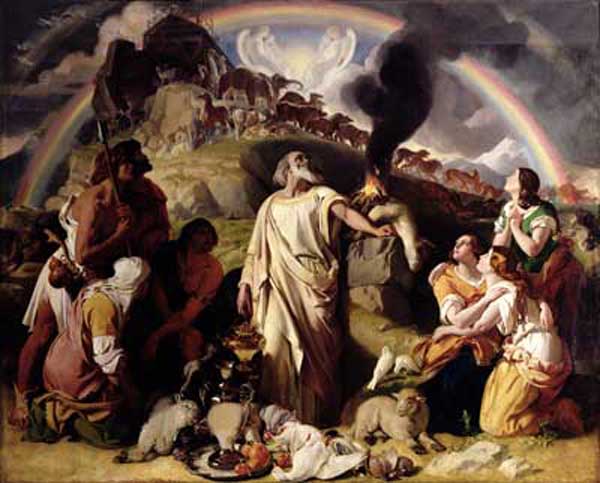
God, upset at mankind's wickedness, resolved to destroy it, but Noah was righteous and found favor with Him. God told Noah to build an ark, 450 x 75 x 45 feet, with three decks. Noah did so, and took aboard his family (8 people in all) and pairs of all kinds of animals (7 of the clean ones). For 40 days and nights, floodwaters came from the heavens and from the deeps, until the highest mountains were covered.
The waters flooded the earth for 150 days; then God sent a wind and the waters receded, and the ark came to rest in Ararat. After 40 days, Noah sent out a raven, which kept flying until the waters had dried up.
He next sent out a dove, which returned without finding a perch. A week later he set out the dove again, and it returned with an olive leaf. The next week, the dove didn't return.
After a year and 10 days from the start of the flood, everyone and everything emerged from the ark. Noah sacrificed some clean animals and birds to God, and God, pleased with this, promised never again to destroy all living creatures with a flood, giving the rainbow as a sign of this covenant. Animals became wild and became suitable food, and Noah and his family were told to repopulate the earth. Noah planted a vineyard and one day got drunk. His son Ham saw him lying naked in his tent and told his brothers Shem and Japheth, who came and covered Noah with their faces turned. When Noah awoke, he cursed Ham and his descendants and blessed his other sons. [Genesis 6-9]
The Koran [11:25-48] refers to the same flood event, adding that the earth swallowed the water, the boat came to rest on the mountain Al-Judi, and one of Noah's disbelieving sons drowned in the flood.
Aprocryphal scripture tells that Adam directed that his body, together with gold, incense, and myrrh, should be taken aboard the Ark and, after the flood, should be laid in the middle of the earth. God would come from thence and save mankind. [Platt, p. 66, 80 (2 Adam 8:9-18, 21:7-11)]
A woman "clothed with the sun" gave birth to a man child who was taken up by God. The woman then lived in the wilderness, where the Devil-dragon, cast down to earth, persecuted her. At one time he cast a flood of water from his mouth trying to wash her away, but the earth helped the woman and swallowed the flood. [Revelation 12]
Babylonian Myth
Three times (every 1200 years), the gods were distressed by the disturbance from human overpopulation. The gods dealt with the problem first by plague, then by famine. Both times, the god Enki advised men to bribe the god causing the problem. The third time, Enlil advised the gods to destroy all humans with a flood, but Enki had Atrahasis build an ark and so escape. Also on the boat were cattle, wild animals and birds, and Atrahasis' family. When the storm came, Atrahasis sealed the door with bitumen and cut the boat's rope. The storm god Adad raged, turning the day black. After the seven-day flood, the gods regretted their action. Atrahasis made an offering to them, at which the gods gathered like flies. and Enki established barren women and stillbirth to avoid the problem in the future. [Dalley, pp. 23-35]
Chaldean Myth
The god Chronos in a vision warned Xisuthrus of a coming flood, ordered him to write a history and bury it in Sippara, and told him to build and provision a vessel (5 stadia by 2 stadia) for himself, his friends and relations, and all kinds of animals, all of which he did. After the flood had come and abated somewhat, he sent out some birds, which returned. Later, he tried again, and the birds returned with mud on their feet. On the third trial, the birds didn't return. He disembarked in the Corcyraean mountains in Armenia and, with his wife, daughter, and pilot, offered sacrifices to the gods. Those four were translated to live with the gods. The others at first were grieved when they could not find the four, but they heard Xisuthrus' voice in the air telling them to be pious and to seek his writings at Sippara. [G. Smith, pp. 42-43]
Zoroastrian Myth
"After Ahura Mazda has warned Yima that destruction in the form of winter, frost, and floods, subsequent to the melting of the snow, are threatening the sinful world, he proceeds to instruct him to build a vara, 'fortress or estate,' in which specimens of small and large cattle, human beings, dogs, birds, red flaming fires, plants and foodstuffs will have to be deposited in pairs." [Dresden, p. 344]
Pygmy:
Chameleon heard a strange noise, like water running, in a tree, but at that time there was no water in the world. He cut open the trunk, and water came out in a great flood that spread all over the earth. The first human couple emerged with the water. [Parrinder, pp. 46-47]
Kikuyu (Kenya):
A beautiful but mysterious woman agreed to marry a man on the condition that he never ask about her family. He agreed, and they lived happily together until it was time for their oldest son's circumcision, and the man asked his wife why her family couldn't attend the ceremony. With that, the wife bounced into the air and made a hole seven miles deep when she landed. She called upon her ancestors, who came as spirits from Mt. Kenya. The spirits raised a thunder and hailstorm as they came. They brought food, goats, cattle, and beer with them and, while the people took shelter in caves, flooded the countryside with beer, turning it into a lake. When the spirits left, they took the couple and their children with them into Mt. Kenya. [Abrahams, pp. 336-338]
Southwest Tanzania:
The rivers began flooding. God told two men to go into a ship, taking with them all sorts of seed and animals. The flood rose, covering the mountains. Later, to check whether the waters had dried up, the man sent out a dove, and it came back to the ship. He waited and sent out a hawk, which did not return because the waters had dried. The men then disembarked with the animals and seeds. [Gaster, pp. 120-121]
Ekoi (Nigeria):
The first people Etim 'Ne (Old Person) and his wife Ejaw came to earth from the sky. At first, there was no water on earth, so Etim 'Ne asked the god Obassi Osaw for water, and he was given a calabash with seven clear stones. When Etim 'Ne put a stone in a small hole in the ground, water welled out and became a broad lake. Later, seven sons and seven daughters were born to the couple. After the sons and daughters married and had children of their own, Etim 'Ne gave each household a river or lake of its own. He took away the rivers of three sons who were poor hunters and didn't share their meat, but he restored them when the sons begged him to. When the grandchildren had grown and established new homes, Etim 'Ne sent for all the children and told them each to take seven stones from the streams of their parents, and to plant them at intervals to create new streams. All did so except one son who collected a basketful and emptied all his stones in one place. Waters came, covered his farm, and threatened to cover the whole earth. Everyone ran to Etim 'Ne, fleeing the flood. Etim 'Ne prayed to Obassi, who stopped the flood but let a lake remain covering the farm of the bad son. Etim 'Ne told the others the names of the rivers and streams which remained and told them to remember him as the bringer of water to the world. Two days later he died. [Courlander, pp. 267-269]
Efik-Ibibio (Nigeria):
The sun and moon are man and wife, and their best friend was flood, whom they often visited. They often invited flood to visit them, but he demurred, saying their house was too small. Sun and moon built a much larger house, and flood could no longer refuse their invitation. He arrived and asked, "Shall I come in?" and was invited in. When flood was knee-deep in the house, he asked if he should continue coming and was again invited to do so. The flood brought many relatives, including fish and sea beasts. Soon he rose to the ceiling of the house, and the sun and moon went onto the roof. The flood kept rising, submerging the house entirely, and the sun and moon made a new home in the sky. [Eliot, pp. 47-48]
Mandingo (Ivory Coast):
A charitable man gave away everything he had to the animals. His family deserted him, but when he gave his last meal to the (unrecognized) god Ouende, Ouende rewarded him with three handfuls of flour which renewed itself and produced even greater riches. Then Ouende advised him to leave the area, and sent six months of rain to destroy his selfish neighbors. The descendants of the rich man became the present human race. [Kelsen, pp. 135-136]
Bakongo (west Zaire):
An old lady, weary and covered with sores, arrived in a town called Sonanzenzi and sought hospitality, which was denied her at all homes but the last she came to. When she was well and ready to depart, she told her friends to pack up and leave with her, as the place was accursed and would be destroyed by Nzambi. The night after they had left, heavy rains came and turned the valley into a lake, drowning all the inhabitants of the town. The sticks of the houses can still be seen deep in the lake. [Feldmann, p. 50; Kelsen, p. 137]
Bachokwe? (southern Zaire):
A chieftainess named Moena Monenga sought food and shelter in a village. She was refused, and when she reproached the villagers for their selfishness, they said, in effect, "What can you do about it"? So she began a slow incantation, and on the last long note, the whole village sank into the ground, and water flowed into the depression, forming what is now Lake Dilolo. When the village's chieftain returned from the hunt and saw what had happened to his family, he drowned himself in the lake. [Vitaliano, pp. 164-165; Kelsen, p. 136]
Bena-Lulua (Congo River, southeast Zaire):
The old water woman only gave water to him who sucks her sores. One man did so, and water flowed and drowned almost everybody. He continued his disgusting task, and the water stopped flowing. [Kelsen, p. 136]
Lower Congo:
The sun once met the moon and threw mud at it, making it dimmer. There was a flood when this happened. Men put their milk stick behind them and were turned into monkeys. The present race of men is a recent creation. [Fauconnet, p. 481; Kelsen, p. 136]
Komililo Nandi:
Ilet, the spirit of lightning, came to live, in human form, in a cave high on the mountain named Tinderet. When he did so, it rained incessantly and killed most of the hunters living in the forest below. Some hunters, searching for the cause of the rain, found him and wounded him with poison arrows. Ilet fled and died in a neighboring country. When he died, the rain stopped. [Kelsen, p. 137]
Cameroon:
As a girl was grinding flour, a goat came to lick it. She first drove it away, but when it came back, she allowed it to lick as much as it could. In return for the kindness, the goat told her there will be a flood that day and advised her and her brother to run elsewhere immediately. They escaped with a few belongings and looked back to see water covering their village. After the flood, they lived on their own for many years, unable to find mates. The goat reappeared and said they could marry themselves, but they would have to put a hoe-handle and a clay pot with a broken bottom on their roof to signify that they are relatives. [Kahler-Meyer, pp. 251-252]
Kwaya (Lake Victoria):
The ocean was once enclosed in a small pot kept by a man and his wife under the roof of their hut to fill their larger pots. The man told his daughter-in-law never to touch it because it contained their sacred ancestors. But she grew curious and touched it. It shattered, and the resulting flood drowned everything. [Kahler-Meyer, pp. 253-254]
Hindu:
Manu, the first human, found a small fish in his washwater. The fish begged protection from the larger fishes, in return for which it would save Manu. Manu kept the fish safe, transferring it to larger and larger reservoirs as it grew, and later the fish saved Manu from a deluge by warning him to build a boat and letting him tie the craft to the fish's horn. The fish led him to a mountain and told Manu to tie the ship's rope to a tree to prevent it from drifting. Manu, alone of all creatures, survived. He made offerings of clarified butter, sour milk, whey, and curds. From these, a woman arose, calling herself Manu's daughter. Whatever blessings he invoked through her were granted him. Through her, he generated this race. [Gaster, pp. 94-95; Kelsen, p. 128; Brinton, pp. 227-228]
"The Lord of the Universe," to preserve king Satyavarata from dangers of the depravity of the age, sent him a large ship, and told him to gather himself, medicinal herbs, and pairs of brute animals aboard it to save them from a flood. Seven days later, the three worlds were flooded and darkened. The god appeared in the ocean as an enormous fish, a million leagues long, and Satyavarata tied the ark to its horn with a huge sea serpent. [Howey, pp. 389-390]
Bhil (central India):
Out of gratitude for the dhobi feeding it, a fish told a dhobi (a pious man) that a great deluge was coming. The man prepared a large box in which he embarked with his sister and a cock. After the flood, a messenger of Rama sent to find the state of affairs discovered the box by the cock's crowing. Rama had the box brought to him and questioned the man. Facing north, east, and west, the man swore that the woman was his sister; facing south, the man said she was his wife. Told that the fish gave the warning, Rama had the fish's tongue removed, and fish have been tongueless since. Rama ordered the man to repopulate the world, so he married his sister, and they had seven daughters and seven sons. [Gaster, pp. 95-96]
Kamar (Raipur District, Central India):
A boy and girl were born to the first man and woman. God sent a deluge to destroy a jackal which had angered him. The man and woman heard it coming, so they shut their children in a hollow piece of wood with provisions to last until the flood subsides. The deluge came, and everything on earth was drowned. After twelve years, God created two birds and sent them to see if the jackal had been drowned. They saw nothing but a floating log and, landing on it, heard the children inside, who were saying to each other that they had only three days of provisions left. The birds told God, who caused the flood to subside, took the children from the log, and heard their story. In due time they were married. God gave each of their children the name of a different caste, and all people are descended from them. [Gaster, p. 96]
Ho (southwestern Bengal):
The first people became incestuous and unheedful of God or their betters. Sirma Thakoor, or Sing Bonga, the creator, destroyed them, some say by water and others say by fire. He spared sixteen people. [Gaster, p. 96]
Lepcha (Sikkim):
A couple escaped a great flood on the top of a mountain called Tendong, near Darjeeling. [Gaster, p. 96]
Tibet:
Tibet was almost totally inundated, until the god Gya took compassion on the survivors, drew off the waters through Bengal, and sent teachers to civilize the people, who until then had been little better than monkeys. Those people repopulated the land. [Gaster, p. 97]
Assam:
A flood once covered the whole world and drowned everyone except for one couple, who climbed up a tree on the highest peak of the Leng hill. In the morning, they discovered that they had been changed into a tiger and tigress. Seeing the sad state of the world, Pathian, the creator, sent a man and a woman from a cave on the hill. But as they emerged from the cave, they were terrified by the sight of the tigers. They prayed to the Creator for strength and killed the beasts. After that, they lived happily and repopulated the world. [Gaster, p. 97]
Kamchadale (northeast Siberia):
A flood covered the whole land in the early days of the world. A few people saved themselves on rafts made from bound-together tree trunks. They carried their property and provisions and used stones tied to straps as anchors to prevent being swept out to sea. They were left stranded on mountains when the waters receded. [Gaster, p. 100]
Mongolia:
Hailibu, a kind and generous hunter, saved a white snake from a crane which attacked it. Next day, he met the same snake with a retinue of other snakes. The snake told him that she was the Dragon King's daughter, and the Dragon King wished to reward him. She advised Hailibu to ask for the precious stone that the Dragon King keeps in his mouth. With that stone, she told him, he could understand the language of animals, but he would turn to stone if he ever divulged its secret to anyone else.
Hailibu went to the Dragon King, turned down his many other treasures, and was given the stone. Years later, Hailibu heard some birds saying that the next day the mountains would erupt and flood the land. He went back home to warn his neighbors, but they didn't believe him. To convince them, he told them how he had learned of the coming flood and told them the full story of the precious stone.
When he finished his story, he turned to stone. The villagers, seeing this happen, fled. It rained all the next night, and the mountains erupted, belching forth a great flood of water. When the people returned, they found the stone which Hailibu had turned into and placed it at the top of the mountain. For generations, they have offered sacrifices to the stone in honor of Hailibu's sacrifice. [Elder & Wong, pp. 75-77]
China:
The Supreme Sovereign ordered the water god Gong Gong to create a flood as punishment and warning for human misbehavior. Gong Gong extended the flood for 22 years, and people had to live in high mountain caves and in trees, fighting with wild animals for scarce resources.
Unable to persuade the Supreme Sovereign to stop the flood, and told by an owl and a turkey about _Xirang_ or Growing Soil, the supernatural hero Gun stole Growing Soil from heaven to dam the waters. Before Gun was finished, however, the Supreme Sovereign sent the fire god Zhu Rong to execute him for his theft. The Growing Soil was taken back to heaven, and the floods continued.
However, Gun's body didn't decay, and when it was cut apart three years later, his son Yu emerged in the form of a horned dragon. Gun's body also transformed into a dragon at that time and thenceforth lived quietly in the deeps. The Supreme Sovereign was fearful of Yu's power, so he cooperated and gave Yu the Growing Soil and the use of the dragon Ying. Yu led other gods to drive away Gong Gong, distributed the Growing Soil to remove most of the flood, and led the people to fashion rivers from Ying's tracks and thus channel the remaining floodwaters to the sea. [Walls, pp. 94-100]
The goddess Nu Kua fought and defeated the chief of a neighboring tribe, driving him up a mountain. The chief, chagrined at being defeated by a woman, beat his head against the Heavenly Bamboo with the aim of wreaking vengeance on his enemies and killing himself. He knocked it down, tearing a hole in the sky. Floods poured out, inundating the world and killing everyone but Nu Kua and her army; her divinity made her and her followers safe from it. Nu Kua patched the hole with a plaster made from stones of five different colors, and the floods ceased. [Werner, p. 225; Vitaliano, p. 163]
Korea:
A son was borne to a fairy and a laurel tree; the fairy returned to heaven when the boy was seven years old. One day, rains came and lasted for many months, flooding the earth with a raging sea. The laurel, in danger of falling, told his son to ride him when it came uprooted by the waves. The boy did so, floating on the tree for many days. One day a crowd of ants floated by and cried out to be saved. After asking the tree for permission, the boy gave them refuge on the branches of the laurel. Later, a group of mosquitoes flew by and also asked to be saved. Again, the boy asked the tree for permission, was granted it, and gave the mosquitoes rest. Then another boy floated by and asked to be saved.
This time the tree refused permission when its son asked. The son asked twice more, and after the third time the tree said, "Do what you like," and the son rescued the other boy. At last the tree came to rest on the summit of a mountain. The insects expressed their gratitude and left.
The two boys, being very hungry, went and found a house where an old woman lived with her own daughter and a foster-daughter. As everyone else in the world had perished and the subsiding waters allowed farming again, the woman decided to marry her daughters to the boys, her own going to the cleverer boy. The second boy maliciously told the woman that the other boy could quickly gather millet grains scattered on sand.
The woman tested this claim, and the first boy despaired of ever succeeding, when the ants came to his aid, filling the grain bag in a few minutes. The other boy had watched, and he told the woman that the task hadn't been done by the first boy himself, so the woman still couldn't decide which daughter to marry to which boy. She decided to let the boys decide by chance, going to one room or another in total darkness. A mosquito came and told the Son of the Tree which room the old woman's daughter was in, so those two were married, and the second boy married the foster-daughter. The human race is descended from those two couples. [Zong, pp. 16-18]
Young Gim's father was killed by robbers, and Gim set out to track them and get revenge. On the way, he met another bereaved boy hunting the same robbers. They became sworn brothers, but they were separated when a storm upset their ferry as they were crossing a river. Gim was rescued by another boy who had been orphaned by the same robbers. They too swore to be brothers but were separated when their ferry sank in a storm. Gim was rescued and hidden by an old woman; he was on the island of the robbers but was helpless from his injuries. One day a mysterious man came by and asked Gim to go with him. Gim lived with the man in the mountains studying magic until he was sixteen, whereupon the man told him to go and rescue the king from the robbers, and that he would meet Gim again in three years exactly.
Gim set out, finding a magic horse, arms, and armor along the way, and arrived at the king's castle when it was on the point of surrender. In the enemy camp, he found a black face belching fire at the castle, a genii studying astrology, a rat whose swinging tail produced a flood which threatened the castle, and a giant who hurled flames at the King's camp. Gim fought them with his magic but was overwhelmed by their numbers. He fled with the king to an island, but the rat tried to submerge it with an even greater flood from its tail. A butterfly led Gim to a cavern in a distant mountain, where he met the first boy he had encountered. They went back to fight together, but the other boy was killed and the island submerged, and Gim and the King retreated to a second island.
Gim was led by a crow to another cavern in the mountains where he met his other friend. They returned to fight, but again the friend was killed, the island submerged, and Gim and the King had to retreat. When a third island was threatened with the flood, they took refuge on a ship. Gim's mentor then came (three years having elapsed) and with his magic called down thunderbolts which destroyed all of the enemy. Gim went to the enemy island, found his mother, and married the sister of his second friend. [Zong, pp. 62-66]
The River Dedong flooded the countryside. An old man in Pyongyang, rowing about in a boat, found and rescued a deer, a snake, and a boy from the waters. He carried them to shore and released them, but the boy had lost his parents in the flood and so became the man's adopted son. One day the deer came and led the man to a buried treasure of gold and silver, and the man became rich. The foster-son became reckless with the money, and he and his father argued. The boy accused the man of theft, and the man was imprisoned. The snake came to him in his cell and bit his arm, which then swelled painfully. But then the snake returned with a small bottle. The man applied the medicine to his arm, which cured it at once. In the morning, he heard that the magistrate's wife was dying of a snakebite, so he sent word that he could cure her. This he did with the snake's ointment. He was released, and the foster-son was arrested and punished. [Zong, pp. 94-95]
A foundling infant grew up incredibly fast and soon showed signs of fantastic strength. He earned the name "Iron-shoes" from the footwear he needed. He set out on a journey and met with and joined three other extraordinary men--"Nose-wind", who had extraordinarily powerful breath; "Long-rake", who crumbled mountains with his rake, and "Waterfall", who made rivers by pissing. They went to an old woman's home and were invited to spend the night, but the woman locked them in, and the men realized that she and her four sons were tigers in disguise. The tigers tried to kill them by roasting the room, but Nose-wind kept it cool by his blowing. The next day, the woman challenged them to a contest of gathering pine trees while her sons stacked them. When it became clear that the four brothers ripped up the trees faster than the tigers could stack them, the woman set fire to the logs. Waterfall, though, made water which not only put out the fire, but created a flood that nearly drowned the tigers. Nose-wind blew on the water and froze it. Iron-shoes skated out and kicked the heads off the tigers, and Long-rake broke up the ice and threw it far and wide, eliminating any trace of the flood. [Zong, pp. 162-166]
Andaman Islands (Bay of Bengal):
Some time after their creation, men grew disobedient. In anger, Puluga, the Creator, sent a flood which covered the whole land, except perhaps Saddle Peak where Puluga himself resided. Of all creatures, the only survivors were two men and two women who had the fortune to be in a canoe when the flood came. The waters sank and they landed, but they found themselves in a sad plight. Puluga recreated birds and animals for their use, but the world was still damp and without fire. The ghost of one of the peoples' friends took the form of a kingfisher and tried to steal a brand from Puluga's fire, but he accidentally dropped it on the Creator. Incensed, Puluga hurled the brand at the bird, but it missed and landed where the four flood survivors were seated. After the people had warmed themselves and had leisure to reflect, they began to murmur against the Creator and even plotted to murder him. However, the Creator warned them away from such rash action, explained that men had brought the flood on themselves by their disobedience, and that another such offense would likewise be met with punishment. That was the last time the Creator spoke with men face to face. [Gaster, pp. 104-105]
Chingpaw (Upper Burma):
When the deluge came, Pawpaw Nan-chaung and his sister Chang-hko saved themselves in a large boat. They took with them nine cocks and nine needles. When the storm and rain had passed, they each day threw out one cock and one needle to see whether the waters were falling. On the ninth day, they finally heard the cock crow and the needle strike bottom. They left their boat, wandered about, and came to a cave home of two nats or elves. The elves bade them stay and make themselves useful, which they did.
Soon the sister gave birth, and the old elfin woman minded the baby while its parents were away at work. The old woman, who was a witch, disliked the infant's squalling, and one day took it to a place where nine roads met, cut it to pieces, and scattered its blood and body about. She carried some of the tidbits back to the cave, made it into a curry, and tricked the mother into eating it. When the mother learned this, she fled to the crossroads and cried to the Great Spirit to return her child and avenge its death. The Great Spirit told her he couldn't restore her baby, but he would make her mother of all nations of men. Then, from each road, people of different nations sprang up from the fragments of the murdered babe. [Gaster, pp. 97-98]
Kammu (northern Thailand):
A brother and sister tried to dig out a bamboo rat, but it told them it was digging to escape a coming flood and instructed them to seal themselves inside a drum to save themselves. They did so. Some richer people took refuge on rafts, but the rafts overturned when the waters receded, and those people died. The brother and sister made a hole, saw water, sealed the drum again, and waited longer.
The second time they made a hole, they saw dry land and emerged. (In another version, they took along a needle and knew the flood was over when no water leaked in the hole they poked.) They looked far and wide for mates, but they were the only survivors.
A malcoha cuckoo sang to them, "brother and sister should embrace one another." They slept together. After seven years, the child was born as a gourd. They put it behind their house and went about their work. Later, hearing noises from the gourd, they burnt a hole in its shell, and people of the different races came out, first Rumeet, then Kammu, Thai, Westerner, and Chinese. The Rumeet are darker because they rubbed off charcoal around the hole. At first, none of those people could not speak. They sat down in a row on a tree trunk, it broke, and they all cried out, and with that they were able to speak. Later, the different people all learned different ways of writing. [Lindell et. al., pp. 268-278]
Ami (eastern Taiwan):
A brother and sister escaped a great deluge in a wooden mortar. They landed on a high mountain, married, had children, and founded the village of Popkok in a hollow of the hills, where they thought themselves safe from another deluge. [Gaster, p. 104]
Ifugao (Philippines):
A great drought dried up all the rivers. The old men suggested digging in a river bed to find the soul of the river. After three days of digging, a great spring gushed forth rapidly enough to kill many of the diggers. While the Ifugaos celebrated the waters, a storm came, the river kept rising, and the elders advised people to run for the mountains, as the river gods were angry.
Only two people made it to safety, a brother and sister, Wigan and Bugan, on the separate mountains Amuyao and Kalawitan. Both had enough food on the summits, but only Bugan had fire. After six months, the waters receded. Wigan traveled to his sister on Mt. Kalawitan, and they settled in the valley. The sister later found herself with child and ran away in shame, following the course of the river. The god Maknongan, appearing as an old man, assured her that her shame had no foundation, since she and her brother would repopulate the world. [Demetrio, p. 262]
Only a brother and sister named Wigam and Bugan survived a primeval flood, on Mount Amuyas. [Gaster, p. 104]
Batak (Sumatra):
Naga-Padoha, the giant snake on which the earth rests, grew tired of its burden and shook it off into the sea. But the god Batara-Guru caused a mountain to fall into the water to preserve his daughter Puti-orla-bulan. She had three sons and daughters from whom the human race is descended. Later, the earth was replaced onto the head of the snake, and there has been a constant struggle between the snake, wanting to be free of its burden, and the deity. [Kelsen, p. 133]
Debata, the Creator, sent a flood to destroy every living thing when the earth grew old and dirty. The last pair of humans took refuge on the highest mountain, and the flood had already reached their knees, when Debata repented his decision to destroy mankind. He tied a clod of earth to a thread and lowered it. The last pair stepped onto it and were saved. As the couple and their descendants multiplied, the clod increased in size, becoming the earth we inhabit today. [Gaster, p. 100]
Dyak (Borneo):
Some women gathered bamboo shoots, sat on a log, and began paring them. But they noticed the trunk exuded drops of blood with each cut of their knives. Some men came by and saw that the trunk was actually a giant, torporous boa constrictor. They killed it, cut it up, and took it home to eat. While they were frying the pieces, strange noises came from the frying pan and a torrential rain began.
The rain continued until only the highest hill remained above water. Only a woman, dog, rat, and a few small creature survived. The woman noticed that the dog had found shelter from the rain under a creeper warmed by the rubbing between the creeper and a tree in the wind. She took the hint, rubbed the creeper against a piece of wood, and produced fire for the first time.
The woman took the fire-drill for her mate and gave birth to a son called Simpang-impang. He was only half a man, with only one arm, one leg, etc. Some time later, the Spirit of the Wind carried off some rice which Simpang-impang had spread out to dry. Simpang-impang demanded compensation. The Spirit of the Wind refused but was vanquished in a series of contests and restored Simpang-impang's missing parts. [Gaster, pp. 101-102]
When the flood came, a man named Trow made a boat from a large wooden mortar previously used for pounding rice. He took with him his wife, a dog, pig, cat, fowl, and other animals, and rode out the flood. Afterwards, to repeople the earth, Trow fashioned additional wives out of a log, stone, and anything else handy. Soon he had a large family which became the ancestors of the various Dyak tribes. [Gaster, p. 102]
Valman (northern New Guinea):
The wife of a very good man saw a very big fish. She called her husband, but he couldn't see it until he hid behind a banana tree and peeked through its leaves. When he finally saw it, he was horribly afraid and forbade his family to catch and eat the fish. But other people caught the fish and, heedless of the man's warning, ate it. When the good man saw that, he hastily drove a pair of all kinds of animals into trees and climbed into a coconut tree with his family. As soon as the wicked men ate the fish, water violently burst from the ground and drowned everyone on it. As soon as the water reached the treetops, it sank rapidly, and the good man and his family came down and laid out new plantations. [Gaster, p. 105]
Papua New Guinea:
A flood covered the whole world except for the summit of Mount Tauga. When the waves threatened to cover even that, the rockface cracked and the diamond-studded head of Radaulo, king of snakes, emerged. His fiery tongue licked out to taste the waves, and the water, hissing, retreated. Radaulo slowly uncoiled and pursued the water all the way back to the ocean bed. [Eliot, p. 224]
Australian:
Grumuduk, a medicine man who lived in the hills, had the power to bring rain and to make plants and animals plentiful. A plains tribe kidnapped him, wanting his power, but Grumuduk escaped and decreed that wherever he walked in the country of his enemies, salt water would rise in his footsteps. [Flood, p. 179]
During the Dreamtime flood, woramba, the Ark Gumana carrying Noah, Aborigines, and animals, drifted south and came to rest in the flood plain of Djilinbadu (about 70 km south of Noonkanbah Station, just south of the Barbwire Range and east of the Worral Range), where it can still be seen today. The white man's claim that it landed in the Middle East was a lie to keep Aborigines in subservience. [Kolig, pp. 242-245]
Arnhem Land (northern Northern Territory):
In one version of the myth of the Wawalik sisters, the sisters, with their two infant children, camped by the Mirrirmina waterhole. Some of the older sister's menstrual blood fell into the well. The rainbow serpent Yurlunggur smelled the blood and crawled out of his well. He spit some well water into the sky and hissed to call for rain. The rains came, and the well water started to rise. The women hurriedly built a house and went inside, but Yurlunggur caused them to sleep. He swallowed them and their sons. Then he stood very straight and tall, reaching as high as a cloud, and the flood waters came as high as he did. When he fell, the waters receded and there was dry ground. [Buchler, pp. 134-135]
Two orphaned children were left in the care of a man called Wirili-up, who shirked the responsibility. The children, always hungry, cried so much that a ngaljod (rainbow serpent) rose from his waterhole and flooded the countryside. Wirili-up fled, but the children drowned. [Mountford, p. 74]
Gumaidj (Arnhem Land):
When a storm came up, two sisters who were gathering shellfish swore at Namarangini, the spirit
man who sang up the rain. He heard, grabbed the younger sister, and tried unsuccessfully to
copulate with her while the older sister beat him with a branch.
He took her to the hut at his camp, made a fire, and tried again, but he discovered there was a cycad nut grinding stone in her vagina. He removed it with her stick for beating cycad nuts, and then he copulated with her easily. When they had finished, she made herself into a fly and returned to her husband. Her husband discovered the stone was missing, and he killed her by pushing a heated stick through her vagina into her stomach. The next morning, the other sister discovered that she was dead and knew that her husband had killed her.
The Fly and Sandfly women cried for their sister and beat her husband, driving him away. He died and turned into a certain milkwood tree. When the women cried, rain fell heavily and continued falling for several weeks. They made bark rafts. A rush of water from inland washed them out to sea, to Elcho and other islands. At sea, you can still hear them crying. Women lost their grinding stones from their vagina when the flood washed them out to sea. [Berndt & Berndt, pp. 287-289]
Western Australia:
Long ago, two races, one white and one black, lived on opposite shores of a great river. At first they were on friendly terms, intermarrying, feasting together, etc. But the whites were more powerful and had better spears and boomerangs, so they came to feel superior and broke off relations. Some time later, it rained for several months. The river overflowed and forced the blacks to retreat into the hinterland. When the rains stopped and the waters receded, the black returned, to find that their neighbors had vanished under a wide sea. [Vitaliano, p. 166]
Victoria:
Bunjil, the creator, was angry with people because of the evil they did, so he caused the ocean to flood by urinating into it. All people were destroyed except those whom Bunjil loved and fixed as stars in the sky, and a man and a woman who climbed a tall tree on a mountain, and from whom the present human race is descended. [Gaster, p. 114]
Southeast Australian:
The animals, birds, and reptiles became overpopulated and held a conference to determine what to do. The kangaroo, eagle-hawk, and goanna were the chiefs of the three respective groups, and their advisors were koala, crow, and tiger-snake.
They met on Blue Mountain. Tiger-snake spoke first and proposed that the animals and birds, who could travel more readily, should relocate to another country. Kangaroo rose to introduce platypus, whose family far outnumbered any others, but the meeting was then adjourned for the day.
On the second day, while the conference proceeded with crow taunting koala for his inability to find a solution, the frilled lizards decided to act on their own. They possessed the knowledge of rain-making, and they spread the word to all of their family to perform the rain ceremony during the week before the new moon. Thus would they destroy the over-numerous platypus family.
They did their ceremonies repeatedly, and a great storm came, flooding the land. The frilled lizards had made shelters on mountains, and some animals managed to make their way there, but nearly all life was destroyed in the great flood. When the flood ended and the sun shone again, the kangaroo called animals together to discover how the platypus family had fared. But they could not find a single living platypus.
Three years later, the cormorant told emu that he had seen a platypus beak impression along a river, but never saw a platypus. Because of the flood, the platypuses had decided that the animals, birds, and reptiles were their enemies and only moved about at night. The animals organized a search party, and carpet-snake eventually found a platypus home and reported its location back to the others.
Kangaroo summoned all the tribes together, even the insect tribe. Fringed lizard was ejected for doing mischief; he has turned ugly because of the hate he dwells upon. The animals and birds found they were both related to the platypus family; even the reptiles found some relationship; and everyone agreed that the platypuses were an old race. Carpet-snake went to the platypus home and invited them to the assembly. They came and were met with great respect. Kangaroo offered platypus his choice of the daughter of any of them.
Platypus learned that emu had changed its totem so that the platypus and emu families could marry. This made platypus decide it didn't want to be part of any of their families. Emu got angry, and kangaroo suggested the platypuses leave silently that night, which they did.
They met bandicoot along the way, who invited the platypuses to live with them. The platypuses married the bandicoot daughters and lived happily. Water-rats got jealous and fought them but were defeated. Platypuses have tried to be separate from the animal and bird tribes ever since, but not entirely successfully. [W. R. Smith, pp. 151-168]
Maori (New Zealand):
Long ago, there were a great many different tribes, and they quarrelled and made war on each other. The worship of Tane, the creator, was being neglected and his doctrines denied.
Two prophets, Para-whenua-mea and Tupu-nui-a-uta, taught the true doctrine about the separation of heaven and earth, but others just mocked them, and they became angry.
So they built a large raft at the source of the Tohinga River, built a house on it, and provisioned it with fern-root, sweet potatoes, and dogs. Then they prayed for abundant rain to convince men of the power of Tane. Two men named Tiu and Reti, a woman named Wai-puna-hau, and other women also boarded the raft. Tiu was the priest on the raft, and he recited the prayers and incantations for rain.
It rained hard for four or five days, until Tiu prayed for the rain to stop. But though the rain stopped, the waters still rose and bore the raft down the Tohinga river and onto the sea. In the eighth month, the waters began to thin; Tiu knew this by the signs of his staff. At last they landed at Hawaiki. The earth had been much changed by the flood, and the people on the raft were the only survivors. They worshipped Tane, Rangi (Heaven), Rehua, and all the gods, each at a separate alter. After making fire by friction, they made thanks-offerings of seaweed for their rescue. Today, only the chief priest may go to those holy spots. [Gaster, pp. 110-112; Kelsen, p. 133]
Two brothers-in-law of the hero Tawhaki attacked him and left him for dead. He recovered, and retired with his own warriors and their families to a high mountain, where he built a fortified village. Then he called to the gods, his ancestors, for revenge. The floods of heaven descended and killed everyone on earth. This event was called "The overwhelming of the Mataaho." [Gaster, p. 112] In another version of the story, Tawhaki, a man, put on a garment of lightning and was worshipped as a god. Once, in a fit of anger, he stamped on the floor of heaven, breaking it and releasing the celestial waters which flooded the earth. [Gaster, p. 112] In another version, the flood was caused by the copious weeping of Tawhaki's mother. [Gaster, p. 112]
Palau Islands (Micronesia):
The stars are the shining eyes of the gods. A man once went into the sky and stole one of the eyes. (The Pelew Islanders' money is made from it.) The gods were angry at this and came to earth to punish the theft. They disguised themselves as ordinary men and went door-to-door begging for food and lodging. Only one old woman received them kindly.
They told her to make a bamboo raft ready and, on the night of the next full moon, to lie down on it and sleep. This she did. A great storm came; the sea rose, flooded the islands, and destroyed everyone else. The woman, fast asleep, drifted until her hair caught on a tree on the top of Mount Armlimui. The gods came looking for her again after the flood ebbed, but they found her dead. So one of the women-folk from heaven entered the body and restored it to life. The gods begat five children by the old woman and then returned to heaven, as did the goddess who restored her to life. The present inhabitants of the islands are descendants of those five children. [Gaster, pp. 112-113]
Before humans, one of the Kaliths (deities) named Athndokl visited an unfriendly village and was killed by its inhabitants. Seven friendly gods, who went searching for him, were met with unkindness except from the woman Milathk, who told them of the death. They resolved vengeance by flooding the village, and suggested Milathk save herself by preparing a raft tied to a tree by a rope. The flood came and covered the village at the next full moon. Milathk perished in the flood, but was recalled to life by the oldest Obakad god. He wanted to make her immortal but was stopped by another god, Tariit. Milathk became the mother of mankind. [Kelsen, p. 132]
Fiji:
The great god Ndengei had a favorite bird, called Turukawa, which would wake him every morning. His two grandsons killed the bird and buried it to hide the crime. Ndengei sent his messenger Utu to find the bird. The first search proved fruitless, but a second search exposed the grandsons' guilt.
Rather than apologizing, they fled to the mountains and took refuge with some carpenters, who built a strong stockade to keep Ndengei at bay. In their fortress, the rebels withstood Ndengei's armies for three months, but then Ndengei caused the earth to be flooded with rain. The rebels sat securely as the surrounding lands were submerged, until the waters reached their walls.
They prayed to another god for direction, and they were brought canoes (or taught how to make them) by Rokoro, the god of carpenters, and his foreman Rokola. (By other accounts, they were instructed to make floats out of the shaddock fruit, or they floated in bowls.) They floated around picking up other survivors. The receding tide left a total of eight survivors on the island of Mbengha. Two tribes were destroyed completely--one consisting entirely of women and the other with tails like dogs. The natives of Mbengha claim to rank highest of all the Fijians. [Kelsen, p. 131; Gaster, p. 106]
Samoa:
In a battle between Fire and Water (offspring of the primeval octopus), everything was overwhelmed by a 'boundless sea', and the god Tangaloa had the task of re-creating the world. [Poignant, p. 30]
Mangaia (Cook Islands):
The gods of sea and rain one day decided to engage in a contest to see which was more powerful. With the help of the wind god, the sea god attacked the coast, reaching the height of the Makatea (a raised barrier reef plateau surrounding the island). The rain god, with five days and nights of rain, washed the red clay and small stones into the ocean and carved deep valleys. Rangi, the people's chief, had been forewarned and led his people to the central peak. When their situation became precarious, he appealed to the supreme god, who ordered the other gods to stop. The results of their actions explain the island's landscape. [Vitaliano, p. 168]
Tahiti:
Tahiti was destroyed by the sea. Even the trees and stones were carried away by the wind. But two people were saved. The wife took up her young chicken, her young dog, and her kitten, and the husband took up his young pig. The husband said they should escape to Mount Orofena, but the wife said (correctly) that the flood would reach even there, and they should go to Mount Pita-hiti instead, which they did. They watched ten nights till the sea ebbed.
The land, though, remained without produce, and the fish in the rock crevices were putrid. When the wind died away, stones and trees began to fall from the heavens, where the winds had carried them. To escape this new danger, the couple dug a hole, lined it with grass, and covered it over with stones and earth. They crept inside and listened to the terrible crash of the falling stones.
By and by, the falling stones stopped, but to
be safe they waited another night before coming out. The land they found was desolated. The
woman brought forth two children, a son and a daughter, but grieved about the lack of food. Again
the mother brought forth, but still there was no food. Then in three days all the trees bore fruit. All
people are descended from that couple. [Gaster, pp. 108-109]
Hawaii:
Lalohona, a woman from the depths of the sea, was enticed ashore by Konikonia with a series of images. She warns him that her parents, Kahinalii and Hinakaalualumoana, will cause the ocean to flood the land so that her brothers, the pao'o fish, may search for her. At her suggestion, they fled to the mountains and built their home in the tops of the tallest trees.
After ten days, Kahinalii sent the ocean; it rose and overwhelmed the land. The people fled to the mountains, and the flood covered the mountains; they climbed the trees, and the flood rose above the trees and drowned them all. But the waters began to subside just as they reached the door of Konikonia's house. When the waters retreated, he and his people returned to their land. This flood is called kai-a-ka-hina-lii. [Barrere, p. 23]
All the land was once overflowed by the sea, except for the peak of Mauna Kea, where two humans survived. The event is called kai a Kahinarii (sea of Kahinarii). There was no ship involved. [Gaster, p. 110; Barr�re, p. 22]
In the earliest times in Hawaii, there was no sea, nor even fresh water. Pele came to Hawaii because she was displeased over her husband having been enticed from her. Her parents gave her the sea so she could bring her canoes. At Kanaloa she poured the sea from her head. It rose until it covered the high ground, leaving only a few mountains not entirely submerged. She later caused it to recede to what we see today. This sea was named after the mother of Pele, Kahinalii, because the sea belonged to her; Pele simply brought it. [Barr�re, pp. 23-24]
The people had turned to evil, so Kane punished their sin with a flood. Nu'u and his company were saved by entering into the Great-Canoe, a large canoe roofed over like a house, which had been given them by Kane. The canoe contained a number of things, and Nu'u ruled over the whole like a chief. After the flood, these people repopulated the islands. The waters came up as a wicked brother-in-law of Nu'u was indulging himself in pleasure. He ran to enter the ark, but his calls were unheard by those inside. He prayed to the god Lono in the name of his sister but did not escape. He became angry at the first pair of people who had brought this trouble by bringing evil into the world, and he prayed to Lono that the whole earth be destroyed and that the first pair of people be brought back to life to witness the trouble they caused. [Barr�re, pp. 19-21]
Nuu was of the thirteenth generation from the first man. The gods commanded Nuu to build an ark and carry on it his wife, three sons, and males and females of all breathing things. Waters came and covered the earth. They subsided to leave the ark on a mountain overlooking a beautiful valley. The gods entered the ark and told Nuu to go forth with all the life it carried. In gratitude for his deliverance, Nuu offered a sacrifice of pig, coconuts, and awa to the moon, which he thought was the god Kane. Kane descended on a rainbow to reproach Nuu for his mistake but left the rainbow as a perpetual sign of his forgiveness. [Kalakaua, p. 37; Barr�re, pp. 21-22]
A high chief had two boys killed for playing with his drums. Their father Kamalo sought the help of the shark god Kauhuhu to get revenge. Kauhuhu told the man to build a special fence around his place and to collect 400 black pigs, 400 red fish, and 400 white chickens. Months later, Kauhuhu came in the form of a cloud. He caused a great storm which washed everyone on the hillside, except Kamalo and his people, into the harbor, where sharks devoured them. [Westervelt, pp. 110-116]
Netsilik Eskimo:
A flood killed all animals and humans except for two Shaman, who survived in a boat. They copulated, and their offspring included the world's first women. [Balikci]
The giant Inugpasugssuk waded into the ocean to hunt seals. His penis stuck up out of the water so far away that he thought it was a seal putting its head up, and he struck it by mistake. He fell backwards in pain, and that raised a wave that flooded the whole district of Arviligjuaq. [Norman, p. 233]
Norton Sound Eskimo:
In the first days, all the earth was flooded except for a very high mountain in the middle. A few animals escaped to this mountain, and a few people survived in a boat, subsisting on fish. The people landed on the mountain as the water subsided and followed the retreating water to the coast. The animals also descended. [Gaster, p. 120]
Innuit:
An unusually high tide caused a global flood. Shellfish and such things in the mountains are evidence of it. [Gaster, p. 120]
Hareskin (Alaska):
Kunyan ("Wise Man"), foreseeing the possibility of a flood, built a great raft, joining the logs with ropes made from roots. He told other people, but they laughed at him and said they'd climb trees in the event of a flood.
Then came a great flood, with water gushing from all sides, rising higher than the trees and drowning all people but the Wise Man and his family on his raft. As he floated, he gathered pairs of all animals and birds he met with.
The earth disappeared under the waters, and for a long time no one thought to look for it. Then the musk-rat dived into the water looking for the bottom, but he couldn't find it. He dived a second time and smelled the earth but didn't reach it. Next beaver dived. He reappeared unconscious but holding a little mud.
The Wise Man placed the mud on the water and breathed on it, making it grow. He continued breathing on it, making it larger and larger. He put a fox on the island, but it ran around the island in just a day.
Six times the fox ran around the island, by the seventh time, the land was as large as it was before the flood, and the animals disembarked, followed by Wise Man with his wife (who was also his sister) and son. They repeopled the land. But the flood waters were still too high, and to lower them, the bittern swallowed them all. Now there was too little water. Plover, pretending sympathy at the bittern's swollen stomach, passed his hand over it, but suddenly scratched it. The waters flowed out into the rivers and lakes. [Gaster, pp. 117-118]
Kaska (northern inland British Columbia):
A great flood came; people survived it on rafts and canoes. Darkness and high winds came, which
scattered the vessels. When the flood subsided, people landed at the nearest land and lived where
they had landed. Thus they were scattered all over the world, and when they met again long
afterwards, they were different tribes and spoke different languages. [Gaster, p. 119]
Skagit (Washington):
The Creator made the earth and gave four names for it -- for the sun, waters, soil and forests. He
said only a few people, with special preparation for the knowledge, should know all four names, or
the world would change too suddenly. After a while, everyone learned the four names. When people
started talking to the trees the change came in the form of a flood.
When the people saw the flood coming, they made a giant canoe and filled it with five people and a male and female of all plants and animals. Water covered everything but the summit of Kobah and Takobah (Mts. Baker and Ranier). The canoe landed on the prairie. Doquebuth, the new Creator, was born of a couple from the canoe. He was told to go to a lake (Lake Campbell) and swim and fast to get his spirit powers, but he delayed.
Finally he did so after his family deserted him. The Old Creator came to him in dreams. First he told Doquebuth to wave his blanket over the water and the forest and name the four names of the earth; this created food for everyone. Next, at the direction of the Old Creator, he gathered the bones of the people who lived before the flood, waved the blanket over them and named the four names, and made people again.
These people couldn't talk, so he similarly made brains for them from the soil. Then they spoke many different languages, and Doquebuth blew them back to the places they lived before the flood. Someday, another flood will come and change the world again. [Clark, pp. 139-141]
Joshua (southern Oregon):
In the beginning, there was no land, and Xowalaci (The Giver) and his companion lived in a sweat house on the water. One day, white land appeared and expanded on the waters. Xowalaci made it solid by blowing tobacco smoke on it. He made more solid land by dropping five mud cakes into the ocean and telling them to expand when they hit the bottom.
When he stepped on the new land, it became solid. He looked on the sand of the new land and saw a man's tracks, seemingly coming from the north and leading into the water to the south. This worried him, and he told the water to overflow the land he had created from the mud and to recede again. But he found more tracks again, coming from the west, so he caused a second flood.
He repeated the process five times with no different results.
Finally he gave up and said, "This is going to make trouble in the future!" and there has been trouble in the world since then.
Then Xowalaci tried to make people. He formed figures from grass and mud, ordered a house to appear, and gave the figures to his companion to put in the house.
Dogs arose from this creation attempt. He tried again using white sand, but those figures gave rise to snakes. He attributed these failures to the footprints. The world became inhabited by dogs and snakes. He crushed the ten biggest snakes in baskets of mixed fresh and salt water and threw them in the ocean.
Two bad snakes got away to give rise to today's snake-like animals. Xowalaci ordered those two to encircle the world and hold it together. He also crushed five bad dogs and threw them in a ditch.
They gave rise to water monsters. Soon after, his companion smoked for three days and created a house from which a woman emerged. Xowalaci told his companion to be her husband. Xowalaci straightened out the world, made more animals, and went up into the sky, saying as he went that the companion, his wife, and their sixteen children would speak different languages and become progenitors of the different tribes. [Sproul, pp. 232-236; von Franz, p. 174]
Shasta:
Coyote encountered an evil water spirit who said, "There is no wood" and caused water to rise until it covered Coyote. After the water receded, Coyote shot the water spirit with a bow and ran away, but the water followed him. He ran to the top of Mount Shasta; the water followed but didn't quite reach the top. Coyote made a fire, and all the other animal people swam to it and found refuge there. After the water receded, they came down, made new homes, and became the ancestors of all the animal people today. [Clark, p. 12]
Pomo (north central California):
Coyote dreamed that water would soon cover the world, but nobody believed him. It rained, and the water started rising. The people climbed trees because there were no mountains to escape to. Coyote and a number of people escaped on a log. With the help of Mole, Coyote created mountains; then he created people for the new world. [Roheim, p. 153]
One day, the Thunder People found trout in their spring. At first, the people were afraid of them, but driven by hunger, the people ate them, except for three children who were warned by their grandmother not to eat them. The next morning, all but those three children had been transformed into deer. The children went to a very high mountain. Rain came and flooded all but the mountaintop. The children asked an old man what he could do; he said he didn't know, but he dug all night while the children slept. In the morning, he woke the children. The flood was gone, and the world was beautiful. [Roheim, pp. 153-154]
Everyone but Gopher was killed in a flood. He climbed to the top of Mt. Kanaktai, and just as the water was about to wash him off, it receded. He had no fire, so he dug into the mountain until he found fire inside, thus bringing fire again to the world. [Roheim, p. 154]
Coyote lived with two little boys whom he had got by deceit from one of the Wood-duck sisters. Everybody abused the boys, so Coyote decided to set the world on fire. He dug a tunnel at the east end of the world, filled it with fir bark, and lit it. With his two children in a sack, he called for rescue from the sky. Spider descended and took Coyote back up through the gates of the sky. When they came back, everything was roasted. Coyote drank too much water and got sick. Kusku the medicine man jumped on his belly, and water flowed out and covered the land. [Roheim, p. 154]
Salinan (California):
The old woman of the sea, jealous of Eagle's power, came with her basket in which she carried the sea. She continually poured out water until it covered the land, almost to the top of Santa Lucia Peak where the animals gathered. Eagle borrowed Puma's whiskers, made a lariat from them, and lassoed the basket. The sea stopped rising, and the old woman died. Eagle told Dove to fetch up some mud, and he made the world from it. Eagle shaped the first people, a woman and two men, from elder-wood. After sweating in a sweat-house, he blew on them and gave them life. Then they had a great fiesta. [Sproul, p. 236]
Luiseno (Southern California):
A great flood covered high mountains and drowned most people. A few saved themselves on a knoll called Mora by the Spaniards and Katuta by the Indians, staying there until the flood went down. The hill still has stones, ashes, and heaps of seashells showing where the Indians cooked their food. [Gaster, pp. 115-116]
Blackfoot (Alberta and Montana):
The Sun, the Moon, and their two children "Old Man" and "Apistotoki God" began creating the world. They were given sand, stone, water, and the hide of a fisher with which to complete the creation. A flood came, and they could save only those four things. Later, they create an old man, a dog, a man, and a woman. After a second flood, only those four are left on earth, and they create the rest of the world. [von Franz, p. 163]
Chippewa (Ontario, Minnesota, Wisconsin):
While the medicine man Wis-kay-tchach was hunting, his young wolf, his nephew, was killed by some water lynxes. Wis tried to kill one of the lynxes to get revenge. First, he turned himself into a stump at the edge of a lake. Frogs and snakes tried to pull the stump down, but Wis kept himself upright. The lynx, suspicions lulled, went to sleep. Wis returned to normal shape and, though warned to shoot the lynx's shadow, forgot and shot its body. He shot a second arrow at the shadow, but the lynx escaped into a river, which then overflowed and flooded the whole country. Wis escaped in a canoe. Land was recreated from mud obtained by a diving animal. [Roheim, p. 157, Kelsen, p. 147]
A wolf which Wenebojo considered his nephew and which hunted for him was captured and killed by the manidog, evil underwater spirits. To get revenge, Wenebojo turned himself to a stump and waited for the manidog to sun themselves. When they emerged, the king was suspicious of the stump and had a snake squeeze it and a bear claw it, but Wenebojo withstood these attacks.
When the manidog slept, Wenebojo shot and wounded the king and the next to the king, then he ran away as the water was rising behind him. Woodchuck saved him by digging a shelter until the water receded. Later, Wenebojo encountered an old woman who was treating the wounded manidog.
He killed and skinned her, put on her skin, and disguised as her went to the wigwam of the wounded manidog and killed them. As he ran away, he heard a roar of water behind him. He climbed a pine tree on a hill, and the tree stretched higher, saving Wenebojo from the flood.
Wenebojo asked loon to dive down to get some dirt, but the loon died in the attempt. Otter and beaver failed similarly. Muskrat, however, was able to get a few grains of dirt before he passed out. Wenebojo used this dirt to recreate land. Wenebojo cut up the body of the king manido and made a lake of fat from it. The animals that ate or touched it acquired fat in their bodies. [Barnouw, pp. 64-69]
The evil serpent Meshekenabek carried off Manobozho's cousin into a deep lake. Manobozho caused the sun to shine fiercely on the lake to drive out Meshekenabek and his companions. When they emerged, Manobozho shot an arrow into the serpent's heart. The serpent, in his dying rage, stirred up the waters of the lake and spread waves over the land. Fleeing, Manobozho warned the Indians also to retreat to a mountain top. The waters still rose, though, and Manobozho made a raft for them to take refuge on. However, Manobozho couldn't disperse the flood without some earth to use as a nucleus. Muskrat finally succeeded in diving for some dirt, and Manobozho used it to make the waters recede. [Howey, pp. 291-293]
In the beginning of time, in September, there was a great snow. A mouse nibbled a hole in the leather bag which contained the sun's heat, and the heat escaped and melted all the snow in an instant. The waters rose to cover even the highest mountains. One old man had foreseen the flood and warned everybody, but the others had thought to escape to the hills; they drowned in the flood. The old man had prepared a canoe and survived, rescuing animals he came across. After a while he sent, in turn, the beaver, otter, muskrat, and duck to find land. Only the duck returned, with some mud in its bill. The old man cast the mud on the water and blew on it, making solid land. [Vitaliano, p. 170]
Cheyenne (Minnesota):
The Great Spirit created three kinds of men: red men, white men with hairy heads, and hairy men with hair all over their body. The hairy men went to the barren south and eventually dwindled in numbers and disappeared. The red men went south after the Great Spirit taught them culture. They went north again when the Great Medicine told them the south would be flooded.
In the north, they found that the white men had gone and they could no longer talk to the animals, though they could still control them.
Later, they went south again, but another flood came and scattered them, and they never came together again. They traveled in small bands to the north, but they found it barren, so they returned south and lived the best they could. One particularly hard winter had earthquakes, volcanoes, and floods which destroyed all the trees. The people spent the long winter in caves and were almost famished the following spring. The Great Medicine, in pity, gave them corn and buffalo. Since then, there have been no more famines or floods. [Erdoes & Ortiz, pp. 112-113]
Lakota:
In the world before this one, the people didn't know how to behave or how to act human, and the creating power was displeased. He placed three dry buffalo chips under a sacred pipe rack and saved a fourth for lighting the pipe. He sang three songs to bring rain, which caused the rivers to overflow; then he sang a fourth song and stamped on the earth. The earth split open, and water flowed from the cracks and covered everything.
The Creating Power floated on the sacred pipe and his huge pipe bag. All people and animals were destroyed except Kangi, the crow. It was very tired and three times asked the Creating Power to make a place for it to rest. The Creating Power opened his pipe bag, which contained all manner of animals and birds, and selected four known for their diving abilities.
He sang a song and commanded the loon to dive and bring up mud, but the loon failed. Likewise, the water was too deep for otter and beaver.
But the turtle succeeded in bringing up a little mud. The Creating Power took the mud and, singing, spread it out on the water. After the fourth song, there was enough land for himself and the crow. He waved two long eagle feathers over the ground, and it spread until it replaced the water. He named it the Turtle Continent.
The Creating Power thought, "Land without water is not good," and wept for the earth and the creatures he would put upon it. His tears became oceans, streams, and lakes. He scattered the animals across the land; they came to life when he stamped on the ground. He created four colors of people from red, white, black, and yellow earth. He created the rainbow as a sign that there would be no more great flood. But warned that he had destroyed the first world by fire because it was bad, and the second world by flood, and he would destroy this world too if people make it bad and ugly. [Erdoes & Ortiz, pp. 496-499]
Unktehi, a water monster, fought the people and caused a great flood. The people retreated to a hill, but the water swept over them, killing them all. The blood gelled and turned to pipestone. (Pipes made from that rock are sacred today.) Unktehi was also turned to stone; her bones are in the Badlands now, forming a long ridge. A giant eagle, Wanblee Galeshka, swept down, saved one girl from the flood, carrying her to a tree on the highest pinnacle, the only place not covered by water. He made her his wife. She bore twins, a boy and a girl, which are the ancestors of the Sioux. [Erdoes & Ortiz, pp. 93-95]
Unktehi puffed up her body to make the Missouri overflow, and the little water monsters, her children, did the same with other streams and lakes. This caused a great flood which covered the country. Only a few people escaped to the highest mountain, and the waves threatened to kill them. The thunderbirds liked people, so they fought the water monsters for several years. In time, it became clear that the thunderbirds were losing when they fought close, so they retreated to the sky and, all together, sent their lightning bolts. This burned the forests, boiled the water, and turned the earth red hot, except where the people had taken refuge. Unktehi and the water monsters were defeated. Their bones can still be seen in the Badlands. [Erdoes & Ortiz, pp. 220-222]
Choctaw (Mississippi):
A prophet was sent by the high god to warn of a coming flood, but nobody took notice. When the flood came, the prophet took to a raft. After several months, he saw a black bird. He signaled it, but it just cawed and flew away. Later, he sighted and signaled a bluish bird. The bird flapped, moaned dolorously, and guided the raft towards where the sun was breaking through. Next morning, he landed on an island with all kinds of animals. He cursed the black bird (a crow) and blessed the bluish one (a dove). [Gaster, p. 116]
Navajo (Four Corners area):
The first world, where Navajos originated, was inhabited by Insect People of twelve types. For their sins of adultery and constant quarreling, the gods expelled them by sending a wall of water from all directions.
The Insect People (gray aliens) flew up into the second world, guided through a hole in the sky by a cliff swallow. The second world was a barren world inhabited by Swallow People. They decided to stay anyway, but after 24 days, one of the Insect People made love to the wife of the Swallow People's chief. They were expelled to the third world; the white face of the wind told them of an opening. The third world was a barren world of Grasshopper People. Again, the Insect People were expelled for philandering after 24 days.
The red face of the wind guided them to the hole to the fourth world. This world was inhabited by animals and Pueblos, with whom the Insect People coexisted peacefully. The gods made people in human form from ears of corn, different colors of corn becoming different tribes.
The Insect People intermarried with them, and their descendants eventually looked fully human. In time, the men and women argued and decided to live apart. But both groups engaged in unnatural sex acts, and eventually the women were starving, so they got back together. The gods were displeased by their sins, though, and sent a wall of water upon them.
The people noticed animals running and sent cicadas to investigate. They escaped the floodwaters by climbing into a fast-growing reed. Cicada dug an entrance into the fifth world, which was inhabited by grebes. The grebes said that people could have that world if they could survive plunging arrows into their heart. The cicadas met this challenge (they bear the scars on their sides still), and people live in the fifth world today. [Capinera, pp. 226-228]
In the last world before this one, the people lived in peace. One day First Anger (Coyote) saw two babies playing by the waters. Finding them cute and seeing no parent around, he took them. Their mother (Water Monster) became enraged when she returned and found them gone. She demanded that her babies be returned or she would flood the lands.
The waters began to rise, so First Man sent the bird and insect people to find some way of escape. They found a hole in the sky to escape through, and they placed four mountains, one on top of the other, then a corn stalk, and finally a hollow reed to reach it. Everyone made it safely into this world, but the waters kept rising. First Man searched for the babies and found them in First Anger's pouch. He forced the old Coyote to return them and apologize to the mother.
Once he had returned the babies, the waters ceased rising. Some of the people returned to the last world, and others decided to stay and make a life here on this world. [Carlos Nakai Rodriguez, personal communication] .
Hopi:
The people repeatedly became distant from Sotuknang, the creator. Twice he destroyed the world (by fire and by cold) and recreated it while the few people who still lived by the laws of creation took shelter underground with the ants.
When people became corrupt and warlike a third time, Sotuknang guided the ones who had retained their wisdom to Spider Woman, who cut down giant reeds and sheltered the people in the hollow stems with a little water and food. Sotuknang caused a great flood with rain and waves, and the people floated in their reeds for a long time.
Finally, they came to rest on a small piece of land, and Spider Woman unsealed their reeds and pulled them out by the tops of their heads. They still had as much food as they started with. They sent out birds to find more land, but to no avail.
They grew a tall reed and climbed it, but they saw only water. But guided by their inner wisdom (which comes from Sotuknang through the door at the top of their head), the people traveled on, using the reeds as canoes.
They went northeast, finding progressively larger islands. The last of these was large and fruitful, and people wanted to stay there, but Spider Woman urged them on. They went further northeast, paddling hard as if going uphill, until they came to the Fourth World.
The shores were rocky with seemingly no place to land, but by opening the doors at the tops of their head, they found a current that took them to a sandy beach. Sotuknang appeared and told them to look back, and they saw the islands, the last remnants of the Third World, sink into the ocean. [Waters, pp. 12-20]
Spider Clan, Blue Flute Clan, Fire Clan, Snake Clan, and Sun Clan traveled together on the Hopi migrations. On their northward journey, they were blocked at the Arctic Circle by a mountain of ice and snow.
This was the Back Door of the Fourth World, which Sotuknang said was closed to them. Spider Woman and the Spider Clan, however, urged them to go on, and all the clans used their powers to try to melt and bread down the mountain. They tried four times but failed. Sotuknang told Spider Woman that if they had succeeded, the melted snow and ice would have flooded the world. He punished her by letting her grow old and ugly, and Spider Clan became breeders of wickedness. [Waters, pp. 39-40]
Jicarilla Apache (northeastern New Mexico):
Before the Apaches emerged from the underworld, there were other people on the earth. Dios told an old man and old woman that it would rain forty days and nights.
People were warned to go to the tops of four mountains (Tsisnatcin, Tsabidzilhi, Becdilhgai, and another whose identity isn't known), and not to look at the flood or sky. The people didn't believe the old couple. When the rains came, only a few people made it to the mountain tops and shut their eyes.
Those who looked at the flood turned into a fish or frog (as did some who were caught in the flood); if they looked at the sky, they turned into a bird.
The people sitting on the mountains were told, when they got hungry, to think of food, and Dios would feed them. After eighty days, Dios told the 24 people remaining to open their eyes and come down.
These 24 people went into 24 mountains. Eight other people survived the flood who were able to travel by looking where they wanted to go, and they were there. These people told the Apaches about the flood before going into two mountains themselves. Dios told them to say there until the world is destroyed. Around the year 2000, when the Apaches dwindle in number, the surface of the earth will again be destroyed, this time by fire. [Opler, pp. 111-113]
When people still lived in the underworld, the chief, after an argument with his mother-in-law, decided that men and women should live apart for awhile, so the men all moved to the other side of a river, and the chief prayed to Kogulhtsude (a water spirit) to widen the river.
They lived four years like this. The women's farms became less and less productive, and they began to go hungry. The men wanted sexual satisfaction and began some sexual perversions; the older girls, likewise affected, began to masturbate with elk horns, eagle feathers, and other things. These things impregnated them and produced the monsters that afterwards killed men. About that time, Coyote found a baby in a whirlpool in the river and took it out to raise himself.
But the baby was Kogulhtsude's child, and he sent water out to draw it back. Some people were drowned and turned into frogs and fish; the other men and women escaped together to a tall mountain. Coyote used his magic to make the mountain grow, but the waters kept rising, finally overflowing onto this world. The people suspected Coyote was causing the trouble and found the baby hidden under his coat.
They threw the baby (which was almost dead from drying) into the water, and the water receded. The people went down into the underworld again. When they later emerged, the surface of the earth was covered with water from that flood. The four Holy Ones made black, blue, yellow, and glittering hoops and threw them in each compass direction, and the water receded. They commanded the four winds to dry the land further. [Opler, p. 20, 265-268]
As the waters rose, a chief led his warriors into the Superstition Mountains in Arizona. When it became clear that even the mountain peaks would be submerged, the chief told his braves that, rather than let them drown ignominiously, he would turn then to stone. They are there guarding the heights even today. [Vitaliano, p. 170]
Yaqui (Sonoran, Northern Mexico):
On the 17th day of February, in the year 614, it rained for fourteen days all over the world. The waters rose and destroyed all living things. Yaitowi, a just and perfect man who walked with Dios, was saved, along with thirteen others and eleven women, on the hill of Parbus (today called Maatale). A few other people, seven birds, seven asses, and seven little dogs were saved on other mountains. After the flood, two angels appeared to two of the survivors, and the angel San Gabriel came, sent by Dios, telling the people to "go by the way of our Dios and Father." When they arrived at Venedici, they heard the voice of Dios, who promised the rainbow as a sign that no other flood would destroy earth. [Giddings, pp. 106-108]
Toltec (Mexico):
One of the Tezcatlipocas (sons of the original dual god) transformed himself into the Sun and created the first humans to show up his brothers. The other gods, angry at his audacity, had Quetzalcoatl destroy the sun and the earth, which he did with a flood. The people became fish. This ended the first age. The second, third, and fourth Suns ended, respectively, with the crumbling of the heavens, a rain of fire, and devastating winds.
Maya (southern Mexico and Guatemala):
The Puzob, an industrious dwarf people, were the first inhabitants of the earth. God destroyed them with a flood because of their carelessness in their observation of custom. They heard that a terrible storm was coming, so they put some stones in a pond and sat on them, but the dwarfs were all destroyed. Jesucristo sent down four angels to investigate what was happening on earth. They removed their clothes and bathed, whereupon they became doves. Some other angels were sent down; they were turned into buzzards when they ate the dead. [Horcasitas, p. 194]
After people were created, the sky fell upon the earth, and the waters followed them. The world was destroyed. The four Bacab gods managed to escape and now hold up the four corners of the sky.
Two floods had destroyed humanity. Three people escaped a third and final flood in a canoe. [Horcasitas, p. 191]
Nicaragua:
The world was once destroyed by a deluge. After its destruction, the gods created all things afresh. [Gaster, p. 121]
Panama:
One man, with his wife and children, escaped the flood in a canoe. Mankind are descended from them. [Gaster, p. 121]
Quechua (Peru):
The world wanted to come to an end. A llama buck, knowing that the ocean would soon overflow, was depressed. When its human owner complained that it wouldn't eat, the llama told him that the flood would occur in five days and suggested they go to Villca Coto mountain with five days' food. The man left in a hurry, carrying both the llama and the supplies. They arrived at the mountain to find the peak already filled with all kinds of animals. The flood came as soon as they arrived and lasted five days, then it dried to the ocean's normal position. The fox's tail was soaked, which turned it black. Afterwards, the man began to multiply once more. [Salomon & Urioste, pp. 51-52]
Paria Caca, a god born from five falcon eggs, heard about a man called Tamta Namca who called himself a god and had himself worshipped, and about other people's sins. He went into a rage, rose up as rain, and washed them all away to the ocean, together with their homes and llamas. At that time a tree called the Pullao formed an arch between the Llantapa and Vichoca mountains; in it lived monkeys, toucans, and other birds. These too were swept to sea. [Salomon & Urioste, pp. 59-60]
Paria Caca went to the village Huauqui Usa, which was celebrating a festival. He sat at the end of the banquet like a stranger. No one offered him a drink while he sat there, until at the end of the day a woman finally did so. Paria Caca told the woman that these people had made him mad, told her that in five days something terrible would happen to the village, and warned her to take her family away and not to tell anyone else, or he might kill her, too. Five days later, the woman and her family left. The other villagers continued drinking without a care. Paria Caca climbed Matao Coto, a mountain which overlooks the village, and rising up as red and yellow hail, caused a torrential rainstorm. It washed all the villagers to the ocean and shaped the slopes and valleys of the area. [Salomon & Urioste, pp. 61-62] He similarly exterminated another village where no one offered him a drink. [Salomon & Urioste, p. 127]
The Inca summoned people from every village to help defeat their enemies. Paria Caca sent his child Maca Uisa. When nobody else at the meeting offered to help, Maca Uisa said he would defeat the enemies completely. Strong litter bearers carried him to the battle front, and as soon as he got there, he started raining on them, gently at first, then pouring rain. He washed away their villages in a mudslide and killed their strong men with lightning bolts. Only a few common people were spared. [Salomon & Urioste, p. 115]
Inca (Peru):
The water rose above the highest mountain in the world. All created things perished, except for a man and woman who floated in a box. When the flood subsided, the floating box was driven by the wind to Tiahuanacu, about 200 miles from Cuzco. [Gaster, p. 127]
Toba (Northern Argentina):
Rainbow does not like menstruating women to enter the water, or even to drink from it. One day a young woman broke this taboo because her mother and sisters didn't leave her any drinking water when they left for the day. Driven by thirst, she went to the lagoon. When she had returned, Rainbow, full of anger, caused a strong wind, accompanied by whirlwinds and heavy rain. All were drowned in the ensuing flood. [Bierhorst, 1988, pp. 142-143]
Chiriguano (southeast Bolivia):
The evil supernatural being Aguara-Tunpa declared war against the god Tunpaete, Creator of the Chiriguanos. He set fire to the prairies in autumn, destroying all the plants and land animals. The people, who had not then begun farming, nearly died of hunger, but they retreated to the banks of rivers and survived on fish. Seeing people still surviving, Aguara-Tunpa caused a torrential rain. Acting on a hint given them by Tunpaete, the Chiriguanos placed two sibling babies, a boy and a girl, on a large mate leaf and set it afloat on the water. The flood rose, covering the earth and killing the rest of the Chiriguanos, but the two babies survived and eventually landed on solid ground when the flood sank. There, they found fish to eat, but they had no way to cook it. Fortunately, before the flood, a frog had taken some hot coals in his mouth, and it kept them alight during the flood by blowing on them. He gave the fire to the children, and they were able to roast their fish. In time, they grew up, and the Chiriguanos are descended from them. [Gaster, pp. 127-128]
Araucania (coastal Chile):
Two great serpents made the sea rise to determine which of them had the more powerful magic. The flood came after a strong earthquake and volcanic eruption. The people took refuge on a mountain which floated close to the sun. Afterwards, whenever the Araucanians felt an earthquake, they would flee to the hills carrying bowls to protect their heads from the sun's heat. [Vitaliano, p. 173]