
An Ancient Shark Graveyard Has Been Found in The Egyptian Desert Science Alert - August 22, 2026
The desert sands of Egypt have been dry for thousands of years. As difficult as it is to picture now, however, much of that desert was once submerged beneath a sea that covered much of the northern perimeter of the African continent. Nor was it a dead sea Ð evidence suggests that, during the Cretaceous period, it may have been a tropical wonderland, where rising currents lifted nutrients into the water column to feed a thriving ecosystem. Now, buried in what was once the floor of that long-ago sea, on the Abu-Tartur Plateau, paleontologists have found evidence of its lushness: the teeth of sharks that would have thrived amid the bounty of fish.
Thoth, the ancient Egyptian god of the moon had two very different faces - a crescent-beaked white bird and a silver-coated baboon. Now, researchers think they may have found the common thread connecting them all. PhysOrg - August 3, 2026


Ancient Egyptian Princesses Were Trained Warriors, Their Bones Reveal Science Daily - August 4, 2026

Strong muscle attachments and healed fractures suggest that royal women could use the weapons buried with them, while also showing that high status did not protect them from hardship. Six royal mummies once considered lost resurfaced in 2020, giving researchers a new opportunity to examine five ancient Egyptian princesses and King Hor. The women included four sisters, Khenmet, Itaweret, Ita, and Sathathormeryt, along with Princess Noub-Hotep.
Mysterious Structure Found Buried Beneath an Ancient Egyptian City Science Alert - April 3, 2026

The ancient city has held many names in the nearly 6,000 years since it was established. Ancient Egyptians named it Per-Wadjet, as it was a site sacred to their snake goddess Wadjet; during ancient Greek occupation of Egypt, beginning 305 BCE, it was called Buto; now, the site of the city's ruins holds the Arabic name Tell el-Fara'in, meaning 'Hill of the Pharaohs'.

Archaeologists in Egypt have opened a massive black granite sarcophagus discovered in Alexandria, ending weeks of speculation about what might lie inside. Instead of a legendary ruler or a mysterious curse, the tomb revealed three skeletons submerged in foul-smelling liquid. The unusual discovery was examined to determine who the individuals were and how they died.
Lost for 96 Years Beneath the Nile, the Missing Half of a Legendary Egyptian Statue Has Finally Been Found Daily Galaxy - February 18, 2026
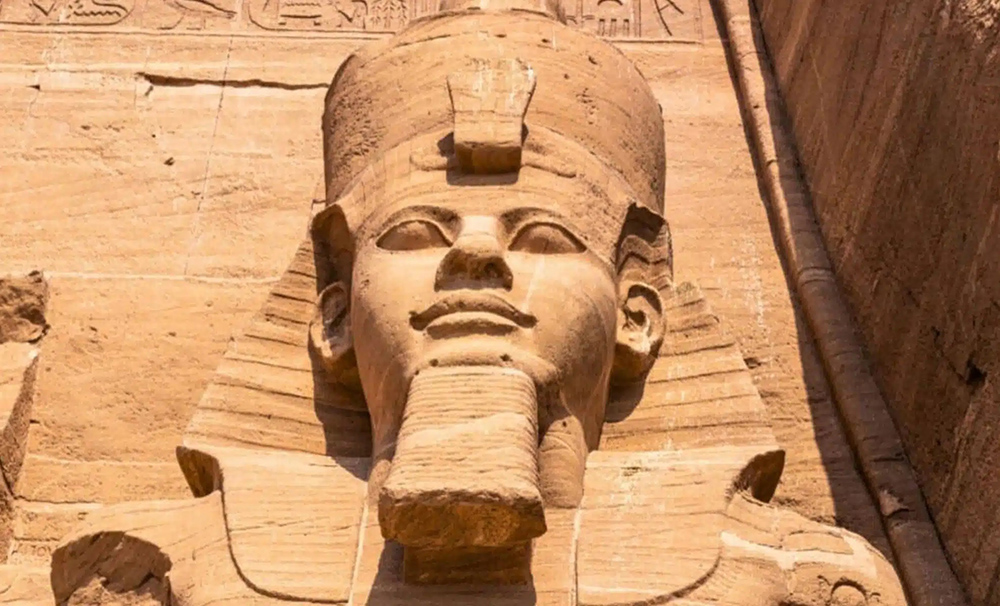
A massive limestone discovery in Middle Egypt has reunited a fractured giant, revealing a lost masterpiece of the 19th Dynasty. The silent landscape of El Ashmunein has finally yielded the remaining half of a royal puzzle that lay fractured for nearly a century. Deep beneath the sediment of Middle Egypt, the upper torso of a massive limestone figure was recovered, ending an archaeological search that began in the 1930s. This physical reunification of a pharaonic monument marks a pivotal moment for the joint Egyptian-American mission operating at the site of ancient Hermopolis Magna. For decades, only the lower half of this seated colossus was known to scholars, standing as a solitary reminder of a vanished temple complex. The recent identification of the matching upper section allows for the first full reconstruction of the monument in over a millennium. This achievement provides researchers with a rare, complete look at the scale of royal propaganda utilized during the 19th Dynasty.
The identification of the upper fragment relied on a comparative analysis of the limestone composition and matching inscriptions found on the back pillar. Researchers reported that the hieroglyphic texts on the newly discovered torso list the various titles of Ramesses II, which correlate directly with the inscriptions on the lower section found by German archaeologist GŸnther Roeder in 1930. These titles were designed to glorify the pharaoh and project imperial stability during the 13th century BC.
Trove of 225 'Exceptional' Egyptian Figurines Solves Long-Standing Mystery Science Alert - December 8, 2025

A treasure trove of 225 funerary figurines has been discovered inside a tomb in the ancient Egyptian capital of Tanis in the Nile Delta, a rare find that has also solved a long-running mystery. Finding figurines in place inside a royal tomb has not happened in the Tanis necropolis since 1946. Such a find has also never happened before further south in Egypt's Valley of the Kings near modern Luxor - apart from the tomb of the famous boy king Tutankhamun in 1922 - because most such sites have been looted throughout history, he added.
Two voids detected on the eastern side of the Pyramid of Menkaure on Egypt's Giza plateau hint at a second, hidden entrance to the pyramid, according to a new study. Live Science - November 10, 2025
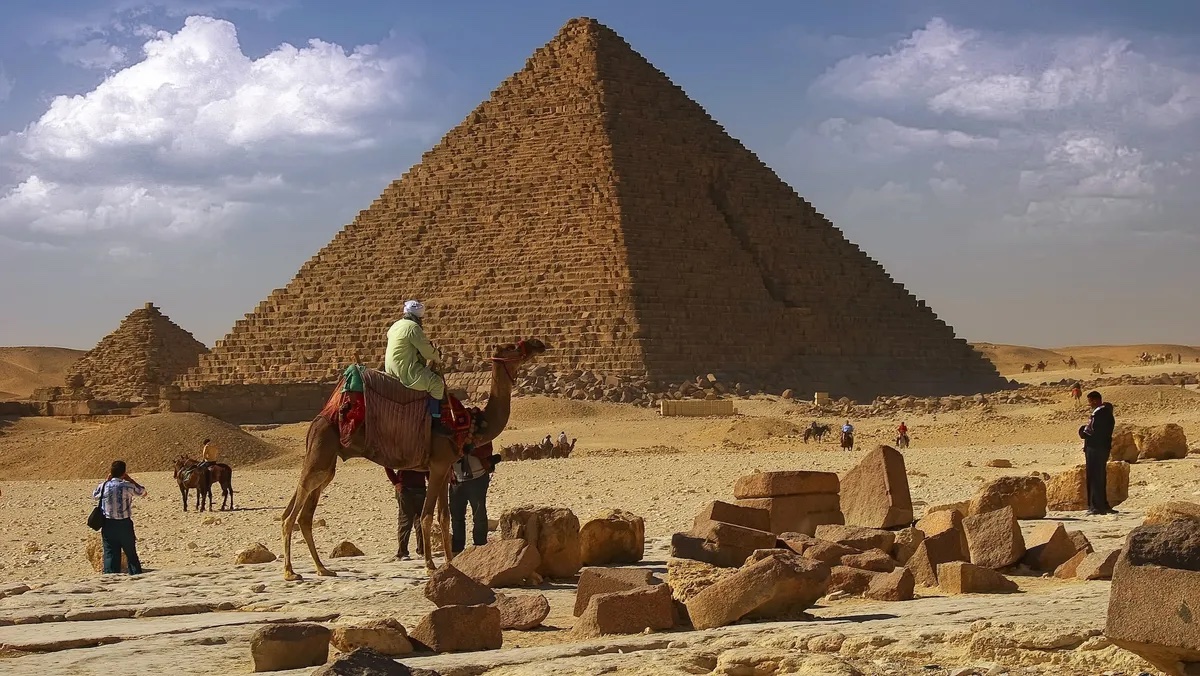
The pyramid was built during the reign of the pharaoh Menkaure (circa 2490 to 2472 B.C.). It's the last and smallest of the three pyramids built on the Giza plateau and originally stood about 213 feet (65 meters) tall. The main entrance to the pyramid is located on the northern face. The eastern side of the pyramid contains an area of polished blocks that have long puzzled researchers. The stones are remarkably polished over an area around four meters [13 feet] high and six meters [20 feet] wide. Such smooth stones are otherwise only found at what is currently the only entrance to the pyramid, on the north side. The unusually polished granite blocks on the pyramid's eastern face have puzzled experts for some time. This smooth section, about four meters tall and six meters wide, resembles the finish used at the pyramid's known entrance on the north side. This distinctive stonework might mark the location of a second entrance.

Artifacts from the roughly 2-acre (0.8 hectares) fortress suggest that it may have been built during the reign of Thu/Users/elliecrystal/Desktop/Crystalinks/Ancient html/Egypt /egyptnews.htmltmose I (circa 1504 to 1492 B.C.), the Egyptian Ministry of Tourism and Antiquities said in a translated statement. Thutmose I was a pharaoh who expanded Egypt's empire into modern-day Syria, which helps explain the fortress' location.
A rock art panel near Aswan, Egypt, may depict a rare example of an elite individual from the First Dynasty, shedding light on the formation of the ancient Egyptian state PhysOrg - July 10, 2025

The late 4th millennium BC was a key period in Egyptian history which saw the beginning of political unification across Egypt, ultimately leading to the formation of the Egyptian state by the first pharaoh, Narmer, about 3100 BC. However, little is known about how this pivotal process in prehistory took place. The late 4th millennium BC was a key period in Egyptian history which saw the beginning of political unification across Egypt, ultimately leading to the formation of the Egyptian state by the first pharaoh, Narmer, about 3100 BC. However, little is known about how this pivotal process in prehistory took place.
More than 150 conservators and 100 archaeologists have labored quietly for over a decade to restore thousands of artifacts ahead of the long-awaited opening of the Grand Egyptian Museum (GEM) PhysOrg - July 7, 2025

The Grand Egyptian Museum is a $1 billion project on the edge of the Giza Plateau about 2 kilometres (1.2 miles) from the Giza pyramid complex. There was a delaying in opening but it happens later this year.


For the very first time, scientists have sequenced DNA from the entire genome of an individual who lived in ancient Egypt up to 4,800 years ago - right when the first pyramids were being built. Science Alert - July 3, 2025

The ancient genome belongs to an older male individual who was probably part of an elite social class and who, based on his ancestry, likely had brown hair, brown eyes, and dark skin. About 80 percent of the man's genome is linked to lineages in North Africa, while the remaining 20 percent is linked to lineages in West Asia.
Oldest and most complete ancient Egyptian human genome ever sequenced reveals ties to Mesopotamia Live Science - July 3, 2025
3,600-Year-Old Tomb of Mystery Warrior King Found Beneath Egypt's Sands Science Alert - April 2, 2025

Archaeologists have discovered a mysterious new king of ancient Egypt, buried in a network of tombs at Anubis Mountain. Researchers don't know this pharaoh's identity because they think ancient grave robbers damaged the marking of his name on the tomb wall. Still, he could help illuminate a forgotten era of Egyptian history from about 1640 BCE to 1540 BCE, when warrior pharaohs battled each other for territory.
2,600-year-old jewelry stash from ancient Egypt includes gold statuette depicting family of gods
Archaeologists in Egypt have discovered a 2,600-year-old pot full of gold jewelry, including a rare statuette that depicts a family of gods and may have been worn as an amulet. A team found the pot at Karnak Temple, a complex near Luxor (ancient Thebes). The temple was initially built around 4,000 years ago and was continuously expanded, renovated and modified over millennia. A number of deities were worshipped at the site, including Amun, the chief god of Thebes. The finds include beads, amulets and statuettes, many of which are gold, according to a translated statement from the Egyptian Ministry of Tourism and Antiquities.
Ancient Egyptian 'granary with scribes' diorama: A miniature workplace found buried in a tomb from the Middle Kingdom Live Science - February 17, 2025
Scientists Sniffed Ancient Egyptian Mummies And Got a Surprise - Descriptions included "woody", "floral", "sweet", "spicy", "stale" and "resin-like" Science Alert - February 17, 2025
2,100-year-old Luxor temple in Egypt discovered hidden in cliff face Live Science - December 2, 2024
'Extraordinary' burial of ancient Egyptian governor's daughter discovered in a coffin within another coffin Live Science - October 5, 2024
Occupational hazards for ancient Egyptian scribes PhysOrg - June 30, 2024

Repetitive tasks carried out by ancient Egyptian scribes - high-status men with the ability to write who performed administrative tasks - and the positions they sat in while working may have led to degenerative skeletal changes
Malaria, smallpox, polio: Here's how we know life in ancient Egypt was ravaged by disease PhysOrg - March 15, 2024
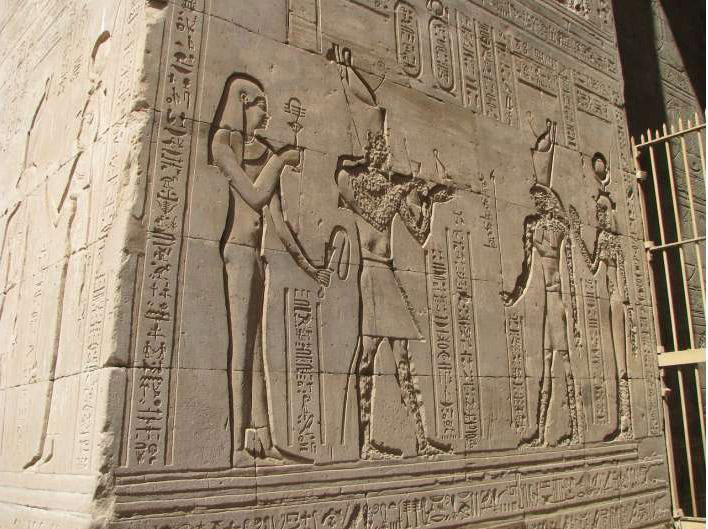
The mention of ancient Egypt usually conjures images of colossal pyramids and precious, golden tombs. But as with most civilizations, the invisible world of infectious disease underpinned life and death along the Nile. In fact, fear of disease was so pervasive it influenced social and religious customs. It even featured in the statues, monuments and graves of the Kingdom of the Pharaohs. By studying ancient specimens and artifacts, scientists are uncovering how disease rocked this ancient culture.
Archaeologists find top half of giant Ramesses II statue, completing a century-long puzzle Live Science - March 11, 2024
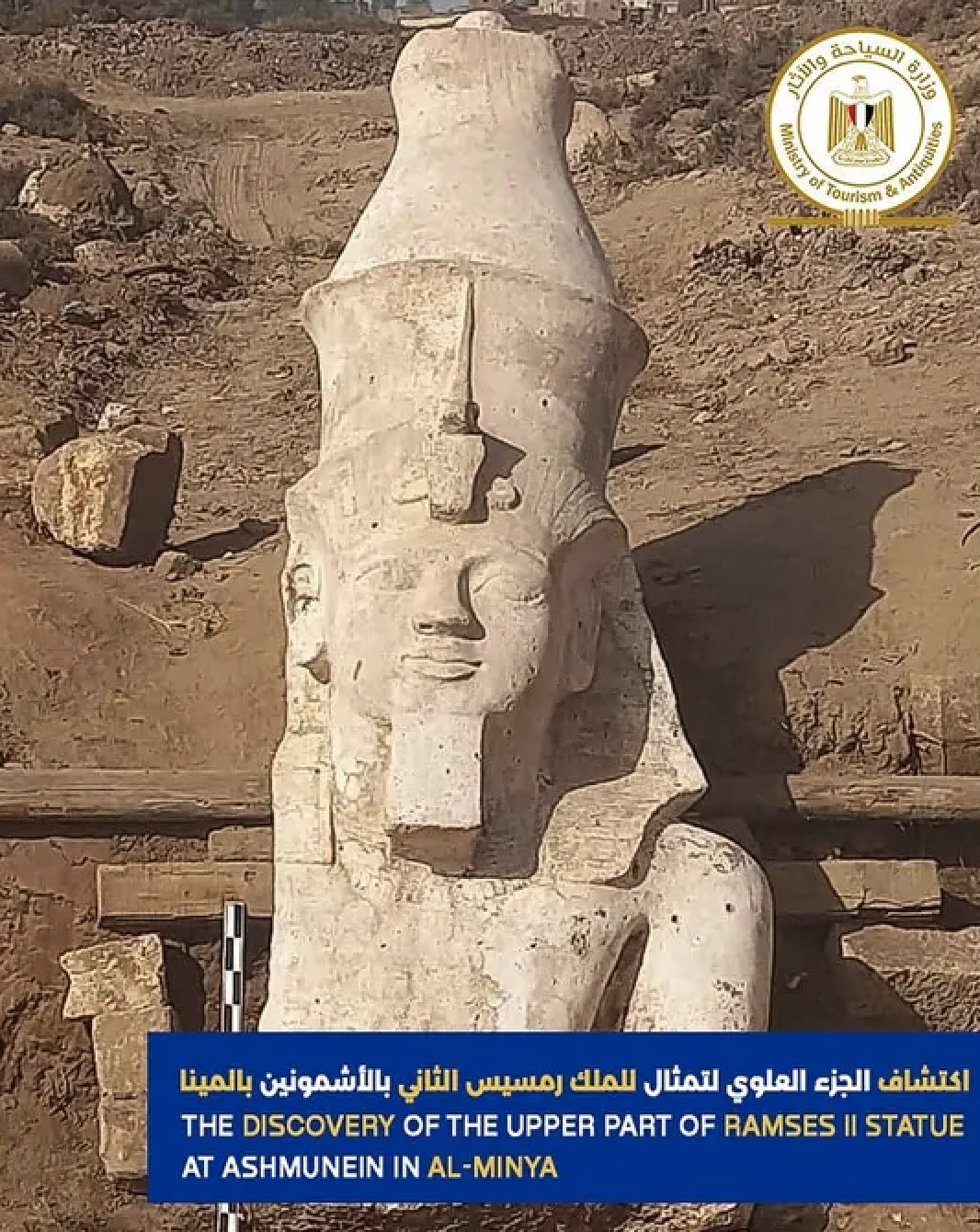
The upper half of a giant statue of the ancient Egyptian pharaoh Ramesses II has been discovered near the ancient city of Hermopolis (modern-day el-Ashmunein), about 155 miles (250 kilometers) south of Cairo. The large stone piece is about 12.5 feet (3.8 meters) tall and depicts Ramesses II (reign circa 1279 to 1213 B.C.) wearing a double crown and a headdress topped with a royal cobra.
13 treasures the ancient Egyptians buried with their dead, and what they mean Live Science - February 26, 2024
The ancient Egyptians are known for their lavish and complex burials. Over the centuries, archaeologists have found a variety of grave goods and decorations that were included in these millennia-old tombs. Here are 13 grave goods that keep turning up in Egyptian burials, including shabti figurines, meant to work for the deceased in the afterlife, and mummy portraits that offer lifelike pictures of the dead.
Ancient New Year's scene from Egypt uncovered on ceiling of 2,200-year-old temple of Esna Live Science - October 21, 2023
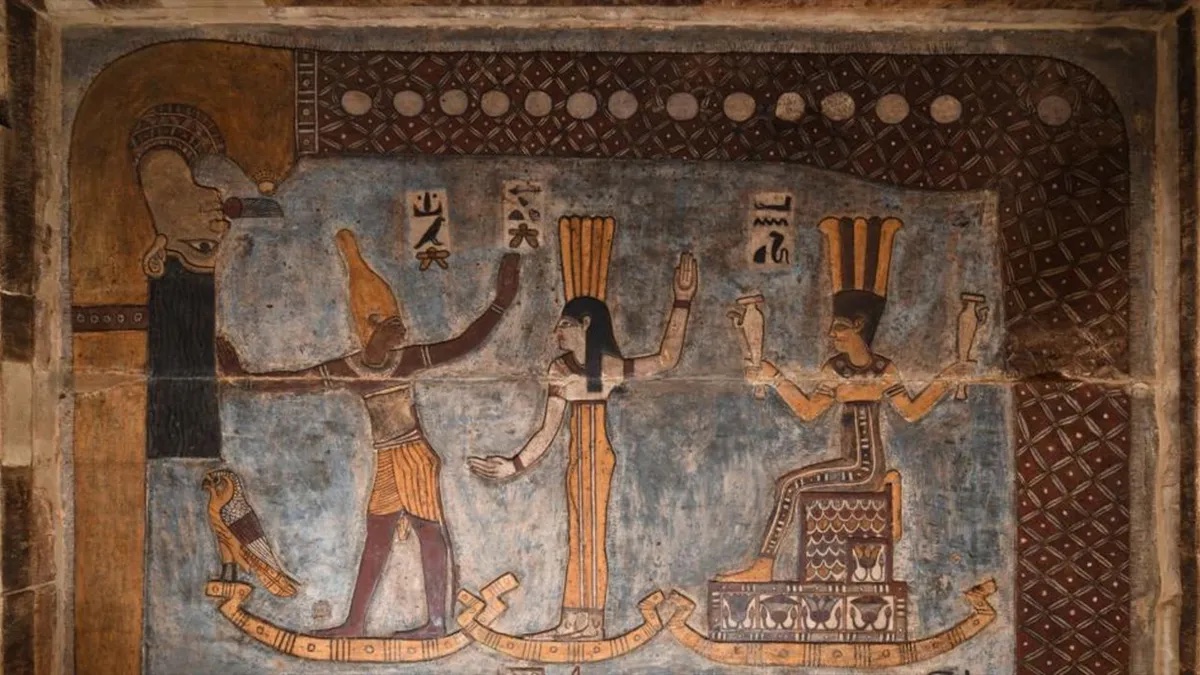
A stunning New Year's scene painted by ancient Egyptians has been uncovered by researchers restoring artwork on the ceiling of the Temple of Esna - a temple built around 2,200 years ago that underwent a major renovation about 2,000 years ago when the Romans controlled Egypt
Hidden Chambers Found in Crumbling Pyramid of Sahure 200 Years After Prediction Science Alert - October 21, 2023
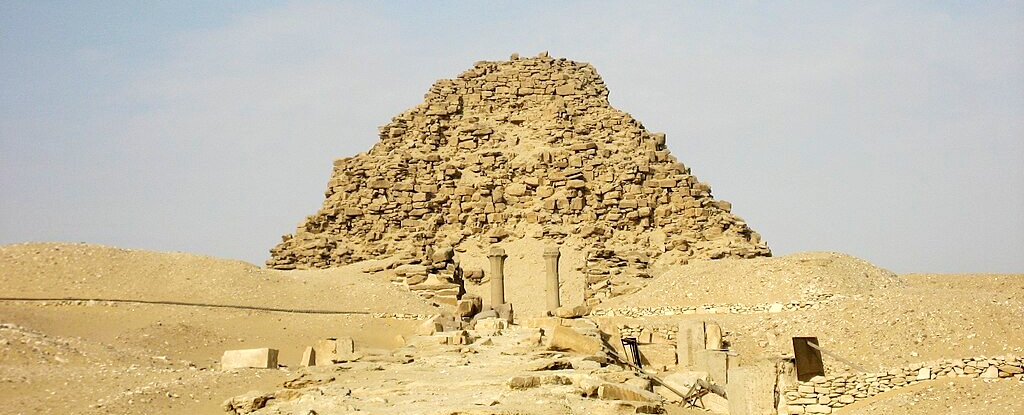
n 1836, Egyptologist John Shae Perring was excavating the Pyramid of Sahure (also known as Sahura) when he noticed a debris-filled passageway. An expert on floor plans for these types of structures, he surmised there might be storage rooms beyond. But it would take another nearly 200 years to finally confirm his suspicions. The hidden storage rooms - The area was so damaged it was impossible to enter, so Perring had no way of knowing if he was right. Decades later, German Egyptologist Ludwig Borchardt ignored Perring's claims when he was excavating the site in the early 1900s. If he'd looked closer, history might have been different. Now, a joint Egyptian-German team working to restore the pyramid has shown Perring was correct.
2,300-year-old Egyptian mummification workshops found at Saqqara Live Science - June 2, 2023
Two ancient mummification workshops - one for humans and another for animals - have been discovered at Saqqara in Egypt. The workshops date back around 2,300 years and were in use between the late 30th dynasty and the early Ptolemaic period. During that time, Egypt lost its independence, first being conquered by the Persians and then by the Macedonian army of Alexander the Great. After Alexander's death in 323 B.C., one of his generals, Ptolemy I, took over Egypt, and his descendants ruled over the country for nearly three centuries. The human mummification workshop is made of mud brick and contains two beds that were used to embalm people, and the remains of tools and resin used in the embalming process were discovered inside, representatives from the Egyptian Ministry of Tourism & Antiquities said in a statement.
Ancient Egyptian queen's bracelets contain 1st evidence of long-distance trade between Egypt and Greece Live Science - June 1, 2023
Bracelets found in the tomb of the ancient Egyptian queen Hetepheres I the mother of Khufu, the pharaoh who commissioned the Great Pyramid of Giza reveal new information about the trade networks that once linked the Old Kingdom to Greece. After analyzing samples taken from the jewelry, an international team of archaeologists determined that the bracelets contained copper, gold and lead. There were also inlays made using semiprecious gemstones such as turquoise, lapis lazuli and carnelian, which were common features in ancient Egyptian jewelry, according to a statement.
See the oldest human ever found in Egypt in stunning new facial approximation Live Science - April 5, 2023
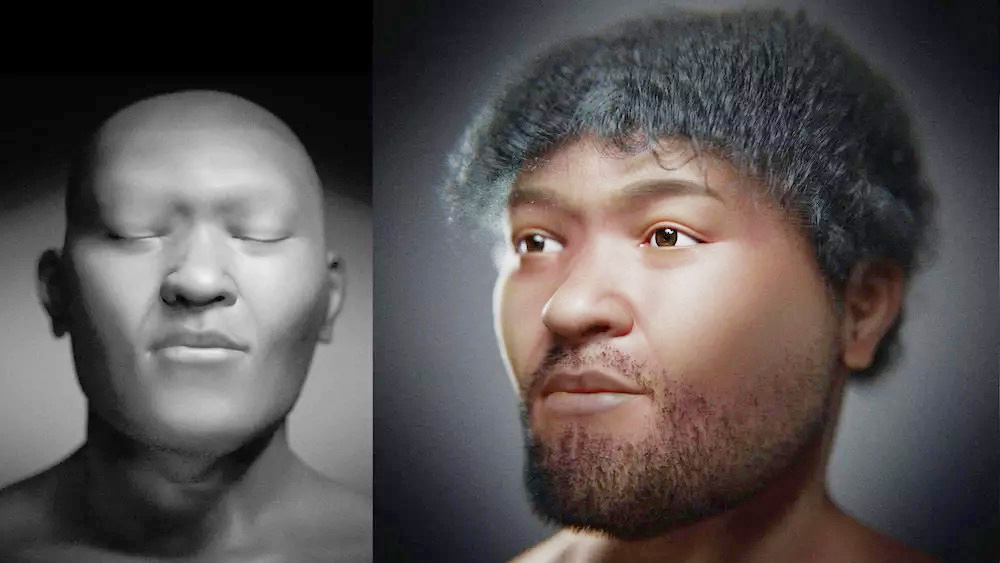
A lifelike facial approximation of a man who lived 30,000 years ago in what is now Egypt may offer clues about human evolution. In 1980, archaeologists unearthed the man's skeletal remains at Nazlet Khater 2, an archaeological site in Egypt's Nile Valley. Anthropological analysis revealed that the man was between 17 and 29 years old when he died, stood approximately 5 feet, 3 inches (160 centimeters) tall and was of African ancestry. The skeleton is the oldest example of Homo sapiens remains found in Egypt and one of the oldest in the world, according to a study (opens in new tab) published March 22. However, little else was known about him other than that he was buried alongside a stone ax.
Medieval Swahilis and Persians paired up 1,000 years ago in East Africa, ancient DNA reveals Live Science - April 5, 2023
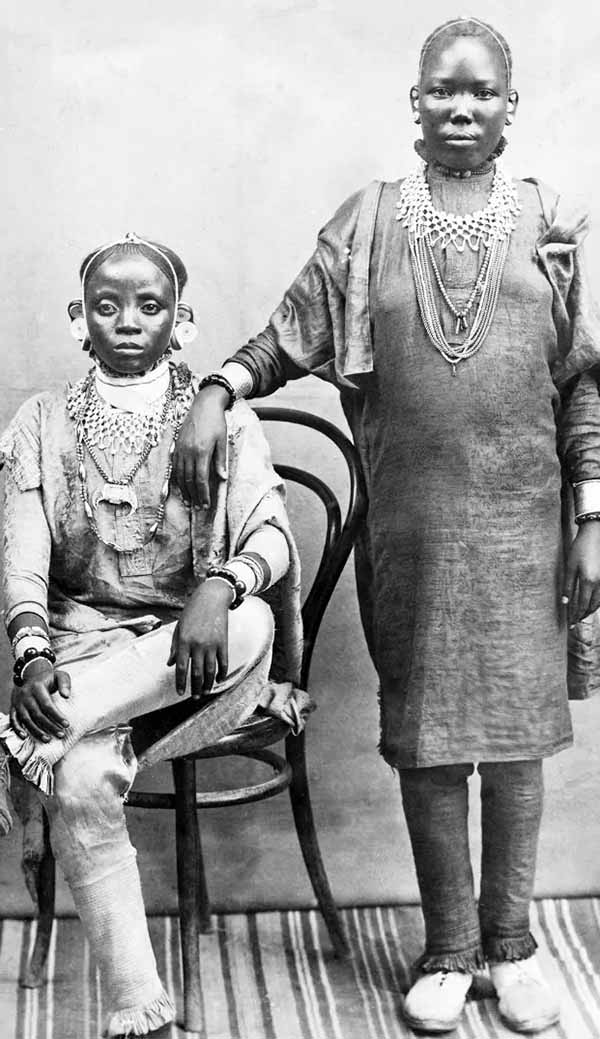
Traditional Swahili culture had a matriarchal nature when Persian men married into the culture about 1,000 years ago. The Swahili retailed this matriarchal feature during colonial rule and modern times. Here we see two Swahili women in Zanzibar circa 1890.
Ancient zodiac paintings on Egyptian temple see the light of day after 2,200 years - restoration project has revealed ancient Egyptian zodiac paintings and inscriptions at the Temple of Esna Live Science - March 22, 2023
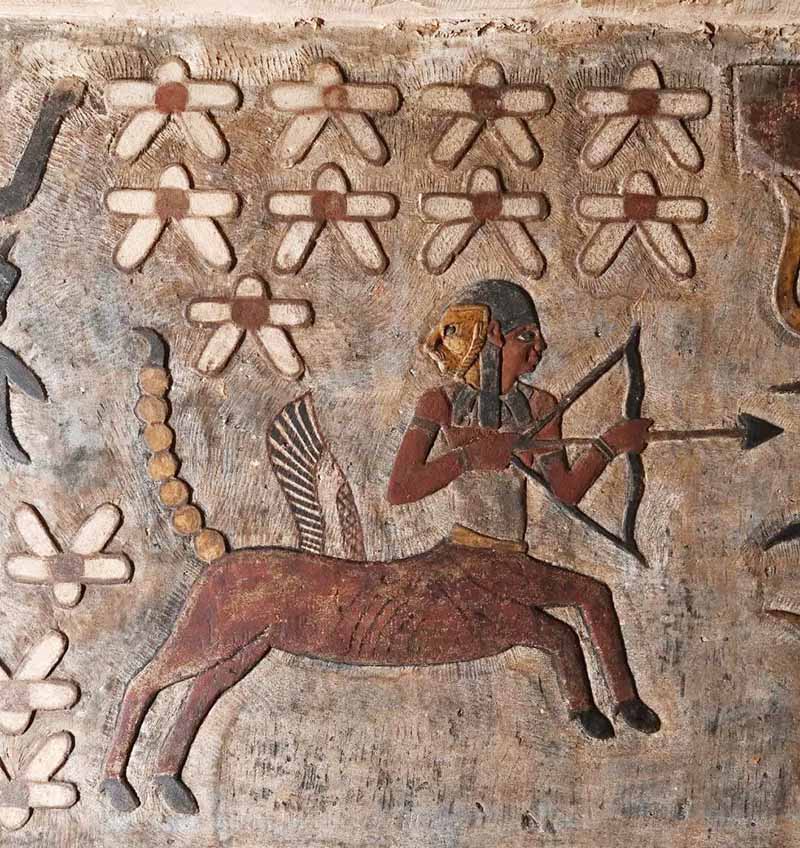
Gorgeous zodiac paintings decorating the roof and walls of the 2,200-year-old Temple of Esna in southern Egypt have been revealed during a restoration project that's clearing away two millennia's worth of grime, soot and bird poop, researchers announced March 20. Restorers painstakingly cleaned the zodiac artworks, many of which were painted onto the temple's ceiling. Other restored images include depictions of the planets Jupiter, Saturn and Mars, as well as images of stars and constellations used by the ancient Egyptians to help measure time, researchers said in a statement. The team also conserved ancient images of snakes, crocodiles and hybrid creatures, such as a snake with a ram's head. While the existence of the zodiac and some of the other images at the temple were already known to researchers, the cleaning and conservation have allowed the artwork to be seen in more detail. The restoration work also revealed previously unknown inscriptions.
52-foot-long Book of the Dead papyrus from ancient Egypt discovered at Saqqara Live Science - January 26, 2023
Archaeologists in Egypt have discovered a 52-foot-long (16 meters) papyrus containing sections from the Book of the Dead. The more than 2,000-year-old document was found within a coffin in a tomb south of the Step Pyramid of Djoser at Saqqara. There are many texts from The Book of the Dead, and analysis of the new finding may shed light on ancient Egyptian funerary traditions. Conservation work is already complete, and the papyrus is being translated into Arabic, according to a translated statement (opens in new tab), which was released in conjunction with an event marking Egyptian Archaeologists Day on Jan. 14. This is the first full papyrus to be uncovered at Saqqara in more than 100 years, Mostafa Waziry
Egypt discovers 4,300-year-old tombs in ancient burial ground in Saqqara ABC - January 26, 2023
The tombs date back to the Fifth and Sixth dynasties of the Old Kingdom (2686-2181 B.C.), officials said in Saqqara, which lies some 19 miles south of Cairo.
Archaeologists may have found Egypt's oldest mummy. The 4,300-year-old mummy was a rich, important 35-year-old man called Djed Sepsh CNN - January 30, 2023
Don't say 'mummy': Why museums are rebranding ancient Egyptian remains CNN - January 30, 2023
They are among the most popular exhibits in museums worldwide, with a name so resonant, blockbuster films have been built on it.
But some museums in Britain are now using words other than "mummy" to describe their displays of ancient Egyptian human remains.
Instead, they are starting to adopt terms such as "mummified person" or to use the individual's name to emphasize that they were once living people. Using different language to describe these human remains can also distance them from the depiction of mummies in popular culture, which has tended to "undermine their humanity" through "legends about the mummy's curse" and by portraying them as "supernatural monsters," Jo Anderson, assistant keeper of archaeology at the Great North Museum: Hancock in Newcastle, northeast England, wrote in a blog posted in May 2021 that outlined her museum's language change.
Scans of Mummified 'Golden Boy' Reveal He Was Covered in Magical Protections Science Alert - January 25, 2023
A teen boy whose mummy had been stored in a museum since 1916 was covered in precious amulets, a study published Tuesday found. A team of scientists has digitally unwrapped the 2,300-year-old mummy using a CT scanner to uncover its secrets.
Stunning CT scans of 'Golden Boy' mummy from ancient Egypt reveal 49 hidden amulets Live Science - January 25, 2023
Incredibly detailed computed tomography (CT scans) of the so-called "Golden Boy" mummy from ancient Egypt have revealed a hidden trove of 49 amulets, many of which were made of gold. The young mummy earned its nickname because of the dazzling display of wealth, which included a gilded head mask found in the mummy's sarcophagus. Researchers think he was about 14 or 15 years old when he died because his wisdom teeth had not yet emerged. The Golden Boy was originally unearthed in 1916 at a cemetery in southern Egypt and has been stored in the basement of The Egyptian Museum in Cairo ever since. The mummy had been "laid inside two coffins, an outer coffin with a Greek inscription and an inner wooden sarcophagus
Egypt unveils ancient royal tomb in Luxor Yahoo - January 14, 2023
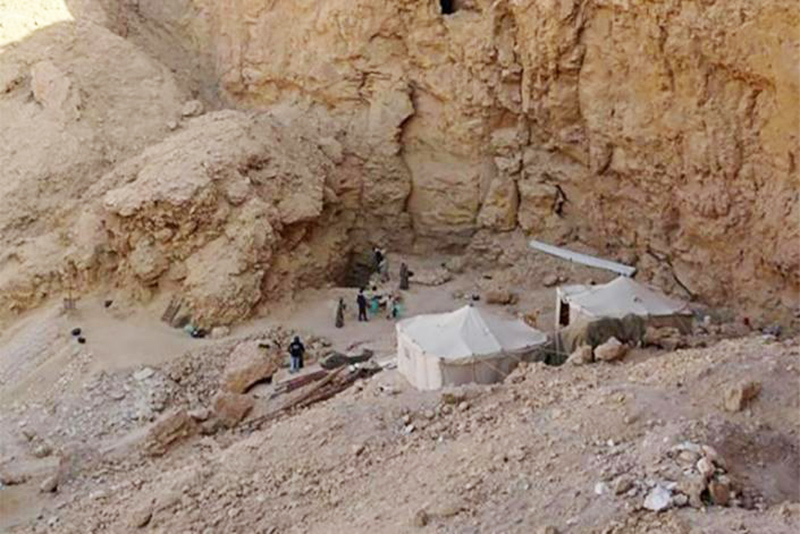
Egyptian authorities announced Saturday the discovery of an ancient tomb in Luxor dating back around 3,500 years that archaeologists believe holds the remains of an 18th dynasty royal. The tomb was unearthed by Egyptian and British researchers on the west bank of the River Nile, where the famous Valley of the Queens and Valley of the Kings lie. The first elements discovered so far inside the tomb seem to indicate that it dates back to the 18th dynasty of pharaohs Akhenaton and Tutankhamun, The 18th dynasty, part of the period of Egyptian history known as the New Kingdom, ended in 1292 BC and is considered among the most prosperous years of Ancient Egypt.
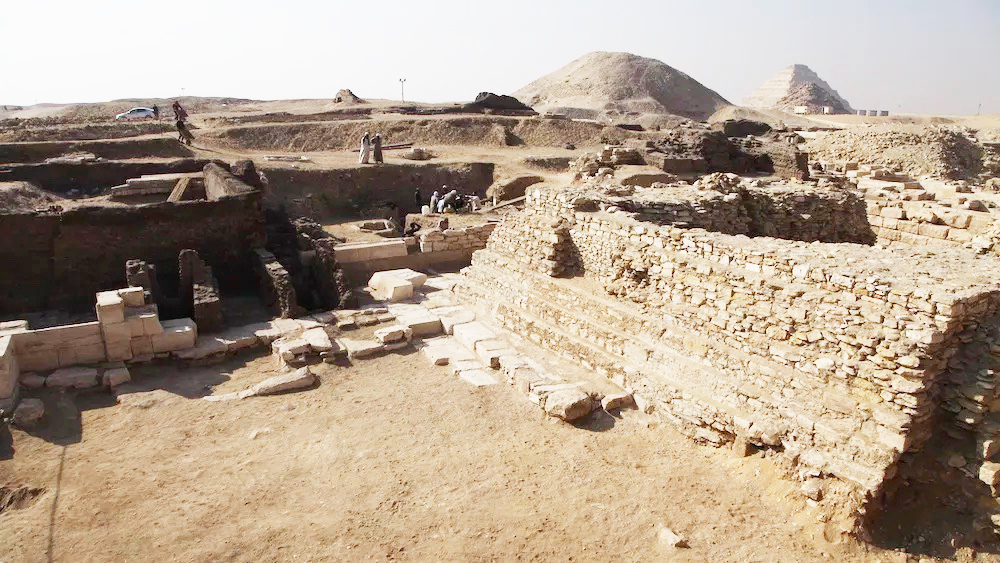
Hundreds of mummies and pyramid of an unknown queen unearthed near King Tut's tomb Live Science - November 16, 2022
Sinking Egypt's Alexandria fabled second city faces up to coming catastrophe PhysOrg - November 2, 2022
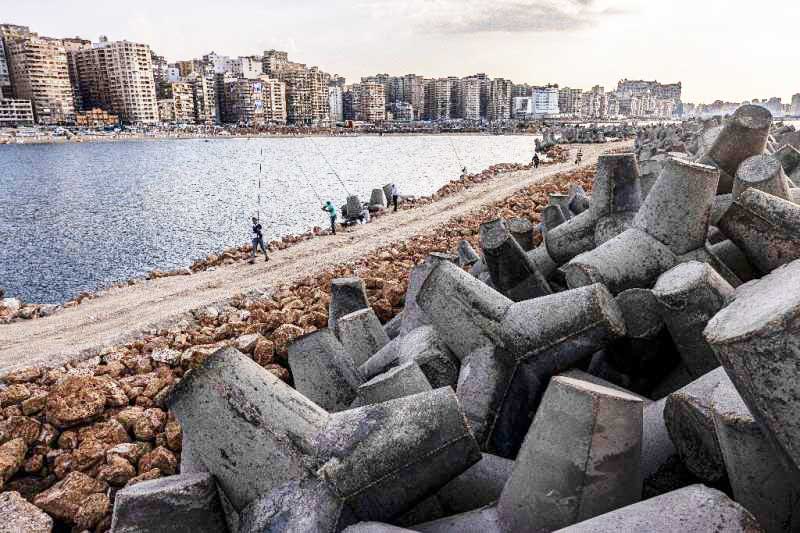
Alexandria, Egypt's fabled second city and its biggest port, is in danger of disappearing below the waves within decades. With its land sinking, and the sea rising due to global warming, the metropolis Alexander the Great founded on the Nile Delta is teetering on the brink. Even by the United Nations' best case scenario, a third of the city will be underwater or uninhabitable by 2050, with 1.5 million of its six million people forced to flee their homes. Its ancient ruins and historic treasures are also in grave danger from the Mediterranean. Already hundreds of Alexandrians have had to abandon apartments weakened by flooding in 2015 and again in 2020. Every year the city sinks by more than three millimetres, undermined by dams on the Nile that hold back the river silt that once consolidated its soil and by gas extraction offshore. Meanwhile, the sea is rising.
3,300-year-old pink granite sarcophagus of Egyptian 'pyramid keeper' found at Saqqara Live Science - September 22, 2022
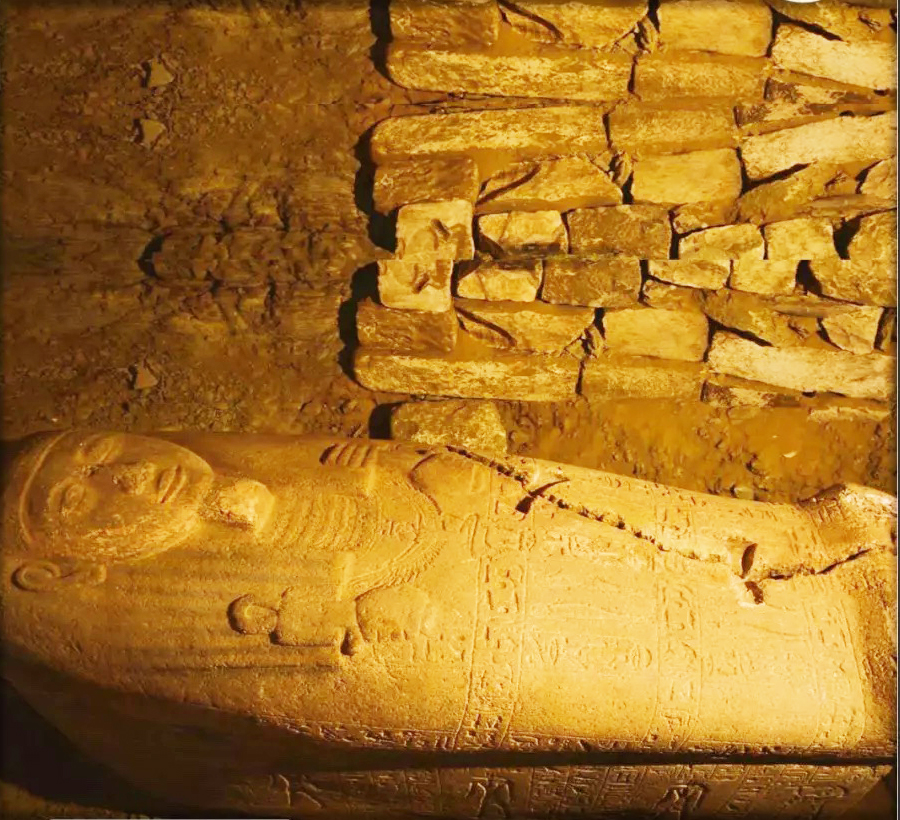
Archaeologists in Egypt have unearthed the 3,300-year-old stone sarcophagus of an official whose mummified body was stolen by grave robbers long ago. The coffin, carved from pink granite, was crafted for an official named "Ptah-im-wea," who, according to the hieroglyphs inscribed on it, lived during the time of Ramesses II (reign circa 1279 B.C. to 1213 B.C.) and managed a temple that Ramesses II had built at Thebes (modern-day Luxor).
Video: Egypt celebrates reopening 3,400-year-old Avenue of the Sphinxes - NBC - November 25, 2021
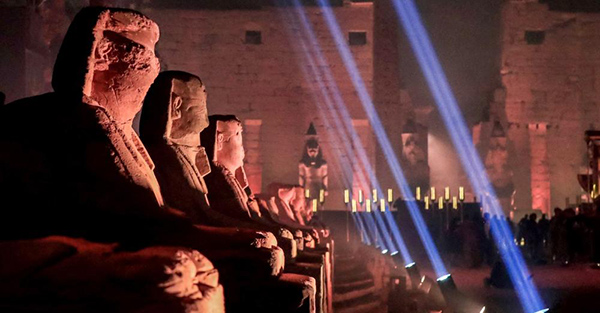
Egypt reopens 3,000-year-old Avenue of Sphinxes in grand, glitzy Luxor ceremony. The ancient road, once named the "Path of God," was covered under sand for centuries and took decades to excavate and restore.
Egypt's 'lost golden city' is found in Luxor: Massive 3,500-year-old settlement founded by Tutankhamun's grandfather Text, Video, Maps, Pics Daily Mail - April 10, 2021
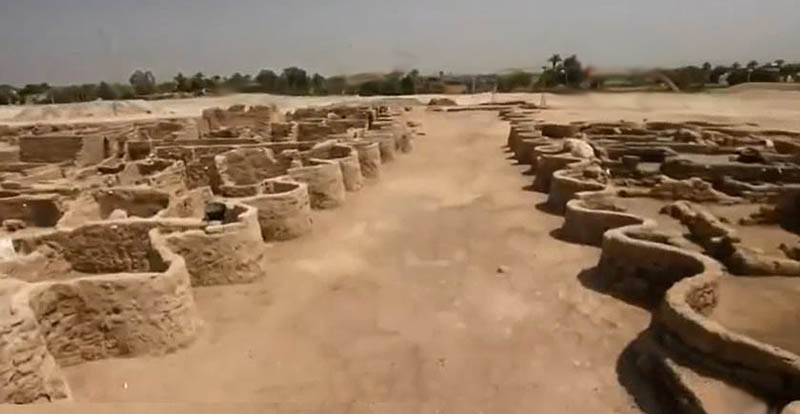
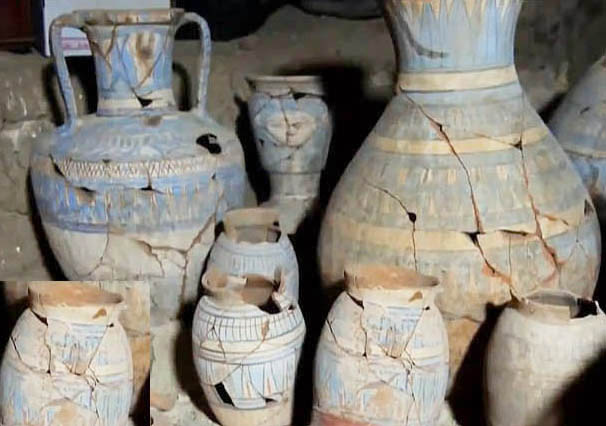
Archaeologists announced the discovery of a 3,500-year-old 'lost golden city' that was built by King Tutankhamun's grandfather and may be the most significant find since the boy-pharaoh's lavish tomb was unearthed nearly a century ago. The ancient pharaonic city, known as Aten, was constructed by King Amenhotep III, who ruled around 1390 BC, and was later used by King Tutankhamun. The settlement, discovered in Luxor, is the largest ancient city to be discovered in Egypt, and is complete with neighborhoods, streets and a security system.
'Lost golden city' found in Egypt reveals lives of ancient pharaohs BBC - April 10, 2021
The discovery of a 3,000-year-old city that was lost to the sands of Egypt has been hailed as one of the most important archaeological finds since Tutankhamun's tomb.
Scientists find eternal Nile to be more ancient than previously thought PhysOrg - November 12, 2019
Ancient Egyptians considered the Nile river to be the source of all life. The steady northward path of the river has nourished the fertile valleys of northeast Africa for millions of years and in doing so, shaped the course of human civilization. The Nile's unchanging path, however, has been a geologic mystery because long-lived rivers usually move over time. Researchers have cracked the case by linking the river's flow to the movement of rock in the Earth's deep mantle. In the course of their investigation, they found the eternal river to be much older than anyone realized, with the scientists estimating the age of the Nile to be 30 million years - about six times as long as previously thought. If it weren't for the mantle movement keeping the river on course, the Nile would have turned west long ago, probably changing the course of history along with it. One of the big questions about the Nile is when it originated and why it has persisted for so long, The results should settle a long-running debate about the age of the river and provide evidence that the slow movement of the deep mantle is one of the key forces shaping our Earth's landscape and geological processes.
Belgian archeologists discover fragments of a book in a burial place dating from 2040 BC in Dayr al-Barsha, Egypt Brussels Times - October 31, 2019
The fragments are the oldest ever discovered to date. Harco Willems describes the document as a collection of sparse incantations and legendary drawings. They do not necessarily make up a story-line but have a common theme: the journey from darkness to Osiris, god of afterlife and many other things in ancient Egyptian religion. Two curved sinuous lines run through the book. They are interpreted by some researchers as a representation of the two roads that lead the deceased to safety through the dangers of the underworld to a happy life in the afterlife. Archaeologists found the fragments in a sarcophagus attributed to Ankh, a woman of the family of a governor named Ahanakht. One of the fragments represents the ship of the sun god Ra, towed by a sled, and another presents a text in which the owner of the grave identifies himself with the sun god. Other fragments are so damaged that scientists have not yet been able to decipher them.
Ancient Egyptian fortress containing terracotta figures and a piece of an elephant skull found near Red Sea Daily Mail - January 3, 2019
Excavations on the ruins of a Roman city built atop a fossil coral reef in Egypt have revealed the remains of a sprawling Hellenistic fortress constructed more than 2,000 years ago. Researchers say the ancient fortress was built to defend a port on the Red Sea coast, with three large courtyards and numerous structures that housed workshops and stores. Inside, the team also found trash heaps filled with terracotta figures, coins, and even a fragment of an elephant skull.
This 2,300-Year-Old Egyptian Fortress Had an Unusual Task: Guarding a Port That Sent Elephants to War Live Science - January 3, 2019
Egypt tomb: Saqqara 'one of a kind' discovery revealed BBC - December 17, 2018
Archaeologists in Egypt have made an exciting tomb discovery - the final resting place of a high priest, untouched for 4,400 years.
Mostafa Waziri, secretary-general of the Supreme Council of Antiquities, described the find as "one of a kind in the last decades".
The tomb, found in the Saqqara pyramid complex near Cairo, is filled with colorful hieroglyphs and statues of pharaohs. Decorative scenes show the owner, a royal priest named Wahtye, with his mother, wife and other relatives.
Archaeologists Sift Through Soup of Human Remains in Waterlogged Mass Grave in Egypt Live Science - December 17, 2018
A desert tomb became a watery grave for some 50 to 60 ancient Egyptians at the ancient Nile quarry site of Gebel el-Silsila, in Upper Egypt. Archaeologists announced the discovery of the mass grave Dec. 13. They discovered the tomb almost two years ago, but the excavation has been painstaking. The two chambers are filled with briny water from a naturally occurring spring, and the remains inside are jumbled. To excavate the tomb, archaeologists must run pumps to remove enough water so they can sit and gently hand-sift the mud for bones and artifacts.
Egypt says village found in Nile Delta predated pharaohs BBC - September 2, 2018
Egypt said Sunday that archeologists have unearthed one of the oldest villages ever found in the Nile Delta, with remains dating back to before the pharaohs. The Antiquities Ministry said the Neolithic site was discovered in Tell el-Samara, about 140 kilometers (87 miles) north of Cairo. Chief archaeologist Frederic Gio said his team found silos containing animal bones and food, indicating human habitation as early as 5,000 B.C. That would be some 2,500 years before the Giza pyramids were built. In recent years, Egypt has touted discoveries in the hopes of reviving tourism after the unrest that followed its 2011 popular uprising.
Egyptian Papyrus Reveals Rare Details of Ancient Medical Practices Live Science - August 17, 2018
Ancient manuscripts that were previously untranslated have revealed a rare and fascinating glimpse of scientific and medical practices in Egypt thousands of years ago. Experts working with the texts recently discovered that the papyrus scrolls included the oldest known medical discussion of the kidneys, as well as notes on treatments for eye diseases and a description of a pregnancy test, the science news site ScienceNordic reported. The manuscripts are part of the Papyrus Carlsberg Collection, housed at the University of Copenhagen in Denmark, where an international team of researchers is collaborating to interpret the unpublished documents
Alexandra Egypt: Massive Black Sarcophagus Opened Live Science - July 19, 2018
A mysterious, black, granite sarcophagus discovered in Alexandria, Egypt, dating to a time after Alexander the Great conquered the area in 332 B.C., has been opened. There was speculation at the time the discovery was announced earlier this month that the massive coffin held the remains of Alexander and that opening the sealed and foreboding-looking box would unleash a curse. Neither seem to be true É unless stinky sewage causes some sort of torment. Along with the sewage, archaeologists found the remains of three skeletons inside the sarcophagus. These may be those of soldiers, Egypt's antiquities ministry said in a statement issued today (July 19) in Arabic.
Mystery of Alexandria's largest coffin: Archaeologists unearth 8.6-foot-long sarcophagus buried in Egypt 2,000 years ago beside a massive stone head Daily Mail - July 2, 2018
Egyptian archaeologists have discovered what's thought to be the largest granite sarcophagus ever found in Alexandria, measuring nearly nine feet long. The massive stone casket was buried more than 16 feet beneath the surface alongside a huge alabaster head Ð likely belonging to the man who owned the tomb. Experts say the ancient coffin has remained untouched since its burial thousands of years ago during the Ptolemaic period. Researchers working under the Supreme Council of Antiquities discovered the ancient tomb during an excavation in the Sidi Gaber district of Alexandria. The team was inspecting a resident's land ahead of digs planned for the foundation of his building at Al-Karmili Street when they stumbled upon the remarkable Ptolemaic burial 5 meters deep. The Ptolemaic period lasted roughly 300 years, from 332-30 BCE, making this particular site more than 2,000 years old. According to the archaeologists who led the dig, the black granite sarcophagus stands at 185 centimeters tall (6 feet), 265cm long (8.6 ft), and 165 cm wide (5.4 ft).
Archaeologists find ancient necropolis in Egypt - tombs belonging to priests of Thoth PhysOrg - February 24, 2018
Egypt's Antiquities Ministry announced on Saturday the discovery of an ancient necropolis near the Nile Valley city of Minya, south of Cairo, the latest discovery in an area known to house ancient catacombs from the Pharaonic Late Period and the Ptolemaic dynasty. The large cemetery is located north of Tuna al-Gabal area, a vast archaeological site on the edge of the western desert. It hosts a range of family tombs and graves. Archaeologists started excavation work in the area started late last year on a quest to find the remainder of the cemetery of Upper Egypt's 15th nome during ancient times. They found tombs belonging to priests of Thoth, the ancient god of the moon and wisdom. One tomb includes more than 1,000 statues and four well preserved alabaster canopic jars inscribed with hieroglyphics and designed to hold the mummified internal organs of their owner who was a high priest of the god Thoth. The priest's mummy was also found decorated with blue and red beads and bronze gilded sheets. Archaeologists also uncovered 40 sarcophagi believed to belong to the priest's family members, some bearing the names of their owners in hieroglyphics.

Egypt's Dinosaurs: the 7 largest organisms that lived within the Nile Valley 40 million years ago Egyptian Geographic - September 7, 2021
Egypt's dinosaurs, discovered quite 100 years ago, haven't only lived within the Fayoum and Beni Suef regions, as there are 26 sites monitored within the past 10 years, All of them are in the Bahariya Oasis and Western Desert, the Egyptian-American Mission for The Search and Exploration of Dinosaur Scars has been ready to observe the bones of dinosaurs buried underground 65 million years ago.
Fossil of New Dinosaur Species Found in Egypt's Desert Live Science - January 29, 2018
Paleontologists from Mansoura University have unearthed a fossil of a new species of dinosaur in the Dakhla oasis in central Egypt that lived nearly 80 million years ago. Scientists call the finding an incredible discovery, describing it as critical for science. The remains of the animal indicate that the dinosaur was a plant-eating Cretaceous Period creature, which paleontologists call Mansourasaurus Shahinae.
6 Dinosaurs That Once Roamed Egypt Scoop Empire - April 16, 2014
Fossil of Gargantuan Dinosaur Unearthed in Egypt - Reuters May 31, 2001
Fossilized remains of a gargantuan plant-eating dinosaur, the second most massive animal ever to walk the Earth, have been unearthed in a desert oasis in Egypt at a site that eons ago was a lush coastal paradise. The discovery of a partial skeleton of Paralititan stromeri was made by 31-year-old University of Pennsylvania doctoral student Joshua Smith, who went on a dinosaur hunt at a remote site that had yielded spectacular finds in the first half of the 20th century in expeditions led by German paleontologist Ernest Stromer von Reichenbach. The fossils of the four new dinosaurs Stromer uncovered were lost to the world during World War Two when British warplanes bombed the Bayerische Staatssammlung museum during a raid over Munich on April 24, 1944. Stromer's excavation site remained largely ignored in the decades since then.
Paralititan (pronounced pah-ral-ih-TY-tan and meaning ''tidal giant'') lived 94 million years ago during the middle of the Cretaceous period of the Mesozoic Era. The long-necked, long-tailed quadruped looked much like the familiar Brontosaurus (formal name Apatosaurus) that lived tens of millions of years earlier, except that its back may have been studded with bony body armor as protection from predators. It might have weighed about 70 tons, 75 tons maybe and it might have approached 100 feet in length. The only dinosaur known to be heavier than Paralititan is Argentinosaurus, which looked much like the new dinosaur (both are classified as titanosaurid sauropods) but is estimated to have been about 7 percent more massive. The remains of only one example of these two colossal dinosaurs exist. Smith found the partial skeleton preserved in fine-grained sediments full of plant remains and root casts in the Bahariya Oasis in the Sahara desert some 180 miles southwest of Cairo. He said the evidence suggests that the arid Bahariya site once resembled the tropical mangrove coasts of Florida, a low-energy, shallow water area of tidal flats and tidal channels much like the Everglades. Based in part on Stromer's earlier finding of three massive carnivorous dinosaurs at the site, Smith said the area must have been teeming with life.
Smith believes the massive herbivore was standing on the edge of a tidal channel in very shallow water when it died. His team also found evidence that the carcass had been scavenged by a flesh-eating dinosaur, including a tooth that may come from Carcharodontosaurus, whose name means shark-tooth lizard and whose size, 45 feet (13.5 meters) long, was comparable to Tyrannosaurus rex. In addition, the pelvis was ripped apart as if it had been eaten. It's unclear whether Paralititan lost a life-or-death struggle with the predator or became a meal after dying for other reasons, Smith said. All we know is that the animal died and somebody came along and munched on it.'' Smith said the skeleton of Paralititan is only 20 to 25 percent complete. Most impressive is a humerus (upper forelimb bone) that measures 6 foot, 7 inches long. The remains also include several vertebrae, ribs and both shoulder blades. The Penn team also found fossils of fish, sharks, turtles, marine reptiles and other dinosaurs.
Extraterrestrial diamond-studded Hypatia stone found in Egypt is unlike anything seen in our solar system ever before, say scientists Daily Mail - January 12, 2018
A chunk of rock which fell to Earth and was discovered in the deserts of Egypt may hold the key to our understanding of how the solar system was formed. The Hypatia stone, named for the first Western woman mathematician and astronomer, contains minerals unlike anything seen before in our solar system. Experts say the extraterrestrial object may have formed at a time when the universe was still taking shape and may predate the sun and its surrounding planets. It contains micro-mineral compounds not found elsewhere in our region of space, or in known meteorites and comets, and has the potential to rewrite the history books.
Essential compounds for life have been found in crystals from two meteors that have been on Earth for nearly 20 years Daily Mail - January 10, 2018
Liquid water and other organic compounds essential for life have been discovered on ancient meteorites that fell to Earth almost 20 years ago. Experts examined crystals found on Zag and Monahans, two 4.5 billion-year-old rocks from the asteroid belt between Mars and Jupiter.
Despite landing on Earth in 1998, the minerals have only now been successfully analyzed thanks to advances in technology. The new study supports previous findings by Nasa's Dawn spacecraft, which suggest that the building blocks of life may be present on neighboring asteroids.
Ancient Athletes: Greek-Style Gymnasium Unearthed in Egypt Live Science - November 7, 2017
Archaeologists have discovered Egypt's first known ancient gymnasium, a building that once sported a racing track, gardens and meeting halls, according to the country's antiquities ministry. The ancient Greeks built gymnasiums as workout spaces where athletes could train for games. After Alexander the Great conquered Egypt, Greek architecture and customs swept through the region. That included, apparently, this gymnasium. The gymnasium was once a grand structure. It had a large hall, likely used for meetings, that was once adorned with statues. It also had a dining hall, a courtyard, bountiful gardens and a racetrack that was nearly 655 feet (200 meters) long, the ministry said.
Ancient Egyptian uprisings triggered by volcanic eruptions Chemistry World - November 8, 2017
New evidence that changes in atmospheric chemistry caused social stresses and uprisings against the ruling elite. Atmospheric chemistry played a surprising life and death role in ancient Egypt. New evidence has emerged that links volcanic eruptions with disruption of the rainfall that fed the Nile. This in turn led to rising food prices, riots and even open revolt against the ruling Ptolemaic dynasty. The climate scientists and historians behind the discovery uncovered a strong relationship between major volcanic events and low water levels in the river Nile. Historically, the Nile's annual flood was crucial for agriculture. When flooding was lighter than usual there were severe societal pressures as harvests failed and food prices rose. Ptolemaic era (305-30BC) documents reveal that this often culminated with civil unrest and rebellions against the authority of the Greek kings who ruled Egypt at the time.
'Big void' identified in Khufu's Great Pyramid at Giza BBC - November 2, 2017
The mysteries of the pyramids have deepened with the discovery of what appears to be a giant void within the Khufu, or Cheops, monument in Egypt. It is not known why the cavity exists or indeed if it holds anything of value because it is not obviously accessible. Japanese and French scientists made the announcement after two years of study at the famous pyramid complex. They have been using a technique called muography, which can sense density changes inside large rock structures. The Great Pyramid, or Khufu's Pyramid, was constructed during the reign of Pharaoh Khufu between 2509 and 2483 BC. At 140m (460 feet) in height, it is the largest of the Egyptian pyramids located at Giza on the outskirts of Cairo.
Great Pyramid of Giza's hidden chamber is revealed: Scientists uncover a mysterious 'big void' in Egypt's 4,500-year-old monument that could reveal its ancient secrets Daily Mail - November 2, 2017
A long-hidden narrow void in the Great Pyramid of Giza has been found by scientists in a discovery that could finally reveal the secrets of the 4,500-year-old monument. The void stretches for at least 30 metres (100ft) above the Grand Gallery - an ascending corridor that links the Queen's chamber to the King's in the heart of the pyramid. It is not known why the void exists or if there are any valuable artifacts inside as it is not obviously accessible. But it has similar dimensions to the Gallery, which is 50 metres (164ft) long, eight metres (26ft) high and more than a metre (3.2ft) wide. Researchers suggest it could be a construction gap - part of a trench that allowed workers to access the Grand Gallery and King's Chamber while the rest of the pyramid was built. The discovery was made after physicists took images of the inside of the pyramid using particles fired to Earth from space. These cosmic particles penetrate the rock in a similar way to X-rays, only much deeper. The collaborative effort, between archaeologists, historians and physicists, has been hailed as the biggest discovery inside the Giza landmark since the 19th century.
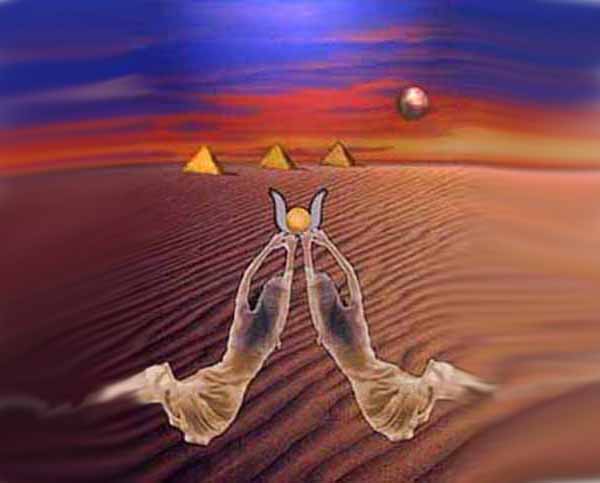
Full Moon 11° Taurus
Taurus and Scorpio are Egypt.
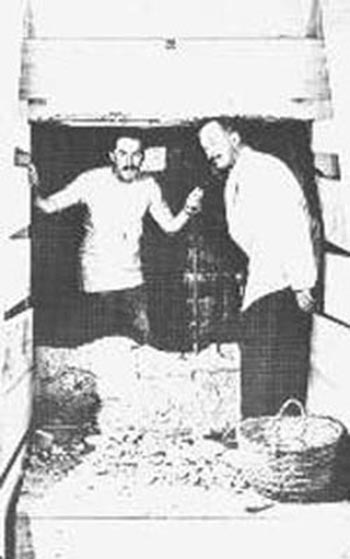
Howard Carter finds the steps leading to Tutankhamen's tomb.
Howard Carter Finds Tut's Tomb Google Videos
Ancient Coptic Tombstone Found Along Egypt's Avenue of Sphinxes Live Science - October 24, 2017
Archaeologists unearthed an ancient Coptic tombstone during a dig Sunday, according to Egypt's antiquities ministry. The tombstone is decorated with a cross and Coptic inscriptions that were carved onto a limestone block, the ministry said. It measures about 1.2 feet by 3 feet (38 by 98 centimeters). It wasn't immediately clear for whom the gravestone was made or when it was produced, but archaeologists plan to study it more to find out, Mostafa Alsager, the general director of Karnak Antiquities and the Avenue of Sphinxes, said in a statement.
The mummy of all mysteries...solved: Archaeologists uncover secrets of how mankind pulled off one of its most awesome miracles - the Great Pyramid of Giza Daily Mail - September 24, 2017
It has for centuries been one of the world's greatest enigmas: how a Bronze Age society with little in the way of technology created Egypt's Great Pyramid of Giza Ð the oldest and only survivor of the Seven Wonders of the Ancient World. Now archaeologists have discovered fascinating proof that shows how the Egyptians transported 2.5 ton blocks of limestone and granite from 500 miles away to build the tomb of Pharaoh Khufu in about 2,600 BC. At 481ft tall, it is the biggest of all the pyramids and was, until the Middle Ages, the largest man-made structure on Earth. Now the discovery of an ancient papyrus, a ceremonial boat and an ingenious system of waterworks have shed light on the infrastructure created by the builders.
Newly unearthed ancient tomb with mummies unveiled in Egypt CNN - September 9, 2017
Egyptian authorities unveiled a previously undiscovered ancient tomb belonging to a goldsmith and his wife near Luxor in southern Egypt on Saturday. The tomb, at the Draa Abul Nagaa necropolis, contains "mummies, sarcophagi, statuettes, pots and other artifacts," according to Egypt's Ministry of Antiquities. It belonged to Amenemhat -- which means the god "Amen Is In the Forefront" -- and his wife Amenhotep, said Mostafa Al-Waziri, who led the Egyptian team which unearthed the 3,500-year-old tomb. While Amenhotep is usually a man's name, Waziri said, the team found references inside the tomb that indicated she was the lady of the house. CNN was the first media outlet to be given access to the tomb on the day of the announcement.
New mummies discovered in tomb near Luxor, Egypt BBC - September 9, 2017
Archaeologists in Egypt have discovered the tomb of a royal goldsmith containing the mummies of a woman and her two children, authorities said. The tomb, dating back to the New Kingdom (16th to 11th Centuries BC), was found near the Nile city of Luxor, 400 miles (700km) south of Cairo. Among the items discovered inside was a statue of the goldsmith Amenemhat, sitting beside his wife. It is unclear whether the three mummies discovered are connected to Amenemhat. The mummies were found down a burial shaft leading off the main chamber, Egypt's Ministry of Antiquities said.
The lost languages of Egypt: Hi-tech cameras help archaeologists find ancient works hidden in monastery parchment in discovery hailed as a 'new golden age' Daily Mail - August 28, 2017
Ancient works hidden underneath monastery scriptures have been uncovered using imaging technology that pieced together words originally scrubbed off. The team found a series of lost texts using a method that allows scientists to restore ancient documents that were written over long ago to save on expensive parchment. The discoveries at Saint Catherine's monastery on the Sinai peninsula, Egypt, signal a 'new golden age of discovery'.
Ancient Egyptian Pharaoh May Be the 1st Known 'Giant' Live Science - August 4, 2017
The supposed remains of Sanakht, a pharaoh of ancient Egypt, may be the oldest known human giant, a new study finds. Myths abound with stories of giants, from the frost and fire giants of Norse legends to the Titans who warred with the gods in ancient Greek mythology. However, giants are more than just myth; accelerated and excessive growth, a condition known as gigantism, can occur when the body generates too much growth hormone. This usually occurs because of a tumor on the pituitary gland of the brain. As part of ongoing research into mummies, scientists investigated a skeleton found in 1901 in a tomb near Beit Khallaf in Egypt. Previous research estimated that the bones dated from the Third Dynasty of Egypt, about 2700 B.C.
Archaeologists discover earliest monumental Egyptian hieroglyphs PhysOrg - June 26, 2017
A joint Yale and Royal Museums of Art and History (Brussels) expedition to explore the the ancient Egyptian city of Elkab has uncovered some previously unknown rock inscriptions, which include the earliest monumental hieroglyphs dating back around 5,200 years. These new inscriptions were not previously recorded by any expedition and are of great significance in the history of the ancient Egyptian writing systems.
DNA discovery reveals genetic history of ancient Egyptians CNN - June 23, 2017
Researchers from Germany have decoded the genome of ancient Egyptians for the first time, with unexpected results. The study concluded that preserved remains found in Abusir-el Meleq, Middle Egypt, were closest genetic relatives of Neolithic and Bronze Age populations from the Near East, Anatolia and Eastern Mediterranean Europeans. Modern Egyptians, by comparison, share much more DNA with sub-Saharan populations. The findings have turned years of theory on its head, causing Egyptologists to re-evaluate the region's history while unlocking new tools for scientists working in the field.
5,000-Year-Old 'Billboard' of Hieroglyphs Contains a Cosmic Message Live Science - June 23, 2017
Archaeologists have discovered a "billboard" of hieroglyphs carved into the rocks near the Egyptian village of El-Khawy. The symbols, which show a message related to the cosmos, are the earliest monumental (large) hieroglyphs known, dating back around 5,200 years. This newly discovered rock art site of El-Khawy preserves some of the earliest - and largest - signs from the formative stages of the hieroglyphic script and provides evidence for how the ancient Egyptians invented their unique writing system. The archaeologists also discovered another carving, this one showing a herd of elephants, created sometime between 4000 B.C. and 3500 B.C. One of the adult elephants in the scene was drawn with a little elephant inside its body - an incredibly rare way of representing a pregnant female animal.
The surprising ancestry of ancient Egyptians: First ever genome study of mummies reveals they were more Turkish and European than African Daily Mail - May 30, 2017
The first ever full-genome analysis of Ancient Egyptians shows they were more Turkish and European than African. Scientists analyzed ancient DNA from Egyptian mummies dating from 1400 BC to 400 AD and discovered they shared genes with people from the Mediterranean. They found that ancient Egyptians were closely related to ancient populations in the Levant - now modern day Turkey, Syria, Jordan, Israel and Lebanon. They were also genetically similar to Neolithic populations from the Anatolian Peninsula and Europe.
The groundbreaking study used recent advances in DNA sequencing techniques to undertake a closer examination of mummy genetics than ever before.
Remains of a new pyramid discovered in Egypt PhysOrg - April 3, 2017
A top antiquities official says an Egyptian excavation team has discovered the remains of a new pyramid that dates back to the 13th Dynasty, some 3,700 years ago. The remains were located north of King Sneferu's bent pyramid in the Dahshur royal necropolis south of Cairo. Due to the bent slope of its sides, the pyramid is believed to have been ancient Egypt's first attempt to build a smooth-sided pyramid. The necropolis was the burial site for courtiers and high-ranking officials.
Egypt's famed pyramids get new lab to restore pharaonic boat PhysOrg - March 29, 2017
The vessel is believed to be the ceremonial boat of Pharaoh Cheops, known for building the largest of Egypt's pyramids. The project, funded by the Japan International Cooperation Agency and the Higashi Nippon International University, is set to complete the initial phase of repairs of the 4,500-year-old vessel by 2020. Once reassembled, the vessel of the ancient Egyptian ruler will be displayed at the Grand Egyptian Museum, currently under construction on Cairo's outskirts and close to the pyramids at Giza.
5,000-Year-Old Nativity Scene Found in Egypt Live Science - December 26, 2016
Italian researchers have discovered what might be the oldest nativity scene ever found - 5,000-year-old rock art that depicts a star in the east, a newborn between parents and two animals. The scene, painted in reddish-brown ochre, was found on the ceiling of a small cavity in the Egyptian Sahara desert, during an expedition to sites between the Nile valley and the Gilf Kebir Plateau.
Is this the world's youngest mummy? Daily Mail - November 17, 2016
Scans of what was thought to be a 2,300-year-old hawk reveal it to be a miscarried baby. The remains, which are preserved in a tiny sarcophagus, are now believed to belong to a miscarried 20-week gestation fetus. It is the latest in a series of remarkable discoveries made by medical experts analyzing ancient Egyptian artifacts at Maidstone Museum, Kent.
3,800-Year-Old 'Tableau' of Egyptian Boats Discovered Live Science - October 31, 2016
More than 120 images of ancient Egyptian boats have been discovered adorning the inside of a building in Abydos, Egypt. The building dates back more than 3,800 years and was built near the tomb of pharaoh Senwosret III, archaeologists reported. The tableau, as the series of images is called, would have looked upon a real wooden boat said Josef Wegner, a curator at the Penn Museum at the University of Pennsylvania, who led the excavation. Only a few planks remain of the wooden boat, which would have been constructed at Abydos or dragged across the desert, Wegner said. In ancient Egypt, boats were sometimes buried near a pharaoh's tomb.
Blood & Gold: Children Dying As Egypt's Treasures Are Looted Live Science - August 8, 2016
Since the 2011 Egyptian revolution, political instability and a tourism decline have led to widespread looting of archaeological sites - with deadly consequences. Children forced to work in dangerous conditions to pillage historical sites have died. Antiquities guards were gunned down within an ancient tomb they were trying to protect. Mummies have been left out in the sun to rot after their tombs were robbed. And looting pits have pockmarked ancient sites in such vast numbers that words cannot adequately describe. An investigation found that not only were these horrific events happening but that an enormous amount of potentially looted Egyptian artifacts had made their way into the United States. These artifacts include a vast number of gold coins.
Who Was Sattjeni? Tomb Reveals Secrets About Ancient Egyptian Elite Live Science - June 2, 2016
Two eyes painted on a newly discovered Egyptian coffin seem to stare out from across millennia, conveying the secrets of the ancient Egyptian elite. The coffin, discovered this year in the necropolis at Qubbet el-Hawa across the Nile River from Aswan, belonged to an important local woman, Sattjeni, daughter of one governor, wife of another and mother of two more. Sattjeni's mummified body was buried in two cedar coffins made of wood imported from Lebanon. Though the outer coffin had degraded over the nearly 4,000 years since Sattjeni's death, her inner coffin was in excellent condition, according to Egypt's antiquities ministry, which announced the discovery May 24.
In Photos: 3,800-Year-Old Coffin Holds Ancient Egyptian Woman Live Science - June 2, 2016
Painted eyes decorate the cedar coffin of Sattjeni, an important figure in the 12th Dynasty (1950-1775 B.C.) Egyptian town of Elephantine. Sattjeni was the second daughter of Sarenput II, the governor of Elephantine. Sarenput II had no surviving male heirs, so the line passed to Sattjeni and her older sister Gaut-Anuket. Gaut-Anuket married a local official named Heqaib, who subsequently became Elephantine's governor; soon after, presumably after Gaut-Anuket's death, Sattjeni married Heqaib. Two of her sons would go on to become governors.
The secrets of a lost Egyptian city were underwater CNN - May 11, 2016
Until 1996, two of Egypt's greatest cities were missing. Then along came French archeologist Franck Goddio, who made an extraordinary discovery underwater. For 1,000 years, Thonis-Heracleion was completely submerged. Fish made their homes among the rubble of mighty temples; hieroglyphs gathered algae. Gods and kings sat in stasis, powerless, their statues slowly withdrawing from the world, one inch of sand at a time. Goddio spent years surveying this find, as well as neighboring Canopus, which was rediscovered by a British RAF pilot in 1933 who noticed ruins leading into the waters. Thanks to a new exhibition at the British Museum, Goddio's incredible finds will soon be open to the public. Sunken Cities: Egypt's Lost Worlds ...
Egyptian Mummy's Symbolic Tattoos Are 1st of Their Kind Live Science - May 10, 2016
More than 3,000 years ago, an ancient Egyptian woman tattooed her body with dozens of symbols - including lotus blossoms, cows and divine eyes - that may have been linked to her religious status or her ritual practice. Preserved in amazing detail on her mummified torso, the surviving images represent the only known examples of tattoos found on Egyptian mummies showing recognizable pictures, rather than abstract designs. The mummy was found at a site on the west bank of the Nile River known as Deir el-Medina, a village dating to between 1550 B.C. and 1080 B.C. that housed artisans and workers who built the royal tombs in the Valley of the Kings
New Research Shows that Some Ancient Egyptians Were Naturally Fair-Haired Ancient Origins - May 3, 2016
According to Dr. Janet Davey from the Victorian Institute of Forensic Medicine in Australia, some ancient Egyptians were naturally blonde or red haired. Her research has brought an answer to an intriguing question connected with Egyptian mummies and the effects of the mummification process.
Oldest Depiction Of Ancient Egyptian Demons Found Live Science - April 20, 2016
A Belgium-based Egyptologist has discovered the oldest depictions of ancient Egyptian demons, showing that demonic entities populated the ancient Egyptians' imaginations as far back as 4,000 years ago. These demons gripped their victims and cut off their heads. Wael Sherbiny, an independent scholar who specializes in the ancient Egyptian religious texts, found two demons on two Middle Kingdom coffins about 4,000 years old.
Eight More Statues of the Ancient Egyptian Goddess Sekhmet Found in Luxor Ancient Origins - March 17, 2016
Eight statues of the goddess Sekhmet have been discovered in the temple of Amenhotep III at Kom El-Hettan on the west bank of the Nile. The black granite statues were found during excavations which are a part of the Colossi of Memnon and Amenhotep III Temple Conservation.
Provocative Yet Sacred: The Ancient Egyptian Festival of Drunkennes Ancient Origins - February 3, 2016
The Festival of Drunkenness is a religiously significant celebration that was held annually (said to be biannually in some places) by the ancient Egyptians. The background story for the celebration of this festival can be found in a text known as The Book of the Heavenly Cow. In this text, there is an ancient Egyptian myth involving the destruction of mankind.
Unique Discovery Made in Egyptian Necropolis: Archaeologists Uncover a 4,500-Year-Old Funerary Boat Alongside Tomb of Unknown Elite, Who Was Not part of the Royal Family Ancient Origins - February 3, 2016
Czech archaeologists have unearthed an 18 meter (59.1 ft.) long boat near a tomb of an unknown member of the Old Kingdom's elite class in Abusir (Abu-Sir), Egypt. The boat was found in a good state of preservation and there are hopes that the new discovery will help to increase Egyptologists' understanding of the purpose of ships in funerary rites and shipbuilding techniques of the Old Kingdom.
The Tomb of Khentkaus III: A Cautionary Tale of Climate Change? Ancient Origins - February 3, 2016
The reign and remains of a recently discovered Queen Mother of ancient Egypt will provide vital new information about the civilization's distant past, and may provide cautionary information for modern times too. Queen Khentkaus III, who had graffiti on her looted tomb calling her the Queen Mother, lived around 2450 BC - a couple of hundred years before the Egyptian civilization failed because drought caused the Nile River to stop flooding. Her skull was smashed in, experts believe by grave robbers.
Thoth's Storm: New Evidence for Ancient Egyptians in Ireland? Ancient Origins - January 19, 2016
The Irish-Egyptian Connection: One of the more controversial theories when it comes to the origins of the Irish people is a connection to ancient Egypt. Although there are many Irish legends connecting Tara and Egyptian royalty, these have been impossible to prove. When ancient Egypt and Ireland are spoken about in the same breath it usually results in the rolling of eyes, polite exits and the sound of murmurs citing pseudo-history and new age babble. At least, that used to be the case. Recent discoveries in DNA research have added to already verified archaeological finds to present a scenario that is now more difficult to dismiss. The Hill of Tara is one of Ireland's most ancient sacred sites. It is surrounded by many other Neolithic earthworks and tombs and although commonly associated with the Celts, the site pre-dates their arrival in Ireland by thousands of years. In legend it is the place where the Tuatha De Danann reigned. These were a God-like people who were said to have arrived in Ireland in mysterious ships and had magical powers.
Two 3,400-Year-Old Shrines with Statues discovered at Egyptian Quarry Site Ancient Origins - December 30, 2015
Archaeologists in Egypt have discovered some statues of two families in shrines that researchers previously thought were destroyed by an earthquake in ancient times. They made the find at Gebel el Silsila, the site of a quarry on both banks of the Nile River, whose rock was used in most of the great temples of ancient Egypt. One of the statues, described as the best-preserved cenotaph at Gebel el Silsila, depicts an ancient Egyptian official named Neferkhewe and his wife, Ruiuresti, and their two children. An inscription near the statues describes Neferkhewe as overseer of the foreign lands and chief of the medjay. The medjay was what the ancient Egyptians called southern Sudan. He served under King Thutmosis III, who reigned from 1479 to 1426 BC.
Tomb Hidden by History, Now Revealed: Wet Nurse of Tutankhamun May have been His Own Sister Ancient Origins - December 21, 2015
The famous Egyptian boy king, Pharaoh Tutankhamun is believed to have been wet-nursed by a woman named Maia - who may have been his sister. The tomb of this mysterious woman has been opened to the public for the first time since its discovery in 1996, revealing ancient engravings and paintings. The tomb in Saqqara, a necropolis located 20 kilometers (12 miles) south of Cairo, was discovered almost 20 years ago and is set to be opened to visitors for the first time. The tomb of the wet nurse was uncovered by French Archaeologist Dr. Alain Zivie, Head of the French mission in Bubastis at Saqqara since 1996, who was there for the unveiling to journalists last week in Egypt
King Tut's wet nurse may have been his sister: expert PhysOrg - December 21, 2015
An archaeologist said Sunday that Maia, Egyptian pharaoh Tutankhamun's wet nurse, may have actually been his sister Meritaten, reviving speculation about the identity of the mother of the boy king. DNA tests have proved that the pharaoh Akhenaten was the father of Tutankhamun, but the identity of his mother has long been a mystery. Egyptian officials and French archaeologist Alain Zivie unveiled Maia's tomb to journalists ahead of its opening to the public next month. The tomb was discovered by Egyptologist Zivie in 1996 in Saqqara, a necropolis about 20 kilometres (12 miles) south of Cairo.
The Abydos Boats: Transporting the Pharaohs Through the Afterlife Ancient Origins - December 22, 2015
The Abydos boats are a fleet of ships discovered in the sands of Abydos, Egypt. Sea vessels played an important role in ancient Egypt, not only in the everyday life of its people, but also in its religion and mythology. The flowing of the Nile from the south to the north of this civilization meant that boats were an indispensable mode of transportation. Additionally, the ancient Egyptian god, Ra, was believed to travel across the sky in a solar-boat.
Sarcophagus of Egyptian High Priest Unearthed with Hieroglyphic Inscriptions and Scenes of Offerings Ancient Origins - November 27, 2015
The sarcophagus of a high priest of the ancient Egyptian god Amun Ra has been unearthed in Egypt. The well preserved sarcophagus, discovered by a team of archaeologists within the 3,400-year-old tomb of a Vizier of Egypt, contains hieroglyphic inscriptions and depicts offerings to deities. The sarcophagus itself belonged to Ankh-f-n-khonsu (Ankh-ef-en-Khonsu), high priest of the deity Amun Ra, 'King of the Gods'. The coffin was located in the tomb of Amenhotep-Huy, High official, or Vizier of Ancient Egypt during the reign of Amenhotep III.
Shrine dedicated to King Nectanebo I unearthed in Egypt Ancient Origins - October 6, 2015
An Egyptian and German archaeological team sifting through the ruins of a temple dedicated to the ancient King Nectanebo I has found building blocks and parts of the ceiling, which was decorated with stars. Authorities hope to rebuild and restore the shrine. The 30th Dynasty king, whose name is also spelled Nakhtanebu, lived in the fourth century BC. His house was the last native Egyptian royal line before Persians reconquered Egypt in 343 BC and overthrew Nectanebo's grandson.
4,000-year-old Ancient Egyptian manuscript measuring more than 8ft has been rediscovered in Cairo Ancient Origins - September 15, 2015
The oldest known Egyptian leather manuscript, dating back some 4,000 years, has been rediscovered at the Egyptian Museum in Cairo after it was pulled from a dusty, old storage box, where it had been lost for around 70 years. The precious text contains fine quality depictions of supernatural beings which predate the famous drawings of the Egyptian Book of the Dead. Discovery News reports that the manuscript measures 2.5 meters (8.2 feet) in length, making it the longest text ever found. It exceeds the next longest text by just 2 inches Ð an ancient pre-nuptial agreement between a couple due to be married, which sets out how the wife will be provided for, should the marriage fail.
Researchers identify oldest known case of heart failure in an Egyptian mummy Ancient Origins - August 30, 2015
The oldest case of heart failure in a mummy has been identified in the remains of Nebiri, Chief of Stables, who lived 3,500 years ago in Egypt. Nebiri's head and a broken canopic jar with his internal organs were found in a plundered tomb in 1904 and researchers were allowed to test the tissues this year because the jars were not intact. The head is almost completely unwrapped, but in a good state of preservation. Since the canopic jar inscribed for Hapy, the guardian of the lungs, is partially broken, we were allowed direct access for sampling.
Experts discover traces of rare artificial pigment on Egyptian mummy portraits and panel paintings Ancient Origins - August 29, 2015
Egyptian Blue is one of the first artificial pigments known to have been used by man. First created around 5,000 years ago by heating a mixture of a calcium compound, a copper-containing compound, silica sand and soda or potash to around 850-950 C, the precious pigment was reserved for the most exquisite of artworks. In Egyptian belief, blue was considered the color of the heavens, and hence the universe. It was also associated with water and the Nile. However, scientists have now found traces of the rare pigment behind drab-colored mummy portraits, leading to a new understanding of how this particular pigment was used by artists in the second century A.D.
Breast Cancer Signs Seen in 4,200-Year-Old Egyptian Bones NBC - March 25, 2015
A team from a Spanish university has discovered what Egyptian authorities are calling the world's oldest evidence of breast cancer in the 4,200-year-old skeleton of an adult woman. Antiquities Minister Mamdouh el-Damaty said the bones of the woman, who lived at the end of the 6th Pharaonic Dynasty, showed "an extraordinary deterioration." The study of her remains shows the typical destructive damage provoked by the extension of a breast cancer as a metastasis. Cancer is one of the world's leading causes of death today,but references to the disease are sparse in archaeological records -giving rise to the idea that cancers are mainly due to modern lifestyles. Tuesday's findings, along with evidence reported last year by British researchers of metastatic cancer in a 3,000-year-old skeleton found in a tomb in modern Sudan, suggest that cancer was known in the ancient Nile Valley.
Egypt unveils renovated Tutankhamun gallery BBC - December 16, 2014
Four renovated halls in the Tutankhamun gallery in the Egyptian Museum in Cairo have been unveiled. The renovation is part of a seven-year project to refurbish the entire Egyptian Museum.
In Photos: Ancient Egyptian Coffin with 'Odd' Art Live Science - December 9, 2014
Radiocarbon dating shows that this Egyptian coffin dates back more than 2,400 years, to a time when the Persian Empire controlled Egypt. Inscriptions on the coffin show that it belonged to someone named Denit-ast, or Dent-ast, likely a woman. The coffin contains a number of unusual features, likely a product of the Persian Empire's deportation of Egyptian artists.
2,400-Year-Old Coffin's 'Odd' Art Hints at Ancient Egypt's Brain Drain Live Science - December 9, 2014
In ancient Egyptian coffin with strange and amateurish decorations has been revealed, shedding light on a tumultuous period in Egyptian history when the Persian Empire was in control of the region. In 525 B.C., Persian King Cambyses marched into Memphis, the Egyptian capital, inaugurating a period of Persian rule that would last for more than a century. The Persian Empire was a vast entity that stretched from modern-day Afghanistan to the west coast of Turkey. Ancient texts say that the Persian kings deported Egyptian artists and used them for building projects in Persia. The coffin bears a series of unusual features that are likely related to the Persian Empire's deportation of artists.
Ancient Egyptian Handbook of Spells Deciphered Live Science - November 20, 2014
An Egyptian Handbook of Ritual Power (as researchers call it) has been deciphered revealing a series of invocations and spells. It includes love spells, exorcisms and a cure for black jaundice (a potentially fatal infection). Written in Coptic (an Egyptian language) the 20 page illustrated codex dates back around 1,300 years. This image shows part of the text.
Ancient Egyptian Woman with 70 Hair Extensions Discovered Live Science - September 17, 2014
More than 3,300 years ago, in a newly built city in Egypt, a woman with an incredibly elaborate hairstyle of lengthy hair extensions was laid to rest. She was not mummified, her body simply being wrapped in a mat. When archaeologists uncovered her remains they found she wore "a very complex coiffure with approximately 70 extensions fastened in different layers and heights on the head. Researchers don't know her name, age or occupation, but she is one of hundreds of people, including many others whose hairstyles are still intact, who were buried in a cemetery near an ancient city now called Amarna.
Egyptian Carving Defaced by King Tut's Possible Father Discovered Live Science - July 24, 2014
A newly discovered Egyptian carving, which dates back more than 3,300 years, bears the scars of a religious revolution that upended the ancient civilization. The panel, carved in Nubian Sandstone, was found recently in a tomb at the site of Sedeinga, in modern-day Sudan. It is about 5.8 feet (1.8 meters) tall by 1.3 feet (0.4 m) wide, and was found in two pieces. Originally, it adorned the walls of a temple at Sedeinga that was dedicated to Queen Tiye (also spelled Tiyi), who died around 1340 B.C. Several centuries after Tiye's death - and after her temple had fallen into ruin - this panel was reused in a tomb as a bench that held a coffin above the floor. Photos
Ancient Priest's Tomb Painting Discovered Near Great Pyramid at Giza Live Science - July 16, 2014
A wall painting, dating back over 4,300 years, has been discovered in a tomb located just east of the Great Pyramid of Giza. The painting shows vivid scenes of life, including boats sailing south on the Nile River, a bird hunting trip in a marsh and a man named Perseneb who's shown with his wife and dog. While Giza is famous for its pyramids, the site also contains fields of tombs that sprawl to the east and west of the Great Pyramid. These tombs were created for private individuals who held varying degrees of rank and power during the Old Kingdom (2649-2150 B.C.), the age when the Giza pyramids were built. The tomb contains a central room, offering room and burial chamber. The complex was first recorded in the 19th century and was noted for its 11 statues, which include depictions of Perseneb and his family. Archaeologists were conducting restoration work and did not expect to make a new discovery. This image shows part of the central room with four of the statues. More Photos ...
Remains of 'End of the World' Epidemic Found in Ancient Egypt Live Science - June 16, 2014
Archaeologists have uncovered the remains of an epidemic in Egypt so terrible that one ancient writer believed the world was coming to an end. Working at the Funerary Complex of Harwa and Akhimenru in the west bank of the ancient city of Thebes (modern-day Luxor) in Egypt, the team of the Italian Archaeological Mission to Luxor (MAIL) found bodies covered with a thick layer of lime (historically used as a disinfectant). The researchers also found three kilns where the lime was produced, as well as a giant bonfire containing human remains, where many of the plague victims were incinerated. Pottery remains found in the kilns allowed researchers to date the grisly operation to the third century A.D., a time when a series of epidemics now dubbed the "Plague of Cyprian" ravaged the Roman Empire, which included Egypt. Saint Cyprian was a bishop of Carthage (a city in Tunisia) who described the plague as signaling the end of the world.
4,000-Year-Old Royal Tomb Unearthed in Egypt NBC - June 9, 2014
Spanish archaeologists say they have unearthed a 4,000-year-old tomb littered with human remains in the Egyptian city of Luxor, from a time when pharaohs reunified ancient Egypt. A 65-foot-long (20-meter-long) hallway runs underground to a square burial chamber. The tomb in the Dra Abu Naga necropolis dates back to the 11th Dynasty, roughly 2125 to 1991 B.C. During that time period, Upper and Lower Egypt were united under pharaonic rule from the ancient city of Thebes, which has given way to modern-day Luxor. Studying the tomb and its contents could provide fresh insights into the era.
Solved! How Ancient Egyptians Moved Massive Pyramid Stones Live Science - May 2, 2014
The ancient Egyptians who built the pyramids may have been able to move massive stone blocks across the desert by wetting the sand in front of a contraption built to pull the heavy objects, according to a new study. Physicists at the University of Amsterdam investigated the forces needed to pull weighty objects on a giant sled over desert sand, and discovered that dampening the sand in front of the primitive device reduces friction on the sled, making it easier to operate. The findings help answer one of the most enduring historical mysteries: how the Egyptians were able to accomplish the seemingly impossible task of constructing the famous pyramids.
Mysterious Buried Artifacts Discovered in Egypt's Valley of the Kings BBC - May 1, 2014
Four deposits of artifacts possibly buried as a ritual act of sorts before the construction of a tomb have been discovered in Egypt's Valley of the Kings. The so-called foundation deposits, arranged in a boxlike shape, contain a mix of artifacts, including the head of a cow, a vase painted in blue and flint blades that have wooden handles that are still preserved after more than three millennia. The Valley of the Kings was used to bury Egyptian royalty during the New Kingdom (1550 - 1070 B.C.) period. The discovery was made in its "western valley," an area sometimes called the "valley of the monkeys" after a scene depicting 12 baboons was discovered in one of its tombs. (View more images)
Early Image of Jesus Found in Egyptian Tomb Live Science - May 1, 2014
Spanish archaeologists have discovered what may be one of the earliest depictions of Jesus in an ancient Egyptian tomb. Painted on the walls of a mysterious underground stone structure in the ancient Egyptian city of Oxyrhynchus, about 100 miles south of Cairo, the image shows a young man with curly hair and dressed in a short tunic. He raises his hand as if making a blessing.
Roman Emperor Dressed As Egyptian Pharaoh in Newfound Carving Live Science - March 27, 2014
An ancient stone carving on the walls of an Egyptian temple depicts the Roman emperor Claudius dressed as an Egyptian pharaoh, wearing an elaborate crown, a team of researchers has discovered. In the carving, Emperor Claudius, who reigned from A.D. 41 to 54, is shown erecting a giant pole with a lunar crescent at the top. Eight men, each wearing two feathers, are shown climbing the supporting poles, with their legs dangling in midair. Egyptian hieroglyphs in the carving call Claudius the "Son of Ra, Lord of the Crowns," and say he is "King of Upper and Lower Egypt, Lord of the Two Lands." The hieroglyphs say he is raising the pole of the tent (or cult chapel) of Min (an ancient Egyptian god of fertility and power) and notes a date indicating a ritual like this took place around the summertime researchers say. It would have taken place even though Claudius never visited Egypt. A cult chapel is a place of worship and a tent could also be used for this purpose.
13 Photos: Ancient Egyptian Skeleton Reveals Earliest Metastatic Cancer Live Science - March 22, 2014
A 3,000-year-old skeleton from a conquered territory of ancient Egypt is now the earliest known complete example of a person with malignant cancer spreading from an organ, findings that could help reveal insights on the evolution of the disease, researchers say. Here, the skeleton (called Skeleton Sk244-8) in its original burial position in a tomb in northern Sudan in northeastern Africa, with a blue-glazed amulet (inset) found buried alongside him; the amulet shows the Egyptian god Bes depicted on the reverse side.
Ancient Egyptian Kittens Hint at Cat Domestication Live Science - March 17, 2014
The skeletons of six cats, including four kittens, found in an Egyptian cemetery may push back the date of cat domestication in Egypt by nearly 2,000 years. The bones come from a cemetery for the wealthy in Hierakonpolis, which served as the capital of Upper Egypt in the era before the pharaohs. The cemetery was the resting place not just for human bones, but also for animals, which perhaps were buried as part of religious rituals or sacrifices. Archaeologists searching the burial grounds have found everything from baboons to leopards to hippopotamuses. The new find includes two adult cats and four kittens from at least two litters. The size of the bones and timing of the litters hints that humans may have kept the cats. The bones date back to between 3600 B.C. and 3800 B.C., which would be 2,000 years before the earliest known evidence of cat domestication in Egypt.
Great Pyramid at Giza Vandalized to 'Prove' Conspiracy Theory Live Science - February 18, 2014
Two German men who visited the Egyptian pyramids in April 2013 now face criminal charges for their attempt to prove their "alternative history" conspiracy theories through vandalism. The men, Dominique Goerlitz and Stefan Erdmann, were joined by a third German, a filmmaker who accompanied them to document their "discoveries." The men were allowed to enter the inner chambers of the Great Pyramid at Giza normally off-limits to the public and restricted to authorized archaeologists and Egyptologists. The group reportedly took several items from the pyramids, including taking samples of a cartouche (identifying inscription) of the pharaoh Khufu, also known as Cheops. Goerlitz and Erdmann, who are not archaeologists but have instead been described as "hobbyists," allegedly smuggled the artifacts out of the country in violation of strict antiquities laws, according to news reports.
Valley of the other kings: Lost dynasty found in Egypt Independent - February 1, 2014
A previously unknown, yet potentially very important, ancient Egyptian kingdom has been discovered by archaeologists working in the Nile Valley. Excavations at Abydos, 70 miles north-west of Egypt's famous Valley of the Kings, have revealed the existence of an entire royal cemetery, now believed to be the final resting place of up to 16 mysterious pharaohs - an entire dynasty whose existence was up till now virtually unknown to the Egyptological world. Pharaoah Senebkay
Archaeologists find remains of previously unknown pharaoh in Egypt The Guardian - February 1, 2014
Archaeologists in Egypt believe they have discovered the remains of King Senebkay, a previously unknown pharaoh who reigned more than 3,600 years ago in a forgotten dynasty.
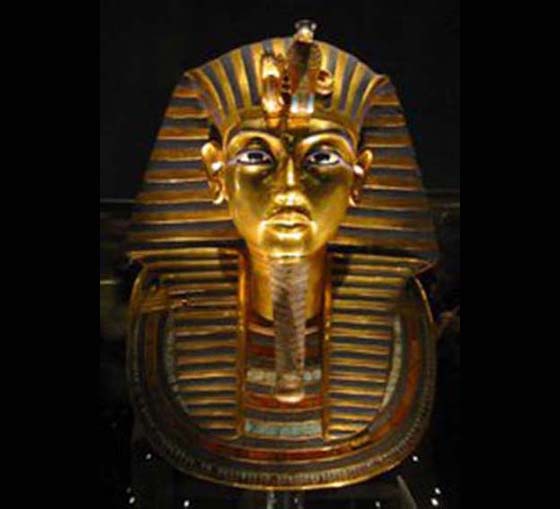
King Tutankhamen Crystalinks
King Tut's Mummified Erect Penis May Point to Ancient Religious Struggle Live Science - January 2, 2014
Egypt's King Tutankhamun was embalmed in an unusual way, including having his penis mummified at a 90-degree angle, in an effort to combat a religious revolution unleashed by his father, a new study suggests.The pharaoh was buried in Egypt's Valley of the Kings without a heart (or a replacement artifact known as a heart scarab); his penis was mummified erect; and his mummy and coffins were covered in a thick layer of black liquid that appear to have resulted in the boy-king catching fire.
In Photos: The Life and Death of King Tut Live Science - January 2, 2014
Tutankhamun was an Egyptian pharaoh who lived between roughly 1343 and 1323 B.C. Often called the "boy-king," he ascended the throne at around the age ...
Ancient Spider Rock Art Sparks Archaeological Mystery BBC - December 20, 2013
Archaeologists have discovered a panel containing the only known example of spider rock art in Egypt and, it appears, the entire Old World. The rock panel, now in two pieces, was found on the west wall of a shallow sandstone wadi, or valley, in the Kharga Oasis, located in Egypt's western desert about 108 miles (175 kilometers) west of Luxor. Facing east, and illuminated by the morning sun, the panel is a "very unusual" find, said Egyptologist Salima Ikram, a professor at the American University in Cairo who co-directs the North Kharga Oasis Survey Project. The identification of the creatures as spiders is tentative and the date of it uncertain, Ikram told LiveScience in an email. Even so, based on other activity in the area, the rock art may date to about 4000 B.C. or earlier, which would put it well into prehistoric times, before Egypt was unified, noted Ikram, who detailed the finding in the most recent edition of the journal Sahara.
Pyramid-Age Love Revealed in Vivid Color in Egyptian Tomb Live Science - November 15, 2013
She was a priestess named Meretites, and he was a singer named Kahai, who performed at the pharaoh's palace. They lived about 4,400 years ago in an age when pyramids were being built in Egypt, and their love is reflected in a highly unusual scene in their tomb - an image that has now been published in all its surviving color. The tomb at Saqqara - which held this couple, their children and possibly their grandchildren - has now been studied and described by researchers at Macquarie University's Australian Center for Egyptology. Among the scenes depicted is a relief painting showing the couple gazing into each other's eyes, with Meretites placing her right hand over Kahai's right shoulder. Such a display of affection was extraordinary for Egypt during the Pyramid Age. Only a few examples of a face-to-face embrace survive from the Old Kingdom (2649 B.C. to 2150 B.C.), the time period when the couple lived and pyramid building thrived.
Pinpointing When the First Dynasty of Kings Ruled Egypt Science Daily - September 14, 2013
For the first time, a team of scientists and archaeologists has been able to set a robust timeline for the first eight dynastic rulers of Egypt. Until now there have been no verifiable chronological records for this period or the process leading up to the formation of the Egyptian state. The chronology of Early Egypt between 4500 and 2800 BC has been reset by building mathematical models that combine new radiocarbon dates with established archaeological evidence. Over 100 fresh radiocarbon dates were obtained for hair, bone and plant samples excavated at several key sites including the tombs of the kings and surrounding burials.
New timeline for origin of ancient Egypt BBC - September 4, 2013
A new timeline for the origin of ancient Egypt has been established by scientists. A team from the UK found that the transformation from a land of disparate farmers into a state ruled by a king was more rapid than previously thought. Using radiocarbon dating and computer models, they believe the civilization's first ruler - King Aha - came to power in about 3100BC. Until now, the chronology of the earliest days of Egypt has been based on rough estimates. Previous records suggested the pre-Dynastic period, a time when early groups began to settle along the Nile and farm the land, began in 4000BC. But the new analysis revealed this process started later, between 3700 or 3600BC. The Palermo Stone is inscribed with the names of early Egyptian kings The team found that just a few hundred years later, by about 3100BC, society had transformed to one ruled by a king.
Far Out: Ancient Egyptian Jewelry Came from Outer Space Live Science - August 20, 2013
Ancient Egyptian beads found in a 5,000-year-old tomb were made from iron meteorites that fell to Earth from space, according to a new study. The beads, which are the oldest known iron artifacts in the world, were crafted roughly 2,000 years before Egypt's Iron Age. In 1911, nine tube-shaped beads were excavated from an ancient cemetery near the village of el-Gerzeh, which is located about 3,100 miles (5,100 kilometers) south of Cairo, said study lead author Thilo Rehren, a professor at UCL Qatar, a Western Asian outpost of the University College London's Institute of Archaeology. The tomb dates back to approximately 3200 B.C., the researchers said. Inside the tomb, which belonged to a teenage boy, the iron beads were strung together into a necklace alongside other exotic materials, including gold and gemstones. Early tests of the beads' composition revealed curiously high concentrations of nickel, a telltale signature of iron meteorites.
Mummy Teeth Tell of Ancient Egypt's Drought Live Science - July 16, 2013
The link between drought and the rise and fall of Egypt's ancient cultures, including the pyramid builders, has long fascinated scientists and historians. Now, they're looking into an unexpected source to find connections: mummy teeth. A chemical analysis of teeth enamel from Egyptian mummies reveals the Nile Valley grew increasingly arid from 5,500 to 1,500 B.C., the period including the growth and flourishing of ancient Egyptian civilization.
Pharaoh's Sphinx Paws Found in Israel Live Science - July 9, 2013
Archaeologists digging in Israel say they have made an unexpected find: the feet of an Egyptian sphinx linked to a pyramid-building pharaoh. The fragment of the statue's front legs was found in Hazor, a UNESCO World Heritage Site just north of the Sea of Galilee. Between the paws is a hieroglyphic inscription with the name of king Menkaure, sometimes called Mycerinus, who ruled Egypt during the Old Kingdom more than 4,000 years ago and built one of the great Giza pyramids. Researchers don't believe Egypt had a relationship with Israel during Menkaure's reign. They think it's more likely that the sphinx was brought to Israel later on, during the second millennium B.C.
Mysterious Toe Rings Found on Ancient Egyptian Skeletons Live Science - July 5, 2013
Archaeologists have discovered two ancient Egyptian skeletons, dating back more than 3,300 years, which were each buried with a toe ring made of copper alloy, the first time such rings have been found in ancient Egypt. The toe rings were likely worn while the individuals were still alive, and the discovery leaves open the question of whether they were worn for fashion or magical reasons. Supporting the magical interpretation, one of the rings was found on the right toe of a male, age 35-40, whose foot had suffered a fracture along with a broken femur above it.
Ancient Egyptians Crafted Jewelry From Meteorites Live Science - May 31, 2013
An ancient Egyptian iron bead found inside a 5,000-year-old tomb was crafted from a meteorite, new research shows. The tube-shaped piece of jewelry was first discovered in 1911 at the Gerzeh cemetery, roughly 40 miles (70 kilometers) south of Cairo. Dating between 3350 B.C. and 3600 B.C., beads found at the burial site represent the first known examples of iron use in ancient Egypt, thousands of years before Egypt's Iron Age. And their cosmic origins were suspected from the start. Soon after the beads were discovered, researchers showed that the metal jewelry was rich in nickel, a signature of iron meteorites. But in the 1980s, academics cast doubt on the beads' celestial source, arguing that the high nickel content could have been the result of smelting.
Cemetery Reveals Baby-Making Season in Ancient Egypt Live Science - May 17, 2013
The peak period for baby-making sex in ancient Egypt was in July and August, when the weather was at its hottest. Researchers made this discovery at a cemetery in the Dakhleh Oasis in Egypt whose burials date back around 1,800 years. The oasis is located about 450 miles (720 kilometers) southwest of Cairo. The people buried in the cemetery lived in the ancient town of Kellis, with a population of at least several thousand. These people lived at a time when the Roman Empire controlled Egypt, when Christianity was spreading but also when traditional Egyptian religious beliefs were still strong. So far, researchers have uncovered 765 graves, including the remains of 124 individuals that date to between 18 weeks and 45 weeks after conception. The excellent preservation let researchers date the age of the remains at death. The researchers could also pinpoint month of death, as the graves were oriented toward the rising sun, something that changes predictably throughout the year
Giza Secret Revealed: How 10,000 Pyramid Builders Got Fed Live Science - April 23, 2013
The pyramid of Menkaure, with three queens' pyramids in front. Behind are the pyramids of Khafre and Khufu. The workers' town that archaeologists have been exploring was used to house laborers building Menkaure's pyramid. The builders of the famous Giza pyramids in Egypt feasted on food from a massive catering-type operation, the remains of which scientists have discovered at a workers' town near the pyramids. The workers' town is located about 1,300 feet (400 meters) south of the Sphinx, and was used to house workers building the pyramid of pharaoh Menkaure, the third and last pyramid on the Giza plateau. The site is also known by its Arabic name, Heit el-Ghurab, and is sometimes called "the Lost City of the Pyramid Builders." So far, researchers have discovered a nearby cemetery with bodies of pyramid builders; a corral with possible slaughter areas on the southern edge of workers' town; and piles of animal bones.
Egyptian Mummy's Elaborate Hairstyle Revealed in 3D Live Science - January 24, 2013
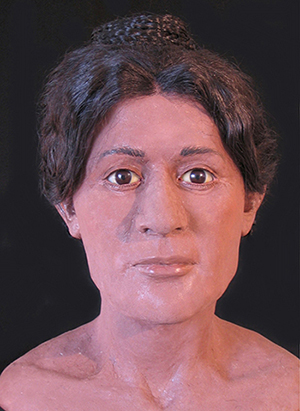
Nearly 2,000 years ago, at a time when Egypt was under the control of the Roman Empire, a young woman with an elaborate hairstyle was laid to rest only yards away from a king's pyramid, researchers report. She was 5 feet 2 inches in height, around age 20 when she died, and was buried in a decorated coffin whose face is gilded with gold. A nearby pyramid, at a site called Hawara, was built about 2 millennia before her lifetime. The location of her burial is known from archival notes. High-resolution CT scans reveal that, before she was buried, her hair was dressed in an elaborate hairstyle.
Oldest Pharaoh Carvings Discovered in Egypt Live Science - December 10, 2012
The oldest-known representations of a pharaoh are carved on rocks near the Nile River in southern Egypt, researchers report. The carvings were first observed and recorded in the 1890s, but only rediscovered in 2008. In them, a white-crowned figure travels in ceremonial processions and on sickle-shaped boats, perhaps representing an early tax-collecting tour of Egypt.
The scenes place the age of the carvings between 3200 B.C. and 3100 B.C., researchers report in the December issue of the journal Antiquity. During that time, Egypt was transitioning into the dynastic rule of the pharaohs.
'Cult Fiction' Traced to Ancient Egypt Priest Live Science - September 24, 2012
A recently deciphered Egyptian papyrus from around 1,900 years ago tells a fictional story that includes drinking, singing, feasting and ritual sex, all in the name of the goddess Mut. Researchers believe that a priest wrote the blush-worthy tale, as a way to discuss controversial ritual sex acts with other priests.
Egyptian pyramids found by infra-red satellite images BBC - May 25, 2011
Seventeen lost pyramids are among the buildings identified in a new satellite survey of Egypt. More than 1,000 tombs and 3,000 ancient settlements were also revealed by looking at infra-red images which show up underground buildings. Initial excavations have already confirmed some of the findings, including two suspected pyramids.
June 29, 2001 - Reuters - Cairo
In a first, a joint team of German and Egyptian archaeologists has unearthed a royal tomb dating back to the 17th Dynasty which likely belonged to a king whose great-grandsons swept out foreign rulers and paved the way for the New Kingdom - Ancient Egypt's "Golden Age". The German Institute of Archaeology in Cairo (DAI), in announcing the find, said they are convinced the 3500-year-old tomb belonged to Nub-Kheper-Ra Intef, a monarch of the late 17th Dynasty. A time of political turmoil and confusion, the 17th Dynasty has failed to provide archaeologists with a royal tomb for study - until now.
The tomb is located across the Nile from modern-day Luxor in the northern portion of the Theban necropolis, at the entrance to the Valley of the Kings. The area, referred to as Dra' Abu el-Naga, has long been felt to be the burial place of kings and private individuals of the 17th and early 18th dynasties. According to archaeologists, the "remnants of the tomb consist of the lower part of a small mud-brick pyramid surrounded by an enclosure wall, also built of mud bricks."
In front of the pyramid lies a burial shaft where the toppled head of a life-size royal sandstone statue of the pharaoh was found. The pyramid-complex and the burial shaft is unequivocally that of Nub-Kheper-Ra Intef, according to Dr Daniel Polz, the lead excavator and deputy director of DAI.
Other discoveries included "a small funerary chapel of a private individual" adjacent to the pyramid, but outside the enclosure wall. The inner walls of the chapel were decorated with depictions of its owner, as well as his name and titles. According to these inscriptions the tomb owner, Teti, was a "treasurer" or "chancellor" of the king. On one of the walls, there remains a large cartouche (the royal name-ring) showing the name of king Nub-Kheper-Ra Intef. The 17th Dynasty at the end of the Second Intermediate Period - the era between the Middle and New Kingdoms - was characterized by the rule of the Hyksos, foreign invaders of an Asiatic origin who ruled in the northern part of Egypt contemporaneously with the kings of the 17th Dynasty in Thebes.
Following numerous military campaigns against them, the Hyksos rulers were eventually expelled from Egypt by Kamose, the last king of the 17th Dynasty and his brother, Ahmose, the first king of the 18th Dynasty which saw a unified Egypt rise to unprecedented wealth and power. It is believed that Nub-Kheper-Ra Intef, one of the immediate predecessors of Kamose and Ahmose, could actually have been their great-grandfather.
German archaeologist Polz and his team were led to the tomb by information obtained from a 3000-year-old papyrus and the works of an American archaeologist who made reference to the tomb, but never found it himself. The papyrus mentioned an attempt by robbers to plunder the royal tomb by digging a tunnel from another tomb belonging to a private individual. The robbers, however, failed to reach the royal tomb. Then in the 19th Century, another group of robbers found the royal tomb, removed the golden casket and sold it without disclosing where they found it - the casket eventually ended up in the British Museum in London. Polz and his team also found what appeared to be evidence of the removal of two obelisks from the tomb of King Nub-Kheper-Ra Intef. The obelisks were reportedly removed from the tomb in 1881 on orders of the then French director of the Council of Antiquities in Cairo, who wanted them transferred to old Cairo Museum. Unfortunately, the boat with the heavy obelisks sank in the Nile, some 10 kilometres from Luxor.
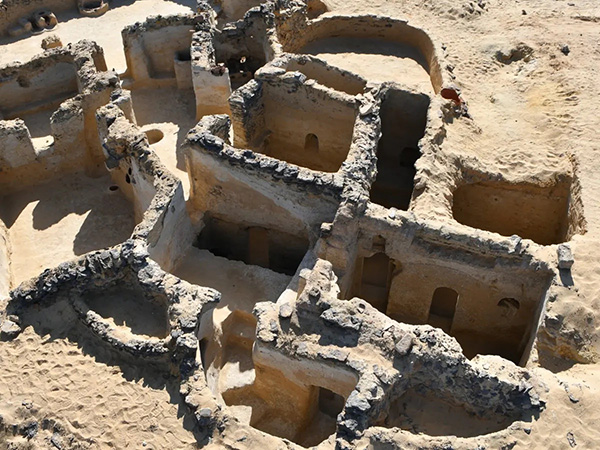
June 2001 - Egypt Revealed
In the middle of the fourth century A.D., a group of hermits, followers of St. Macarius, settled in the Egyptian desert west of the Nile Delta. At Wadi al-Natrun, this colony of anchorites (religious believers who choose to live in isolation) survived the harshness of the desert and the raids of nomads over the centuries and evolved into what was probably one of the first monastic communities of Egypt.
A team from Leiden University in the Netherlands has been excavating this site since 1995, and the results so far are beginning to paint a reliable image of how this evolution from hermits to monastery monks came about.
Initially, the settlement must have had a rather open, informal structure, similar to that of a village. The core of the settlement consisted of a church and a defensive tower. The remains of a church, excavated in 1999, are of a rather late date, probably the early eighth century, although an earlier church might still be found underneath it. Shortly after A.D. 700, the monasteries of Wadi al-Natrun were sacked by Bedouins, and this eighth-century church, apparently one of the first buildings to be reconstructed, is little more than a makeshift structure.
Remnants of a huge building were found immediately south of the church, in the southeast corner of the complex. It must have been a square tower about 16 meters (52 feet) on a side, with walls 2 meters (6.5 feet) thick and a height of as much as 20 meters (65 feet).
Much evidence suggests this tower existed in the fifth century and may date to the fourth century. The fact that blocks from a pharaonic temple were found in the debris of the church suggests that this tower was built to guard a settlement of workers producing salt and natron (sodium carbonate) from nearby lakes. Such a settlement would have included a temple and, if abandoned before the monks arrived, it might have served as a quarry for building materials.
The region was invaded by Bedouins over the following centuries, and the settlements were destroyed or heavily damaged several times. After the sack around 700 and the makeshift rebuilding effort, the monks apparently no longer relied on the crumbling tower for defense. But in the ninth century, the towers outer walls were reinforced and the core of the settlement was surrounded by a defensive wall, giving it the appearance of a real monastery. This new physical structure may have influenced the social structure of the community. Instead of living some distance apart in hermitages sprinkled over a wide area, many monks may have chosen to live within the safety of the enclosure wall. The result would have been a true monastery.
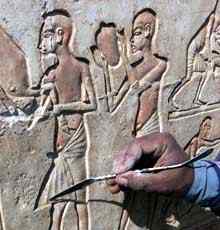
February 12, 2001 - Cairo - Reuters
A tomb dating back to the reign of New Kingdom Pharaoh Amenhotep IV in the 14th century BC has been discovered in the Giza suburb of Sakkara, an antiquities official said on Sunday. "This is a unique discovery because it is the first time we have uncovered a tomb in Sakkara from the reign of Akhenaton, who had his capital at Akhetaton (now called Tel al-Amarna) in Upper Egypt. The tomb once occupied by the high priest Meryneith, whose name means "the beloved of Neith (goddess of war and hunting),'' was discovered by a Dutch-Egyptian archaeological mission on January 31 during excavation of New Kingdom tombs at Saqqara.
The excavation work, which is still under way, has so far uncovered two store rooms in the east of the tomb, three small chapels in the west, wall reliefs that include depictions of funeral rituals, five columns with hieroglyphic inscriptions and a burial chamber, Hussein noted.
No mummies have yet been uncovered, but we have come across bones. There is a good chance we will find a mummy once excavation work on the burial chamber is complete. Hussein sees the discovery as an addition to our knowledge of the reign of Amenhotep IV and Sakkara, which was used as a site for pyramids and tombs from the first Pharaonic dynasties. In his quest to unify Egypt in the worship of a single deity, Aton - a form of the sun-god Ra, the 18th dynasty ruler Amenhotep IV changed his name to Akhenaton, meaning "It pleases Aton,'' and built a new capital in Amarna dedicated to Aton and called it 'Akhetaton' (the Horizon of Aton). Akhenaten, a religious hard-liner who provoked the wrath of the powerful Amun priesthood, among others, for his reforms, is said by some scholars to have been the world's first monotheist. He ruled from 1353-36 BC.
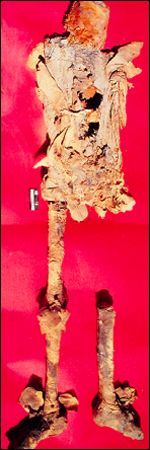
The reconstructed mummy
December 22, 2000 - BBC
The discovery of a false toe attached to the foot of an mummy provides more evidence of the sophistication of ancient Egyptian medicine. The well-crafted wooden toe was discovered by a team investigating remains found in a burial chamber believed to be in the ancient city of Thebes. Pottery fragments found in the chamber dated the find at approximately the 21st or 22nd Egyptian dynasty, or between 1065BC and 740BC.
They found that the woman, aged between 50 and 55 at death had lost the big toe on the right foot - probably by amputation - during life, as soft tissue and skin had regrown over the wound. In addition, a wooden prosthetic toe - perfectly shaped to match the lost toe, even to the point of having a nail - had been created and attached to the foot with textile laces.
The regrowth of tissue, allied with definite scuff marks on the base of the wooden toe, seem to indicate a functional role rather than simply an effort by embalmers to make the body appear complete in readiness for the afterlife. Examination of the rest of the body suggest that this may well be one of the earliest examples of someone suffering diabetic complications. The woman had suffered significant hardening of the arteries, but not just the large arteries, but also the tiny vessels supplying the extremities. Although they cannot prove this, the researchers suggest that the toe may have had to be amputated after the blood supply was cut, and gangrene set in.
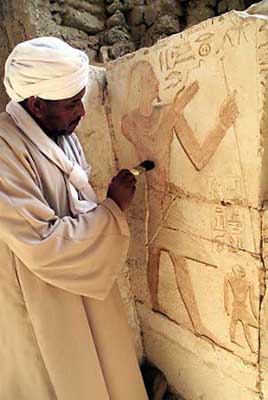
November 20, 2000 - Reuters - Abu Sir
Galal Abdu al Keriti, an Egyptian antiquities worker, dusts off a newly-discovered Pharaonic portrait of Queen Inty near the Giza plateau November 20, 2000. The portrait was among finds, which included an empty sarcophagus, in a 4,000-year-old tomb being excavated by a Czech-Egyptian team of archaeologists. Archaeologists excavating a 4,000-year-old tomb near Cairo found an empty sarcophagus on Monday that they said could yield vital clues about the collapse of the pyramid-building era in ancient Egypt. Zahi Hawass, director of the Giza Plateau, told Reuters that a team of Egyptian and Czech archaeologists discovered the stone coffin in a sixth dynasty tomb at the pyramids of Abu Sir 17 miles southwest of Cairo.
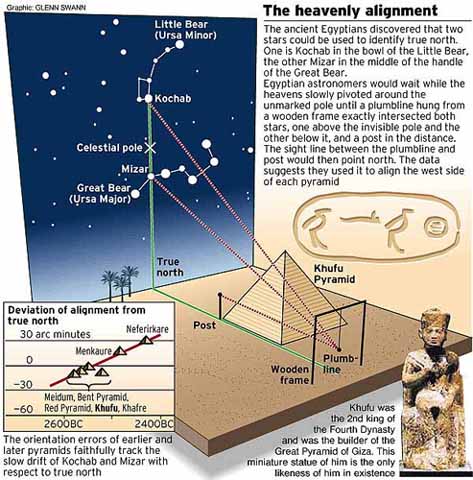
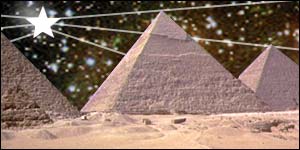
November 15, 2000 - BBC
Ancient Egyptian astronomers aligned the pyramids due north by using two stars that circle the celestial polar point.Spence has come up with an ingenious solution to a long-standing mystery. Nearly 4,500 years ago, each star was about 10 degrees from the celestial pole which lay directly between them. When one star was exactly above the other in the sky, astronomers could find a line that pointed due north. But the alignment was only true for a few years around 2,500 BC. Before and after that time, the stars deviated from the north-south line and anyone using the stars to plot a direction would have made errors. And it is these mistakes that a British Egyptologist now believes can be used to estimate very accurately when the pyramids were built. Her theory suggests that the Great Pyramid at Giza was constructed within 10 years of 2,480 BC.
Kate Spence is from the University of Cambridge. She developed her theory while trying to explain the deviations in the alignment of the bases of many pyramids from true north.
She believes the ancients may have used a pair of fairly bright stars, which in 2,467 BC lay precisely along a straight line that included the celestial pole. "We know that the ancient Egyptians were extremely interested in the night sky, particularly the circumpolar stars. These circle around the North Pole, and as you can always see them, the Egyptians always referred to them as 'The Indestructibles'. As a result, they became closely associated with eternity and the king's afterlife. So that after death, the king would hope to join the circumpolar stars - and that's why the pyramids were laid out towards them.
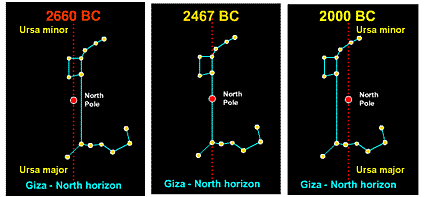
The pyramid builders may have used a pair of stars for alignment
The north-finding stars were Kochab, in the bowl of the Little Dipper (Ursa Minor), and Mizar, in the middle of the handle of The Plough or Big Dipper (Ursa Major).
An Egyptian astronomer would have held up a plumb line and waited for the night sky to slowly pivot around the unmarked pole as the Earth rotated.
When the plumb line exactly intersected both stars, one about 10 degrees above the invisible pole and the other 10 degrees below it, the sight line to the horizon would aim directly north.
However, the Earth's axis is unstable and wobbles like a gyroscope over a period of 26,000 years. Modern astronomers now know that the celestial north pole was exactly aligned between Kochab and Mizar only in the year 2,467 BC.
Either side of this date, the ancient astronomers trying to find true north would lose some accuracy.
Writing in the journal Nature, Kate Spence shows that the orientation errors of earlier and later pyramids faithfully track the slow drift of Kochab and Mizar with respect to true north.
And because the error in the Kochab-Mizar alignment can be readily calculated for any date, the error in each pyramid's orientation corresponds to a period of several years.
Owen Gingerich, of the Harvard-Smithsonian Center for Astrophysics, Cambridge, Massachusetts, said: "Spence has come up with an ingenious solution to a long-standing mystery."
August 5, 2000 - Discovery
According to an analysis of the clothing found in Tutankhamen's tomb, the ancient pharaoh was pear-shaped and may have suffered from a disease that gave him huge hips. In an eight-year study, Vogelsang-Eastwood, curator at the Ethnological Museum in Leiden, Netherlands, found that the pharaoh, who was only 18 when he died in about 1323 BC, measured 31 inches around the chest, 29 inches around the waist, and 43 inches around the hips, according to the London Times. Vogelsang-Eastwood believes that being pear-shaped may have run in the family, considering the pharaoh's father Akhenaten had a similar figure.
She said, "This is shown on statues and reliefs of Akhenaten. But by the time of Tutankhamen, Egypt had returned to the old religion, and reliefs were idealized - they show him as a golden boy." According to Vogelsang-Eastwood, father and son may have suffered from an inherited disease or one common to the area, although she has no idea as to what it might be. She told the Times, "Not enough medical research has been done in this area. The disease, or whatever he had, certainly affected his weight, putting fatty deposits on his hips." A leading expert on Tutankhamen's wardrobe, Vogelsang-Eastwood began her study in 1992, a time when little research on the textiles had been done since they were found in 1922. She used the hundreds of items found in his tomb, including garments he was buried in and clothing dating from his childhood, to create exact copies of the pharaoh's clothing. Tutankhamen's recreated wardrobe will be featured in an exhibition in Edinburgh early next year.
July 23, 2000 - Discovery
Two mini-replicas of the great pyramids of Giza have been unearthed south of the Sphinx, at the eastern foot of the three great pyramids. Containing the bodies of the workers who built the pyramids and their supervisors, the limestone tombs may throw new light on the knowledge of the funerary traditions in ancient Egypt. Built 4,600 years ago, during the reign of the pharaoh Cheops, the tombs are modeled exactly on the design made to house kings, with false doors and causeways leading to an offering basin.
The upper-level tombs, made in limestone, were reserved for technicians, craftsmen and artisans, while the lower-level tombs, made with "leftovers" from the pyramids construction, housed the bodies of the workmen who positioned the huge stone blocks. Like the great pyramids, the workers tombs bore inscriptions depicting the worker's title - such as "Inspector of Pyramid Building" - curses to ward off sacrilegious visitors, and even frescoes showing builders at work with a customary dress very similar to the galabiyas, the traditional garb peasants still wear today.
The skeletons found in the tombs show that the workforce also received good health care. Twelve skeletons had splints on their hands for injuries probably caused by falling rocks; one had an amputated leg and lived for 14 years after the surgery. Moreover, X-rays on a skull revealed what may be one of the earliest examples of brain surgery. Egyptologists are intrigued. "The imitation of elements of the royal pyramid complex in these private tombs is a process seen also at other periods, by which the fashions and styles of the elite were copied by other levels of society, " said Alan Jeffrey Spencer of the British Museum.
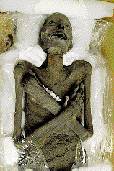
July 16, 2000 - London Times
More than 3,000 years after it was stolen from a tomb in Egypt, scientists believe they have found the body of Ramses I, who is thought to have been the pharaoh at the time of the Exodus recounted in the Old Testament. The mummy was discovered in a private museum at Niagara Falls where it had lain unrecognised for 140 years.
American Egyptologists who bought the remains are awaiting the results of DNA tests. They hope these will back up evidence from the body's provenance and appearance which suggest that it is Ramses. They will compare material taken from the body with DNA samples from Ramses I's son, Sethi I, and his grandson, Ramses II. The Egyptologists at the Michael C Carlos Museum in Atlanta, Georgia, say clues suggest it is the body of a pharaoh even though the 5ft 5in man has lost his original coffins and bandage wrappings. He lies in a cardboard box, head tilted back and arms crossed across his chest. "The arms are crossed in a way which is generally only seen in royal mummies and the incisions made in its side to allow the removal of internal organs also correspond to the techniques used on the pharaohs," said Betsy Teasley Trope, the assistant curator of antiquities. Her museum bought the remains last year from the owner of the Niagara Falls Daredevil Museum.
Museum records show that in 1861 Colonel Sydney Barnett, the son of its founder, bought five mummies from James Douglas, an adventurer who may have bought them during a visit to Thebes in Upper Egypt around 1860. It is believed that one of these bodies came from a cache of royal mummies that was discovered near Thebes and later transferred to Cairo.
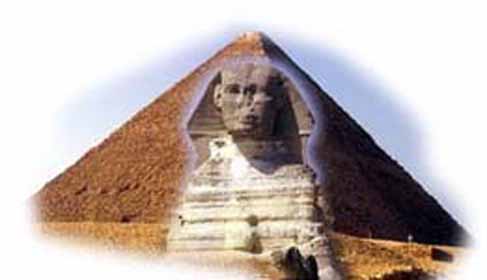
June 24, 2000 - AP
Two mini-replicas of the great pyramids of Giza have been unearthed south of the Sphinx, at the eastern foot of the three great pyramids. Containing the bodies of the workers who built the pyramids and their supervisors, the limestone tombs may throw new light on the knowledge of the funerary traditions in ancient Egypt.
"Now we can say that pyramid-shaped tombs were not a privilege reserved to kings and nobility. Ordinary people were also allowed to use the pyramid design to construct their own tombs," said Zahi Hawass, director of the Giza plateau where the pyramids are located, announcing the discovery on Thursday.
Built 4,600 years ago, during the reign of the pharaoh Cheops, the tombs are modeled exactly on the design made to house kings, with false doors and causeways leading to an offering basin. The upper-level tombs, made in limestone, were reserved for technicians, craftsmen and artisans, while the lower-level tombs, made with "leftovers" from the pyramids construction, housed the bodies of the workmen who positioned the huge stone blocks.
Like the great pyramids, the workers tombs bore inscriptions depicting the worker's title - such as "Inspector of Pyramid Building" - curses to ward off sacrilegious visitors, and even frescoes showing builders at work with a customary dress very similar to the galabiyas, the traditional garb peasants still wear today. Hawass said that the skeletons found in the tombs show that the workforce also received good health care. Twelve skeletons had splints on their hands for injuries probably caused by falling rocks; one had an amputated leg and lived for 14 years after the surgery. Moreover, X-rays on a skull revealed what may be one of the earliest examples of brain surgery. The findings dispel once and for all the popular belief that the pyramids were built by whip-driven slaves: "This care would not have been given to slaves," he said.
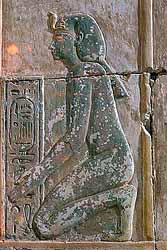
AP - June 13, 2000
Archaeologists found in late May a hidden chamber containing a statue of what is thought to be Ramses II, ruler of Egypt more than 3,000 years ago. Above, a relief depicting Ramses as a young man. Statues of a pharaoh thought to be Ramses II and an ancient cow goddess, their colors intact, have been discovered in a hidden chamber at a necropolis south of Cairo. The three-foot-high statue of the king and the taller sculpture of Hathor, goddess of love and happiness and guardian of cemeteries, were found in a sealed room beneath the Saqqara funerary chapel of Ramses II's treasurer, Necheruymes, who lived more than 3,200 years ago. Alain Zivie of France's national science research center said he and his team made an opening in a chapel wall that appeared to date back to the later Greco-Roman period, and came face to face May 21 with the two statues.
The pharaoh was wearing a yellow headdress with blue stripes, the traditional royal cobra over his forehead and false beard on his chin. Hathor, who was standing protectively over the king, was depicted with her long horns twisted into the shape of a lyre. Zivie said the discovery was the logical next step of a breakthrough his team made in 1996.
Four years ago, the Egyptologist discovered a series of tombs in a cliff on the edge of the Saqqara necropolis that had housed the remains of New Kingdom pharaonic dignitaries including Maia, the nurse of Tutankhamun. This year, they were exploring a gallery that ran along the edge of the nearby richly colored chapel of Necheruymes, who is believed to have negotiated a peace accord with the Hittites, the other great Middle Eastern empire of Ramses II's day. The French team ran into a wall, which they breached. "The two statues were standing in a room several meters deep which could lead to funerary chambers," Zivie said.
The archeologists are waiting for the next excavation season in the cooler temperatures of October and have in the meantime re-sealed the wall to protect the statues from curious people and the ravages of the climate. Zivie, who has been excavating for 20 years in Saqqara, discovered on the same site in 1987 the vault of pharaoh Akhenaton's prime minister, or vizir, Aper-El, which contained a wealth of funerary treasure.
Reuters - June 7, 2000
Archaeologists aren't exaggerating when they say ancient treasures abound in the sands of Egypt. So many, in fact, that even a pilot from Iowa, out on a desert outing, can make a notable discovery: cave drawings that could date back thousands of years before the birth of Christ. George Cunningham was in the desert 25 miles southeast of Cairo looking for fossilized sea urchins, shells and plants - a favorite hobby - when he spotted "an interesting looking wall" late last month. Cunningham led Egyptian scholars to the site to investigate the find - a sort of cave in a limestone hill.
The cave drawings appear to be from three eras, according to Egyptian experts. The earliest, which could date back to 7000-6500 B.C., are hunting scenes: men and women carrying bows alongside what appear to be dogs or wolves. A later drawing appears to be religious: two gods or goddesses in an arch alongside three shapely women - probably goddesses as well. It could date to the early Pharaonic dynastic period, around 3,000-2500 B.C., the experts say.
From yet another era comes writing that includes hieroglyphic elements, like a primitive version of an eye of Horus. Specialists speculate that it could represent a transition between languages, either before or after hieroglyphics. Archaeologists have found similar drawings in caves in southern Egypt. But, says el-Saghir, this may be the first time such etchings have been found in northern Egypt. If anything, it could help mark the route that Stone Age nomads took from southern Egypt to the Nile Valley to settle in what is now Ma'adi, a posh Cairo suburb, el-Saghir said. Those Bedouin later became the Ma'adi civilization, established around 3200 B.C., about 1,000 years before the Early Dynastic Period.
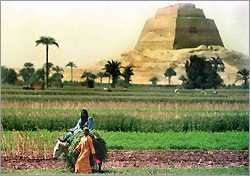
FOX - April 13, 2000
And now French and Egyptian archaeologists, armed with a fiber-optic endoscope like those doctors use to peer inside the human body, have discovered two previously unknown chambers and a tunnel that stretches nearly 40 meters (131 feet) into the heart of the enigmatic pyramid.
The structure began as a step pyramid, with stair-step sides like a giant wedding cake, in the style of the famous "first pyramid" built at Saqqara for Pharaoh Djoser. Then the steps were expanded by adding another layer. Finally, its steps were encased in a smooth shell to create one of the first true pyramids. Ninety kilometers (56 miles) south of Cairo, it rose nearly 100 meters (330 feet). It likely was unstable from the beginning and seems never to have been used as a tomb.
A tunnel shaft leads from the outside of the mostly collapsed pyramid to the burial chamber deep inside. But, Gaballah Ali Gaballah told the Eighth International Congress of Egyptologists in Cairo Thursday (March 30), two recesses near the bottom of the shaft have confused archaeologists. Gaballah is head of Egypt's Supreme Council of Antiquities. Each recess is about 1.7 meters (5.7 feet) high and 2.1 meters (6.9 feet) across. An unreinforced span of that size should be too great to support the enormous weight of the stone blocks above it. But the Franco-Egyptian team thinks it has solved the mystery.
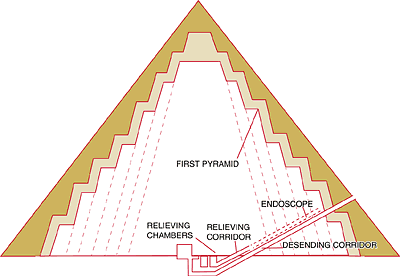
The Pyramid of Meidum, nearly 328 feet high, was built in three stages.
Examining the masonry along the top of the shaft revealed what looked like a carefully concealed window. In May 1998, the researchers slipped an endoscope - a device like a long, flexible telescope about the diameter of a human finger - through a joint between building blocks. What they saw through the scope was another tunnel directly above the first. And this one had a corbelled roof - a top built of overlapping blocks that rise progressively to a point. Such a roof would distribute the overlying weight and relieve pressure on the open corridor below it. The new shaft does not open on the outside of the pyramid, but it does head down toward the two troublesome recesses.
Last year, the team used the endoscope to explore beyond the end of the tunnel and above the recesses. What they found were two identical corbeled chambers, one above each recess and the same width. This rather clever, weight-distributing construction likely explains how the flat-roofed recesses were made possible. Gaballah notes that the exact purpose of the complex recesses, chambers, and twin shafts is not clear. The work is still in progress and we don't know what to expect.
February 2, 2000 - Discovering Archaeology
Five rabbits received a pharaoh's honor when they were mummified with the pomp and splendor of Egyptian royalty during an experimental mummification project at the American University in Cairo. Salima Ikram, assistant professor of Egyptology at AUC and author of the book Equipping the Dead for Eternity, sought answers to questions such as: How were mummies made? How were the materials processed and used? What logistical problems were involved?
During the project, which was done as both research for the Animal Mummy Project in the Cairo Museum that Ikram co-directs, and also as part of her class on "Death in Ancient Egypt," the group experimented with different procedures, since not just one method was used in ancient Egypt. Evisceration (in which the entrails are removed through an incision) and turpentine enemas (which allowed the insides to be flushed out) were the most common. "The method used in antiquity depended on time and finances," says Ikram. The turpentine enema, sometimes made with juniper oil, was a cheaper method than a time-consuming evisceration. The quality of ingredients such as natron or resins, could also hike up costs, as well as the type of bandages and amulets provided.
The spice market where the natron, oils and resins were purchased
The funereal recipes were extracted from varying sources: fifth-century Greek historical accounts from Herodotus; chemical tests; and from a previous successful experiment that Ikram herself performed on food mummies. Insight was also gleaned from previous mummification attempts by American Egyptologist Bob Brier in the 1990s, and the University of Manchester Mummy Project in the 1970s.
The five rabbits -- "available from a local butcher, so we didn't have to kill anything unnecessarily" - were mummified through varying methods, and not all were transformed gracefully into mummies. Two rabbits, which were not eviscerated, exploded. Laughs Ikram, "It was a complete disaster."
The entrails of the remaining three rabbits were removed, including the blood of one animal. The innards were drawn out either through skin incisions, or via turpentine enema. The enema was the second-most successful of the rabbit mummies, and "definitely the most fragrant."
After evisceration, the mummies were plopped in a wooden box of powdered natron (a salt-like mineral, mined in abundance from Egypt's Wadi Natrun) which was left on the roof of AUC's Science Building to desiccate. The drying process is aided by the open wind, and sun, which helps prevent the forming of bacteria.
The rabbit completely immersed in natron
The parched rabbits were then brushed off, and coated with oils and resins to make their bodies more supple before bandaging and to freshen the carcass smell. "It took us three to four weeks to mummify the animals, but a human is supposed to take 40 days."
The mummification was done with great ceremony. "We even had readings from The Book of the Dead," says Ikram. "Each rabbit was individually wrapped in linen bandages - ears wrapped so they stood up -- with amulets stuffed into the bandages. Some bandages were inscribed with hieroglyphic spells."
The protective spells, listed in The Book of the Dead, contained such well-wishing phrases as "May your head not roll off." Because a dead person was expected to need his body (and amenities like food, furniture, etc.) in the afterlife, great care was taken to make mummies attractive. A mummy losing its head could indeed pose a grave problem, since that person would then remain headless for eternity.
Not only did the mummies enlighten Ikram's class on the correct way to mummify, they also explained some mummification bloopers from antiquity. "For example, reused natron often brings in bits of other mummies, creating a situation in which a duck's feathers sometimes found their way into a rabbit mummy."
The ancient Egyptians mummified more than the human body-- animals were often mummified along with people. The most common type of mummies in ancient Egypt were the votive mummies of cats, ibises, and crocodiles. Food mummies - a piece of mummified meat or poultry thoughtfully placed in a tomb as food for the afterlife - were also common. The mummies may soon be featured in a display at the American University in Cairo as part of a class on archaeological method and theory, and museology.
January 27, 2000 - Netherlands Organization For Scientific Research
During excavations at Tel Ibrahim Awad in the eastern Nile Delta, Dutch archaeologists discovered a large Middle Kingdom temple. Beneath this building, which dates from around 2000 BC, there were traces of five earlier temples, the earliest dating back to around 3100 BC. This is at least as old as the oldest temple previously discovered, namely at Hierakonpolis. Heavy-duty groundwater pumps had to be brought in to make it possible to reach the earliest remains. Financial support for the excavations was provided by the NWO's Council for the Humanities.
The ground plan of the earliest of these temples is unlike anything previously discovered in Egypt, and no other sites are known where a similar series of temples was built one on top of the other and which date back so far. The archaeologists do not yet know which gods were worshipped in the temples. In the third-earliest, they discovered about a thousand "disposable ritual objects", including statuettes of baboons and pottery. According to the laws of the ancient Egyptians, objects which had been used in religious worship must not be profaned and they therefore had to be preserved within the walls of the temple. The objects are currently being studied to see what they can tell us about temple rituals at this early date. No inscriptions were found to provide any clues. Alongside the temple, a burial ground was discovered containing 50 small-scale tombs from various periods. Excavation of a large First Dynasty tomb (about 3000 BC) uncovered rich finds of pottery and of stone and bronze vessels.
The archaeologists are collaborating under the auspices of the Netherlands Foundation for Archaeological Research in Egypt, linked to Amsterdam University (UvA). They chose the area to be excavated ten years ago on the basis of the remains of walls and fragments of pottery visible on the surface. Increasing population pressure in the Nile Delta is making archaeological investigations more difficult. Only five percent of Egypt is habitable, so that archaeological research has to compete with land cultivation, infrastructure and urban expansion.
AP - August 23, 1999
A luxurious house under excavation in an ancient Egyptian town belonged to its mayor and is the first such house ever found, said an archaeologist in Pennsylvania. "It's comparable in scale to a pharaoh's palace of the period," said Josef Wegner, an assistant curator of the University of Pennsylvania Museum of Archaeology and Anthropology. "We know about mayors from ancient Egyptian texts, but never before has the home of a mayor been positively identified. Wegner said he and other researchers identified the building as the mayor's house this summer in the ancient town called Enduring-are-the-Places-of-Khakaure-maa-kheru-in-Abydos, which dates from the Middle Kingdom from 2000 B.C. to 1700 B.C. The structure, discovered in 1994, dates back 3,700 years.
Researchers in 1997 found thousands of seal impressions, similar to those made with sealing wax, made by ancient Egyptians using clay. The seal impressions gave the names of four mayors, and other seals now illegible may have borne the names of two more mayors, Wegner said.
The town, like many in ancient Egypt, was set up to take care of a pharaoh's mortuary temple, in this case that of King Senwosret III, also known as Sesostris III, who ruled from 1878 B.C. to 1841 B.C. The idea was to create a place that would last forever, dedicated to worship of the dead king. It lasted about 200 years. Sesostris III was one of the greatest warrior kings of ancient Egypt, probably one of the greatest warrior kings of antiquity," Arnett said. "His administration was at a peak of prosperity. For that reason, it's not surprising that the mayor of a town set up to take care of his mortuary temple would have such an elaborate home, he said.
Wegner said the house, about half of which has been excavated, is well-preserved for such an old building. In addition to the many seals that indicate heavy written correspondence, fragments of toys and games also were found in the house. It was built of brick, plastered throughout, and had a broad front hall with 14 columns running the entire width of the building. Fragments of statuettes, cosmetic coal pots, jewelry and mirrors with ebony and ivory handles show that the mayor had an affluent lifestyle, Wegner said. The back of the house was a massive granary, capable of storing great quantities of rations, in which wheat has been identified, Wegner said. The granary was not merely a food storehouse but likely also the town's treasury, he said. Grain was essentially the money of ancient Egypt, Wegner said. Wegner said the clay seals revealed that the first mayor was a man named Nakht. Arnett said Nakht was already known to be a prominent figure in that period of Egyptian history.
Mayors were responsible for serving as the high priest of the nearby temples, administering the major economic activities of the town and serving as a judge to settle disputes, Wegner said. Temples owned endowments of land and mines, so people were employed to work in those commercial ventures to keep money coming in.