The Fourth Dynasty of ancient Egypt is characterized as a "golden age" of the Old Kingdom. Dynasty IV lasted from ca. 2613 to 2494 BC. It was a time of peace and prosperity as well as one during which trade with other countries is documented.
Dynasties III, IV, V and VI are often combined under the group title the Old Kingdom, which often is described as the age of the pyramids. The capital at that time was Memphis.
The Fourth Dynasty heralded the height of the pyramid-building age. The relative peace of the Third Dynasty allowed the Fourth Dynasty rulers the leisure to explore more artistic and cultural pursuits. Sneferu's building experiments led to the evolution from the mastaba styled step pyramids to the smooth sided 'true' pyramids, such as those on the Giza plateau. No other period in Egypt's history equaled Dynasty IV's architectural accomplishments. Each of the rulers of this dynasty commissioned at least one pyramid to serve as a tomb or cenotaph.
The Fourth Dynasty of Egypt was the second of the four dynasties considered forming the Old Kingdom. The pharaohs of this dynasty include some of the best-known kings of ancient Egypt known for constructing pyramids, perhaps the hallmark of Egypt. All of the kings of this dynasty commissioned at least one pyramid to serve as a tomb or cenotaph.
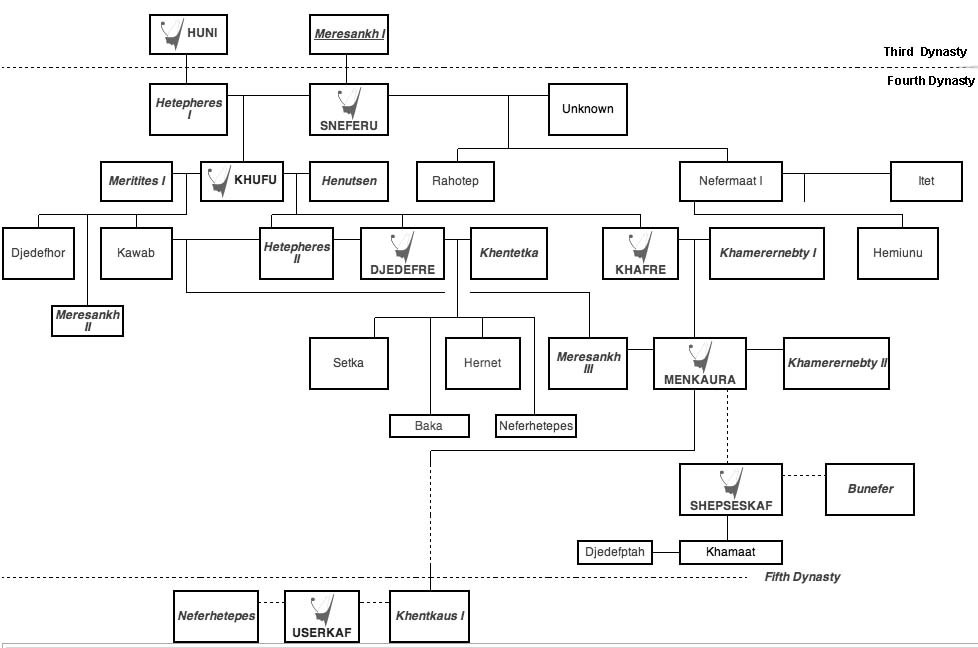
Like the Third Dynasty, these kings maintained their capital at Memphis.Sneferu, the dynasty's founder, is known to have commissioned three pyramids, and some believe he was responsible for a fourth. So although Khufu, his successor and son by Hetepheres I, erected the largest pyramid in Egypt, Sneferu had more stone and brick moved than any other pharaoh.
Khufu (Greek Cheops), his son Khafra (Greek Chephren), and his grandson Menkaura (Greek Mycerinus) all achieved lasting fame in the construction of their pyramids. To organize and feed the manpower needed to create these pyramids required a centralized government with extensive powers, and Egyptologists believe the Old Kingdom at this time demonstrated this level of sophistication.
Although it was once believed that slaves built these monuments, study of the pyramids and their environs have shown that they were built by a corvee of peasants drawn from across Egypt, who apparently worked while the annual Nile flood covered their fields.
While the pyramids suggest that Egypt enjoyed unparalleled prosperity during the Fourth Dynasty, they survived as a reminder to the inhabitants of the forced labor that created them, and these kings - Khufu in particular - were remembered as tyrants: first in the Westcar Papyrus, and millennia later in legends recorded by Herodotus (Histories, 2.124-133).
The archetype of the Turin King List, which otherwise records all of the names of the kings of this dynasty, has two names missing, which the scribe indicated with the Egyptian word wsf ("missing").
Sextus Julius Africanus reports Manetho had the names Bikheris and Tamphthis in those positions, while Eusebius does not mention either. Some authorities (such as K.S.B. Ryholt) follow Africanus in adding a possible Egyptian version of these names to the list; others omit them entirely.
The earliest known records of Egypt's contact with her neighbors are dated to this dynasty. The Palermo stone records the arrival of 40 ships laden with timber from an unnamed foreign land in the reign of Sneferu.
The names of Khufu and Djedefra were inscribed in gneiss quarries in the Western Desert 65 km. to the northwest of Abu Simbel; objects dated to the reigns of Khufu, Khafra, and Menkaura have been uncovered at Byblos and to the reign of Khafra even further away at Ebla, evidence of diplomatic gifts or trade.
It is unclear how this dynasty came to an end. Our only clue is that a number of Fourth Dynasty administrators are attested as remaining in office in the Fifth Dynasty under Userkaf.
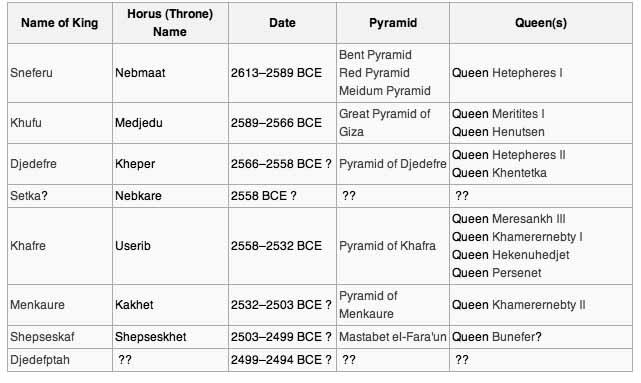
The pharaohs of the Fourth Dynasty ruled for approximately 120 years, from ca 2613 to 2494 BCE. The names in the table are taken from Dodson and Hilton.
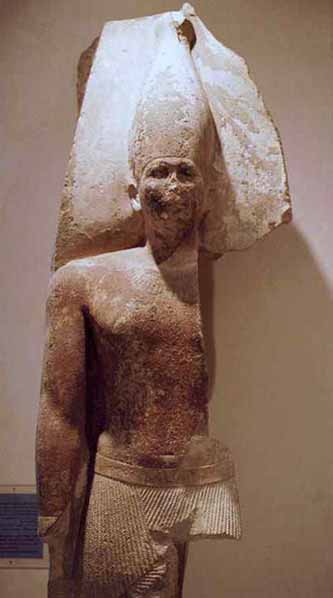
(2613 BC - 2589 BC)
First king of the 4th Dynasty
Sneferu, also spelt as Snefru or Snofru (in Greek known as Soris), was the founder of the fourth dynasty of Egypt, reigning from around 2613 BC to 2589 BC. While the Turin Cannon records the length of his reign as 24 years, graffiti in his northern (Red, and later) pyramid at Dahshur may suggest a longer reign. His name, Snefer, means "To make beautiful" in Egyptian. His Horus name was Nebmaat, but his royal titulary was the first to have his other name, Snefru, enclosed within a cartouche.
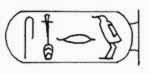
It was by this "cartouche name" that he and subsequent kings were best known. He enjoyed a very good reputation by later generations of ancient Egyptians. Considered a benign ruler (highly unusual), the Egyptian term, snefer can be translated as "to make beautiful".
Snefru was most likely the son of Huni, his predecessor, though there seems some controversy to this, considering the break in Dynasties. However, his mother may have been Meresankh I, who was probably a lessor wife or concubine and therefore not of royal blood. Hence, this may explain what prompted the ancient historian, Manetho (here, Snefru is known by his Greek name, Soris), to begin a new dynasty with Snefru. However, it should be noted that both the royal canon of Turin and the later Saqqara List both end the previous dynasty with Huni.
Snefru was almost certainly married to Hetepheres I, who would have been at least his half sister, probably by a more senior queen, in order to legitimize his rule. She was the mother of his son, Khufu, who became Egypt's best known pyramid builder, responsible for the Great Pyramid at Giza.
It is believed he had at least three other wives who bore him a number of other sons, including his eldest son, Nefermaet, who became a vizier. He probably did not outlive his father, so was denied the Egyptian throne. Other sons include Kanefer, another vizier who apparently continued in this capacity under Khufu (Cheops). We also believe he fathered several other sons, and at least several daughters.
In reality, Snefru may probably be credited with developing the pyramid into its true form. He apparently began by build what was probably a step pyramid at Maidum (Madum), which was later converted into a true pyramid. But this effort met with disaster (though probably not a quick one), because of the pyramid's mass and steep slope.
He also built the Red Pyramid and Bent Pyramid at Dahshur. The Bent Pyramid was the first true pyramid planned from the outset, while the Red Pyramid is the first successful true pyramid built in Egypt. The Red and Bent Pyramids are, respectively, the third and fourth largest pyramids known to have been built in Egypt.
In addition, Snefru is credited with at least one of a series of "regional" or provincial pyramids, at Seila. This is a small, step pyramid with no substructure. A number of other similar pyramids dot the Egyptian landscape, as far south as Elephantine Island, and some Egyptologists believe Snefru (or his father) may be responsible for all, or at least some of these. No one is very certain of the purpose of these small pyramids, but they were likely either associated with provincial cult worship of the king, or may have been located near to the king's "rural" palaces.
In many respects, including the combined scale of building projects and the evolutionary architectural achievements, Snefru must be ranked as one of Egypt's most renowned pyramid builders. In fact, the sheer volume of building work was greater than any other ruler in the Old Kingdom.
However, his achievements in pyramid building extended beyond the pyramid structure itself, and obviously incorporated evolving religious beliefs. During his reign, we see the first real elements of the sun worship that was to follow and reach a culmination over a thousand years later in the reign of Akhenaten.
For the first time in the orientation of the building plan the main axis was oriented from east to west rather than north to south, as were earlier pyramids. This was apparently a move away from the astronomical "star" oriented beliefs, toward the east-west passage of the sun and the worship of Ra. Now, with Snefru, the mortuary temple is on the east rather than than on the north side like in the Djoser Step Pyramid complex at Saqqara. Furthermore, we see the first of the small satellite pyramids placed near the southern face of the main pyramid, a structure that we still do not completely understand today. Furthermore, the pyramid and mortuary temple elements were now linked by a causeway to a valley temple located on the edge of the cultivation closer to the Nile. It is believed the valley temple operated as a monumental gateway to the whole of the pyramid complex.
While the growing importance of the sun worship is obvious in Snefru's reign, the worship of Osiris was probably also beginning to influence Egyptian religion, though little in the way of documented evidence can be supplied. With all of Snefru's building activities, it is not surprising that he was very active in the quarries. His name has been found attested to in rock inscriptions at the turquoise and copper mines of the Wadi Maghara in the Sinai peninsula, as well as other quarries.
Snefru is also credited with keeping the administrative power of the country within the royal family, As stated above, two of his sons became viziers and it is likely that many other royal children held important posts. By the end of the 6th Dynasty, administrative power within Egypt would be greatly decentralized which is considered at least one of the reasons Egypt fell into the chaos of the First Intermediate Period. Generally, Egypt was most powerful and prosperous when Egyptian rulers maintained a strong central government, like that of Snefru's. In order to further facilitate this centralized power base, he also apparently reorganized land ownership among his nobles, presumably to prevent them from becoming too powerful, but also to stimulate the cultivation of marshlands.
According to the Palermo Stone, he campaigned militarily against the Nubians and Libyans. The expedition to Nubia was a very large campaign. The Palemo Stone records a booty of 7,000 captives and 200,000 head of cattle. The population of Nubia was never very great, so this was perhaps a rather substantial depopulation of the area. Not only were these campaigns against Nubia initiated to obtain raw material and goods, but also to protect Egypt's southern borders as well as the all important African trade routes. The campaign in Libya records 11,000 captives and 13,100 head of cattle.
The Palermo Stone also provides a record of forty ships that brought wood (probably cedar) from an unnamed region, but perhaps Lebanon. Among other building uses, Snefru is credited as has having used some of this wood to build Nile river boats up to about 50 meters (about 170 ft.) in length.
It is interesting to note that Snefru's later deification was perhaps partially due to his status as an "ideal" king, who's deeds were emulated by later kings to justify their legitimacy to the throne. His reputation was no doubt enhanced by the Westcar Papyrus (now in Berlin), probably written during the Hyksos period. Yet, even though considered a warlike king by many, his worship in the Middle Kingdom was just as much fueled by the admiration of common Egyptians (according to traditional history).
Ancient literature repeatedly depicts him as a ruler who would address common Egyptians as "my friend", or "my brother". It is also not surprising that during the Middle Kingdom, his cult was particularly strong among the Sinai miners. Because of his massive building projects, considerable resources from Snefru's reign were employed to develop those quarries.
Therefore, Snefru became especially associated with this quarry district. Certainly Snefru had a number of choices for his burial, but we believe he was actually interred in the Red Pyramid at Dahshure. There, in the 1950s, the remains of a mummy were found of a man past middle age, but not much so, suggesting that the king may have come to rule Egypt at a fairly early age.
Some Egyptologists continue to attribute the Madium Pyramid to Huni (or more properly, Nysuteh), as well as possibly to Horus Qahedjet (2637-2613 BC). However, even these scholars appear to believe that Snefru finished this pyramid, but it would have been highly unusual for a ruler of Egypt to have made such a substantial contribution to his predecessor's mortuary complex. Still the question of who actually started the construction of this pyramid is a mater for future discovery.
Egyptian Pharaohs Left Behind Non-Fractal Footprint Live Science - July 24, 2012
Everything from broccoli florets to riverbeds divide and branch in fractal patterns, or patterns that repeat themselves at ever-smaller scales. In Egypt, archaeologists are taking advantage of that fact to look for riverbed patterns in the Western Desert that don't appear fractal, the New Scientist reported.
The Western Desert is where King Sneferu - father of the pharaoh who built the Great Pyramid of Giza - practiced his own pyramid-building. If nature loves fractals, the researchers reasoned, then non-fractal riverbeds may have been altered during Sneferu's and other Old Kingdom rulers' reigns, 4,500 years ago. By analyzing now-dry riverbeds, archaeologists from the Freie Universitat Berlin in Germany and the German Archaeological Institute in Egypt discovered that at least 2.3 square miles (6 square kilometers) of desert was altered by people, the New Scientist reported. That is a surprisingly large area, lead researcher Arne Ramisch told the magazine. Without the fractal analysis, determining the affected area would be difficult because most other signs of human activity have worn away over the millennia.
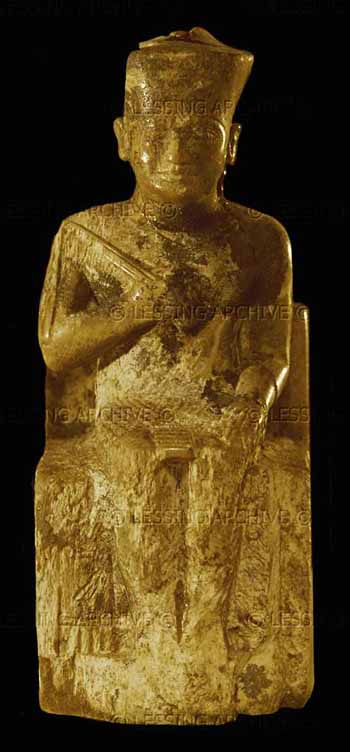
Protected by Khnum - (2589 BC - 2566 BC)
Second king of the 4th Dynasty
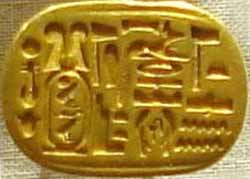
Cheops' Ring
The so-called "Ring of Cheops", which bears the cartouche of Khufu and was once thought to have belonged to him. It is now thought to have belonged to a priest in the cult that deified Khufu at Giza. Late Period, Dynasty XXV or XXVII.
Khufu was a Pharaoh of Ancient Egypt's Old Kingdom. He reigned from around 2589 to 2566 BC. Khufu was the second pharaoh of the Fourth Dynasty. He is generally accepted as being the builder of the Great Pyramid of Giza, one of the Seven Wonders of the Ancient World. Khufu's full name was "Khnum-Khufu" which means "the god Khnum protects me.".
Khufu was the son of King Sneferu and Queen Hetepheres I and brother of Princess Hetepheres. Unlike his father, Khufu is remembered as a cruel and ruthless pharaoh in later folklore. Khufu had nine sons, one of whom, Djedefra, was his immediate successor. He also had fifteen daughters, one of whom would later become Queen Hetepheres II. Several of Khufu's sons are known from the papyrus Westcar, while other children are merely known from their tombs in Giza. Cemetery G 7000 contains several of the mastabas of these royal children.
Khufu came to the Egyptian throne in his twenties, and reigned for about 23 years, which is the number ascribed to him by the Turin King List. Other sources from much later periods suggest a significantly longer reign: Manetho gives him a reign of 63 years, and Herodotus states that he reigned for 50 years.
Since 2000, two dates have been discovered from his reign. An inscription containing his highest regnal year, the "Year of the 17th Count of Khufu", first mentioned by Flinders Petrie in an 1883 book and then lost to historians, was rediscovered by Zahi Hawass in 2001 in one of the relieving chambers within Khufu's pyramid. Secondly, in 2003, the "Year after the 13th cattle count" of Khufu was found on a rock inscription at the Dakhla Oasis in the Sahara. He started building his pyramid at Giza, the first to be built there. Based on inscriptional evidence, it is also likely that he led military expeditions into the Sinai, Nubia and Libya.
The Westcar Papyrus, which was written well after his reign during the Middle Kingdom or later, describes the pharaoh being told magical tales by his sons Khafre and Djedefre. This story cycle depicts Khufu as mean and cruel, and as being ultimately frustrated in his attempts to ensure that his dynasty survived past his two sons.
Whether anything in this story cycle is based on fact is unknown, but Khufu's negative reputation lasted at least until the time of Herodotus, who was told further stories of that king's cruelty to his people and to his own family in order to ensure the construction of his pyramid. Unlike his grandfather Huni, and his father Sneferu, both of whom were remembered as benevolent and compassionate rulers, Khufu was reported by Herodotus to have been a cruel despot. What is known for certain is that his funerary cult lasted until the 26th Dynasty, which was one of the last native-Egyptian royal dynasties, almost 2,000 years after his death.
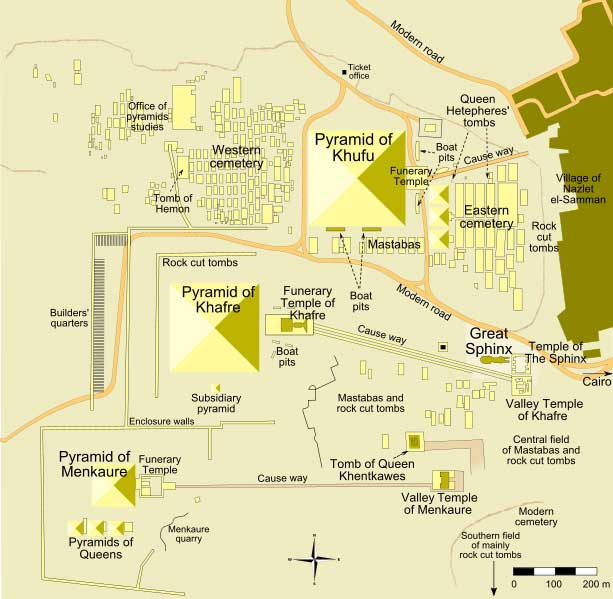
Khufu was allegedly the builder of the Great Pyramid of Giza and founder of the Giza Plateau near modern Cairo and Memphis. He reigned from around 2589 BC to 2566 BC.
Most likenesses of Khufu are lost to history. Only one miniature statuette has been fully attributed to this pharaoh. Since he is credited with building the single largest building of ancient times, it is ironic that the only positively identified royal sculpture of his was discovered not at Giza, but in a temple in Abydos during an excavation by Flinders Petrie in 1903. Originally this piece was found without its head, but bearing the pharaoh's name. Realizing the importance of this discovery, Petrie halted all further excavation on the site until the head was found three weeks later after an intensive sieving of the sand from the area where the base had been discovered. This piece is now on display in the Egyptian Museum, Cairo.
In more recent years, two other likenesses have been tentatively identified as being that of Khufu, based largely on stylistic similarities to the piece discovered by Petrie. One is a colossal head made of red granite of a king wearing the white crown of Upper Egypt that resides in the Brooklyn Museum, and the other, a fragmentary miniature head made of limestone that also wears the white crown of Upper Egypt, which can be found in the Staatliche Sammlung fur Agyptische Kunst in Munich.
An empty sarcophagus is located in the King's Chamber inside the pyramid though it is unclear if it had ever been used for such a purpose as burial. While his mummy has never been recovered, two impressive and well preserved solar barges - or Khufu ships - were discovered buried in a pit at the foot of his great pyramid at Giza in 1954 by Egyptian archaeologists. One of the ships has been reassembled and placed in a museum for public viewing, while excavation operations on the second ship were begun in 2011.
While pyramid construction had been solely for the reigning pharaoh prior to Khufu, his reign saw the construction of several minor pyramid structures that are believed to have been intended for other members of his royal household, amounting to a royal cemetery. Three small pyramids to the east of Khufu's pyramid are tentatively thought to belong to two of his wives, and the third has been ascribed to Khufu's mother Hetepheres I, whose funerary equipment was found relatively intact in a shaft tomb nearby.
A series of mastabas were created adjacent to the small pyramids, and tombs have been found in this "cemetery". The closest tombs to Khufu's were those belonging to Prince Kawab and Khufukhaf I and their respective wives. Next closest are the tombs of Prince Minkhaf and Queen Hetepheres II, and those of Meresankh II and Meresankh III (Khufu's grand-daughter). When the largest of these tombs (G 7510) was excavated in 1927, it was found to contain a bust of Prince Ankhhaf, which can now be seen in the Museum of Fine Arts, Boston. Ankhhaf was Khufu's younger half-brother.
Inscriptions on the rocks at Wadi Maghara record the presence of his troops there to exploit the turquoise mines, and a very faint inscription at Elephantine indicates that he probably mined the red granite of Aswan as well.
Herodotus, who wrote his histories and commentaries on Egypt around 450 BCE, centuries after Khufu had reigned around 2585 BCE, recorded this about the King: Kheops brought the country into all kinds of misery. He closed the temples, forbade his subjects to offer sacrifices, and compelled them without exception to labor upon his works the Egyptians can hardly bring themselves to mention Cheops so great is their hatred.
It was even said that Khufu set one of his daughters into a brothel so that she could raise revenue to build the pyramid, also asking each client for a block of stone so she could build her own pyramid. No evidence exists for such a story, though there are smaller pyramids which probably belonged to half-sister/wives of Khufu, and he did have at least three daughters of record.
Even prior to Herodotus, the author of the document now known as the Papyrus Westcar depicts Khufu as cruel. The text was inscribed in the Hyksos period prior to the 18th Dynasty, though its composition seems to date from the 12th Dynasty. One story, Kheops and the Magicians, relates that a magician named Djedi who can reputedly bring back the dead to life. He is presented to Khufu, who orders a prisoner brought to him, so that he may see a demonstration of the magician's talents.
Khufu further orders that the prisoner should be killed, and then Djedi can bring him back to life. When Djedi objects, the King relents his initial decision, and Djedi then demonstrates his talent on a goose. It should be noted that while Khufu has acquired this reputation, accurate or not, the years and labor that went into building his Pyramid tomb was surpassed by the three pyramids built by his father Sneferu, who was contrarily remembered as an amiable ruler.
The Great Pyramid originally stood 481 feet high complete with its original casing, but since it lost its top 30 feet, it stands only 451 feet now. It covers about 13 acres. The exterior casing was shining white limestone, laid from the top downwards. It was largely robbed in the Middle Ages to build medieval Cairo. Nothing now remains of the limestone mortuary temple, which was 171 feet by 132 feet, except its black basalt floor. The complex's valley temple has disappeared under the Arab village, though traces of this temple could be seen when new sewer systems were being laid down.
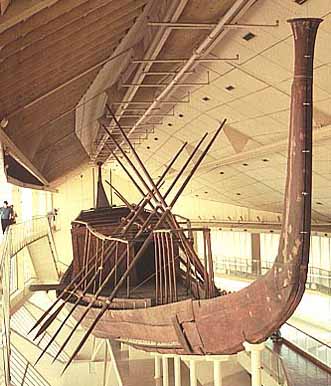
Along with the pyramid itself, the remains of a magnificent 141-foot long ship of cedar wood had also been found in a rock-cut pit close to the south side of the Great Pyramid. A second ship may also rest in a second sealed pit, though not in as good condition as this first. The ship was restored over many years, and now lies in a special museum built near the pyramid itself. The ship may havesymbolized the solar journey of the deceased king with the gods, particularly the sun-god Ra.
It is ironic indeed that for all the magnificence of his pyramid, his funeral boat, and the wonders of the funerary furnishings that were discovered belonging to his mother, Queen Hetepheres, wife to Sneferu, the only portrait we have of Khufu is a tiny 3-inch high statue sculpted in ivory.
It may have been once easy to contemplate the builder of such a monument as the Great Pyramid to have virtually enslaved his people to accomplish it, and to order a royal princess to prostitute herself. Sneferu, Khufu's father, had three separate pyramids built during his reign. Surely the workmen or nobles would have left some evidence of their dissatisfaction at least at the whimsicality of their sovereign if not his despotism. Yet Sneferu is remembered as amiable and pleasure-loving.
And Khafre, Khufus son, left not only a pyramid but quite possibly a Sphinx as well. And history, or at least, historians, do not record Khafre is being a despot.
Continuing work at Giza is further showing that the men responsible for the building of the pyramids led normal lives. They baked bread, ate fish, made offerings to their blessed dead and the gods, and cared for their families.
They left funerary stelae and tombs behind to give us an indication of how they considered their lot. It is more likely that the Greeks could less easily conceive of such a project of long-term labor as being anything but forced. Perhaps some archaeologist millennia in our own future may find rusted iron skeletons of some of our finest skyscrapers and wonder to what cruel overlords we owed the sweat of our own forced labor.
Reference: Monarchs of the Nile Aidan Dodson, 1995
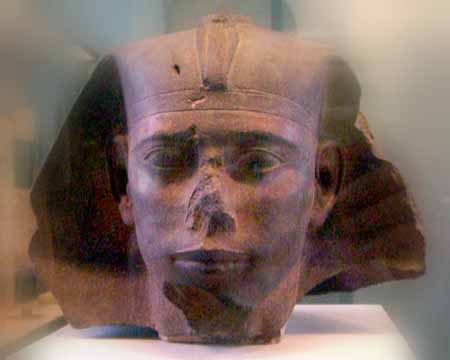
Head of Djedefre from Abu Rawash in Louvre
Enduring Like Re - (2566 BC - 2558 BC)
Third king of the 4th Dynasty
Djedefre (also known as Radjedef) was an Egyptian pharaoh, the son and immediate successor of Khufu. The mother of Djedefre is unknown. His name means "Enduring like Re." Djedefre was the first king to use the title Son of Ra as part of his royal titulary, which is seen as an indication of the growing popularity of the cult of the solar god Ra.
He married his (half-) sister Hetepheres II, which may have been necessary to legitimise his claims to the throne if his mother was one of Khufu's lesser wives. He also had another wife, Khentetka with whom he had (at least) three sons, Setka, Baka and Hernet, and one daughter, Neferhetepes. These children are attested to by statuary fragments found in the ruined mortuary temple adjoining the pyramid. Various fragmentary statues of Khentetka were found in this ruler's mortuary temple at Abu Rawash.
Abu Rawash actually sits at an elevation higher than the rest of Giza, making it the highest, albeit not the tallest, pyramid. Some historians claim that the "pyramid" at Abu Rawash isn't even a pyramid at all; instead, it may be a "sun temple." Archaeologist Vassil Dobrev has claimed that it may not even be Djedefre's. Excavations by the French team under Michel Valloggia have recently added another potential daughter, Hetepheres, as well as a son, Nikaudjedefre, to this list.
The Turin King List credits him with a rule of eight years, but the highest known year referred to during this reign appears to be the Year of his 11th cattle count. The anonymous Year of the 11th count date presumably of Djedefre was found written on the underside of one of the massive roofing-block beams which covered Khufu's southern boat-pits by Egyptian work crews.
Miroslav Verner notes that in the work crew's mason marks and inscriptions, "either Djedefra's throne name or his Golden Horus name occur exclusively." Verner writes that the current academic opinion regarding the attribution of this date to Djedefre is disputed among Egyptologists: Rainer Stadelman, Vassil Dobrev, Peter Janosi favor dating it to Djedefre whereas Wolfgang Helck, Anthony Spalinger, Jean Vercoutter and W.S. Smith attribute this date to Khufu instead on the assumption "that the ceiling block with the date had been brought to the building site of the boat pit already in Khufu's time and placed in position [only] as late as during the burial of the funerary boat in Djedefra's time.
The German scholar Dieter Arnold, in a 1981 MDAIK paper noted that the marks and inscriptions of the blocks from Khufu's boat pit seem to form a coherent collection relating to the different stages of the same building project realised by Djedefra's crews. Verner stresses that such marks and inscriptions usually pertained to the breaking of the blocks in the quarry, their transportation, their storage and manipulation in the building site itself.
Verner also notes that the French-Swiss team excavating Djedefra's pyramid have discovered that this king's pyramid was actually finished in his reign. According to Vallogia, Djedefre's pyramid largely made use of a natural rock promontory which represented circa 45 % of its core; the side of the pyramid was 200 cubits long and its height was 125 cubits. The original volume of the monument of Djedefra, hence, approximately equalled that of Menkaura's own pyramid.
Therefore, the argument that Djedefre enjoyed a short reign because his pyramid was unfinished is somewhat discredited. This means that Djedefre likely ruled Egypt for a minimum of eleven years if the cattle count was annual or 21 years if it was biannual; Verner, himself, supports the shorter 11 year figure and notes that "the relatively few monuments and records left by Djedefra do not seem to favour a very long reign" for this king.
Djedefre continued the move north in the location of pyramids by building his (now ruined) pyramid at Abu Rawash, some 8 km to the north of Giza. It is the northernmost part of the Memphite necropolis.
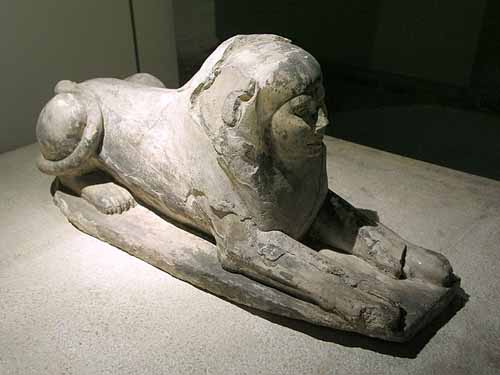
Some believe that the sphinx of his wife, Hetepheres II, was the first sphinx created. It was part of Djedefre's pyramid complex at Abu Rawash. In 2004, evidence that Djedefre may have been responsible for the building of the Sphinx at Giza in the image of his father was reported by the French Egyptologist Vassil Dobrev.
While Egyptologists previously assumed that his pyramid at the heavily denuded site of Abu Rawas - some 5 miles north of Giza - was unfinished upon his death, more recent excavations from 1995 to 2005 have established that it was indeed completed. The most recent evidence rather indicates that his pyramid complex was extensively plundered in later periods while "the king's statues [were] smashed as late as the 2nd century AD."
Due to the poor condition of Abu Rawash, only small traces of his mortuary complex have been found; his pyramid causeway proved to run from north to south rather than the more conventional east to west while no valley temple has been found. Only the rough ground plan of his mud-brick mortuary temple was traced - with some difficulty - "in the usual place on the east face of the pyramid."
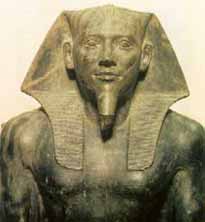
(2558 BC - 2532 BC)
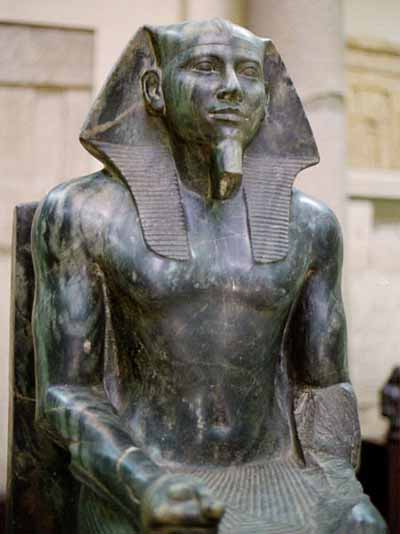
Fourth king of the 4th Dynasty
Khaf-Re - Khauf-Re - Khafre - Khephren - Rakhaef - Chephren - Suphis II
also Khafre, sometimes known as Kefren - was an Egyptian pharaoh of the Fourth dynasty, who had his capital at Memphis. According to some authors he was the son and successor of Khufu, but it is more commonly accepted that Djedefre was Khufu's successor and Khafra was Djedefre's.
Khafra's two chief wives were Queen Meresankh III whose mastaba tomb is located at Giza and Queen Khamaerernebty I who was the mother of his successor, Menkaura. Khafre was the builder of the second largest pyramid in the Giza Necropolis complex (his is 3 metres shorter than Khufu's). Most modern egyptologists also credit him with the building of the Great Sphinx.
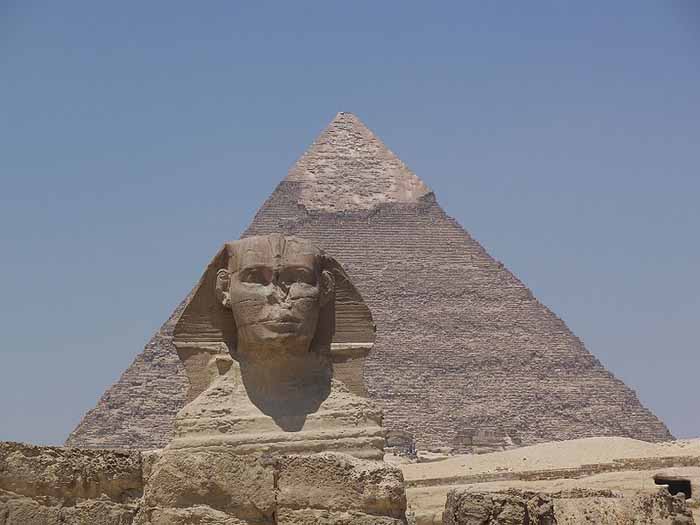
There is no agreement on the date of his reign. Some authors say it was between 2558 BC and 2532 BC; this dynasty is commonly dated ca. 2650 BC-2480 BC. While the Turin King Listlength for his reign is blank, and Manetho's exaggerates his reign as 66 years, most scholars believe it was between 24 to 26 years, based upon the date of the Will of Prince Nekure which was carved on the walls of this Prince's mastaba tomb. The will is dated anonymously to the Year of the 12th Count and is assumed to belong to Khufu since Nekure was his son. Khafra's highest year date is the "Year of the 13th occurrence" which is a painted date on the back of a casing stone belonging to mastaba G 7650. This would imply a reign of 24-25 years for this king if the cattle count was biannual during the Fourth Dynasty.
Khafra built the second largest pyramid at Giza. The Egyptian name of the pyramid was Wer(en)-Khafre which means "Khafre is Great". The pyramid has a subsidiary pyramid, labeled GII a. It is not clear who was buried there. Sealings have been found of a King's eldest son of his body etc. and the Horus name of Khafre.
The valley temple of Khafre was located closer to the Nile and would have stood right next to the Sphinx temple. Inscriptions from the entrance way have been found which mention Hathor and Bubastis. Blocks have been found showing the partial remains of an inscription with the Horus name of Khafre (Weser-ib). Mariette discovered statues of Khafre in 1860. Several were found in a well in the floor and were headless. But other complete statues were found as well.
The mortuary temple was located very close to the pyramid. From the mortuary temple come fragments of maceheads inscribed with Khafre's name as well as some stone vessels. The sphinx is said to date to the time of Khafre. A temple dedicated to Haremakhet was erected by Khafre. It was located right in front of the paws of the Sphinx. The sphinx has the face of a human and the body of a lion. In ancient Greek and Egyptian mythology the sphinx would tell riddles and kill whoever failed to solve them.
Fifth king of the 4th Dynasty
(2532 BC - 2503 BC)
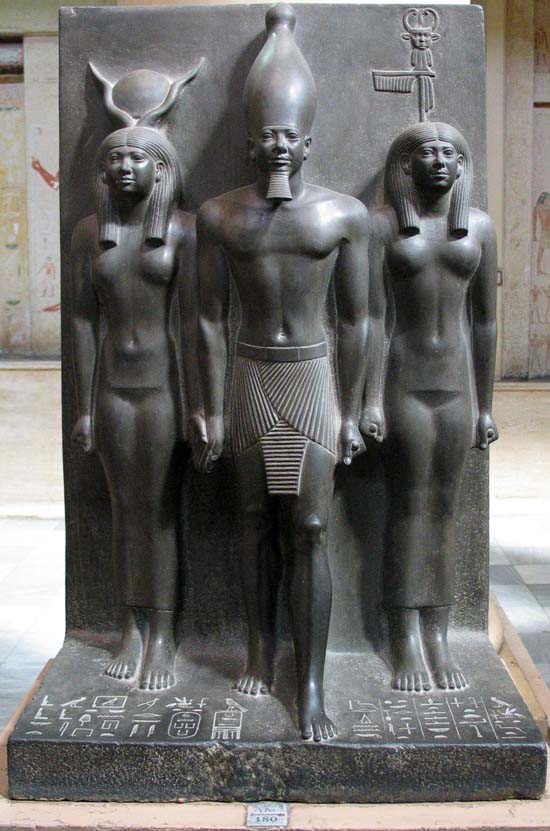
Menkaure with his wife Khamerernebty II appearing as Hathor (left)
and the goddess of the seventeenth nome of Egypt (right)
Mycerinus - Menhaure - Eternal Like the Souls of Re
Menkaure was a pharaoh of the Fourth dynasty of Egypt (c. 2620 BC-2480 BC) who ordered the construction of the third and smallest of the Pyramids of Giza. His name means "Eternal like the Souls of Re". He was the successor of Khafra. Some authors date his rule between 2532 BC-2503 BC or 28 years but the Turin King List has him ruling for 18 years which is the time given to him by other authors. Several of his statues were unfinished upon his death - suggesting the shorter reign - while his pyramid is the smallest of all the three royal pyramids at Giza.
Menkaure was the son of Khafra and the grandson of Khufu of Dynasty IV. There are doubts that Menkaure could be the son of Khafre, because the Turin Papyrus mentioned a name of a king between Menkaure and Khafre, but the name was smashed. A Middle Kingdom text written on a rock at Wadi Hamamat includes the names of the kings: Khufu, Djedefre, Khafre, Hordedef and Bauefre. This text indicates to some that Hordedef and Bauefre ruled after Khafre. But it seems that their names were not written as kings because Menkaure's names were not mentioned. It has been suggested that Hordedef's name was mentioned because was a wise educated man in this period and perhaps Bauefre was a vizier.
A flint knife found in the mortuary temple of Menkaure mentioned a king's mother Khamerernebty I, suggesting that Khafra and this queen were the parents of Menkaure. Menkaure is thought to have had at least two wives - Queen Khamerernebty II the daughter of Khamerernebti I and the mother of a king's son Khuenre. The location of Khuenre's tomb suggests that he was a son of Menkaure, making his mother the wife of this king. Queen Rekhetre is known to have been a daughter of Khafra and as such the most likely identity of her husband is Menkaure. The royal court included several of Menkaure's half brothers. His brothers Nebemakhet, Duaenre, Nikaure and Iunmin served as vizier during the reign of their brother. His brother Sekhemkare may have been younger and became vizier after the death of Menkaure.
Menkaure's pyramid at Giza was called Netjer-er-Menkaure which means "Menkaure is Divine". This pyramid is the smallest of the three pyramids at Giza. There are three subsidiary pyramids associated with Menkaure's pyramid. These pyramids are sometimes labeled G-IIIa (East subsidiary pyramid), G-IIIb (Middle subsidiary pyramid) and G-IIIc (West subsidiary pyramid). In the chapel associated with G-IIIa a statue of a Queen was found. It is possible that these pyramids were meant for the Queens of Khafra. It may be that Khamerernebti II was buried in one of the pyramids.
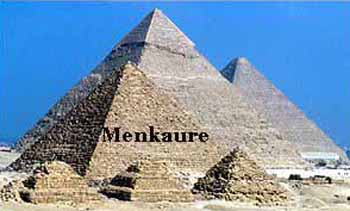
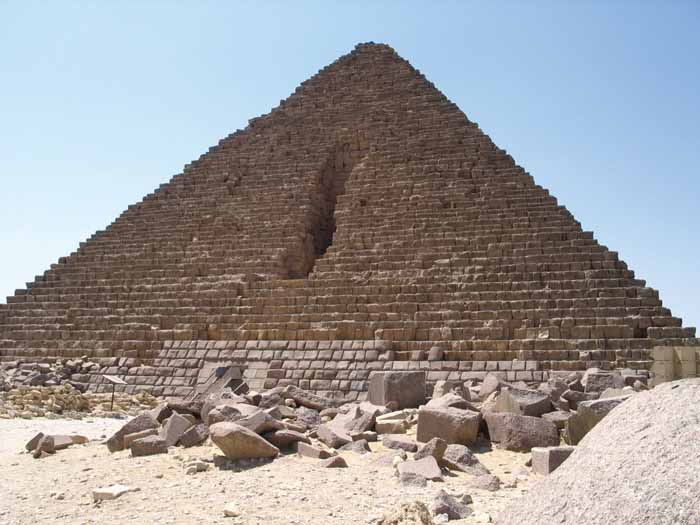
The last major pyramid of Giza is the Pyramid of Menkaure, son of Khafre. Although much smaller than the other two pyramids on the plateau, the lower courses were originally encased in granite. It has three subsidiary pyramids and some of its Mortuary temple remains intact. The interior of this pyramid includes a room possibly for the burial of some of the king's family as well as the king himself. At the end of the steps leading to the opening, there are a few steps downward into the descending passageway. As the descending passageway ends we enter into the first antechamber. This room is relatively small and there is another opening at the far end. Both openings are flanked by a carved "palace facade" design, the first such carved relief seen in any major pyramid since that of Zoser. The opening at the end of the first antechamber leads to another passageway. Off of this passageway is the opening into the next set of chambers. This next chamber is unique because it offers a view of the top of the vaulted ceiling of the main burial chamber through a space that you can look through at the far end.
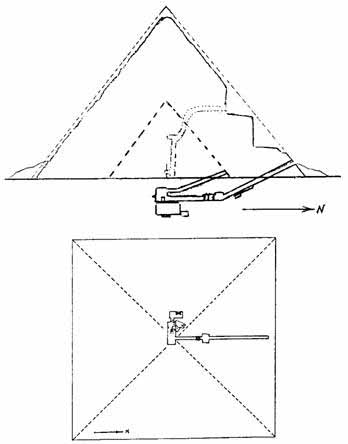
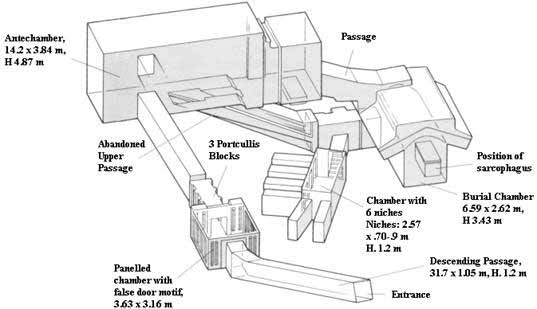
This descending passageway levels off and to the right, just before the main burial chamber lies another passageway into a mysterious chamber, sometimes known as the "cellar". This chamber has six obvious niches within it. This room may have been used to store treasure or for offerings. Or perhaps the king's family was buried here, although this would be unusual compared to the layout preceding pyramids. Walking back out of this chamber and taking a right into the passageway leads to the final burial chamber. Down the passageway from the previous chamber leads to the main burial chamber.
There is a finely finished interior of the vaulted ceiling. The niche in the floor housed the original sarcophagus. This sarcophagus was removed from the pyramid and shipped on a boat to England on Oct. 1838. The boat sank on the way, and the sarcophagus of Menkaure has not been seen since.
His pyramid is called Menkaure is Divine. Menkaure's pyramid is two-tone in color: the top half covered with bright white limestone casing, while red Aswan granite was used for the casing on the bottom. E1-Makrizi, the Arab historian named Menkaure's pyramid as the colored pyramid because of the red granite casing. The pyramid stands 66.5m high, which is much smaller than the other two pyramids at Giza. The pyramid is remarkable because it is the only pyramid in Dynasty IV that was cased in 16 layers of granite, Menkaure planned to cover the surface with granite but he could not because of his sudden death.
The pyramid complex of Menkaure was completed by his son and successor Shepseskaf but the temples has architectural additions which were made during Dynasties V and VI. This suggests that the cult of Menkaure was very important and perhaps differed from the cults of Khufu and Khafre. Shepseskaf completed the pyramid complex with mudbrick and left an inscription inside the Valley Temple indicating that he built the temple for the memory of his father.
At the pyramid's entrance, there is an inscription records that Menkaure died on the twenty-third day of the fourth month of the summer and that he built the pyramid. It is thought that this inscription dates to the reign of Khaemwas, son of Ramsses II. The name of Menkaure found written in red ochre on the ceiling of the burial chamber in one of the subsidiary pyramids.
When pyramid was explored in the 1830's, a lidless basalt sarcophagus was found in the burial chamber. Inside it was a wooden mummiform coffin inscribed with Menkaure's name. This is curious because mummiform coffins weren't made until much later. Best guess is that the coffin was provided in an attempted restoration during the 26th dynasty (that's 2000 years later!) when there was a renewed interest in the culture of the Old Kingdom.
The wooden coffin and basalt sarcophagus were sent on separate ships to England to end up on display in the British Museum, but a storm at sea sank the boat that was transporting the sarcophagus. It sank to the bottom of the sea and was never recovered.
The sarcophagus was allegedly lost in the Mediterranean between ports of Cartagena and Malta when the ship 'Beatrice' sank after setting sail on October 13, 1838. There still exists the wooden anthropoid coffin found inside the pyramid which bears the name and titles of Menkaure.
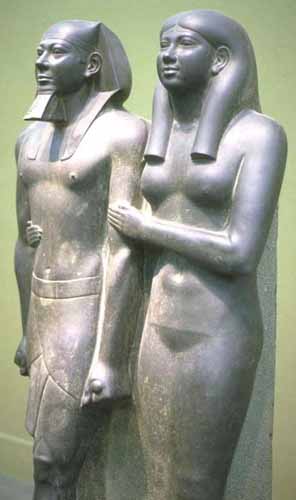
Menkaure's main queen was Khamerernebty II, who is portrayed with him in a group statue found in the Valley Temple. It is believed that she is buried in Giza.
Menkaure ruled for 18 years. There are two inscriptions found in his pyramid complex. The first was a decree bearing the Horus name of Merenre of Dynasty VI. The decree stated that the Valley Temple was in use until the end of the Old Kingdom. The objects found in some of the storage rooms of the temples show that the king's cult was maintained and that the temple had a dual function as a temple and a palace.
The second decree of Pepi II was found on the lower temple vestibule, awarding privileges to the priests of the pyramid city. In the adjacent open court and in the area just east of the temple lie the remains of the Old Kingdom houses. Pepi II's decree indicates that these houses belonged to the pyramid city of Menkaure. Here lived the personnel responsible for maintaining the cult of the deceased king.
The statuary program found inside the complex displays the superb quality of arts and crafts. The triads in Menkaure's valley temple suggest that his pyramid complex was dedicated to Re, Hathor, and Horus. In addition, they show the king's relationship with the gods and are essential to his kingship, indicating both a temple and palace function.
The textual evidence indicates that the high officials had more privileges in his reign that in any other period. They had many statues in their tombs; the inscriptions and the scenes increased and were set on rock-cut tombs. In the tomb of Debhen an inscription was found describing the kindness of Menkaure.
When Debhen came to visit the king's pyramid, he asked the king for permission to build his tomb near the pyramid. The king agreed and even ordered that stones from the royal quarry in Tura should be used in building his tomb. The text also mentions that the king stood on the road by the Hr pyramid inspecting the other pyramid. The name "Hr" was also found written in the tomb of Urkhuu at Giza, who was the keeper of a place belonging to the Hr pyramid. It is not clear what the Hr pyramid is. Is it a name of a subsidiary pyramid, or the name of the plateau? The Debhen texts is a revelation of how the king tried to inspire loyalty by his people giving them gifts.
Menkaure also had a new policy - he opened his palace to the children of his high officials. They were educated and raised with the king's own children. Shepsesbah is one of those children. The textual and archaeological evidence of the Old Kingdom indicates that the palace of the king was located near his pyramid and not at Memphis. Menkaure explored granite from Aswan and he sent expeditions to Sinai. Excavations under the author revealed a pari of statues of Ramses II on the south side of Menkaure's pyramid. The statues were made of granite, and one represents Ramses as king while the other as Atum-Re.
The name of Menkaure was found written on scarabs dated to the 26th Dynasty, which may imply that he was worshipped in this period.
Herodotus mentioned that Menkaure died suddenly and added that there was an oracle from the Buto statue that foretold that he would live for 6 years. Menkaure started to drink, and enjoy every moment of his remaining years. However, Menkaure lived for 12 years, thus disproving the prophecy. Herodotus also said that his daughter committed suicide.
The Greek historian also wrote that the Egyptians loved Menkaure more than his father and grandfather. The Late Period tales were based on Menkaure's reputation during the Old Kingdom. He ruled with justice, gave freedom to his officials to carve statues and make offerings, and stopped the firm rules.
In 1837, English army officer Richard William Howard Vyse, and engineer John Shae Perring began excavations within the pyramid of Menkaure. In the main burial chamber of the pyramid they found a large stone sarcophagus 8 feet 0 inches (244 cm) long, 3 feet 0 inches (91 cm) in width, and 2 feet 11 inches (89 cm) in height, made of basalt. The sarcophagus was uninscribed with hieroglyphs although it was decorated in the style of palace facade. Adjacent to the burial chamber were found wooden fragments of a coffin bearing the name of Menkaure and a partial skeleton wrapped in a coarse cloth. The sarcophagus was removed from the pyramid and was sent by ship to the British Museum in London, but the merchant ship Beatrice carrying it was lost after leaving port at Malta on October 13, 1838. The other materials were sent by a separate ship, and the materials now reside at the museum, with the remains of the wooden coffin case on display.
It is now thought that the coffin was a replacement made during the much later Saite period, nearly two millennia after the pharaoh's original interment. Radio carbon dating of the bone fragments that were found place them at an even later date, from the Coptic period in the first centuries AD.
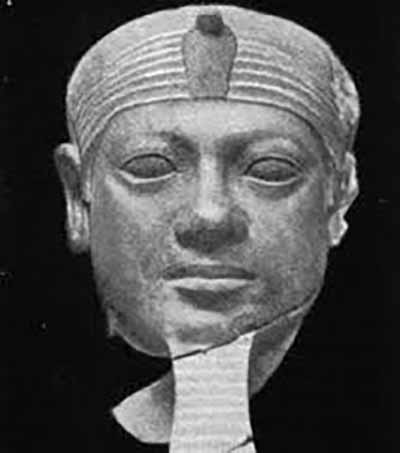
Shepseskaf was the sixth king of the 4th Dynasty.
'His Soul is Noble' - (2503 BC - 2498 BC)
Shepseskaf was a son of Menkaure who succeeded his father on the throne. Shepseskaf's name means "His Soul is Noble. Shepseskaf was a son of Menkaure and grandson of Khafra, but his mother's name is not known. His mother can be either Khamerernebty II or Rekhetre. It's possible that Shepseskaf's wife was Khentkaus I, but this is far from certain.
Queen Bunefer has been suggested as a possible wife of Shepseskaf based on the titles as a priestess of Shepseskhaf. She may however have been a daughter who served as a priestess in the cult for her father instead. Khamaat, the wife of a nobleman named Ptahshepses, may be a daughter of Shepseskhaf or Userkaf.
He was likely the last Egyptian Pharaoh of the Fourth dynasty if he was not succeeded by a certain unknown ruler named Djedefptah as recorded in some Egyptian literature and, indirectly, by the Turin Canon. No ruler named Djedefptah is recorded in contemporary documents such as royal monuments or private tombs in the Old Kingdom cemeteries of Giza and Saqqara which date to this period.
Palace officials who served in the interval between the 4th and 5th dynasties of Egypt such as the long-lived palace courtier Netry-nesut-pu explicitly lists this sequence of Old Kingdom kings under whom he served under in his tomb: Radjedef -> Khafre -> Menkaure -> Shepseskaf, and the first three 5th dynasty kings namely Userkaf, Sahure and Neferirkare.
The Turin King List ascribes Shepseskaf a rule of four years and his anonymous 4th dynasty successor - presumably a reference to Djedefptah - a reign of two years. In contrast, A HREF="manetho.html">Manetho's King List explicitly gives Shepseskaf a reign of seven years which may be a combination of the 4 + 2 (= 6) full year figures noted in the Turin Kinglist for the last two kings of the Fourth Dynasty plus a significant monthly fraction. Manetho's King List does, however, also note the existence of the unknown and possibly fictitious ruler Djedefptah - called Thampthis in his records - who is ascribed a reign of nine years.
Shepseskaf broke with the Fourth Dynasty tradition of constructing large pyramid tombs by choosing to construct his tomb as a great mastaba at Saqqara, now known as Mastabat Fara'un. In contrast, his three immediate predecessors built 2 pyramids of Giza and one in Abu-Rawash while Sneferu, the founder of the fourth dynasty, alone constructed three pyramids in his reign most notably, the Bent Pyramid and the Red Pyramid. Shepseskaf may have designed a smaller tomb for himself since he was faced with the arduous task of completing his father's pyramid at Giza while simultaneously building his own tomb - all this within his short reign.
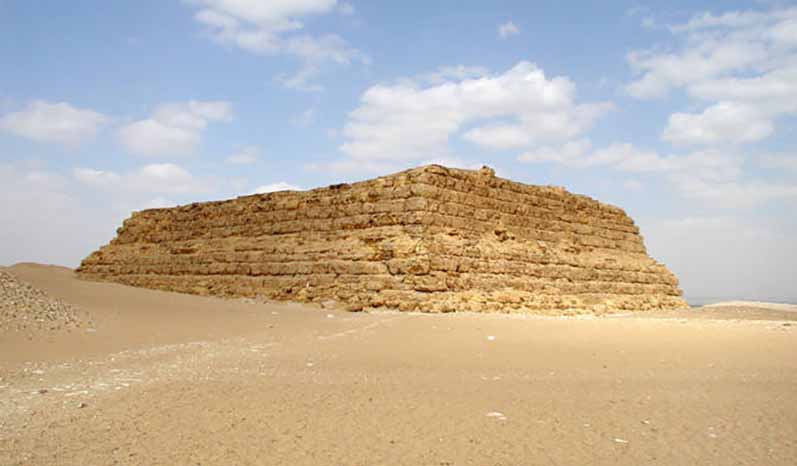
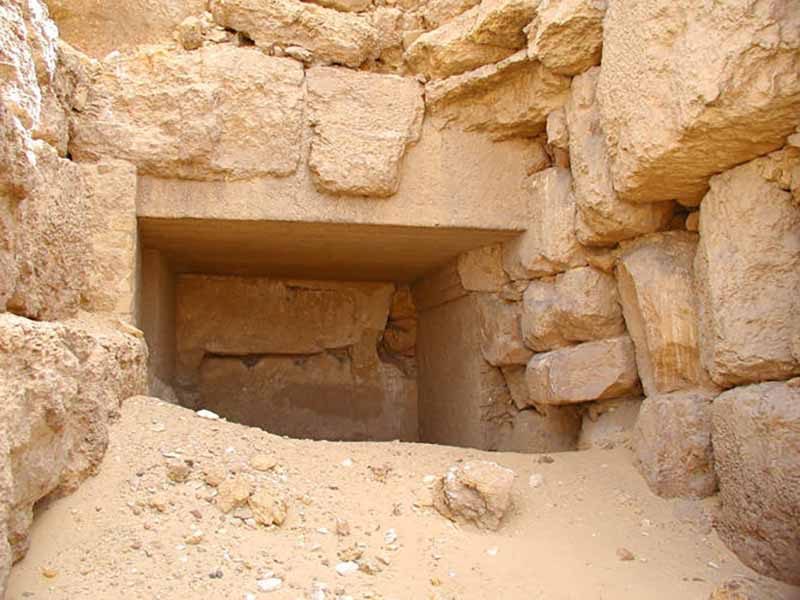
Shepseskaf was the sixth and last pharaoh of the Fourth Dynasty of Egypt during the Old Kingdom. He reigned six to eight years starting circa 2510 BC. The only activities firmly datable to his reign are the completion of the temple complex of the Pyramid of Menkaure and the construction of its own mastaba tomb at South Saqqara, the Mastabat al-Firoaun, "stone bench of the pharaoh".
Egyptologist George Andrew Reisner proposed that Shepseskaf was Menkaure's son based on a decree mentioning that Shepseskaf completed Menkaure's mortuary temple. This, however, cannot be considered a solid proof of filiation since the decree does not describe the relationship between these two kings. Furthermore, the completion of the tomb of a deceased pharaoh by his successor does not necessarily depend on a direct father/son relation between the two.
The mother, wives and children of Shepseskaf are unknown. If Menkaure was indeed his father, his mother could have been one of Menkaure's royal wives Khamerernebty II or Rekhetre. It's possible that Shepseskaf's wife was Khentkaus I, but this is far from certain. Queen Bunefer has been suggested as a possible wife of Shepseskaf based on the titles as a priestess of Shepseskhaf. She may, however, have been a daughter who served as a priestess in the cult for her father. Finally, Khamaat, the wife of a nobleman named Ptahshepses and daughter of a king, may be a daughter of Shepseskaf or Userkaf.
He was likely the last pharaoh of the Fourth Dynasty of Egypt if he was not succeeded by a certain unknown ruler named Thamphthis as recorded in some Egyptian literature and, indirectly, by the Turin King List. No ruler named Thamphthis is recorded in contemporary documents such as royal monuments or private tombs in the Old Kingdom cemeteries of Giza and Saqqara, which date to this period.The long-lived palace courtier Netry-nesut-pu explicitly lists this sequence of Old Kingdom kings he served under in his tomb: Radjedef -> Khafre -> Menkaure ->Shepseskaf, and the first three 5th dynasty kings namely Userkaf, Sahure and Neferirkare.
Inside the Tomb of Shepseskaf is undecorated and large granite blocks make up the walls. The tomb looks like a huge sarcophagus from the outside. It was originally covered with a thin layer of limestone.
Further to the south are two more pyramids. The first belongs to Khendjer. This pyramid is made of brick and has a funerary complex that is made of quartzite. The second pyramid has no inscriptions and is unfinished. It has white stone chambers which are underground and a funerary chamber made of quartzite. No signs of use are found.
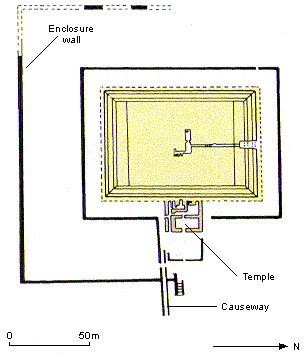
Map of the tomb and temple of Shepseskaf.
The mastaba, which has earned this monument the name Mastabat el-Fara'un, was 99.6 metres long and 74.4 metres broad. It was originally encased in limestone, except for its base course, which was in granite. It had a slope of 70 E and certainly was shaped like a shrine: a rounded top flanked by two almost vertical walls.
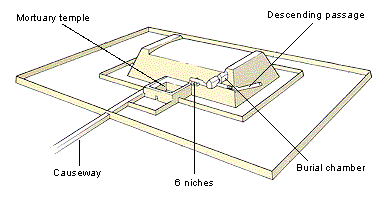
Cut-away of the Mastabat el-Fara'un showing
the original shape of this rather unique royal tomb.
The mastaba is entered from the north side, from where a corridor descends for 20.95 metres with a slope of 23ƒ30'. At the end of the passage is a horizontal corridor passage followed by a second passage blocked by three portcullises and an antechamber. A short passage to the west goes down into the vaulted burial chamber that measures 7.79 by 3.85 metres and has a height of 4.9 metres. Fragments of the sarcophagus indicate that it was made of a hard dark stone and decorated like Mykerinos'. To the south of the antechamber a corridor extends with 6 niches to the east, again similar to the niches found in the pyramid of Mykerinos.
The mastaba is enclosed within two mudbrick walls: the first also incorporates a small mortuary temple that had some open courts, an offering hall and a false door, flanked by 5 magazines. The long causeway that extended towards the east has not (yet) been excavated.
After Shepseskaf died, Khentkawes, another child of Menkaure by a minor wife and Shepseskaf's half-sister, married a nobleman named Userkaf, who was the great grandson of Pharaoh Khufu. Upon his marriage to Pharaoh Shepseskaf's half sister Khentkawes, Userkaf was in a strong enough position to be crowned Pharaoh over all Egypt, and begin the 5th Dynasty of Kings.
Userkaf returned to the more traditional pyramid-tomb. From then on, the dimensions and shape of the pyramid, and the temple connected to it, would become more and more standardized.
Reference: Monarchs of the Nile Aidan Dodson, 1995
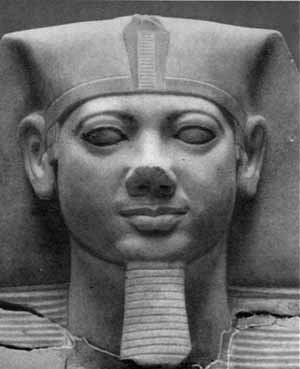
(2498 - 2494 BC)
Djedefptah is a shadowy figure, and his existence is questionable. It is usual to consider Shepseskaf to be the last pharaoh of the Fourth Dynasty. Manetho however lists a king Tamphthis (this may probably a corrupted form of ptah-djedef), and notes that he reigned for 9 years. The Turin Canon has an unnamed pharaoh after Shepseskaf who ruled for about two years, and this ruler may be Djedefptah. Very little else is known about him, although he may have been a son of Shepseskaf.
He is known as by Thamphthis in Greece and is an ancient Egyptian ruler (pharaoh) of the 4th dynasty in the Old Kingdom, who may have ruled around 2500 BC for between two to nine years. His original Egyptian name is lost, but it may have been Djedefptah or Ptahdjedef ("he endures like Ptah") after William C. Hayes Thamphthis is one of the shadowy rulers of the Old Kingdom, since he is completely unattested in contemporary sources. For this reason, his historical figure is discussed intensely by historians and egyptologists.
Since Thamphthis' name was found in the historical works of Manetho, the Aegyptiacae, egyptologists are trying to connect this ruler with contemporary kings to build up a continuous chronology, which resulted in controversies and debates.
As early as 1887, Eduard Meyer viewed Thamphthis as a mere usurper, who was not allowed to be mentioned in royal annals or have his own mortuary cult because he gained the throne illegitimately. Peter Janosi goes further and says that Thamphthis is a fiction, due to the lack of archaeological support. He claims that Thamphthis should be erased from modern kinglists.
Winfried Seipel and Hermann Alexander Schlogl instead postulate that the historical figure behind Thamphthis could have been queen Khentkaus I. This theory is supported by Khentkaus being depicted in her mortuary temple as a ruling pharaoh with nemes-headdress, king's beard and uraeus-diadem on her forehead. But this theory is problematic since Khentkaus' name never appears inside a serekh or royal cartouche.
Wolfgang Helck points out that Khentkaus I could have been the mother of Thamphthis, so Thamphthis would have been the son of king Shepseskaf. As a possible wife of Thamphthis he proposes a princess named Bunefer, who may have been the daughter of Shepseskaf. She was a priestess of Shepseskaf.
In the Manethonian tradition of the historian Sextus Julius Africanus, who translated A HREF="manetho.html">Manetho, Thamphthis is described as the last ruler of the 4th dynasty with a reign of nine years. In the tradition of the historians Eusebius and Eratosthenes his name is missed. Eusebius gives the reason that Thamphthis wasn't meant to be named, for he "didn't do something worth to be mentioned".
A further source for the chronology of rulers of the Old Kingdom is the Royal Canon of Turin, composed during the 19th dynasty around 1300 BC. It names kings which are missed in many other kinglists. But the Turin Canon is damaged at several spots, so many royal names are fragmentary or completely lost in lacunae today. For this reason it cannot be excluded that Thamphthis' name was originally present in this document too, since the Aegyptiacae of Manetho are mostly consistent with the Turin Canon.
In column III, line 12 king Khafra is mentioned, after him, in line 13, a lacunae appears. After king Shepseskaf, mentioned in line 15, a second lacunae appears. Whilst line 13 can be assigned to a king Baufra, the missing line 16 could have originally held Thamphthis' name. These lacunae cover two years during which a king could have reigned.
The Royal kinglist of Saqqara from the tomb of Tjuneroy (19th dynasty) lists nine kings for the 4th dynasty, whilst the Abydos King List gives only six names. Curiously the Saqqara-Table has after Shepseskaf two cartouches before Userkaf, but both are heavily damaged, so the original names are no longer legible. Whilst one of these two cartouches once may have held Thamphthis' name, the other cartouche remains a mystery.
A rock inscription in the Wadi Hammamat made in the Middle Kingdom presents a list of the cartouche-names of Khufu, Djedefre, Baufra and prince Djedefhor (also recorded as Hordjedef). Curiously Djedefhor's name is written in a cartouche, too. This leads to the possibility that he could have been a king for a very short while himself. If this was true, this fact would close the chronological gaps. But contemporary sources don't show Djedefhor and Baufra as kings; they give to these two only the titles of princes and call them both "son of the king".
The tomb inscriptions of several high officials, princes and priests do not preserve any evidence that some kind of internal political conflict had arisen or that a usurper had seized the throne of Egypt. Prince Sekhemkare reports about his career under the kings Khafra, Menkaura, Shepseskaf, Userkaf and even Sahure, but makes no mention of Thamphthis. The same goes for the high official Netjer-pu-nesut, who was honoured under the kings Djedefre, Khafra, Menkaura, Shepseskaf, Userkaf and Sahure.
Again no Thamphthis is mentioned. The 5th dynasty high priest and official Ptahshepses who served under king Niuserre and took care of the mortuary cults of king Menkaura and Shepseskaf also made no reference to Thamphthis. The late Patrick F. O'Mara in a GM 158 paper notes that "no royal monument private tomb in the cemeteries of Gizeh and Saqqara record names of any other except the aforementioned kings for the fourth dynasty. No names of estates of the period compounded with royal names make mention of any other fourth dynasty kings than these, nor do the names of the royal grandchildren, who often bore the name of a royal ancestor as a component of their own" names.
The lack of contemporary attestations for Thamphthis, does not by itself prove that he was a "faux king" or 'phantom king' since he may well have been a short-lived ruler of the fourth dynasty. The stela of the fifth dynasty official Khau-Ptah is informative: while this official lists his career in an uninterrupted sequence of Sahure, Neferirkare, Raneferef and Niuserre, he completely omits Shepseskare.
Shepseskare or Sisires likely did not rule Egypt for the 7 years assigned to him by both Manetho and the Turin Canon judging by the paucity of contemporary records for his rule, but he certainly ruled Egypt for a brief period of time. This is established by the existence of two cylinder seals identifying him and four or five fragments of clay sealings bearing his name.
In more recent years, "several new sealings of Shepseskare" which were found in Abusir also show that Shepseskare did exist. Verner argues that the archaeological context of the sealings show that Shepseskare succeeded Raneferef (rather than the reverse as Manetho and the Turin Canon states) and that a dynastic struggle ensued in which Shepseskare was soon overthrown by Niuserre, Raneferef's brother, after a very brief reign.
This would explain the surprising omission of Shepseskare by Khau-ptah since the former was a usurper who briefly seized the throne after Raneferef's death. But there is no evidence for any dynastic difficulties in the late fourth dynasty and the complete lack of contemporary attestations for Thamphthis is strong evidence for regarding him as a phantom king. In this situation, the two year figure assigned to him by later Egyptian records could possibly be added to Shepseskaf's existing 4 year reign.