An impact crater is an approximately circular depression in the surface of a planet, moon or other solid body in the Solar System, formed by the hypervelocity impact of a smaller body with the surface.
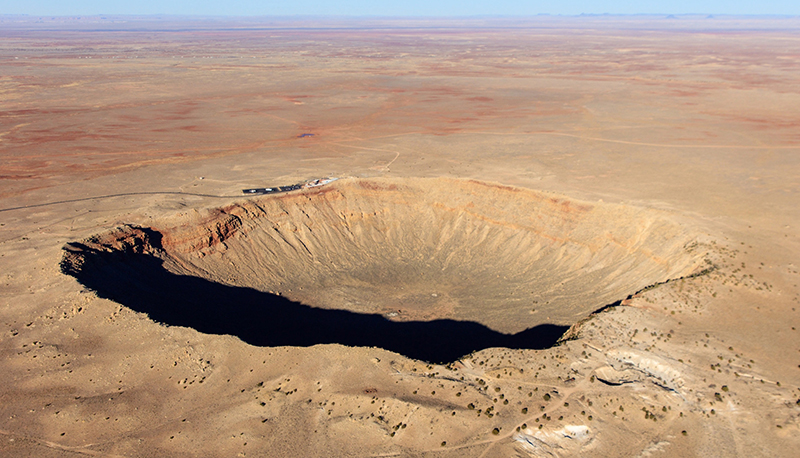
In contrast to volcanic craters, which result from explosion or internal collapse, impact craters typically have raised rims and floors that are lower in elevation than the surrounding terrain. Impact craters range from small, simple, bowl-shaped depressions to large, complex, multi-ringed impact basins. Meteor Crater is perhaps the best-known example of a small impact crater on the Earth.
Impact craters are the dominant geographic features on many solid Solar System objects including the Moon, Mercury, Callisto, Ganymede and most small moons and asteroids. On other planets and moons that experience more active surface geological processes, such as Earth, Venus, Mars, Europa, Io and Titan, visible impact craters are less common because they become eroded, buried or transformed by tectonics over time. Where such processes have destroyed most of the original crater topography, the terms impact structure or astrobleme are more commonly used. In early literature, before the significance of impact cratering was widely recognized, the terms crypto-explosion or crypto-volcanic structure were often used to describe what are now recognized as impact-related features on Earth.
The cratering records of very old surfaces, such as Mercury, the Moon, and the southern highlands of Mars, record a period of intense early bombardment in the inner Solar System around 3.9 billion years ago. Since that time, the rate of crater production on Earth has been considerably lower, but it is appreciable nonetheless; Earth experiences from one to three impacts large enough to produce a 20 km diameter crater about once every million years on average. This indicates that there should be far more relatively young craters on the planet than have been discovered so far. Read more

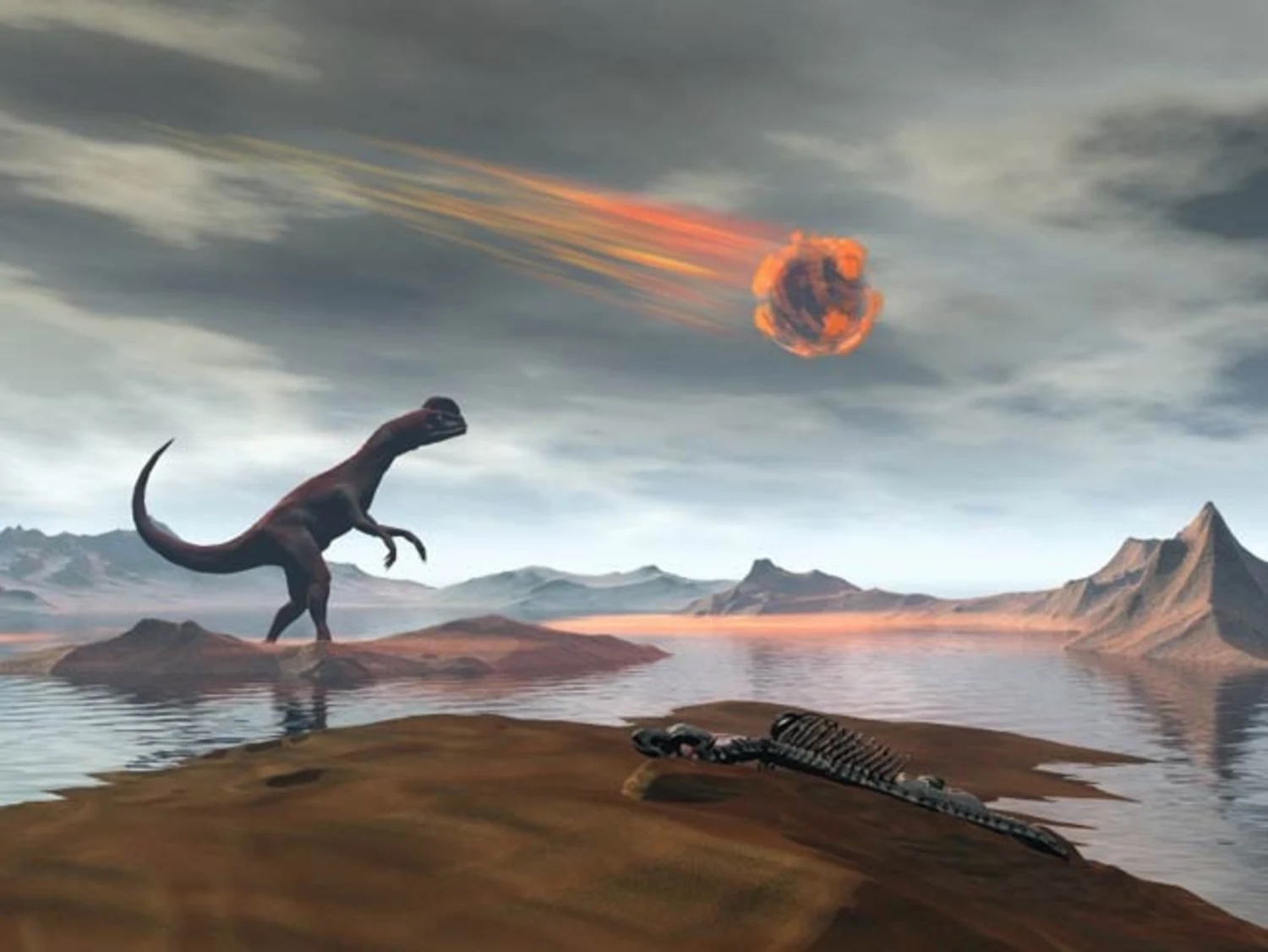
The Chicxulub Crater Event was an asteroid impact that occurred approximately 66 million years ago, creating the Chicxulub crater off the Yucatan Peninsula in Mexico. It was an approximately 6- to 9-mile-wide asteroid that struck the Earth 66 million years ago, creating the Chicxulub crater in what is now Mexico.
This event is widely considered the cause of the Cretaceous-Paleogene extinction event, which wiped out about 80% of all species on Earth, including the non-avian dinosaurs.
The impact triggered massive wildfires, tsunamis, and a prolonged "impact winter" caused by dust and soot blocking the sun, leading to a global climate collapse.
The impact triggered a mass extinction event by causing devastating tsunamis, wildfires, and a long-term "impact winter" by throwing debris and gases into the atmosphere, which blocked the sun and caused global temperatures to plummet.
The asteroid hit at a high speed and steep angle, maximizing the vaporized rock and debris sent into the atmosphere. Immediate effects: The impact caused powerful earthquakes, massive tsunamis, and widespread wildfires.
Long-term effects: The impact winter, which may have lasted for years, led to a drastic drop in global temperatures, impacting ecosystems and food chains.
The aftermath: The impact left behind the massive Chicxulub crater, which is mostly hidden under the Yucatan Peninsula and the Gulf of Mexico.
The Chicxulub crater is an impact crater buried underneath the Yucatan Peninsula in Mexico. Its center is offshore, but the crater is named after the onshore community of Chicxulub Pueblo (not the larger coastal town of Chicxulub Puerto). It was formed slightly over 66 million years ago when an asteroid, about ten kilometers (six miles) in diameter, struck Earth.
The crater is estimated to be 200 kilometers (120 miles) in diameter and 30 kilometers (19 miles) in depth. It is one of the largest impact structures on Earth, alongside the much older Sudbury and Vredefort impact structures, and the only one whose peak ring is intact and directly accessible for scientific research.
The crater was discovered by Antonio Camargo and Glen Penfield, geophysicists who had been looking for petroleum in the Yucatan Peninsula during the late 1970s. Penfield was initially unable to obtain evidence that the geological feature was a crater and gave up his search.
Later, through contact with Alan R. Hildebrand in 1990, Penfield obtained samples that suggested it was an impact feature. Evidence for the crater's impact origin includes shocked quartz, a gravity anomaly, and tektites in surrounding areas.
9-Kilometer Impact Crater Beneath Atlantic Reveals Dino-Killing Asteroid Had A Friend. The crater lies deep beneath the Atlantic Ocean and was formed around 66 million years ago - making it a contemporary of Chicxulub IFL Science - October 4, 2024
The Chicxulub impactor, as it is called, famously wiped out the non-avian dinosaurs and left a huge crater at the edge of the Yucatan peninsula - but it may not have acted alone. New research has revealed that a second, smaller space rock smashed into our planet during the same era, creating a 9.2-kilometer (5.7-mile) crater deep below the Atlantic.
The Nadir Crater was discovered back in 2022, located off the coast of Guinea in West Africa and lying 300 meters (984 feet) under the floor of the Atlantic Ocean. It is believed to have been created at the end of the Cretaceous period, around 66 million years ago, right when Chicxulub hit. However, the exact circumstances of how it came to be have remained uncertain - until now. Thanks to the new study, which has mapped the crater in unparalleled detail, researchers have finally confirmed how it was formed.
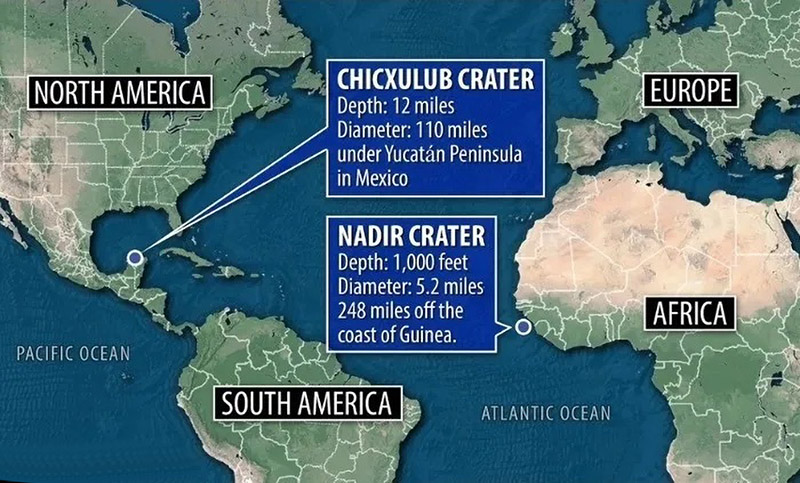
Nadir crater is a buried impact crater on the Guinea Plateau in the Atlantic Ocean, 400 kilometres (248 miles) off the coast of Guinea. The feature is named after the Nadir Seamount, located 100 km to the south. The paper announcing the discovery of the feature was published in Science Advances in 2022, with an impact origin being confirmed in 2024. The crater is around 9.2 km (5.7 mi) in diameter, and formed around 66 million years ago, close to the Cretaceous-Paleogene boundary when a small asteroid struck the ocean floor.
The crater features all characteristics of an impact crater: appropriate ratio of width to depth, the height of the rims, and the height of the central uplift. It was formed at or near the Cretaceous-Paleogene boundary about 66 mya around the same time as the Chicxulub crater. The impactor is estimated to be around 400 m (1⁄4 mi) in diameter, roughly equivalent to the size of the Bennu asteroid.[1] The authors of the paper speculated that it may have been part of a binary asteroid with the Chicxulub impactor or part of an impact cluster, but it is also probable that it is unrelated. Impacts similar in size to Nadir occur on average every 50,000 to 100,000 years.
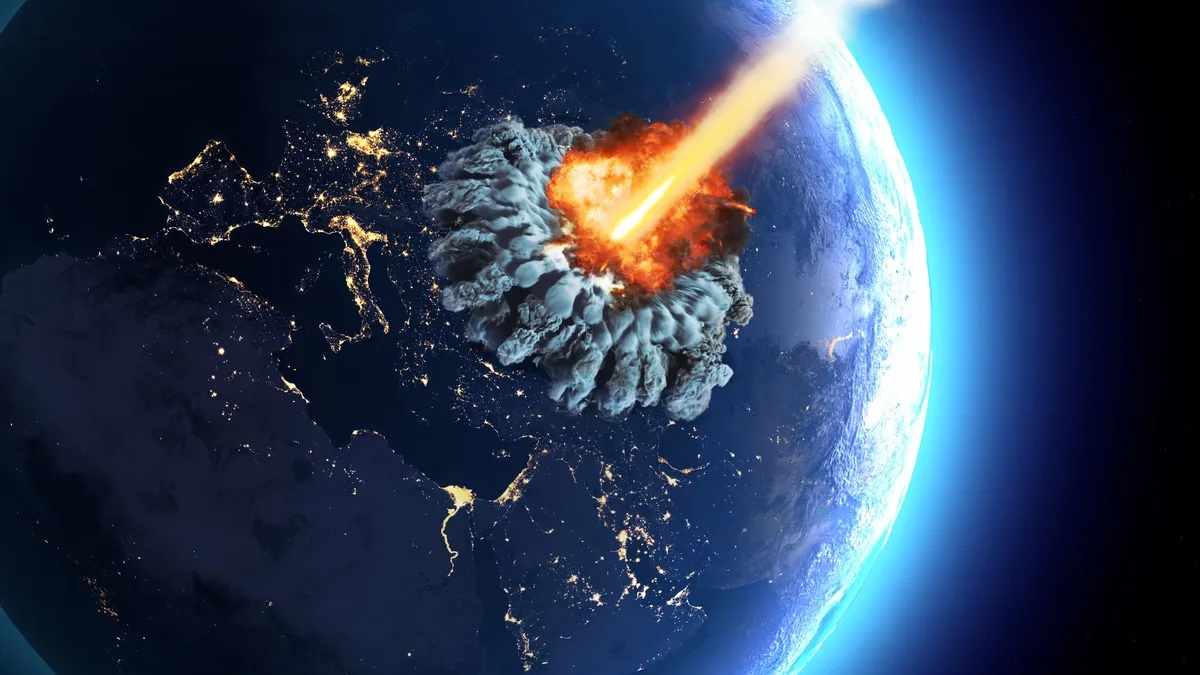
52-foot-tall 'megaripples' from dinosaur-killing asteroid are hiding under Louisiana Live Science - July 20, 2021
These are the largest known megaripples on Earth. The 52-foot-tall (16 meters) megaripples are about 5,000 feet (1,500 m) under the Iatt Lake area, in north central Louisiana, and date to the end of the Cretaceous period 66 million years ago, when that part of the state was underwater, the researchers said.
The megaripples' size and orientation suggest that they formed after the giant space rock, known as the Chicxulub asteroid, slammed into the Yucatan Peninsula, leading to the Chicxulub impact tsunami, whose waves then rushed into shallower waters and created the megaripple marks on the seafloor, the researchers said.
Meteor Crater is the spectacular result of a collision that rocked the American Southwest approximately 50,000 years ago with the energy of more than 20 million tons of TNT. It is the largest impact crater yet discovered in the United States.
Meteor Crater, or Barringer Crater, is about 37 mi (60 km) east of Flagstaff and 18 mi (29 km) west of Winslow in the desert of northern Arizona, United States. The site had several earlier names, and fragments of the meteorite are officially called the Canyon Diablo Meteorite, after the adjacent Canyon Diablo.
The crater was created about during the Pleistocene epoch, when the local climate on the Colorado Plateau was much cooler and damper. The area was an open grassland dotted with woodlands inhabited by mammoths and giant ground sloths. Continue reading
List of impact structures on Earth
Other Impacts Craters in the Universe
Evidence of Ancient Life Found Buried Under an Asteroid Crater Science Alert - May 25, 2026

A new discovery in South Korea suggests that the asteroid effect may have been even more complex than we realized. Beneath a crater gouged by a massive impact around 42,000 years ago, a tea has identified several stromatolites. Stromatolites are layered structures built by microbial mats, similar to some of the oldest known evidence of life on Earth.
Hundreds of glass fragments found in Brazil are traces of an ancient impact that scattered them millions of years ago, scientists have found Science Alert - March 6, 2026
Hundreds of glass fragments found in Brazil are traces of an ancient impact that scattered them millions of years ago, scientists have found. These blobs of material represent spray from melted rock that was liquefied in the impact, then rapidly cooled and hardened to form pebble-like glass objects, some the size of a pea and others as large as a golf ball, known as tektites.
World's Largest 'Modern' Crater Found Hiding in Plain Sight in China Science Alert - November 17, 2025
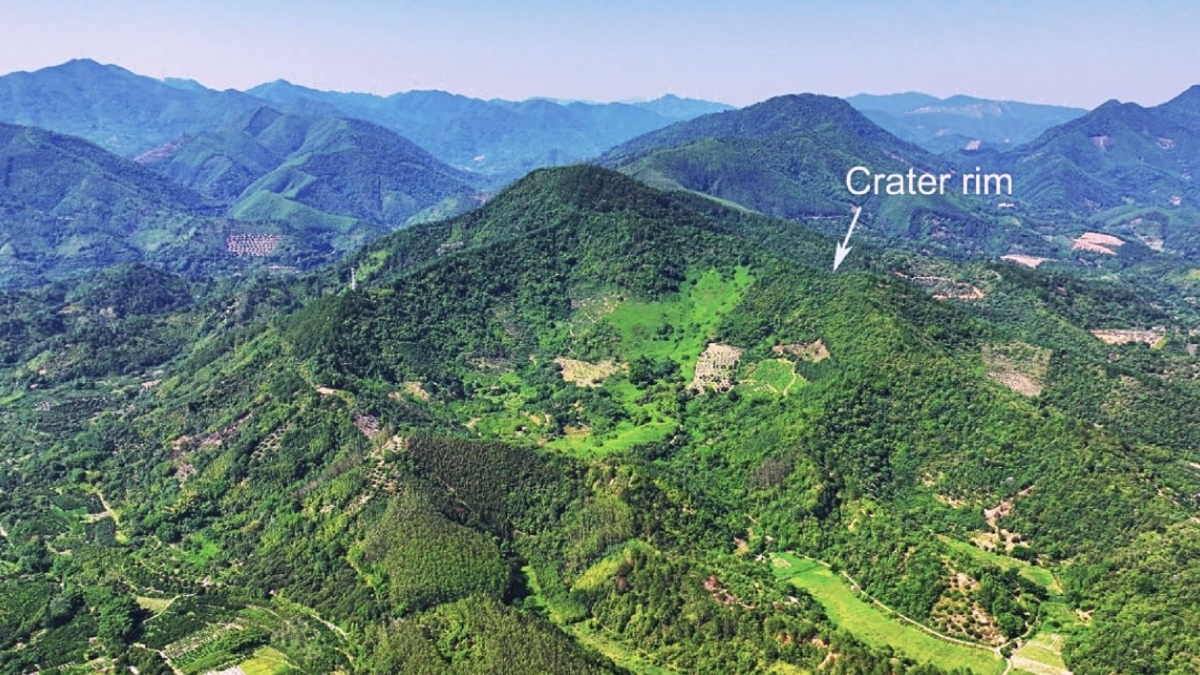
Nestled on a hillside in Guangdong Province near Zhaoqing City, the Jinlin crater managed to hide in plain sight until researchers identified it as an impact structure. Only about 200 confirmed impact craters exist worldwide, making each discovery scientifically valuable. But this one stands out for its exceptional size and youth.
Unusual Crater in The North Sea Result of a Cosmic Collision, Study Confirms Science Alert - September 30, 2025

Sometime in the Middle Eocene epoch, nearly 50 million years ago, a large object hurtled through Earth's atmosphere, crashing into the North Sea between what's now Britain and northwestern Europe. The impact formed a crater 1 kilometer (about half a mile) deep and 3 kilometers wide. A plume of debris and water blasted skyward before falling back down, triggering a monster tsunami. These are the findings of a new study, in which researchers attempt to settle a decades-long dispute over the origins of the Silverpit Crater, now buried 700 meters beneath the seabed about 130 kilometers off the southeastern coast of Great Britain.
Origins of Siberia's Mysterious Craters May Lie Deeper Than We Thought Science Alert - September 22, 2025

More than a decade after mysterious holes were first discovered in the permafrost of Western Siberia, scientists are still putting forward new theories - ' from gas explosions to meteor impacts - on how they are formed. A team of geoscientists from the University of Oslo, led by Helge Hellevang, has now thrown their hat into the icy ring, putting forth a new model that could explain why these holes formed exclusively on the Yamal and Gydan peninsulas and not in other Arctic permafrost regions.
Record Discovery: Impact Crater in Australia's Outback Oldest by a Billion Years Science Alert - March 7, 2025

We have discovered the oldest meteorite impact crater on Earth, in the very heart of the Pilbara region of Western Australia. The crater formed more than 3.5 billion years ago, making it the oldest known by more than a billion years.
Earth from space: Wandering sand dunes circle gigantic 'eye' sculpted by ancient city-killer meteor in the Sahara Live Science - November 26, 2024
This 2013 astronaut photo shows a giant eye-shaped impact crater in the Sahara Desert that is slowly being circled by migrating sand dunes, helping researchers track how far these dunes can move over time.
Siberia's 'gateway to the underworld' is growing a staggering amount each year Live Science - May 20, 2024


The "gateway to the underworld," a huge crater in Siberia's permafrost, is growing by 35 million cubic feet (1 million cubic meters) every year as the frozen ground melts, according to a new study. The crater, officially known as the Batagay crater or megaslump, features a rounded cliff face that was first spotted on satellite images in 1991 after a section of hillside collapsed in the Yana Uplands of northern Yakutia in Russia.
This collapse exposed layers of permafrost within the remaining portion of the hillside that have been frozen for up to 650,000 years - the oldest permafrost in Siberia and second oldest in the world. New research suggests that the Batagay megaslump's cliff face, or headwall, is retreating at a rate of 40 feet (12 meters) per year due to permafrost thaw. The collapsed section of the hillside, which fell to 180 feet (55 m) below the headwall, is also melting rapidly and sinking as a result.
World's first mountaintop impact crater discovered in northeastern China Live Science - September 15, 2023
A nearly mile-wide (1.6 kilometer) divot in a Chinese mountaintop is actually an impact crater from a long-ago meteorite landing. The newly discovered crater, located in northeastern China not far from the North Korean border, is the first confirmed mountaintop crater on Earth. Researchers aren't sure when the impact happened, but it left a circular depression and split the mountaintop into two peaks, known as Front Baijifeng and Rear Baijifeng. The mountain peaks are littered with rock fragments known locally as "celestial stone," which turns out to be a scientifically accurate moniker.
Earth Oldest Impact Craters Are Disappearing Science Alert - August 2, 2023
The earliest impact scars from asteroids that bombarded Earth's surface may be lost forever to the ravages of time. According to a new analysis, there's a reason scientists have been unable to find any craters older than about 2 billion years. The constant erosion and geological processes on Earth have likely erased them from the surface completely, leaving behind only the barest traces, such as high-pressure minerals and melted rock.
Geology
Rock Art