Black Stones: Alchemy, Monoliths, Isis, Omphalos, Mecca, Goddesses


The black stone has many spiritual references.

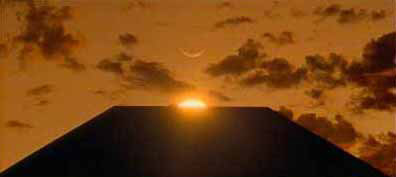
Stanley Kubrick uses alchemical allegories through out the film '2001: A Space Odyssey'.

- Alchemical Kubrick - 2001: The Great Work On Film - by Jay Weidner
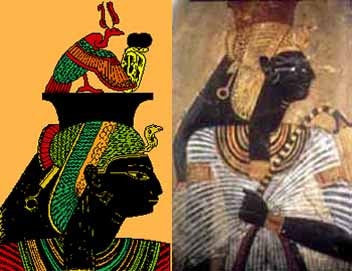


Isis was a magician who sometimes used a shiny black stone. She is linked to Horus and Osiris which takes us to rebirth. Her magic was allied to the wisdom of Thoth and given to mankind as a tool in resurrection after destruction in the alchemy of time.

- Egyptian Mythology by Richard Patrick


The Black Stone - The Omphalos of the Goddess

Long-suffering readers of Mercian Mysteries will know of my obsession with 'omphali' - the sacred centres which each civilisation seems to create or adopt. Many of these involve stones - the Lia F il (Stone of Destiny) at Tara or the various 'king stones' (such as Kingston upon Thames) where medieval English kings were crowned. Our monarchs still sit on, or at least above, the Stone of Scone for their coronation. But some of these sacred stones have special interest - they are (or are said to be) black. Such Black Stones also tend to have the legend that they have fallen from the stars. Clearly, meteorites the size of these large boulders would explode into tiny fragments on impact, and also leave a substantial crater. The literal truth is not important; rather the symbolism of such stones being a link between this world and the heavens is an integral aspect of the Cosmic Axis which is invoked by all sacred centres.

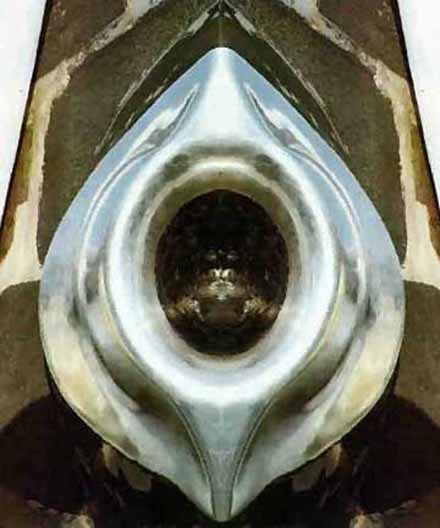
Perhaps the best-known Black Stone, and now by far the most revered, is the Ka'bah at Mecca. Ka'bah means 'cube' and this describes the shape of the black stone structure on a marble base which stands in the centre court of the Great Mosque, Masjidul Haram, at the centre of Mecca. It stands about 50 feet high by about 35 feet wide. Set into the eastern corner is the sacred stone, covered by an elaborately embroidered black drape. As any non-moslem in the temple would be slain on sight, and photography is generally prohibited, this stone is shrouded is mystery. However, Rufus Camphausen has succeeded in tracking down three accounts of the pilgrimage to Mecca, two of which do contain photographs. What these reveal is a polished black stone of which less than two feet is visible, set in a large, solid silver mount. The whole resembles - quite deliberately, for reasons which will emerge - the vulva of the goddess. That moslems now refer to it as the Hand of Allah does not diminish the urge for all those who complete the pilgrimage to Mecca to touch or kiss this sacred object.

The Black Stone has long since been broken and the silver band holds together the fragments. Tradition holds that it was a meteorite and the stone was white in colour when it first landed and then blackened. The faithful attribute this change in colour to the belief that the stone absorbs the sins of the pilgrims, but it is consistent with known meteorites which are white at first but oxidise over a period of time.

'A principal sacred object in Arabian religion was the stone. . . . Such stones were thought to be the residence of a god hence the term applied to them by Byzantine Christian writers of the fifth and sixth centuries: 'baetyl', from bet'el, 'the house of god'.'

'In north Arabian temples the image of the deity sometimes stood in the open air or could be sheltered in a qubbah, a vaulted niche. . . . Not to be confused with the qubbah is the word ka'bah, for a cube-shaped walled structure which . . . served as a shelter for the sacred stones.'

Camphausen, in his article, reveals that the misogynic moslem religion has its origins in goddess worship. Allah is a revamped version of the ancient goddess Al'Lat, and it was her shrine which has continued - little changed - as the Ka'bah. The known history of Mohammed reveals that he was born around 570 CE into a tribe of the Quraysh, who not only worshipped the goddess Q're but were the sworn guardians of her shrine. By 622 Mohammed was preaching the ways of his god, Allah, and was driven out by his own tribe as a result.

The Triple Goddess

Pre-islamic worship of the goddess seems to be primarily associated with Al'Lat, which simply means 'goddess'. She is a triple goddess, similar to the Greek lunar deity Kore/Demeter/Hecate. Each aspect of this trinity corresponds to a phase of the moon. In the same way Al'Lat has three names known to the initiate: Q're, the crescent moon or the maiden; Al'Uzza, literally 'the strong one' who is the full moon and the mother aspect; then Al'Menat, the waning but wise goddess of fate, prophecy and divination. Islamic tradition continue to recognise these three but labels them 'daughters of Allah'.

According to Edward Rice Al'Uzza was especially worshipped at the Ka'bah where she was served by seven priestesses. Her worshippers circled the holy stone seven times - once for each of the ancient seven planets - and did so in total nudity. Near the Ka'bah is the ever-flowing well, Zamzam, which cools the throats of the countless millions of pilgrims.

In an oasis of always-flowing water, the Black Stone in its mount became an unmatched image of the goddess as giver of life. Only in the Indian continent do such physical symbols for the male and female generative powers - the lingam and yoni - continue to be worshipped with their original fervour.

It is easy to imagine that in pre-moslem times the goddess's temple at Mecca was pre-eminent - whether to celebrate life, ask protection, pray for offspring. Legend tells how Abraham, unable to produce children by his wife Sarah, came here to make love to his slave Hagar. Later, when Hagar came back to give birth, she could find no water and Abraham created the holy well of Zamzam to save the life of his first son.

When Mohammed wanted to surplant Al'Lut with Allah, this was the one Temple he must conquer. Although Mohammed did conquer the Ka'bah, little else changed. The faithful still circle the Holy of Holies seven times (although, I hasten to add, now fully clothed). The priests of the sacred shrine are still known as Beni Shaybah or 'Sons of the Old Woman' - Shaybah being, of course, the famous Queen Sheeba of Solomon's times.

Sheeba appears under the guise of Lilith in the Near East and as Hagar ('the Egyptian') in the Hebrew mythology of the Old Testament. So, rewriting the legend given above, Abraham begot his son, Ishmael - the ancestor of all Arab peoples - by the goddess on the Black Stone of the Ka'bah.

While we are tracing names, Q're (or Qure), the maiden aspect of Al'Lut, seems certain to be the origin of the Greek Kore. Camphausen suggests that the holy Koran (qur'an in Arabic) is the 'Word of Qure'.

Even moslems admit that the work existed before the time of Mohammed. Legend said it was copied form a divine prototype that appeared in heaven at the beginning of time, or the Mother of the Book. Al'Uzza, the mother aspect of Al'Lut, may give us the pre-dynastic Egyptian snake goddess Ua Zit, who develops into Isis.

Archaeo-astronomy

Returning to the geomantic significance of the Ka'bah, Professor Hawkins has argued that it is exceedingly accurately aligned on two heavenly phenomena. These are the cycles of the moon and the rising of Canopus, the brightest star after Sirius.

In a thirteenth-century Arabic manuscript by Mohammed ibn Abi Bakr Al Farisi it is stated that the alignment is set up for the setting crescent moon - an ancient symbol of the virgin-goddess which still appears in the national flags of many islamic nations. In some flags - Algeria, Mauritania, Tunisia and Turkey - the crescent is accompanied by a star, perhaps representing Canopus.

The Egyptian city known as Canopus seems also have been a goddess temple, as the Greek historian Strabo (63BCE-21CE) considered the place to be notorious for wild sexual activities. Such references typically refer to temples where sacred 'prostitution' or ritual promiscuity were part of the worship; invariably sacred objects depicting the genitals of either god and/or goddess were venerated. Such sacred promiscuity continued to be part of the Pilgrimage to Mecca, at least for some moslems.

The Shi'ites from Persia were allowed to form temporary 'marriages' for the period of the pilgrimage. Any children born as a result were regarded as divine or as saints - a custom with worldwide parallels (English surnames such as Goodman, Jackson or Robinson perhaps derive from similar sacred unions with god in the form of Green Men characters such as Jack o'the Green or Robin Greenwood; I would also suggest that the original sense of 'godparent' and 'godchild' has similar origins.)

Aniconic black stone once venerated at the Temple of Aphrodite, near Paphos, Cyprus.

More Black Stones

Deities of other cultures known to have been associated with stones include Aphrodite at Paphos, Cybele at Pessinus and later Rome, Astarte at Byblos and the famous Artemis/Diana of Ephesus. The latter's most ancient sculpture was, it is said, carved from a black meteorite.

The earliest form of Cybele's name may have been Kubaba or Kumbaba which suggests Humbaba, who was the guardian of the forest in the Epic of Gilgamesh (the world's oldest recorded myth from Assyria of c.2500BCE and, as scholars reveal more of the text, increasingly the source of most of the major mythological themes of later civilisations.

The origin of Kubaba may have been kube or kuba meaning (guess what) - 'cube'. The earliest reference we have to a goddess worshipped as a cube-shaped stone is from neolithic Anatolia. Alternatively, 'Kubaba' may mean a hollow vessel or cave - which would still be a supreme image of the goddess. The ideograms for Kubaba in the Hittite alphabet are a lozenge or cube, a double-headed axe, a dove, a vase and a door or gate - all images of the goddess in neolithic Europe.

The stone associated with Cybele's worship was, originally, probably at Pessinus but perhaps at Pergamum or on Mount Ida. What is certain is that in 204 BCE it was taken to Rome, where Cybele became 'Mother' to the Romans. The ecstatic rites of her worship were alien to the Roman temperament, but nevertheless animated the streets of their city during the annual procession of the goddess's statue. Alongside Isis, Cybele retained prominence in the heart of the Empire until the fifth century CE; the stone was then lost. Her cult prospered throughout the Empire and it is said that every town or village remained true to the worship of Cybele.

The home of Aphrodite was at Paphos on Cyprus. Various Classical writers describe the rituals which went on her in her honour - these seem to include the practice which is now known by the disdainful term of 'sacred prostitution'. In any event, the tapering black stone which was the object of verneration at this Temple still survives, even if it now placed inside the site musuem.

Also on Cyprus is another highly venerated islamic site - the third most important after Mecca and Medina - the Hala Sultan Tekke. This, too, has a black rock, said to have fallen as a meteorite as part of the tritholon over the shrine. The shrine is to a woman - the aunt and foster mother of Prophet Mohammed. Could this, like Mecca, have been originally a goddess shrine? Unfortunately no other clues are forthcoming.

Another site stated to have a Black Stone was at Petra, but I have been unable to discover where this was or who was worshipped there - could any readers who know please write in!

To add a little local flavour, numerous standing stones in the British Isles are reputed to have fallen from the stars. The now-lost Star Stone marked the meeting of Leicestershire, Nottinghamshire and Lincolnshire; an also-vanished stone at Grimston, Leicestershire, was also said to have such an origin. However, whether or not such stones were ever associated with goddess worship we will never know.

It would take far too long to discuss to what extent the cult of the goddess's Black Stone may have been perpetrated as Solomon's bride in the Song of Songs, who is 'black but beautiful' or to come to terms with the black images of Demeter, Artemis and Isis who have their direct continuation in the Black Virgins of Europe - patrons of the troubadours, the gnostics and the alchemists, as well as the present Pope. Those who wish to follow such ideas would do well to read The myth of the goddess which, in a sober but inspirational manner, re-evaluates how the feminine deity has remained with us throughout history.

by Bob Trubshaw


Goddess of the Black Stone

- Alby Stone

Bob Trubshaw's article on the Black Stone of Mecca was of great interest to myself, as I had already seen Rufus Camphausen's original article on The Ka'bah at Mecca, and already had something of an interest in the subject.

Camphausen, and now Bob Trubshaw, have done us all a great service by bringing this material to our attention in an accessible form, and presenting what is basically a strong and coherent case for the original pagan context of the Black Stone; but it is also apparent that there is a good deal more that could be said on the subject.

Indeed, there are a number of points that really must be made, particularly with regard to the goddess Al'Lat, whose identity - and those of her old Meccan companions, Al'Uzza and Manat - is perhaps not as clear-cut as Rufus Camphausen has asserted, and as Bob Trubshaw has reported. There are more connections to be made, and these show the goddess of the Black Stone in a rather different light.

Of especial interest is the explanation of the Beni Shaybah, the imams who attend the sacred structure, as 'Sons of the Old Woman', the old lady in question supposedly being the Queen of Sheba. Any connection with an authentic, historical Queen of Sheba is debatable, but in view of the tradition it is worth pointing out that the Hebrew sheba' can mean either 'seven' or 'oath'.

The Biblical place-name Beer-sheba is literally 'the well of seven', the well in question being dug by Abraham and where he made a peace-treaty with Abimelech. Abraham gave seven ewe-lambs to seal the pact, and the place was named to commemorate the event.

The well is said to have been reopened by Isaac, who renamed it Shibah, which just happens to be the feminine form of the numeral sheba'. Interestingly, the site is now said to have seven wells. The name given by Abraham thus seems to have been a play on the Hebrew words for 'seven' and 'oath'. The sacred complex at Mecca has the holy well Zamzam, of course.

That the Semitic tribes associated oath-taking with the number seven is confirmed by Herodotus, writing in the fifth century BCE, who reports that Arabs solemnised oaths between two men by enlisting the services of a third, who 'stands between them and with a sharp stone cuts the palms of their hands...then he takes a little tuft of wool from their clothes, dips it in the blood and smears the blood on seven stones which lie between them, invoking as he does so, the names of Dionysus and Urania'. Herodotus identifies the latter as Alilat, who is undoubtedly the same goddess formerly venerated at Mecca as Al'Lat.

It seems relevant that the sanctity of treaties made at the Ka'bah is stressed in the Koran [9:6], where even covenants made with infidels are to be honoured: 'God and His apostle repose no trust in idolaters, save those with whom you have made treaties at the Sacred Mosque. So long as they keep faith with you, keep faith with them. God loves the righteous.'

There were, in pagan times, seven priestesses at site of the Black Stone, who circled it seven times, naked. Today, the tawaf, the sevenfold counterclockwise circuit of the Ka'bah, is a memory of that ancient practice. But the older practice is itself a strong echo of the descent of the Sumerian goddess Inanna (and her Babylonian equivalent Ishtar) through the seven gates of the underworld, the gatekeepers demanding the removal of a garment at each gate until she stands naked before her elder sister Ereshkigal, 'Queen of the Great Earth', the goddess of death and the underworld. Another name for Ereshkigal is Allatu, 'the goddess', which is clearly an earlier form of Al'Lat/Alilat.

This suggests that, far from being a moon-goddess, Al'Lat is actually the goddess of the underworld, who could indeed be fittingly described as the 'Old Woman'. I do not myself subscribe to the idea of three-phase moon goddesses of the maiden-mother-hag model popularised by the likes of Robert Graves, but in the case of Al'Lat and her sisters there is a definite argument against it - although the reported evidence is contradictory and confusing. In his introduction to the Penguin edition of the Koran, translator N.J. Dawood says that Al'Lat, Al'Uzza, and Manat 'represented the Sun, Venus, and Fortune respectively' - but I have also seen Allat described as a representation of Venus, and she once had a temple in the precinct devoted to the sun-god Shamash in Hatra, Iraq.

In early Mesopotamian art, the only heavenly bodies regularly shown as a group were the triad of Sun, Moon, and Venus, the three most important celestial lights; and in Sumer and early Babylon the sun and moon were represented mainly by a male divinity, though elsewhere in the Semitic world the moon was usually regarded as feminine.

Al'Uzza and Manat are less easily traced to a more archaic source. Their names - 'the Strong' and 'Destiny' respectively - suggest abstract forces rather than natural objects. If the three 'daughters of Allah' are personifications of any natural phenomena, then one is surely the Earth (Al'Lat = Allatu = Ereshkigal); the others are of uncertain pedigree. But there is also a strong chance that their form and function were influenced by the banat, the three daughters of Baal, the supreme deity of the Canaanites. They symbolised light, rain, and Earth.

At Petra, the Nabataeans venerated a four-sided stone named after Allat, whose son Dusura (in their system) is a version of Tammuz/Dumuzi/Du'uzi, the vegetation god characterized by a seasonal death and resurrection, who dwells in the underworld for half the year.

His full name in Sumerian is Dumu-zi-abzu, 'faithful son of the abyssal waters' - a rough but appropriate rendering of abzu, which denotes the spaces below the earth as well as the primal waters. Dumuzi/Tammuz, of course, was the reason for Inanna/Ishtar descending to Allatu's realm in the first place, according to nearly every version of the myth.

Once there, the Mesopotamian Venus lies about the reason for her visit, so breaking the 'law of the underworld which must be fulfilled', and is sentenced to death by the Anunnaki, the seven judges of the underworld. Abzu(later: Apsu), was the natural home of the Sebettu, the seven sages associated by Babylonians with the foundation of culture and the seven major cities of the region.

All this fits in well with Islamic and pagan Arab traditions concerning the Black Stone and its precincts. By word-play, the Beni Shaybah are at once the Sons of the Old Woman, the Sons of the Seven, and the Sons of the Oath; they are also the successors of the seven sky-clad servitors of Al'Lat, whose Babylonian predecessor ruled the sevenfold palace of the underworld; and of the seven Anunnaki.

Like many examples of the axis mundi, the Black Stone has a sacred well nearby, and is associated with oath-taking. The Queen of Sheba, bearing in mind the lore associated with Beer-sheba, takes on further significance: tradition has it that she was black, and of djinn ancestry - in other words, she was a divine being in her own right, possibly even a hypostasis of Al'Lat herself.

As for Q're: the identification with Kore (a title of Persephone) is a familiar notion, but one that is almost certainly mistaken. In Greek, kore can denote a girl, and koros a boy; the word actually comes from the same Indo-European stem as a number of other words meaning 'to grow', and denotes more or less the same thing - an increase in size.

Any phonetic similarity between Q're and Kore is coincidental, but oddly fortuitous if the former is an aspect or title of Al'Lat: Persephone, 'bringer of destruction', is Queen of the Underworld in Greek myth, daughter of Demeter, who represents the earth as mother. Persephone's son is Triptolemos, who resembles Tammuz/Dumuzi.

Essentially, Demeter and Persephone are effectively twin aspects of the Earth - mother and grave of all - and have no real connection with the moon whatsoever.

Hekate, who figures in their myth, cas indeed be seen as a representation of the moon, but is in herself a triad of maleficent, nocturnal entities; she is quite separate from Persephone and Demeter. The supposed triad of Kore, Demeter, and Hekate is a relatively modern invention, with no real foundation in ancient Greek myth or iconography.

Little of this affects Bob Trubshaw's reading of Camphausen's analysis, other than to suggest that worship of the moon is probably not as dominant in the pre-Islamic Meccan schema as Camphausen thinks.

There is always a chance that Al'Lat did become linked with a lunar cult at some point, but little evidence to suggest that she or her sisters were moon-goddesses.

On the whole, the pattern presented here suggests that Al'Lat is essentially a chthonic mother-goddess, a deity of the underworld also associated with fidelity and covenants - a later form of Ereshkigal, who has retained many of her older attributes, albeit in a slightly distorted form.

After Mecca and Medina, the third most holy site of Islam is surely the Dome of the Rock on Temple Mount in Jerusalem. One reason for this is undoubtedly the influence of Judaic and Christian monotheism upon Mohammed's early teachings; but another major reason for it is probably the fact that in the Dome of the Rock is the Eben Shetiyyah, a flat, yellow-brown, asymmetrical rock believed by many Jews to be, as its name implies, the 'Stone of Foundation', around which God built the world, and which was used as the pedestal of the Ark of the Covenant.

The Ark, as is well known, was a symbol of the Hebrews' communal pact with God; it was also used as a weapon in the destruction of Jericho, an event replete with sevens; and it contained the two stone tablets engraved with the Law - which have been roundly equated with baetyls by a number of Biblical scholars, and sometimes presumed to have been of meteoric origin. Beneath the Eben Shetiyyah is a deep hollow known to Muslims as Bir-el-Arweh, the Well of Souls.

In Jewish lore, the Eben Shetiyyah rests upon and keeps in place the waters of the Abyss (that is, abzu).

One Jewish tradition has it that David dug the foundations of the Temple at Jerusalem, and discovered the Eben Shetiyyah during his excavations. When he tried to remove the stone, the waters of the Abyss began to well up.

This parallels the Islamic tradition that has Mohammed casting down an idol that stood in the sacred complex at Mecca.

According to the tradition, this idol was blocking a well inside the Ka'bah, and the waters began to flow from that moment. Supposedly, the idol represented a deity named Hubal, which seems to be a version of the name of the goddess who was known elsewhere as Kybele, and who was venerated in Phrygia in the form of a stone, a black aerolite that was presented to Rome in 204 BCE by King Attalus.

Knowing that the Arabs habitually worshipped stones as representations of their divinities, it seems probable that the idol Hubal was a stone, perhaps of celestial provenance. Interestingly, the goddess Na'ila - one of a veritable host of divinities venerated at the Meccan site - supposedly appeared in the form of a black woman at the time Mohammed destroyed the idols, and ran screaming from the sacred place.


The Black Meteorite Stone

Nicholas Roerich was a poet, artist and eminent man of learning who had emigrated from White Russia and settled in Paris. He was regarded as one of the most distinguished of the Theosophical elite of the period. Apart from searching for the home of the Mahatmas, the purpose of his scientific expedition across Tibet and Xinjiang to Altai (1923-26) was never made entirely clear in his diary, but appears to have been related to the return of a certain sacred stone to its rightful home in the King's Tower in the center of Shambhala.

Tibetan dharma wheel Orion - as above, so below Sirius A & B

The stone was said to be part of a much larger meterorite possessed of occult properties called the Chintamani Stone, which was capable of giving telepathic inner guidance and effecting a transformation of consciousness to those in contact with it. The black stone of the Ka'aba at Mecca and that of the ancient shrine of Cybele, the Goddess-Mother of the Near East, are both believed by some occultists to be pieces of this magical meterorite, which is alleged to have come from a solar system in the constellation of Orion, probably Sirius [part of Canis Major]. The Orion constellation, we may note, is a recurring motif in the Shambhalic story.

According to lamaist lore, a fragment of the Chintamani Stone from what is probably the star Sirius [there seem to be actually three of them] is sent wherever a spiritual mission vital to humanity is set up, and is returned when that mission is completed. Such a stone was said to be in the possession of the failed League of Nations, its return being entrusted to Roerich."

Shambhala - Victoria LePage


Standing in the middle of the Great Mosque of Mecca is the Ka'ba, a cubed shaped temple rebuilt by Abraham and his son Ishmael. Reverently draped in black cloth throughout the year, it beckons to every Muslim of the world to come to its sacred ground.

The Ka'ba is the canonical center of the Islamic world and every pious act, particularly prayer, is directed toward it. Once a year it plays host to the greatest convention of religious believers and stands ready to sanctify the Umrah traveler through the balance of the year.

Placed into the Eastern corner of the Ka'ba rests the Hajar al-Aswad (literally the black stone). During the Tawaf (refer to 3performance of the Hajj2) pilgrims kiss or touch the black stone as they circumambulate the Ka1ba.

There is no indication as to where this stone originated, but since it pre-dates the revelation of the Holy Qur'an and Muhammad's prophethood, and even kissed, it must stem from the time of Abraham since the Hajj traditions are traceable to the patriarch of monotheism. It is remarkable, however, that even though the temple contained 360 idols worshipped before Muhammad's Prophethood, the black stone was never kissed or made an idol of worship. In fact, the Ka'ba was never worshipped by the idolaters prior to Muhammad's Prophethood. The building contained idols of worship but the building itself was never an object of worship.

The fact that the Ka'ba was rebuilt by Abraham is a historical fact. In addition, since the stone has been there ever since, it stands to reason that Abraham placed the stone in the Ka'ba. The Black Stone is in fact the cornerstone of the Ka'ba and is there as an emblem of the progeny of Abraham which was rejected by the Israelites and became the corner stone of the Kingdom of God.

The Psalms contains a clear reference to it: "The stone which the builders refused is become the head-stone of the corner." (Psalms 118:22) Ishmael was looked on as being rejected by God, or so the Israelites believed. Yet it was a progeny of Ishmael that the Last Prophet, the 'head-stone of the corner' was to arise.

While David referred to it as the stone which the builders refused, Jesus spoke of it more plainly in the parable of the husbandman, telling the Israelites that the vineyard, which in the parable stands for the Kingdom of God, would be taken away from them and given to other husbandmen: that is, to a non-Israelite: Did ye never read in the scriptures. The stone which the builders rejected, the same is become the head of the corner? (Matthew 21:42); The Kingdom of God shall be taken from you, and given to a nation bringing forth the fruits thereof (Matthew 21:43).

That by the rejected stone in the prophecy (21:42) was meant a rejected nation (21:43) is made clear by Jesus Christ. That this rejected nation was none other than the Ishmaelites has been borne out by history.

The Black Stone, therefore, passes for the mithaq, the primordial covenant between the Creator and His created. And in the whole world there is only this unhewn stone, the stone, Cut out of the mountains without hands (Daniel 2:45), and that is the corner-stone of a building, which in point of importance, stands unique in the world.

Touching or kissing the stone has a profound impact on the faithful as it is suppose to count in their favor on judgment day. The great Muslim traveler from Valencia, Ibn Jubayr (1145-1217) describes the emotion he felt on touching the stone, The stone, when one kisses it, has a softness and freshness which delights the mouth; so much so that he who places his lips upon it wishes never to remove them. It suffices, moreover, that the Prophet said that it is the Right Hand of God on Earth.

The single most important reason for kissing the stone is that Prophet Muhammad (SAW) did so. No devotional significance whatsoever is attached to the stone. The Caliph, Umar ibn al-Khattab, made this crystal clear when, on kissing the stone himself in emulation of the Prophet, he proclaimed, "I know that you are but a stone, incapable of doing good or harm. Had I not seen the Messenger of God kiss you ­ may God's blessing and peace be upon him ­ I would not kiss you." (CDLXXXIV; Sahih Muslim; Kitab al-Hajj; p.642)

Kissing or touching the Black Stone is a reverential act of acknowledgment that God's hand directed its placement and construction. That Abraham and Muhammad, God's blessing upon them, had touched and kissed the stone and an acknowledgment that God had entrusted the 'corner stone' of His religious central focus for man upon that hollowed and sacred place.

The Black Stone of Mecca


SACRED PLACES AND TEACHINGS INDEX


ALPHABETICAL INDEX OF ALL FILES


CRYSTALINKS MAIN PAGE


PSYCHIC READING WITH ELLIE


2012 THE ALCHEMY OF TIME


Google