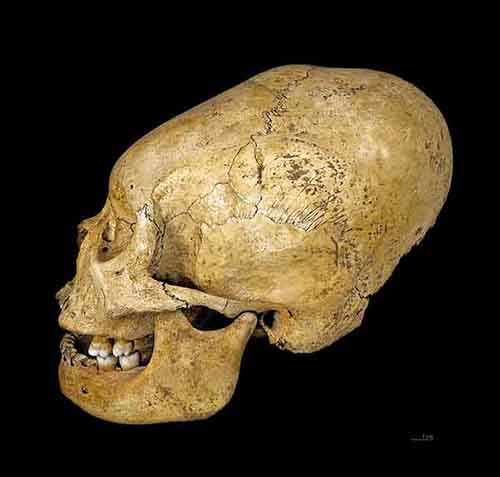
Artificial cranial deformation or modification (ACD), head flattening, or head binding is a form of body alteration in which the skull of a human being is deformed intentionally. Typically, it is carried out on an infant, as the skull is most pliable at that time.
Intentional cranial deformation predates written history - misshapen skulls found all over the world. It was common practice in a number of ancient cultures that were widely separated geographically and chronologically. Head blinding in ancient times was sometimes done to differentiate the ruling class from the masses. Read more ...

Skulls represent consciousness. Ancient elongated skulls are sometimes found with enlarged eye sockets, a combination that echoes depictions of gray aliens - beings portrayed with large heads and oversized blue eyes concealed behind black lenses that function both as protection and as a computer ocular interface.
Ancient elongated skulls seem to mirror gray aliens or human-alien hybrids who once existed on Earth perhaps a race - or experiment - as yet unknown.
Ancient alien theorists suggest the Anunnaki - the founding gods of the Sumerian civilization - also had elongated skulls. They find it intriguing that 13 elongated skulls were discovered in the same region the Anunnaki were said to have descended to Earth to create the human race.
This takes us to 12 Around 1 to create physical realities. Further there is a myth about 13 crystal skulls that will come together as human consciousness remembers its soul's purpose and all evolves out of existence in the alchemy of time.

The soul's purpose is the discovery or remembrance that we exist within a simulated reality as an experiment set in time to study emotions ... along the way creating multiple humanoid forms, with our current version representing only one iteration in a much larger experiment.
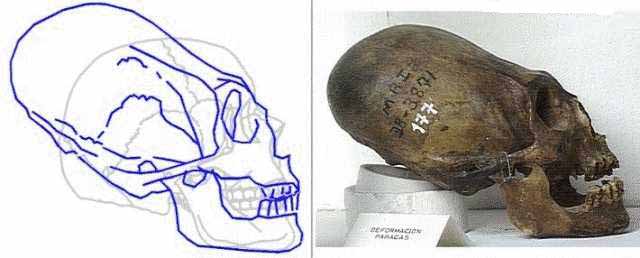
The Conehead Skulls or Inca Skulls are deformed human-like skulls associated with the Paracas culture in what is now Peru. They are unnaturally elongated, giving a comparatively pointed shape. Most experts believe they are the result of artificial cranial deformation, a procedure well known by anthropologists in which the skull's shape is modified by tightly binding the head.
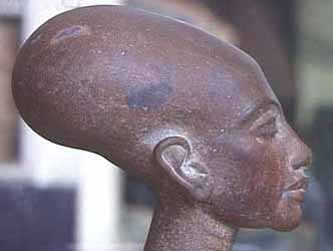
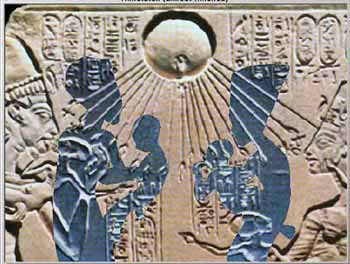
In mythology, we find images of people with elongated skulls in Egypt and other countries - again associated with extraterrestrials.
The sarcophagi for Nefertiti and Akhenaten have never been found leading some researchers to believe they were extraterrestrials who vanished through a portal. Their purpose was to introduce the concept of monotheism to the local people of that timeline - creation by one god. They failed.
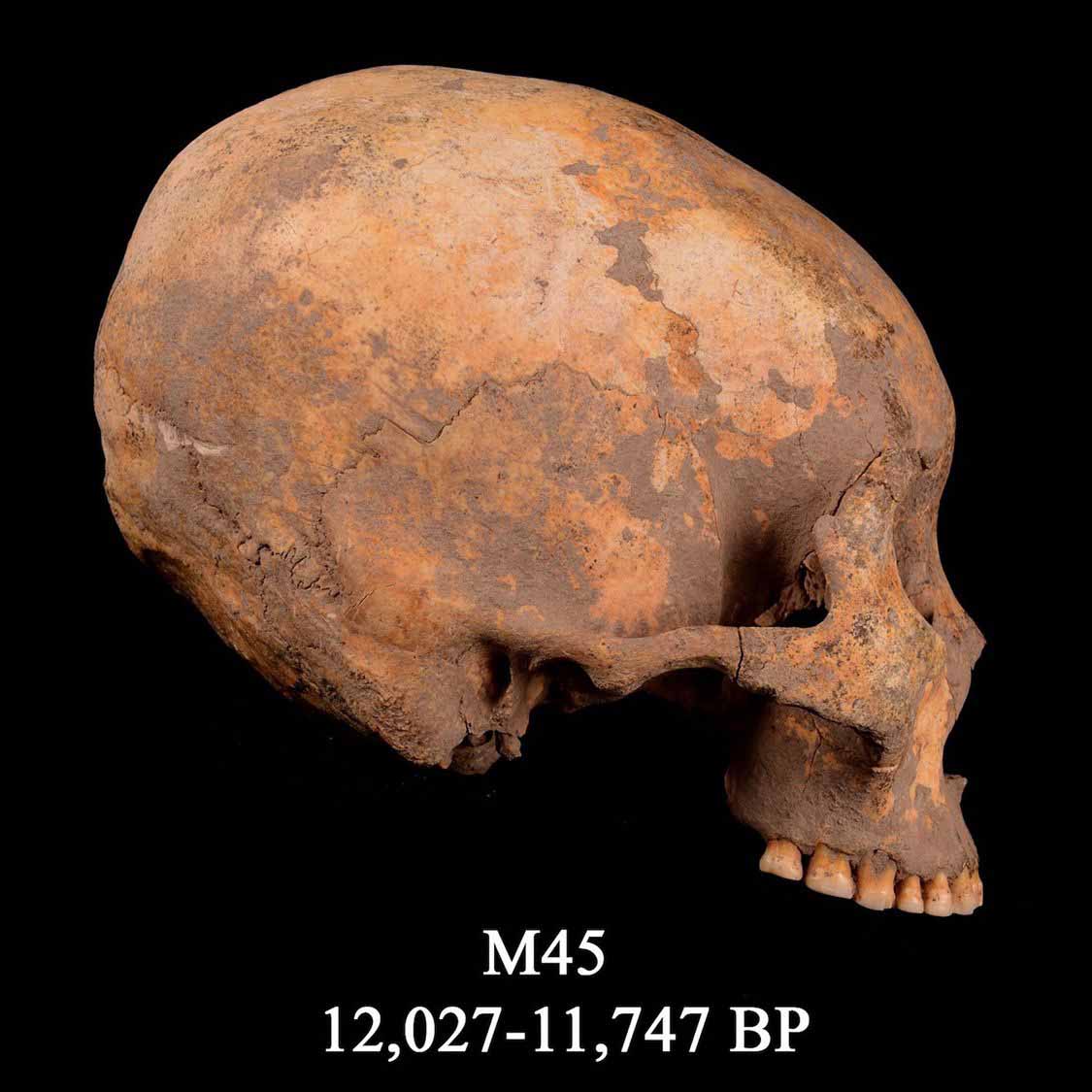
Elongated skulls in China are a significant archaeological finding, particularly at the Houtaomuga site, revealing intentional cranial modification (skull shaping) dating back 5,000 to 12,000 years, making them some of the earliest examples globally, suggesting a cultural practice for status or beauty among ancient East Asians, involving binding infants' heads to reshape them over time.
Elongated skull from Italian cave reveals earliest European evidence of cranial modification PhysOrg - August 13, 2025

A University of Florence-led team reports early Eurasian evidence of artificial cranial modification (ACM) in a Late Upper Paleolithic individual from Arene Candide Cave, Italy. Shape analyses place the specimen within the ACM cluster and radiocarbon dates to 12,620–12,190 years ago. Body culturalization runs deep in human history, from adornments to permanent modifications recorded in archaeological contexts. More than just stylistic choices, transformations in appearance impart cultural values and symbolic meanings through the physical body, serving as a living artifact of cultural practices and societal beliefs, perpetuating shared values and collective identity.
Argentina: Alien-shaped skull of toddler is actually evidence of long-standing practice of head shaping Live Science - July 3, 2025

While installing a water pipeline in Argentina last month, workers stumbled upon the skull of a child who was buried at least 700 years ago. The archaeological discovery quickly garnered media attention because of the asymmetry of the skull, drawing comparisons to aliens. But the flattening on the back of the skull, which belonged to a 3- to 4-year-old child, is simply the result of the cultural practice of head shaping
Teen girl from 6,200 years ago with cone-shaped skull unearthed in Iran PhysOrg - June 11, 2025

A pair of archaeologists working at a dig site in an ancient cemetery in western Iran have discovered the skull of a young girl that shows evidence of cranial modification. In their paper published in the International Journal of Osteoarchaeology, Mahdi Alirezazadeh and Hamed Vahdati Nasab describe where the skull was found, its condition, the modifications they observed and the likely way its owner died. Cranial modification has been found in many ancient civilizations - it was typically done by wrapping the head of a child tightly as they grew to adulthood. The practice was done for different reasons in different cultures, and has been seen more often in girls than in boys.
The First Evidence of 'Head Cones' Found in 3,300-Year-Old Egyptian Tomb Live Science - December 11, 2019

Ancient Egyptians have long been depicted wearing so-called head cones, but until now, archaeologists had no physical evidence of their existence. Now, two such head cones, made of wax, have been discovered on the skulls of two individuals buried about 3,300 years ago at the site of Amarna in Egypt. Between 1550 B.C. and 30 B.C., Egyptian art depicted people wearing what look like cones on their heads. Because no examples of these cones had ever been found, archaeologists wondered whether they actually existed or were an artistic motif that had no basis in reality (similar to people with halos over their heads depicted in Christian art).
New insights into the origin of elongated heads in early medieval Germany Science Daily - March 13, 2018
A palaeogenomic study investigates early medieval migration in southern Germany and the peculiar phenomenon of artificial skull deformation. In an interdisciplinary study, the international research team analyzed the ancient genomes of almost 40 early medieval people from southern Germany. While most of the ancient Bavarians looked genetically like Central and Northern Europeans, one group of individuals had a very different and diverse genetic profile. Members of this group were particularly notable in that they were women whose skulls had been artificially deformed at birth. Such enigmatic deformations give the skull a characteristic tower shape and have been found in past populations from across the world and from different periods of time.
Parents wrapped their children's heads with bandages for a few months after birth in order to achieve the desired head shape. It is difficult to answer why they carried out this elaborate process, but it was probably used to emulate a certain ideal of beauty or perhaps to indicate a group affiliation. So far, scholars have only speculated about origins of the practice in medieval Europe. The presence of these elongated skulls in parts of eastern Europe is most commonly attributed to the nomadic Huns, led by Atilla, during their invasion of the Roman Empire from Asia, but the appearance of these skulls in western Europe is more mysterious, as this was very much the fringes of their territory.
Deformed, Pointy Skull from Dark Ages Unearthed in France Live Science - November 15, 2013
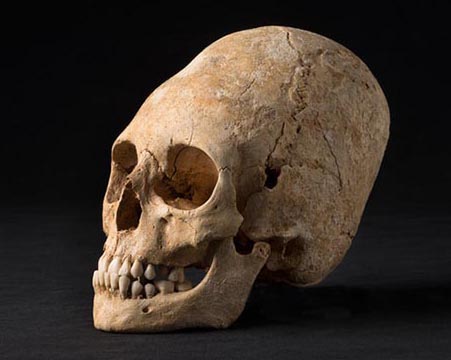
The skeleton of an ancient aristocratic woman whose head was warped into a deformed, pointy shape has been unearthed in a necropolis in France. The necropolis, found in the Alsace region of France, contains 38 tombs that span more than 4,000 years, from the Stone Age to the Dark Ages. The Obernai region where the remains were found contains a river and rich, fertile soil, which has attracted people for thousands of years.