A nebula is an interstellar cloud of dust, hydrogen gas and plasma. It is the first stage of a star's cycle. Originally nebula was a general name for any extended astronomical object, including galaxies beyond the Milky Way (some examples of the older usage survive; for example, the Andromeda Galaxy was referred to as the Andromeda Nebula before galaxies were discovered by Edwin Hubble).
Nebulae often form star-forming regions, such as in the Eagle Nebula. This nebula is depicted in one of NASA's most famous images, the "Pillars of Creation". In these regions the formations of gas, dust and other materials 'clump' together to form larger masses, which attract further matter, and eventually will become big enough to form stars. The remaining materials are then believed to form planets, and other planetary system objects.
Many nebulae form from the gravitational collapse of diffuse gas in the interstellar medium or ISM. As the material collapses under its own weight, massive stars may form in the center, and their ultraviolet radiation ionizes the surrounding gas, making it visible at optical wavelengths. An example of this type of nebula is the Rosette Nebula or the Pelican Nebula. The size of these nebulae, known as HII regions, varies depending on the size of the original cloud of gas, and the number of stars formed can vary too. As the sites of star formation, the formed stars are sometimes known as a young, loose cluster.
Some nebulae are formed as the result of supernova explosions, the death throes of massive, short-lived stars. The material thrown off from the supernova explosion is ionized by the supernova remnant. One of the best examples of this is the Crab Nebula, in Taurus. It is the result of a recorded supernova, SN 1054, in the year 1054 and at the centre of the nebula is a neutron star, created during the explosion.
Other nebulae may form as planetary nebulae. This is the final stage of a low-mass star's life, like Earth's Sun. Stars with a mass up to 8-10 solar masses evolve into red giants and slowly lose their outer layers during pulsations in their atmospheres. When a star has lost a sufficient amount of material, its temperature increases and the ultraviolet radiation it emits is capable of ionizing the surrounding nebula that it has thrown off.
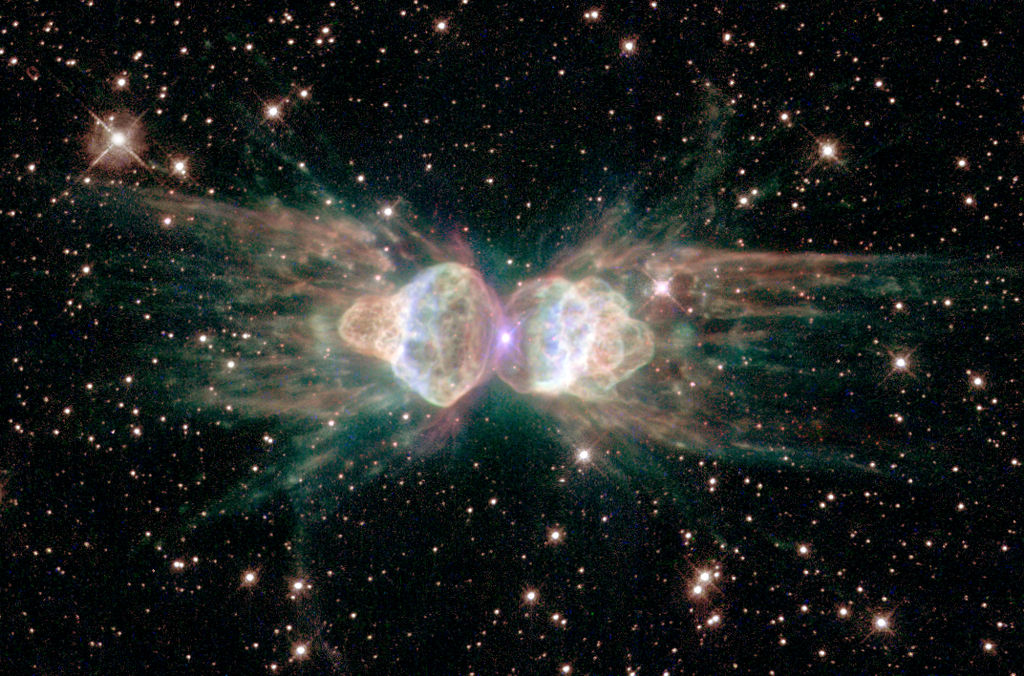
Mz 3 (Menzel 3) is a young bipolar planetary nebula (PN) in the constellation Norma that is composed of a bright core and four distinct high-velocity outflows that have been named lobes, columns, rays, and chakram. These nebulosities are described as: two spherical bipolar lobes, two outer large filamentary hour-glass shaped columns, two cone shaped rays, and a planar radially expanding, elliptically shaped chakram.
Mz 3 is a complex system composed of three nested pairs of bipolar lobes and an equatorial ellipse. Its lobes all share the same axis of symmetry but each have very different morphologies and opening angles. It is an unusual PN in that it is believed, by some researchers, to contain a symbiotic binary at its center. One study suggests that the dense nebular gas at its center may have originated from a source different from that of its extended lobes. The working model to explain this hypothesizes that this PN is composed of a giant companion that caused a central dense gas region to form, and a white dwarf that provides ionizing photons for the PN. Mz 3 is often referred to as the Ant Nebula because it resembles the head and thorax of a garden-variety ant.
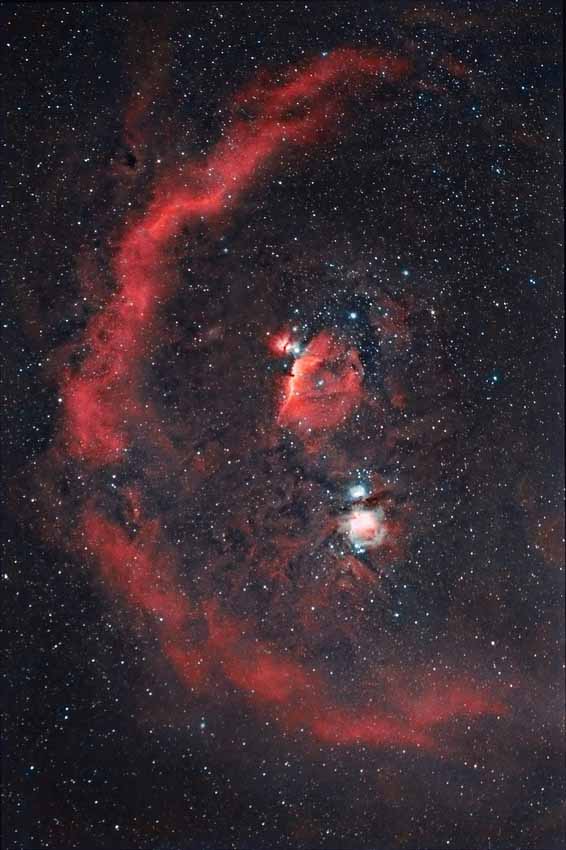
Barnard's Loop (catalogue designation Sh 2-276) is an emission nebula in the constellation of Orion. It is part of the Orion molecular cloud complex which also contains the dark Horsehead and bright Orion nebulae. The loop takes the form of a large arc centered approximately on the Orion Nebula. The stars within the Orion Nebula are believed to be responsible for ionizing the loop.
The loop extends over about 600 arcminutes as seen from Earth, covering much of Orion. It is well seen in long-exposure photographs, although observers under very dark skies may be able to see it with the naked eye.
Recent estimates place it at a distance of either 159 pc (518 light years) or 440 pc (1434 ly) giving it dimensions of either about 100 or 300 ly across respectively. It is thought to have originated in a supernova explosion about 2 million years ago, which may have also created several known runaway stars, including AE Aurigae, Mu Columbae and 53 Arietis, which are believed to have been part of a multiple star system in which one component exploded as a supernova.
Although this faint nebula was certainly observed by earlier astronomers, it is named after the pioneering astrophotographer E. E. Barnard who photographed it and published a description in 1894.
The Boomerang Nebula is believed to be a star system evolving toward the planetary nebula phase. It continues to form and develop due to the outflow of gas from its core where a star in its late stage life sheds mass and emits starlight illuminating dust in the nebula. Millimeter scale dust grains mask portions of the nebula's center so most escaping visible light is in two opposing lobes forming a distinctive hourglass shape as viewed from Earth. The outflowing gas is moving outwards at a speed of about 164 km/s and expanding rapidly as it moves out into space; this gas expansion results in the nebula's unusually low temperature.
Keith Taylor and Mike Scarrott called it the "Boomerang Nebula" in 1980 after observing it with the Anglo-Australian telescope at the Siding Spring Observatory. Unable to view it with great clarity, the astronomers saw merely a slight asymmetry in the nebula's lobes suggesting a curved shape like a boomerang. The nebula was photographed in detail by the Hubble Space Telescope in 1998 revealing a more symmetric hourglass shape.
In 1995, using the 15-metre Swedish-ESO Submillimetre Telescope in Chile, astronomers revealed that it is the coldest place in the Universe found so far, besides laboratory-created temperatures. With a temperature of -272 °C, it is only 1°C warmer than absolute zero (the lowest limit for all temperatures). Even the -270 °C background glow from the Big Bang is warmer than the nebula. It is the only object found so far that has a temperature lower than the background radiation.
In 2013, observations of the ALMA radio interferometer revealed other features of the Boomerang Nebula. The visible double lobe of the Boomerang Nebula was observed to be surrounded by a larger spherical volume of cold gas seen only in sub-millimeter radio wavelengths. The nebula's outer fringes appear to be gradually warming.
As of mid-2017, it is believed that the star at the center of the nebula is a dying red giant.
James Webb Space Telescope Reveals an Eerie Nebula That Looks Like a Giant Brain SciTech Daily - March 12, 2026
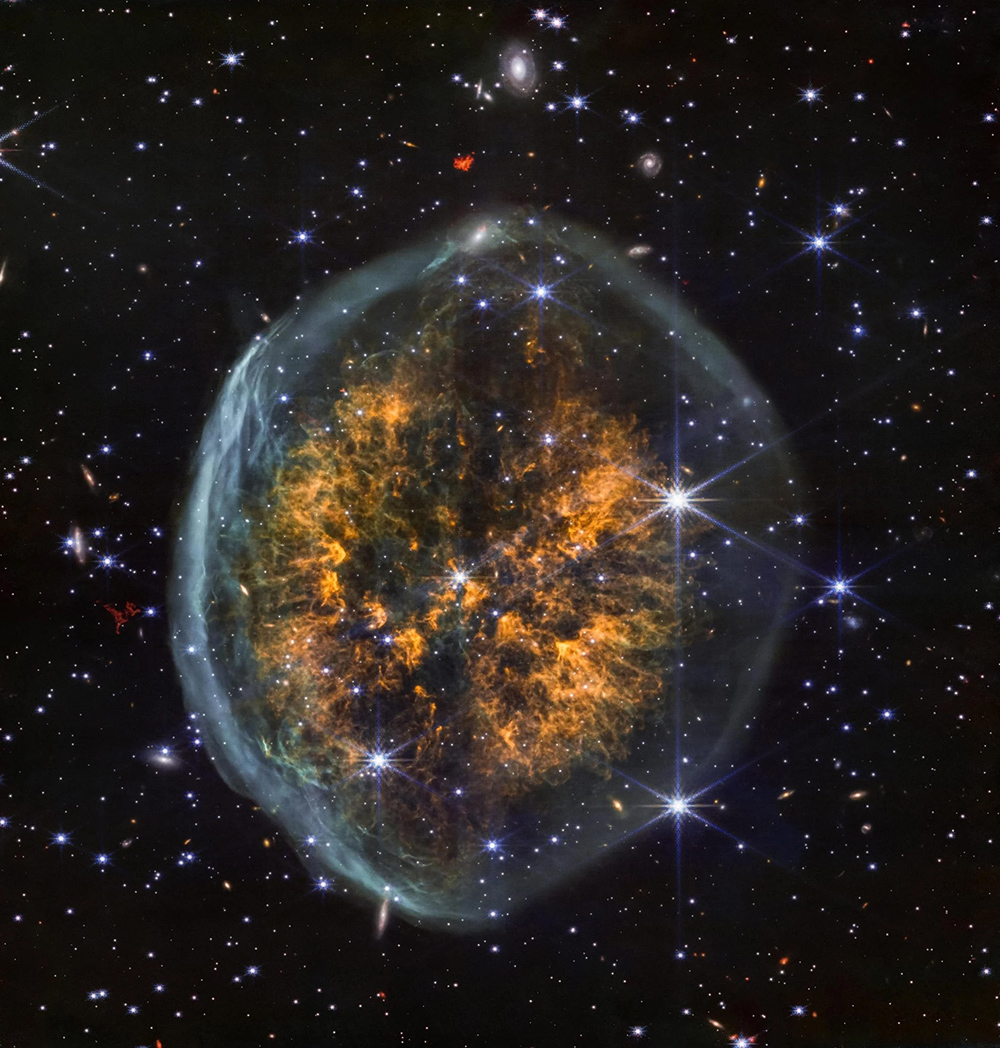
Webb has captured the haunting "Exposed Cranium" nebula - an otherworldly cloud shaped by a dying star that looks remarkably like a brain inside a skull. The detailed observations reveal complex structures within the cloud of gas and dust, offering a clearer view of how the object formed and how it continues to evolve.
Known as Nebula PMR 1, this cosmic cloud has an eerie appearance that resembles a brain inside a transparent skull. Because of this unusual shape, it has earned the nickname the "Exposed Cranium" nebula. Webb observed the object using both near-infrared and mid-infrared wavelengths, allowing scientists to see features that were previously hidden.
NGC 7635 is commonly known as the Bubble Nebula and is located approximately 11 thousand light-years distant in the constellation Cassiopeia. The nebula was formed by a very massive star designated BD +60°2522. This star is estimated to be about 40 times as massive as our Sun. Its huge energy emissions and prodigious stellar winds have blown a bubble of ionized gas approximately 6 to 10 light-years in diameter. This very active star is of a stellar class known as Wolf-Reyet stars. These stars are in the final stage of their lives and are rapidly expelling their outer layers in an extremely powerful and high velocity stellar wind that can exceed 1500 kilometers per second. When this wind rams into a surrounding interstellar gas cloud it creates an expanding shock front we observe as a ring or bubble. This process will continue until the star finally ends its violent life in a supernova explosion.
The image above is known as a mapped, or false, color image and was acquired using narrowband filters. It was assembled using the standard Hubble palette with SII mapped to Red, Ha mapped to Green and OIII mapped to Blue. The stars were overlaid with color data from a separate RGB image. This was accomplished in Photoshop with the purpose of displaying stars that approximate true colors.
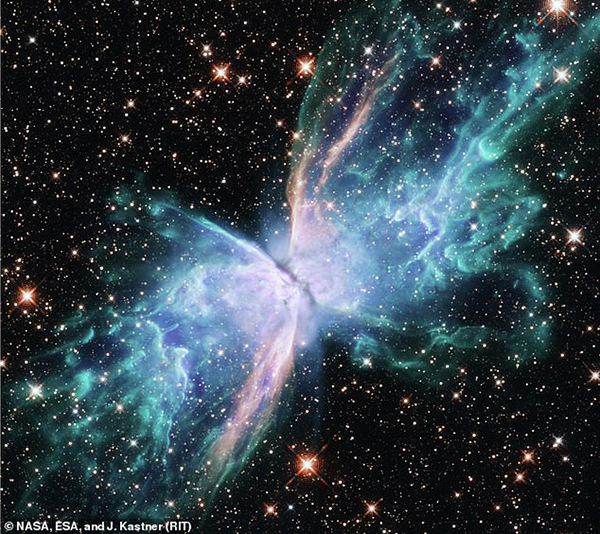
NGC 6302 (also known as the Bug Nebula, Butterfly Nebula, or Caldwell 69) is a bipolar planetary nebula in the constellation Scorpius. The structure in the nebula is among the most complex ever observed in planetary nebulae. The spectrum of NGC 6302 shows that its central star is one of the hottest stars known, with a surface temperature in excess of 250,000 degrees Celsius, implying that the star from which it formed must have been very large.
The central star, a white dwarf, was identified in 2009, using the upgraded Wide Field Camera 3 on board the Hubble Space Telescope. The star has a current mass of around 0.64 solar masses. It is surrounded by a dense equatorial disc composed of gas and dust. This dense disc is postulated to have caused the star's outflows to form a bipolar structure similar to an hourglass. This bipolar structure shows features such as ionization walls, knots and sharp edges to the lobes
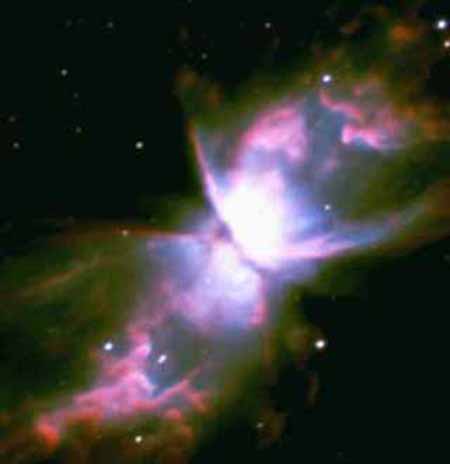
inkowski 2-9, abbreviated M2-9 (also known as Minkowski's Butterfly, Twin Jet Nebula, the Wings of a Butterfly Nebula, or just Butterfly Nebula) is a planetary nebula that was discovered by Rudolph Minkowski in 1947. It is located about 2,100 light-years away from Earth in the direction of the constellation Ophiuchus. This bipolar nebula takes the peculiar form of twin lobes of material that emanate from a central star. Astronomers have dubbed this object as the Twin Jet Nebula because of the jets believed to cause the shape of the lobes. Its form also resembles the wings of a butterfly. The nebula was imaged by the Hubble Space Telescope in the 1990s.
The nebula has inflated dramatically due to a fast stellar wind, blowing out into the surrounding disk and inflating the large, wispy hourglass-shaped wings perpendicular to the disk. These wings produce the butterfly appearance when seen in projection. The outer shell is estimated to be about 1,200 years old (Schwarz et al. 1997).
The California Nebula (NGC 1499/Sh2-220) is an emission nebula located in the constellation Perseus. Its name comes from its resemblance to the outline of the US State of California in long exposure photographs. It is almost 2.5° long on the sky and, because of its very low surface brightness.
JWST Reveals Cosmic Cliffs, Glittering Landscape of Star Birth
NASA - July 12, 2022
CNN: NASA releases first images from JWST
CNN - July 12, 2022
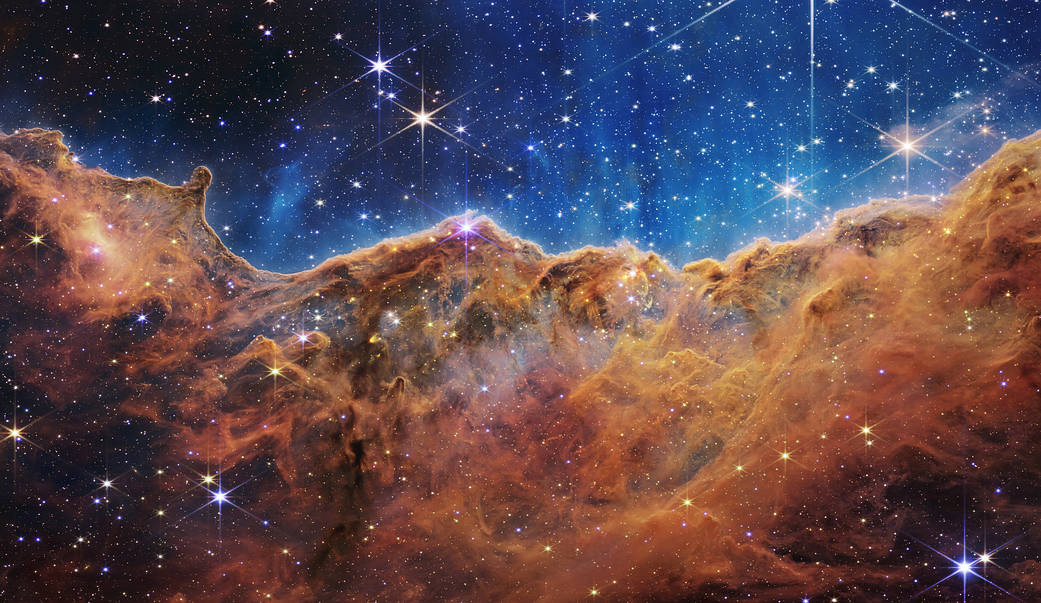
The Carina Nebula was a classic target of the Hubble telescope - Webb's predecessor - although in this Webb version we get a very different rendering. Carina is one of the largest and brightest nebulae in the sky, located roughly 7,600 light-years from Earth. Nebulae are stellar nurseries. They are a massive clouds of gas and dust in which new stars are forming. Except in this Webb image, we not only see the stars - our eyes are drawn to all that gas and the dust. Astronomers refer here to a "cosmic reef", or "cosmic cliff" - a kind of broad demarcation between dust in the bottom half, and then gas in the top half. One of Webb's key scientific goals is to study how stars form, and Carina is an excellent place to do
The Cat's Eye Nebula (also known as NGC 6543 and Caldwell 6) is a planetary nebula in the northern constellation of Draco, discovered by William Herschel on February 15, 1786. It was the first planetary nebula whose spectrum was investigated by the English amateur astronomer William Huggins, demonstrating that planetary nebulae were gaseous and not stellar in nature. Structurally, the object has had high-resolution images by the Hubble Space Telescope revealing knots, jets, bubbles and complex arcs, being illuminated by the central hot planetary nebula nucleus (PNN). It is a well-studied object that has been observed from radio to X-ray wavelengths.
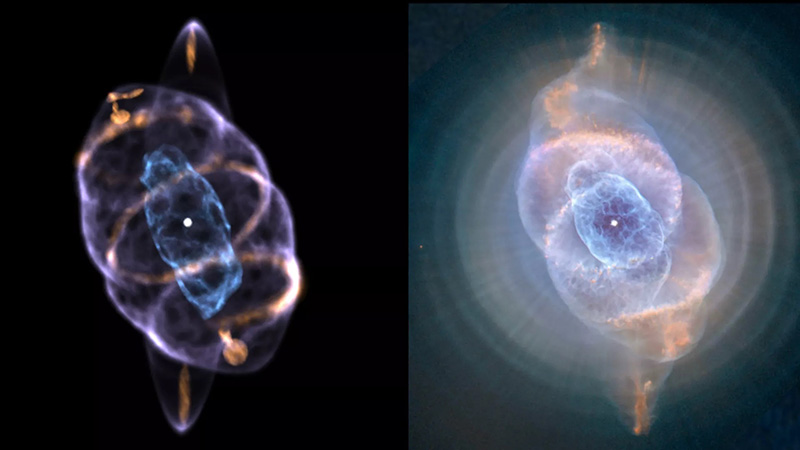
Astronomers discover secret star at the center of gorgeous Cat's Eye Nebula Live Science - September 25, 2022
A computer-generated map reveals a pair of perfectly symmetrical rings swirling around the entire length of the nebula's outer shell. According to the researchers, there's only one possible cause of these rings' symmetry: a double-barreled burst of energy known as a precessing jet. Basically, as the nebula's central star died, it released twin bursts of high-density gas in opposite directions at the same time, the study authors wrote. But rather than remaining fixed in place, the jets began to wobble (or precess) like a spinning top, leaving slowly looping rings of gas twirling above and below the star.
NGC 6334, colloquially known as the Cat's Paw Nebula, Bear Claw Nebula, or Gum 64, is an emission nebula and star-forming region located in the constellation Scorpius. NGC 6334 was discovered by astronomer John Herschel in 1837, who observed it from the Cape of Good Hope in South Africa. The nebula is located in the Carina–Sagittarius Arm of the Milky Way, at a distance of approximately 5.5 kilolight-years from the Sun. The nebula is a high mass filamentary cloud structure spanning ~320 ly. In the visible part of the spectrum, it emits mainly in red (from hydrogen atoms) and blue (from oxygen atoms). Several embedded star-forming regions have been identified from infrared and radio emissions.
IC 5146 (also Caldwell 19, Sh 2-125, Barnard 168, and the Cocoon Nebula) is a reflection/emission nebula and Caldwell object in the constellation Cygnus. The NGC description refers to IC 5146 as a cluster of 9.5 mag stars involved in a bright and dark nebula. The cluster is also known as Collinder 470.
The Cone Nebula is an H II region in the constellation of Monoceros. It was discovered by William Herschel on December 26, 1785, at which time he designated it H V.27. The nebula is located about 830 parsecs or 2,700 light-years from Earth. The Cone Nebula forms part of the nebulosity surrounding the Christmas Tree Cluster. The designation of NGC 2264 in the New General Catalogue refers to both objects and not the nebula alone.
The Crab Nebula (catalogue designations M1, NGC 1952, Taurus A) is a supernova remnant and pulsar wind nebula in the constellation of Taurus. The common name comes from a drawing that somewhat resembled a crab with arms produced by William Parsons, 3rd Earl of Rosse, in 1842 or 1843 using a 36-inch (91 cm) telescope. The nebula was discovered by English astronomer John Bevis in 1731. It corresponds with a bright supernova observed in AD 1054 by Mayan, Japanese, and Arab stargazers; this supernova was also recorded by Chinese astronomers as a guest star. The nebula was the first astronomical object identified that corresponds with a historically-observed supernova explosion.
The Crescent Nebula (also known as NGC 6888, Caldwell 27, Sharpless 105) is an emission nebula in the constellation Cygnus, about 5000 light-years away from Earth. It was discovered by William Herschel in 1792. It is formed by the fast stellar wind from the Wolf-Rayet star WR 136 (HD 192163) colliding with and energizing the slower moving wind ejected by the star when it became a red giant around 250,000 years ago. The result of the collision is a shell and two shock waves, one moving outward and one moving inward. The inward moving shock wave heats the stellar wind to X-ray-emitting temperatures.

James Webb telescope reveals hidden past of the 'Crystal Ball Nebula' Live Science - April 21, 2025
Crystal Ball Nebula aka NGC 1514 is a planetary nebula in the zodiac constellation of Taurus, positioned to the north of the star Psi Tauri along the constellation border with Perseus. It was discovered by William Herschel on November 13, 1790, describing it as "a most singular phenomenon" and forcing him to rethink his ideas on the construction of the heavens.
How a dying star created the Crystal Ball Nebula PhysOrg - May 25, 2026
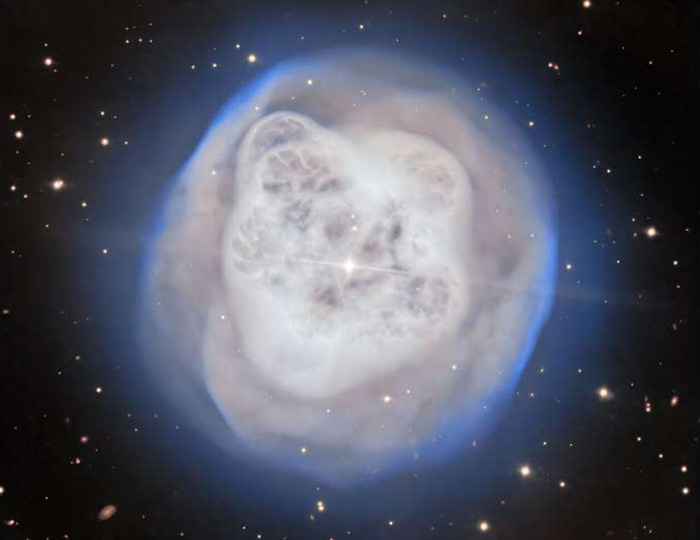
Planetary nebulae like the Crystal Ball Nebula (NGC 1514) are sort of like stellar obituaries. Though crystal balls supposedly reveal the future, the Crystal Ball Nebula tells us more about the past. It shows us how a binary pair of stars met their end. And since NGC 1514 is 1,500 light years away, we're seeing what it looked like 1,500 years ago. Planetary nebulae have nothing to do with planets. They just looked like planets in early telescopes, and astronomer William Herschel, who discovered the Crystal Ball Nebula, is the one who coined the term.
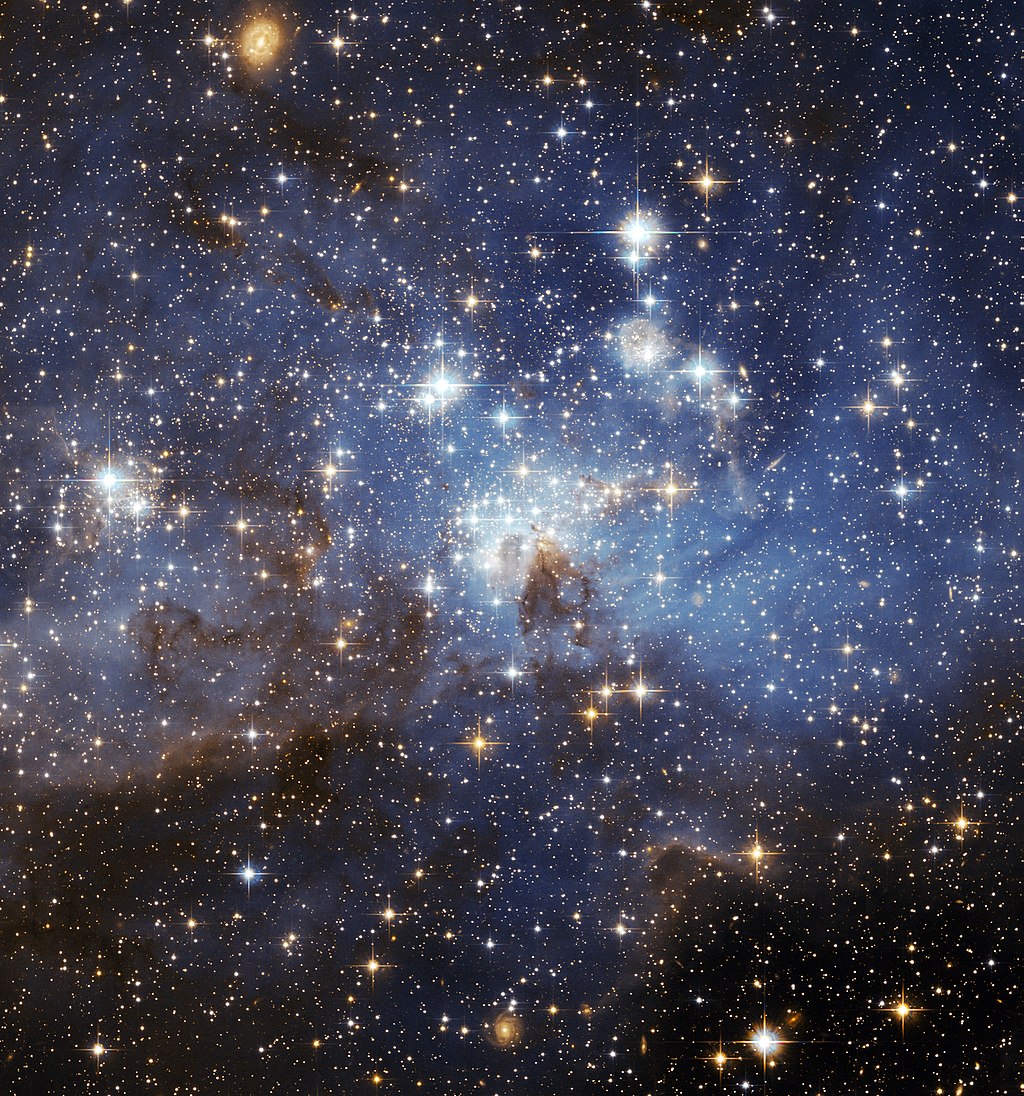
Dark nebulae are clouds of dust which are simply blocking the light from whatever is behind. They are physically very similar to reflection nebulae; they look different only because of the geometry of the light source, the cloud and the Earth. Dark nebulae are also often seen in conjunction with reflection and emission nebulae. A typical diffuse nebula is a few hundred light-years across.
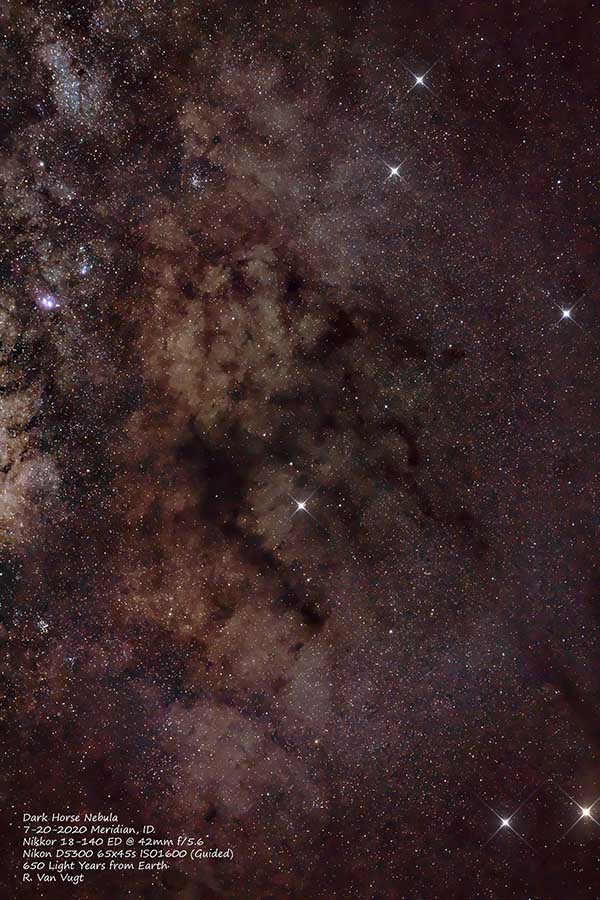
The Dark Horse Nebula or Great Dark Horse (sometimes called the Prancing Horse) is a large dark nebula that, from Earth's perspective, obscures part of the upper central bulge of the Milky Way. The Dark Horse lies in the equatorial constellation Ophiuchus (the Serpent Bearer), near its borders with the more famous constellations Scorpius and Sagittarius. It is a large, visible feature of the Milky Way's Great Rift, uniting several individually catalogued dark nebulae, including the Pipe Nebula. It is visible from Earth only on clear moonless nights without light pollution and with low humidity.
Most nebulae can be described as diffuse nebulae, which means that they are extended and contain no well-defined boundaries. In astronomy, diffuse nebulae is the general term for illuminated nebulae. The three types of diffuse nebulae are reflection nebulae, emission nebulae and supernova remnants. They are diffuse as opposed to the non-diffuse dark nebulae, i.e. the particles have spread out.
In visible light these nebulae may be divided into emission nebulae and reflection nebulae, a categorization that depends on how the light we see is created. Emission nebulae contain ionized gas (mostly ionized hydrogen) that produces spectral line emission. These emission nebulae are often called HII regions; the term "HII" is used in professional astronomy to refer to ionized hydrogen. In contrast to emission nebulae, reflection nebulae do not produce significant amounts of visible light by themselves but instead reflect light from nearby stars.
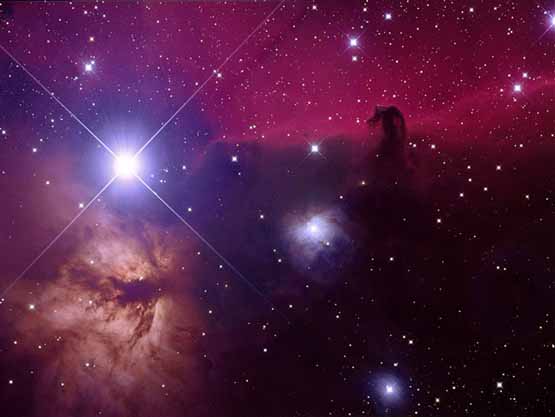
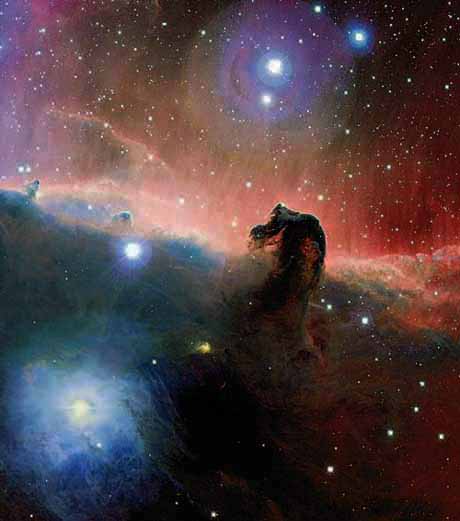
The Horsehead Nebula, an example of a dark nebula. Dark nebulae are similar to diffuse nebulae, but they are not seen by their emitted or reflected light. Instead, they are seen as dark clouds in front of more distant stars or in front of emission nebulae. Although these nebulae appear different at optical wavelengths, they all appear to be bright sources of emission at infrared wavelengths. This emission comes primarily from the dust within the nebulae.
The Dumbbell Nebula (also known as the Apple Core Nebula, Messier 27, and NGC 6853) is a planetary nebula (nebulosity surrounding a white dwarf) in the constellation Vulpecula, at a distance of about 1360 light-years. It was the first such nebula to be discovered, by Charles Messier in 1764. At its brightness of visual magnitude 7.5 and diameter of about 8 arcminutes, it is easily visible in binoculars and is a popular observing target in amateur telescopes. It appears shaped like a prolate spheroid and is viewed from our perspective along the plane of its equator. In 1992, Moreno-Corral et al. computed that its rate of expansion angularly was, viewed from our distance, no more than 2.3 arcseconds per century.
The Eagle Nebula (catalogued as Messier 16 or M16, and as NGC 6611, and also known as the Star Queen Nebula) is a young open cluster of stars in the constellation Serpens, discovered by Jean-Philippe de Cheseaux in 1745–46. Both the "Eagle" and the "Star Queen" refer to visual impressions of the dark silhouette near the center of the nebula, an area made famous as the "Pillars of Creation" imaged by the Hubble Space Telescope. The nebula contains several active star-forming gas and dust regions, including the aforementioned Pillars of Creation. The Eagle Nebula lies in the Sagittarius Arm of the Milky Way.
The Egg Nebula (also known as RAFGL 2688 and CRL 2688) is a bipolar protoplanetary nebula approximately 3,000 light-years away from Earth. Its peculiar properties were first described in 1975 using data from the 11 μm survey obtained with sounding rocket by Air Force Geophysical Laboratory (AFGL) in 1971 to 1974. (Previously, the object was catalogued by Fritz Zwicky as a pair of galaxies.)
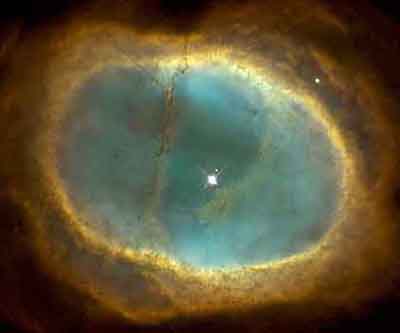
NGC 3132 (also known as the Eight-Burst Nebula, the Southern Ring Nebula, or Caldwell 74) is a bright and extensively studied planetary nebula in the constellation Vela. Its distance from Earth is estimated at 613 pc or 2,000 light-years. From Earth, it appears to have a strongly elliptical shape. Three-dimensional modeling of the nebula has found that NGC 3132 is a bipolar nebula, with its major axis inclined about twenty degrees from the line of sight. The central low-density cavity is surrounded by multiple ring-like structures. The Southern Ring Nebula was selected as one of the five cosmic objects observed by the James Webb Space Telescope as part of the release of its first official science images on July 12, 2022.
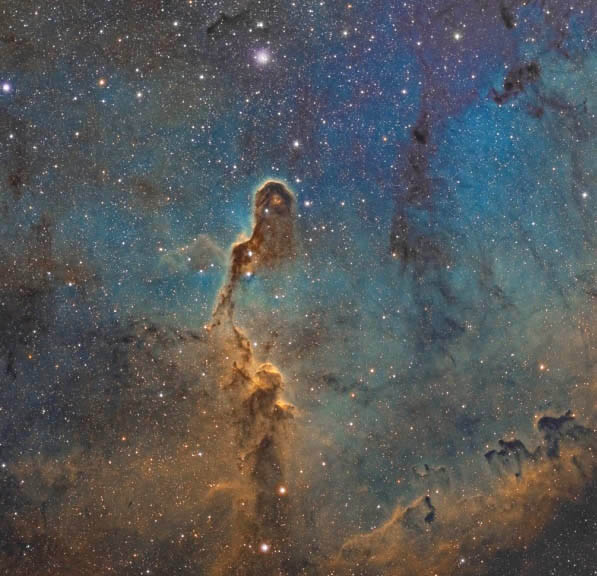
The Elephant's Trunk Nebula (IC 1396A) is a concentration of interstellar gas and dust within the much larger ionized gas region IC 1396 located in the constellation Cepheus about 2,400 light years away from Earth. The nebula is a dark, dense globule that gets its name from its appearance at visible light wavelengths, where there is a dark patch with a bright, sinuous rim. The bright rim is the surface of the dense cloud that is being illuminated and ionized by a very bright, massive multiple star (HD 206267) that is just to the east of the Elephant's Trunk Nebula . The entire IC 1396 region is ionized by the massive star, except for dense globules that can protect themselves from the star's harsh ultraviolet rays.
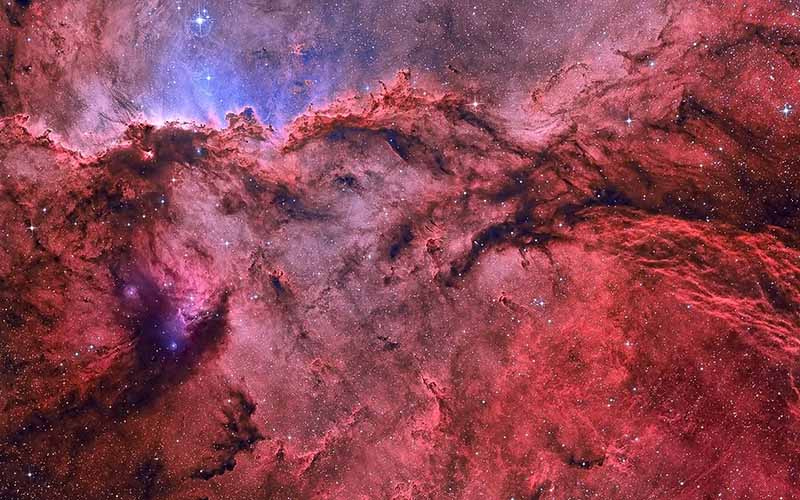
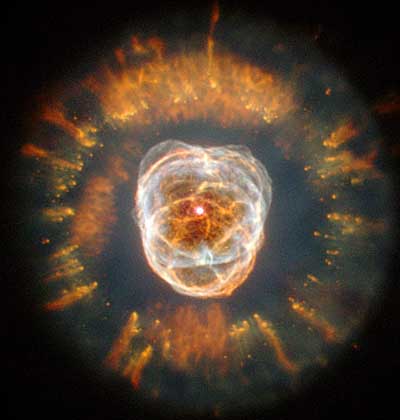
An emission nebula is a nebula formed of ionized gases that emit light of various wavelengths. The most common source of ionization is high-energy ultraviolet photons emitted from a nearby hot star. Among the several different types of emission nebulae are H II regions, in which star formation is taking place and young, massive stars are the source of the ionizing photons; and planetary nebulae, in which a dying star has thrown off its outer layers, with the exposed hot core then ionizing them
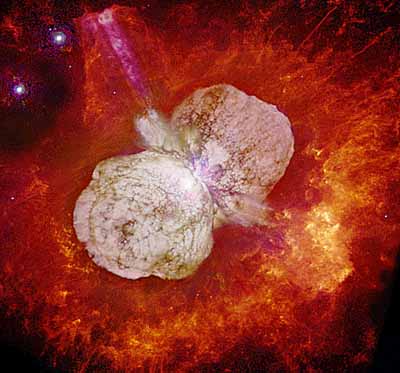
The Carina Nebula or Eta Carinae Nebula (catalogued as NGC 3372; also known as the Great Carina Nebula) is a large, complex area of bright and dark nebulosity in the constellation Carina, located in the Carina–Sagittarius Arm of the Milky Way galaxy. The nebula is approximately 8,500 light-years (2,600 pc) from Earth.
The nebula has within its boundaries the large Carina OB1 association and several related open clusters, including numerous O-type stars and several Wolf–Rayet stars. Carina OB1 encompasses the star clusters Trumpler 14 and Trumpler 16. Trumpler 14 is one of the youngest known star clusters at half a million years old and contains stars like the O2 supergiant HD 93129A. Trumpler 16 is the home of many extremely luminous stars, such as WR 25 and the Eta Carinae star system. Trumpler 15, Collinder 228, Collinder 232, NGC 3324, and NGC 3293 are also considered members of the association. NGC 3293 is the oldest and furthest from Trumpler 14, indicating sequential and ongoing star formation.
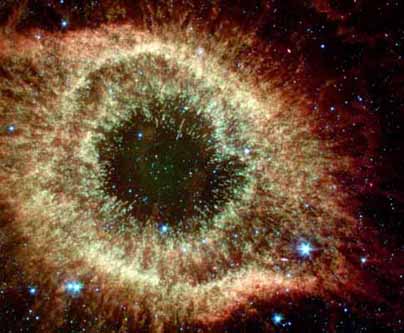
The Cat's Eye Nebula (also known as NGC 6543 and Caldwell 6) was a planetary nebula in the northern constellation of Draco, discovered by William Herschel on February 15, 1786. It was the first planetary nebula whose spectrum was investigated by the English amateur astronomer William Huggins, demonstrating that planetary nebulae were gaseous and not stellar in nature. Structurally, the object has had high-resolution images by the Hubble Space Telescope revealing knots, jets, bubbles and complex arcs, being illuminated by the central hot planetary nebula nucleus (PNN). It is a well-studied object that has been observed from radio to X-ray wavelengths. At the centre of the Cat's Eye Nebula is a dying Wolf–Rayet star, the sort of which can be seen in the Webb Telescope's image of WR 124. The Cat's Eye Nebula's central star shines at magnitude +11.4. Hubble Space Telescope images show a sort of dart board pattern of concentric rings emanating outwards from the centre.
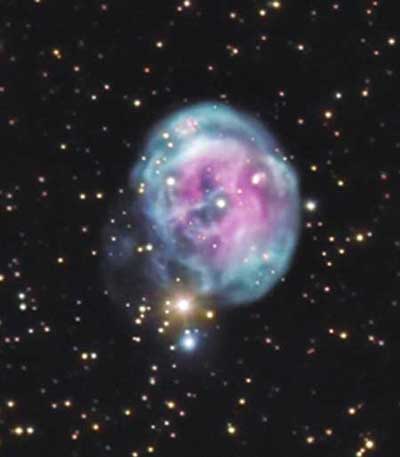
NGC 7008 (PK 93+5.2), also known as the Fetus Nebula, is a planetary nebula with a diameter of approximately 1 light-year located at a distance of 2800 light years in northern Cygnus. It was discovered by William Herschel in 1787, in Slough, England. NGC 7008 (H I-192) is included in the Astronomical League's Herschel 400 observing program. NGC 7008 is that its intricate and delicate structures make it a fascinating target for both amateur and professional astronomers studying the late stages of stellar evolution and the formation of planetary nebulae.
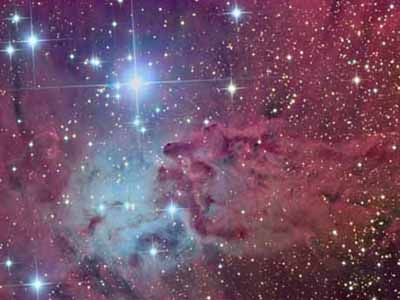
The Fox Fur Nebula is a nebula (a formation of gas and dust) located in the constellation of Monoceros (the Unicorn) not far off the right arm of Orion and included in the NGC 2264 Region. In the Sharpless catalog it is number 273. The image is a close-up of a small section of a much larger complex, generally known as the Christmas Tree cluster. The Cone Nebula is also a part of this same cloud.
The red regions of this nebula are caused by hydrogen gas that has been stimulated to emit its own light by the copious ultraviolet radiation coming from the hot, blue stars of the cluster. The blue areas shine by a different process: they are mainly dust clouds that reflect the bluish light of the same stars. Its popular name arises because the nebula looks like the head of a stole made from the fur of a red fox.
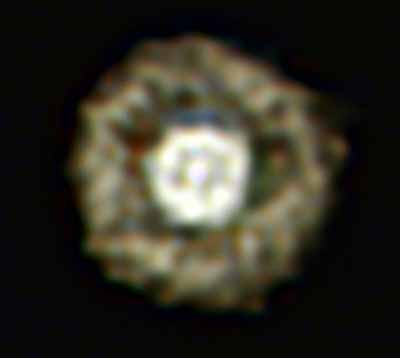
IRAS 17163-3907, also known as Hen 3-1379, is a yellow hypergiant star located 13,000 light years from Earth in the constellation of Scorpius. The star is embedded in thick shells of expelled gases and dust, and owing to its appearance has been nicknamed by astronomers the "Fried Egg Nebula". Yellow hypergiants are in an extremely active phase of their evolution.
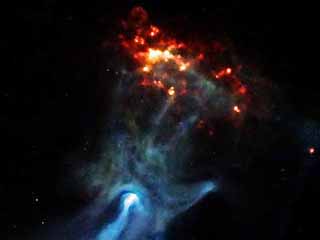
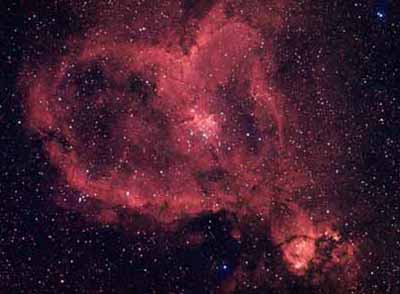
The Heart Nebula (also known as the Running Dog Nebula, Sharpless 2-190) is an emission nebula, 7,500 light-years (2,300 pc) away from Earth and located in the Perseus Arm of the Galaxy in the constellation Cassiopeia. It was discovered by William Herschel on 3 November 1787. In 1958, it was identified as a radio source by Gart Westerhout and is therefore also referred to as Westerhout 4 (or W4) It displays glowing ionized hydrogen gas and darker dust lanes.
The brightest part of the nebula (a knot at its western edge) is separately classified as NGC 896, because it was the first part of the nebula to be discovered. The nebula's intense red output and its morphology are driven by the radiation emanating from a small group of hot stars near the nebula's center. This open cluster of stars, known as Collinder 26, Melotte 15, or IC 1805, contains a few bright stars nearly 50 times the mass of the Sun, and many more dim stars that are only a fraction of the Solar mass.
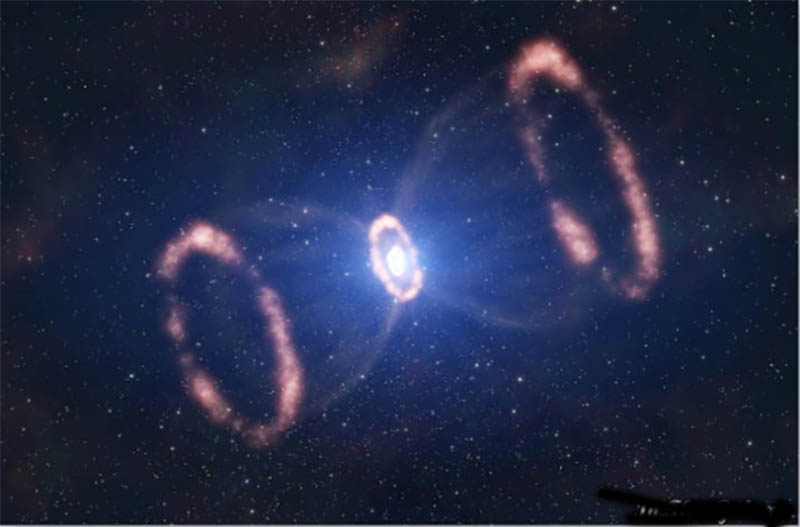
Cosmic hourglass captured by the James Webb Space Telescope reveals birth of a star
CNN - November 17, 2022
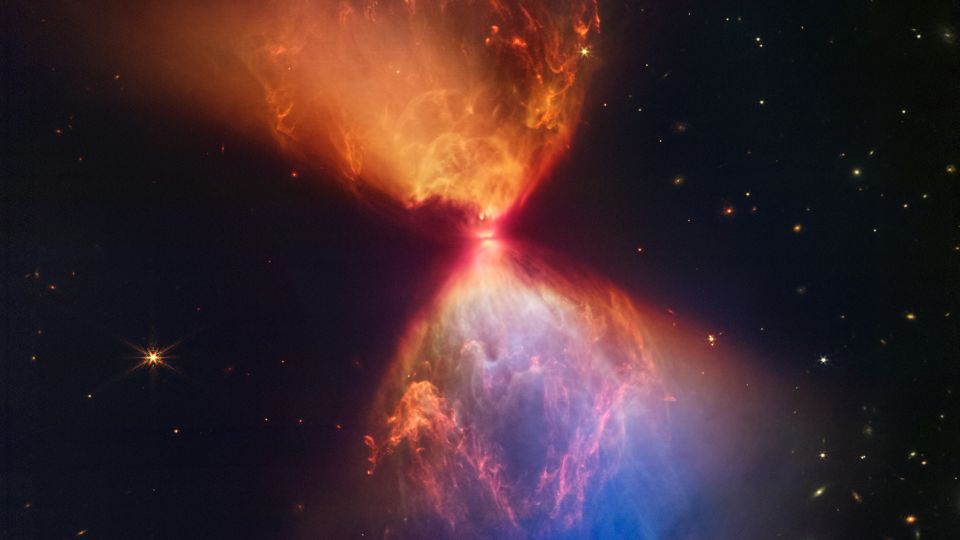
Baby Star's Dramatic Eruptions Seen In Celestial Hourglass Nebula
IFL Science - July 3, 2024

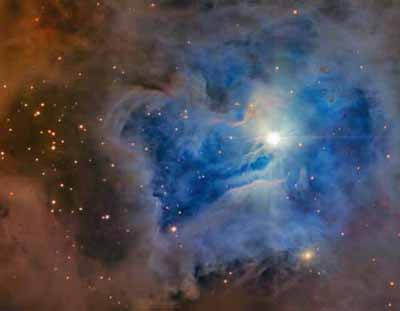
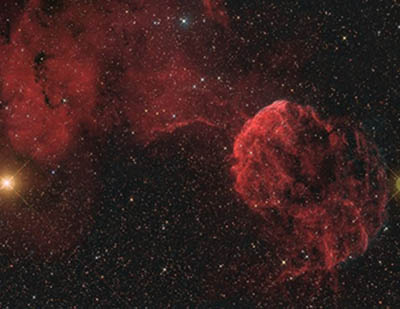
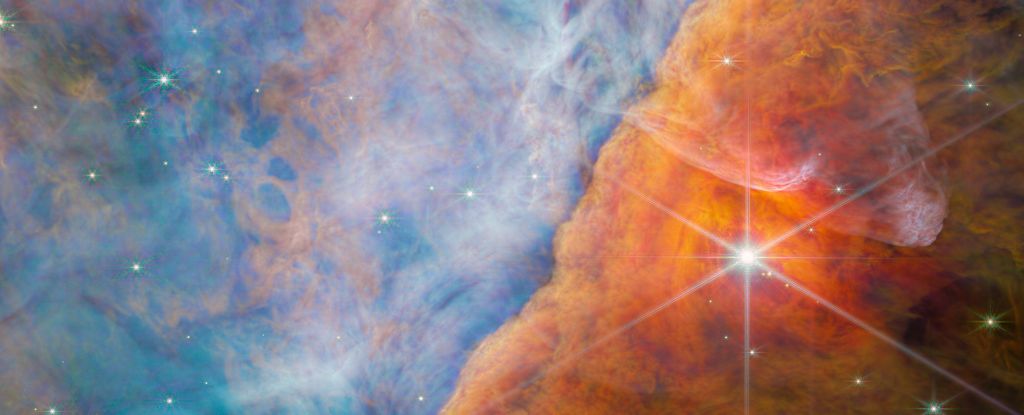
JWST Discovers Crucial Carbon Molecule in The Orion Nebula
Science Alert - June 27, 2023
Hubble's Closeup of The Orion Nebula Looks Like a Surreal Dreamscape
Science Alert - August 14, 2022
When it comes to dramatic and awe-inspiring pictures of space, few can contend with what appears to be a pic of, well, nothing at all: a fascinating image of what seems to be a hole in the fabric of space, taken by the NASA/ESA Hubble Space Telescope Science Alert - October 27, 2022
Described as a "cosmic keyhole" by experts, the phenomenon caught by the telescope is what's known as a reflection nebula - part of the debris left behind by the formation of a newborn star, or in this case, a small, multiple star system known as V380 Orionis in the constellation Orion.
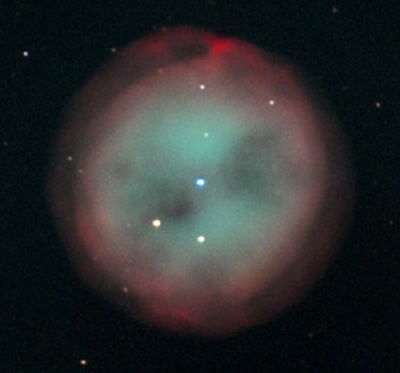
The Owl Nebula (also known as Messier 97, M97 or NGC 3587) is a planetary nebula approximately 2,030 light years away in the constellation Ursa Major. Estimated to be about 8,000 years old, it is approximately circular in cross-section with a faint internal structure. It was formed from the outflow of material from the stellar wind of the central star as it evolved along the asymptotic giant branch. The nebula is arranged in three concentric shells, with the outermost shell being about 20–30% larger than the inner shell. The owl-like appearance of the nebula is the result of an inner shell that is not circularly symmetric, but instead forms a barrel-like structure aligned at an angle of 45° to the line of sight.
The Owl Nebula was discovered by French astronomer Pierre Méchain on February 16, 1781. Pierre Méchain was Charles Messier's observing colleague, and the nebula was observed by Messier himself a few weeks following the initial sighting.Thus, the object was named Messier 97, and included in his catalog on March 24, 1781.
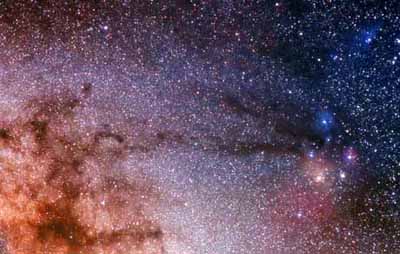
The Pipe Nebula (also known as Barnard 59, 65-67, and 78) is a dark nebula in the Ophiuchus constellation and a part of the Dark Horse Nebula. It is a large but readily apparent smoking pipe-shaped dust lane that obscures the Milky Way star clouds behind it. Clearly visible to the naked eye in the Southern United States under clear dark skies, but it is best viewed with 7× binoculars.
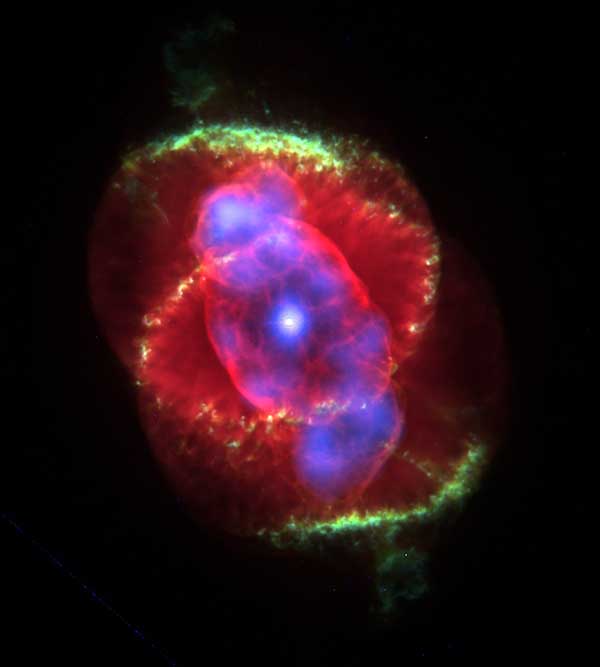
Planetary nebulae are nebulae that form from the gaseous shells that are ejected from low-mass asymptotic giant branch stars when they transform into white dwarfs. These nebulae are emission nebulae with spectral emission that is similar to the emission nebulae found in star formation regions. Technically, they are a type of HII region because the majority of hydrogen will be ionized. However, planetary nebulae are denser and more compact than the emission nebulae in star formation regions. Planetary nebulae are so called because the first astronomers who observed these objects thought that the nebulae resembled the disks of planets, although they are not at all related to planets.
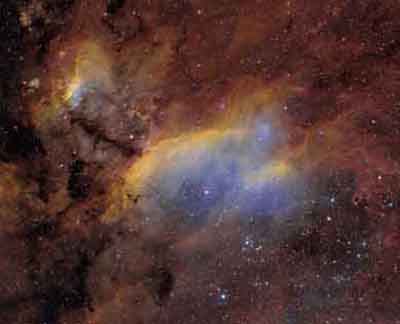
The Red Square Nebula is a celestial object located in the area of the sky occupied by star MWC 922 in the constellation Serpens. The first images of this bipolar nebula, taken using the Palomar Observatory Hale Telescope in California, were released in April 2007. It is notable for its square shape, which according to Sydney University astrophysicist Peter Tuthill, makes it one of the most nearly discrete-symmetrical celestial objects ever imaged.
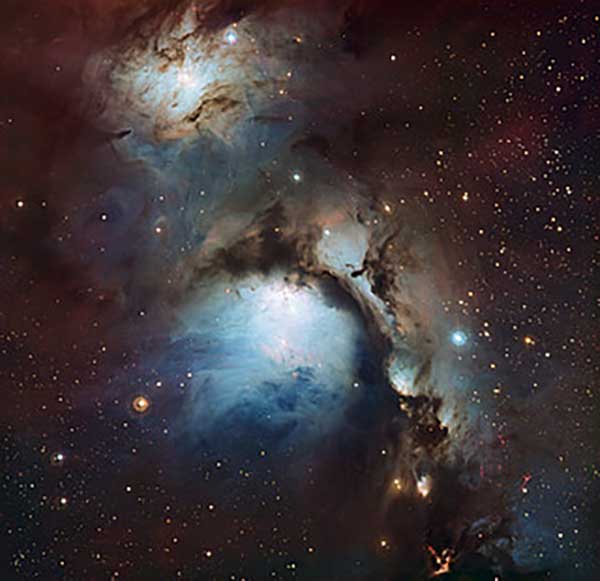
In Astronomy, reflection nebulae are clouds of dust which are simply reflecting the light of a nearby star or stars. The energy from the nearby star, or stars, is insufficient to ionize the gas of the nebula to create an emission nebulae, but is enough to give sufficient scattering to make the dust visible. Thus, the frequency spectrum shown by reflection nebulae is similar to that of the illuminating stars. Among the microscopic particles responsible for the scattering are carbon compounds (e. g. diamond dust) and compounds of other elements such as iron and nickel. The latter two are often aligned with the galactic magnetic field and cause the scattered light to be slightly polarized (Kaler, 1998). Edwin Hubble distinguished between the emission and reflection nebulae in 1922. Reflection nebulae are usually blue because the scattering is more efficient for blue light than red (this is the same scattering process that gives us blue skies and red sunsets).
Ring Nebula: A Dying Star Beams In The Depths Of Space In JWST's New Image
IFL Science - August 21, 2023
The Ring Nebula is a planetary nebula in the northern constellation of Lyra, about mid-way between the prominent stars Beta and Gamma Lyrae. It is also catalogued as Messier 57, M57 and NGC 6720. The nebula was discovered by Charles Messier in 1779. It has an apparent visual magnitude of 8.8, which is too faint to be visible with the naked eye, but it can be readily observed with a small telescope. This nebula was discovered by the French astronomer Charles Messier while searching for comets in late January 1779. Messier's report of his independent discovery of Comet Bode reached fellow French astronomer Antoine Darquier de Pellepoix two weeks later, who then independently rediscovered the nebula while following the comet.
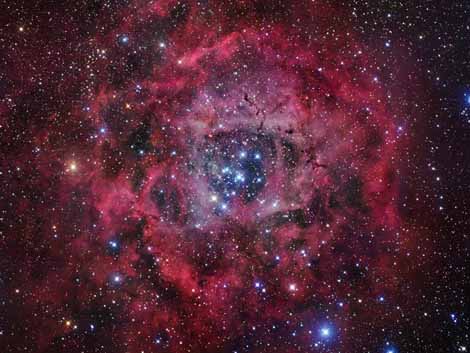
The Rosette Nebula (also known as Caldwell 49) is an H II region located near one end of a giant molecular cloud in the Monoceros region of the Milky Way Galaxy. The open cluster NGC 2244 (Caldwell 50) is closely associated with the nebulosity, the stars of the cluster having been formed from the nebula's matter. The nebula has a shape reminiscent of a human skull, and is sometimes referred to as the "Skull Nebula". It is not to be confused with NGC 246, which is also nicknamed the "Skull Nebula". The Little Rosette Nebula, or Sharpless 2-170, is a less known nebula named for the Rosette Nebula
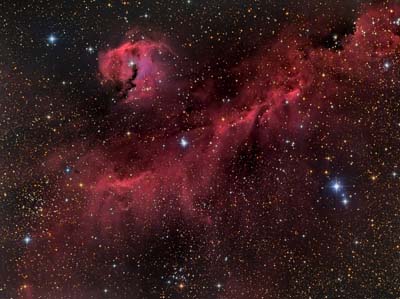
IC 2177 is a region of nebulosity that lies along the border between the constellations Monoceros and Canis Major. It is a roughly circular H II region centered on the Be star HD 53367. This nebula was discovered by Welsh amateur astronomer Isaac Roberts and was described by him as "pretty bright, extremely large, irregularly round, very diffuse."
The name Seagull Nebula is sometimes applied by amateur astronomers to this emission region, although it more properly includes the neighboring regions of star clusters, dust clouds and reflection nebulae. This latter region includes the open clusters NGC 2335 and NGC 2343. IC 2177 is also known as the Seagull's Head, due to its larger presence in the Seagull nebula. The nebula Gum 2, also known as Sh 2-296, forms the Seagull's wings.
The Snake Nebula (also known as Barnard 72) is a dark nebula in the Ophiuchus constellation. It is a small but readily apparent SP-shaped dust lane that snakes out in front of the Milky Way star clouds from the north-north-west edge of the bowl of the Pipe Nebula. Its thickness runs between 2' and 3' and runs around 6' in the north-west / south-east orientation. A good view in a 4" to 6" telescope requires clear dark skies. It is part of the much larger Dark Horse Nebula.
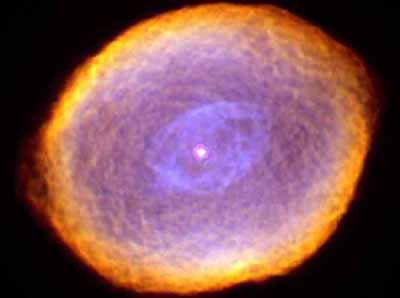
IC 418, also known as the Spirograph Nebula, is a bright planetary nebula located in the constellation of Lepus about 3,600 ly away from Earth. It spans 0.3 light-years across. The central star of the planetary nebula, HD 35914, is an O-type star with a spectral type of O7fp. The nebula formed a few thousand years ago during the star's last stages of its red giant phase. Material from the star's outer layers was ejected from the star into the surrounding space. The nebula's glow is caused by the central star's ultraviolet radiation interacting with the gas.
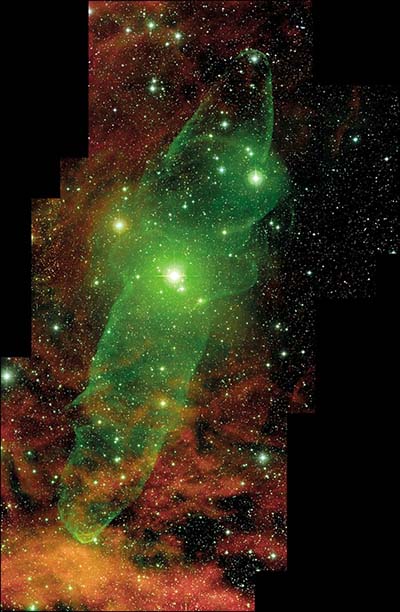
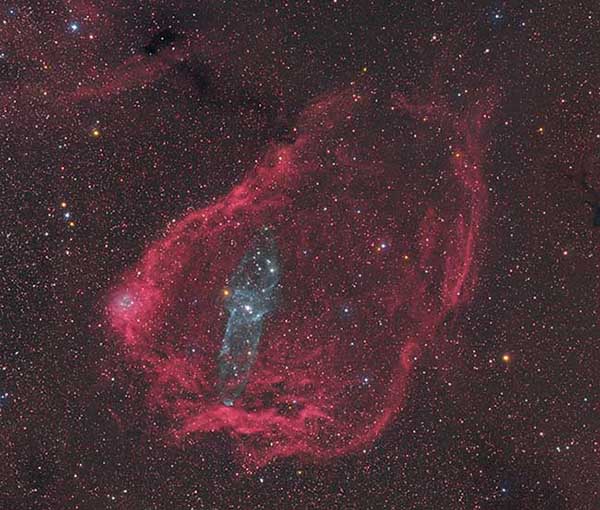
Sh 2-129 (also known as the Flying Bat Nebula), is a large emission nebula and H II region located in the constellation Cepheus. It is part of the Cepheus molecular cloud complex and belongs to the Cep OB2 association.Reflection nebula vdB 140 can be seen near Sh 2-129. Within Sh 2-129 lies a bipolar outflow nebula named Ou 4 (also known as Squid Nebula). The central star of Ou4 is believed to be the massive triple star system named HD 202214 (O9.5IV).
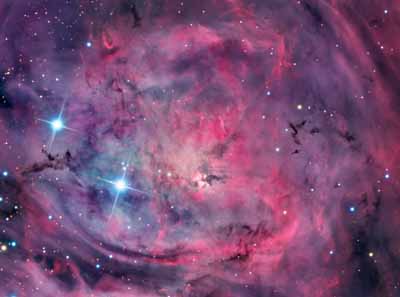
The Orion Nebula (also known as Messier 42, M42, or NGC 1976) is a diffuse nebula in the Milky Way situated south of Orion's Belt in the constellation of Orion,[b] and is known as the middle "star" in the "sword" of Orion. It is one of the brightest nebulae and is visible to the naked eye in the night sky with an apparent magnitude of 4.0. It is 1,267.0 ± 5.4 light-years (388.5 ± 1.7 pc) away and is the closest region of massive star formation to Earth. M42 is estimated to be 25 light-years across (so its apparent size from Earth is approximately 1 degree). It has a mass of about 2,000 times that of the Sun. Older texts frequently refer to the Orion Nebula as the Great Nebula in Orion or the Great Orion Nebula.
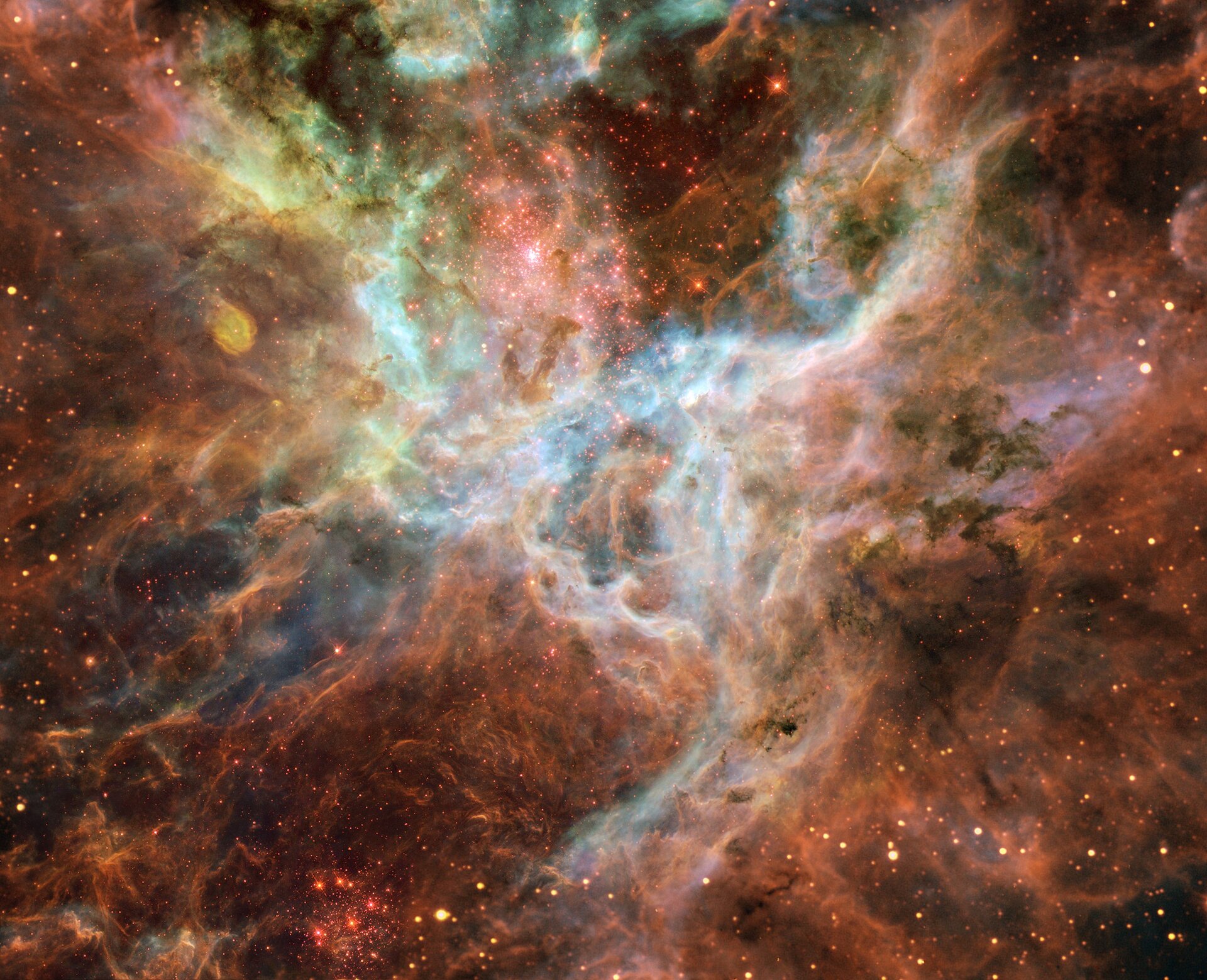
The Tarantula Nebula (also known as 30 Doradus) is a large H II region in the Large Magellanic Cloud (LMC), forming its south-east corner (from Earth's perspective).
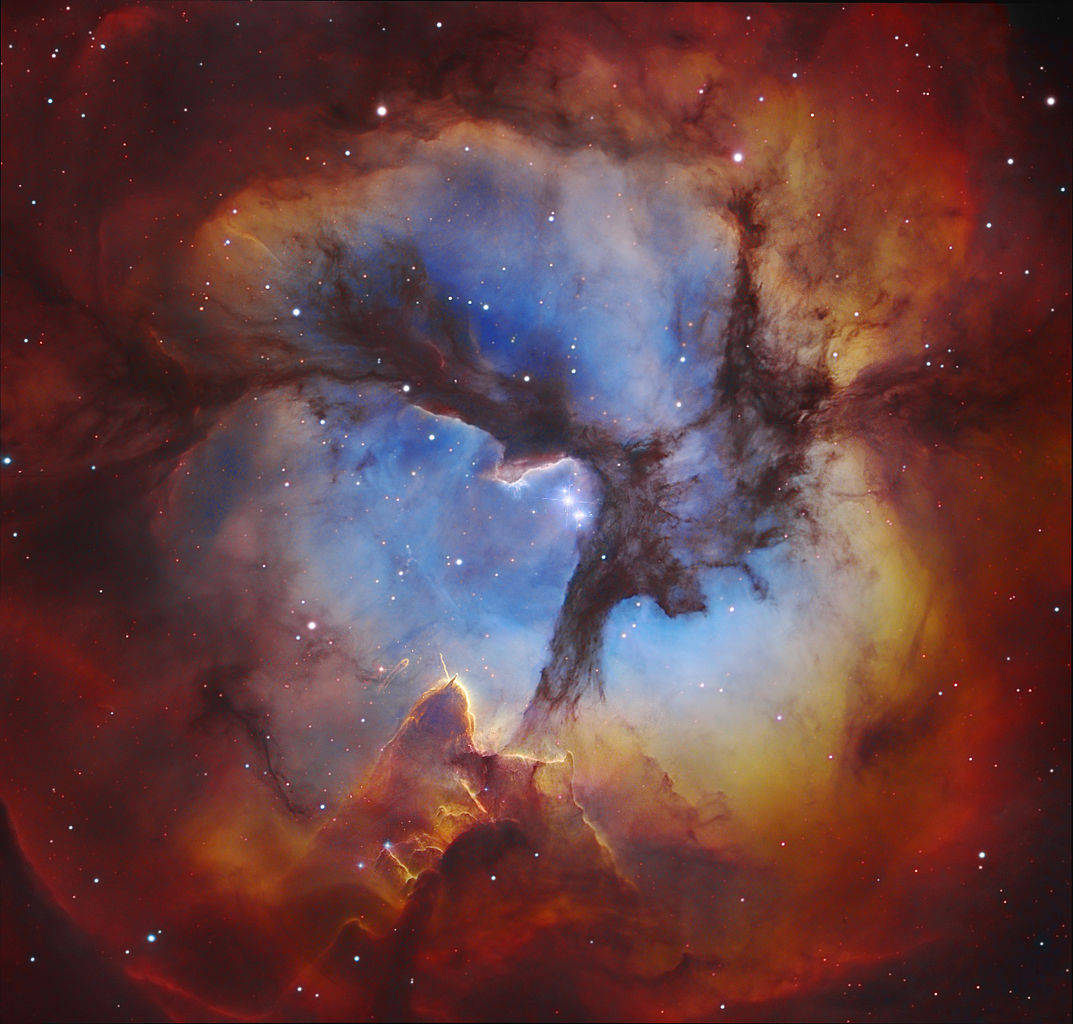
The Trifid Nebula (catalogued as Messier 20 or M20 and as NGC 6514) is an H II region in the north-west of Sagittarius in a star-forming region in the Milky Way's Scutum–Centaurus Arm. It was discovered by Charles Messier on June 5, 1764. Its name means 'three-lobe'. The object is an unusual combination of an open cluster of stars, an emission nebula (the relatively dense, reddish-pink portion), a reflection nebula (the mainly NNE blue portion), and a dark nebula (the apparent 'gaps' in the former that cause the trifurcated appearance, also designated Barnard 85). Viewed through a small telescope, the Trifid Nebula is a bright and peculiar object, and is thus a perennial favorite of amateur astronomers.
The Veil Nebula is a cloud of heated and ionized gas and dust in the constellation Cygnus. It constitutes the brightest parts of the visible portion of the Cygnus Loop, a supernova remnant, many portions of which have acquired their own individual names and catalogue identifiers. The source supernova was a star 20 times more massive than the Sun which exploded between 10,000 and 20,000 years ago. At the time of the explosion, the supernova would have appeared brighter than Venus in the sky, and visible in the daytime. The remnants have since expanded to cover an area of the sky roughly 3 degrees in diameter (about 6 times the diameter, and 36 times the area, of the full Moon). While previous distance estimates have ranged from 1,200 to 5,800 light-years, a 2018 determination of 2,400 light-years is based on direct astrometric measurements. (The distance estimates affect also the estimates of size and age.)
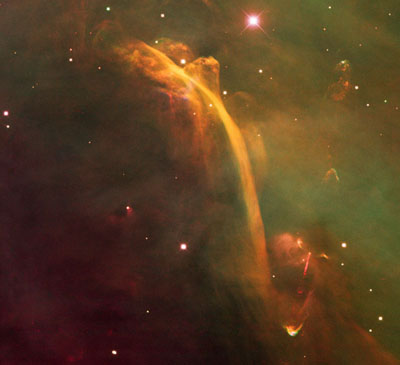
HH 222 (also known as the Waterfall Nebula and Orion Streamers) is a prominent Herbig–Haro object located in the Orion molecular cloud complex. It is characterized by its elongated, cascade-like structure resembling a flowing waterfall, formed by ionized gas streams interacting with surrounding molecular clouds.