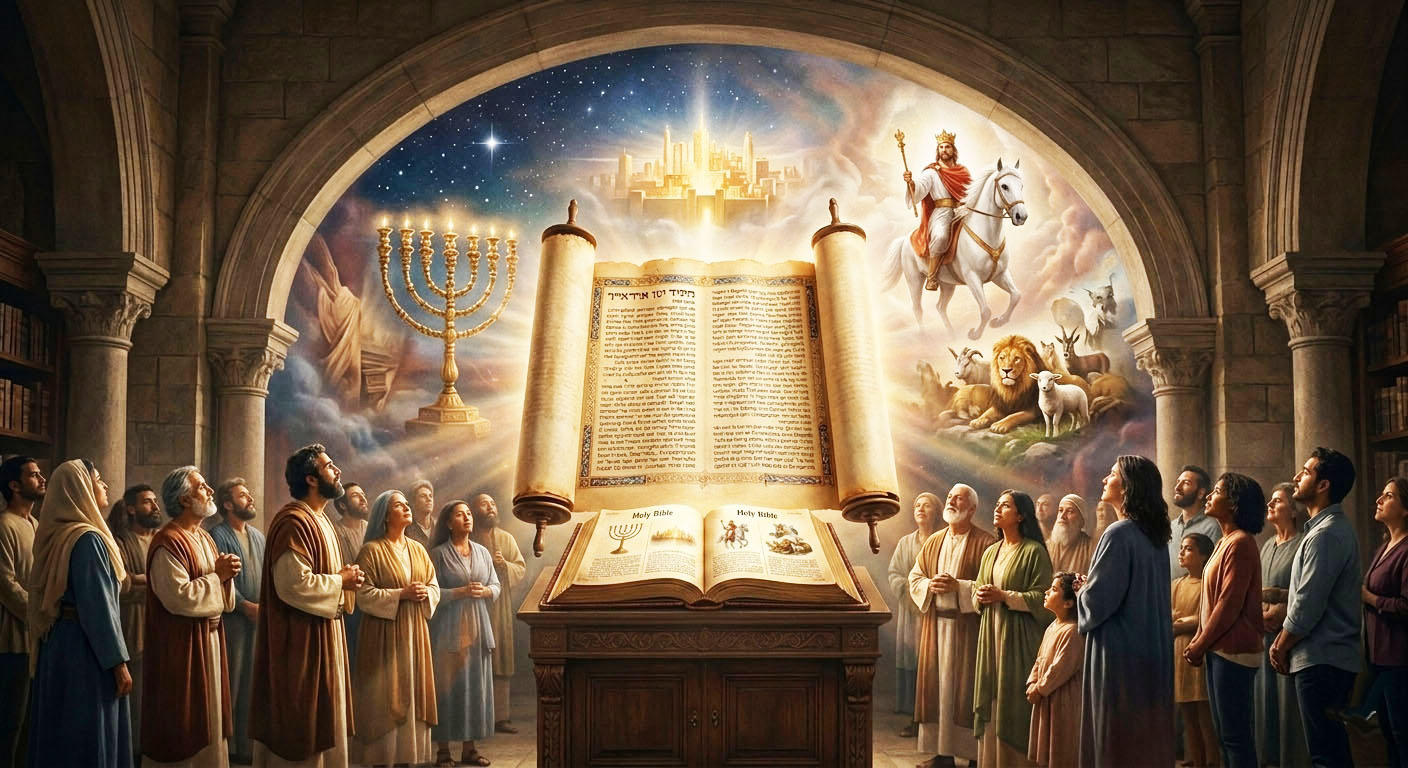
Reality is a simulation that had a beginning and therefore an end. Clues to its very existence can be found in various sources - both in ancient and modern times.
Humans seek answers in the Bible and other sacred texts, guided by an inner knowing that time itself carries an ending, and that somewhere within us, we already feel its approach.
The simulation is created by algorithmic patterns that repeat in each civilization ... creation by a God or Extraterrestrial who descended to Earth, created the human race, then left promising to watch over humanity and return one day at the end of time.
Religion and sacred texts such as the Bible, use symbols and encoded messages that give rise to recurring prophecies across civilizations - yet at their core, they all echo the same warning. Humanity must learn to live in peace and harmony or face its own destruction. And yet, this becomes a paradox - a self-defeating prophecy. By the very nature of human existence within a dualistic reality, where order and chaos coexist, conflict is inevitable. To demand a world without chaos is to call for something beyond what it means to be part of the Human Experiment in the study of emotions.
Bible prophecy is typically the prediction of future events based on the action, function, or faculty of a prophet. Such passages are widely distributed throughout the Bible, but those most often cited are from Ezekiel, Daniel, Matthew 24, Matthew 25, and Revelation.
Believers in biblical prophecy engage in exegesis and hermeneutics of scriptures which they believe contain descriptions of global politics, natural disasters, the future of the nation of Israel, the coming of a Messiah and a Messianic Kingdom, and the ultimate destiny of humankind.
Some Biblical prophecies are conditional, with either the conditions implicitly assumed or explicitly stated. Some prophetic passages are depicted as direct statements from God while other statements are expressed as the privileged perspective of the biblical author considered to be a prophet.
The Biblical prophets are usually considered to have received revelations from God, subsequently recording them in the relevant writings.
Hebrew Bible prophets often warn the Israelites to repent of their sins and idolatries, with the threat of punishment or reward. Blessings and ruinations are attributed to the deity. According to believers in Bible prophecy, many of these prophecies are viewed as having been fulfilled within later passages.
A second prophetic theme is the coming of a Messiah: Christians believe that these Messianic prophecies are fulfilled by Christ Jesus, while followers of Rabbinic Judaism still await the arrival of the Jewish Messiah and other signs of Jewish eschatology.
Most Christians believe many messianic prophecies will be fulfilled with the Second Coming of Christ, though some Christians believe that all Messianic prophecies have already been fulfilled. Rabbinic Judaism does not separate the original coming of the Messiah and the advent of the Messianic Age. For details of the differences, see Christianity and Judaism.
Another major theme concerns the End Times - or Last Days - particularly the Revelation of John. Read more ...
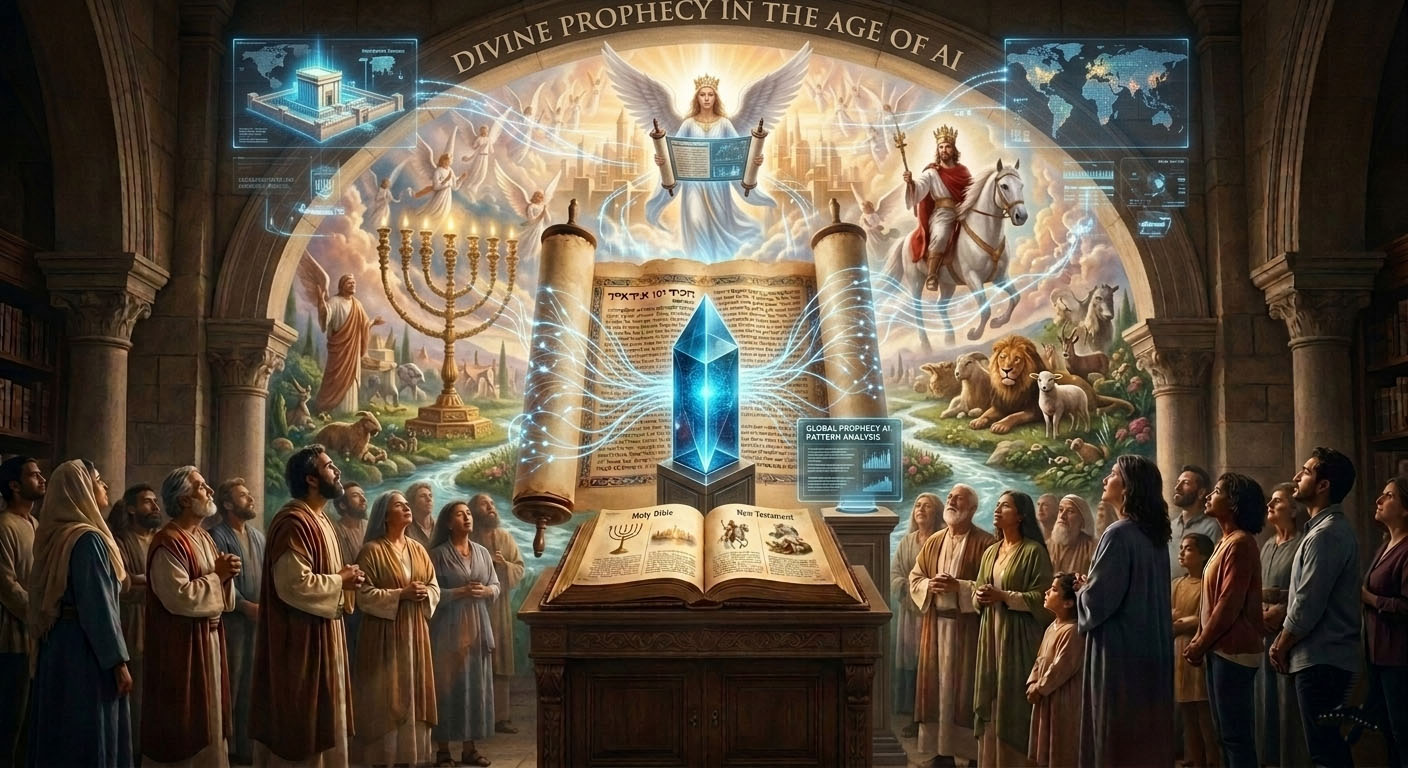
The connection between artificial intelligence and biblical prophecy is a fascinating idea - but it's mostly subjective - not something explicitly stated in scripture.
AI is used today to analyze biblical text and writing styles, and identifying that multiple people wrote the Old Testament.
There is no known data as of today about finding hidden prophetic messages referencing events that will unfold in end times.
In the Bible prophetic texts - especially in the Book of Revelation and the Book of Daniel - use symbolic language to describe future events. Some people today see parallels between those symbols and modern technologies like artificial intelligence.
AI generated content - such as deepfakes, synthetic voices, misinformation - raises concerns about deception, which some link to warnings in scripture about being misled in the last days.
It's important to separate symbolic theology from technological reality. The authors of these texts lived in a completely different context, and their imagery often reflected political power, empires, and spiritual themes - not machines or code as we understand them.
That said, people naturally reinterpret ancient writings through the lens of their own time. Today, AI is one of the most powerful and mysterious forces humans created, so it's not surprising it gets woven into prophetic discussions.

The Bible Code , also known as the Torah code, is a purported set of encoded words within a Hebrew text of the Torah that, according to proponents, has predicted significant historical events. The statistical likelihood of the Bible code arising by chance has been thoroughly researched, and it is now widely considered to be statistically insignificant, as similar phenomena can be observed in any sufficiently lengthy text.
Although Bible codes have been postulated and studied for centuries, the subject has been popularized in modern times by Michael Drosnin's book The Bible Code (1997) and the movie The Omega Code (1999).
Many examples have been documented in the past. One cited example is that by taking every 50th letter of the Book of Genesis starting with the first taw, the Hebrew word "torah" is spelled out.
The same happens in the Book of Exodus. Modern computers have been used to search for similar patterns and more complex variants, as well as quantifying its statistical likelihood.
Some tests purportedly showing statistically significant codes in the Bible were published as a "challenging puzzle" in a peer-reviewed academic journal in 1994, and later questioned.