Tuesday September 1, 2026
While archiving the news about flooding in the Grand Canyon - I realized the file needed a complete overhaul - which generally takes hours and sometimes days. So I began early and just finished - adding an index, personal experiences, clarifying the Kincaid hoax, new pics, videos, and texts.
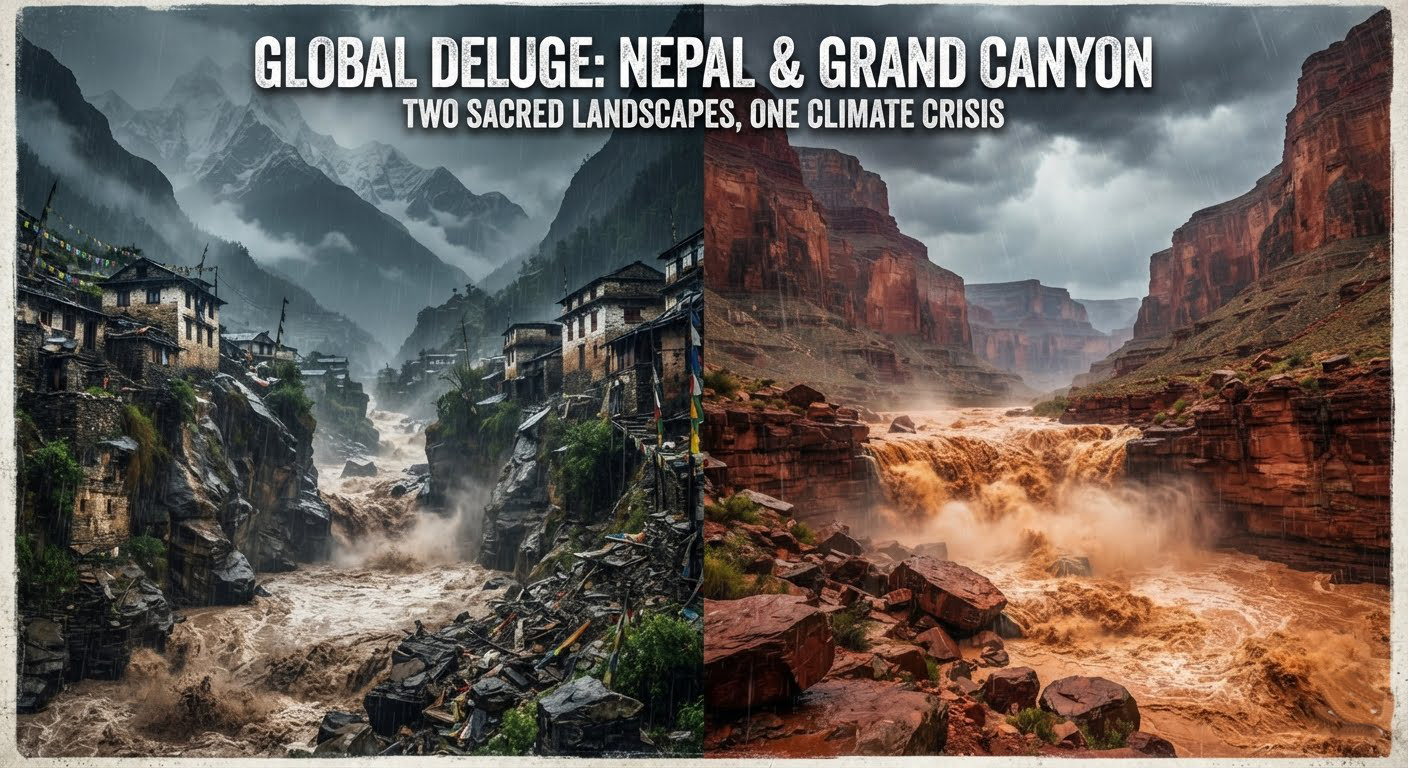
In the past week - two of Earth's most awe-inspiring landscapes - the Himalayas and Grand Canyon - made headlines for the same volatile reason - devastating flash floods. Halfway across the world from each other - both Nepal nestled beneath the towering peaks of the Himalayas - and the Grand Canyon saw torrents of water tear through their ancient terrain.
It makes you wonder what other sacred sites around the world are going to be devastated in the near future. Local flooding in civilian areas teach lessons in letting go if only to discover what is truly important in your life.
If you still don't understand that planet Earth will not be sustainable much longer then keep paying attention as closure accelerates.
Beyond the immediate geological impact, the Himalayas and the Grand Canyon share a deep, historical connection to the spiritual and the mythic. When the waters rise in places of such immense natural power, they bridge the physical world with ancient lore.
The torrential rains and glacial floods in Nepal and along the Tibetan border carve through lands considered holy by billions. The region surrounds peaks like Mount Kailash, an axis mundi or spiritual center in Hinduism, Buddhism, and Jainism. Here, water is both a divine blessing and a fierce force of nature.
Across the Himalayas, mythic deluges represent cosmic cycles of destruction and rebirth. Rivers like the Ganges and Indus are personified as deities, and sudden, violent floods are traditionally viewed as manifestations of Shiva's raw power, washing away the old to make way for the new.
The Desert Cathedral - In the American Southwest, monsoon deluges transformed the arid Grand Canyon into a network of raging rivers. For the Indigenous peoples who have lived there for millennia, the canyon is not a tourist destination, but a living spiritual entity whose waters carry deep cultural significance.
The Grand Canyon is central to Native American creation stories. In Havasupai lore, a great primordial flood once covered the earth, shaping the canyon walls. For the Hopi, the canyon holds Sipapuni, the sacred place where humanity emerged from a previous world after a great purging of the earth.
It's all connected...
Walk through the Grand Canyon today and you will see names like Vishnu Temple, Shiva Temple, and Buddha Temple printed on the maps. In the late 1800s, geologists overwhelmed by the canyon's majestic architecture named these massive rock formations after Eastern deities, permanently linking the two landscapes.
This conceptual blending even fueled early 20th-century legends and sensational hoaxes claiming that secret caves in the Grand Canyon hid ancient Egyptian and Tibetan artifacts. While historically false, it proves how naturally the human mind connects these two profoundly spiritual landscapes.