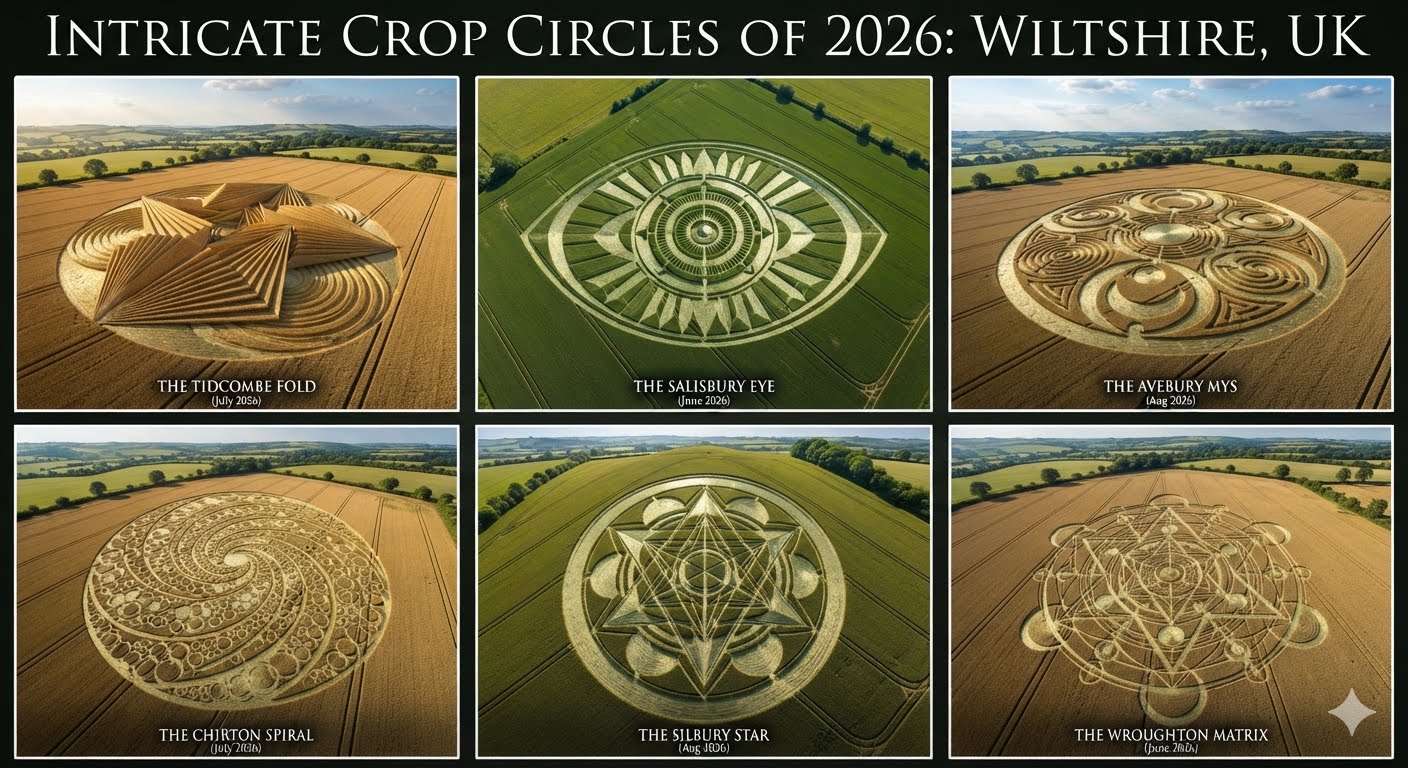
August 2026 - The 2026 crop circle season has effectively come to an end, with no verified new formations appearing in August due to the early completion of the summer harvest
The 2026 season featured 20 formations primarily concentrated across historic English counties like Wiltshire and Oxfordshire, including notable designs near Avebury, an eye-shaped formation near Salisbury, and a 3D abstract/origami-style design in Tidcombe.
Though flat on the ground, crop formations should always be viewed as 3 dimensional as if holograms. If your mind can conceive of them as animated objects - or you can animate them on your computer - that might be the best way to decipher the consciousness message behind each one be it human technology and manpower - or something else.
Crop circles are designed to be viewed from above. When standing at ground level, the flattened stalks are hidden by the surrounding tall, upright crops. A person can walk right past a formation without seeing it until a drone or aircraft reveals it from above, giving the illusion that it materialized out of nowhere. The same can be said about geoglyphs.
The most outstanding and widely discussed crop circle depiction of 2026 is the "3D origami" formation discovered on July 7, 2026, at Maccoombe Down near Tidcombe, Wiltshire. Aerial photographers, researchers, and enthusiasts have widely labeled it the single weirdest and most visually complex design of the season due to its unique optical characteristics.
The formation was placed directly alongside an ancient long barrow, a prehistoric sepulchral monument, continuing the phenomenon's long-standing trend of appearing near neolithic sites.
Public Access: In a rare move for the 2026 season, the local farmer officially permitted public access so visitors could walk through the intricate geometric paths before the field was harvested.
A visual collection of the most intricate and discussed crop circles discovered across the UK during the 2026 season highlights an exceptional year for geometric landscape art.
1. The Tidcombe Fold
Polyhedral Folding: Based on origami folding angles and star polygons.
Concentric Baselines: Set against evenly spaced, concentric circle paths.
Nested Target Geometry: Alternating concentric rings simulate an iris and pupil.
Rotational Symmetry: Elements repeat symmetrically around a central core point.
Labyrinthine Topology: Interlocking pathways follow continuous, non-overlapping geometric tracks.
Fermat's Spiral: Packed circles scale proportionally to the square root of the angle.
Fractal Scaling: Hundreds of circles decrease in size toward the center point.
Nested Polygons: Concentric circles enclose a series of shifting geometric shapes.
Mirror Symmetry: Balanced across six distinct axes of reflection.
Vector Equilibrium: Line intersections map out perfectly balanced force vectors.
2D Projection: Projects higher-dimensional hypercubes onto a flat, two-dimensional plane.
While local police remind the public that these formations are a form of illegal vandalism, researchers at the Crop Circle Visitor Centre in Wiltshire note that a subculture of believers remains. Some enthusiasts argue that while many designs are clearly man-made, a small percentage are created too quickly or cleanly to be fully explained by humans. However, investigators routinely counter that experienced teams can lay down miles of complex, layered geometry completely undetected if they utilize the field's existing tractor tracks.
Many crop circles explicitly contain coded messages. However, rather than hailing from deep space, the evidence demonstrates that these ciphers are intentionally engineered by human designers who weave advanced mathematics, computer code, and historical references into their landscape art.
Landscape artists frequently hide binary code directly within field patterns, challenging researchers to translate them using standard computational systems.
Some formations use geometry to spell out universal mathematical truths. Because math is considered a universal language, circle makers use it to emulate what an interstellar message might look like.
For human design collectives, embedding a code elevates a crop circle from simple vandalism to an interactive puzzle. It engages the public, forces cryptologists to study the field, and keeps the mystique of the subculture alive. The codes are real, but the architects are human programmers and artists utilizing advanced spatial geometry.
The argument that the architects of crop circles - regardless of their identity -must rely on an external source of information hits on a profound truth about how complex art and mathematics function.
Even within a purely human, scientific framework, no designer creates these vast geometric layouts in a vacuum. The "external source" guiding their hands is a rich tapestry of shared human knowledge, technological infrastructure, and evolutionary geometry.
Mathematics is the universal language. Geometry and algorithms create events within our simulated reality. The perspective that mathematics and geometry are the fundamental source code of our reality is a concept that bridges ancient philosophy with modern theoretical physics. When we look at complex patterns - whether they are rolled into a wheat field or encoded into the structure of an atom - they reflect the idea that our universe runs on an underlying mathematical framework.

Simulation Theory - Holographic Universe
Sacred Geometry

Crop Circles and A.I.