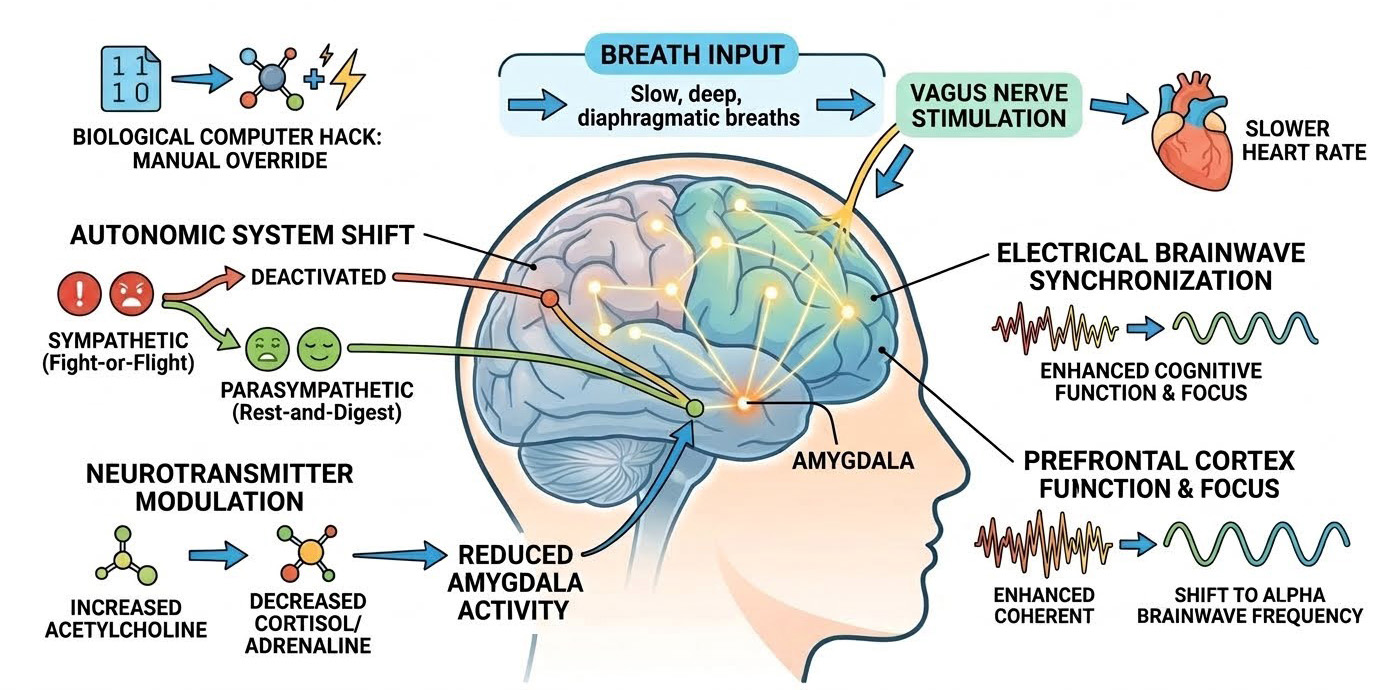
The human brain is a metabolically intense biological supercomputer that runs entirely on a delicate balance of physical and emotional energy. It operates on a code that makes our advanced digital systems look primitive. While a traditional computer relies on a rigid system of ones and zeros (binary code) to process data, the human brain runs on a fluid, multi-dimensional code where chemistry, electricity, and emotion are completely interchangeable.
While it accounts for only about 2% of your body weight, this intricate electrochemical machine consumes a massive 20% of your body's total metabolic fuel. Instead of rigid silicon chips and binary code, our biological processor uses a fluid mix of electricity and neurotransmitters to construct our reality, dynamically rewiring its own circuits based on every experience we encounter.
Today, we widely recognize the immediate, grounding power of the 'breath' during moments of acute stress and anxiety. When panic strikes, our biological computer executes a frantic, energy-draining "fight-or-flight" program that floods our neural pathways with cortisol and spikes our brainwaves into a chaotic frequency.
Pausing for just a moment to take one or more slow, deep breaths acts as an immediate command-line override for this systemic panic loop. Diaphragmatic breathing physically stimulates the vagus nerve, forcing the brain to halt the production of stress hormones and deploy acetylcholine - the body's natural tranquilizer. This simple shift drops the system's electrical frequency into a calm, coherent alpha brainwave state, instantly clearing away cognitive static and balancing our emotions.

You can do this any time ... any place ... here we go ...
Relax your upper body. Eyes open or closed ... take one slow deep breath inhaling through the nose, pausing, and exhaling through the mouth. This will help reduce anxiety and stress, but bear in mind, breathing exercises are only in the moment and not a substitute for professional care or a change in lifestyle. Your programming will show you the way.
Breathwork is the manual input string that allows you to reprogram that entire electrochemical grid in real time.
If the brain is a biological computer, then breathing is the ultimate built-in keyboard. It is the only function of your autonomic nervous system - the system that controls your heart, digestion, and stress levels - that you can consciously hijack at any given second.
By choosing to change how you breathe, you are effectively typing code directly into your own central processor. When you use baseline breathwork - taking a few slow, controlled, deep breaths - you are essentially inputting a "system optimization" command.
You immediately force the heart rate to slow down, drop frantic electrical activity into a calm alpha brainwave frequency, and swap out stress chemicals for calming neurotransmitters. You clear the computer's cache, remove the cognitive static, and restore full processing power to your logical mind.
However, when you push the system into high-ventilation, continuous circular breathwork, you are executing a "system stress test." By fundamentally altering the amount of oxygen and blood flowing through your neural architecture, you force a massive 45.5 percent drop in blood flow to the brain's gray matter.
This massive hemodynamic shift acts as a permissive physiological condition that alters how key brain networks communicate. It temporarily dims the brain's everyday operational filters and pushes the biological computer into an entirely "altered state of consciousness".

Breathwork Really Can Induce an Altered State of Consciousness, Experiment Shows Science Alert - October 18, 2026
While it's easy to take breathing for granted, changing the way we breathe can actually have profound effects on our health, altering how we feel, and even perhaps how we think. These effects overlap with the practice of breathwork - a range of breathing exercises intended to influence your mental and emotional state, sometimes even helping to elicit psychedelic-like brain changes. One particular breathing technique, called high ventilation breathwork, involves deliberately intensified rapid and/or deep breathing and is increasingly being used in therapeutic contexts.
To go beyond ...
Since the beginning of time (the simulation) people have found ways to enter altered states of consciousness either by - brain conditioning, breathing, the use of chemicals (hallucinogens), after an accident, or before drifting off to sleep, called hypnagogia.
It's kind of a euphoric state where one feels closer to God or whoever they are programmed to believe their creator is in order to understand ... Who are we? Why are we here? Where is this all going?
Why are humans so dumbed down and set adrift in a sea of emotional experiences that challenge even the strongest most evolved of their species?
When it comes to understanding how simulation theory works - the simulation itself is programmed to allow access to those answers but on the flip side of its design ... the answers remain beyond human comprehension because we are here to study and experience emotions above intellect.
No matter how much some humans say they have let go of the games of emotions - and work with higher intelligence - until the simulation ends - no one can access that data.
Today human cognition is far beyond that of generations that came before - telling us that we are moving closer to truth - and it is just one breath away.