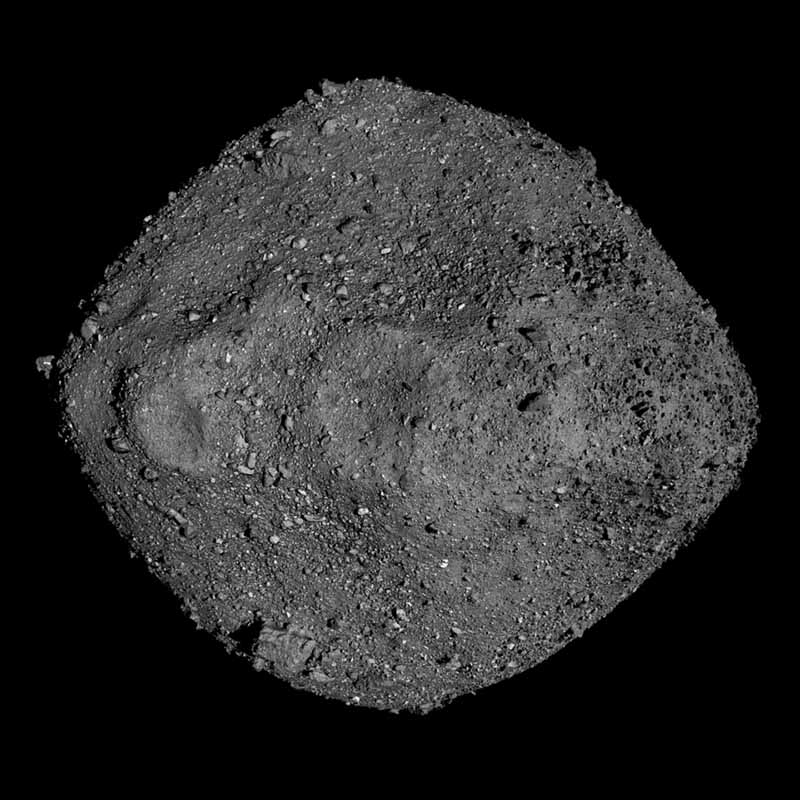
101955 Bennu (provisional designation 1999 RQ36) is a carbonaceous asteroid in the Apollo group discovered by the LINEAR Project on September 11, 1999. It is a potentially hazardous object that is listed on the Sentry Risk Table and has the second highest cumulative rating on the Palermo scale. It has a cumulative chance of around 1-in-1,750 of impacting Earth between 2178 and 2290 with the greatest risk being on September 24, 2182.
It is named after Bennu, or Phoenix, the ancient Egyptian mythological bird associated with the Sun, creation, and rebirth.
Bennu was the target of the OSIRIS-REx mission that returned samples of the asteroid to Earth. The spacecraft, launched in September 2016, arrived at the asteroid two years later and mapped its surface in detail, seeking potential sample collection sites. Analysis of the orbits allowed calculation of Bennu's mass and its distribution.
In October 2020, OSIRIS-REx briefly touched down and collected a sample of the asteroid's surface. A capsule containing the sample was returned and landed on Earth in September 2023, with distribution and analysis of the sample ongoing. On May 15, 2024, an overview of preliminary analytical studies on the returned samples was reported. Read more ...
NASA Just Found Something Strange Inside Asteroid Bennu Sample SciTech Daily - March 31, 2026
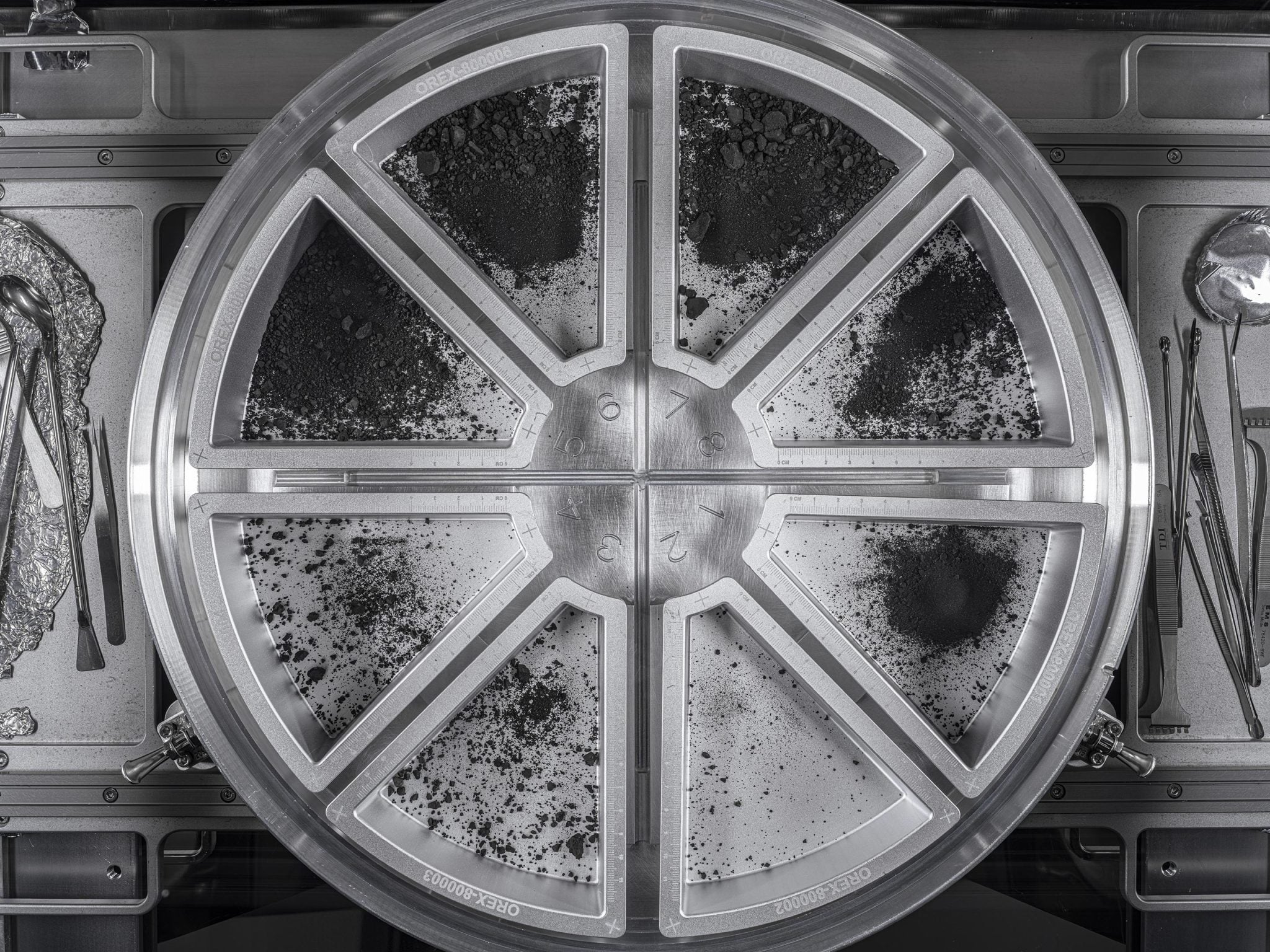
Scientists studying samples from the asteroid Bennu have uncovered a surprisingly complex chemical landscape at the tiniest scales. A new study shows that, at an extremely small scale, organic material and minerals inside the asteroid Bennu are organized into three clearly different chemical groupings. These patterns provide important clues about how liquid water once altered the asteroid.
Dust from asteroid Bennu is revealing a surprising origin story for life's building blocks Science Daily - February 13, 2026

New research suggests some amino acids formed in frozen ice exposed to radiation, not warm liquid water as scientists long believed. Isotopic clues show Bennu's chemistry differs sharply from well-studied meteorites, pointing to multiple pathways for creating life's ingredients.
Sugars, 'Gum', Stardust Found in NASA's Asteroid Bennu Samples NASA - December 2, 2025
Scientists led by Yoshihiro Furukawa of Tohoku University in Japan found sugars essential for biology on Earth in the Bennu samples. The asteroid Bennu continues to provide new clues to scientists' biggest questions about the formation of the early solar system and the origins of life.
As part of the ongoing study of pristine samples delivered to Earth by NASA's OSIRIS-REx (Origins, Spectral Interpretation, Resource Identification, and Security-Regolith Explorer) spacecraft, three new studies present remarkable discoveries: sugars essential for biology, a gum-like substance not seen before in astromaterials, and an unexpectedly high abundance of dust produced by supernova explosions.
For life on Earth, the sugars deoxyribose and ribose are key building blocks of DNA and RNA, respectively. DNA is the primary carrier of genetic information in cells. RNA performs numerous functions, and life as we know it could not exist without it. Ribose in RNA is used in the molecule’s sugar-phosphate backbone that connects a string of information-carrying nucleobases.
Are we all aliens? NASA's Osiris-Rex spacecraft returned asteroid samples hold the ingredients of life from a watery world in the near-Earth asteroid Bennu PhysOrg - February 1, 2025
Asteroid samples fetched by NASA hold not only the pristine building blocks for life but also the salty remains of an ancient water world. The findings provide the strongest evidence yet that asteroids may have planted the seeds of life on Earth and that these ingredients were mingling with water almost right from the start.
This takes us to the Theory of Panspermia - Life from outer space seeded human evolution
Tantalizingly Beautiful Rocks Yield More Evidence That Asteroid Bennu Came From A Wet World IFL Science - June 27, 2024
The sample collected by OSIRIS-REx on asteroid Bennu continues to deliver unique insights into the history of this small space rock and the early Solar System. In the first few weeks following the opening of the sample, evidence began to show that Bennu might have had a wet past. A new discovery now adds to that.
First Look at Asteroid Bennu Hints It's a Fragment of a Lost Ocean World Science Alert - February 12, 2024

That assumption is based on the phosphate crust detected on the asteroid. The calcium and magnesium-rich phosphate mineral has never been seen before on meteorites - those small space rocks that make it through our atmosphere and down to Earth. The mineral's chemistry bears an eerie resemblance to that found in vapor shooting from beneath the icy crust of Saturn's moon, Enceladus.
Scientists found signs of organic molecules in the first samples of potentially hazardous asteroid Bennu, as well as a 'head scratching' material that has yet to be identified Live Science - December 13, 2023

Tasked with finding clues about origins of life on Earth, NASA's OSIRIS-REx spacecraft scooped up pieces of a rugged, rubble-pile asteroid named Bennu in late 2020 and delivered them to Earth about two months ago. On Monday (Dec. 11), scientists got their first detailed description of some of that extraterrestrial collection.
Unprecedented asteroid sample contains crucial elements for life, NASA says in historic reveal CNN - October 12, 2023
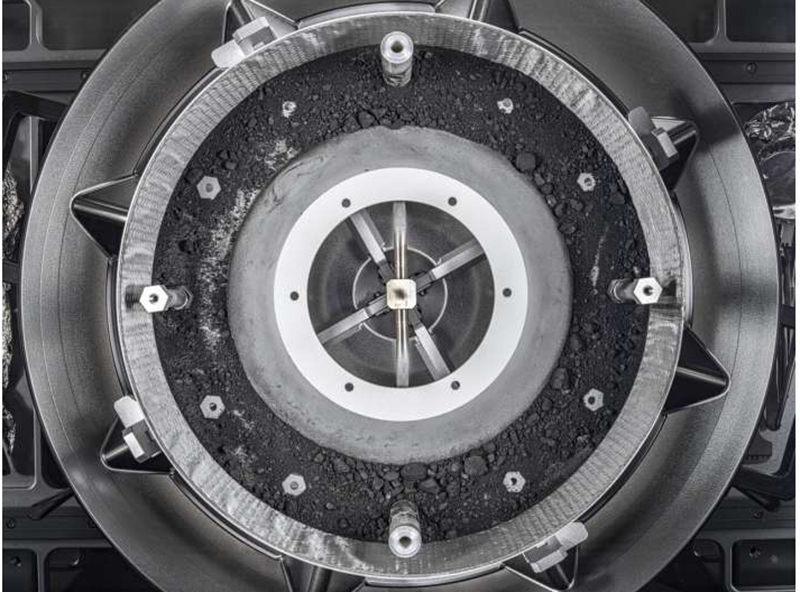
A view of the outside of the OSIRIS-REx sample collector shows material from asteroid Bennu that can be seen on the middle right. Scientists have found evidence of both carbon and water in initial analysis of this material. The bulk of the sample is located inside. There was so much bonus material when the scientists opened the canister that the team has yet to open the bulk sample.
The reason that Earth is a habitable world, that we have oceans and lakes and rivers and rain, is because these clay minerals landed on Earth 4 billion years ago to 4 and a half billion years ago, making our world habitable. So we're seeing the way that water got incorporated into the solid material.
NASA's first asteroid samples land on Earth after release from spacecraft PhysOrg - September 24, 2023


In a flyby of Earth, the Osiris-Rex spacecraft released the sample capsule from 63,000 miles (100,000 kilometers) out. The small capsule landed four hours later on a remote expanse of military land, as the mothership set off after another asteroid.
Highly porous rocks are responsible for asteroid Bennu's surprisingly craggy surface PhysOrg - October 8, 2021
Scientists thought asteroid Bennu's surface would be like a sandy beach, abundant in fine sand and pebbles, which would have been perfect for collecting samples. Past telescope observations from Earth's orbit had suggested the presence of large swaths of fine-grain material called fine regolith that's smaller than a few centimeters.
A collection chamber that could contain more than 2 pounds of samples gathered from an asteroid in deep space last week has been sealed inside of a return capsule on NASA's OSIRIS-REx spacecraft to bring the extraterrestrial specimens back to Earth in 2023 Space Flight - October 29, 2020
Mission managers accelerated plans to stow the sample inside the return capsule after finding that asteroid particles were escaping from the collection chamber last week. The OSIRIS-REx spacecraft descended to a precise touch-and-go landing on asteroid Bennu Oct. 20 to gather the surface specimens.
A Handful of Asteroid Could Help Decipher Our Entire Existence The Atlantic - October 22, 2020
OSIRIS-REx mission explains Bennu's mysterious particle events PhysOrg - December 5, 2019
Hayabusa-2: Japanese spacecraft makes final touchdown on asteroid BBC - July 11, 2019
Touchdown! Incredible Photos Show 2nd Asteroid Landing by Japan's Hayabusa2 Space.com - July 11, 2019
The Asteroid Bennu Keeps Spinning Faster and Scientists Aren't Sure Why Space.com - March 12, 2019
Right now, the asteroid known as Bennu is spinning once every 4.3 hours. But scientists working on NASA's OSIRIS-REx mission to the space rock have used data gathered before the probe's arrival to calculate that Bennu's rotation rate is speeding up over time by about 1 second each century.
The Asteroid Bennu Keeps Spinning Faster and Scientists Aren't Sure Why Space.com - March 12, 2019
Right now, the asteroid known as Bennu is spinning once every 4.3 hours. But scientists working on NASA's OSIRIS-REx mission to the space rock have used data gathered before the probe's arrival to calculate that Bennu's rotation rate is speeding up over time by about 1 second each century.
The Asteroid Bennu Keeps Spinning Faster and Scientists Aren't Sure Why Space.com - March 12, 2019
Right now, the asteroid known as Bennu is spinning once every 4.3 hours. But scientists working on NASA's OSIRIS-REx mission to the space rock have used data gathered before the probe's arrival to calculate that Bennu's rotation rate is speeding up over time by about 1 second each century.
Hayabusa-2: Japan spacecraft touches down on asteroid BBC - February 22, 2019
A Japanese spacecraft has touched down on an asteroid in an attempt to collect a sample of rock from the surface. The Hayabusa-2 probe was trying to grab the sample from a pre-chosen site on the asteroid Ryugu just before 23:00 GMT on 21 February. The spacecraft reached asteroid Ryugu in June 2018 after a three-and-a-half-year journey from Earth. It is expected to return to Earth with the rocky material it has cached in 2020. During sample collection, the spacecraft approached the 1km-wide asteroid with an instrument called the sampler horn. On touchdown, a 5g "bullet" made of the metal tantalum was fired into the rocky surface at 300m/s. The particles kicked up by the impact should have been be caught by the sampler horn.
Water found on asteroid, confirming Bennu as excellent mission target Science Daily - December 11, 2018
Spectral observations made by the OSIRIS-REx spacecraft identified hydrated minerals across the asteroid, confirming that Bennu, a remnant from early in the formation of the solar system, is an excellent specimen for the OSIRIS-REx mission to study the composition of primitive volatiles and organics.