
November 2026
Weather and climate in general have both a positive and negative effect on humans and other sentient lifeforms. For most people a moderate temperature with low humidity is best for their health but finding a temperate climate like that grows more dire as climate change accelerates exponentially.
The picture perfect days of sunny California have given way to flooding, drought, wildfires, mudslides, and other things that create health issues across the world. Climate change and natural disasters are increasing exponentially, making people wonder how much longer planet Earth will be sustainable?
Weather affects everything from the water we drink, to the food we eat, to the air we breathe, to where we live, and more.
I am a cold-weather person who lives in New York City and couldn't survive in thereat and humidity of the south. Though many of my friends, family, and clients have left the north for states like Florida and Arizona, health wise it wouldn't be beneficial for me. As we are now in 2026 and the planet is heating up, they all tell me about the effects of increasing months of hot weather on their health and the possibility.

Evidence suggests that cold temperatures are mysteriously beneficial for longevity, helping to boost metabolism and delivering positive effects at the cellular level. Science Alert - October 30, 2026
On the flip side, excessive heat doesn't seem to do great things for the human body. But what is it about coldness that's so beneficial in comparison?
Weather is the state of the Earth's atmosphere at a specific place and time, typically described in terms of temperature, humidity, cloud cover, and stability. On Earth, most weather phenomena occur in the lowest layer of the planet's atmosphere, the troposphere, just below the stratosphere.
Weather refers to day-to-day temperature, precipitation, and other atmospheric conditions, whereas climate is the term for the averaging of atmospheric conditions over longer periods of time. When used without qualification, "weather" is generally understood to mean the weather of Earth.
Weather is driven by air pressure, temperature, and moisture differences between one place and another. These differences can occur due to the Sun's angle at any particular spot, which varies with latitude. The strong temperature contrast between polar and tropical air gives rise to the largest scale atmospheric circulations: the Hadley cell, the Ferrel cell, the polar cell, and the jet stream. Weather systems in the middle latitudes, such as extratropical cyclones, are caused by instabilities of the jet streamflow.
Because Earth's axis is tilted relative to its orbital plane (called the ecliptic), sunlight is incident at different angles at different times of the year.
On Earth's surface, temperatures usually range +-40 °C (-40 °F to 104 °F) annually. Over thousands of years, changes in Earth's orbit can affect the amount and distribution of solar energy received by Earth, thus influencing long-term climate and global climate change.
Surface temperature differences in turn cause pressure differences. Higher altitudes are cooler than lower altitudes, as most atmospheric heating is due to contact with the Earth's surface while radiative losses to space are mostly constant. Weather forecasting is the application of science and technology to predict the state of the atmosphere for a future time and a given location.
Earth's weather system is a chaotic system; as a result, small changes to one part of the system can grow to have large effects on the system as a whole. Human attempts to control the weather have occurred throughout history, and there is evidence that human activities such as agriculture and industry have modified weather patterns.
Studying how the weather works on other planets has been helpful in understanding how weather works on Earth. A famous landmark in the Solar System, Jupiter's Great Red Spot, is an anticyclonic storm known to have existed for at least 300 years. However, the weather is not limited to planetary bodies. A star's corona is constantly being lost to space, creating what is essentially a very thin atmosphere throughout the Solar System. The movement of mass ejected from the Sun is known as the solar wind.
Weather has played a large, and sometimes direct, part in human history. Aside from climatic changes that have caused the gradual drift of populations (for example the desertification of the Middle East, and Ice ages in Northern Europe), extreme weather events have caused smaller scale population movements and intruded directly on the course of human history.
One such event that is celebrated is the saving of Japan from invasion by the Mongol fleet of Kublai Khan by the Kamikaze winds in 1281.
The Little Ice Age of the 14th to 18th centuries had wide ranging effects in the northern hemisphere, including decimating the fledgling Viking colonies of Greenland, catalysing the formation of leagues among the Native American groups in North America, and forcing the change of patterns of agriculture across Europe to accommodate the shortened growing season. A series of great storms throughout the 13th century caused the powerful English Cinque Ports to be silted up and hence lose their influence.
More recently, Hurricane Katrina forced the temporary abandonment of the entire city of New Orleans in 2005.
Because of the large effect that weather has on day-to-day life and due to the impossibility of any type of forecasting before the advent of modern technology, a large body of folklore aimed at trying to explain the weather has grown up, some of which is fairly accurate, most less so.
A well known example is the Groundhog Day celebrated near the end of winter in parts of the United States.
The effect of seasons on the life of primitive peoples also caused them to observe and celebrate certain events during the calendar, some of which, in adulterated form, are still observed today.
Christmas, for example, is the Yule of the pagans, celebrated around the winter solstice, the shortest day of the year (in the Northern Hemisphere, the summer solstice in the Southern Hemisphere).
It is the goal of some scientists to control the weather. Experiments have been carried out for many years, but the results are usually ambiguous. On a grander scale, science fiction authors have long posited the idea of terraforming other planets in order to make them habitable by human beings. While this may be possible in the distant future, this is far beyond current technology.
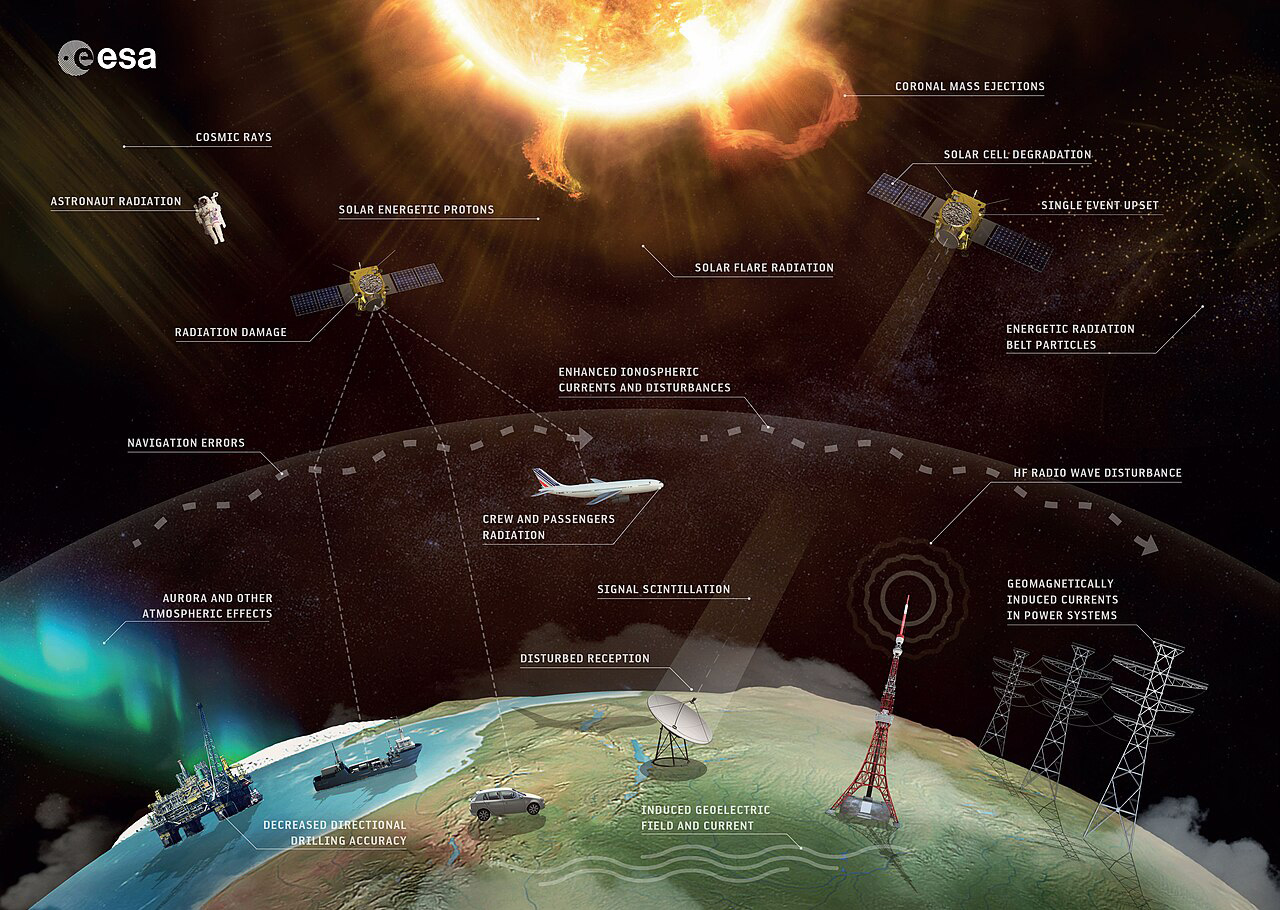
Space weather is a branch of space physics and aeronomy, or heliophysics, concerned with the varying conditions within the Solar System and its heliosphere. This includes the effects of the solar wind, especially on the Earth's magnetosphere, ionosphere, thermosphere, and exosphere.
Though physically distinct, space weather is analogous to the terrestrial weather of Earth's atmosphere (troposphere and stratosphere). The term "space weather" was first used in the 1950s and popularized in the 1990s. Later, it prompted research into "space climate", the large-scale and long-term patterns of space weather. Read more ...
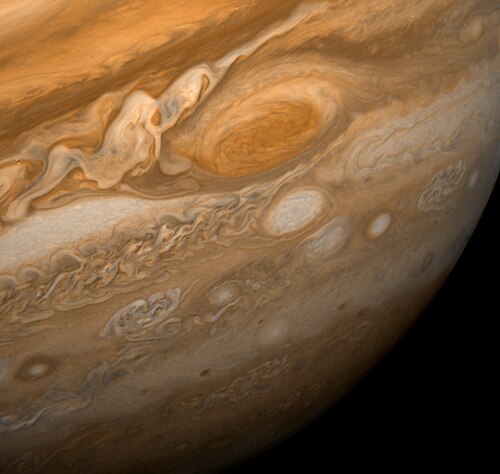
Studying how the weather works on other planets has been seen as helpful in understanding how it works on Earth.
Weather on other planets follows many of the same physical principles as weather on Earth, but occurs on different scales and in atmospheres having different chemical composition. The Cassini-Huygens mission to Titan discovered clouds formed from methane or ethane which deposit rain composed of liquid methane and other organic compounds.
Earth's atmosphere includes six latitudinal circulation zones, three in each hemisphere. In contrast, Jupiter's banded appearance shows many such zones, Titan has a single jet stream near the 50th parallel north latitude, and Venus has a single jet near the equator.
One of the most famous landmarks in the Solar System, Jupiter's Great Red Spot, is an anticyclonic storm known to have existed for at least 300 years.
On other giant planets, the lack of a surface allows the wind to reach enormous speeds: gusts of up to 600 metres per second (about 2,100 km/h or 1,300 mph) have been measured on the planet Neptune.
This has created a puzzle for planetary scientists. The weather is ultimately created by solar energy and the amount of energy received by Neptune is only about 1/900 of that received by Earth, yet the intensity of weather phenomena on Neptune is far greater than on Earth. As of 2007, the strongest planetary winds discovered are on the extrasolar planet HD 189733 b, which is thought to have easterly winds moving at more than 9,600 kilometres per hour (6,000 mph). Continue reading