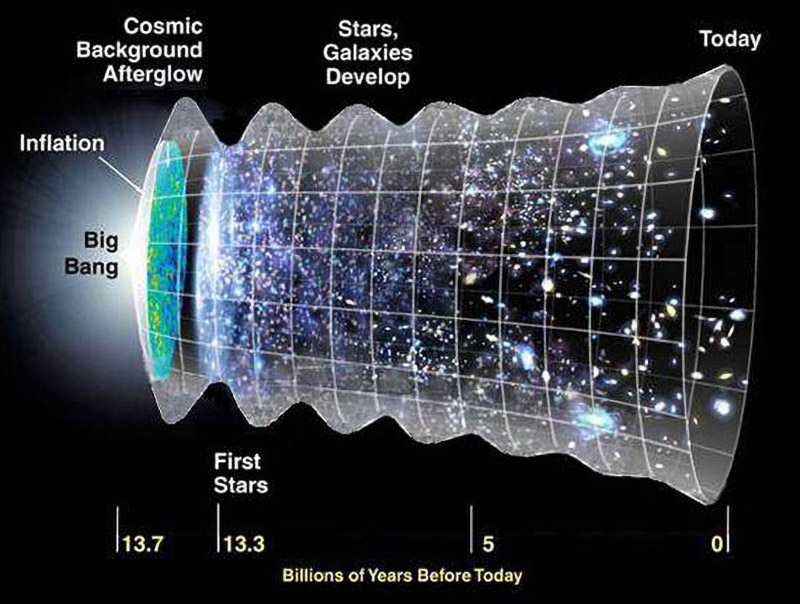
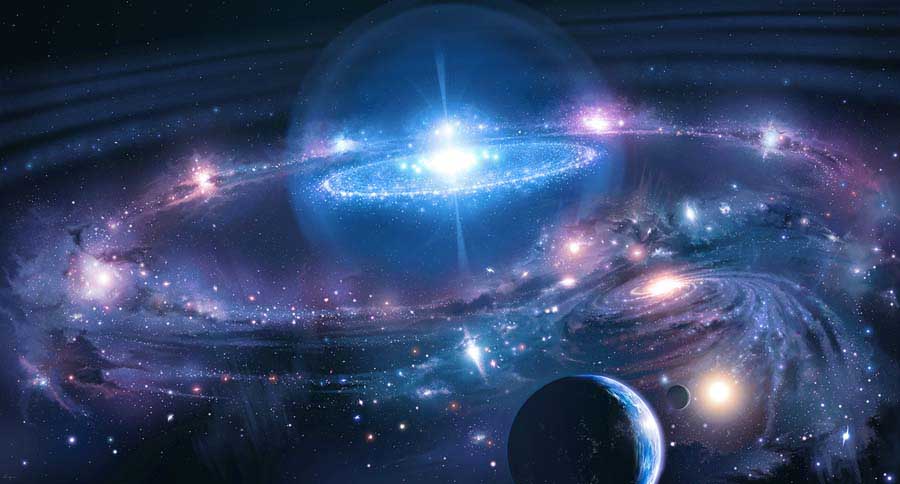
The Universe is the totality of everything that exists, has existed, and ever will exist. Similar meaning is sometimes conveyed with the words cosmos, world, reality, and nature. The Universe includes all of spacetime; the entire contents of outer space; all matter, energy, dark matter, and dark energy; all galaxies, stars, and planets; all humans and every living thing; all molecules, atoms, subatomic particles, photons, and their wave dualities; all physical constants, physical laws and fundamental interactions. The Universe can even be understood to encompass all of mathematics, all concepts and ideas, and all thoughts and emotions. Read more ...
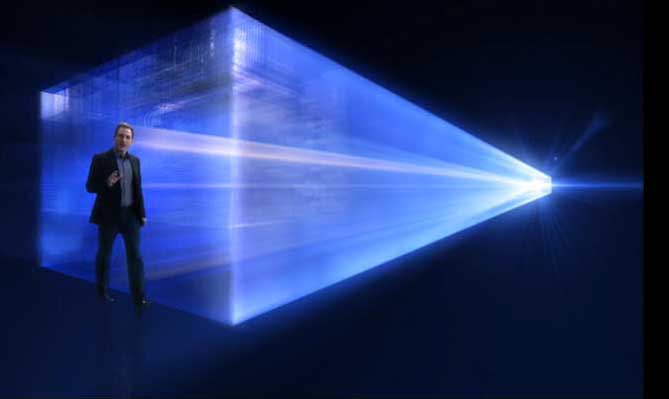
The Holographic Universe
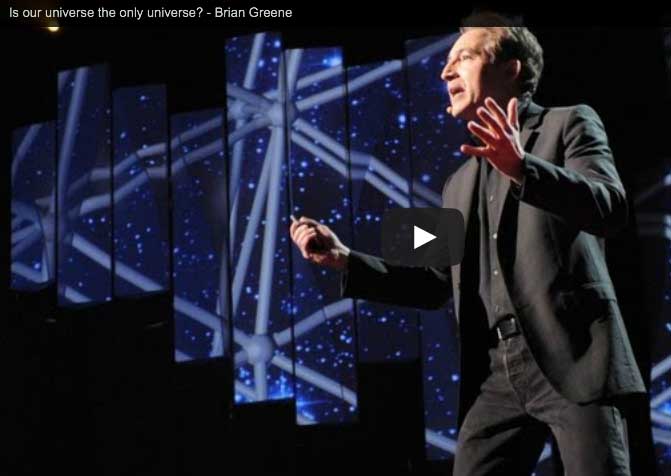
The Multiverse
The universe is still speeding up, but nobody knows why Science Daily - August 29, 2026

A major new analysis challenges recent claims that the universe's expansion is slowing, finding that the evidence for cosmic acceleration remains strong. The findings preserve the leading role of dark energy, while leaving scientists with the enduring mystery of what this strange cosmic force actually is.
Stardust Trapped in Antarctic Ice Reveals Earth's Journey Through The Cosmos Science Alert - May 12, 2026

This glittering spaceship Earth and the Solar System it inhabits are not fixed in space, but whirl, slowly and grandly, as part of the galactic-scale waltz around the heart of the Milky Way. Where the Solar System has been on this ancient journey is often impossible for us to know Ð but new clues have just surfaced, frozen for tens of thousands of years in Antarctic ice. There, a team of scientists led by nuclear astrophysicist Dominik Koll has found rare iron isotopes that trace our planet's recent passage through an interstellar cloud of supernova dust - the leftover debris from long-dead stars.
Could the Universe's Hidden Shape Solve One of Physics' Biggest Mysteries? SciTech Daily - May 4, 2026

Physicists are grappling with a major mismatch between theory and observation in the energy driving the universeÕs expansion. New research points to an unexpected link between quantum gravity and exotic states of matter.
Best Measurement Yet of Cosmic Expansion Confirms The Universe Has a Very Big Problem Science Alert - April 19, 2026
The most precise measurement yet of how fast the Universe is expanding shows we have a real and serious problem on our hands. The international H0DN Collaboration - a community consensus report on the Hubble constant - has remapped the markers we use to measure cosmic expansion, creating a framework that pins the rate at 73.5 kilometers per second per megaparsec for the local Universe, with a certainty of 7 sigma. The problem is that independent measurements still return a rate of 67.24 kilometers per second per megaparsec for the early Universe - and these new efforts have brought us no closer to resolving the discrepancy, known as the Hubble tension.
The Universe is expanding too fast and scientists still can't explain it Science Daily - April 12, 2026

A major international effort has produced an ultra-precise measurement of the Universe's expansion rate, confirming it's faster than early-Universe models predict. By linking multiple distance-measuring techniques, scientists ruled out simple errors as the cause of the discrepancy. The persistent 'Hubble tension' now looks more real than ever. It could mean our current model of the cosmos is incomplete.
The Universe's Most Pristine Ancient Star Is Surprisingly Close Science Alert - April 12, 2026
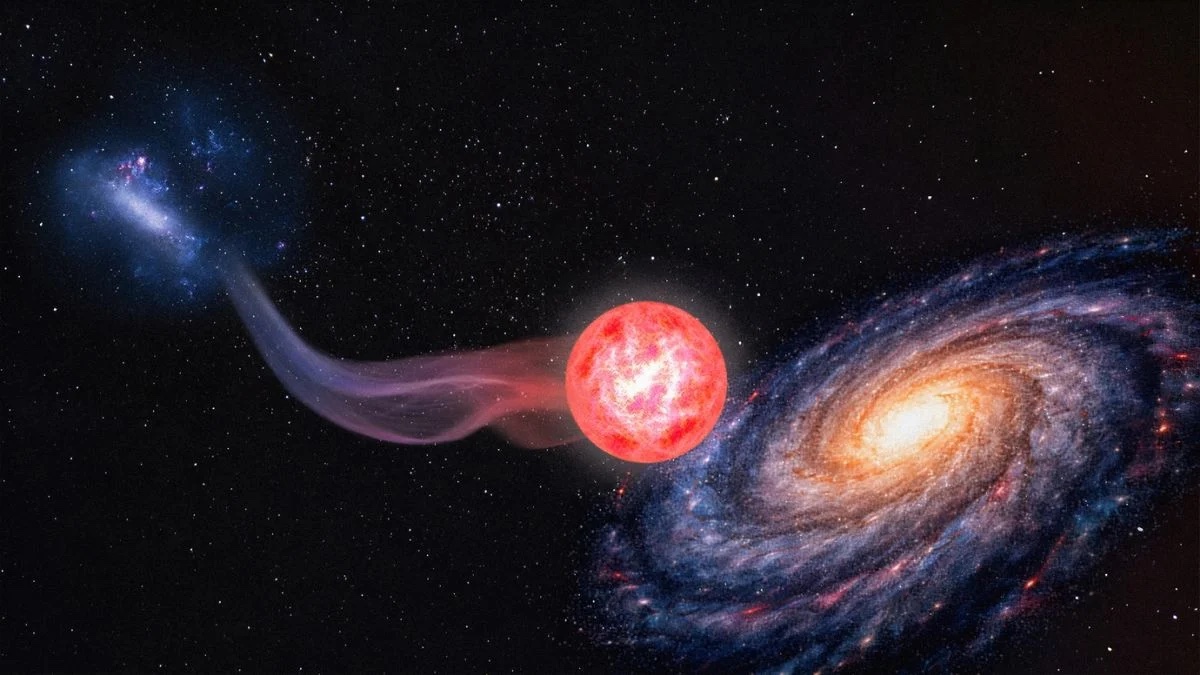
A star right here in the Milky Way galaxy is the purest ancient star astronomers have found to date. That means that it's remarkably (although not entirely) unpolluted by the metals that only formed after stars had already lived and died - a fossil relic of the early Universe, likely born from gas enriched by one of the early Universe's first supernova explosions. Once a low-mass Sun-like star, SDSS J0715-7334 has reached the end of its main-sequence lifespan and is now a red giant nearing the end of its life Ð surviving just long enough to teach us about times eons past.
We Finally Know How The Lights Turned on at The Dawn of Time Science Alert - March 31, 2026
According to data from the Hubble and James Webb Space Telescopes, the origins of the free-flying photons in the early cosmic dawn were small dwarf galaxies that flared to life, clearing the fog of murky hydrogen that filled intergalactic space.
A Subtle Twist in the Universe's Oldest Light May Be Larger Than We Thought SciTech Daily - March 12, 2026

Scientists have developed a new way to reduce uncertainties in measurements of cosmic birefringence, a subtle rotation in the polarization of the cosmic microwave background that could reveal new physics.
Our Universe Appears Lopsided, And It Could Break Cosmology Entirely Science Alert - December 23, 2025
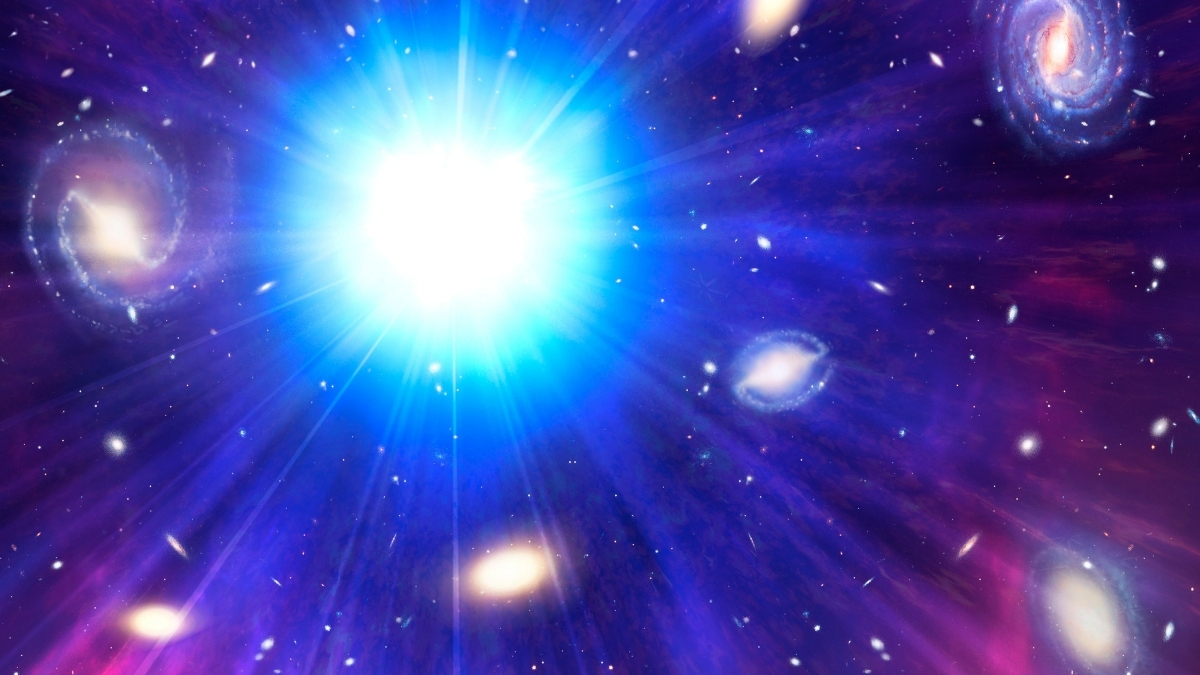
A new study suggests the universe could be asymmetric or lopsided, meaning not the same in every direction
Is the Universe Slowing Down? Stunning New Evidence Says Yes SciTech Daily - November 11, 2025

Astronomers at Yonsei University corrected for stellar age effects in supernova data and found that dark energy may be losing strength, suggesting the cosmos has already begun slowing down.
Physicists unlock secrets of stellar alchemy, yielding new insights into gold's cosmic origins PhysOrg - October 24, 2025
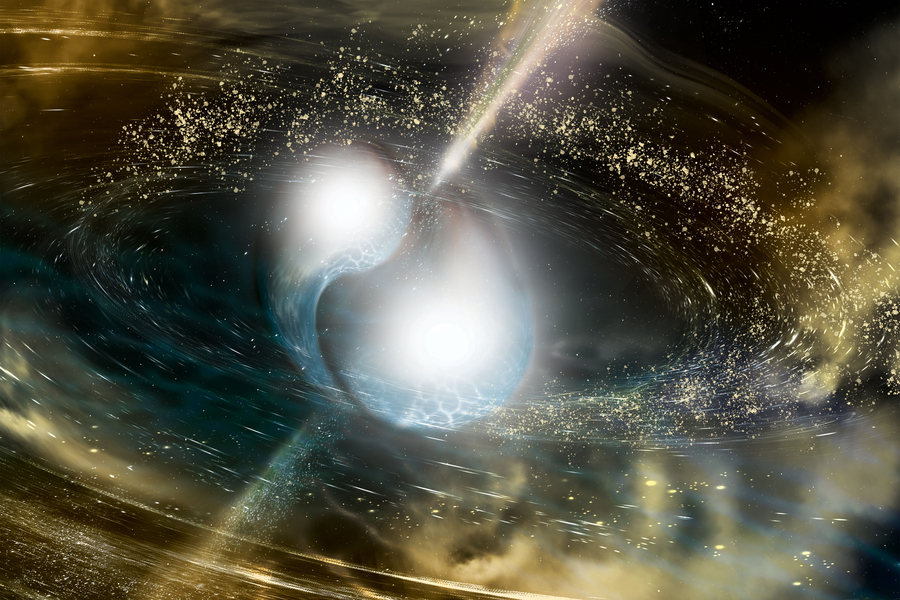
You can't have gold until a nucleus decays. The specifics of that process have been hard to pin down, but UT's nuclear physicists have published three discoveries in one paper explaining key details. The results can help scientists come up with new models to describe the stellar processes that give us heavy elements, as well as make better predictions about the expanding landscape of exotic nuclei.
Gold flakes expose the secret forces binding our world together Science Daily - October 24, 2025

Chalmers researchers have developed a simple, light-based platform to study the mysterious 'invisible glue' that binds materials at the nanoscale. Gold flakes floating in salt water reveal how quantum and electrostatic forces interact through vivid color changes. The technique could lead to new discoveries in physics, chemistry, and biology - from designing biosensors to understanding how galaxies form.
Record-breaking clump of dark matter found hiding within a warped 'Einstein ring' 10 billion light-years away Live Science - October 16, 2025
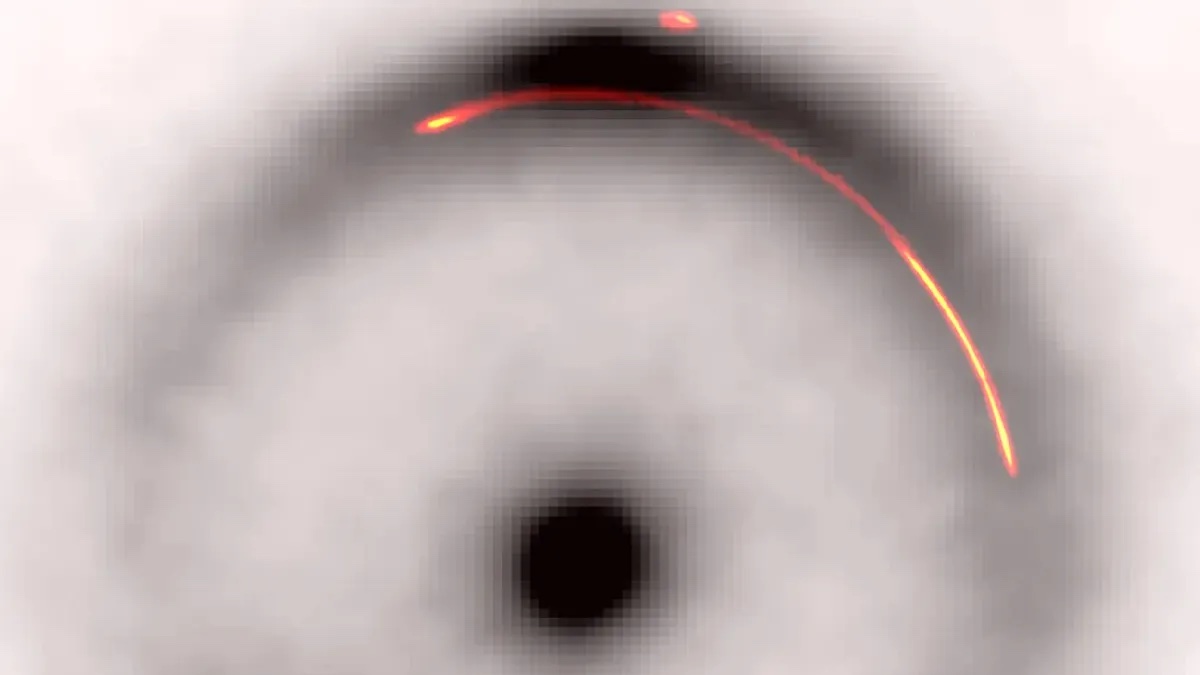
Researchers have found a suspected clump of dark matter lurking within the luminous halo of a well-known "Einstein ring." The mysterious object, the smallest of its kind ever seen, could help shed light on the universe's missing matter.
JWST may have found the Universe's first stars powered by dark matter Science Daily - October 14, 2025
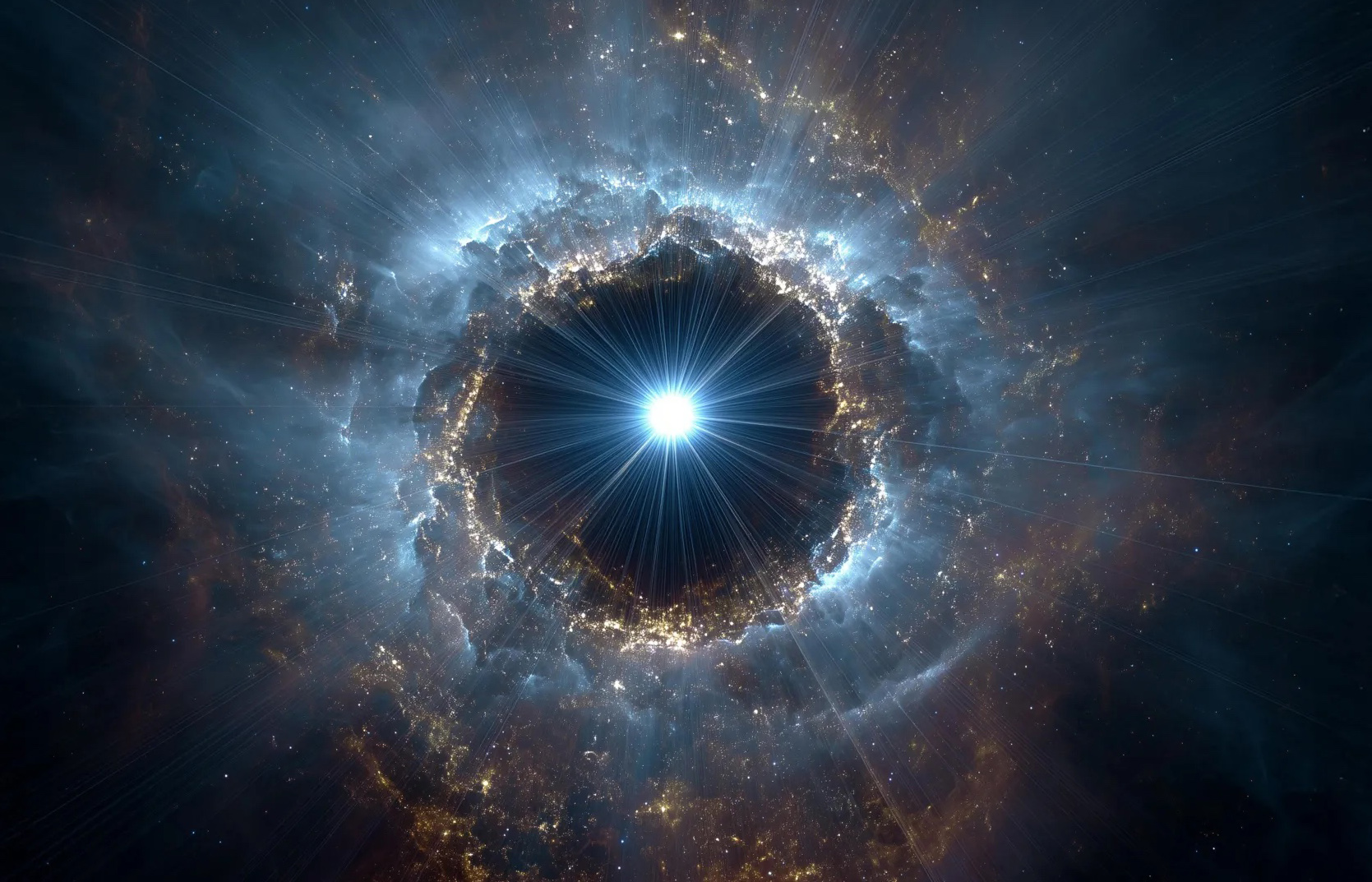
New observations from the James Webb Space Telescope hint that the universe's first stars might not have been ordinary fusion-powered suns, but enormous supermassive dark stars powered by dark matter annihilation. These colossal, luminous hydrogen-and-helium spheres may explain both the existence of unexpectedly bright early galaxies and the origin of the first supermassive black holes.
Physicists Predict When The Universe Will End in a Reverse Big Bang

If recent discoveries that dark energy is evolving hold any water, our Universe will collapse under its own gravity on a finite timeline, new calculations suggest.
What if the Universe Remembers Everything? New Theory Rewrites the Rules of Physics SciTech Daily - October 3, 2025

For over a century, physics has been divided between the elegance of EinsteinÕs relativity and the strangeness of quantum mechanics. A new framework, the quantum memory matrix, suggests that spacetime itself is made of discrete ÒcellsÓ that remember every interaction.
Time Without Time: A new perspective on how cosmological correlations change based on kinematic parameters PhysOrg - August 23, 2025

To study the origin and evolution of the universe, physicists rely on theories that describe the statistical relationships between different events or fields in spacetime, broadly referred to as cosmological correlations. Kinematic parameters are essentially the data that specify a cosmological correlation - the positions of particles, or the wave-numbers of cosmological fluctuations.

A team of physicists has reproduced the reactions of helium hydride ion (HeH+), a molecule made from a neutral helium atom fusing with an ionized atom of hydrogen. These are the first steps that lead to the formation of molecular hydrogen (H2); the most abundant molecule in the Universe and the stuff from which stars are born. The new work, therefore, elucidates some of the earliest processes that gave rise to the Universe as we know it today.
Distorted sound of the early universe suggests we are living in a giant void PhysOrg - July 28, 2025

Looking up at the night sky, it may seem our cosmic neighborhood is packed full of planets, stars and galaxies. But scientists have long suggested there may be far fewer galaxies in our cosmic surroundings than expected. In fact, it appears we live in a giant cosmic void with roughly 20% lower than the average density of matter.
Astronomers have found the home address for the universe's 'missing' matter PhysOrg - June 17, 2025

A new landmark study has pinpointed the location of the universe's "missing" matter, and detected the most distant fast radio burst (FRB) on record. Using FRBs as a guide, astronomers at the Center for Astrophysics | Harvard & Smithsonian (CfA) and Caltech have shown that more than three-quarters of the universe's ordinary matter has been hiding in the thin gas between galaxies, marking a major step forward in understanding how matter interacts and behaves in the universe.
Universe expected to decay much sooner than previously thought Live Science - May 15, 2025

The End of The Universe May Not Be as Far Off as Once Thought Science Alert - May 15, 2025
Half of the universe's hydrogen gas, long unaccounted for, has been found PhysOrg - April 14, 2025

Astronomers tallying up all the normal matter - stars, galaxies and gas - in the universe today have come up embarrassingly short of the total matter produced in the Big Bang 13.6 billion years ago. In fact, more than half of normal matter - half of the 15% of the universe's matter that is not dark matter - cannot be accounted for in the glowing stars and gas we see.
How will the universe end? A changing understanding of dark energy may provide a new answer PhysOrg - March 20, 2025

Scientists are homing in on the nature of a mysterious force called dark energy, and nothing short of the fate of the universe hangs in the balance. The force is enormous - it makes up nearly 70% of the universe. And it is powerful - it is pushing all the stars and galaxies away from each other at an ever faster rate.
Is our universe trapped inside a black hole? This James Webb Space Telescope discovery might blow your mind Live Science - March 17, 2025
The simplest explanation of the rotating universe is that the universe was born inside a rotating black hole. That explanation agrees with theories such as black hole cosmology, which postulates that the entire universe is within the interior of a black hole. Simulation Theory
At 1.3 Billion Light-Years Wide, Quipu Is Officially The Biggest Thing in The Universe Science Alert - February 6, 2025

Quipu is named after an Incan measuring system.
Could we travel to parallel universes? Live Science - January 31, 2024

While parallel universes are a staple of science fiction, there are some real scientific theories to support them. But if parallel universes do exist, could we ever travel to them? It certainly wouldn't be easy, but let's explore this possibility.
New Study of Supernovae Data Suggests That Dark Energy is an Illusion Universe Today - January 2, 2025

Dark energy is central to our modern understanding of cosmology. In the standard model, dark energy is what drives the expansion of the Universe. In general relativity, itÕs described by a cosmological constant, making dark energy part of the structure of space and time. But as weÕve gathered more observational evidence, there are a few problems with our model. For one, the rate of cosmic expansion we observe depends on the observational method we use, known as the Hubble tension problem. For another, while we assume dark energy is uniform throughout the cosmos, there are some hints suggesting that might not be true. Now a new study argues weÕve got the whole thing wrong. Dark energy, the authors argue, doesnÕt exist.

It all started with a Big Bang: The quest to unravel the mystery behind the birth of the universe PhysOrg - October 31, 2024
This describes how the universe was born in a cataclysmic explosion almost 14 billion years ago. In a tiny fraction of a second, the observable universe grew by the equivalent of a bacterium expanding to the size of the Milky Way. The early universe was extraordinarily hot and extremely dense. But how do we know this happened?
Did the early cosmos balloon in size? A mirror universe going backwards in time may be a simpler explanation PhysOrg - October 24, 2024
We live in a golden age for learning about the universe. Our most powerful telescopes have revealed that the cosmos is surprisingly simple on the largest visible scales. Likewise, our most powerful "microscope," the Large Hadron Collider, has found no deviations from known physics on the tiniest scales. These findings were not what most theorists expected. Today, the dominant theoretical approach combines string theory, a powerful mathematical framework with no successful physical predictions as yet, and "cosmic inflation" - the idea that, at a very early stage, the universe ballooned wildly in size. In combination, string theory and inflation predict the cosmos to be incredibly complex on tiny scales and completely chaotic on very large scales.
Meet The Cosmic Web - The Largest Structure In The Universe IFL Science - August 28, 2024
When we look for Òthe biggestÓ in the universe, it is important to specify our definition of the object of study. Is it something indivisible and with a neat boundary, like a black hole? Or do we prefer fuzzy edges so we can talk about galaxies? But if we are looking for the BOAT, the biggest of all time (and space), there is only one answer: the cosmic web. This is how the universe is organized. Galaxies can be found quite isolated, in groups, or in clusters. And no matter their location, they are likely to be involved in a supercluster of galaxies. The superclusters are connected by filaments, sheets, and walls. Between these, there are enormous voids. The ÒwebÓ in the cosmic web showcases the interconnection between the structures, but the distribution can be visualized as foam: galaxies are in the soapy water, the bubbles are the void.
Discovery sheds light on the origins of matter in the early universe PhysOrg - July 29, 2024

The early universe was 250,000 times hotter than the core of our sun. That's far too hot to form the protons and neutrons that make up everyday matter. Scientists recreate the conditions of the early universe in particle accelerators by smashing atoms together at nearly the speed of light.
New model suggests partner anti-universe could explain accelerated expansion without the need for dark energy PhysOrg - June 4, 2024

The accelerated expansion of the present universe, believed to be driven by a mysterious dark energy, is one of the greatest puzzles in our understanding of the cosmos. The standard model of cosmology called Lambda-CDM, explains this expansion as a cosmological constant in Einstein's field equations. However, the cosmological constant itself lacks a complete theoretical understanding, particularly regarding its very small positive value.
Cosmic Glitch: Scientists Discover an Anomaly in The Universe's Gravity Science Alert - May 24, 2024

Over the last 100 years, countless studies have proven that Albert Einstein's greatest theory Ð his theory of general relativity Ð is practically bulletproof, capable of everything from predicting black holes to guiding your GPS technology. However, as scientists arm themselves with more powerful and sophisticated technology, capable of peering into the cosmos in unprecedented detail, they see phenomena they can't explain with Einstein's theory. Einstein's general theory of relativity states that the curvature of space-time causes gravity. But zoom out to enormous scales like clusters of galaxies spanning billions of light years across, and the laws of Einstein's gravity theory appear to change.
Astronomers Found A Massive Void In The Universe 1.8 Billion Light-Years Across IFL Science - May 9, 2024
In 1981, while conducting a redshift survey of the distribution of galaxies, astronomers spotted something (or nothing) that they weren't expecting. They found evidence of a void spanning 1.91 percent of the diameter of observable universe, although the void is still not large enough to explain the mysterious CMB cold spot.
NASA Loses Contact With Voyager 2 After Commands Misdirect Probe Science Alert - August 1, 2023
A mysterious, 16-minute-long explosion of energy detected from the beginning of the universe could be the result of a gravitational mirage - or something that astronomers can't explain. Gamma-ray bursts (GRBs) are the most powerful explosions in the universe since the Big Bang. Typically, these short and extremely bright flashes of light only last seconds to a few minutes. But now, astronomers have discovered one named GRB 220627A that lasted for more than a thousand seconds - or just shy of 17 minutes. It arrived in two powerful bursts from an unknown event 2 billion years into the universe's existence.
The expansion of the universe could be a mirage, new theoretical study suggests Live Science - June 20, 2023
This rethinking of the cosmos also suggests solutions for the puzzles of dark energy and dark matter, which scientists believe account for around 95% of the universe's total energy and matter but remain shrouded in mystery.
Wild Study Shows Everything in The Universe Will Eventually Evaporate Science Alert - June 2, 2023
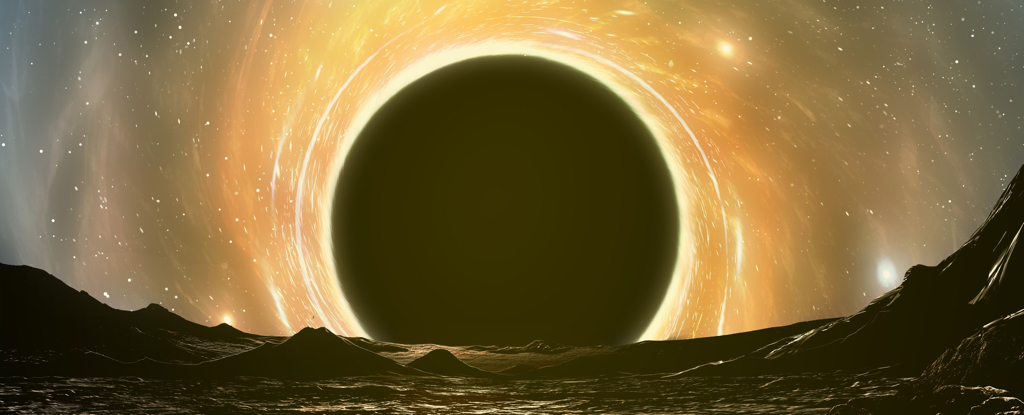
According to a famous theory by Stephen Hawking, black holes evaporate over time, gradually losing mass in the form of a strange kind of radiation as the event horizon plays havoc with surrounding quantum fields. But it turns out that the dramatic cliff of an event horizon may not be as critical to this process after all. According to new research by astrophysicists in the Netherlands, a steep enough slope in the curvature of space-time could do the same thing. This means Hawking radiation, or something very similar to it, may not be limited to black holes. It could be everywhere, meaning that the Universe is very slowly evaporating before our very eyes.
The first light in the universe helps build a dark matter map PhysOrg - April 23, 2023
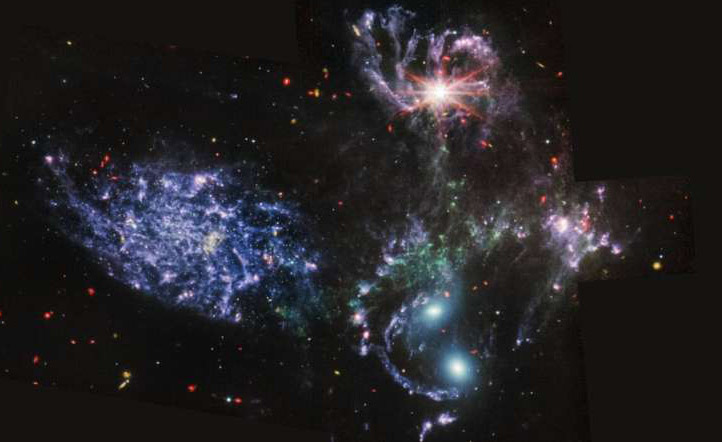
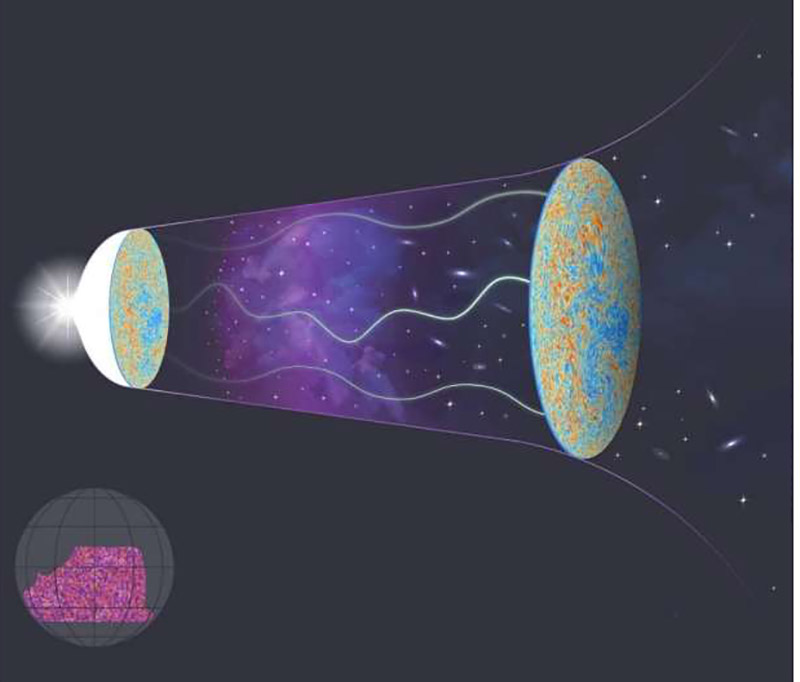
This latest map has taken that research a step further by using it to measure how the structure of matter has evolved since, 85% of which is Dark Matter.
The multiverse: Our universe is suspiciously unlikely to exist - unless it is one of many, says physicist PhysOrg - March 16, 2023
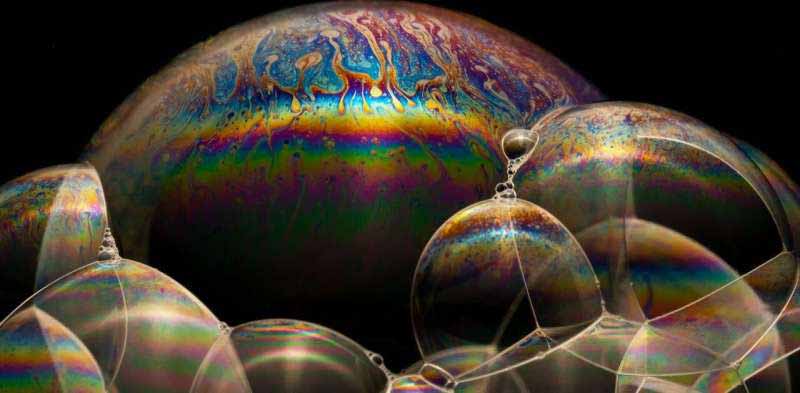
It's easy to envisage other universes, governed by slightly different laws of physics, in which no intelligent life, nor indeed any kind of organized complex systems, could arise. Should we therefore be surprised that a universe exists in which we were able to emerge? That's a question physicists including me have tried to answer for decades. But it is proving difficult. Although we can confidently trace cosmic history back to one second after the Big Bang, what happened before is harder to gauge. Our accelerators simply can't produce enough energy to replicate the extreme conditions that prevailed in the first nanosecond.
We're Either Suspiciously Lucky, or There Really Are Many Universes Out There Science Alert - March 16, 2023
It's easy to envisage other universes, governed by slightly different laws of physics, in which no intelligent life, nor indeed any kind of organized complex systems, could arise. Should we therefore be surprised that a universe exists in which we were able to emerge?
The Multiverse: Our Universe Is Suspiciously Unlikely To Exist - Unless It Is One Of Many IFL Science - March 16, 2023
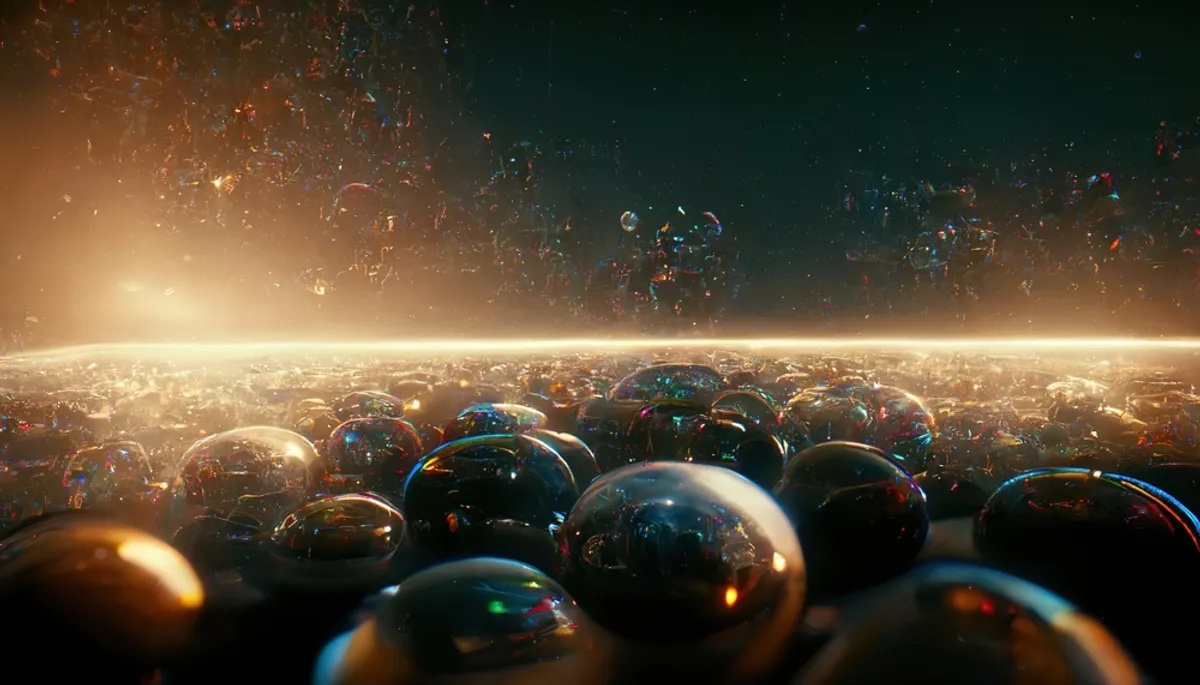
Do universes pop up as bubbles from a multiverse? The conditions of the universe can be described through its fundamental constants - fixed quantities in nature, such as the gravitational constant (called G) or the speed of light (called C). There are about 30 of these representing the sizes and strengths of parameters such as particle masses, forces or the universe's expansion. But our theories don't explain what values these constants should have. Instead, we have to measure them and plug their values into our equations to accurately describe nature.
The largest structures in the universe are still glowing with the shock of their creation PhysOrg - February 21, 2023
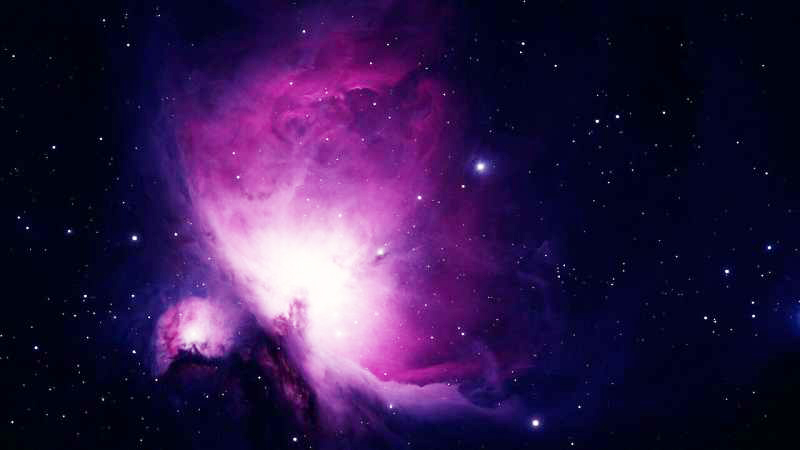
On the largest scales, the universe is ordered into a web-like pattern: galaxies are pulled together into clusters, which are connected by filaments and separated by voids. These clusters and filaments contain dark matter, as well as regular matter like gas and galaxies. We call this the "cosmic web", and we can see it by mapping the locations and densities of galaxies from large surveys made with optical telescopes. We think the cosmic web is also permeated by magnetic fields, which are created by energetic particles in motion and in turn guide the movement of those particles. Our theories predict that, as gravity draws a filament together, it will cause shockwaves that make the magnetic field stronger and create a glow that can be seen with a radio telescope.
Do quantum universes really exist? Live Science - January 4, 2023
In some interpretations of quantum mechanics, such as the Many-Worlds interpretation or the Pilot Wave Theory, parallel universes may form every time a subatomic particle goes through any interaction.
Ripples in fabric of universe may reveal start of time PhysOrg - January 20, 2023
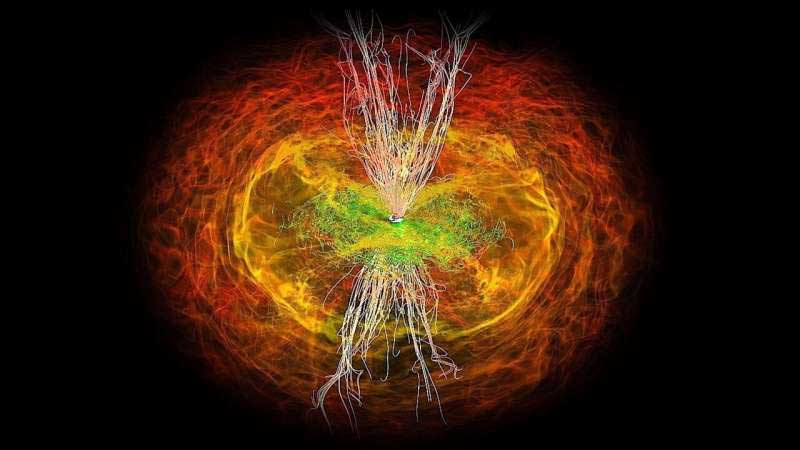
Scientists have advanced in discovering how to use ripples in space-time known as gravitational waves to peer back to the beginning of everything we know. The researchers say they can better understand the state of the cosmos shortly after the Big Bang by learning how these ripples in the fabric of the universe flow through planets and the gas between the galaxies.
NASA: NASA's Webb Reveals Cosmic Cliffs, Glittering Landscape of Star Birth
CNN: NASA releases first images from JWST
BBC: James Webb Space Telescope delivers spectacular pictures
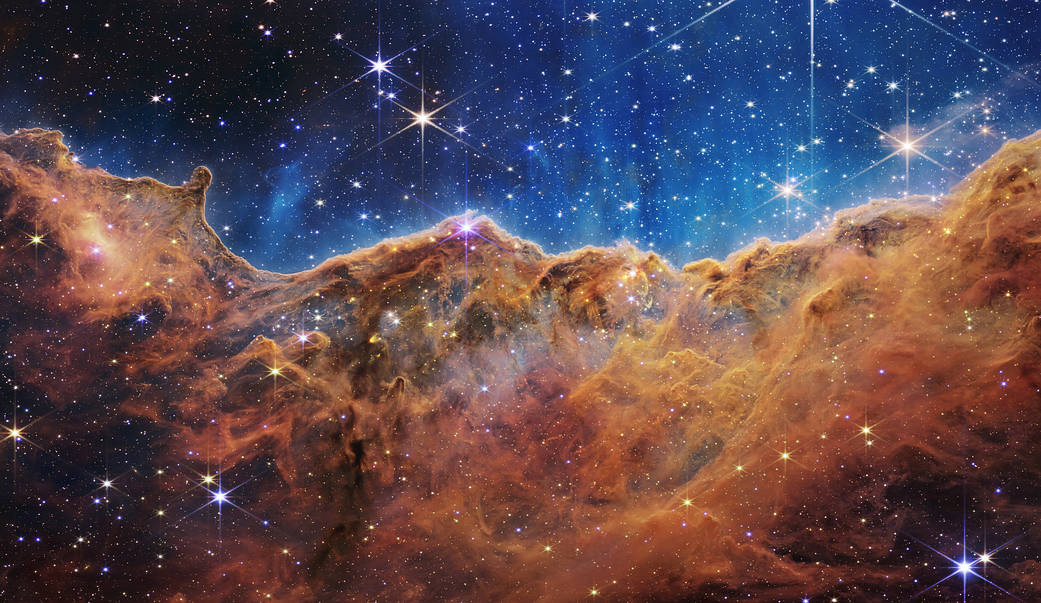
The Carina Nebula was a classic target of the Hubble telescope - Webb's predecessor - although in this Webb version we get a very different rendering. Carina is one of the largest and brightest nebulae in the sky, located roughly 7,600 light-years from Earth. Nebulae are stellar nurseries. They are a massive clouds of gas and dust in which new stars are forming. Except in this Webb image, we not only see the stars - our eyes are drawn to all that gas and the dust. Astronomers refer here to a "cosmic reef", or "cosmic cliff" - a kind of broad demarcation between dust in the bottom half, and then gas in the top half. One of Webb's key scientific goals is to study how stars form, and Carina is an excellent place to do that.
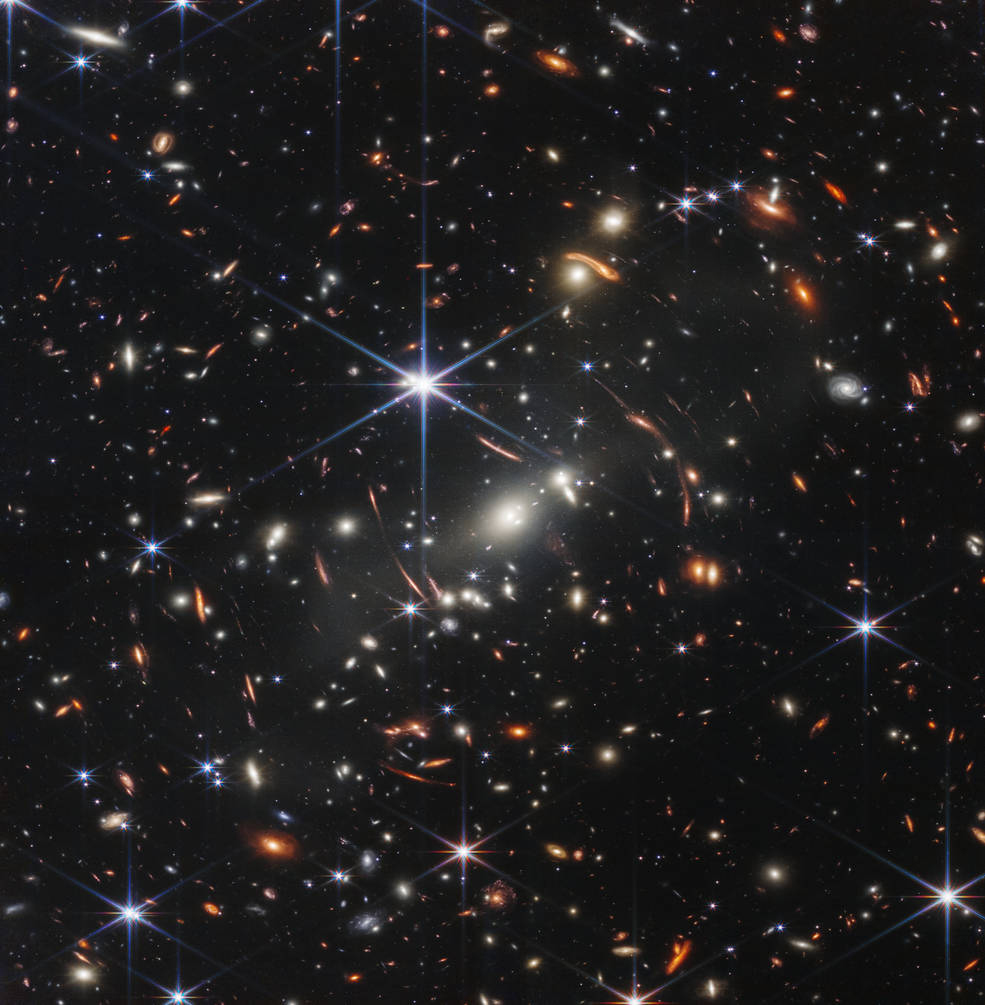
SMACS 0723 is a huge cluster of galaxies. It's known to astronomers as a "gravitational lens" because the mass of the cluster bends and magnifies the light of objects that are much further away. Everywhere you see a red arc-like structure - that's something - a galaxy - way off in the distance and far further back in time. The light in some of those arcs has taken over 13 billion years to reach us. And here's the slightly bizarre thing - some of those arcs on either side of the image are actually the same object. Their light has been bent through SMACS 0723 on more than one path.
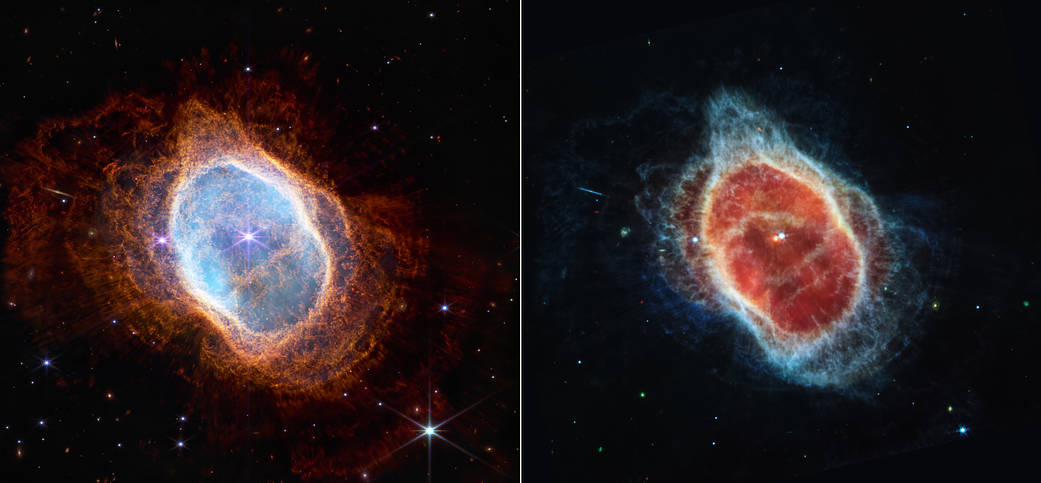
The Southern Ring, or "Eight-Burst" nebula, is a giant expanding sphere of gas and dust that's been lit up by a dying star in the centre. As stars age, they change the way they make energy and eject their outer layers. And then, when the star gets very hot again, it energizes all that material it had previously spurned. The Southern Ring is nearly half a light-year in diameter and is located about 2,000 light-years from Earth. This type of structure is called a "planetary nebula", but it actually has nothing to do with planets. It's a misnomer from the early days of telescopes when they didn't have anything like the resolution they have today. Just as Webb wants to see how stars are born, it wants to see how they die, also.
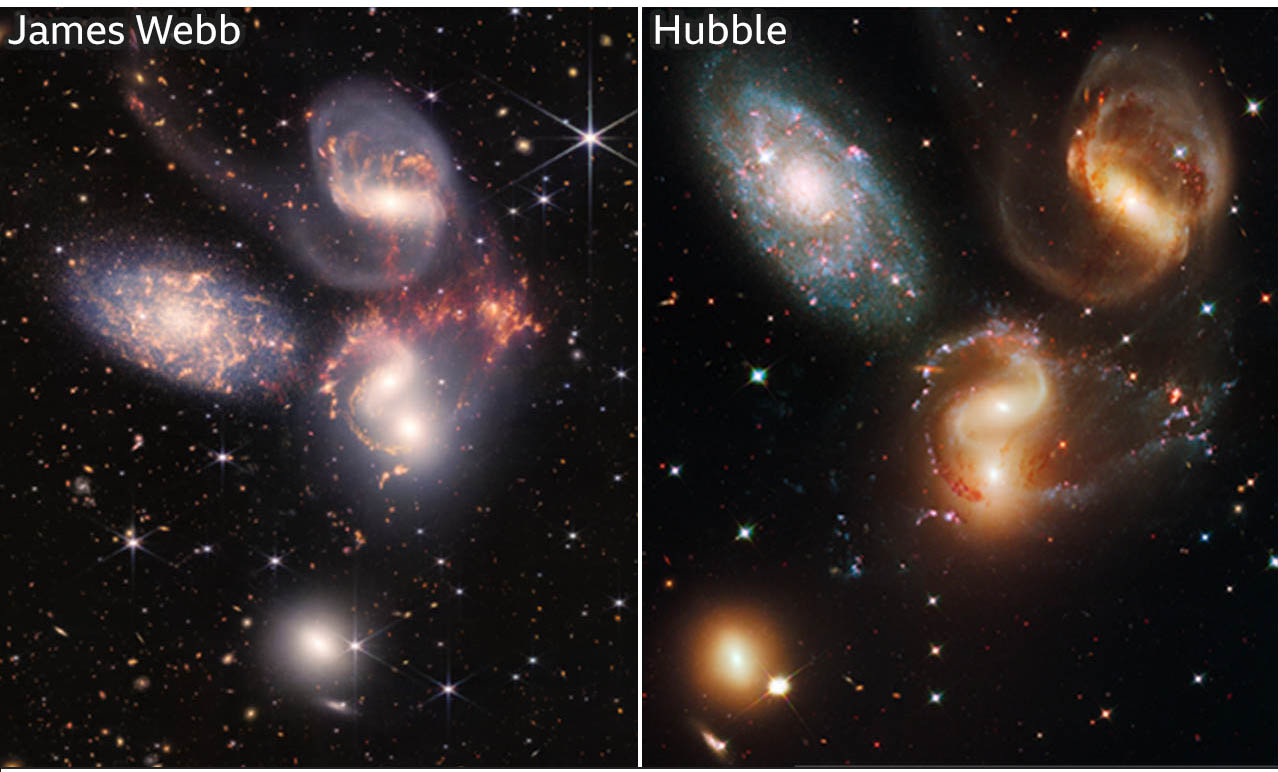
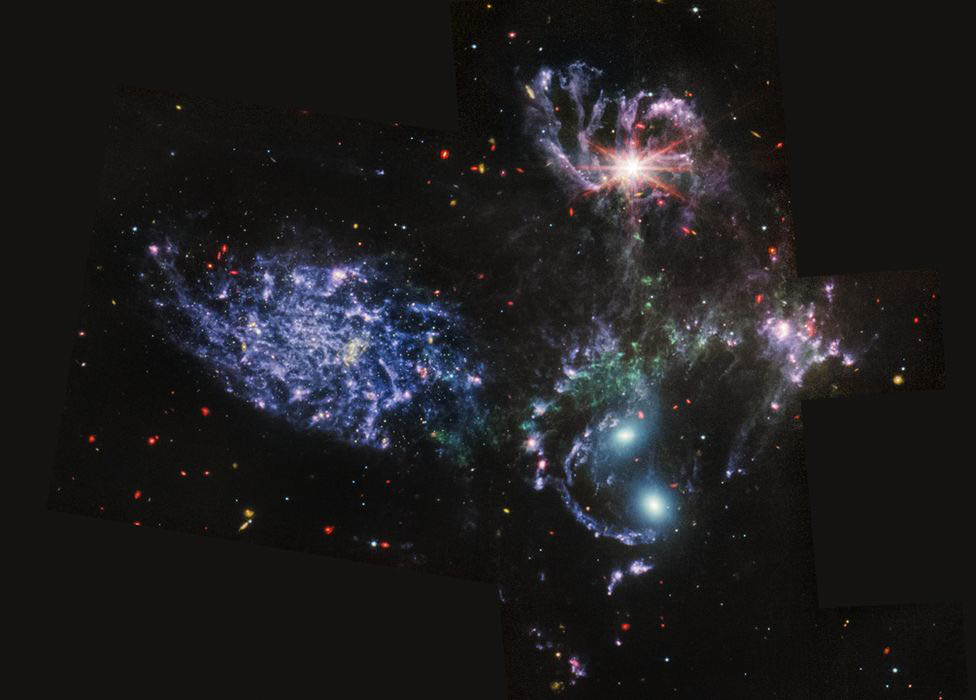
About 290 million light-years away, Stephan's Quintet is located in the constellation Pegasus. It's notable for being the first compact galaxy group ever discovered. Four of the five galaxies within the quintet are locked in a cosmic dance of repeated close encounters. This Webb image doesn't look that different from the Hubble version at first glance, but the new telescope's infrared sensitivity will pull out different features for astronomers to study. And this was the great hope - that we would have Webb working alongside Hubble. They have different strengths and being able to compare and contrast will give scientists a new dimension to their studies. We don't know for how much longer Hubble will operate. It's 32 years old and prone to technical glitches. But the officials at Nasa who are in charge of the old warhorse have just submitted a five-year budget plan. Keep your fingers crossed.
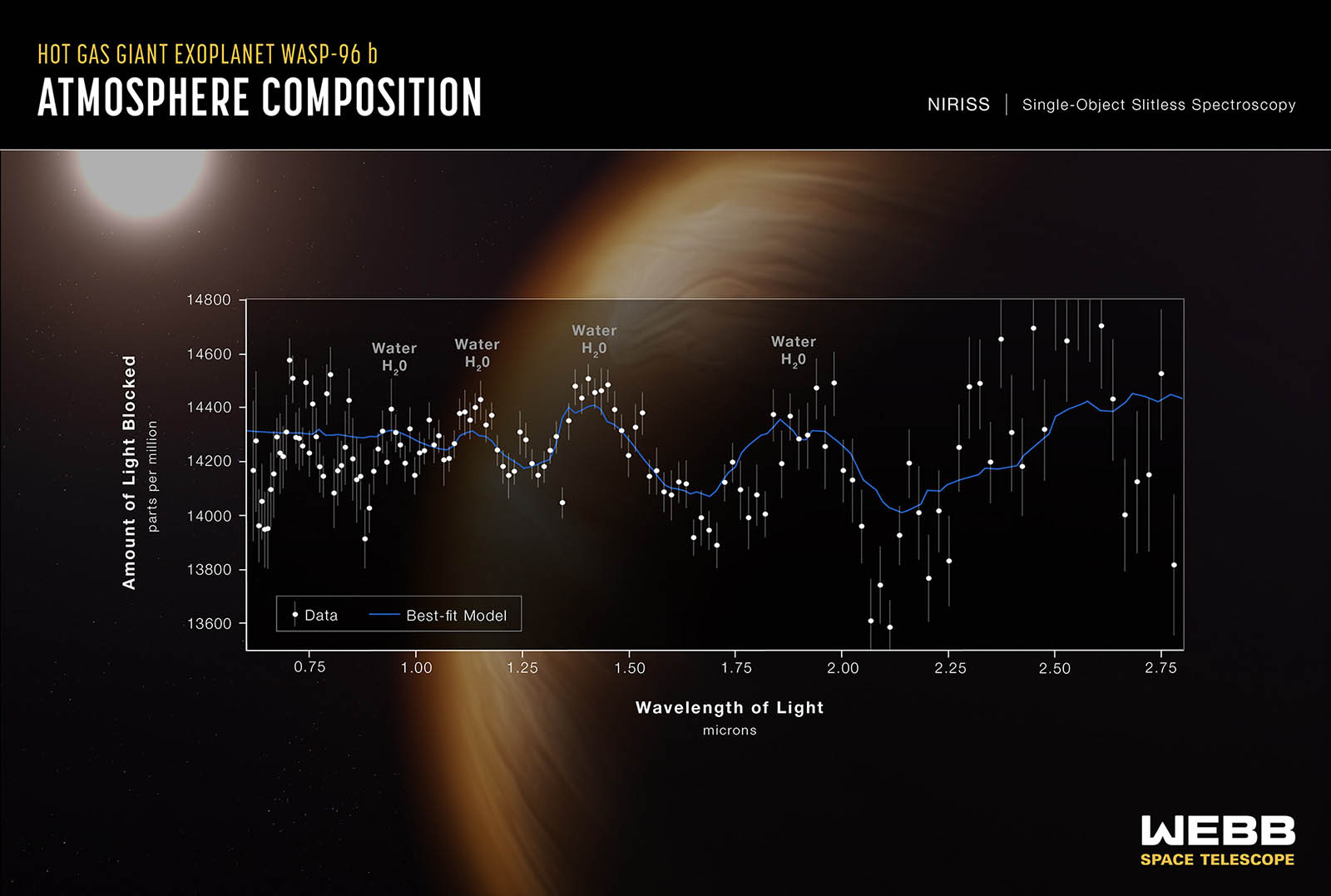
The giant planet WASP-96b, is located about 1,150 light-years from Earth. This mostly gaseous planet measures about half the mass of Jupiter, but orbits so closely to its home star that one year on the planet lasts the equivalent of just 3.4 Earth days. That quick orbital period is important, because it allows astronomers to easily study how light from the planet's home star is absorbed and reemitted by molecules in the planet's atmosphere. By breaking this spectrum of light down into its component wavelengths, scientists can discern the type and quantity of elements in the planet's atmosphere. This image reveals, for example, that there is a good deal of water vapor in WASP-96b's atmosphere. Blazing hot, is unlikely to harbor life. However, astronomers plan to take spectrum images of many other planets beyond our solar system, advancing the hunt for life beyond our solar system.
Quintessence - Dark Energy - Collapse of the Universe - If the universe is expanding like a rubber band - when it snaps back will it collapse into itself or the dark energy of its very existence?
In physics, Quintessence is a hypothetical form of dark energy postulated as an explanation of the observation of an accelerating rate of expansion of the universe. Continue reading
The universe could stop expanding 'remarkably soon' Live Science - May 1, 2022
Predicting how soon the universe could collapse if dark energy has quintessence PhysOrg - May 3, 2022
The Universe Could Collapse On Itself A Lot Quicker Than We Were Expecting Unilad - May 4, 2022
Mystery of Universe's Expansion Rate: Hubble Data Shows That Something Weird Is Going On SciTech Daily - May 22, 2022
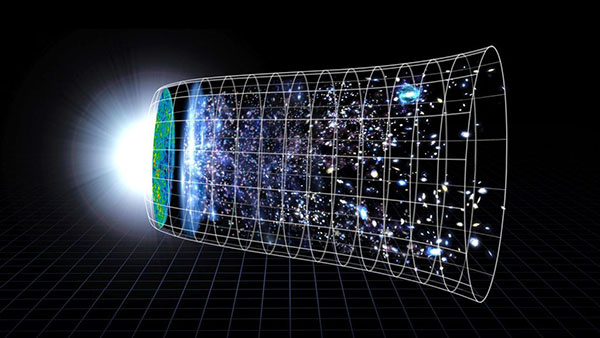
The Universe is already in its sixth and final era Big Think - January 5, 2022
From cosmic inflation to a primordial particle soup to the expanding, cooling aftermath, the Universe went through many important stages in our cosmic history. About 6 billion years ago, however, a new form of energy began to dominate the Universe's expansion: dark energy, which now determines our cosmic fate. The era we're living in, where dark energy dominates the Universe's expansion, is the final one our Universe will ever experience. Here's why we're already living through the beginning of the ultimate end.
Theories about the end of the universe Wikipedia
Big Freeze, Big Rip, Big Crunch, Big Bounce
Could the universe collapse into a singularity? New study explains how. Live Science - August 27, 2020
Has the universe been around forever? If so, perhaps it's been bouncing back and forth in a never-ending cycle of big bangs in which all matter bubbles out of a singularity, followed by big crunches, in which everything gets swallowed up again to form that dense point from which the universe is born again. And the cycle continues over and over and over.
Scientist Describes When and How the Universe Will Die a Sad and Lonely Death - Our Sun most likely end up burning out and collapsing into a dense frozen black dwarf Mysterious Universe - August 18, 2020
Black dwarf supernova might be the last interesting thing to happen in the universe.
It's Official: The Universe Is Dying Slowly Space.com - August 11, 2015
The most comprehensive assessment of the energy output in the nearby universe reveals that today's produced energy is only about half of what it was 2 billion years ago. A team of international scientists used several of the world's most powerful telescopes to study the energy of the universe and concluded that the universe is slowly dying. "We used as many space- and ground-based telescopes as we could get our hands on to measure the energy output of over 200,000 galaxies across as broad a wavelength range as possible," Galaxy And Mass Assembly (GAMA) team leader Simon Driver, of the University of Western Australia, said in a statement. The astronomers created a video explaining the slow death of the universe to illustrate the discovery. When the Big Bang created the energy of the universe about 13.8 billion years ago, some portion of that energy found itself locked up as mass. When stars shine, they are converting that mass back into energy, as described by Albert Einstein's famous equation E=mc2 (energy = mass x speed of light squared).
Is the universe actually shrinking? PhysOrg - February 3, 2015
There are some people who would have you believe the Universe is expanding. They're peddling this idea it all started with a bang, and that expansion is continuing and accelerating. Yet, they can't tell us what force is causing this acceleration. Just "dark energy", or some other JK Rowling-esque sounding thing. Otherwise known as the acceleration that shall not be named, and it shall be taught in the class which follows potions in 3rd period. I propose to you, faithful viewer, an alternative to this expansionist conspiracy. What if distances are staying the same, and everything is in fact, shrinking?
Collapse of the universe is closer than ever before PhysOrg - December 12, 2013
Sooner or later a radical shift in the forces of the universe will cause every little particle in it to become extremely heavy. Everything - every grain of sand on Earth, every planet in the solar system and every galaxy - will become millions of billions times heavier than it is now, and this will have disastrous consequences: The new weight will squeeze all material into a small, super hot and super heavy ball, and the universe as we know it will cease to exist. This violent process is called a phase transition and is very similar to what happens when, for example water turns to steam or a magnet heats up and loses its magnetization. The phase transition in the universe will happen if a bubble is created where the Higgs-field associated with the Higgs-particle reaches a different value than the rest of the universe. If this new value results in lower energy and if the bubble is large enough, the bubble will expand at the speed of light in all directions. All elementary particles inside the bubble will reach a mass, that is much heavier than if they were outside the bubble, and thus they will be pulled together and form supermassive centers.
Endless Void or Big Crunch: How Will the Universe End? Live Science - October 26, 2011
Snapshot from a computer simulation of the formation of large-scale structures in the universe, showing a patch of 100 million light-years and the resulting coherent motions of galaxies flowing toward the highest mass concentration in the center. Not only are scientists unsure how the universe will end, they aren't even sure it will end at all. Several possibilities for the fate of our universe have been bandied about. They tend to have names such as Big Crunch, Big Rip and Big Freeze that belie their essential bleakness. Ultimately, space could collapse back in on itself, destroying all stars and galaxies in existence, or it could expand into essentially an endless void.
How was the universe created? Short answer: We don't really know how the universe was created, though most astrophysicists believe it started with the Big Bang Live Science - November 25, 2022
We know that we live in an expanding universe. That means the entire universe is getting bigger with every passing day. It also means that in the past our universe was smaller than it is today. Rewind that tape far enough, and the physics suggests our universe was once an infinitely tiny, infinitely dense point - a singularity. Most physicists think this point expanded out in the Big Bang, but because all known physics breaks down in the extreme conditions that prevailed in our universe's infancy, it's hard to say with confidence what happened in those earliest moments of the universe.
NASA Is Unveils Deepest View of The Universe Science Alert - July 12, 2022
The deepest infrared view of the Universe ever was just unveiled, and it's even better than we could have imagined. In a NASA livestream, US President Joe Biden released the first official image from the James Webb Space Telescope (JWST), showing us an unprecedented new image of a region of space known as SMACS 0723 - a deep field into the distant Universe. It's the furthest back in time we've peered in the Universe to date, thanks to JWST's impressive infrared capabilities and its giant mirror. You can witness the image below in all its glory.
Take a Look at The Largest And Most Detailed 3D Map of The Universe Ever Made Science Alert - January 14, 2022
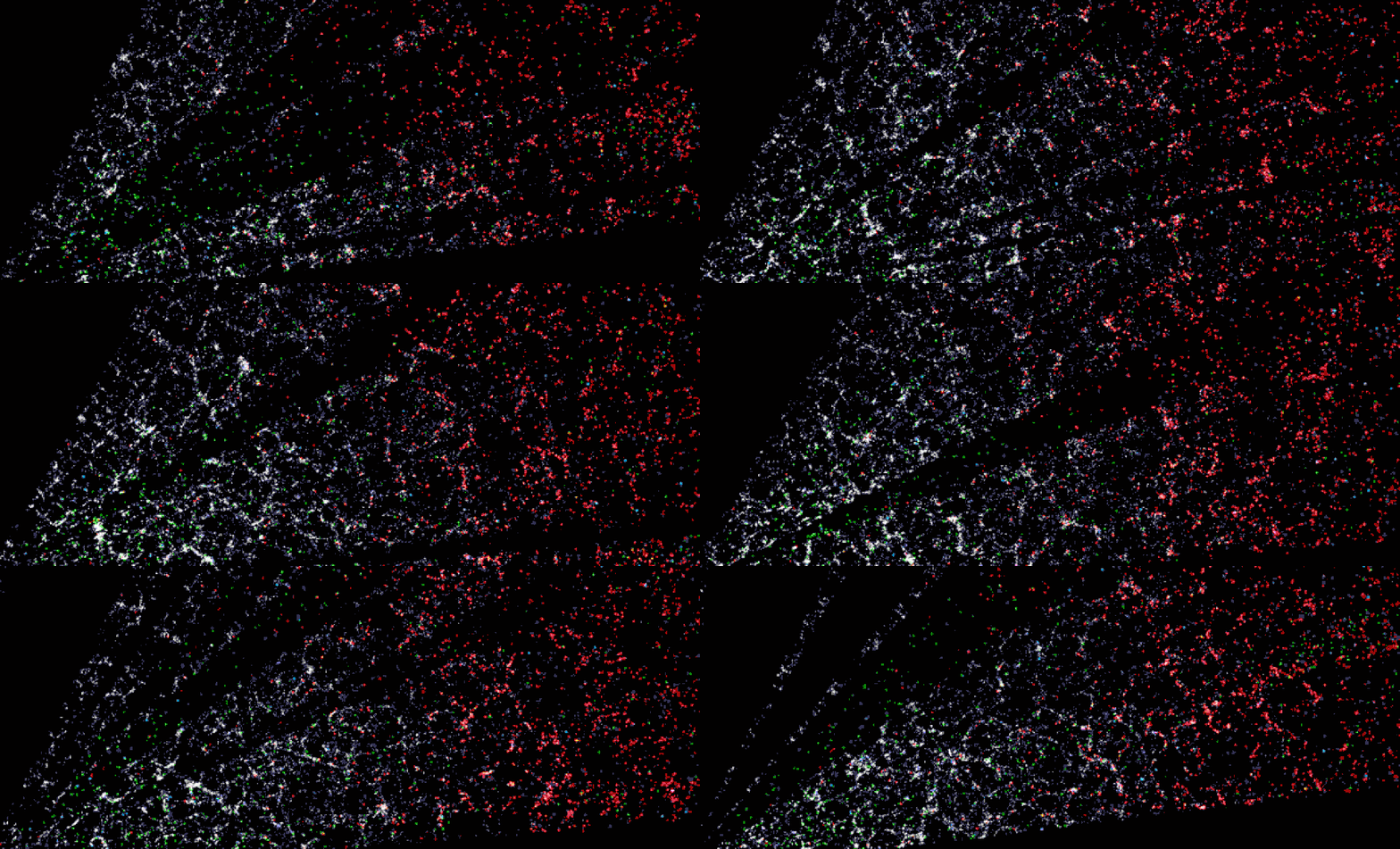
The Dark Energy Spectroscopic Instrument (DESI), currently pointed at the skies from its home in the Nicholas U. Mayall Telescope at the Kitt Peak National Observatory in Arizona, is tasked with charting the expansion of space, investigating dark energy, and creating the most detailed 3D map of the Universe that's ever been put together.The Dark Energy Spectroscopic Instrument (DESI), currently pointed at the skies from its home in the Nicholas U. Mayall Telescope at the Kitt Peak National Observatory in Arizona, is tasked with charting the expansion of space, investigating dark energy, and creating the most detailed 3D map of the Universe that's ever been put together.
Scientists Have Detected a Faint Hint of The Background Hum of The Universe Science Alert - January 13, 2022
Ever since scientists made the first detection of gravitational waves from a pair of colliding black holes in 2015, evidence has been growing that the Universe ought to be full of them. Every massive event - every black hole or neutron star merger, every supernova - should have sent gravitational waves ringing out across space-time. The combined effect of all these waves would be to create a faint, background hum that permeates the entire Universe. This gravitational wave background is predicted to be weak and very hard to detect. Nevertheless, a year ago, scientists with the international NanoGRAV collaboration said they may have done just that. Now, from the International Pulsar Timing Array (IPTA) consortium, tentative new evidence that we may have detected the hum has emerged. If confirmed, this will be a very big deal indeed.
A Gamma-Ray Burst Just Revealed a 'Goldilocks' Black Hole in The Early Universe nbsp; Science Alert - March 30, 2021
Scientists have reported the discovery of a rare, medium-sized black hole that may help answer one of the more tantalizing questions in astronomy: how do their supermassive counterparts come into being?
Scientists precisely measure total amount of matter in the universe PhysOrg - September 28, 2020
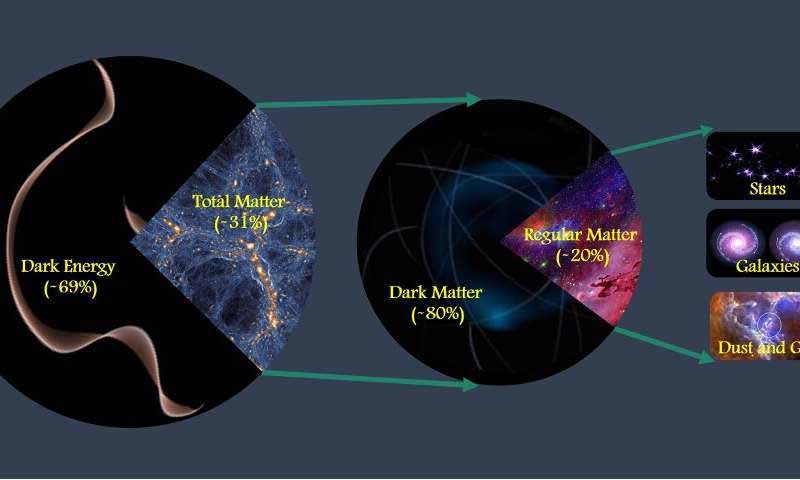
A top goal in cosmology is to precisely measure the total amount of matter in the universe, a daunting exercise for even the most mathematically proficient.
Oldest surviving light reveals the universe's true age PhysOrg - July 22, 2020
Ancient light from the Big Bang has revealed a precise new estimate for the universe's age: 13.77 billion years, give or take 40 million years. The new estimate, based on data from an array of telescopes in the Chilean Atacama Desert, also weighs in on one of the most important disagreements in astrophysics: How fast is the universe expanding? Described in two scientific papers, the new result gives a significant boost to one side of the disagreement, though the physicists couldn't prove the other side of the dispute wrong.
Here's the problem: Physicists need to understand the universe's expansion rate to make any sense of cosmology - the science of our whole universe's past, present and future. They know that a mysterious substance called dark energy is causing the universe to expand (at an ever-increasing rate) in all directions.. But when astronomers point their telescopes into space to measure the Hubble constant (H0) - the number that describes how fast the universe is expanding at different distances from us or another point - they come up with numbers that disagree with each other, depending on the method they use.
Astronomers detect biggest explosion in the history of the Universe PhysOrg - February 27, 2020
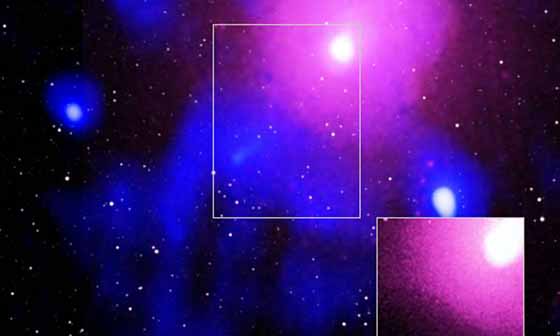
Scientists studying a distant galaxy cluster have discovered the biggest explosion seen in the Universe since the Big Bang. The blast came from a supermassive black hole at the centre of a galaxy hundreds of millions of light-years away. It released five times more energy than the previous record holder.
Universe's First Molecule Detected in Space for the First Time Ever Live Science - April 18, 2019
A few hundred thousand years after the Big Bang, the hot, young soup of our universe cooled enough for the smallest building blocks of life to combine into atoms for the first time. One balmy, 6,700-degree-Fahrenheit day (3,700 degrees Celsius), a helium atom glommed onto a single proton - actually a positively charged hydrogen ion Ñ and the universe's very first molecule was formed: helium hydride, or HeH+.
Scientists have studied lab-made versions of this primordial molecule for nearly a century, but they have never found traces of it in our modern universe - until now. In a new study published today (April 17) in the journal Nature, astronomers report on their use of an airborne telescope to detect HeH+ smoldering in the cloud of gas around a dying star some 3,000 light-years away. According to the researchers, this discovery, which has been more than 13 billion years in the making, shows conclusively that HeH+ is formed naturally in conditions similar to those found in the early universe.
Our Universe Could Be An Expanding Bubble in an Extra Dimension Live Science - January 5, 2019

The state of the early universe: The beginning was fluid PhysOrg - October 17, 2018
Scientists from the Niels Bohr Institute, University of Copenhagen, and their colleagues from the international ALICE collaboration recently collided xenon nuclei in the superconducting Large Hadron Collider in order to gain new insights into the properties of the quark-gluon plasma (QGP). The QGP is a special state consisting of quarks and the gluons that bind the quarks together. Scientists from the Niels Bohr Institute, University of Copenhagen, and their colleagues from the international ALICE collaboration recently collided xenon nuclei in the superconducting Large Hadron Collider in order to gain new insights into the properties of the quark-gluon plasma (QGP). The QGP is a special state consisting of quarks and the gluons that bind the quarks together.
The universe shouldn't exist: World's top scientists struggle to explain why our cosmos didn't destroy itself as soon as it came into existence Daily Mail - October 24, 2017
Experts say, according to the standard model of physics, the cosmos should have destroyed itself when it formed. This is because the universe was born with equal amounts of matter and anti-matter, which must have collided and instantly annihilated one another. But this didn't happen - and scientists are still baffled as to why. Researchers have spent years looking for any difference between anti-matter and matter that explains why they didn't cancel one another out when the cosmos was created. The latest possibility being probed by researchers was that matter and anti-matter may have different magnetism. But new research shows that they are identical, deepening the mystery of why the universe still exists.
Galaxy 5 billion light-years away shows we live in a magnetic universe Science Daily - August 28, 2017
A chance combination of a gravitational lens and polarized waves coming from a distant quasar gave astronomers the tool needed to make a measurement important to understanding the origin of magnetic fields in galaxies. With the help of a gigantic cosmic lens, astronomers have measured the magnetic field of a galaxy nearly five billion light-years away. The achievement is giving them important new clues about a problem at the frontiers of cosmology - the nature and origin of the magnetic fields that play an important role in how galaxies develop over time.
Magnetic galaxy discovered five billion light-years away suggests planets hosting alien life could have been a 'common phenomenon' since the dawn of time Daily Mail - August 28, 2017
Astronomers have observed the magnetic field of a galaxy that suggests life-bearing planets could have been a relatively common phenomenon in the history of the universe. The galaxy - which is five billion light-years from Earth and also five billion years younger - has a similar sized magnetic field to our own, suggesting magnetic fields must start early relative to the age of the universe. Planets with magnetism are places where life can evolve as the field forms a shield that protects the surface from harmful radiation. The new discovery has therefore extended the window in which alien life could have developed in many distant galaxies.
Is the Universe Conscious? NBC - June 16, 2017
Some of the world's most renowned scientists are questioning whether the universe is a living entity that can think and feel and move at will. For centuries, modern science has been shrinking the gap between humans and the rest of the universe, from Isaac Newton showing that one set of laws applies equally to falling apples and orbiting moons to Carl Sagan intoning that 'we are made of star stuff' - that the atoms of our bodies were literally forged in the nuclear furnaces of other stars.
Was Einstein wrong? Researchers suggest there is a fifth force of nature governing our universe Daily Mail - May 30, 2017
Our understanding of the universe, based largely on Einstein's theory of general relativity, relies on four fundamental forces: Gravity, electromagnetic, and the strong and weak nuclear forces. These forces stop planets, molecules and even atoms from tearing themselves apart and are the building blocks for the physical rules of the cosmos. But in recent decades, whispers of a fifth force of nature have surfaced, and if it exists, it could overthrow everything we know about how the universe works. Now, researchers have discovered the ultimate way to test whether this fifth force is real, and it involves tracking the stars at the centre of our galaxy.
Research reinforces role of supernovae in clocking the universe PhysOrg - January 4, 2017
How much light does a supernova shed on the history of universe? The findings support a widely held theory that the expansion of the universe is accelerating and such acceleration is attributable to a mysterious force known as dark energy. The findings counter recent headlines that Type Ia supernova cannot be relied upon to measure the expansion of the universe.
Scientists confirm the universe has no direction PhysOrg - September 25, 2016
The universe is not spinning or stretched in any particular direction, according to the most stringent test yet. Looking out into the night sky, we see a clumpy universe: planets orbit stars in solar systems and stars are grouped into galaxies, which in turn form enormous galaxy clusters. But cosmologists assume this effect is only local: that if we look on sufficiently large scales, the universe is actually uniform. The vast majority of calculations made about our universe start with this assumption: that the universe is broadly the same, whatever your position and in whichever direction you look. If, however, the universe was stretching preferentially in one direction, or spinning about an axis in a similar way to the Earth rotating, this fundamental assumption, and all the calculations that hinge on it, would be wrong.
Explaining why the universe can be 'transparent': Universe's re-ionization is based on a galaxy's dust content Science Daily - September 13, 2016
The Universe's re-ionization is based on a galaxy's dust content. Scientists can explain why the universe has enough energy to become transparent. The study marks the first quantitative study of how the gas content within galaxies scales with the amount of interstellar dust. Re-ionization, which marks the point at which the hydrogen in the Universe became ionized, has become a major area of current research in astrophysics. Ionization made the Universe transparent to these photons, allowing the release of light from sources to travel mostly freely through the cosmos.
Does the Universe Have an Edge? Live Science - June 2, 2016
Scientists now know the universe is expanding, at an ever-increasing rate. So if it's ballooning, what is it growing into? In other words, what is beyond the known universe? Defining this "beyond the universe" would imply that the universe has an edge. And that's where things get tricky, because scientists aren't certain if such a drop-off exists. The answer depends on how one views the question.
Five billion light years across: The largest feature in the universe Science Daily - August 4, 2015
Astronomers have found what appears to be the largest feature in the observable universe: a ring of nine gamma ray bursts - and hence galaxies - 5 billion light years across. Gamma-ray bursts (GRBs) are the most luminous events in the universe, releasing as much energy in a few seconds as the Sun does over its 10 billion year lifetime. They are thought to be the result of massive stars collapsing into black holes. Their huge luminosity helps astronomers to map out the location of distant galaxies, something the team exploited. The GRBs that make up the newly discovered ring were observed using a variety of space- and ground-based observatories. They appear to be at very similar distances from us - around 7 billion light years - in a circle 36° across on the sky, or more than 70 times the diameter of the Full Moon.
Assembly of galaxies in the early universe witnessed for the first time Science Daily - July 22, 2015
The Atacama Large Millimeter/submillimeter Array (ALMA) has been used to detect the most distant clouds of star-forming gas yet found in normal galaxies in the early universe. The new observations allow astronomers to start to see how the first galaxies were built up and how they cleared the cosmic fog during the era of reionization. This is the first time that such galaxies are seen as more than just faint blobs. When the first galaxies started to form a few hundred million years after the Big Bang, the Universe was full of a fog of hydrogen gas. But as more and more brilliant sources -- both stars and quasars powered by huge black holes -- started to shine they cleared away the mist and made the Universe transparent to ultraviolet light . Astronomers call this the epoch of reionisation, but little is known about these first galaxies, and up to now they have just been seen as very faint blobs. But now new observations using the power of ALMA are starting to change this.
Is the universe ringing like a crystal glass? PhysOrg - June 27, 2015
Many know the phrase "the big bang theory." There's even a top television comedy series with that as its title. According to scientists, the universe began with the "big bang" and expanded to the size it is today. Yet, the gravity of all of this matter, stars, gas, galaxies, and mysterious dark matter, tries to pull the universe back together, slowing down the expansion. Now, two physicists at The University of Southern Mississippi, Lawrence Mead and Harry Ringermacher, have discovered that the universe might not only be expanding, but also oscillating or "ringing" at the same time.
What shape is the universe? PhysOrg - May 12, 2015
The universe. It's the only home we've ever known. Thanks to its intrinsic physical laws, the known constants of nature, and the heavy-metal-spewing fireballs known as supernovae we are little tiny beings held fast to a spinning ball of rock in a distant corner of space and time. Doesn't it seem a little rude not to know much about the universe itself? For instance, if we could look at it from outside, what would we see? A vast blackness? A sea of bubbles? Snow globe? Rat maze? A marble in the hands of a larger-dimensional aliens or some other prog rock album cover?
Physicists offer a solution to the puzzle of the origin of matter in the universe Science Daily - February 26, 2015
Most of the laws of nature treat particles and antiparticles equally, but stars and planets are made of particles, or matter, and not antiparticles, or antimatter. That asymmetry, which favors matter to a very small degree, has puzzled scientists for many years. Physicists offer a possible solution to the mystery of the origin of matter in the universe. Most of the laws of nature treat particles and antiparticles equally, but stars and planets are made of particles, or matter, and not antiparticles, or antimatter. That asymmetry, which favors matter to a very small degree, has puzzled scientists for many years.
Monster black hole discovered at cosmic dawn Science Daily - February 26, 2015
The discovery of the brightest quasar in the early universe, powered by the most massive black hole yet known at that time presents a puzzle to researchers: How could something so massive and luminous form so early in the universe, only 900 million years after the Big Bang?
The black hole at the birth of the Universe PhysOrg - August 8, 2014
Our universe may have emerged from a black hole in a higher-dimensional universe, propose a trio of Perimeter Institute researchers. The big bang poses a big question: if it was indeed the cataclysm that blasted our universe into existence 13.7 billion years ago, what sparked it? In our three-dimensional universe, black holes have two-dimensional event horizons Ð that is, they are surrounded by a two-dimensional boundary that marks the "point of no return." In the case of a four-dimensional universe, a black hole would have a three-dimensional event horizon.
Universe Shouldn't Be Here, According to Higgs Physics Live Science - June 25, 2014
The universe shouldn't exist - at least according to a new theory. Modeling of conditions soon after the Big Bang suggests the universe should have collapsed just microseconds after its explosive birth, the new study suggests. During the early universe, we expected cosmic inflation - this is a rapid expansion of the universe right after the Big Bang. This expansion causes lots of stuff to shake around, and if we shake it too much, we could go into this new energy space, which could cause the universe to collapse.
Video: Universe evolution recreated in lab BBC- May 8, 2014
An international team of researchers has created the most complete visual simulation of how the Universe evolved. The computer model shows how the first galaxies formed around clumps of a mysterious, invisible substance called dark matter. It is the first time that the Universe has been modelled so extensively and to such great resolution.
Cosmos speed-check probes dark energy BBC - April 7, 2014
Scientists have produced their most precise measurement yet of the rate at which the early Universe was expanding. They find that some three billion years after the Big Bang, the cosmos was pushing itself apart by another 1% every 44 million years.
Major Big Bang Discovery Brings 'Theory of Everything' a Bit Closer to Reality Live Science - March 21, 2014
The discovery that the universe really did expand at many times the speed of light immediately after the Big Bang should bring physicists slightly closer to their ultimate goal - the long-sought "Theory of Everything." The bottom part of this illustration shows the scale of the universe versus time. Specific events are shown such as the formation of neutral Hydrogen at 380 000 years after the big bang. Prior to this time, the constant interaction between matter (electrons) and light (photons) made the universe opaque. After this time, the photons we now call the CMB started streaming freely.
Cosmic Microwave Map Swirls Indicate Inflation NASA - March 17, 2014
Did the universe undergo an early epoch of extremely rapid expansion? Such an inflationary epoch has been postulated to explain several puzzling cosmic attributes such as why our universe looks similar in opposite directions. Yesterday, results were released showing an expected signal of unexpected strength, bolstering a prediction of inflation that specific patterns of polarization should exist in cosmic microwave background radiation -- light emitted 13.8 billion years ago as the universe first became transparent. Called B-mode polarizations, these early swirling patterns can be directly attributed to squeeze and stretch effects that gravitational radiation has on photon-emitting electrons. The surprising results were discovered in data from the Background Imaging of Cosmic Extragalactic Polarization 2 (BICEP2) microwave observatory near the South Pole. BICEP2 is the building-mounted dish pictured above on the left. Note how the black polarization vectors appear to swirl around the colored temperature peaks on the inset microwave sky map. Although statistically compelling, the conclusions will likely remain controversial while confirmation attempts are made with independent observations.
The oldest star in the universe? Maybe, maybe not PhysOrg - February 14, 2014
This week, the international media has trumpeted the discovery by Australian scientists of the oldest star in the universe, with the catchy name SMSS J031300.36-670839.3, formed in the almost pristine gas soon after the Big Bang. This would mean the star has been slowly burning away for almost 13.7 billion years. But this story may leave those that follow the scientific media scratching their heads slightly, as only six months ago the media telling us about HD 140283, the Methuselah Star, whose best-estimated age is almost 14.5 billion years. This formally makes HD 140283 older than the universe itself, but the uncertainty in the age, by about 800,000 years, could bring it back into line with our cosmological measurements for the universe's age.
What's the Universe Made Of? Math, Says Scientist Live Science - January 30, 2014
Brooklyn, NY - Scientists have long used mathematics to describe the physical properties of the universe. But what if the universe itself is math? That's what MIT cosmologist Max Tegmark believes. In Tegmark's view, everything in the universe - humans included - is part of a mathematical structure. All matter is made up of particles, which have properties such as charge and spin, but these properties are purely mathematical, he says. And space itself has properties such as dimensions, but is still ultimately a mathematical structure. "If you accept the idea that both space itself, and all the stuff in space, have no properties at all except mathematical properties," then the idea that everything is mathematical "starts to sound a little bit less insane," Tegmark said in a talk given Jan. 15 here at The Bell House. The talk was based on his book "Our Mathematical Universe: My Quest for the Ultimate Nature of Reality" (Knopf, 2014). "If my idea is wrong, physics is ultimately doomed," Tegmark said. But if the universe really is mathematics, he added, "There's nothing we can't, in principle, understand."
Universe measured to 1% accuracy BBC - January 9, 2014
Astronomers have measured the distances between galaxies in the universe to an accuracy of just 1%. This staggeringly precise survey - across six billion light-years - is key to mapping the cosmos and determining the nature of dark energy. The new gold standard was set by BOSS (the Baryon Oscillation Spectroscopic Survey) using the Sloan Foundation Telescope in New Mexico, US.
Subtle Distortion in Universe's Oldest Light: Swirls in Remnants of Big Bang May Hold Clues to Universe's Infancy Science Daily - December 16, 2013
South Pole Telescope scientists have detected for the first time a subtle distortion in the oldest light in the universe, which may help reveal secrets about the earliest moments in the universe's formation.
Cosmologist suggests universe might not be expanding after all PhysOrg - August 14, 2013
For nearly a century, the consensus among astrophysicists has been that the universe started with a Big Bang and has been expanding ever since. This hypothesis formed because researchers found that in analyzing the light emitted from stars, a redshift occurred - where its frequency changes as an object that emits light moves away from us. But Wetterich says the redshift might me due to something else - an increase in the total mass in the universe.
The beginning of everything: A new paradigm shift for the infant universe PhysOrg - November 29, 2012
A new paradigm for understanding the earliest eras in the history of the universe has been developed by scientists at Penn State University. Using techniques from an area of modern physics called loop quantum cosmology, the scientists now have extended analyses that include quantum physics farther back in time than ever before - all the way to the beginning. The new paradigm of loop quantum origins shows, for the first time, that the large-scale structures we now see in the universe evolved from fundamental fluctuations in the essential quantum nature of "space-time," which existed even at the very beginning of the universe over 14 billion years ago. The achievement also provides new opportunities for testing competing theories of modern cosmology against breakthrough observations expected from next-generation telescopes.
Astronomers discover complex organic matter in the universe PhysOrg - October 26, 2011
Organic compounds of unexpected complexity exist throughout the Universe. The results suggest that complex organic compounds are not the sole domain of life but can be made naturally by stars.
The Big Bang: What Really Happened at Our Universe's Birth? Live Science - October 21, 2011
Our universe was born about 13.7 billion years ago in a massive expansion that blew space up like a gigantic balloon. That, in a nutshell, is the Big Bang theory, which virtually all cosmologists and theoretical physicists endorse. The evidence supporting the idea is extensive and convincing. We know, for example, that the universe is still expanding even now, at an ever-accelerating rate.
The first detection of abundant carbon in the early universe PhysOrg - October 6, 2011
A research team of astronomers, has successfully detected a carbon emission line in the most distant radio galaxy known so far in the early universe. Their investigation of the detected carbon line showed that a significant amount of carbon existed as early as 12.5 billion years ago, less than a billion years after the Big Bang. This important finding contributes to our understanding of the chemical evolution of the universe and may provide clues about the chemical nature of humans, who are composed of various elements such as carbon and oxygen.
Alma radio telescope begins study of cosmic dawn BBC - October 3, 2011
One of the 21st Century's grand scientific undertakings has begun its quest to view the "Cosmic Dawn". The Atacama large milllimetre/submillimetre array (Alma) in Chile is the largest, most complex telescope ever built. Alma's purpose is to study processes occurring a few hundred million years after the formation of the Universe when the first stars began to shine. Its work should help explain why the cosmos looks the way it does today. One of Alma's scientific operations astronomers, Dr Diego Garcia, said that the effective switching on of the giant telescope ushered in a "new golden age of astronomy".
Astronomers Find Largest, Oldest Mass of Water in Universe Live Science - July 23, 2011
Astronomers have discovered the largest and oldest mass of water ever detected in the universe - a gigantic, 12-billion-year-old cloud harboring 140 trillion times more water than all of Earth's oceans combined. "This discovery pushes the detection of water one billion years closer to the Big Bang than any previous find.
The universe may have been born spinning, according to new findings on the symmetry of the cosmos PhysOrg - July 8, 2011
Physicists and astronomers have long believed that the universe has mirror symmetry, like a basketball. But recent findings from the University of Michigan suggest that the shape of the Big Bang might be more complicated than previously thought, and that the early universe spun on an axis.
Dark statistics PhysOrg - March 28, 2011
The hypothetical dark flow seen in the movement of galaxy clusters requires that we can reliably identify a clear statistical correlation in the motion of distant objects which are, in any case, flowing outwards with the expansion of the universe and may also have their own individual (or peculiar) motion arising from gravitational interactions.
Scientists find first evidence that many universes exist PhysOrg - December 19, 2010
By looking far out into space and observing what's going on there, scientists have been led to theorize that it all started with a Big Bang, immediately followed by a brief period of super-accelerated expansion called inflation. Perhaps this was the beginning of everything, but lately a few scientists have been wondering if something could have come before that, setting up the initial conditions for the birth of our universe.
Cosmos may show echoes of events before Big Bang BBC - November 27, 2010
Evidence of events that happened before the Big Bang can be seen in the glow of microwave radiation that fills the Universe, scientists have asserted. Renowned cosmologist Roger Penrose said that analysis of this cosmic microwave background showed echoes of previous Big Bang-like events. The events appear as "rings" around galaxy clusters in which the variation in the background is unusually low.
Dark energy and flat Universe exposed by simple method BBC - November 25, 2010
Researchers have developed a simple technique that adds evidence to the theory that the Universe is flat. Moreover, the method - developed by revisiting a 30-year-old idea - confirms that "dark energy" makes up nearly three-quarters of the Universe. Author Christian Marinoni says the idea turns estimating the Universe's shape into "primary school" geometry. While the idea of the Earth being flat preoccupied the first philosophers millennia ago, the question of whether the Universe itself is flat remains a debatable topic. The degree to which the Universe is curved has an effect on what astronomers see when they look into the cosmos. A telescope on or near Earth may see an image of a celestial object differently from how the object actually looks, because the very fabric of space and time bends the light coming from it.
Dark Energy Measurement Sheds New Light on Universe's Expansion PhysOrg - July 16, 2010
Through observations of massive galaxy clusters, scientists have made the most precise measurements to date of the effects of dark energy and gravity on cosmological scales. This work is an important step toward understanding why the expansion of the universe is accelerating. Something is pushing our universe apart, faster and faster, with each passing moment, and future work using similar methods should determine whether that something is dark energy or a change in the way gravity works on cosmological scales.
Planck satellite unveils the Universe -- now and then PhysOrg - July 5, 2010
ESA's Planck mission has delivered its first all-sky image. It not only provides new insight into the way stars and galaxies form but also tells us how the Universe itself came to life after the Big Bang. From the closest portions of the Milky Way to the furthest reaches of space and time, the new all-sky Planck image is an extraordinary treasure chest of new data for astronomers. The main disc of our Galaxy runs across the centre of the image. Immediately striking are the streamers of cold dust reaching above and below the Milky Way. This galactic web is where new stars are being formed, and Planck has found many locations where individual stars are edging toward birth or just beginning their cycle of development.
Our universe at home within a larger universe? So suggests wormhole research PhysOrg - April 6, 2010
Einstein-Rosen bridges like the one visualized above have never been observed in nature, but they provide theoretical physicists and cosmologists with solutions in general relativity by combining models of black holes and white holes. Could our universe be located within the interior of a wormhole which itself is part of a black hole that lies within a much larger universe? Such a scenario in which the universe is born from inside a wormhole (also called an Einstein-Rosen Bridge). In studying the radial motion through the event horizon (a black hole's boundary) of two different types of black holes -- Schwarzschild and Einstein-Rosen, both of which are mathematically legitimate solutions of general relativity -- Poplawski admits that only experiment or observation can reveal the motion of a particle falling into an actual black hole. But he also notes that since observers can only see the outside of the black hole, the interior cannot be observed unless an observer enters or resides within.
Dark Matter And Dark Energy Make Up 95 Percent Of Universe, Detailed Measurements Reveal Science Daily - November 4, 2009
A detailed picture of the seeds of structures in the universe has been unveiled by an international team co-led by Sarah Church of the Kavli Institute for Particle Astrophysics and Cosmology, jointly located at the Department of Energy's SLAC National Accelerator Laboratory and Stanford University, and by Walter Gear, of Cardiff University in the United Kingdom. These measurements of the cosmic microwave background -- a faintly glowing relic of the hot, dense, young universe -- put limits on proposed alternatives to the standard model of cosmology and provide further support for the standard cosmological model, confirming that dark matter and dark energy make up 95% of everything in existence, while ordinary matter makes up just 5%. The light from the early universe was initially unpolarized but became polarized when it struck moving matter in the very early universe. By creating maps of this polarization, the QUaD team was able to investigate not just where the matter existed, but also how it was moving.
The Average Color of the Universe is Beige NASA - November 2, 2009
What color is the universe? More precisely, if the entire sky were smeared out, what color would the final mix be? This whimsical question came up when trying to determine what stars are commonplace in nearby galaxies. The answer, depicted above, is a conditionally perceived shade of beige. To determine this, astronomers computationally averaged the light emitted by one of the largest sample of galaxies yet analyzed: the 200,000 galaxies of the 2dF survey. The resulting cosmic spectrum has some emission in all parts of the electromagnetic spectrum, but a single perceived composite color. This color has become much less blue over the past 10 billion years, indicating that redder stars are becoming more prevalent. In a contest to better name the color, notable entries included skyvory, univeige, and the winner: cosmic latte.
Stellar blast is record-breaker BBC - October 29, 2009
Astronomers have confirmed that an exploding star spotted by Nasa's Swift satellite is the most distant cosmic object to be detected by telescopes. In the journal Nature, two teams of astronomers report their observations of a gamma-ray burst from a star that died 13.1 billion light-years away. The massive star died about 630 million years after the Big Bang. UK astronomer Nial Tanvir described the observation as "a step back in cosmic time".
Physicists Calculate Number of Parallel Universes PhysOrg - October 18, 2009
Over the past few decades, the idea that our universe could be one of many alternate universes within a giant multiverse has grown from a sci-fi fantasy into a legitimate theoretical possibility. Several theories of physics and astronomy have hypothesized the existence of a multiverse made of many parallel universes. One obvious question that arises, then, is exactly how many of these parallel universes might there be.