Teeth are small whitish structures found in the jaws (or mouths) of many vertebrates that are used to tear, scrape, and chew food. Some animals, particularly carnivores, also use teeth for hunting or defense. The roots of teeth are covered by gums. Teeth are not made of bone, but rather of tissues of varying density and hardness.
Teeth are among the most distinctive (and long-lasting) features of mammal species. Paleontologists use teeth to identify fossil species and determine their relationships. The shape of the animal's teeth are related to its diet. For example, plant matter is hard to digest, so herbivores have many molars for chewing. Carnivores, on the other hand, need canines to kill and tear meat.
Mammals are diphyodont, meaning that they develop two sets of teeth. In humans, the first set (the "baby," "milk," "primary" or "deciduous" set) normally starts to appear at about six months of age, although some babies are born with one or more visible teeth, known as neonatal teeth. Normal tooth eruption at about six months is known as teething and can be painful.
Some animals develop only one set of teeth (monophyodont) while others develop many sets (polyphyodont). Sharks, for example, grow a new set of teeth every two weeks to replace worn teeth. Rodent incisors grow and wear away continually through gnawing, maintaining relatively constant length. Many rodents, such as rabbits, guinea pigs, and the sibling vole, have continuously growing molars in addition to incisors.
Dentistry is the known evaluation, diagnosis, prevention, and treatment of diseases, disorders and conditions of the oral cavity, maxillofacial area and the adjacent and associated structures and their impact on the human body. Dentistry is widely considered necessary for complete oral health. Those in the practice of dentistry are known as dentists. Other people aiding in oral health service include dental assistants, dental hygienists, dental technicians, and dental therapists. Dentistry is that branch of science which deals with the study and practice of diagnosis, prevention, and treatment of diseases of the mouth, the maxilla, and the face.

Preserved baby Neanderthal milk tooth shows earlier emergence than in humans PhysOrg - November 25, 2021
In modern humans, deciduous teeth, also known as baby teeth, or milk teeth, generally emerge from the gums around seven to 10 months of age. They remain in place for approximately six years, when they are replaced by succedaneous or permanent dentition. Prior research has shown that the enamel that covers milk teeth has neonatal lines that mark the point where enamel was produced before and after a baby is born. Prior research has also shown that enamel grows on teeth in a daily cycle, which gives them cross-striations. The amount of tooth growth in a single day can be seen in the distance between the stripes. In this new effort, the researchers used this information as they studied a Neanderthal milk tooth from a child who lived approximately 120,000 near what is now the city of Krapina in Croatia.
The Indus Valley Civilization has yielded evidence of dentistry being practiced as far back as 7000 BCE. This earliest form of dentistry involved curing tooth related disorders with bow drills operated, perhaps, by skilled bead craftsmen. The reconstruction of this ancient form of dentistry showed that the methods used were reliable and effective.
A Sumerian text from 5000 BC describes a "tooth worm" as the cause of dental caries.
Evidence of this belief has also been found in ancient India, Egypt, Japan, and China.
The legend of the worm is also found in the writings of Homer, and as late as the 1300s AD the surgeon Guy de Chauliac still promoted the belief that worms cause tooth decay.
The Edwin Smith Papyrus, written in the 17th century BC but which may reflect previous manuscripts from as early as 3000 BC, includes the treatment of several dental ailments.
In the 18th century BC, the Code of Hammurabi referenced dental extraction twice as it related to punishment.
Examination of the remains of some ancient Egyptians and Greco-Romans reveals early attempts at dental prosthetics and surgery.
Ancient Greek scholars Hippocrates and Aristotle wrote about dentistry, including the eruption pattern of teeth, treating decayed teeth and gum disease, extracting teeth with forceps, and using wires to stabilize loose teeth and fractured jaws.
The first use of dental appliances or bridges comes from the Etruscans from as early as 700 BC.
Roman medical writer Cornelius Celsus wrote extensively of oral diseases as well as dental treatments such as narcotic-containing emollients and astringents.
Historically, dental extractions have been used to treat a variety of illnesses. During the Middle Ages and throughout the 19th century, dentistry was not a profession in itself, and often dental procedures were performed by barbers or general physicians. Barbers usually limited their practice to extracting teeth which alleviated pain and associated chronic tooth infection. Instruments used for dental extractions date back several centuries.
In the 14th century, Guy de Chauliac invented the dental pelican (resembling a pelican's beak) which was used up until the late 18th century. The pelican was replaced by the dental key which, in turn, was replaced by modern forceps in the 20th century.
The first book focused solely on dentistry was the "Artzney Buchlein" in 1530, and the first dental textbook written in English was called "Operator for the Teeth" by Charles Allen in 1685.
It was between 1650 and 1800 that the science of modern dentistry developed. It is said that the 17th century French physician Pierre Fauchard started dentistry science as we know it today, and he has been named "the father of modern dentistry".
Among many of his developments were the extensive use of dental prosthesis, the introduction of dental fillings as a treatment for dental caries and the statement that sugar derivate acids such as tartaric acid are responsible for dental decay.
Neanderthal dentists used stone drills to treat cavities nearly 60,000 years ago, ancient molar suggests PhysOrg - May 13, 2026
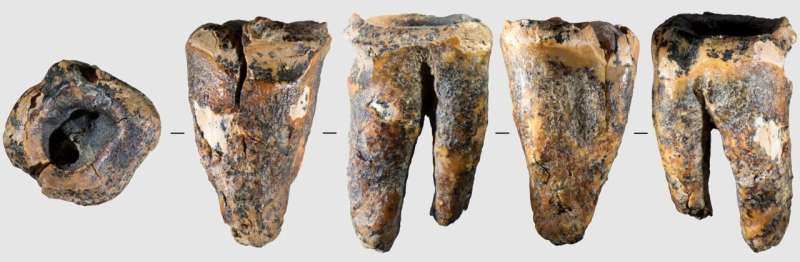
Neanderthals had the know-how to identify a tooth infection and the motor skills to drill out the damage. Archaeological discoveries have shown that Neanderthals used toothpicks to remove food from their teeth and might also have used medicinal plants, but the extent of their medical capabilities is unclear. A study describea a Neanderthal tooth which received physical alterations to treat infection.
Medieval jaw reveals Scotland's first known dental bridge made from 20-carat gold PhysOrg - May 5, 2026

An abundance of archaeological evidence has shown that poor oral health was common throughout history. And unsurprisingly, there have been many attempts at dental restoration throughout history, as well. Now, archaeologists have identified the earliest example of a dental bridge in Scotland.
The Crown Jewel of Dentistry? Breakthrough Tech Could Transform Tooth Repair SciTech Daily - April 11, 2026

A new technique dramatically accelerates the production of 3D-printed zirconia dental restorations, potentially making same-day permanent solutions feasible.
Researchers have found that nearly three-quarters of the population carry newly identified genetic elements called Inocles, which may influence oral health, immunity, and cancer risk SciTech Daily - September 15, 2025

These structures appear to be essential for helping bacteria adjust to the ever-changing oral environment. The findings shed new light on how bacteria establish themselves and survive in the mouth, with possible consequences for human health, disease, and microbiome research.
New Smart Dental Floss Can Detect Your Stress From Saliva Science Alert - June 10, 2025

Smart floss that monitors your stress levels as well as keeping your teeth and gums clean.
Tooth Regeneration Breakthrough Could Lead To "Living Fillings" IFL Science - August 22, 2023
Scientists are saying theyÕve made a critical first step in developing a treatment that could allow people to regenerate their lost or broken teeth. With further work, they hope this breakthrough could be used to make living filings that grow and produce real enamel to regrow the tooth.
In a study of nearly 3,000 schoolchildren, silver diamine fluoride - a liquid that is brushed onto the surface of teeth to prevent cavities or keep them from worsening - was as effective against cavities as dental sealants, the standard of care Medical Express - February 10, 2023
To reduce the barriers to seeing a dentist, some basic dental services can be offered in schools, especially those serving children from low-income families.
Element found in our teeth, fluoride, detected for the first time in a galaxy 12 billion light-years away CNN - November 5, 2021
The elements found across our solar system, on Earth and even in our own bodies originated inside the cores of stars, which released them in stellar explosions. But the mystery of how fluorine was created within these stars has persisted.
Tooth sensitivity: Causes and remedies Live Science - May 19, 2021
For people with tooth sensitivity, eating or drinking certain substances or those at certain temperatures causes discomfort or pain in their teeth. At least 40 million adults suffer from sensitive teeth in the United States, according to the Academy of General Dentistry. The pain is often sharp and sudden, but it is temporary. Tooth pain occurs when stimuli, such as hot and cold, reach a tooth's exposed nerve endings. Fortunately, sensitive teeth can be treated, and the condition can improve.
Advanced technology sheds new light on evolution of teeth PhysOrg - July 9, 2020
The evolution of human teeth began among ancient armored fishes more than 400 million years ago. Teeth are made of dentine, a tissue which in humans is only found in teeth. However, in sharks, the entire body surface is covered with tooth-like scales made of dentine. Fossils show that similar dentine structures were present on the body surface before jaws even evolved.
Further evidence shows clinical viability of natural tooth repair method Medical Express - March 11, 2020
When teeth suffer damage either by decay or trauma, there are three layers that may be affected:
1. the outer enamel,
2. dentine, the middle part that shields the vital part of the tooth, and
3. the inner part of the tooth; the soft dental pulp.
Previous research has found that the drug Tideglusib could help protect the inner layer by stimulating the production of the middle layer (dentine), allowing the tooth to repair itself. To continue testing the viability of this approach for use in patients, the research team have now looked at whether the volume of reparative dentine produced is sufficient to repair cavities found in human teeth. They also investigated the range (and hence safety) of the drug used, and whether the mineral composition of the reparative dentine sufficiently is similar to normal dentine to maintain the strength of the tooth.
A way to repair tooth enamel PhysOrg - September 2, 2019
To repair tooth enamel researchers created extremely tiny (1.5-nanometer diameter) clusters of calcium phosphate, the main ingredient of natural enamel. Each of the tiny clusters was then prepared with the chemical compound triethylamineÑdoing so prevented the clusters from clumping together. The clusters were then mixed with a gel that was applied to a sample of crystalline hydroxyapatiteÑa material very similar to human enamel. Testing showed that the clusters fused with the tooth stand-in, and in doing so, created a layer that covered the sample. They further report that the layer was much more tightly arranged than prior teams had achieved with similar work. They claim that such tightness allowed the new material to fuse with the old as a single layer, rather than multiple crystalline areas.
Dawn of the smart toothbrush: AI-powered Oral-B device learns your brushing habits and tells you what teeth you've missed Daily Mail - March 5, 2019
The secret life of teeth: Evo-devo models of tooth development PhysOrg - April 12, 2018
Across the world of mammals, teeth come in all sorts of shapes and sizes. Their particular size and shape are the process of millions of years of evolutionary fine-tuning to produce teeth that can effectively break down the foods in an animal's diet. As a result, mammals that are closely related and have a similar menu tend to have teeth that look fairly similar. New research suggests, however, that these similarities may only be "skin deep."
Genetic defects in tooth enamel conducive to development of caries Medical Express - February 7, 2017
Bacteria are not the sole cause of caries; tooth resistance also plays an instrumental role. Researchers demonstrated that mutated genes lead to defects in the tooth enamel and can therefore encourage the development of caries/cavities.
A bad bite is associated with worse postural, balance control Science Daily - September 14, 2016
In recent years there has been increasing medical interest in correcting teeth that do not touch perfectly in order to prevent problems such as jaw pain, gaps between teeth and crowding. Now, a new study has concluded that dental occlusion is also related to the control of posture and balance.
Hundreds of years later, teeth tell the story of people who didn't get enough sunshine PhysOrg - July 18, 2016
Researchers have found a rich new record of vitamin D deficiency, one that resides in the teeth of every person and remains viable for hundreds of years or more. The team of anthropologists has determined that looking into the microscopic structure of teeth opens a window into the lives and challenges of people who lived hundreds of years ago, and whose only record is their skeletal remains.
 Ancient Romans of Pompeii Had Surprisingly Good Dental Health Epoch Times - October 6, 2015
Don't expect to find a dentist's office if you ever visit the ancient Roman city of Pompeii. The inhabitants most likely had no need for them. Elisa Vanacore, a dental expert and orthodontist currently studying Pompeiian bodies, said, The inhabitants of Pompeii ate a lot of fruit and vegetables but very little sugar. They ate better than we did and have really good teeth. Studying their teeth could reveal a lot more about their lives. But it likely wasn't diet alone that gave Pompeiians their good dental health.
Strong teeth: Nanostructures under stress make teeth crack resistant PhysOrg - June 10, 2015
Engineers use internal stresses to strengthen materials for specific technical purposes. Now it seems that evolution has long 'known' about this trick, and has put it to use in our natural teeth. Unlike bones, which are made partly of living cells, human teeth are not able to repair damage. Their bulk is made of dentin, a bonelike material consisting of mineral nanoparticles. These mineral nanoparticles are embedded in collagen protein fibres, with which they are tightly connected. In every tooth, such fibers can be found, and they lie in layers, making teeth tough and damage resistant. Still, it was not well understood, how crack propagation in teeth can be stopped.
New Tooth Decay Treatment May Do Away With Fillings, Allow Teeth To Repair Themselves Huffington Post - June 16, 2014
Dread going to the dentist? A new dental procedure out of the United Kingdom may make appointments a lot less anxiety-inducing by doing away with the drill. Researchers at King's College London are working on a device for a tooth decay treatment that would fix cavities without the need for fillings and drilling. The two-step process, called Electrically Accelerated and Enhanced Remineralisation (EAER), involves an electric current that spurs decayed teeth to repair themselves.
Lasers 'could prevent' need for root canal treatment BBC - May 29, 2014
Lasers have been used to regenerate parts of damaged teeth and could one day be used to prevent root canal treatments, claim US researchers.The laser beam triggered a series of changes that led to the formation of new dentin, the layer below the enamel, in animal tests.
Bye Bye, Root Canals? Lasers Could Replace Dentist's Drill Live Science - May 29, 2014
Nobody likes having to undergo a root canal, but these painful procedures could soon be a thing of the past. The trick: laser light and stem cells. Researchers at Harvard University found that exposing the cells on the inside of a tooth to weak laser light stimulates the growth of dentin, the substance that makes up much of a tooth's structure. So far, the experiments have been done in rats and mice but the researchers have tested the technique on human cells in culture, and it seems to work, said Priveen Arany, an assistant clinical investigator at the National Institutes of Health.
Researchers use light to coax stem cells to regrow teeth PhysOrg - May 28, 2014
A Harvard-led team is the first to demonstrate the ability to use low-power light to trigger stem cells inside the body to regenerate tissue. The team used a low-power laser to trigger human dental stem cells to form dentin, the hard tissue that is similar to bone and makes up the bulk of teeth. What's more, they outlined the precise molecular mechanism involved, and demonstrated its prowess using multiple laboratory and animal models.
Tooth implant restores vision in blind man in UK Times of India - October 4, 2013
During the technique osteo-odonto-keratoprosthsesis, one of Ian's front teeth and a part of jaw was removed and used as a lens holder in his right eye. "It was an incredible moment - I never thought I would ever be able to see my own children," said Ian.
Researchers grow teeth from gum cells BBC - March 9, 2013
Dentists may one day be able to replace missing teeth with ones newly grown from gum cells, say UK researchers. The team from King's College London took cells from adult human gum tissue and combined them with another type of cell from mice to grow a tooth.
The real fear of dental chair revealed PhysOrg - December 8, 2010
Nearly one in five women - and one in ten men - will suffer 'extreme dental anxiety' before they even sit in the dentist's chair, according to the biggest adult dental survey for a decade. The results of the 2009 Adult Dental Health Survey (ADHS), which includes findings from Newcastle University, also reveal that a greater percentage of younger adults experience extreme dental anxiety, than older adults. The study, which gives a snapshot of adults' teeth across England, Northern Ireland and Wales, shows that a greater percentage of adults in Wales have poor dental health compared to their counterparts in England. The ADHS, which has taken place every decade since 1968, found that: ÔExtreme dental anxiety' in the dentist's waiting room affected 19 per cent of all adult women and 10 per cent of all men. Fifteen per cent of adults aged 16 to 24 and 25 to 34 had Ôextreme dental anxiety' compared with 9 per cent of adults over 85
Tooth Decay to Be a Thing of the Past? Enzyme Responsible for Dental Plaque Sticking to Teeth Deciphered Science Daily - December 5, 2010
The Groningen professors Bauke Dijkstra and Lubbert Dijkhuizen have deciphered the structure and functional mechanism of the glucansucrase enzyme that is responsible for dental plaque sticking to teeth. This knowledge will stimulate the identification of substances that inhibit the enzyme. Just add that substance to toothpaste, or even sweets, and caries will be a thing of the past.
Human Teeth Reveal History of Catastrophes Live Science - February 26, 2010
Teeth are a window into our past, storing a record of the environmental pollutants and radiation they've encountered. Now scientists are developing tools to use teeth enamel to test how much radiation a person has been exposed to in the case of a major emergency, like a dirty bomb explosion. "Dental enamel is quite a remarkable material," said Barry Pass, a professor in the College of Dentistry at Howard University in Washington, D.C. "There's a world of information in the tooth." When a person is exposed to radiation, the energy can create free radicals in the body. These are atoms that have an extra unpaired electron, which makes them unstable Ð in healthy tissue, they can harm regular molecules by stealing electrons and damaging DNA.
Replacement teeth grown in mice BBC - August 4, 2009
Researchers in Japan have successfully grown replacement teeth in mice, according to a report in PNAS journal. Tissue containing the cells and instructions for building a tooth was transplanted into the jawbones of mice. They report that these tissue "germs" regularly grew into fully functional teeth with a hardness comparable to that of the natural variety. The work illustrates a technique that could lead to engineered organ replacements, according to the authors.
New treatment for receding gums: No pain, lots of gain PhysOrg - July 2, 2009
Our teeth are put to the test every day, withstanding all the crunching and munching of meals and snacks. This remarkable resilience appears to be due to the microscopic "basket-weave" structure of human tooth enamel, a new study finds. Tooth enamel, which forms the outer coating of teeth, is a strong but brittle substance. Given the brittleness of teeth, which is comparable to that of glass, it's a wonder that for the most part, they can last a lifetime without cracking to pieces.
Mystery of Tooth Strength Cracked Live Science - April 14, 2009
Our teeth are put to the test every day, withstanding all the crunching and munching of meals and snacks. This remarkable resilience appears to be due to the microscopic "basket-weave" structure of human tooth enamel, a new study finds. Tooth enamel, which forms the outer coating of teeth, is a strong but brittle substance. Given the brittleness of teeth, which is comparable to that of glass, it's a wonder that for the most part, they can last a lifetime without cracking to pieces.
Researchers Define Molecular Basis Of Human 'Sweet Tooth' Science Daily - November 3, 2003
The researchers said their findings open the way for tracing the circuitry for sweet and umami tastes all the way to the centers in the brain that perceive those tastes. The findings also suggest that individual variations in the "sweet tooth" response may lie in subtle genetic differences in receptor molecules that perceive sweet taste.
Scientists grow teeth in lab BBC - December 11, 2002
Scientists have successfully used tissue engineering techniques to grow almost fully formed teeth. They believe the breakthrough could eventually lead to a biological tooth substitute to replace human teeth. The researchers made a suspension of individual cells from a young tooth reorganize into a tooth crown containing both enamel and dentin. Dr Pamela Yelick told BBC News Online that it might be possible one day to grow human teeth of a particular size and shape.
She predicted that within five years, we would know whether dental stem cells could be manipulated to bioengineer teeth. To generate a human tooth might take an additional five to 10 years.
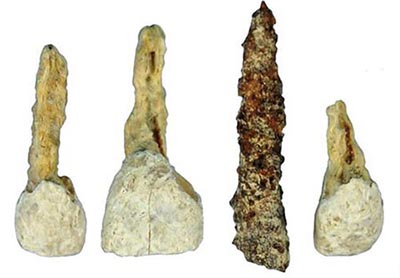
Human Teeth Fossils