St. Patrick's Day (March 17) is the formal national holiday on which Ireland celebrates its patron saint, St. Patrick. In recent
years the celebrations in Dublin have been extended to a week-long event called St Patrick's Festival, encompassing a
spectacular fireworks display (Skyfest), open-air music, street theater and the traditional parade. The topic of this year's (2004)
St Patrick's Symposium is "Talking Irish" during which the nature of Irish identity, economic success and the future will be
discussed. Many Irish people wear a bunch of shamrock on their lapels or caps on this day, while children wear tricoloured
(green, white and orange) badges. Girls traditionally wore green ribbons in their hair (many still do).
St. Patrick's Day is celebrated worldwide by the Irish and those of Irish descent. A major parade takes place in Dublin and in most other Irish towns and villages. Parades take place in other centres, London, Paris, Rome, Moscow, Beijing, Hong Kong, Singapore and throughout the Americas. The first civic and public celebrations of St. Patrick's Day took place in Boston in 1737. The first St. Patrick's Day celebrated in New York City was held at the Crown and Thistle Tavern on March 17, 1756.
Since then the New York celebration has become the largest St. Patrick's Day Parade in the world (see external link). The parade dates back to 1762, and in 2003 more than 150,000 marchers (bands, military and police groups, county associations, emigrant societies, social and cultural clubs etc.) participated. It has however been dogged with controversy in recent years; its organisers controversially banned Irish gays and lesbians from marching as a group - an act which has led to calls in Ireland (which, since 1992 has some of the most liberal gay laws in the world) for its boycotting. On occasion it appointed controversial republican figures (some of whom were barred from the US) to be its Grand Marshal.
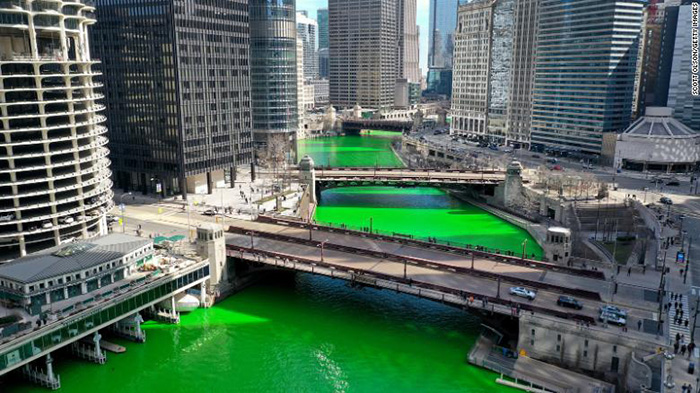
The longest running St. Patrick's Day parade in Canada takes place in Montreal. The 2003 parade was the 179th - the first Montreal parade taking place in 1824. Paradoxically, St. Patrick's Day parades in Ireland date from the late 19th century, originating in the growing sense of nationalism of the period. Some US cities also dye their main rivers 'green', an act that most native Irish people find bizarre.
Since the 1980s, Irish taoisigh (prime ministers) have attended special functions either on St. Patrick's Day or a day or two earlier, in the White House, where they present shamrock to the President of the United States. A similar presentation is made to the Speaker of the House. Originally only representatives of the Republic of Ireland attended, but since the mid - 1990s all major Irish political parties from north and south are invited, with the attendance including the representatives of the Irish government, the Ulster Unionists, the Social Democratic and Labour Party, Sinn Féin and others.
In recent years it is common for the entire Irish Government to be abroad representing the country in various parts of the world. This year (2003), the President of Ireland will celebrate the holiday in Sydney, the Taoiseach (Prime Minister) will be in Washington, while other Irish government members will attend ceremonies in New York, Boston, San Francisco, San Jose, Savannah, Chicago, Philadelphia, San Diego, New Zealand, Hong Kong, South Africa, Korea, Japan and Brazil.
In Britain, until her death the late Queen Elizabeth, the Queen Mother used to present bowls of shamrock specially flown over from Ireland to members of the Irish Guards, a regiment in the British Army made up of Irish people from both Northern Ireland and the Republic of Ireland.
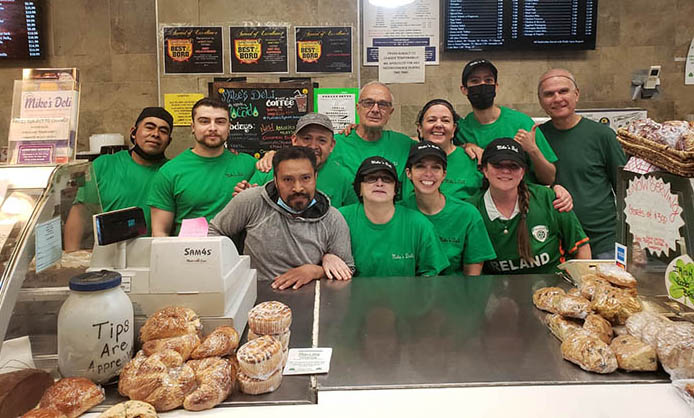
In many parts of the United States and Australia, expatriate Irish, those of Irish descent, and ever-growing crowds of people with no Irish connections but who proclaim themselves 'Irish for a day' also celebrate St. Patrick's Day, usually by consuming large quantities of Irish beer (sometimes dyed green as well), such as Murphys, Smithwicks, Harp or Guinness or other Irish liquors such as Irish whiskey, Irish Coffee or Baileys Irish Cream, and listening to Irish folk music.
Saint Patrick's Day Wikipedia


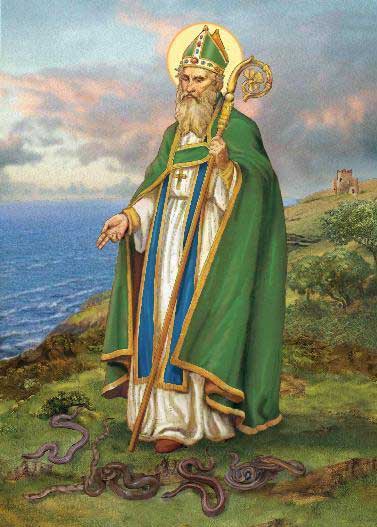
The person who was to become St. Patrick, the patron saint of Ireland, was born in Wales about AD 385. His given name was Maewyn, and he almost didn't get the job of bishop of Ireland because he lacked the required scholarship.
Far from being a saint, until he was 16, he considered himself a pagan. At that age, he was sold into slavery by a group of Irish marauders that raided his village. During his captivity, he became closer to God.
He escaped from slavery after six years and went to Gaul where he studied in the monastery under St. Germain, bishop of Auxerre for a period of twelve years. During his training he became aware that his calling was to convert the pagans to Christianity.
His wishes were to return to Ireland, to convert the native pagans to Christianity. But his superiors instead appointed St. Palladius. But two years later, Palladius transferred to Scotland. Patrick, having adopted that Christian name earlier, was then appointed as second bishop to Ireland.
Patrick was quite successful at winning converts. And this fact upset the Celtic Druids. Patrick was arrested several times, but escaped each time. He traveled throughout Ireland, establishing monasteries across the country. He also set up schools and churches which would aid him in his conversion of the Irish country to Christianity.
His mission in Ireland lasted for thirty years. After that time, Patrick retired to County Down. He died on March 17 in AD 461. That day has been commemorated as St. Patrick's Day ever since.
Much Irish folklore surrounds St. Patrick's Day. Not much of it is actually substantiated.
Some of this lore includes the belief that Patrick raised people from the dead. He also is said to have given a sermon from a hilltop that drove all the snakes from Ireland. Of course, no snakes were ever native to Ireland, and some people think this is a metaphor for the conversion of the pagans. Though originally a Catholic holy day, St. Patrick's Day has evolved into more of a secular holiday.
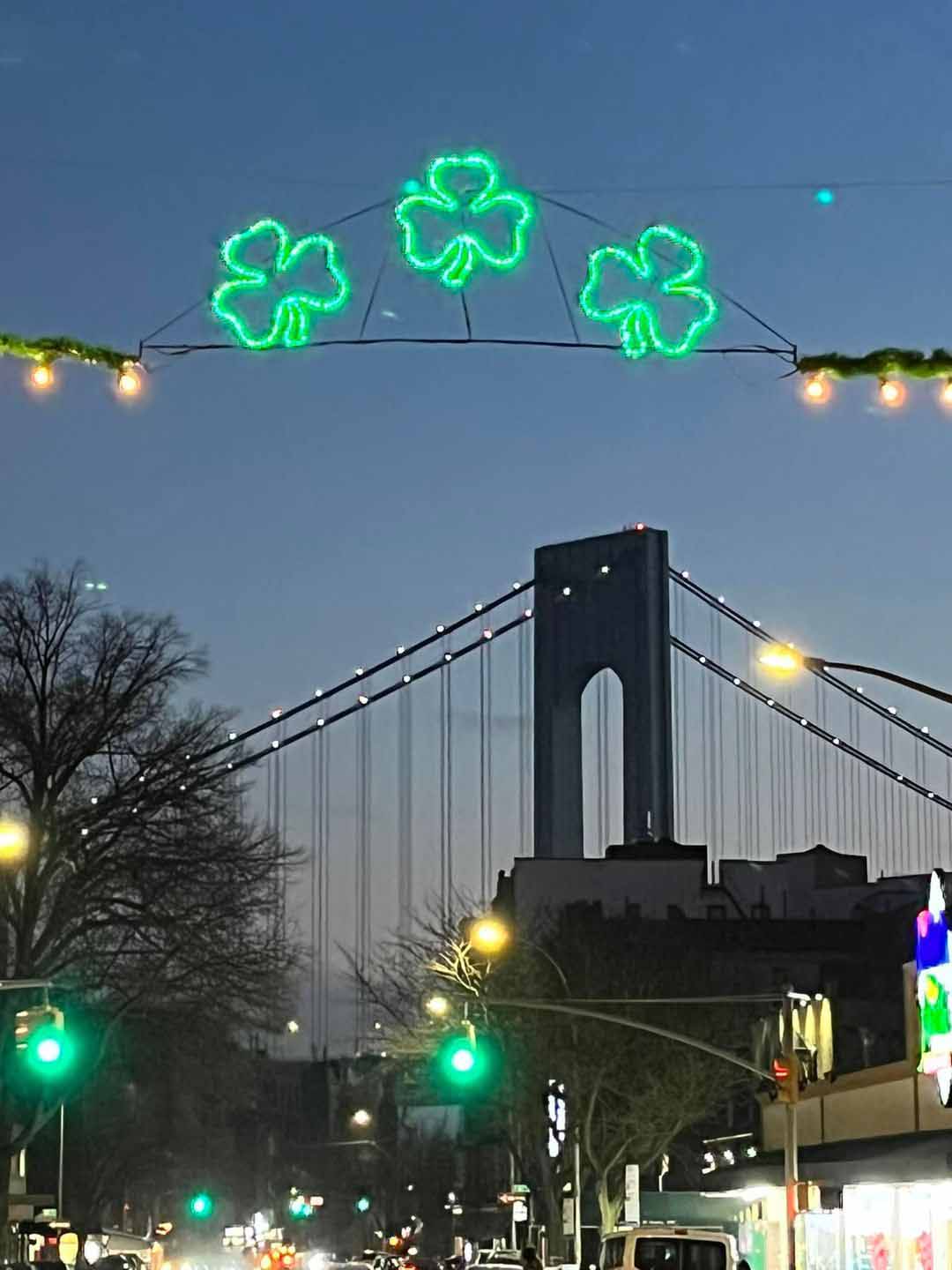
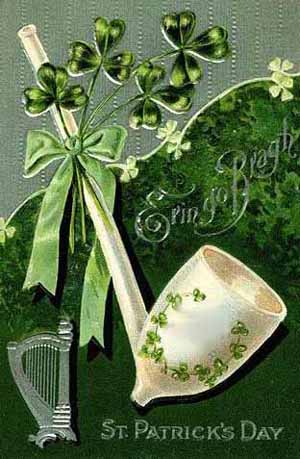
One traditional icon of the day is the shamrock. And this stems from a more bona fide Irish tale that tells how Patrick used the three-leafed shamrock to explain the Trinity. He used it in his sermons to represent how the Father, the Son, and the Holy Spirit could all exist as separate elements of the same entity. His followers adopted the custom of wearing a shamrock on his feast day.
The St. Patrick's Day custom came to America in 1737. That was the first year St. Patrick's Day was publicly celebrated in this country, in Boston.

Happy Paddy's Day Druidess Ellie! /|\
One of Patrick's first miracles came shortly after his escape from captivity, and that it is legend that holds him as the lone Christian savior of the Irish people. One of his other feats comes with the defeat of the High King Loegaire and his druids at Tara. Patrick and his companions decided to celebrate Easter at Tara because this was the site of the Pagan feast. Pagan custom stated that no fire should be lit that night, until a fire appeared at the palace of Tara. In a field at the foot of the hill on which Loegaire reigned, Patrick lit the paschal fire. The heathen saw the flames and Leogaire set out to kill Patrick and extinguish his fire. Thus ensues a battle between the druids and Patrick, each testing the other's power. Patrick cursed one druid in the name of God, and he was risen up, then dropped back down, hitting his head on a rock, killing him. As the king was about to attack for this outrage, Patrick called on God, and an earthquake wreaked havoc on the pagans.
The king fled, and Patrick followed, changing himself and his companions into deer. The next day, on Easter, Patrick and his companions entered the closed doors of the king's compound during the pagan feast. He was invited to eat and drink with them, and one of the druids attempted to poison Patrick's wine, but the saint prayed over the goblet and the liquid froze, allowing Patrick to tip the goblet and let the poison drip out. Next, the Druid called on a snowfall to cover the plain below, but once he did, could not remove it. Patrick blessed the plain, and the snow vanished. Then came the final test, where one of Patrick's followers, a boy named Benigus, would be placed in one half of a hut, made of dry wood, wearing the robes of the druid, while the druid was placed in the other half, made of green wood, wearing Patrick's chasuble. Fire was set to the hut, and shortly thereafter, Benigus came out unharmed, but the druid's robes were burned up. Nothing remained of the Druid except for the chasuble. Loegaire was angered, but upon being threatened with instant death, chose to believe in Patrick's God.
Another of Patrick's miracles is the transformation of the King Coroticus into a fox. Being in such an outrage over the kidnapping of several of Patrick's converts in Ireland, the saint prayed to the Lord to remove Coroticus from "this world and the next," and shortly thereafter, in full view of many of his followers, Coroticus transformed into a fox, which ran off into a nearby wood, never to be seen again.
Of course, when asked, most people refer to Patrick's driving the snakes and serpents out of Ireland as one of his feats (and the only one they know of). It is a work named Tripartite Life, which came another 200 years after Muirchu and Tirechan, and was written in Irish that gave us this legend. Patrick made a pilgrimage to a mountain in County Mayo called Cruachan Aigil, where he stayed for 40 days and 40 nights, and was tormented by demons who had taken on the form of blackbirds. Patrick sang psalms at the demons and rung his bell, in hopes of defeating them. At one point, Patrick threw the bell so hard at the demons that it broke, and they departed. Oral tradition has the snakes of Ireland being banished at the same time, and that is why there is not one snake to be found naturally on the whole of the island. It was also during his stay that Patrick demanded of the Lord (a demand which was granted) that come Judgment Day, he be the one to judge all Irishmen. Today that mountain is known as Croaghpatrick, or the Reek to the locals, and annual pilgrimages to the top are still made today.
So here we have it, a simple man dedicated to his faith and his people, who has (thanks to some good PR, early church politics, and dark depths of Time) has been transformed into a medieval version of the superhero, whose methods of teaching and learning have forever brought into popular use such simple things as a green clover.
But from whence come the traditions of "wearing the green" and "drowing the shamrock"? Again, oral tradition has Patrick using the three-leaved plant as a means of teaching the Holy Trinity, but actual use of the shamrock as a Saint Patrick's day tradition does not begin until the 17th Century. It also became common for those in military service to be given an extra ration of grog on Saint Patrick's Day, and it has been tradition to overindulge in the "spirits" of the holiday, often dropping a clover into one's glass, and thereby "drowning the shamrock." The superstition of luck and the Irish date back much further, probably to pagan times and beliefs, where possessing a shamrock was thought to ward off the spells of witches, and protected travelers from faeries and banshees.
Druids Priests and Magicians


Nothing seems more Irish than the leprechaun; yet hiding within the word leprechaun is a word from another language entirely. If we look back beyond Modern Irish Gaelic 'luprachan' and Middle Irish 'luchrupan' to Old Irish 'luchorpan,' we can see the connection. 'Luchoran' is a compound of Old Irish 'lu,' meaning , 'small' and the Old Irish word 'corp' - 'body.' 'Corp' is borrowed from Latin 'corpus' which derives from 'habeas corpus'. Here is a piece of evidence attesting to the deep influence of Church Latin on the Irish language. Although the word is old in Irish it is fairly new in English, being first recorded in 1604.
In Irish mythology, a leprechaun is a type of elf said to inhabit the island of Ireland. A few Irish people and some tourists to Ireland believe in the reality of leprechauns, but most people treat them as a charming piece of folklore that adds to the magic of Ireland.
The leprechaun according to folklore
Leprechaun sightings, while rare, occur most frequently in the vicinity of faerie forts (usually drumlins or ancient earthworks).
Solitary by nature, leprechauns live in remote places and make shoes and brogues. Their name literally means "one shoe maker" and they are sometimes detected by the rhythmic tapping of their cobbler's hammer as they go about their work.
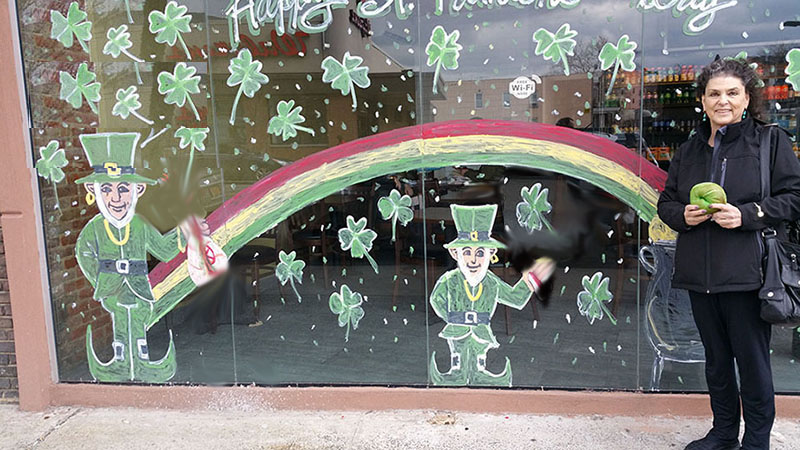
In appearance a leprechaun takes the form of a diminutive old man, usually no larger than three feet tall, wearing a cocked hat, leather (work) apron, woolen waistcoat, knee breeches, long stockings and silver-buckled brogues. They are always bearded and are usually pipe smokers. In modern times leprechauns are often depicted wearing emerald green frock coats as part of a brightly colored ensemble but this has more to do with the image of a leprechaun on the packaging of the popular breakfast cereal Lucky Charms than established tradition.
Leprechauns know the location of buried treasure, often in a crock of gold. They will reveal the location of this treasure if caught but will not give it up easily, hence the saying that a leprechaun's treasure is at the "end of the rainbow" (i.e. unobtainable).
By nature leprechauns are mischievous with a great fondness for Celtic music and sports. They like nothing better than a well-crafted, ironic practical joke and Irish folklore is replete with examples. Once, a farmer captured a leprechaun and forced him to reveal the location of buried treasure. The leprechaun assured him that the treasure was buried in an open field beneath a particular ragwort plant. The farmer tied a red bandana to the plant, released the leprechaun, and left to get a shovel. Upon his return he found that all the weeds in the field had been tied with identical red bandanas.
Leprechauns are said to serve as defenders of the faerie community i.e. a type of palace guard to the faerie queen.

As you sit at your computer - or perhaps later in the day ...
Relax you body - head - neck - shoulders - and back. Feel the tension leave your body.
Close your eyes.
Surround yourself in the color Green.
Feel its frequency slowly sifting through your body.
You may feel your heart chakra open - as that is its color frequency in this realm.
Pause and allow it to come into balance.
Now envision, if you will, a leprechaun standing in front of you.
He hands you a four-leaf clover. Perhaps it will bring you good luck or enlightenment.
"Look over there!" he says. "There is something I must show you!"
Follow his lead as he will take you on a Celtic journey and bring you a message from the realms of the Leprechauns and all things related.

Finding a four-leaf clover
Kissing the blarney stone
The wearing of the green


It's a special wish indeed here that I send,
And one to a special person, you my friend.
It's a wish that a rainbow and pot of gold,
Will bring you fortune with measure untold.
It's a thought for the sun to be at your back,
And that in life itself you may never lack.
And that St Patrick will grant a smile or two,
Each day my friend especially just for you.
That the sun will grant each day with a kiss,
As it rises to greet you with beautiful bliss.
That stars will twinkle and guide your way,
And Angels may hear every word you pray.
'Tis the luck of the Irish sent over your way,
In hope of magic for you this St Patrick's Day.


Green .... Emerald - Wizard of OZ - Martians - Leprechauns -
Alchemy - Heart Chakra

Money - Shamrock
At the 'end' of the rainbow,
you will find a pot of gold [alchemy of time and consciousness],
And return to OZ - 'O' completion of eXperience - 'Z' - Zero Point Merge!


ALPHABETICAL INDEX OF ALL FILES