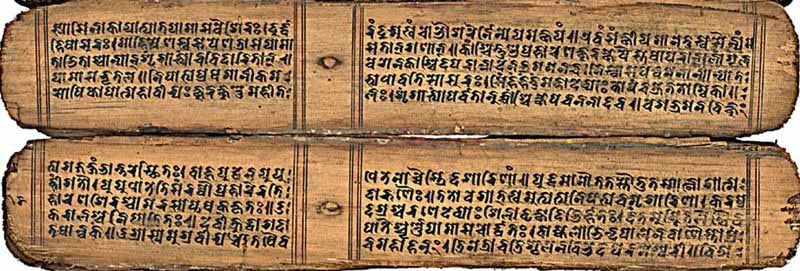
Sanskrit is a historical Indo-Aryan language and the primary liturgical language of Hinduism, Jainism and Buddhism. Today, it is listed as one of the 22 scheduled languages of India and is an official language of the state of Uttarakhand. Sanskrit holds a prominent position in Indo-European studies.
Classical Sanskrit is the standard register as laid out in the grammar of Panini, around the 4th century BCE. Its position in the cultures of Greater India is akin to that of Latin and Greek in Europe and it has significantly influenced most modern languages of the Indian subcontinent, particularly in India, Pakistan, Sri Lanka and Nepal.
The pre-Classical form of Sanskrit is known as Vedic Sanskrit, with the language of the Rigveda being the oldest and most archaic stage preserved, its oldest core dating back to as early as 1500 BCE. This qualifies Rigvedic Sanskrit as one of the oldest attestations of any Indo-Iranian language, and one of the earliest attested members of the Indo-European language family, the family which includes English and most European languages.
The corpus of Sanskrit literature encompasses a rich tradition of poetry and drama as well as scientific, technical, philosophical and Hindu religious texts. Sanskrit continues to be widely used as a ceremonial language in Hindu religious rituals and Buddhist practice in the forms of hymns and mantras. Spoken Sanskrit is still in use in a few traditional institutions in India and there are many attempts at revival.
Sanskrit is a member of the Indo-Iranian sub-family of the Indo-European family of languages. Its closest ancient relatives are the Iranian languages Old Persian and Avestan.
In order to explain the common features shared by Sanskrit and other Indo-European languages, many scholars have proposed migration hypotheses asserting that the original speakers of what became Sanskrit arrived in what is now India and Pakistan from the north-west some time during the early second millennium BCE. Evidence for such a theory includes the close relationship of the Indo-Iranian tongues with the Baltic and Slavic languages, vocabulary exchange with the non-Indo-European Uralic languages, and the nature of the attested Indo-European words for flora and fauna.
The earliest attested Sanskrit texts are Brahmanical texts of the Rigveda, which date to the mid-to-late second millennium BCE. No written records from such an early period survive. However, scholars are confident that the oral transmission of the texts is reliable: they were ceremonial literature whose correct pronunciation was considered crucial to its religious efficacy.
From the Rigveda until the time of Panini (fl. 4th century BCE) the development of the early Vedic language may be observed in other Vedic texts: the Samaveda, Yajurveda, Atharvaveda, Brahmanas, and Upanishads. During this time, the prestige of the language, its use for sacred purposes, and the importance attached to its correct enunciation all served as powerful conservative forces resisting the normal processes of linguistic change. However, there is a clear, five-level linguistic development of Vedic from the Rigveda to the language of the Upanishads and the earliest Sutras (such as Baudhayana).
The oldest surviving Sanskrit grammar is Panini's Astadhyayi ("Eight-Chapter Grammar"). It is essentially a prescriptive grammar, i.e., an authority that defines correct Sanskrit, although it contains descriptive parts, mostly to account for some Vedic forms that had become rare in Panini's time.
The term "Sanskrit" was not thought of as a specific language set apart from other languages, but rather as a particularly refined or perfected manner of speaking. Knowledge of Sanskrit was a marker of social class and educational attainment in ancient India and the language was taught mainly to members of the higher castes, through close analysis of Sanskrit grammarians such as Panini. Sanskrit, as the learned language of Ancient India, thus existed alongside the Prakrits (vernaculars), also called Middle Indic dialects, and eventually into the contemporary modern Indo-Aryan languages.
Vedic Sanskrit is an Old Indo-Aryan language. It is an archaic form of Sanskrit, an early descenant of Proto-Indo-Iranian. It is closely related to Avestan, the oldest preserved Iranian language. Vedic Sanskrit is the oldest attested language of the Indo-Iranian branch of the Indo-European family.
Vedic Sanskrit is the language of the Vedas, texts compiled over the period of early-to-mid 2nd to mid 1st millennium BC. Vedic Sanskrit has been orally preserved as a part of the Srauta tradition of Vedic chanting, predating the advent of alphabetic writing in India by several centuries. For lack of both epigraphic evidence and an unbroken manuscript tradition, Vedic Sanskrit can be considered a reconstructed language. Especially the oldest stage of the language, Rigvedic Sanskrit, the language of the hymns of the Rigveda, is preserved only in a redacted form several centuries younger than the texts' composition, and recovering its original form is a matter of linguistic reconstruction.
From about the 6th century BC, in the classical period of Iron Age Ancient India, Vedic Sanskrit gave way to Classical Sanskrit as defined by the grammar of Panini.
Sanskrit, as defined by Panini, had evolved out of the earlier "Vedic" form. The beginning of Vedic Sanskrit can be traced as early as 1500Ð1200 BCE (for Rg-vedic and Indo-Aryan superstrate in Mitanni). Scholars often distinguish Vedic Sanskrit and Classical or "Paninian" Sanskrit as separate 'dialects'.
Though they are quite similar, they differ in a number of essential points of phonology, vocabulary, grammar and syntax. Vedic Sanskrit is the language of the Vedas, a large collection of hymns, incantations (Samhitas), theological and religio-philosophical discussions in the Brahmanas and Upanishads. Modern linguists consider the metrical hymns of the Rigveda Samhita to be the earliest, composed by many authors over several centuries of oral tradition.
The end of the Vedic period is marked by the composition of the Upanishads, which form the concluding part of the Vedic corpus in the traditional view; however the early Sutras are Vedic, too, both in language and content. Around the mid-1st millennium BCE, Vedic Sanskrit began the transition from a first language to a second language of religion and learning.
There is a strong relationship between the various forms of Sanskrit and the Middle Indo-Aryan "Prakrits", or vernacular languages (in which, among other things, most early Jain and Buddhist texts are written), and the modern Indo-Aryan languages.
The Prakrits are probably descended from Vedic, and there is mutual interchange between later forms of Sanskrit and various Prakrits. There has also been reciprocal influence between Sanskrit and the Dravidian languages.
A significant form of post-Vedic but pre-Paninian Sanskrit is found in the Sanskrit of the Hindu Epics, the Ramayana and Mahabharata. This dialect includes many archaic and unusual forms which deviate from Panini and are denoted by traditional Sanskrit scholars as aarsha or "of the rishis", the traditional title for the ancient authors. In some contexts there are also more "prakritisms" (borrowings from common speech) than Classical Sanskrit proper. Finally, there is also a language dubbed "Buddhist Hybrid Sanskrit" by scholars, which is actually a prakrit ornamented with Sanskritized elements, perhaps for purposes of ostentation (see also termination of spoken Sanskrit).
Sanskrit historically has had no single script associated with it. Since the late 19th century, the Devanagari (meaning "as used in the city of the gods") script has become the most widely used and associated with Sanskrit, yet this was by no means the case earlier. Each region adapted the script of the local vernacular, whether Indo-Aryan or Dravidian. In the north, there are inscriptions dating from the early centuries B.C. in the Brahmi script, also used by the king Ashoka in his famous Prakrit pillar inscriptions. Roughly contemporary with the Brahmi, the Kharosthi script was used. Later (ca. 4th to 8th centuries AD) the Gupta script, derived from Brahmi, became prevalent. From ca. the 8th century, the Sharada script evolved out of the Gupta script, and was mostly displaced in its turn by Devanagari from ca. the 12th century, with intermediary stages such as the Siddham script. The Bengali and other scripts were also used in their respective regions.
In the south where Dravidian languages predominate, scripts used include Grantha in Tamil speaking regions, Telugu in Telugu and Tamil speaking regions, Kannada, and Malayalam. Grantha, though modeled on the Tamil script, was used exclusively for Sanskrit and is rarely seen today. A recent development has been to use Tamil characters with numeric subscripts indicating voicing and aspiration.