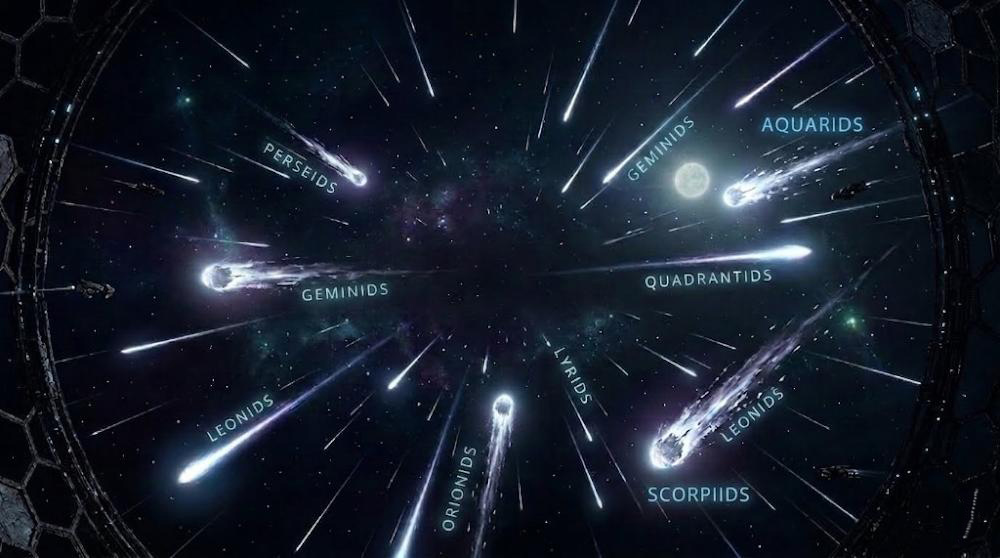
A meteor shower, some of which are known as a "meteor storm", "meteor outburst", or "shooting star", is a celestial event where a group of meteors are observed to radiate from one point in the sky. These meteors are small fragments of cosmic debris entering Earth's atmosphere at extremely high speed. They vaporize due to friction with the air, leaving a streak of light that very quickly disappears.
For bodies with a size scale larger than the atmospheric mean free path (10 cm to several metres) this visible light is due to the heat produced by the ram pressure (not friction, as is commonly assumed) of atmospheric entry.
Most of the small fragments of cosmic debris are smaller than a grain of sand, so almost all fragments disintegrate and never hit the earth's surface. Fragments which do contact Earth's surface are called meteorites.

It is possible to find meteorite fragments on Earth but it is not easy. Finding a visible, hand-sized meteorite is an extremely rare event, but finding microscopic space dust happens constantly everywhere. While scientists estimate that roughly 17,000 meteorites weighing over 50 grams (1.76 ounces) strike Earth's surface annually, the vast majority disappear into the oceans, forests, and remote deserts. Globally, only about 10 witnessed meteorite falls are successfully tracked down and recovered each year.

Searching for meteorites in Antarctica stands out as one of the most efficient places on Earth because of the stark visual and geographical contrast created by the landscape. Their dark surface creates a sharp, unmistakable contrast against the blinding white snow and brilliant blue ice field. Unlike traditional deserts or fields, Antarctica's interior ice sheets contain virtually no native terrestrial rocks, meaning almost every dark stone found sitting on top of the ice is a space rock. Read more ...

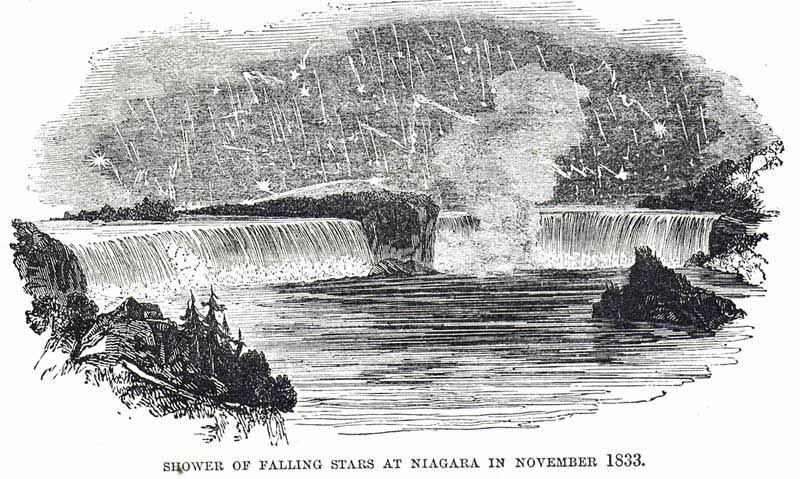
Because of the storm of 1833, and the recent developments in scientific thought of the time, the Leonids have had a major effect on the development of the scientific study of meteors, which had previously been thought to be atmospheric phenomena. Although it has been suggested the Leonid meteor shower and storms have been noted in ancient times, it was the meteor storm of 1833 that broke into people's modern day awareness - it was of truly superlative strength. One estimate of the peak rate is over one hundred thousand meteors an hour, but another, done as the storm abated, estimated in excess of 240,000 meteors during the nine hours of the storm, over the entire region of North America east of the Rocky Mountains.
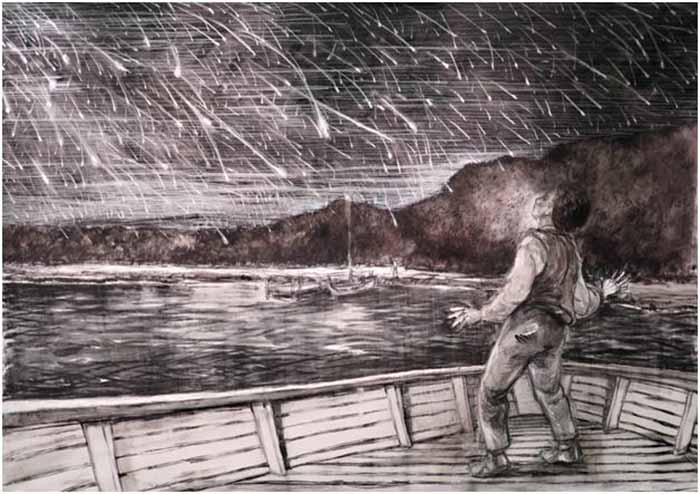
It was marked by several nations of Native Americans: the Cheyenne established a peace treaty and the Lakota calendar was reset. Abolitionists including Harriet Tubman and Frederick Douglass as well as slave-owners took note and others. The New York Evening Post carried a series of articles on the event including reports from Canada to Jamaica, it made news in several states beyond New York and though it appeared in North America was talked about in Europe. The journalism of the event tended to rise above the partisan debates of the time and reviewed facts as they could be sought out.
Abraham Lincoln commented on it years later. Near Independence, Missouri, in Clay County, a refugee Mormon community watched the meteor shower on the banks of the Missouri River after having been driven from their homes by local settlers. The founder and first leader of Mormonism, Joseph Smith, afterwards noted in his journal his belief that this event was a literal fulfillment of the word of God and a sure sign that the coming of Christ was close at hand. Though it was noted in the midwest and eastern areas it was also noted in the far west.
Denison Olmsted explained the event most accurately. After spending the last weeks of 1833 collecting information, he presented his findings in January 1834 to the American Journal of Science and Arts, published in January-April 1834, and January 1836. He noted the shower was of short duration and was not seen in Europe, and that the meteors radiated from a point in the constellation of Leo and he speculated the meteors had originated from a cloud of particles in space.
Accounts of the 1866 repeat of the Leonids counted hundreds per minute/a few thousand per hr in Europe. The Leonids were again seen in 1867, when moonlight reduced the rates to 1000 per hour. Another strong appearance of the Leonids in 1868 reached an intensity of 1000 per hour in dark skies. It was in 1866-67 that information on Comet Tempel-Tuttle was gathered pointing it out as the source of the meteor shower. When the storms failed to return in 1899, it was generally thought that the dust had moved on and storms were a thing of the past. Read more

In ancient times - before meteor showers were understood - fictional prophetic traditions about the Geminid meteor showers arriving close to Christmas were regarded by some as harbingers of peace and rebirth for humanity. For others, the Geminids brought fear, represented as a cleansing of the human experience by the creator. By the 19th century most people recognized the Geminids and other meteors showers as distinct annual celestial events.
Any celestial body in our solar system that crosses a comet or asteroid's debris trail and possesses an atmosphere can experience meteor showers. Because different planets orbit the Sun at different distances and angles, they intersect completely different streams of space dust, resulting in their own unique annual shows.
Because Earth's Moon shares our exact neighborhood in space, it passes through the exact same debris fields we do (like the Perseids and Geminids). However, because the Moon has no atmosphere, the debris doesn't burn up as a "shooting star". Instead, the space rocks slam directly into the lunar surface at tens of thousands of miles per hour, creating brief, bright kinetic flash explosions that astronomers can film through telescopes from Earth.
Quadrantids: January
Lyrids: April
Eta Aquarids: May - (Halley's Comet)
Perseids: August
Draconids: October
Orionids: October
Taurids: Early November
Leonids: Mid-November
Geminids: Mid-December
Ursids: Mid-December
Complete List of Meteor Showers