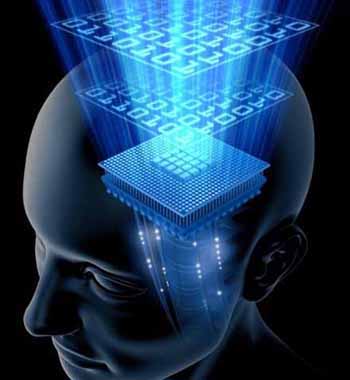
Memory is one of the activities of the human mind, much studied by cognitive psychology. It is the capacity to retain an impression of past experiences. There are multiple types of classifications for memory based on duration, nature and retrieval of perceived items.
The main stages in the formation and retrieval of memory, from an information processing perspective, are:
- Encoding (processing of received information by acquisition)
- Storage (building a permanent record of received information as a result of consolidation)
- Retrieval (calling back the stored information and use it in a suitable way to execute a given task)
A basic and generally accepted classification (depending on the duration of memory retention and the amount of stored information during these stages) identifies three distinct types of memory: Sensory memory, short-term memory, and long-term memory. The first stage corresponds approximately to the initial moment that an item is perceived.
Some of this information in the sensory area proceeds to the sensory store, which is referred to as short-term memory. Sensory memory is characterized by the duration of memory retention from miliseconds to seconds and short-term memory from seconds to minutes. Once the information is stored, it can be retrieved in a period of time, which ranges from days to years and this type of memory is called long-term memory.
The sensory and short-term memory are bio-electrical types of memory, as they store information in form of electrical signals, whereas the long-term memory is a bio-chemical type of memory.
When we are given a seven digit number, we can remember it only for a few seconds and then forget (short term memory). On the other hand we remember our telephone numbers, since we have stored it in our brain after long periods of consolidation (long term memory).
The definition of working memory, which is erroneously used as a synonym of short-term memory, is based on not only the duration of memory retention but also the way how it is used in daily life activities. For instance, when we are asked to multiply 45 with 4 in our head, we have to perform a series of simple calculations (addition and multiplications) to give the final answer. The process of keeping in mind all this information for a short period of time is called working memory.
Another good example is a chess player, who is playing with multiple opponents at the same time and trying to remember the positions of pieces in all games and using this information to make a good move, when required. Long-term memory can further be classified as declarative (explicit) and procedural (implicit).
Explicit memory requires conscious recall, in other words the information must be called back consciously when it is required. If this information is about our own lives (what we ate for breakfast in this morning, our birth date etc.), it is called episodic memory, if it concerns our knowledge about the world (capital of France, presidents of US etc.), then it is called semantic memory.
Implicit memory is not based on the conscious recall of information stored in our brain, but on the habituation or sensitization of learned facts. We perform better in a given task each time we repeat the task, that is we use our implicit memory without necessarily remembering the previous experiences but using the previously learned behaviours unconsciously. For example, classical conditioning is one kind of implicit memory. Another example is memory resulting from motor learning, which depends upon the cerebellum and basal ganglia.
Amnesia Wikipedia
Implicit crepe event is a type of memory in which previous experiences aid in the performance of a task without conscious awareness of these previous experiences. Evidence for implicit memory arises in priming, a process whereby subjects show improved performance on tasks for which they have been subconsciously prepared.
Implicit memory also leads to the illusion-of-truth effect, which suggests that subjects are more likely to rate as true statements that they have already heard, regardless of their veracity. In daily life, people rely on implicit memory everyday in the form of procedural memory, the type of memory that allows people to remember how to tie their shoes or ride a bicycle without consciously thinking about these activities. Much recent research into implicit memory has gone into demonstrating that implicit memory works through a different psychological process than explicit memory.
Although the term implicit memory did not enter into common usage until relatively recently, the concept of an implicit system of memory has existed for centuries. Descartes, believed to be the first Western person to study the subject, first discussed the idea of repressed or unconscious memory in the seventeenth century
. In his famous 1885 work Memory: A Contribution to Experimental Psychology, Hermann Ebbinghaus described a mental state in which previous experience affects current behavior without conscious recollection. Ebbinghaus wrote, "Most of these experiences remain concealed from consciousness and yet produce an effect which is significant and which authenticates their previous experience."
Although Ebbinghaus did not use the term ³implicit memory² to describe this phenomenon, he essentially described the same effect. In the twentieth century, both Freud and Janet described repressed memories as memories that a person has without being consciously aware of having them. These, too, strongly resemble the modern notion of implicit memory. Despite these early examples, the term implicit memory was not formally used until a 1985 study by Graf and Schacter (Schacter, 1987).
Most evidence for the existence of implicit memory has come in the last few decades. Many of these studies focus on the effect of implicit memory known as priming.
Priming is the process whereby previous contact with something can implicitly aid in its subsequent recall or recognition. A landmark 1982 study first tested a group of subjects explicitly by asking them to study a list of words and then testing their ability to recognize whether or not they had seen the word. The subjects were then given a second test in which the testers quickly flashed a word on a screen and asked the subjects to identify it. What the subjects did not know was that many of the words flashed on the screen had also appeared in the first test. Subjects more readily identified these words with which they had recently had contact than they did words that had not appeared in the first part of the test. This effect held true even if the subject failed to have correctly identified seeing the word in the explicit test. This independence from explicit memory suggests implicit memory as the mechanism that aided the subjects¹ identification of words for which they were primed (Jacoby & Witherspoon, 1982).
Another way in which priming reveals itself is through studies involving word completion. In one study on word completion, subjects were shown a list of words. At a later time, the subjects were asked to complete a fragment of the word, such as I_P_IC_T for "implicit." They were then asked to identify whether or not the completed word was on the list of words that they had been previously shown. Regardless of whether or not they recalled having seen the completed word on the list, subjects demonstrated a superior ability to complete words that had in fact appeared on the list as opposed to words that they had not recently seen. This result again strongly suggests that implicit memory exists as a phenomenon independent from explicit memory (Tulving, Schacter, & Stark, 1982).
The illusion-of-truth effect states that a person is more likely to believe a familiar statement than a new one. In a 1977 study, testers read subjects 60 plausible sentences every two weeks and asked them to rate the validity of the sentence. Unbeknownst to the subjects, the testers strategically repeated a few of these sentences, both true ones and false ones, from session to session. The results showed that the subjects were more likely to rate as true the sentences that they had previously heard. As priming, the illusion-of-truth effect occurred just as much for sentences that the subjects had no conscious recollection of having previously heard (Hasher, Goldstein, & Toppino, 1977).
Because this illusion-of-truth effect occurs even without explicit knowledge, it is a direct result of implicit memory. Amazingly, subjects tend to rate these previously heard sentences as more true even when the person initially giving the sentences states that they are false (Begg, Anas, & Farinacci, 1992). The illusion-of-truth effect in some ways shows the dangers of implicit memory because it can lead to individuals¹ making decisions on a statement¹s veracity without conscious knowledge of why they act. This effect raises concerns about the possible effects of advertising and other such attempts to control people¹s minds.
Procedural Memory
A form of implicit memory used by all people everyday is procedural memory. Procedural memory explains why people can tie their shoes or ride a bike without being consciously aware of the execution of these procedures. The best evidence for this form of procedural memory comes in tests of amnesic patients with heavily impaired short-term memory. One study tested a group of amnesic subjects on their ability to learn how to complete the Tower of Hanoi puzzle, a complex problem-solving activity that involves thirty-one steps to complete. Compared to the control group, the amnesic patients showed the same improvement over time at solving the puzzle, even if they claimed in later tests not to remember having seen the puzzle before. These findings strongly suggest that memory for procedures and tasks exist independently of declarative memory (Cohen, Eichenbaum, Deacedo, & Corkin, 1985).
Some experts also group learned emotional and reflex responses under procedural memory. For example, in one study, subjects were given a flavored carbonated drink and then introduced to motion sickness. These subjects showed a learned taste aversion for the carbonated drink as compared to a control group exposed to the drink and then not exposed to motion sickness. This result occurs even though the subjects are well aware that the drink did not directly lead to their feeling of sickness. Thus, there seems to be an implicit, procedural memory that subconsciously links the sickness and the drink flavor (Arwas, Rolnick, & Lubow, 1989).
Debate exists as to whether implicit attitudes, that is, attitudes people have without being consciously aware of them, belong under the category of implicit memory or if they are a related but different phenomenon. In some ways, implicit attitudes resemble procedural memory in that they too rely on an implicit, unconscious memory of information that has been previously learned (Roediger, Nairne, Neath, & Surprenant, 2003).
Evidence strongly suggests that implicit memory is largely distinct from and operates through a different process in the brain than explicit memory. Much recent interest has been directed towards studying these differences, most notably by studying amnesic patients and the effect of priming.
Implicit memory in Amnesic Patients
The strongest evidence that suggests a separation of implicit and explicit memory focuses on studies of amnesic patients. As was previously discussed in the section on procedural memory, amnesic patients showed unimpaired ability to learn tasks and procedures that do not rely on explicit memory. In one study, amnesic patients showed a severely impaired ability in verbal long-term memory, but no impairment in their memory for learning how to solve a certain motor task called a pursuit rotor. Patients showed this improvement over time even while claiming each time to have never seen the puzzle before (Brooks & Baddeley, 1976).
This result indicates that the mechanism which allows for long-term declarative memory does not have a similar effect on implicit memory. Furthermore, studies on priming in amnesic patients also reveal the possibility of an intact implicit memory despite a severely impaired explicit memory. For example, amnesic patients and a control group show similar improvements in word completion as a result of priming, even if they have no memory of having been involved in a previous test (Graf & Schacter, 1985). That priming occurs without the involvement of explicit memory again suggests that the two types of memory have different functions in the brain.
Other evidence for differences between implicit and explicit memory
Besides the study of amnesic patients, other evidence also indicates a separation between implicit and explicit memory. One such method of differentiation is revealed through the depth-of-processing effect.
In a 1981 study by Jacoby and Dallas, subjects were first given a list of words and asked to engage with them in some way. For some of these words, subjects were asked to interact with the words in a relatively superficial way, such as counting the number of letters in each given word. For one set of words, subjects performed tasks that required elaborative processing, such as answering questions about a word¹s meaning. They were then given a test that assessed their ability to recognize whether they had seen the word in the studying part of the experiment. Because depth of processing aids in the explicit memory of a word, subjects showed better memory for the words that required elaborative processing on this test. When implicit memory was tested through flashing words on a screen and asking subjects to identify them, though, the priming effect was extremely similar for the words that involved elaborative processing as compared to the words that did not. This suggests that implicit memory does not rely on depth of processing like explicit memory (Jacoby & Dallas, 1981).
The same study also tested the effect on memory by priming the words via an auditory test and then testing through visual stimuli. In this case, there was little decline in the priming effect when patients were tested explicitly by merely being asked whether they recognized having heard the word in the first part of the experiment. But on the word identification test of implicit memory, the priming effect was severely reduced by the change in modality from the studying part to the testing part (Jacoby & Dallas, 1981).
A later study showed that attempts to interfere with the memory of a list of words significantly impacted subjects¹ ability to recognize the words in a test of explicit recognition. But the interference did not have a similar effect on the subjects¹ implicit memory of the words (Graf & Schacter, 1987). And there seems to be no statistical correlation between a person¹s ability to explicitly remember a list of words and his ability to subconsciously use the priming effect to aid his performance in identifying previously seen words in tests of word completion (Tulving, Schacter, & Stark, 1982). All of these results strongly indicate that implicit memory not only exists but exists as its own entity with its own processes that significantly differ from explicit memory.
Implicit Memory Wikipedia
Memory pill that could help students and Alzheimer's patients being developed Telegraph.co.uk - April 29, 2009
Scientists identify machinery that helps make memories PhysOrg - October 30, 2008
New understanding of how we remember traumatic events PhysOrg - October 23, 2008
What do you remember? BBC - June 18, 2008
If someone was killed in front of you would you remember what happened?
New Understanding Of Basic Units Of Memory Science Daily - September 24, 2007
Blind People Have Superior Memory Skills Live Science - June 22, 2007
Amnesia Destroys Imagination as Well as Memory, Study Finds National Geographic - January 18, 2007
Amnesiacs struggle to imagine future events New Scientist - January 15, 2007
Memory Retention Enhanced by Sleep Scientific American - July 11, 2006
Memories grow sweeter with time News in Science - May 30, 2006
When we remember events that helped to shape our identity,
such as a break-up or marriage, we tend to downplay the fear,
anger or other negative emotions and remember more of the positive ones.
Key to a Good Memory: Predict What You Need to Remember Live Science - November 28, 2005
Too Much Knowledge Can Be Bad For Some Types Of Memory Science Daily - May 20, 2005
Short Term Memory's Effectiveness Influenced By Sight, Sound Science Daily - September 2004
The amazing memory man BBC - October 2003
Computer boosts memory by 10% - Neurofeedback BBC - January 2003
Key memory process identified BBC - June 2002
SCREEN MEMORIES, ALIEN AND FAERY ABDUCTIONS
MEMORY (CONSCIOUSNESS) FROZEN IN TIME METAPHYSICS
ALPHABETICAL INDEX OF ALL FILES