Gateway At Harappa: Indus Valley Civilization
Gateway At Harappa: Indus Valley Civilization
The Indus Valley Civilization (IVC) was a Bronze Age civilization (3300-1300 BCE; mature period 2600-1900 BCE) extending from what today is northeast Afghanistan to Pakistan and northwest India. Along with Ancient Egypt and Mesopotamia it was one of three early civilizations of the Old World, and of the three the most widespread It flourished in the basins of the Indus River, one of the major rivers of Asia, and the Ghaggar-Hakra River, which once coursed through northwest India and eastern Pakistan.
At its peak, the Indus Civilization may have had a population of over five million. Inhabitants of the ancient Indus river valley developed new techniques in handicraft (carnelian products, seal carving) and metallurgy (copper, bronze, lead, and tin). The Indus cities are noted for their urban planning, baked brick houses, elaborate drainage systems, water supply systems, and clusters of large non-residential buildings
The Indus Valley Civilization is also known as the Harappan Civilization, after Harappa, the first of its sites to be excavated in the 1920s, in what was then the Punjab province of British India, and now is Pakistan. The discovery of Harappa, and soon afterwards, Mohenjo-Daro, was the culmination of work beginning in 1861 with the founding of the Archaeological Survey of India in the British Raj.Excavation of Harappan sites has been ongoing since 1920, with important breakthroughs occurring as recently as 1999.
There were earlier and later cultures, often called Early Harappan and Late Harappan, in the same area of the Harappan Civilization. The Harappan civilization is sometimes called the Mature Harappan culture to distinguish it from these cultures.
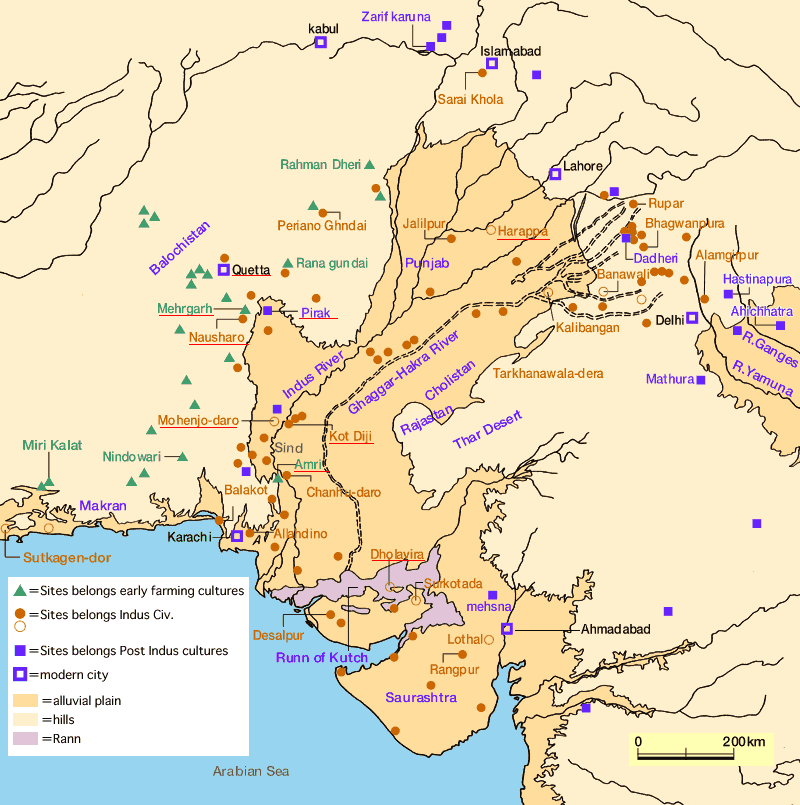
Until 1999, over 1,056 cities and settlements had been found, of which 96 have been excavated, mainly in the general region of the Indus and Ghaggar-Hakra Rivers and their tributaries. Among the settlements were the major urban centres of Harappa, Mohenjo-daro (UNESCO World Heritage Site), Dholavira, Ganeriwala in Cholistan and Rakhigarhi.
The Harappan language is not directly attested and its affiliation is uncertain since the Indus script is still undeciphered. A relationship with the Dravidian or Elamo-Dravidian language family is favored by a section of scholars.
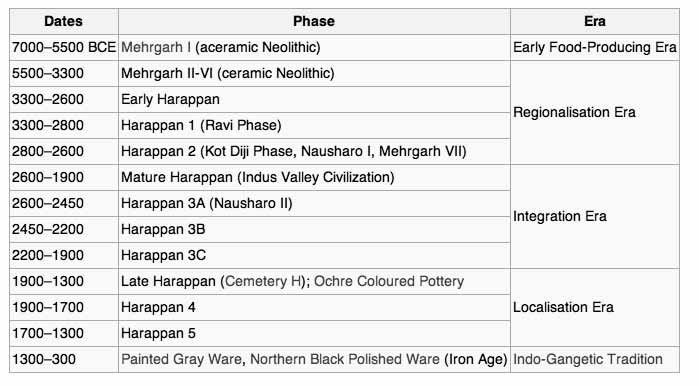
The mature phase of the Harappan civilization lasted from c. 2600 to 1900 BCE. With the inclusion of the predecessor and successor cultures - Early Harappan and Late Harappan, respectively - the entire Indus Valley Civilization may be taken to have lasted from the 33rd to the 14th centuries BCE. Two terms are employed for the periodization of the IVC: Phases and Eras.
The Early Harappan, Mature Harappan, and Late Harappan phases are also called the Regionalisation, Integration, and Localisation eras, respectively, with the Regionalization era reaching back to the Neolithic Mehrgarh II period. "Discoveries at Mehrgarh changed the entire concept of the Indus civilization", according to Ahmad Hasan Dani, professor emeritus at Quaid-e-Azam University, Islamabad. "There we have the whole sequence, right from the beginning of settled village life."
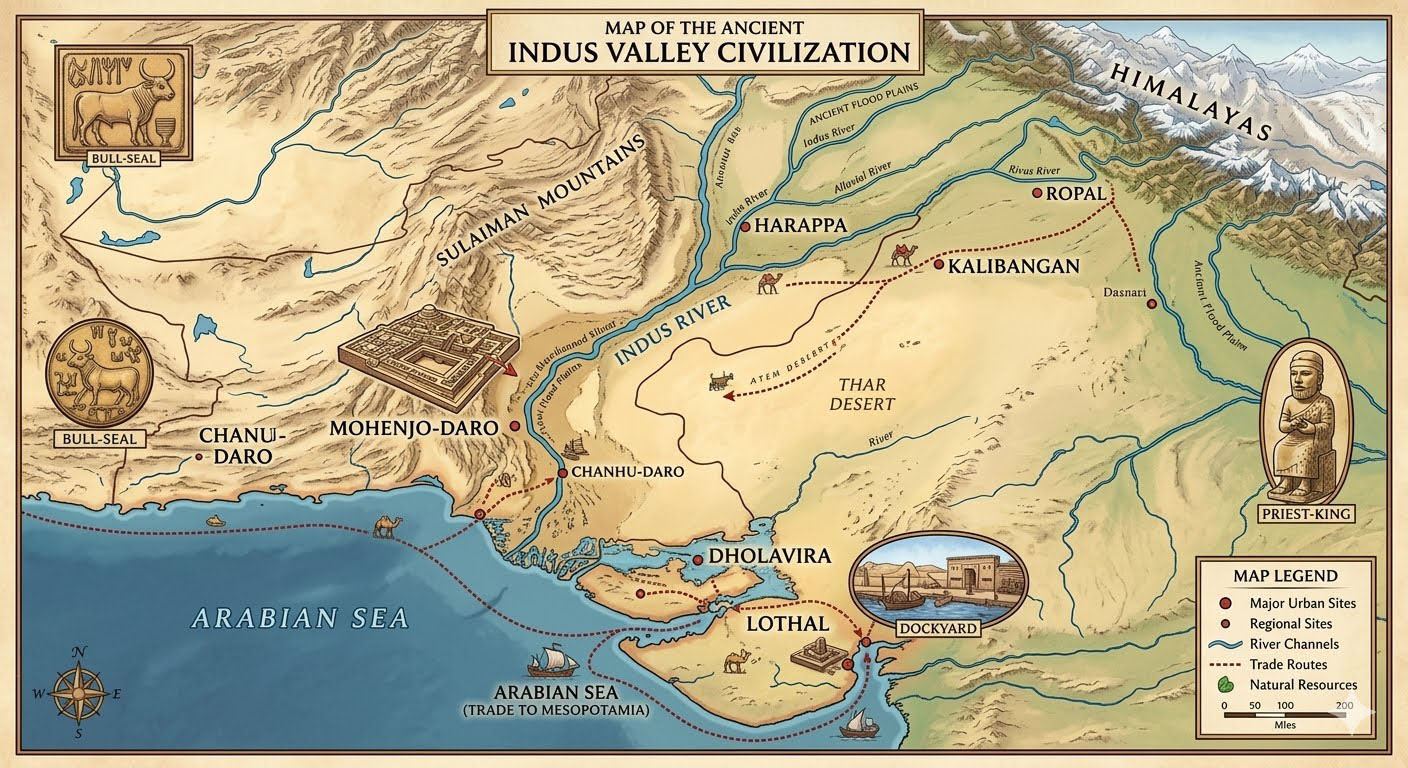
The Indus Valley Civilization encompassed most of Pakistan and parts of northwestern India, Afghanistan and Iran, extending from Balochistan in the west to Uttar Pradesh in the east, northeastern Afghanistan to the north and Maharashtra to the south.
The geography of the Indus Valley put the civilizations that arose there in a highly similar situation to those in Egypt and Peru, with rich agricultural lands being surrounded by highlands, desert, and ocean. Recently, Indus sites have been discovered in Pakistan's northwestern Frontier Province as well.
Other IVC colonies can be found in Afghanistan while smaller isolated colonies can be found as far away as Turkmenistan and in Gujarat. Coastal settlements extended from Sutkagan Dor in Western Baluchistan to Lothal in Gujarat. An Indus Valley site has been found on the Oxus River at Shortughai in northern Afghanistan, in the Gomal River valley in northwestern Pakistan, at Manda,Jammu on the Beas River near Jammu, India, and at Alamgirpur on the Hindon River, only 28 km from Delhi. Indus Valley sites have been found most often on rivers, but also on the ancient seacoast, for example, Balakot, and on islands, for example, Dholavira.
There is evidence of dry river beds overlapping with the Hakra channel in Pakistan and the seasonal Ghaggar River in India. Many Indus Valley (or Harappan) sites have been discovered along the Ghaggar-Hakra beds. Among them are: Rupar, Rakhigarhi, Sothi, Kalibangan, and Ganwariwala. According to J. G. Shaffer and D. A. Lichtenstein, the Harappan Civilization "is a fusion of the Bagor, Hakra, and Koti Dij traditions or 'ethnic groups' in the Ghaggar-Hakra valley on the borders of India and Pakistan".
According to some archaeologists, more than 500 Harappan sites have been discovered along the dried up river beds of the Ghaggar-Hakra River and its tributaries, in contrast to only about 100 along the Indus and its tributaries; consequently, in their opinion, the appellation Indus Ghaggar-Hakra civilization or Indus-Saraswati civilization is justified.
However, these politically inspired arguments are disputed by other archaeologists who state that the Ghaggar-Hakra desert area has been left untouched by settlements and agriculture since the end of the Indus period and hence shows more sites than found in the alluvium of the Indus valley; second, that the number of Harappan sites along the Ghaggar-Hakra river beds have been exaggerated and that the Ghaggar-Hakra, when it existed, was a tributary of the Indus, so the new nomenclature is redundant. "Harappan Civilization" remains the correct one, according to the common archaeological usage of naming a civilization after its first findspot.
The Early Harappan Ravi Phase, named after the nearby Ravi River, lasted from circa 3300 BCE until 2800 BCE. It is related to the Hakra Phase, identified in the Ghaggar-Hakra River Valley to the west, and predates the Kot Diji Phase (2800-2600 BCE, Harappan 2), named after a site in northern Sindh, Pakistan, near Mohenjo Daro. The earliest examples of the Indus script date from around 3000 BCE.
The mature phase of earlier village cultures is represented by Rehman Dheri and Amri in Pakistan. Kot Diji (Harappan 2) represents the phase leading up to Mature Harappan, with the citadel representing centralised authority and an increasingly urban quality of life. Another town of this stage was found at Kalibangan in India on the Hakra River.
Trade networks linked this culture with related regional cultures and distant sources of raw materials, including lapis lazuli and other materials for bead-making. Villagers had, by this time, domesticated numerous crops, including peas, sesame seeds, dates, and cotton, as well as animals, including the water buffalo. Early Harappan communities turned to large urban centres by 2600 BCE, from where the mature Harappan phase started.
By 2600 BCE, the Early Harappan communities had been turned into large urban centres. Such urban centres include Harappa, Ganeriwala, Mohenjo-Daro in modern day Pakistan, and Dholavira, Kalibangan, Rakhigarhi, Rupar, and Lothal in modern day India. In total, more than 1,052 cities and settlements have been found, mainly in the general region of the Indus Rivers and their tributaries.
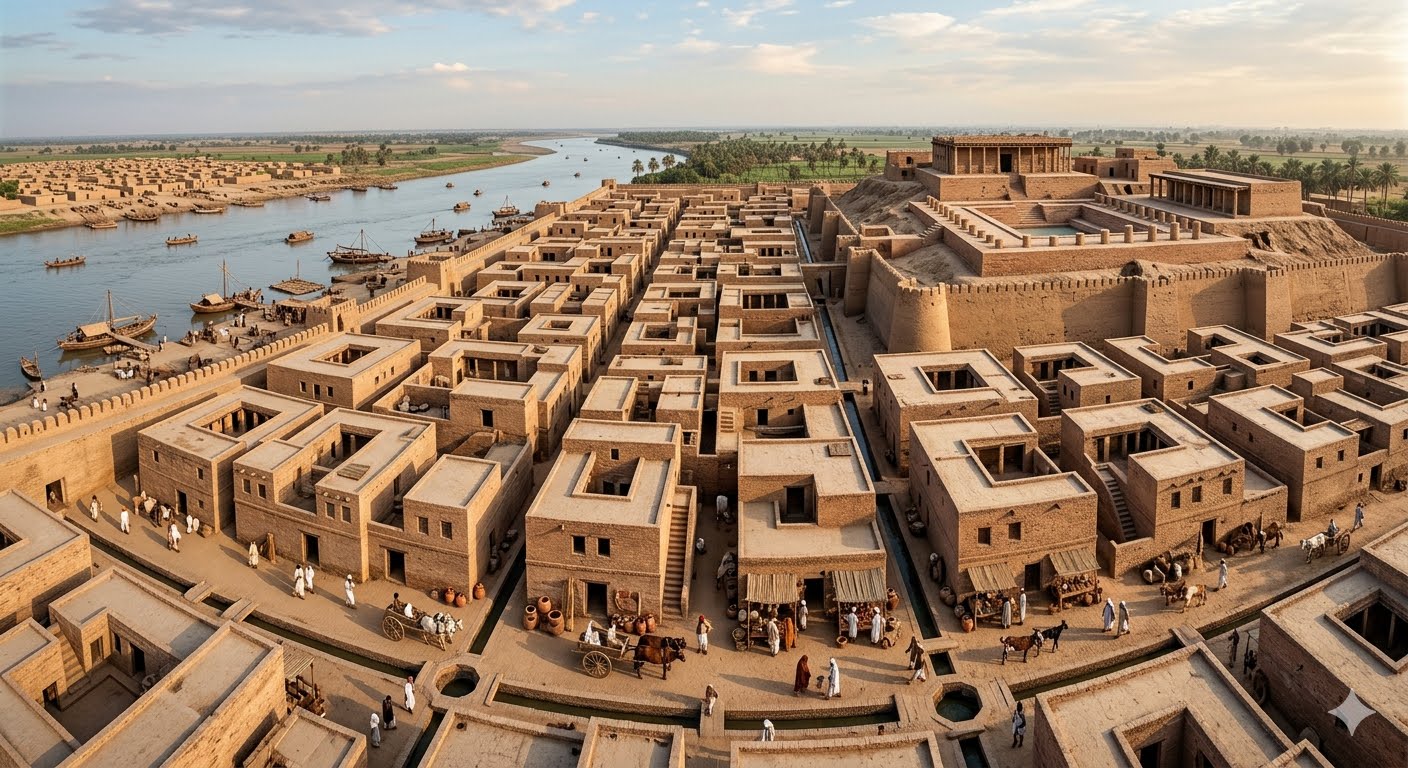
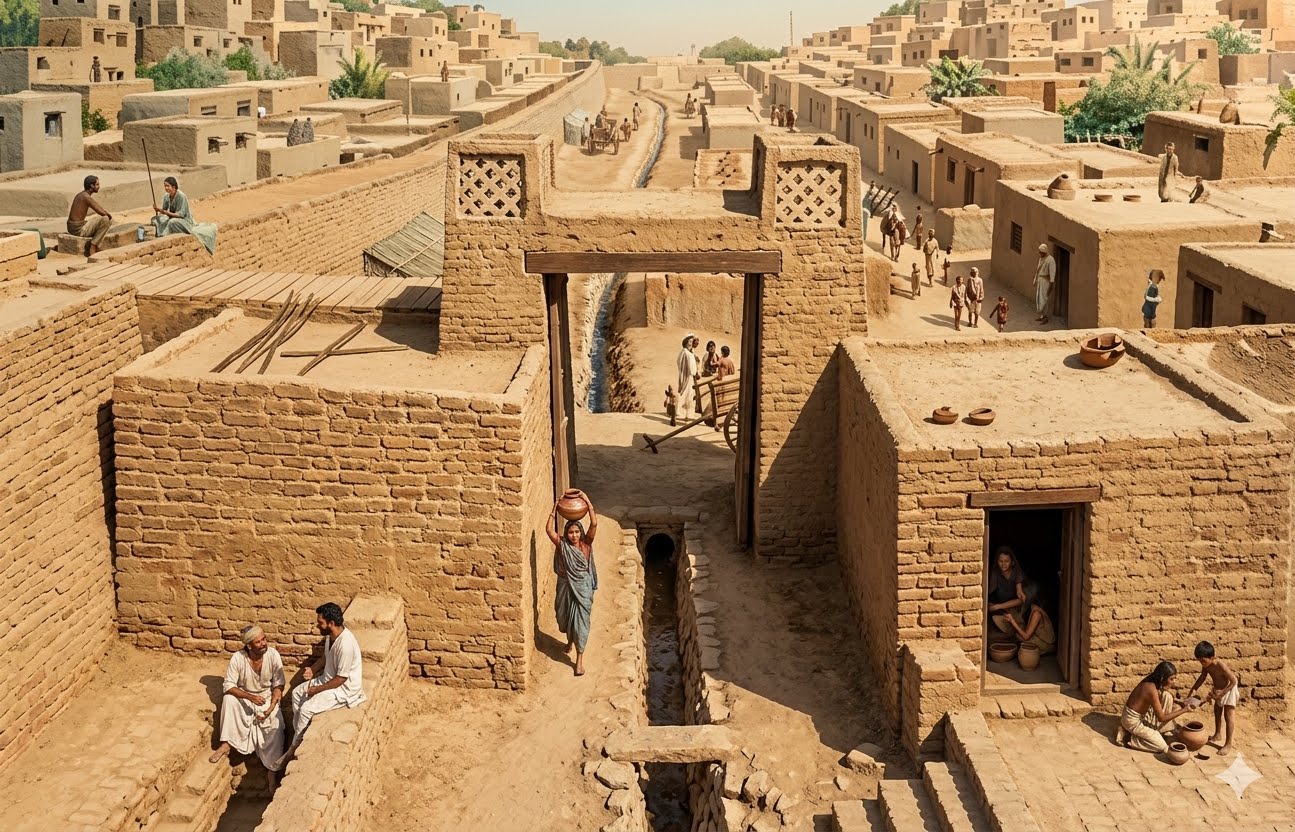
A sophisticated and technologically advanced urban culture is evident in the Indus Valley civilization. The quality of municipal town planning suggests knowledge of urban planning and efficient municipal governments which placed a high priority on hygiene. The streets of major cities such as Mohenjo-daro or Harappa were laid out in a perfect grid pattern, comparable to that of present day New York. The houses were protected from noise, odors, and thieves.
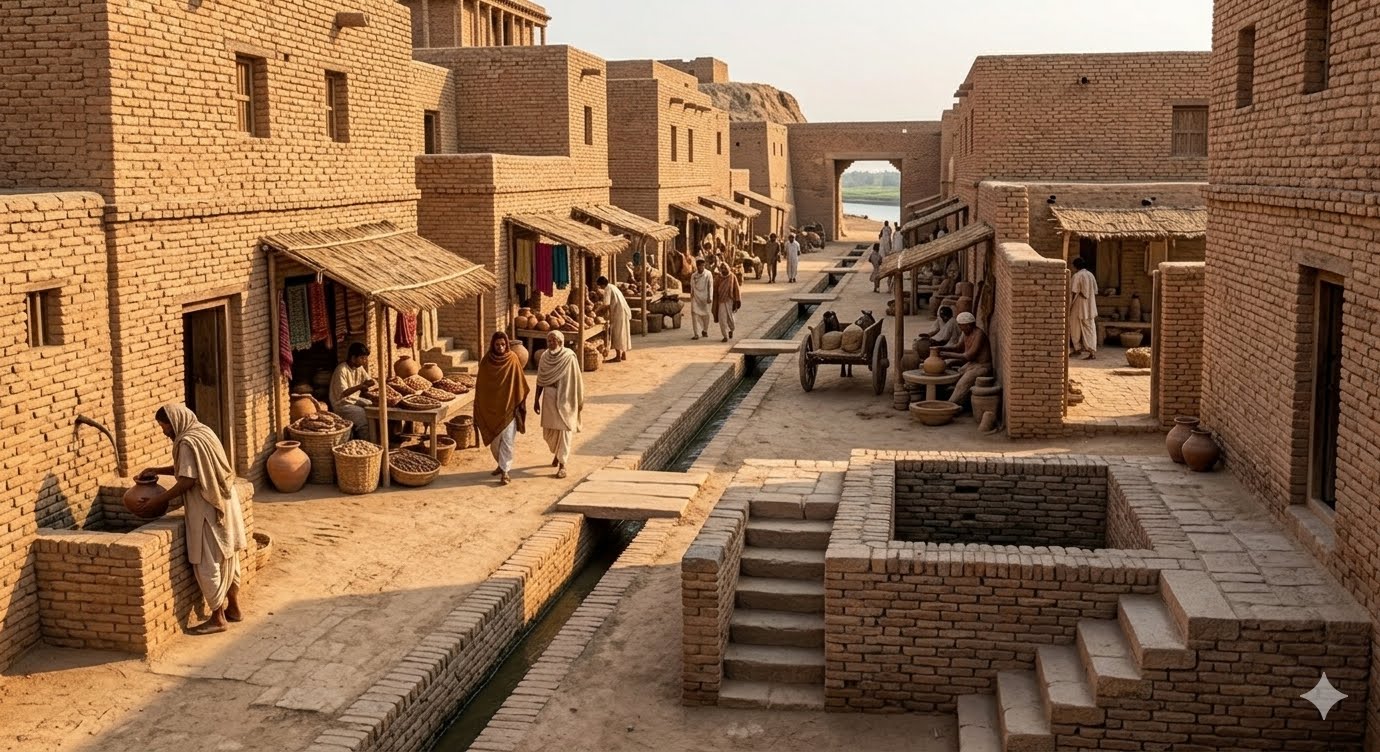
As seen in Harappa, Mohenjo-daro, and the recently discovered Rakhigarhi, this urban plan included the world's first urban sanitation systems. Within the city, individual homes or groups of homes obtained water from wells. From a room that appears to have been set aside for bathing, waste water was directed to covered drains, which lined the major streets. Houses opened only to inner courtyards and smaller lanes.
The ancient Indus systems of sewage and drainage that were developed and used in cities throughout the Indus Empire were far more advanced than any found in contemporary urban sites in the Middle East and even more efficient than those in some areas of modern Pakistan and India today. The advanced architecture of the Harappans is shown by their impressive dockyards, granaries, warehouses, brick platforms, and protective walls. The massive citadels of Indus cities that protected the Harappans from floods and attackers were larger than most Mesopotamian ziggurats.
The purpose of the "Citadel" remains debated. In sharp contrast to this civilization's contemporaries, Mesopotamia and ancient Egypt, no large monumental structures were built. There is no conclusive evidence of palaces or templesÜor, indeed, of kings, armies, or priests. Some structures are thought to have been granaries. Found at one city is an enormous well-built bath, which may have been a public bath. Although the "Citadels" are walled, it is far from clear that these structures were defensive. They may have been built to divert flood waters.
Most city dwellers appear to have been traders or artisans, who lived with others pursuing the same occupation in well-defined neighborhoods. Materials from distant regions were used in the cities for constructing seals, beads, and other objects. Among the artifacts made were beautiful beads of glazed stone called fa•ence. The seals have images of animals, gods, etc., and inscriptions. Some of the seals were used to stamp clay on trade goods, but they probably had other uses.Although some houses were larger than others, Indus civilization cities were remarkable for their apparent egalitarianism. For example, all houses had access to water and drainage facilities. One gets the impression of a vast middle-class society.
The ruins of Harrappa were first described in 1842 by Charles Masson in his Narrative of Various Journeys in Balochistan, Afghanistan, and the Punjab, where locals talked of an ancient city extending "thirteen cosses" (about 25 miles), but no archaeological interest would attach to this for nearly a century.
In 1856, General Alexander Cunningham, later director general of the archeological survey of northern India, visited Harappa where the British engineers John and William Brunton were laying the East Indian Railway Company line connecting the cities of Karachi and Lahore. John wrote: "I was much exercised in my mind how we were to get ballast for the line of the railway". They were told of an ancient ruined city near the lines, called Brahminabad. Visiting the city, he found it full of hard well-burnt bricks, and, "convinced that there was a grand quarry for the ballast I wanted", the city of Brahminabad was reduced to ballast. A few months later, further north, John's brother William Brunton's "section of the line ran near another ruined city, bricks from which had already been used by villagers in the nearby village of Harappa at the same site. These bricks now provided ballast along 93 miles (150 km) of the railroad track running from Karachi to Lahore".
In 1872Š75 Alexander Cunningham published the first Harappan seal (with an erroneous identification as Brahmi letters). It was half a century later, in 1912, that more Harappan seals were discovered by J. Fleet, prompting an excavation campaign under Sir John Hubert Marshall in 1921-22 and resulting in the discovery of the civilization at Harappa by Sir John Marshall, Rai Bahadur Daya Ram Sahni and Madho Sarup Vats, and at Mohenjo-daro by Rakhal Das Banerjee, E. J. H. MacKay, and Sir John Marshall.
By 1931, much of Mohenjo-Daro had been excavated, but excavations continued, such as that led by Sir Mortimer Wheeler, director of the Archaeological Survey of India in 1944. Among other archaeologists who worked on IVC sites before the partition of the subcontinent in 1947 were Ahmad Hasan Dani, Brij Basi Lal, Nani Gopal Majumdar, and Sir Marc Aurel Stein.
Following the Partition of India, the bulk of the archaeological finds were inherited by Pakistan where most of the IVC was based, and excavations from this time include those led by Sir Mortimer Wheeler in 1949, archaeological adviser to the Government of Pakistan. Outposts of the Indus Valley civilization were excavated as far west as Sutkagan Dor in Baluchistan, as far north as at Shortugai on the Amu Darya (the river's ancient name was Oxus) in current Afghanistan, as far east as at Alamgirpur, Uttar Pradesh, India and as far south as at Malwan, Surat Dist., India.
On July 11th, heavy floods hit Haryana in India and damaged the archaeological site of Jognakhera, where ancient copper smelting were found dating back almost 5,000 years. The Indus Valley Civilization site was hit by almost 10 feet of water as the Sutlej Yamuna link canal overflowed.
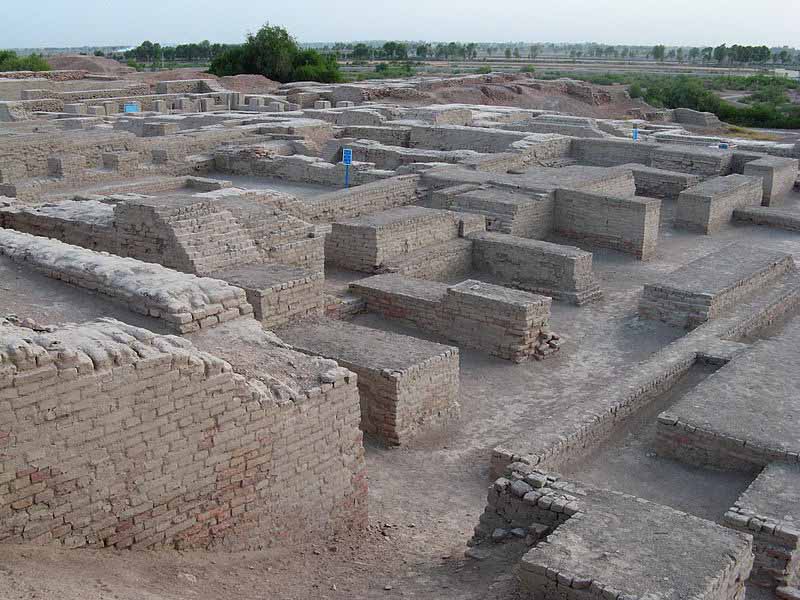
Mohenjo Daro - Mound of the Dead - is an archeological site in the province of Sindh, Pakistan. Built around 2600 BCE, it was one of the largest settlements of the ancient Indus Valley Civilization, and one of the world's earliest major urban settlements, contemporaneous with the civilizations of ancient Egypt, Mesopotamia, and Crete. Mohenjo-daro was abandoned in the 19th century BCE, and was not rediscovered until 1922. Significant excavation has since been conducted at the site of the city, which was designated a UNESCO World Heritage Site in 1980. However, the site is currently threatened by erosion and improper restoration.
4,000-year-old city - Mohenjo-daro - defies the rules of history by becoming richer by sharing prosperity instead of concentrating it. Science Daily - July 30, 2026
New research suggests that Mohenjo-daro followed a very different path from many other early cities. As the 4,000-year-old urban center became larger, more productive, and more successful, its society appears to have grown more equal rather than less. Historians have often argued that inequality increased when small farming settlements developed into cities. Under this traditional model, kings, priests, and other powerful leaders gained control of wealth and resources, causing the divide between rich and poor to expand.
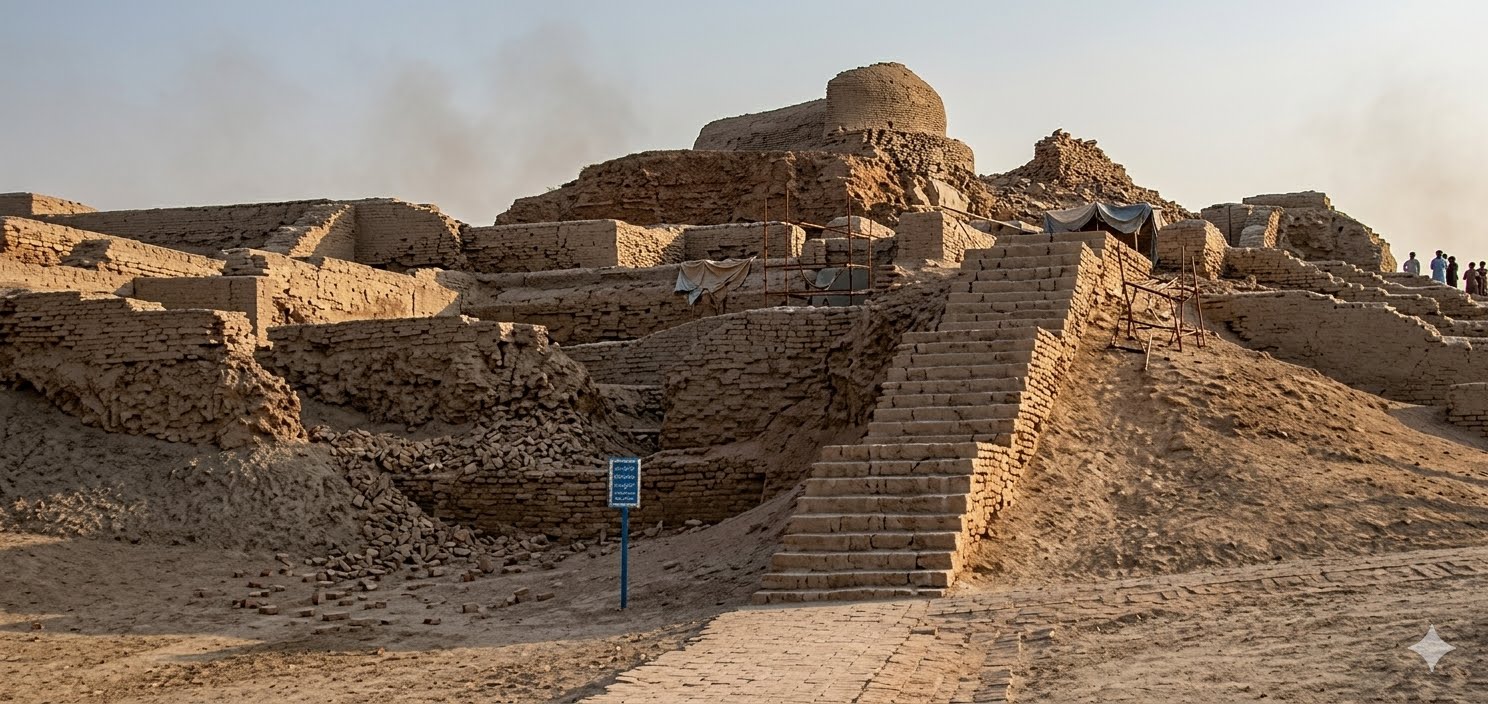
The 4,500-Year-Old City of Mohenjo Daro Is Crumbling
Mohenjo Daro likely was, at its time, the greatest city in the world. Roughly 4,500 years ago, as many as 35,000 people lived and worked in the massive city, which occupies 250 acres along PakistanÕs Indus river. Mohenjo Daro sat beneath the soil for thousands of years, a preserved relic of the ancient Indus Valley civilization. But excavation exposed the city to the elements, and now, says the Telegraph, the ruins may have as little as 20 years left.
Archaeological records provide no immediate answers for a center of power or for depictions of people in power in Harappan society. But, there are indications of complex decisions being taken and implemented. For instance, the extraordinary uniformity of Harappan artifacts as evident in pottery, seals, weights and bricks. These are the major theories:
There was a single state, given the similarity in artifacts, the evidence for planned settlements, the standardized ratio of brick size, and the establishment of settlements near sources of raw material.
There was no single ruler but several: Mohenjo-daro had a separate ruler, Harappa another, and so forth.
Harappan society had no rulers, and everybody enjoyed equal status.
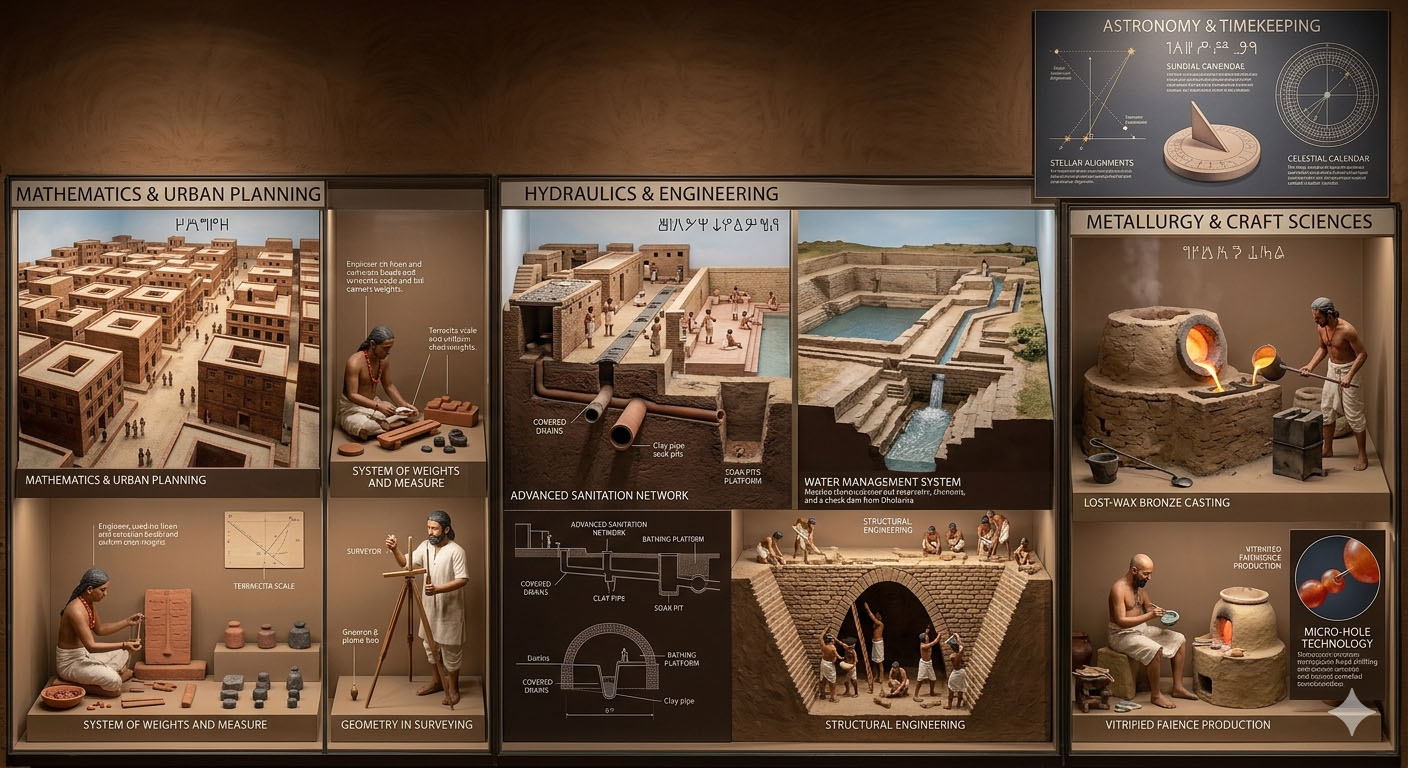
Core Technological Innovations - Advanced Urban Sanitation: Cities featured the world's first known covered street drainage gutters. Houses included indoor plumbing, private bathing platforms, and flush toilets connected directly to street sewers via clay pipes.
Standardized Metrology: Harappan engineers achieved incredible accuracy in measurement. They manufactured uniform kiln-fired clay bricks with a strict 4:2:1 dimensional ratio and used precise cubical chert weights for commerce.
Hydraulic Engineering: Sites like Dholavira integrated massive stone-cut water reservoirs, check dams, and intricate water harvesting channels. Lothal housed a massive artificial tidal dockyard engineered to handle changing sea levels.
Metallurgy and Craft Material Science: Artisans pioneered new techniques in metallurgy (bronze casting) and chemistry, particularly in vitrifying faience and drilling micro-holes through hard carnelian beads for luxury exports.
The people of the Indus Civilization achieved great accuracy in measuring length, mass, and time. They were among the first to develop a system of uniform weights and measures. A comparison of available objects indicates large scale variation across the Indus territories.
Their smallest division, which is marked on an ivory scale found in Lothal, was approximately 1.704 mm, the smallest division ever recorded on a scale of the Bronze Age. Harappan engineers followed the decimal division of measurement for all practical purposes, including the measurement of mass as revealed by their hexahedron weights.
These chert weights were in a ratio of 5:2:1 with weights of 0.05, 0.1, 0.2, 0.5, 1, 2, 5, 10, 20, 50, 100, 200, and 500 units, with each unit weighing approximately 28 grams, similar to the English Imperial ounce or Greek uncia, and smaller objects were weighed in similar ratios with the units of 0.871. However, as in other cultures, actual weights were not uniform throughout the area. The weights and measures later used in Kautilya's Arthashastra (4th century BCE) are the same as those used in Lothal.
Harappans evolved some new techniques in metallurgy and produced copper, bronze, lead, and tin. The engineering skill of the Harappans was remarkable, especially in building docks.
In 2001, archaeologists studying the remains of two men from Mehrgarh, Pakistan, made the discovery that the people of the Indus Valley Civilization, from the early Harappan periods, had knowledge of proto-dentistry.
Later, in April 2006, it was announced in the scientific journal Nature that the oldest (and first early Neolithic) evidence for the drilling of human teeth in vivo (i.e., in a living person) was found in Mehrgarh. Eleven drilled molar crowns from nine adults were discovered in a Neolithic graveyard in Mehrgarh that dates from 7,500-9,000 years ago. According to the authors, their discoveries point to a tradition of proto-dentistry in the early farming cultures of that region.
A touchstone bearing gold streaks was found in Banawali, which was probably used for testing the purity of gold (such a technique is still used in some parts of India).
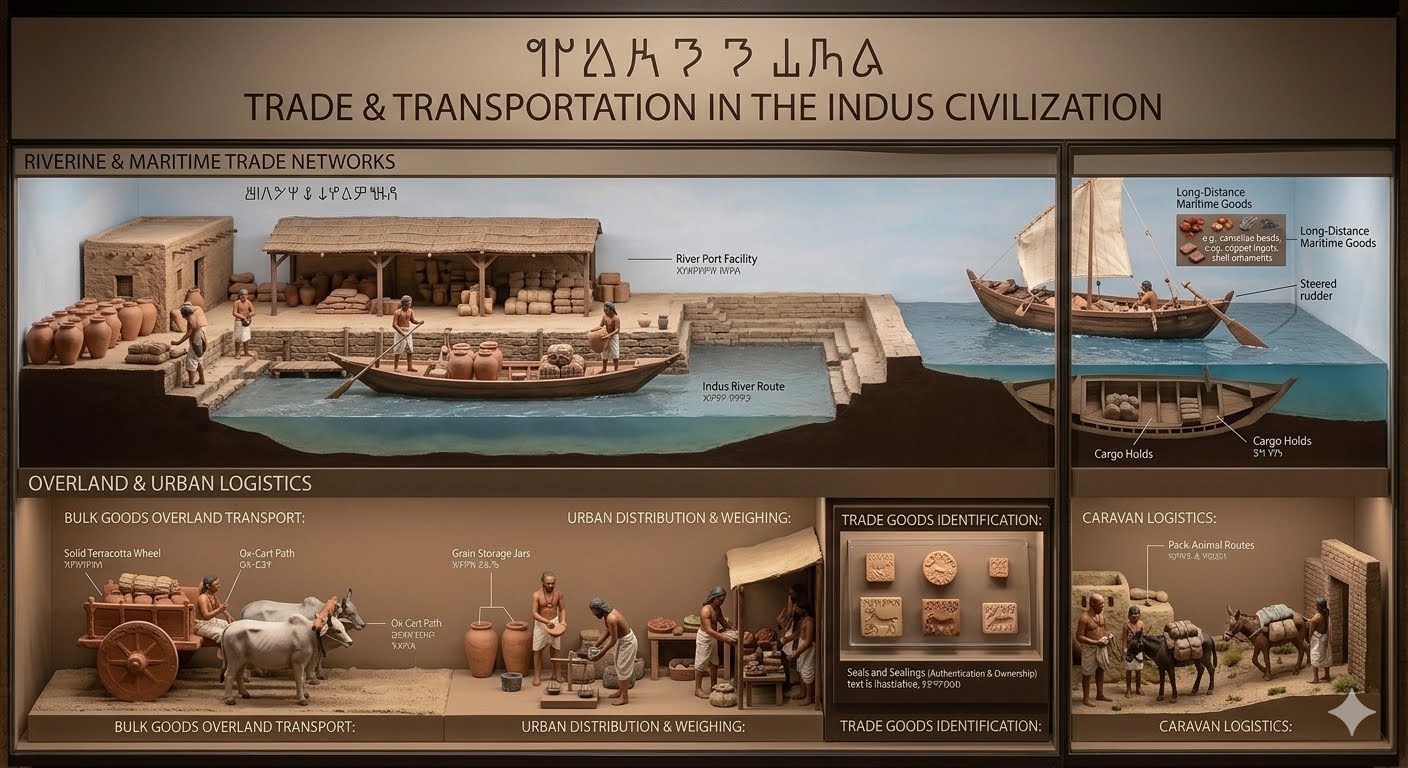
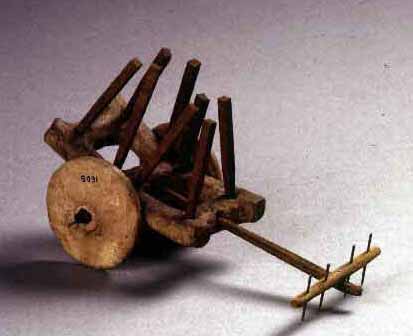
The Indus civilization's economy appears to have depended significantly on trade, which was facilitated by major advances in transport technology. The IVC may have been the first civilization to use wheeled transport. These advances may have included bullock carts that are identical to those seen throughout South Asia today, as well as boats. Most of these boats were probably small, flat-bottomed craft, perhaps driven by sail, similar to those one can see on the Indus River today; however, there is secondary evidence of seagoing craft. Archaeologists have discovered a massive, dredged canal and what they regard as a docking facility at the coastal city of Lothal in western India (Gujarat state). An extensive canal network, used for irrigation, has however also been discovered by H.-P. Francfort.
During 4300Š3200 BCE of the chalcolithic period (copper age), the Indus Valley Civilization area shows ceramic similarities with southern Turkmenistan and northern Iran which suggest considerable mobility and trade. During the Early Harappan period (about 3200Š2600 BCE), similarities in pottery, seals, figurines, ornaments, etc. document intensive caravan trade with Central Asia and the Iranian plateau.
Judging from the dispersal of Indus civilization artifacts, the trade networks, economically, integrated a huge area, including portions of Afghanistan, the coastal regions of Persia, northern and western India, and Mesopotamia. There is some evidence that trade contacts extended to Crete and possibly to Egypt.
There was an extensive maritime trade network operating between the Harappan and Mesopotamian civilizations as early as the middle Harappan Phase, with much commerce being handled by "middlemen merchants from Dilmun" (modern Bahrain and Failaka located in the Persian Gulf). Such long-distance sea trade became feasible with the innovative development of plank-built watercraft, equipped with a single central mast supporting a sail of woven rushes or cloth.
Several coastal settlements like Sotkagen-dor (astride Dasht River, north of Jiwani), Sokhta Koh (astride Shadi River, north of Pasni), and Balakot (near Sonmiani) in Pakistan along with Lothal in India testify to their role as Harappan trading outposts. Shallow harbors located at the estuaries of rivers opening into the sea allowed brisk maritime trade with Mesopotamian cities.
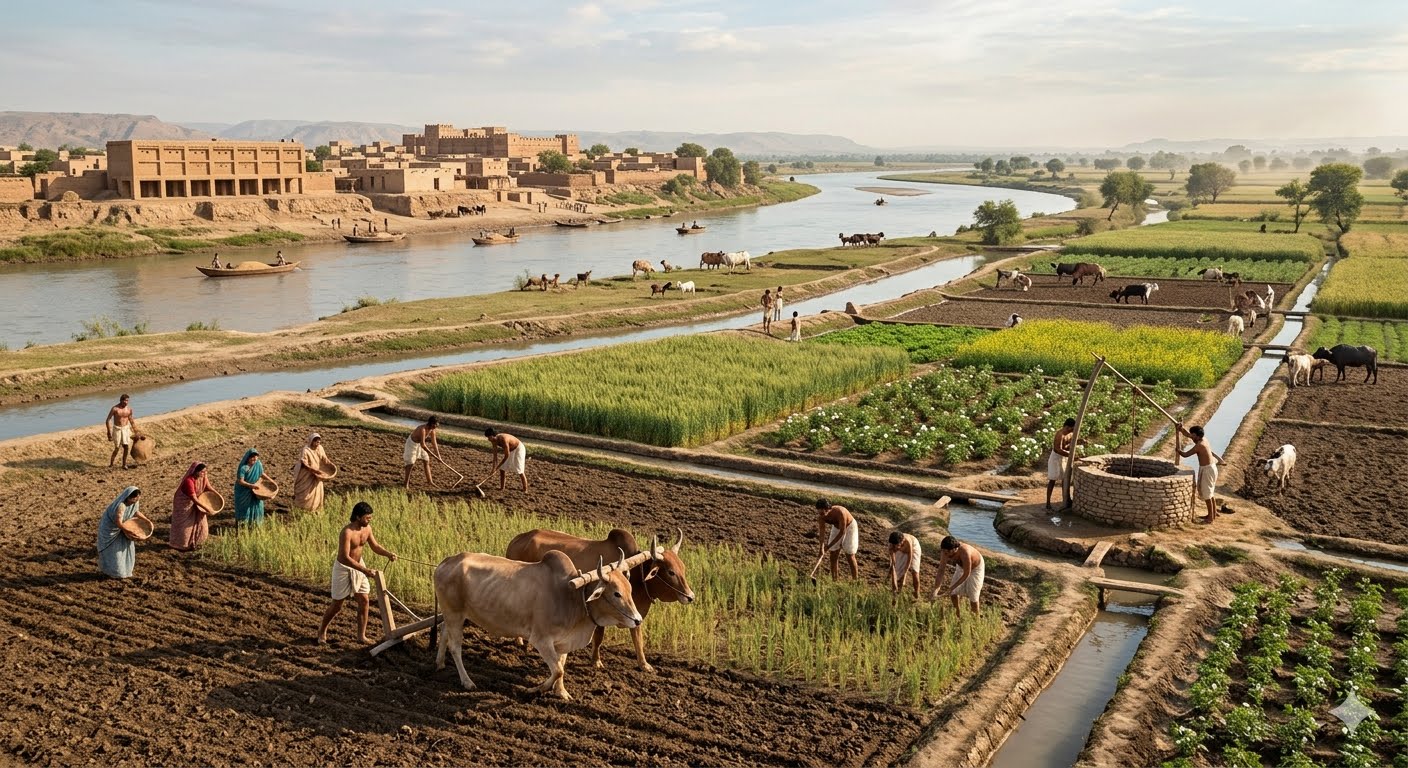
The nature of the Indus civilization's agricultural system is still largely a matter of conjecture due to the limited amount of information surviving through the ages. Some speculation is possible, however.
Earlier studies (prior to 1980) often assumed that food production was imported to the Indus Valley by a single linguistic group ("Aryans") and/or from a single area. But recent studies indicate that food production was largely indigenous to the Indus Valley. Already the Mehrgarh people used domesticated wheats and barley and the major cultivated cereal crop was naked six-row barley, a crop derived from two-row barley.
Archaeologist Jim G. Shaffer (1999: 245) writes that the Mehrgarh site "demonstrates that food production was an indigenous South Asian phenomenon" and that the data support interpretation of "the prehistoric urbanization and complex social organization in South Asia as based on indigenous, but not isolated, cultural developments."
Indus civilization agriculture must have been highly productive; after all, it was capable of generating surpluses sufficient to support tens of thousands of urban residents who were not primarily engaged in agriculture. It relied on the considerable technological achievements of the pre-Harappan culture, including the plough.
Still, very little is known about the farmers who supported the cities or their agricultural methods. Some of them undoubtedly made use of the fertile alluvial soil left by rivers after the flood season, but this simple method of agriculture is not thought to be productive enough to support cities. There is no evidence of irrigation, but such evidence could have been obliterated by repeated, catastrophic floods.
The Indus civilization appears to contradict the hydraulic despotism hypothesis of the origin of urban civilization and the state. According to this hypothesis, cities could not have arisen without irrigation systems capable of generating massive agricultural surpluses. To build these systems, a despotic, centralized state emerged that was able to suppress the social status of thousands of people and harness their labor as slaves. It is very difficult to square this hypothesis with what is known about the Indus civilization. There is no evidence of kings, slaves, or forced mobilization of labor.
It is often assumed that intensive agricultural production requires dams and canals. This assumption is easily refuted. Throughout Asia, rice farmers produce significant agricultural surpluses from terraced, hillside rice paddies, which result not from slavery but rather the accumulated labor of many generations of people. Instead of building canals, Indus civilization people may have built water diversion schemes, which - like terrace agriculture - can be elaborated by generations of small-scale labor investments.
In addition, it is known that Indus civilization people practiced rainfall harvesting, a powerful technology that was brought to fruition by classical Indian civilization but nearly forgotten in the 20th century. It should be remembered that Indus civilization people, like all peoples in South Asia, built their lives around the monsoon,a weather pattern in which the bulk of a year's rainfall occurs in a four-month period. At a recently discovered Indus civilization city in western India, archaeologists discovered a series of massive reservoirs, hewn from solid rock and designed to collect rainfall, that would have been capable of meeting the city's needs during the dry season.
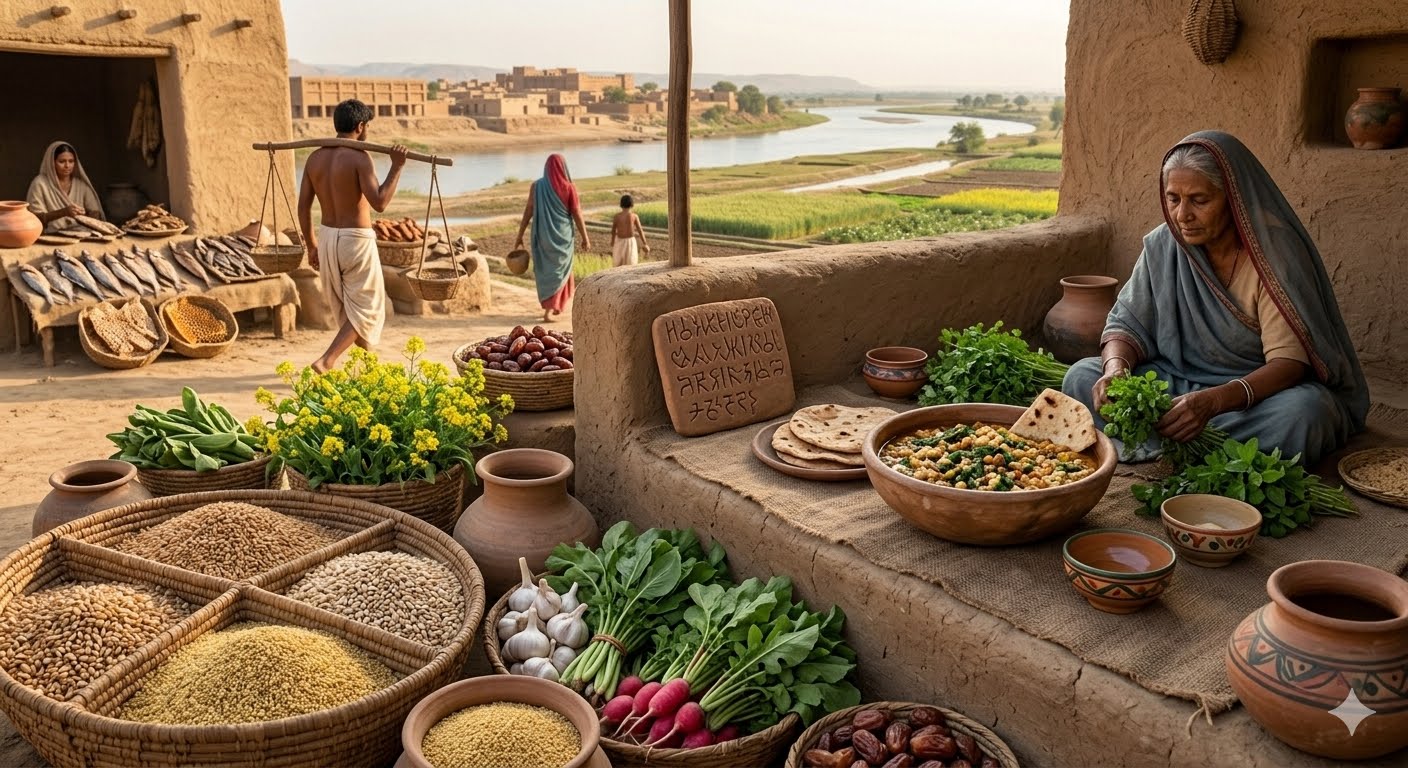
Primary Dietary Pillars - Agricultural Staples:
The absolute foundation of their diet was wheat and barley, alongside various pulses, field peas, chickpeas, green gram, and mustard. They were also pioneering cultivators of millets and early rice variations.
Heavy Meat & Dairy Intake: Chemical analysis of ancient cooking pottery indicates an exceptionally high consumption of meat. They frequently consumed cattle, water buffalo, sheep, goats, and pigs. Dairy products like milk, curd, and butter were also core elements of daily meals.
Riverine & Wild Resources: Living along expansive river plains, citizens supplemented their meals with extensive amounts of freshwater fish, mollusks, turtles, and water birds.
Fruits & Spices: Excavations highlight the use of wild and cultivated fruits like dates, jujube, pomegranates, and grapes, seasoned with early culinary herbs including wild coriander and ginger.
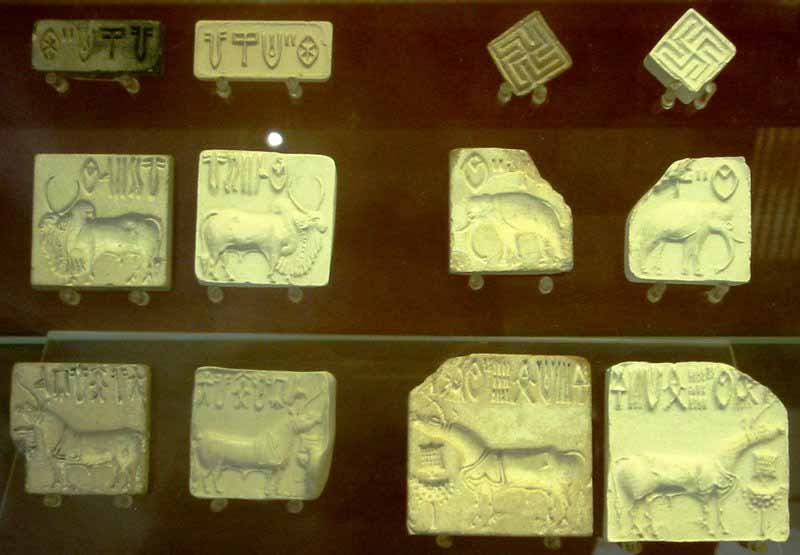
Indus Valley Seals
It has long been claimed that the Indus Valley was the home of a literate civilization, but this has recently been challenged on linguistic and archaeological grounds. Well over 400 Indus symbols have been found on seals or ceramic pots and over a dozen other materials, including a 'signboard' that apparently once hung over the gate of the inner citadel of the Indus city of Dholavira. Typical Indus inscriptions are no more than four or five characters in length, most of which (aside from the Dholavira 'signboard') are exquisitely tiny; the longest on a single surface, which is less than 1 inch (2.54 cm) square, is 17 signs long; the longest on any object (found on three different faces of a mass-produced object) carries only 26 symbols. It has been recently pointed out that the brevity of the inscriptions is unparalleled in any known premodern literate society, including those that wrote extensively on leaves, bark, wood, cloth, wax, animal skins, and other perishable materials.
Based partly on this evidence, a controversial recent paper by Farmer, Sproat, and Witzel (2004), argues that the Indus system did not encode language, but was related instead to a variety of non-linguistic sign systems used extensively in the Near East. It has also been claimed on occasion that the symbols were exclusively used for economic transactions, but this claim leaves unexplained the appearance of Indus symbols on many ritual objects, many of which were mass produced in molds. No parallels to these mass-produced inscriptions are known in any other early ancient civilizations.
Photos of many of the thousands of extant inscriptions are published in the Corpus of Indus Seals and Inscriptions (1987, 1991), edited by A. Parpola and his colleagues. Publication of a final third volume, which will reportedly republish photos taken in the 20s and 30s of hundreds of lost or stolen inscriptions, along with many discovered in the last few decades, has been announced for several years, but has not yet found its way into print. For now, researchers must supplement the materials in the Corpus by study of the tiny photos in the excavation reports of Marshall (1931), Mackay (1938, 1943), Wheeler (1947), or reproductions in more recent scattered sources.
The term Indus Script refers to short strings of symbols associated with the Harappan civilization of ancient India (most of the Indus sites are distributed in present day North West India and Pakistan) used between 2600Š1900 BC, which evolved from an earlier form of the Indus script attested from around 3300 BC. They are most commonly associated with flat, rectangular stone tablets called seals, but they are also found on at least a dozen other materials.
The first publication of a Harappan seal dates to 1875, in the form of a drawing by Alexander Cunningham. Since then, well over 4000 symbol-bearing objects have been discovered, some as far afield as Mesopotamia. After 1900 BC, use of the symbols ends, together with the final stage of Harappan civilization. Some early scholars, starting with Cunningham in 1877, thought that the script was the archetype of the Brahmi script used by Ashoka. Today Cunningham's claims are rejected by nearly all researchers, but a minority of mostly Indian scholars continues to argue for the Indus script as the predecessor of the Brahmic family. There are over 400 different signs, but many are thought to be slight modifications or combinations of perhaps 200 'basic' signs.
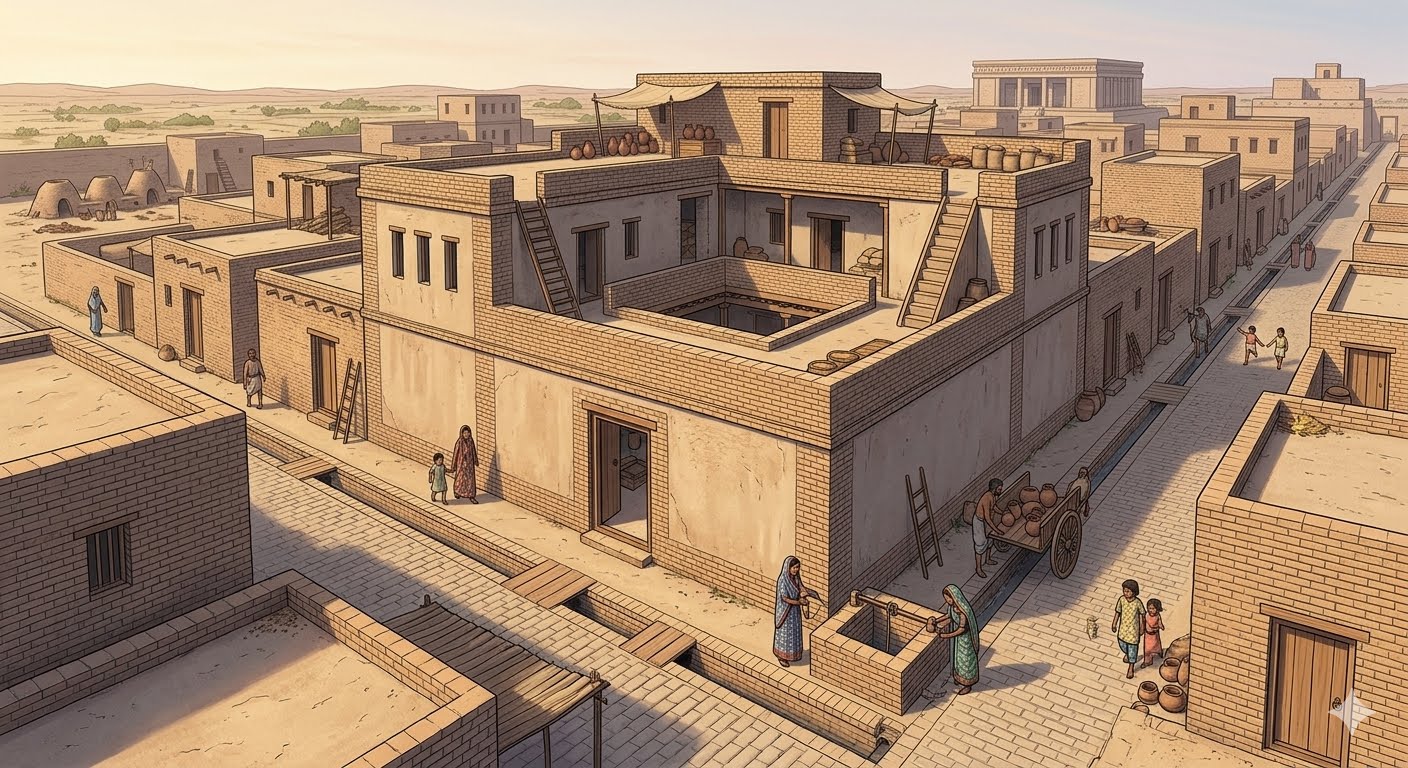
Houses were one or two stories high, made of baked brick, with flat roofs, and were just about identical. Each was built around a courtyard, with windows overlooking the courtyard. The outside walls had no windows. Each home had its own private drinking well and its own private bathroom. Clay pipes led from the bathrooms to sewers located under the streets. These sewers drained into nearly rivers and streams.
Harappan cities did not develop slowly, which suggests that whoever built these cities learned to do so in another place. As the Indus flooded, cities were rebuilt on top of each other. Archaeologists have discovered several different cities, one built over the other, each built a little less skillfully. The most skillful was on bottom. It would appear that builders grew less able or less interested in perfection over time. Still, each city is a marvel, and each greatly advanced for its time.
Their towns were laid out in grids everywhere (straight streets, well built homes!) These people were incredible builders. Scientists have found what they think are giant reservoirs for fresh water. They have also found that even the smallest house at the edge of each town was linked to that town's central drainage system. (Is it possible that they not only drained waste water out, but also had a system to pump fresh water into their homes, similar to modern plumbing.
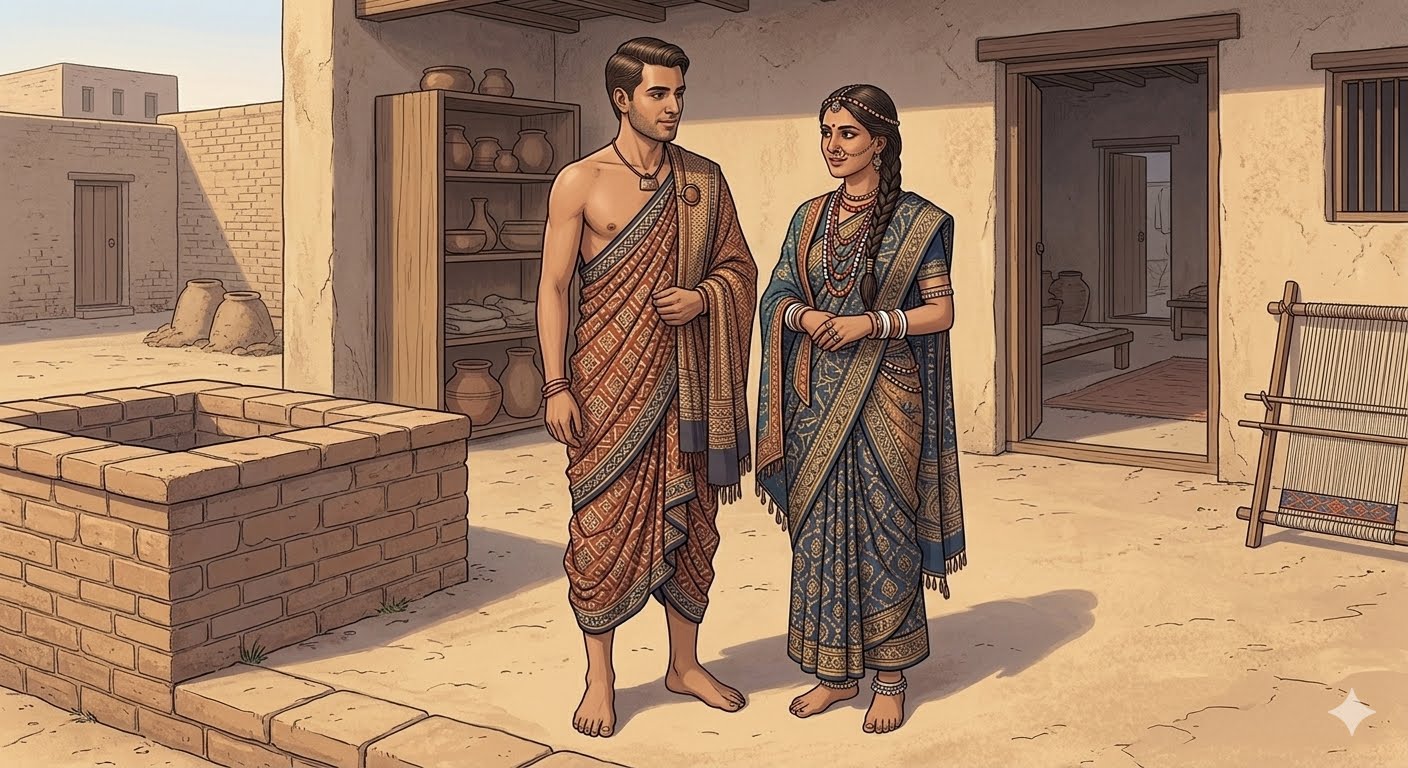
Men and women dressed in colorful robes. Women wore jewelry of gold and precious stone, and even wore lipstick! Among the treasures found was a statue of a women wearing a bracelet. (Bracelets with similar designs are worn today in India.)
Clothing was for the most part, similar for both men and women. The basic costume of ancient society was a length of cloth wrapped around the lower part of the body, and a loose fitting garment for the upper body, which was usually another length of fabric. A headdress was also worn, mainly by the men.
Women in Vedic society wore a variety of garments. The first being a skirt type garment (dhoti), with a blouse (choli) and scarf. Second is a sari, which is a length of fabric wound around the body with the loose end (pallu) thrown over the shoulder. Sometimes a choli would be worn with this. The last garment was worn mainly by tribal women. The Adivasi is a length of fabric tied around the waist with no upper garment worn.
Men also had a choice in their clothing though not as varied as the women. Men usually wore a Dhoti, which is a length of fabric wrapped around the waist. This could be left as a skirt or brought through the legs and made into a pants type garment. Men of the south rarely wore shirts, but men of the north wore a fitted upper garment. Male headdress was also a length of fabric, wrapped around the head, called a Turban. Women sometimes wore the turban also.
Due to the large area of India many differences in clothing emerged, mainly due to climate differences. The southern Indians wore much less than in the colder north. Women in the south rarely wore a upper garment. Northern women adopted a fitted upper garment to be worn under the loose fitting one.
Clothing was made from resources found in each region. Cotton and wool were the most abundant, since silk was not introduced from China until around the 1st century B.C.E. People also enjoyed lavish embroidery and embellishments. Gold being the preferred, though there was also an abundance of silver and precious gems.
A beautiful small bronze statue of a dancer was found, which tells us that they enjoyed dance and had great skill working with metals. In the ancient city of Mohenjo-daro, scientists have found the remains of a large central pool, with steps leading down at both ends. This could have been a public swimming pool, or perhaps have been used for religious ceremonies. Around this large central pool were smaller rooms, that might have dressing rooms, and smaller pools that might have been private baths.
Musical instruments include the Sarangi, Sitar, Tabla, Tambora, and Tanpura.

The Tambora
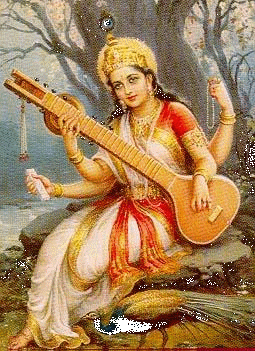
Since Vedic times, Indians had been required to correctly recite, the Vedas. The correctness in recitation was very important as the Vedas were, in those days, transmitted through memory (Smriti) and were learned through hearing (Shruti).
This kind of an emphasis on recitation the correct pronunciation lead to studies in phonetics and sound manipulation. This was the birthplace of Indian Musical Raga (metre) and Swaras (rhymes). That Music in ancient India was given considerable recognition is illustrated by the fact that Saraswati, the Indian goddess of learning is shown to be holding a musical instrument (Veena) in her hand.
Traditionally, vocal music in India has tended to be devotional music (Bhakti-geet), and temples have been places where musicians used to practice music to please the deity and the devotees. Indian vocal music is broadly divided into two schools - the Hindustani or north Indian school and the Carnatic or South Indian school. As far as instrumental music goes there is a general identity of instruments that have been used.
The main Indian musical instruments are the Sarod, the Veena, the Sarangi, the Tambora, the Harmonium, the Ghata, the Tabla, the Tanpura, the Satar, etc., As compared to art and architecture Indian music has had less impact on the outside world. This was so as most of Indian musical instruments require specialized material and craftsmanship for their manufacture. And in the absence of transmission of these skills and the absence of trade in musical instruments, Along with the necessity of long and arduous practice which was required to master these instruments, made the transmission of music a difficult task.
However, as far as, devotional vocal music goes, Indian musical traditions did travel to the countries of South east Asia. The instrumental and vocal music of Korea has many elements of Indian music, which it received along with the Buddhist invocative and devotional songs and slokas (religious couplets). Along with Buddhism, some Indian musical instruments like the flute (bansi), temples bell (Ghanta), etc., went to the countries of south-east Asia. Even Europe owes certain instruments to India.
Two popular European musical instruments namely the flute and violin are believed to be of Indian origin. Though we do not know about the process of transmission of these instruments, however in India the flute (bansi) and the violin (a variant of the Veena) are definitely indigenously Indian.
A pointer to the fact that these instruments have been in usage in India since a very long time is that the bansi is associated with Sri Krishna and the Veena with the goddess Saraswati.
This apart, in modern times the western musical instruments like the Tambourin and the Tambour are adaptations of the Indian Tambora and Tanpura. The names Tambourin and Tambour are also derived from the word Tambora. The Saralngi, another Indian musical instrument has also found its place in western music. The acceptance of these musical instruments in the west is also evident from the fact that the words Tambora, Sarangi and Tabla are mentioned in the Oxford Dictionary.
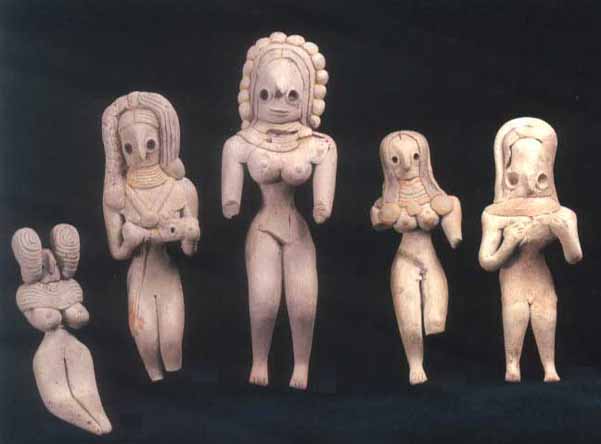
Terracotta Figurines
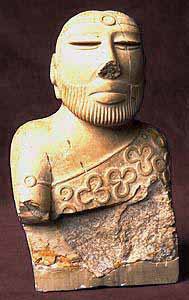
Priest King
Ancient India's fine art and performing arts attest to this fact. This find expression in music, musical instruments, dancing, paintings and several other art forms.
Music had a divine character in India and in recognition of that the Indian Goddess of learning, Saraswati is always shown holding a musical instrument, namely, the veena. Likewise, Krishna is associated with 'banshi', that is, the flute - a musical instrument, which traveled throughout the world from India. Indian devotional songs and reciting influenced religious recitations in several eastern countries, where the style was adopted by Buddhists monks. The India developed several types of musical instruments and forms of dancing, with delicate body movements and grace.
Paintings have remained the oldest art form as found in several cave paintings across the globe. In India also, in places like Bhimbetka, a UNESCO declared world heritage site, pre-historic cave paintings have been discovered. In relatively recent times, paintings and carvings on rock had significantly developed, and many such rock carvings have been found dating to the period of the emperor Ashoka. Indian influences may be seen in paintings at Bamiyan, Afghanistan, and in Miran and Domko in Central Asia. Sometimes, such paintings depict not only Buddha but Hindu deities such as Shiva, Ganesha and Surya.
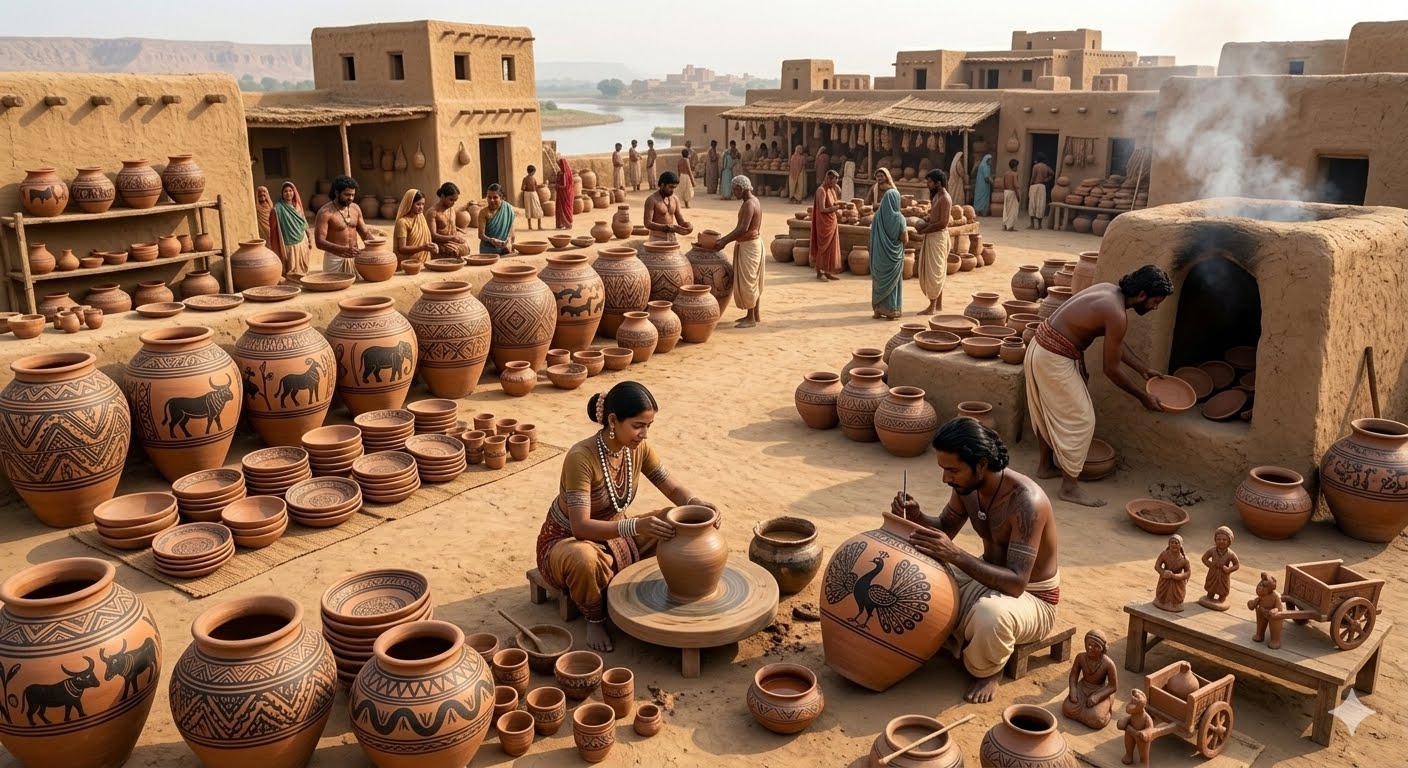
Ancient India had marvelous craftsmen, skilled in pottery, weaving, and metal working. Various sculptures, seals, pottery, gold jewelry, and anatomically detailed figurines in terracotta, bronze, steatite have been found at the excavation sites. The pottery that has been found is of very high quality, with unusually beautiful designs. Several small figures of animals, such as monkeys, have been found. These small figures could be objects of art or toys. There are also small statues of what they think are female gods. They found bowls made of bronze and silver, and many beads and ornaments. The metals used to make these things are not found in the Indus Valley. So, either the people who lived in this ancient civilization had to import all of these items from some other place, or more probably, had to import the metals they used to make these beautiful things from somewhere else.
A harp-like instrument depicted on an Indus seal and two shell objects found at Lothal indicate the use of stringed musical instruments. Seals have been found at Mohenjo-daro depicting a figure standing on its head, and one sitting cross-legged; perhaps the earliest indication, at least illustration, of the practice of yoga. A horned figure in a meditation pose has been interpreted as one of the earliest depictions of the god Shiva.
The very first works of visual art created in the Indian sub-continent were primitive cave or rock paintings. Many are assumed to exist, but the largest number of discoveries are in Central India, on sandstone rock shelters within a hundred mile radius around Bhopal in Madhya Pradesh. these paintings are dated at around 5500 B.C. i.e. they are 1500 years old. Some of these paintings have been overlaid with later paintings and graffiti.
The paintings generally depict animals, in scenes such as hunting. Human figures are also shown with bows and arrows, and swords and shields. The colors used An intricately carved pillar at Ellora in Maharashtra dating back to the 7th century. are made up of natural minerals and are in various shades of red and orange. These paintings are the forerunners of the frescos of a later age which are seen at Ajanta, Ellora and elsewhere in India. But unfortunately no well preserved art remains, to document the period between the coming of the Aryans i.e. 1500 B.C. to about the time of Buddha i.e. 550 B.C.
We are told by the literary sources that the art of painting was practiced. In the Buddhist texts, elaborate palaces of kings and houses of the wealthy are described as being embellished with wall paintings. But actual evidence about this art is lost. How this art could have been, can be guessed from the paintings on stone surfaces found at Ajanta and Ellora which are said to have been done in around 400 A.D. These paintings at Ajanta and Ellora depict Buddhist tales from the Jatakas. Though the paintings are today 1500 years old, the paint has not only retained its color but also much of its luster.
The technique of painting has been thus described by a student of Indian Art. The surface of the stone was first prepared by a coating of potter's clay, mixed variously with cow dung, straw, and animal hair. Once this was leveled to a thickness of half an inch to two inches, it was coated with a smooth fine white lime plaster which became the actual painting surface. On the still-damp wall, the artist first laid out his composition with a red cinnabar line and then defined the subjects with an undercoat of grey or terre verte.
This was followed by the addition of local colors, and once the whole wall was completely colored, a brown or black line restated the drawing to finish the composition. A last burnishing with a smooth stone gave it a rich lustrous surface. The colors which were natural and water soluble, consisted of purple, browns, yellow, blue, white, green, reds and black.
Thus it is evident that the technique of painting had developed to an advanced level This monumental bull was carved in marble in the 3rd century B.C. It stood on a column built by Emperor Ashoka, which was inscribed with Buddhist edicts. of sophistication due which the paintings could survive for 1500 years.
Though the colors used are supposed to have been derived from minerals and vegetables they had been treated to last long. The above description also illustrates how, complicated procedures of preparing the surface to be painted had evolved in India. This technique of painting had also spread to central Asia and South-east Asia. Some strains of Indian painting can even be identified in western church paintings and mosaics. Indian influence is clearly evident in the paintings at Bamiyan in Afghanistan and in Miran and Domko in Central Asia. Not only do these paintings depict the Buddha but also Hindu deities such as Shiva, Ganesha and Surya.
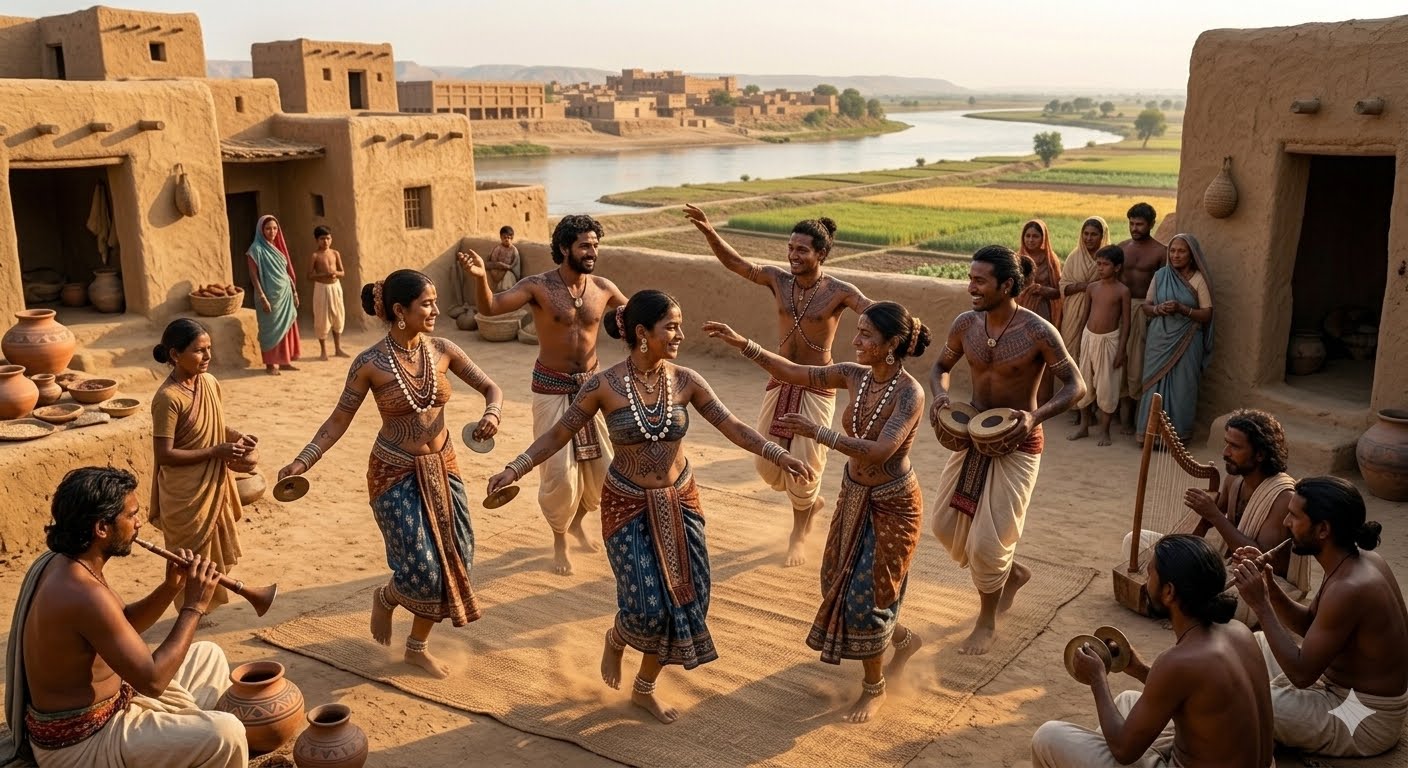
The mention of the word dance conjures up images of Nataraja - Lord of Dance - as the Indian God Shiva is portrayed. Apart from Shiva even Ganesha and Srikrishna are associated with dance and music. India has many classical dance styles. The oldest text dealing with aesthetics covering various art forms including dance is the Natyashastra which is authored by Bharatamuni.
All the Indian classical dance styles viz. Bharata Natyam, Kuchipudi, Kathak, Odissi, Mohiniattam, Kathakali, Manipuri, etc., are derived from the Natyashastra. Some of these dance styles have evolved from folk dances and are intimately connected with the art of story telling. Most of these stories are drawn from our epics like the Ramayana and Mahabharata, tales from collections like the Panchatantra, Hitopadesha, Katha Sarit Sagara, etc., also from the subject matter of these dance styles. In fact the Kathak and Kathakali from U.P. and Kerala respectively, derive their names from the term Katha which in Sanskrit means a story. As the story is told in the form of dance, these dance styles can actually be called dance-dramas, the only difference is the absence of dialogues.
The Charkul dance-drama of Central India revolves around a story generally from the Indian epics like the Ramayana and the Mahabharata. Similar traditions of dance-dramas are prevalent in other parts of India too. In Maharashtra, you have the Dashavatara, in Karnataka you have the Yakshagana The Kathak dance of North India and the ktha*ali dance of Kerala also originated as dance dramas and derive their names from the Sanskrit work 'Katha' which means a story.
The story has to be told solely through actions and hence an elaborate pattern of facial expressions (Mudra), movement of hands (Hasta) and the simulation of various moods like anger (Krodha), envy (Matsara), greed (Lobha), lust (Kama), ego (Mada), etc., have been evolved. The mastery of perfect expression of these feelings by subtle movement of the lips and eyes forms the root of all the classical Indian dance styles.
In fact the combination of the three qualities viz. expression, rhyme and rhythm i.e. Bhava, Raga, and Tala go into the determination of the term Bha-Ra-Ta, which is used as the name of one dance style viz. Bharata Natyam.
The integration of Indian classical dance with the physical exercises of Yoga and the breath control of "Pranayam" has perfected the dance styles. Yoga especially had given the dance styles an excellent footwork which is called Padanyasa and Padalalitya. Another feature of these dance styles is that they are integrated with theology and worship.
Traditionally these dances were patronized by the temples. During festivals and other religious occasions, these dances were performed in the temple premises to propitiate the deity. Thus the dance came to combine both art and worship. Even today every recital of any Indian classical dance begins with an invocation to Nataraja or Nateshwara the god of dance.
In Indian folklore and legend, the God of Dance is himself shown to be dancing in a form called the Tandava. This has also been depicted in the statues and carvings in temples like, Khajuraho and Konark in Northern India, and at Chidambaram, Madurai, Rameshwaram, etc. in the South.
Indian dances have also evolved styles based on the Tandava like the Urdhra Tandava, Sandhya Tandava, etc. Indian classical dance found its way outside India, especially to the countries of Southeast Asia. The dance styles of Thailand, Indonesia, Burma, etc., have so heavily borrowed from the Indian classical dance traditions that to a casual observer there would seem to be hardly any difference between the two. While Western dance has not directly borrowed anything from Indian classical dance, it has borrowed from Indian folk dance through the medium of the Gypsies.
The Gypsies as has been established today, migrated from India to the west many centuries ago. The Gypsies speak a language called Romany which has many common words with Indian languages. The religion of the Gypsies is a modified form of early Hinduism. The Gypsies seem to have been the Banjar nomads who are still found in India. Being a very carefree nomadic community the Gypsies earned their living by giving performance of folk dances, along with the pursuing of other nomadic activities.
Gypsy dance has influenced western dance styles like the Waltz and the foxtrot. Even the American Break dance and other dances associated with jazz music have borrowed elements from the gypsy folk dance. The Gypsy folk dance, is itself a free flowing and care free dance, a modified version of which is found in the folk dances of many Adivasi and nomadic tribal communities in India.
The origin of the Indian theatre or rather folk theatre and dramatics can be traced to religious ritualism of the Vedic Aryans. This folk theatre of the misty past was mixed with dance, ritualism, plus a depiction of events from daily life. It was the last element which made it the origin of the classical theatre of later times. Many historians, notably D.D. Kosambi, Debiprasad Chattopadhyaya, Adya Rangacharaya, etc. have referred to the prevalence of ritualism amongst Aryan tribes in which some members of the tribe acted as if they were wild animals and some others were the hunters.
Those who acted as animals like goats, buffaloes, reindeer, monkeys, etc. were chased by those playing the role of hunters and a mock hunt was enacted. In such a simple and crude manner did the theatre originate in India nearly 4000 years back in the tribal Aryans of Rig Vedic times. There also must have existed a theatrical tradition in the Indus valley cities, but of this we have no literary numismatic or any other material proof.
The origin of drama and the theatre has been told to us in an aptly dramatic manner by Bharatamui, the author of Natyashastra an ancient Indian text on dance and drama. Bharatamuni is said to have lived around the 4th century but even he is not aware of the actual origin of the theatre in India. He has cleverly stated in a dramatic manner that it was the lord of creation Brahma who also created the original Natyashastra (Drama). According to Bharatamuni, since the lord Brahma created the entire universe we need not question his ability in creating dramas.
But Bharatamuni goes on to tell us that the original Natyashastra of Brahma was too unwieldy and obscure to be of any practical use. Hence, Bharatamuni, himself took up the task of making Natyashastra simple, intelligible and interesting. Thus the Natyashastra of Bharatamuni was supported to be understood by lay people. So the Natyashastra of Bharatamunii is not the oldest text on dance and drama, as Bharata himself says that he has only simplified the original work of lord Brahma. The Natyashastra assumes the existence of many plays before it was composed, and says that most of the early plays did not follow the rules set down in the Natyashastra.
But the Natyashastra itself seems to be the first attempt to develop the technique or rather art, of drama in a systematic manner. The Natya Shastra a tells us not only what is to be portrayed in a drama, but how the portrayal is to be done. Drama, as Bharatamuni says, is the imitation of men and their doings (loka-vritti). As men and their doings have to be respected on the stage, so drama in Sanskrit is also known by the term roopaka which means portrayal.
According to the Natyashastra all the modes of expression employed by an individual viz. speech, gestures, movements and intonation must be used. The representation of these expressions can have different modes (vritti) according to the predominance and emphasis on one mode or another. Bharatamuni recognizes four main modes viz., Speech and Poetry (Bharati Vritti), Dance and Music (Kaishiki Vritti), Action (Arabhatti Vritti) and Emotions (Sattvatti Vritti).
Bharatamuni also specifies where and how a play is to be performed. In ancient India plays were generally performed either in temple-yard or within palace precincts. During public performances, plays were generally performed in the open. For such public performances, Bharatamuni has advocated the construction of a mandapa. According to the Natyashastra in the construction of a mandapa, pillars must be set up in four corners. With the help of these pillars a platform is built of wooden planks. The area of the mandapa is divided into two parts. The front part, which is the back stage is called the r angashrishu. Behind the ranga-shirsha is what was called the nepathya-griha, where the characters dress up before entering the stage.
Bharatamuni has also specified that every play should have a Sutradhara which literally means 'holder of a string'. The Sutradhara was like the producer-director of today. Every play had to begin with an innovation of God. This invocation was called the poorvaranga. Even today, plays in Indian languages begin with a devotional song called Naandi. The Ramayana and the Mahabharata can be called the first recognized plays that originated in India.
These epics also provided the inspiration to the earliest Indian dramatists and they do even today. One of the earliest Indian dramatists was Bhasa whose plays have been inspired by the Ramayana and Mahabharata. Bhasa's date cannot be definitely ascertained, but that he lived before Kalidasa is proved by the latter's reference to Bhasa as one of the early leading playwrights. As Kalidasa lived in the 4th century, Bhasa should have lived in the early centuries of our era. Bhasa was a natural dramatist who drew heavily from the epics, but Kalidasa can be called an original playwright.
Kalidasa has written many plays, some of which are; AbhijananShakuntalam, Kumarsambhavam, Meghadutam and Malavikagnimitram. Kalidasa was the court playwright at the Gupta court. He lived at Ujjaini, the capital of the Guptas and was for some days the Gupta ambassador at the court of the Vakatakas at Amaravati where he wrote the play Meghadutam.
The next great Indian dramatist was Bhavabhuti. He is said to have written the following three plays viz. Malati-Madhava, Mahaviracharita and Uttar Ramacharita. Among these three, the last two cover between them the entire epic, Ramayana. Bhavabhuti lived around the 7th century A.D., when Sanskrit drama was on its decline, mainly due to the lack of royal patronage. The last royal patron of Sanskrit drama seems to be king Harshavardhana of the 7th century. Harshavardhana is himself credited with having written three plays viz. Ratnavali, Priyadarshika and Nagananda.
But nevertheless despite lack of patronage two more leading playwrights came after Bhavabhuti, they were Shudraka whose main play was the Mricchakatikam, and the second dramatist was Rajashekhara whose play was titled Karpuramanjari. But the decline of Sanskrit theatre is evident from the fact that while Mricchakatikam was in Sanskrit, the Karpuramanjari was in Prakrit which was a colloquial form of Sanskrit. Rajashekhara has himself said that he chose to write in Prakrit as the language was soft while Sanskrit was harsh. Sanskrit plays continued to be written up to the 17th century in distant pockets of the country, mainly in the Vijayanagara empire of the South. But they had passed their prime, the later Sanskrit dramas are mostly imitations of Kalidasa or Bhavabhuti.
As in the case of the other fine arts, the Indian theatre has left its mark on the countries of South-east Asia. In Thailand, especially it has been a tradition from the middle ages to stage plays based on plots drawn from Indian epics.
This had been so even in Cambodia where, at the ancient capital Angkor Wat, stories from the Ramayana and Mahabharata have been carved on the walls of temples and palaces. Similar, bas reliefs are found at Borobudur in Indonesia. Thus, the Indian theatre has been one of the vehicles of enriching the culture of our neighboring countries since ancient times.
Indian epic poetry is the epic poetry written on the Indian sub-continent. Written in Sanskrit, Tamil and Hindi, it includes some of the oldest epic poetry ever created and some works form the basis of Hindu scripture.
The ancient Sanskrit epics, the Ramayana and Mahabharata, occasionally termed "Mahakavya" ("Great Compositions"), refer to epic poems that form a canon of Hindu scripture. Indeed, the epic form prevailed and verse was and remained until very recently the preferred form of Hindu literary works. Hero-worship was and is a central aspect of Indian culture, and thus readily lent itself to a literary tradition that abounded in epic poetry and literature. The Puranas, a massive collection of verse-form histories of India's many Hindu gods and goddesses, followed in this tradition.
The post-sangam period (2nd century-6th century) saw many great Tamil epics being written, including Cilappatikaram (or Silappadhikaram), Manimegalai, Jeevaga-chintamani, Valayapati and Kundalakesi. Later, during the Chola period, Kamban (12th century) wrote what is considered one of the greatest Tamil epics - the Kamba ramayanam of Kamban, based on the Ramayana.
The post-sangam period (2nd century-6th century) saw many great Tamil epics being written, including Cilappatikaram (or Silappadhikaram), Manimegalai, Jeevaga-chintamani, Valayapati and Kundalakesi. Later, during the Chola period, Kamban (12th century) wrote what is considered one of the greatest Tamil epics - the Kamba ramayanam of Kamban, based on the Ramayana.
The first epic to appear in Hindi was Tulsidas' (1543-1623) Ramacharitamanasa, also based on the Ramayana. It is considered a great classic of Hindi epic poetry and literature, and shows the author Tulsidas in complete command over all the important styles of composition - narrative, epic, lyrical and dialectic. He has given a human character to Rama, the Hindu avatar of Vishnu, potraying him as an ideal son, husband, brother and king.
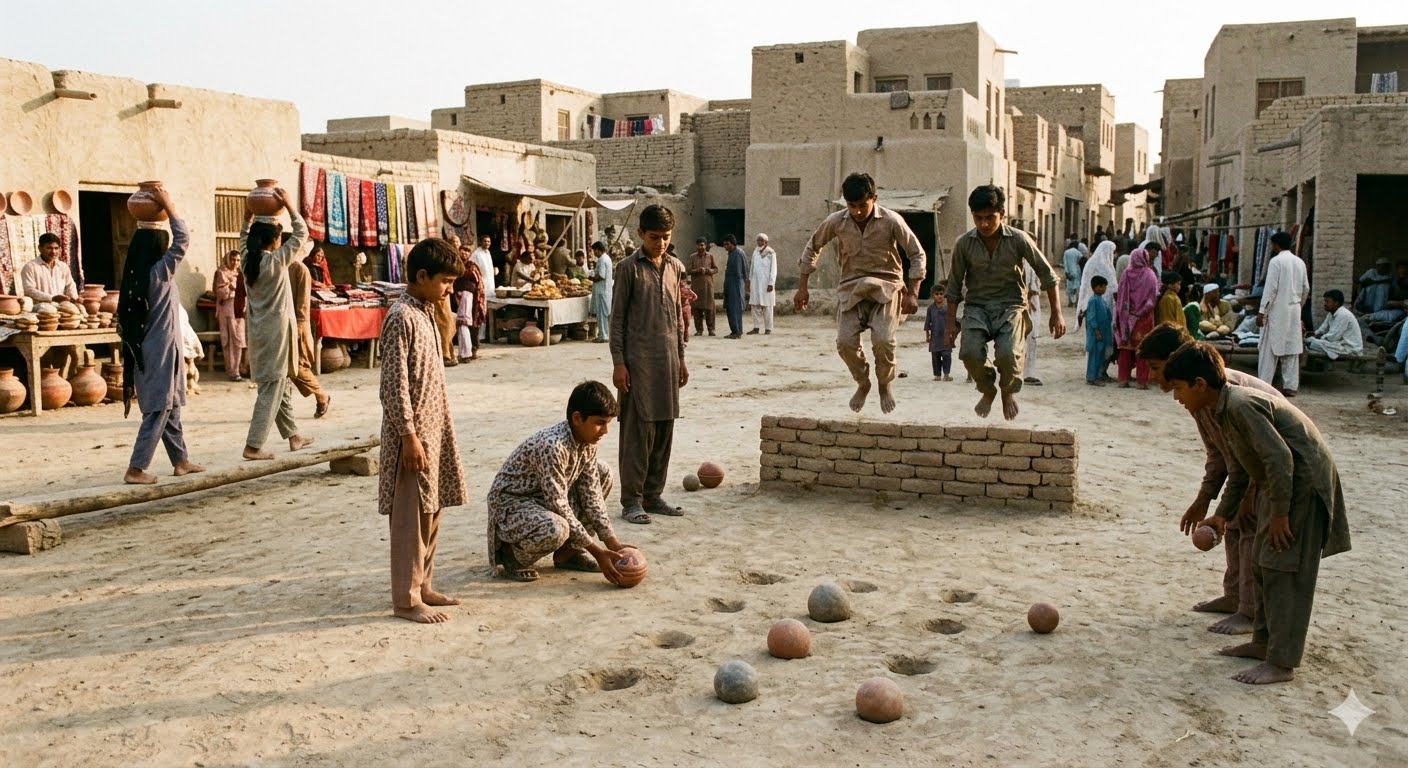
Sports and Games
Around 1900 BCE, signs of a gradual decline begin to emerge. People started to leave the cities. Those who remained were poorly nourished. By around 1800 BC, most of the cities were abandoned.
By around 1700 BCE, most of the cities were abandoned. In 1953, Sir Mortimer Wheeler proposed that the decline of the Indus Civilization was caused by the invasion of an Indo-European tribe from Central Asia called the "Aryans". As evidence, he cited a group of 37 skeletons found in various parts of Mohenjo-Daro, and passages in the Vedas referring to battles and forts.
However, scholars soon started to reject Wheeler's theory, since the skeletons belonged to a period after the city's abandonment and none were found near the citadel. Subsequent examinations of the skeletons by Kenneth Kennedy in 1994 showed that the marks on the skulls were caused by erosion, and not violent aggression.
Today, many scholars believe that the collapse of the Indus Civilization was caused by drought and a decline in trade with Egypt and Mesopotamia. It has also been suggested that immigration by new peoples, deforestation, floods, or changes in the course of the river may have contributed to the collapse of the IVC.
Previously, it was also believed that the decline of the Harappan civilization led to an interruption of urban life in the Indian subcontinent. However, the Indus Valley Civilization did not disappear suddenly, and many elements of the Indus Civilization can be found in later cultures. Current archaeological data suggest that material culture classified as Late Harappan may have persisted until at least c. 1000-900 BCE and was partially contemporaneous with the Painted Grey Ware culture. Harvard archaeologist Richard Meadow points to the late Harappan settlement of Pirak, which thrived continuously from 1800 BCE to the time of the invasion of Alexander the Great in 325 BCE.
Recent archaeological excavations indicate that the decline of Harappa drove people eastward. After 1900 BCE, the number of sites in India increased from 218 to 853. Excavations in the Gangetic plain show that urban settlement began around 1200 BCE, only a few centuries after the decline of Harappa and much earlier than previously expected. Archaeologists have emphasized that, just as in most areas of the world, there was a continuous series of cultural developments. These link "the so-called two major phases of urbanization in South Asia".
A possible natural reason for the IVC's decline is connected with climate change that is also signaled for the neighboring areas of the Middle East: The Indus valley climate grew significantly cooler and drier from about 1800 BCE, linked to a general weakening of the monsoon at that time. Alternatively, a crucial factor may have been the disappearance of substantial portions of the Ghaggar Hakra river system.
A tectonic event may have diverted the system's sources toward the Ganges Plain, though there is complete uncertainty about the date of this event, as most settlements inside Ghaggar-Hakra river beds have not yet been dated. The actual reason for decline might be any combination of these factors. New geological research is now being conducted by a group led by Peter Clift, from the University of Aberdeen, to investigate how the courses of rivers have changed in this region since 8000 years ago, to test whether climate or river reorganizations are responsible for the decline of the Harappan. A 2004 paper indicated that the isotopes of the Ghaggar-Hakra system do not come from the Himalayan glaciers, and were rain-fed instead, contradicting a Harappan time mighty "Sarasvati" river.
A research team led by the geologist Liviu Giosan of the Woods Hole Oceanographic Institution also concluded that climate change in form of the easterward migration of the monsoons led to the decline of the IVC.[77] The team's findings were published in PNAS in May 2012.
According to their theory, the slow eastward migration of the monsoons across Asia initially allowed the civilization to develop. The monsoon-supported farming led to large agricultural surpluses, which in turn supported the development of cities. The IVC residents did not develop irrigation capabilities, relying mainly on the seasonal monsoons. As the monsoons kept shifting eastward, the water supply for the agricultural activities dried up. The residents then migrated towards the Ganges basin in the east, where they established smaller villages and isolated farms. The small surplus produced in these small communities did not allow development of trade, and the cities died out.
The legacy of the Indus Valley Civilization (IVC) is not defined by monumental pyramids or grand palaces, but by an extraordinary blueprint for civic utility, standardization, and cultural continuity that heavily shaped the subsequent history of South Asia.
Despite fading around 1900 BCE, its foundational advancements echo clearly through modern engineering, trade, and cultural traditions
In the aftermath of the Indus Civilization's collapse, regional cultures emerged, to varying degrees showing the influence of the Indus Civilization. In the formerly great city of Harappa, burials have been found that correspond to a regional culture called the Cemetery H culture. At the same time, the Ochre Colored Pottery culture expanded from Rajasthan into the Gangetic Plain.
The Cemetery H culture has the earliest evidence for cremation; a practice dominant in Hinduism today.
The Indus Vally Civilization has been tentatively identified with the toponym Meluhha known from Sumerian records. It has been compared in particular with the civilizations of Elam (also in the context of the Elamo-Dravidian hypothesis) and with Minoan Crete (because of isolated cultural parallels such as the ubiquitous goddess worship and depictions of bull-leaping).
The mature (Harappan) phase of the IVC is contemporary to the Early to Middle Bronze Age in the Ancient Near East, in particular the Old Elamite period, Early Dynastic to Ur III Mesopotamia, Prepalatial Minoan Crete and Old Kingdom to First Intermediate Period Egypt.
After the discovery of the IVC in the 1920s, it was immediately associated with the indigenous Dasyu inimical to the Rigvedic tribes in numerous hymns of the Rigveda. Mortimer Wheeler interpreted the presence of many unburied corpses found in the top levels of Mohenjo-Daro as the victims of a warlike conquest, and famously stated that "Indra stands accused" of the destruction of the IVC.
The association of the IVC with the city-dwelling Dasyus remains alluring because the assumed timeframe of the first Indo-Aryan migration into India corresponds neatly with the period of decline of the IVC seen in the archaeological record. The discovery of the advanced, urban IVC however changed the 19th-century view of early Indo-Aryan migration as an "invasion" of an advanced culture at the expense of a "primitive" aboriginal population to a gradual acculturation of nomadic "barbarians" on an advanced urban civilization, comparable to the Germanic migrations after the Fall of Rome, or the Kassite invasion of Babylonia. This move away from simplistic "invasionist" scenarios parallels similar developments in thinking about language transfer and population movement in general, such as in the case of the migration of the proto-Greek speakers into Greece, or the Indo-Europeanization of Western Europe.
It was often suggested that the bearers of the IVC corresponded to proto-Dravidians linguistically, the breakup of proto-Dravidian corresponding to the breakup of the Late Harappan culture. Today, the Dravidian language family is concentrated mostly in southern India and northern and eastern Sri Lanka, but pockets of it still remain throughout the rest of India and Pakistan (the Brahui language), which lends credence to the theory.
Finnish Indologist Asko Parpola concludes that the uniformity of the Indus inscriptions precludes any possibility of widely different languages being used, and that an early form of Dravidian language must have been the language of the Indus people. However, in an interview with the Deccan Herald on 12 August 2012, Asko Parpola clarified his position by admitting that Sanskrit-speakers had contributed to the Indus Valley Civilization. Proto-Munda (or Para-Munda) and a "lost phylum" (perhaps related or ancestral to the Nihali language) have been proposed as other candidates.
The civilization is sometimes referred to as the Indus Ghaggar-Hakra civilization or Indus-Sarasvati civilization by Hindutva groups. or the Indus-Sarasvati civilization.