Odd Pyramid Had Rooftop Homes, Ritual Sacrifices? National Geographic - October 22, 2010

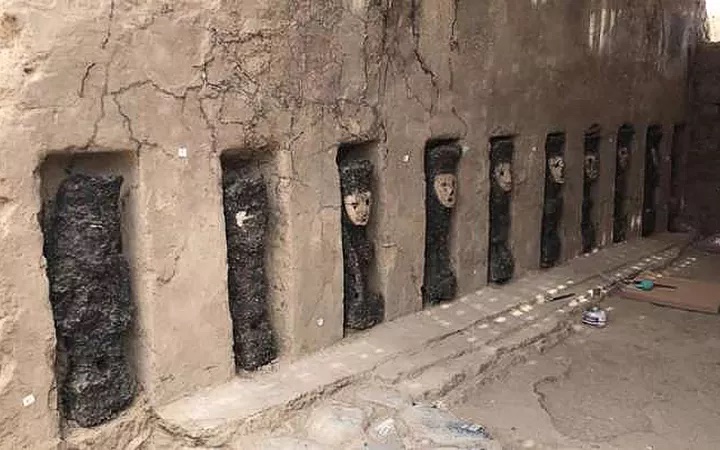
A newly excavated platform atop a pyramid at the Huaca Colorada site looks out on the Peruvian desert. it's yielded human remains - including five females who may have been ritually sacrificed. But it's the signs of life that make a half-excavated Peruvian pyramid of the Moche culture stand out, archaeologists say.
"Often these pyramidal mounds were built as mortuaries more than anything else," said excavation co-leader Edward Swenson. (See pictures from the tomb of the Moche "king of bling.") The newly exposed 1,400-year-old flat-topped pyramid supported residences for up to a couple dozen elites, who oversaw and perhaps took part in copper production at the site, evidence suggests. The pre-Inca pyramid dwellers likely presided over important rituals, feasted on roasted llama and guinea pig, and drank corn beer, according to archaeologists working at the site.
"Lost" Language Found on Back of 400-Year-Old Letter National Geographic - August 27, 2010

Native Peruvian language rediscovered in remains of church. Notes on the back of a 400-year-old letter have revealed a previously unknown language once spoken by indigenous peoples of northern Peru, an archaeologist says. Penned by an unknown Spanish author and lost for four centuries, the battered piece of paper was pulled from the ruins of an ancient Spanish colonial church in 2008. But a team of scientists and linguists has only recently revealed the importance of the words written on the flip side of the letter.
Human Sacrifice National Geographic - January 28, 2010

"Unexpected" Man Found Amid Ancient Priestesses' Tombs National Geographic - September 19, 2009
"Unexpected" Male Found in Pre-Inca Tomb? National Geographic - September 19, 2009
Ancient "King of Bling" Tomb Revealed in Peru National Geographic - April 13, 2009
Found in a treasure-filled tomb of the Moche culture in Peru, this 1,500-year-old gilded-copper-and-seashell funerary mask was one of two that shielded the face of the so-called Lord of Ucupe.
Human Trophy Heads Were No Strangers Live Science - January 5, 2009
Trophy heads reveal secrets about ancient South American Nazca civilization PhysOrg - January 8, 2009
"Spider God" Religious Temple Found in Northern Peru National Geographic - October 29, 2008
1,300-Year-Old Peru Mummy Found National Geographic - August 27, 2008
Ancient "Human Sacrifices" Found in Peru, Expert Says National Geographic - June 4, 2008
Oldest Gold Jewelry in Americas National Geographic - April 3, 2008
Americas' Oldest Gold Artifact Discovered in Peru National Geographic - April 1, 2008

A nine-bead necklace discovered in Peru is the oldest known gold artifact in the Americas, archaeologists say.
Necklace is 'oldest in Americas' BBC - April 1, 2008
Ancient Temple Discovered Among Inca Ruins National Geographic - March 31, 2008
Pre-Inca temple discovered in Peru National Geographic - March 17, 2008
Peru: Oldest Urban Site in the Americas Found, Experts Claim National Geographic - February 27, 2008
Peru's "Lost City" Is a Natural Formation, Experts Rule National Geographic - February 25, 2008
Remnants of at least ten pyramids have been discovered on the coast of Peru,
marking what could be a vast ceremonial site of an ancient, little-known culture.
Peru's "Lost City" Is a Natural Formation, Experts Rule National Geographic - February 25, 2008

Ancient Iron Ore Mine Discovered in Peruvian Andes National Geographic - February 11, 2008
Archaeologist 'Strikes Gold' With Finds Of Ancient Nasca Iron Ore Mine In Peru Science Daily - February 5, 2008
Ancient "Lost City" Discovered in Peru, Official Claims National Geographic - January 16, 2008
Video: Pre-Inca Ancient Treasures Found National Geographic - December 6, 2007
4,000-Year-Old Temple, Mural Found in Peru National Geographic - November 12, 2007

A 4,000-year-old temple filled with murals has been unearthed on the
northern coast of Peru, making it one of the oldest finds in the Americas.
Ancient Ruler's Tomb, Gold Trove Found in Bolivia Pyramid National Geographic - August 6, 2007
Remains of a 1,300-year-old tomb - skeleton in the tomb belongs to
a ruler or priest of the ancient Tiwanaku civilization, which spread
throughout pre-Hispanic South America before vanishing around A.D. 1200.
Pre-Incan Metallurgy Discovered Live Science - April 19, 2007
Towers point to ancient Sun cult BBC - March 1, 2007

Pre-Inca Observatory Is Oldest in Americas, Study Says National Geographic - March 1, 2007

Peruvian citadel is site of earliest ancient solar observatory in the Americas PhysOrg - March 1, 2007
The fortified stone temple, ceremonial complex, at Chankillo. Archeologists is 2,300 years old
Vast "Cloud Warrior" Ruin Found in Amazon National Geographic - January 20, 2007

An unusual archeological site discovered in Peru's mountains may hold
clues to the history of the Chachapoya people, known as "cloud warriors,"
who fought the Inca Empire before the Spanish conquest.
Tombs of Pre-Inca Elite Discovered Under Peru Pyramid National Geographic - November 28, 2006
Tomb find reveals pre-Inca city BBC - November 22, 2006

The complex contains at least 20 tombs, and dates from the pre-Inca Sican era.
Mummies of 'cloud warriors' tribe found in Peruvian cave Independent - October 7, 2006
The Chachapoyas commanded a vast kingdom stretching across the Andes to the fringe of Peru's northern Amazon jungle until they were conquered by the Incas in the 15th century. The Incan empire was itself overrun soon after by the Spanish, and details of the Chachapoyas and their way of life were lost or destroyed in the widespread pillaging that followed. Now a team of archaeologists, working on a tip-off from a local farmer, have uncovered a burial site in a 820ft-deep cave. The researchers have so far found five mummies, two of which are intact with skin and hair, as well as ceramics, textiles and wall paintings, the expedition's leader, Herman Corbera, told Reuters. "This is a discovery of transcendental importance. We have found these five mummies but there could be many more," Mr Corbera said. "We think this is the first time any kind of underground burial site this size has been found belonging to Chachapoyas or other cultures in the region."
The tribe's own name is unknown. The word Chachapoyas is thought to come from the Quechua for "cloud people", and is the name by which they were known to the Incas, because of the cloud forests they inhabited in what is now northern Peru. A white-skinned people who were famed as ferocious fighters, the Chachapoyas held out against the Incans, who ruled an empire stretching from southern Chile to northern Ecuador until their conquest by the Spanish.
Today, the Cloud People are best known for their stone citadel, Kuelap, with more than 400 buildings and massive exterior stone walls, which is often referred to as the Machu Picchu of the north. Mr Corbera said the walls in the limestone cave near the mummies were covered with paintings of faces and warrior-like figures which may have been drawn to ward off intruders and evil spirits. "The remote site for this cemetery tells us that the Chachapoyas had enormous respect for their ancestors because they hid them away for protection," Mr Corbera said. "Locals call the cave Iyacyecuj, or Enchanted Water in Quechua, because of its spiritual importance and its underground rivers. "The idea now is to turn this cave into a museum, but we've got a huge amount of research to do first and protecting the site is a big issue."
Backs to the Future PhysOrg - June 13, 2006

Ancient Calendar Unearthed in Peru Discovery - June 5, 2006

Similar monuments erected by the Mayans of Mexico have also been found, but those have dated to approximately 2,000 years ago. There have been European versions too. "Early solstice markers are known in Ireland with dates earlier than Buena Vista, but not, to my knowledge, with multiple instruments," said Robert Benfer, who oversaw the project and is a professor emeritus of anthropology at the University of Missouri-Columbia. "The most famous would be the case of (Egyptian ruler) Amenhotep, who at 1,500 B.C. had statues erected to gaze at the solstice when the Nile was about to flood".
The Peruvian calendar would have been a dramatic sight for onlookers 4,000 years ago. Its towering sculptures - made of mud plaster mixed with grass and covered with clay - were painted bright yellow and red. Benfer told Discovery News the temple and its sculptures seem linked to astronomical alignments that would have guided practitioners of flood plain agriculture, which persists in the region.
Major celestial events, such as the rising and setting of the sun during equinoxes and solstices, would have drawn lines connecting points at the temple's entrance, sculptures, surrounding ridges and chambers. One chamber creates a line aimed toward the rising sun on Dec. 21, which marks the season when floodwaters begin to rise. On March 21, when these waters recede, the same line points towards the Andean constellation of the fox. Field director Neil Duncan, who worked with Peruvian archaeologist Bernardino Ojeda, told Discovery News the chambers contained remnants of offerings primarily consist of plant remains: cotton and cotton seeds, fruits such as lucuma and guava, squash and gourds, beans and grass. He added that a sunken pit in the center of the temple also contained shellfish, crab and mussel shells, and anchovy-sized fish bones. The researchers found no evidence of human sacrifice, but they did discover a cotton-shrouded mummy of a woman in the fetal position. Perhaps the most striking object found at the temple was a large personified disk that frowns at the sunset on June 21, the traditional start of the harvest. The ancients may have enjoyed a bit of dry humor, given all of the upcoming work. The frowning face represents Pacha Mama, an Earth mother goddess who became sad when the sun set.
Tattooed Mummy With Jewelry Found in Peru Pyramid National Geographic - May 16, 2006
Ancient Canals in Andes Reveal Early Agriculture National Geographic - December 6, 2005
Brewery Was Burned After Ancient Peru Drinking Ritual National Geographic - November 17, 2005
Experts 'decipher' knotted Inca strings BBC - August 12, 2005

Experts say one bunch of knots appears to identify a city,
marking the first intelligible word from the extinct South American
civilization. The mystery surrounding a cryptic string-based
communication system used by ancient Incan administrators
may at last be unravelling, thanks to computer analysis of
hundreds of different knotted bundles.
Peruvian writing system goes back 5,000 years MSNBC - July 20, 2005

Ancient culture used knots and strings to convey information
Archaeologists in Peru have found a 'quipu' on the site of the oldest city in the Americas, indicating that the device, a sophisticated arrangement of knots and strings used to convey detailed information, was in use thousands of years earlier than previously believed. Previously the oldest known quipus, often associated with the Incas whose vast South American empire was conquered by the Spanish in the 16th century, dated from about A.D. 650. But Ruth Shady, an archaeologist leading investigations into the Peruvian coastal city of Caral, said quipus were among a treasure trove of articles discovered at the site, which is about 5,000 years old. "This is the oldest quipu, and it shows us that this society ... also had a system of ÔwritingÕ (which) would continue down the ages until the Inca empire and would last some 4,500 years," Shady said. She was speaking before the opening in Lima Tuesday of an exhibition of the artifacts which shed light on Caral, which she called one of the worldÕs oldest civilizations.
The quipu, with its well-preserved, brown cotton strings wound around thin sticks, was found with a series of offerings including mysterious fiber balls of different sizes wrapped in ÓnetsÓ and pristine reed baskets. "We are sure it corresponds to the period of Caral because it was found in a public building, It was an offering placed on a stairway when they decided to bury this and put down a floor to build another structure on top."
Pyramid-shaped public buildings were being built at Caral, a planned coastal city 115 miles (185 kilometers) north of Lima, at the same time that the Saqqara pyramid, the oldest in Egypt, was going up. They were were already being revamped when Egypt's Great Pyramid of Cheops (or Khufu) was under construction, Man only began living in an organized way 5,000 years ago in five points of the globe - Mesopotamia (roughly comprising modern Iraq and part of Syria), Egypt, India, China and Peru, Caral was 3,200 years older than cities of another ancient American civilization, the Maya," she added.
Shady said no equivalent of the Rosetta Stone that deciphered the hieroglyphs of ancient Egypt had yet been found to fully unlock the language of the quipus, but said their existence pointed to a sophisticated, organized society where such information as production, taxes and debts were recorded. They came up with their own system becausem unlike cities in the Old World which had contact with each other and exchanged knowledge and experiences, this (city) in Peru was isolated in the Americas, and advanced alone. Caral's arid location at an altitude of 11,500 feet (3,500 meters) has helped preserve its treasures, such as piles of raw cotton - still uncombed and containing seeds, though turned a dirty brown by the ages - and a ball of cotton thread. Nobles wore their hair in two long ponytails each side of the face, with a fringe at the front and the hair on the top of the head cropped close to the skull.
Inca tax man collected child sacrifices News in Science - May 30, 2005
Giant Figures in Peru Desert Pre-date Nazca Lines Epoch Times - May 24, 2005
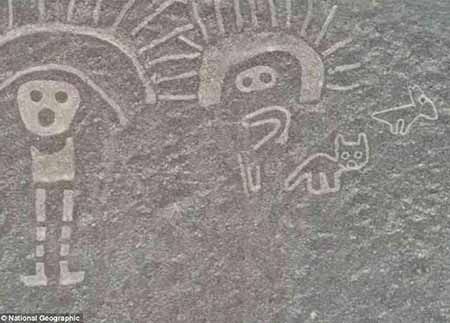
The Paracas figures were created by removing dark stones in order to expose the lighter surface underneath. Some areas were cleared and others built up with rock, creating figures in high and low relief. With the Nazca lines though, the geoglyphs were only made by clearing low-relief areas. Until recently scientists believed that the figures in the Palpa and Nazca regions were only from the Nazca culture. Mr. Isla says cultural dating and style of the newly found Paracas figures sets them apart. "Most of these geoglyphs belong to the Nazca culture but our recent studies demonstrated that there are at least 50 geoglyphs pertaining to the Paracas culture. These new figures are definitely different and older than those of the Nazca culture. "First, the Paracas figures were drawn on the slopes of the hills, while the Nazca images were drawn in level areas. Second, the Paracas figures are smaller and were made in a naturalistic style, while the Nazca figures are bigger and stylised. Third, the Paracas figures are mostly arranged in groups, while the Nazca figures are arranged individually. Finally, it is important to note that not one of the Paracas figures were repeated in the Nazca iconography," Mr, Isla added.
Although the existence of some of the Paracas figures was previously known, most were undiscovered due to their remote location, and their visibility is highly affected by the position of the sun. One set of figures is known as the ÒTemple of FertilityÓ as one image represents a man, another a woman and the center image seems to represent a divine figure with a head from which emanates a series of rays that end in human heads. Mr. Isla said, "The principal idea is that together the three figures represent the reproduction of the human species, the continuity of life.Ó ÒAccording to results obtained from our studies of the Nazca geoglyphs, we can suggest that the Paracas geoglyphs were made also in the context of a religious culture related to water. The Palpa and Nazca valleys are in the middle of one of the most arid deserts of the world, where the surface water is a vital resource to develop life," said Mr. Isla. Further studies may tell more about the Paracas people, their ways of life and early history of the area.
Giant figures older than Nazca lines unearthed in Peru -- CNN - March 12, 2005
First Andes civilization explored BBC - December 2004
A Peruvian site previously reported as the oldest city in the
Americas is a much larger complex of as many as 20 cities with
enormous pyramids and sunken circular plazas sprawled over
three river valleys.
Pre-Inca Ruins Emerging From Peru's Cloud National Geographic - September 2004
Remains of the world's largest lava flow found MSNBC - September 2004
1,300 year old city found in remote Peru jungle MSNBC - August 2004
Walled complex may have been home to 10,000 people
An American-led expedition has discovered five new districts
in what its leader describes as a massive metropolitan complex
spread along a river valley through thick mountainous jungle on
the eastern slope of the Peruvian Andes. It is the oldest
Chachapoyan find that we know of to date.
Scores of Inca Mummies Unearthed in Peru National Geographic - March 2004

Dozens of exquisitely preserved Inca mummies are being recovered from
a barren hillside on the outskirts of Peru's bustling capitol city Lima.
Incan Counting System Decoded? Discovery - February 2004

Recent studies are investigating the hypothesis that elaborated knotted strings known as khipu contain a hidden written language stored following a seven-bit binary code. Nobody, however, had been able to explain the meaning of these geometrical tablets known as yupana. Different in size and shape, the yupana had been often interpreted as a stylized fortress model. Some scholars also interpreted it as a counting board, but how the abacus would have worked remained a mystery. "It took me about 40 minutes to solve the riddle. I am not an expert on pre-Columbian civilizations. I simply decoded a 16th century drawing from a book on mathematical enigmas I received as a Christmas present," engineer Nicolino De Pasquale said.
The drawing was found in a 1,179 page letter by the Peruvian Felipe Guaman Poma de Ayala to the King of Spain. A simple array of cells consisting of five rows and four columns, the drawing showed one circle in the right cell on the bottom row, two circles in the next cell, three circles in the other one and five circles in the last cell of the row. The same pattern applied to the above rows.
According to De Pasquale, the circles in the cells are nothing but the first numbers of the Fibonacci series, in which each number is a sum of two previous: 1, 2, 3, 5. The abacus would then work on a base 40 numbering system."Instead, all scholars based their calculations according to a base 10 counting system. But calculations made to base 40 are quicker, and can be easily reconverted to base 10," Antonio Aimi, curator of the exhibition "Peru, 3,000 Years of Masterpieces" running in Florence, told Discovery News. "Since we lack definitive archaeological evidence, we tested this claim on 16 yupana from museums across the world. De Pasquale's system works on all of them," Antonio Aimi, curator of the exhibition
The Inca's calculating system (see an example of how it works in the slide show) does not take into consideration the number zero. Moreover, numbers do not exist as graphic representations.According to Aimi, in most cases the Inca made their calculations by simply drawing rows and columns on the ground. The unusual counting way is described in an account by the Spanish priest Jose de Acosta, who lived among the Inca from 1571 to 1586. "To see them use another kind of calculator, with maize kernels, is a perfect joy... . They place one kernel here, three somewhere else and eight, I do not know where. They move one kernel here and there and the fact is that they are able to complete their computation without making the smallest mistake," Acosta wrote in his book "Historia Natural Moral de las Indias. "The claim has sparked a dispute among scholars.Gary Urton, professor of Precolumbian studies at Harvard University, an authority on khipu research, told Discovery News: "The fact that an explanation can be constructed for one or even several yupana that conforms to this theory of a base 40 numbering system amongst the Incas is of some modest interest. "How would one explain the many statements in the Spanish chronicles, both those written by Spaniards and by literate Andeans, who stated quite straightforwardly that the Inca used a base 10 counting system? This system is also attested in a mountain of early colonial documents that describe how the Inca organized their administrative system according to a base 10 counting system." As Aimi concedes, the claim has the limits of any interpretative system that isn't proven with definitive historical evidence. "We would need to find a Rosetta yupana, something similar to the deciphering of Egyptian hieroglyphics from the Rosetta stone. Since we can't have it, I would consider a strong evidence the fact that the system works on all yupana examined," he said.
Peruvian farmers learn from history BBC - May 2003

Agricultural techniques perfected by Inca farmers 500 years ago
are beginning to have a dramatic effect on the incomes of today's
farmers in Pampachiri, one of the poorest areas of Peru.
First City in the New World? - July 2002 - Smithsonian

Peru's Caral suggests civilization emerged in the
Americas 1,000 years earlier than experts believed
Thousands of Inca mummies were found in a shanty town close to Peruvian capital, Lima in April 2002
Peru Ruins Trace Anthropological Riddle in Sand
Peruvian archaeologists excavate what they believe to be the oldest city in the Americas, the sacred ruins of Caral, which lie some 120 miles north of Lima in a coastal desert between the Andes and the waters of the Pacific, in this photo taken May 11, 2001. The ruins, which have been carbon dated to some 100 years before the Great Pyramid at Giza, could provide anthropologists with a glimpse of the birth of modern society in the Americas.
May 30, 2001 - Caral, Peru -- On a scarp overlooking a lush valley carved through Peru's dusty Andean foothills, archeologists have unearthed what they believe is the oldest city in the Americas - the sacred ruins of Caral. A team from Peru's San Marcos University has painstakingly excavated the arid hillocks above the River Supe north of Lima to reveal six ancient pyramids, an amphitheater and residential complex that they have dated to as early as 2627 BC. "In these structures of stone, mud and tree trunks we find the cradle of American civilization,'' said Ruth Shady, who is leading the excavations.
The discovery is already being hailed as the most exciting find in Peru since 1911, when Yale archeologist Hiram Bingham stumbled on the ruined Inca citadel of Machu Picchu hidden in the clouds of the craggy Andean highlands.
Anthropologists working at Caral believe the windswept ruins 14 miles from the Pacific will provide a glimpse of the birth of urban society in the Americas and may challenge theories that the earliest civilizations settled by the sea.
They say a priestly society built the stone structures here without the aid of wheels or metal tools almost a century before the Egyptians erected the Great Pyramid at Giza. The remains, some 120 miles north of Lima in a coastal desert between the Andes and the Pacific, predate Machu Picchu by three millennia and are some 1,100 years older than Olmec in Mexico, the oldest city in the Americas outside Peru. Up to 10,000 people may once have inhabited the 160-acre site at Caral, archeologists believe, and its construction suggests a regional capital with urban planning, centralized decision making and a structured labor force.
Now Andean Indians -- including women with braids, black hats and traditional colored skirts - carve out a livelihood tending goats and growing corn beside the dirt track that connects Caral to the nearest town an hour's drive away.Despite the hardships of working in the blazing sun and living in an isolated farmhouse with no electricity or running water, the sunburned, bearded Peralta brims with enthusiasm.
For a nation subjugated by 16th century Spanish conquistadors, who ransacked its rich indigenous culture in a frenzied lust for gold, such discoveries testify to the long heritage of what Europeans dubbed the ``New World.'' The once-in-a-lifetime find has sparked acrimony in the international academic community. Shady accuses U.S. anthropologist Jonathan Haas of Chicago's Field Museum of trying to steal the credit for seven years of her hard work.
Subsequent civilizations never occupied the site but apparently revered it, leaving gold and silver offerings at its perimeters. South America's most advanced pre-conquest civilization, the Incas, built temples on its outskirts. Inhabitants of Caral also apparently believed the buildings were divine, dotting their homes and temples with tiny alcoves filled with dried-mud figurines and small sacred bonfires. Excavations have also exhumed a skeleton from the walls of one home, which was buried there rather than sacrificed.
As with the Mayans who ruled Mexico, Guatemalaand Honduras
around AD 300, the construction of religious pyramids suggest
the existence of a theocracy, but the inhabitants of Caral
differed by living in their ceremonial centers, Peralta said.
Now the Ancient Ways Are Less Mysterious -- February 2, 2000 - AP
Now Western researchers have applied the scientific method to this seeming madness. Poring over reams of satellite data on cloud cover and water vapor, Professor Benjamin Orlove, an anthropologist at the University of California at Davis, and colleagues have discovered that these star-gazing farmers are accurate long-range weather forecasters. High wisps of cirrus clouds dim the stars in El Nino years, which brings reduced rainfall to that part of the Andes. In such drought conditions, it makes sense to plant potatoes as late as possible.
Orlove's work, which was reported in January in the British journal Nature, is just the latest example of indigenous or traditional knowledge that has been found to have a sound scientific basis. In agriculture, nutrition, medicine and other fields, modern research is showing why people maintain their traditions.
Take the Masai of East Africa, who are famous for the kind of high-fat diet, rich in meat and milk, that would make a cardiologist swoon. Timothy Johns, a professor at McGill University in Montreal and director of the Center for Indigenous Peoples' Nutrition and Environment, has long studied the Masai to determine how they stay healthy. The Masai add the roots and barks of certain plants, including a species of acacia high in antioxidants, Johns said. They also chew a natural gum, related to myrrh, that helps to break down fats. "It's not a magic bullet protecting the Masai against heart disease," he said. "But there is a benefit from what they are doing."
In a 1998 study, two Cornell University researchers analyzed the spices used in 36 countries and found a correlation between average temperature and cooking with spices like cumin, turmeric, ginger and chili peppers, all of which have antimicrobial properties. The hotter the climate, the hotter the food -- in part, at least, to keep it from spoiling. Sometimes, however, the benefits of traditional knowledge are not so obvious to those outside the culture. In Bali in the 1970s, the Indonesian government, persuaded by international advocates of the "green revolution," forced rice farmers adopt new growing schemes. Among other things, the farmers were made to stop their centuries-old ritual of meeting in small groups at a series of water temples set at the forks of rivers, to negotiate seasonal schedules for flooding their paddies.
The new techniques resulted in disaster. Farmers were pressured to plant as often as possible. With little coordination of irrigation, water shortages and pest infestation were the norm. At about this time, J. Stephen Lansing, an American anthropologist, began to study the water temples. What he found, which was supported later by computer modeling, was that the old system was quite sophisticated and efficient, encouraging cooperation among thousands of farmers. Water was shared and controlled through a process involving reciprocal altruism.
ALPHABETICAL INDEX OF ALL FILES