Heqet
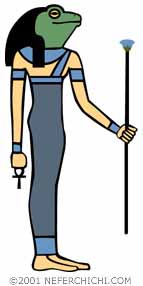
Frog headed Goddess of creation, childbirth.
Frog headed Goddess of creation, childbirth.
To the Egyptians, the frog was a symbol of life and fertility, since millions of them were born after the annual inundation of the Nile, which brought fertility to the otherwise barren lands. Consequently, in Egyptian mythology, there began to be a frog-goddess, who represented fertility, named Heqet (also Heqat, Hekit, Heket etc, more rarely Hegit, Heget etc.), written with the determinative frog.
Heqet was usually depicted as a frog, or a woman with a frog's head, or more rarely as a frog on the end of a phallus to explicitly indicate her association with fertility. She was often referred to as the wife of Khnum.
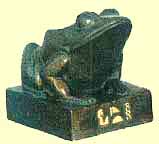
The beginning of her cult dates to the early dynastic period at least. Her name was part of the names of some high-born Second Dynasty individuals buried at Helwan and was mentioned on a stela of Wepemnofret and in the Pyramid Texts. Early frog statuettes are often thought to be depictions of her.
She was worshipped in the areas where the Ogdoad cosmogony had gained favour, and so, like most deities belonging to this world view, except for the eight members of the Ogdoad themselves, she was considered a child of Ra. After Ra became Atum-Ra, it was sometimes said that as the bringer of life to the newborn, she had to be the wife of Shu, who had fathered Nut and Geb, and his first wife was Tefnut.
Later, as a fertility goddess, associated explicitly with the last stages of the flooding of the Nile, and so with the germination of corn, she became associated with the final stages of childbirth. This association, which appears to have arisen during the Middle Kingdom, gained her the title She who hastens the birth.
Some claim that - even though no ancient Egyptian term for "midwife" is known for certain - midwives often called themselves the Servants of Heqet, and that her priestesses were trained in midwifery.
Women often wore amulets of her during childbirth, which depicted Heqet as a frog, sitting in a lotus. As goddess of the last stages of birth, she was considered the wife of Khnum, who formed the bodies of new children on his potter's wheel.
When the Legend of Osiris and Isis developed, it was said that it was Heqet who breathed life into the new body of Horus at birth, as she was the goddess of the last moments of birth. As the birth of Horus became more intimately associated with the resurrection of Osiris, so Heqet's role became one more closely associated with resurrection.
Eventually, this association lead to her amulets gaining the phrase I am the resurrection, and consequently the amulets were used by early Christians. Finally, as the legend of Osiris' resurrection grew increasingly stronger, she became ever more aligned with Isis, and eventually becoming an aspect of her.
Heqet Wikipedia
ALPHABETICAL INDEX OF ALL FILES
