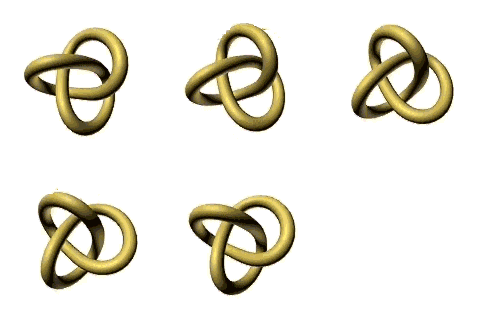
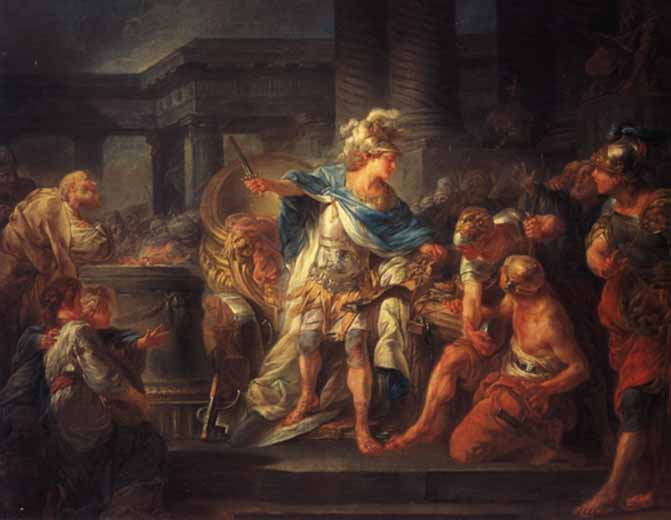
The term Gordian Knot, commonly used to describe a complex or unsolvable problem, can be traced back to a legendary chapter in the life of Alexander the Great.
As the story goes, in 333 B.C. the Macedonian conqueror marched his army into the Phrygian capital of Gordium in modern day Turkey. Upon arriving in the city, he encountered an ancient wagon, its yoke tied with what one Roman historian later described as several knots all so tightly entangled that it was impossible to see how they were fastened.
Phrygian tradition held that the wagon had once belonged to Gordius, the father of the celebrated King Midas. An oracle had declared that any man who could unravel its elaborate knots was destined to become ruler of all of Asia.
According to the ancient chronicler Arrian, the impetuous Alexander was instantly seized with an ardent desire to untie the Gordian knot. After wrestling with it for a time and finding no success, he stepped back from the mass of gnarled ropes and proclaimed, It makes no difference how they are loosed. He then drew his sword and sliced the knot in half with a single stroke.
In another version of the legend, he simply pulled out a lynchpin running through the yoke, loosening the knot enough that he was able to unfasten it. Whatever method he used, the young king was immediately hailed as having outsmarted the ancient puzzle. That same night, Gordium was rocked by a thunder and lightning storm, which Alexander and his men took as a sign that he had pleased the gods. True to the prophecy, he went on to conquer Egypt and large swaths of Asia before his death at age 32.
Thanks to the enduring popularity of the Alexander fable, the phrase ÒGordian knotÓ has entered the lexicon as shorthand for an intricate or intractable obstacle. One of its earliest appearances came in the Shakespeare play Henry V, where the titular character is praised for his ability to ÒunlooseÓ the Gordian knots of politics. Likewise, the saying Òcutting the Gordian knotÓ is now commonly used to describe a creative or decisive solution to a seemingly insurmountable problem.
The Gordian Knot is a legend of Phrygian Gordium associated with Alexander the Great. It is often used as a metaphor for an intractable problem (disentangling an "impossible" knot) solved easily by cheating or "thinking outside the box" ("cutting the Gordian knot"). The myth it refers to is associated in legend with Alexander the Great.
According to a Phrygian tradition, an oracle at Telmissus, the ancient capital of Phrygia, decreed to the Phrygians, who found themselves temporarily without a legitimate king, that the next man to enter the city driving an ox-cart should become their king.
Gordias, a poor peasant, happened to drive into town with his wife, both riding on an ox-cart, and he was declared king. In gratitude, he dedicated the ox-cart to the Phrygian god Sabazios, whom the Greeks identified with Zeus, and either tied it to a post or tied its shaft with an intricate knot of cornel (Cornus mas) bark. It was further prophesied by an oracle that the one to untie the knot would become the king of Asia, or at least so claimed the publicists in the circle of Alexander the Great.
The ox-cart, often depicted as a chariot, was an emblem of power and constant military readiness. It still stood in the palace of the former kings of Phrygia at Gordium in the 4th century BC when Alexander arrived, at which point Phrygia had been reduced to a satrapy of the Persian Empire.
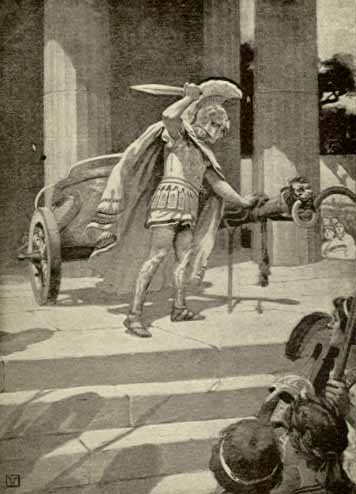
In 333 BC, wintering at Gordium, Alexander attempted to untie the knot. When he could find no end to the knot, to unbind it, he sliced it in half with a stroke of his sword, producing the required ends (the so-called "Alexandrian solution"). Ever since then, when a person has settled a difficulty by bold or violent means instead of patiently solving it, the custom has been to say that he has "cut the Gordian knot," in memory of Alexander's feat. Alexander went on to conquer Asia, though the prophecy itself might have been later propaganda created on his behalf. The knot may in fact have been a religious knot-cipher guarded by Gordium's priests and priestesses.
Robert Graves suggested that it may have symbolized the ineffable name of Dionysus that, unknotted like a cipher, would have been passed on through generations of priests and revealed only to the kings of Phrygia.
Unlike fable, true myth has few completely arbitrary elements. This myth taken as a whole seems designed to confer legitimacy upon a dynasty change in this central Anatolian kingdom.
To judge from the myth, apparently the new dynasty was not immemorially ancient, but had widely-remembered origins in a local, but non-priestly "outsider" class, represented by the peasant Gordias in his oxcart. Other Greek myths legitimize dynasties by right of conquest, but the legitimizing oracle in this myth suggests that the previous dynasty had been a race of priest-kings allied to the oracle deity.
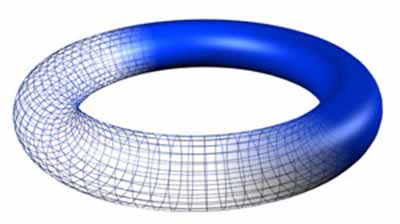
which looks like a donut or a sphere that turns in from one side
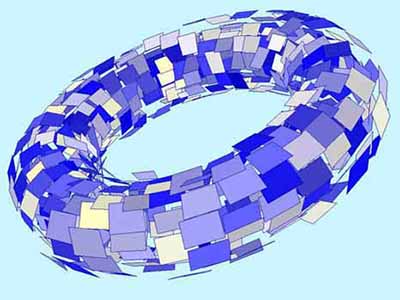
and comes out the other in a perpetual motion
Sacred geometry, - an ancient mystery schools teaching, stressed the one force or consciousness behind existence through the laws of geometry, made extensive.
According to ancient teachings in the beginning there was a great void. This void is the creator, with no body shape or definition. Creation requires a definition of space (as well as direction). The Torus tube provides this kind of definition by using the inside, the outside, and infinity. In that way it can be the shape also represents the idea of The one and only God and the holy trinity relation which comes from the one God and exists in everything (positive, negative and neutral for example).
The word "one" in Hebrew, "Echad" as well as the word "love" - "Ahava" in Hebrew, has a numerological value of 13. The number 13 contains the one and the three.
Many people claim they had dreams in which they were able to solve difficult karmatic personal relations or situations during the daytime after wearing a Gordian knot pendant. The reason for this might be that the pendant symbolists the idea of unity which binds everything into one.
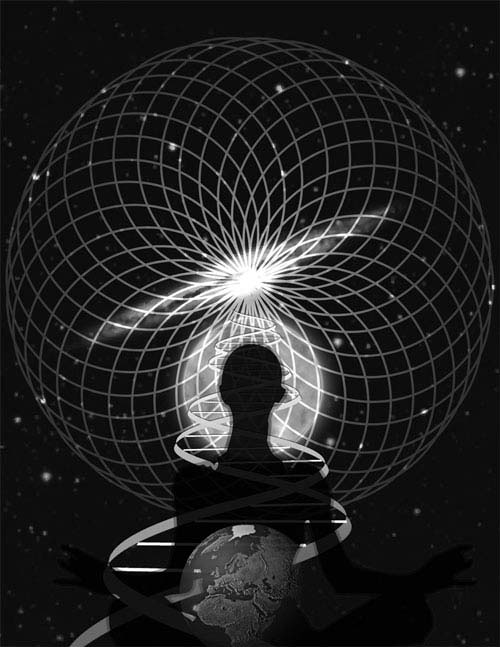
Simulation Theory - Holographic Universe Theory
Knot Mathematics
List of Knots
Chinese Knots