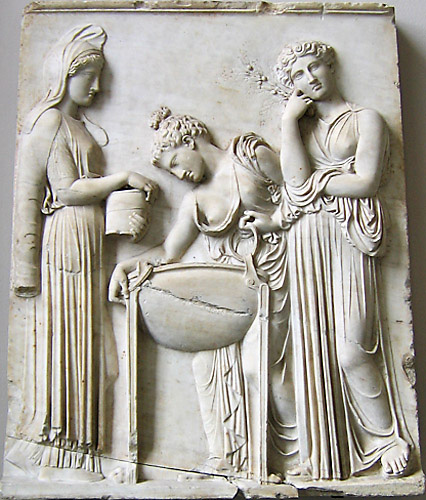
Gaius Valerius Flaccus (died ca AD 90) was a Roman poet who flourished in the "Silver Age" under the emperors Vespasian and Titus and wrote a Latin Argonautica that owes a great deal to Apollonius of Rhodes' more famous epic.
He has been identified on insufficient grounds with a poet friend of Martial (1.61.76), a native of Padua, and in needy circumstances; but as he was a member of the College of Fifteen, who had charge of the Sibylline books (1.5), he must have been well off. The subscription of the Vatican manuscript, which adds the name Setinus Balbus, points to his having been a native of Setia in Latium. The only ancient writer who mentions him is Quintilian (10.1.90), who laments his recent death as a great loss; as Quintilian's work was finished about 90 AD, this gives a limit for the death of Flaccus.
His only surviving work, the Argonautica, dedicated to Vespasian on his setting out for Britain, was written during the siege, or shortly after the capture, of Jerusalem by Titus in 70 AD. As the eruption of Vesuvius in 79 AD is alluded to, its composition must have occupied him a long time. The Argonautica is an epic poem probably intended to be in eight books (though intended totals of ten and twelve books, the latter corresponding to Virgil's "Aeneid", an important poetic model, have also been proposed) written in traditional dactylic hexameters, which recounts Jason's quest for the Golden Fleece.
The poem's text, as it has survived, is in a very corrupt state; it ends so abruptly with the request of Medea to accompany Jason on his homeward voyage, that it is assumed by most modern scholars that it was never finished. It is a free imitation and in parts a translation of the Argonautica of Apollonius of Rhodes, "to whom he is superior in arrangement, vividness, and description of character" (Loeb Classical Library). The familiar subject had already been treated in Latin verse in the popular version of Varro Atacinus. The object of the work has been described as the glorification of Vespasian's achievements in securing Roman rule in Britain and opening up the ocean to navigation (as the Euxine was opened up by the Argo).
In 1911, the compilers of Encyclopaedia Britannica remarked, "Various estimates have been formed of the genius of Flaccus, and some critics have ranked him above his original, to whom he certainly is superior in liveliness of description and delineation of character. His diction is pure, his style correct, his versification smooth though monotonous. On the other hand, he is wholly without originality, and his poetry, though free from glaring defects, is artificial and elaborately dull. His model in language was Virgil, to whom he is far inferior in taste and lucidity. His tiresome display of learning, rhetorical exaggeration and ornamentations make him difficult to read, which no doubt accounts for his unpopularity in ancient times."
The first printed edition was in 1474. Increased interest in the last decades has resulted in a full-length general introduction, two new editions, in 1997 (Liberman) and 2003, and commentaries by H.J.W. Wijsman, 1996 (Book V) and 2000 (Book VI), F. Spaltenstein, 2002 (Books I and II), and Adrianus Jan Kleywegt, 2005 (Book I) which attempts to amend the faulty text.
Gaius Valerius Flaccus Wikipedia
ALPHABETICAL INDEX OF ALL FILES
CRYSTALINKS MAILING LIST, NEWSLETTER, UPDATES

Quintus Ennius (239 - 169 BC) was a writer during the period of the Roman Republic, and is often considered the father of Roman poetry.
Although only fragments of his works survive, his influence in Latin literature was significant.
Ennius' more famous works include: the Epicharmus, the Euhemerus, the Hedyphagetica, Saturae, and the Annals (Annales in Latin).
The Epicharmus presented an account of the gods and the physical operations of the universe. In it, the poet dreamed he had been transported after death to some place of heavenly enlightenment.
The Euhemerus presented a theological doctrine of a vastly different type in a mock-simple prose stylemodelled on the Greek of Euhemerus of Messene and several other theological writers. According to this doctrine, the gods of Olympus were not supernatural powers still actively intervening in the affairs of men, but great generals, statesmen and inventors of olden times commemorated after death in extraordinary ways.
The Hedyphagetica took much of its substance from the gastronomical epic of Archestratus of Gela, a work commonly associated with Epicureanism. The eleven extant hexameters have prosodical features avoided in the more serious Annales.
The remains of six books of Saturae show a considerable variety of metres. There are signs that Ennius varied the metre sometimes even within a composition. A frequent theme was the social life of Ennius himself and his upper-class Roman friends and their intellectual conversation.
The Annals was an epic poem in eighteen books covering Roman history from the fall of Troy in 1184 BC down to the censorship of Cato the Elder in 184 BC. It was the first Latin poem to adopt the dactylic hexameter metre used in Greek epic and didactic, leading it to become the standard metre for these genres in Latin poetry. The Annals became a school text for Roman schoolchildren, eventually supplanted by Virgil's Aeneid. About 600 lines survive.
R. A. Brooks, Ennius and Roman Tragedy (1981)

Publius Ovidius Naso (Sulmona, March 20, 43 BC Tomis, now Constanta AD 17) Roman poet known to the English-speaking world as Ovid, wrote on topics of love, abandoned women, and mythological transformations. Ranked alongside Virgil and Horace as one of the three canonical poets of Latin literature, Ovid was generally considered the greatest master of the elegiac couplet. His poetry, largely imitated during Late Antiquity and the Middle Ages, had a decisive influence on European art and literature for centuries.
Ovid wrote in elegiac couplets, with two exceptions: his lost Medea, whose two fragments are in iambic trimeter and anapests, respectively, and his great Metamorphoses, which he wrote in dactylic hexameter, the meter of Virgil's Aeneid and Homer's epics. Ovid offers an epic unlike those of his predecessors, a chronological account of the cosmos from creation to his own day, incorporating many myths and legends about supernatural transformations from the Greek and Roman traditions.
Augustus banished Ovid in AD 8 to Tomis on the Black Sea for reasons that remain mysterious. Ovid himself wrote that it was because of an error and a carmen a mistake and a poem (Tr. 2.207). The error itself is uncertain. Ovid may have had an affair with a female relative of Augustus, or withheld knowledge of such an affair. The carmen, however, is probably his Ars Amatoria, a didactic poem offering amatory advice to Roman men and women, which had been in circulation for several years.
It was during this period of exile -- more properly known as a relegation -- that Ovid wrote two more collections of poems, called Tristia and Epistulae ex Ponto, which illustrate his sadness and desolation away from Rome. Even though he was friendly with the natives of Tomis, he still pined for Rome and his beloved third wife. Many of the poems are addressed to her, but also to Augustus, whom he calls Caesar and sometimes God, to himself, and even sometimes to the poems themselves, which expresses his heart-felt solitude. The famous first two lines of the Tristia demonstrate the poet's misery from the start.
Ovid died at Tomis after nearly ten years of banishment.

September 23, 2000 - The London Times
The long-lost villa of Ovid has been discovered on the banks of the Tiber, together with what may be a portrait of the Roman poet not seen for 2,000 years.
The villa, which dates to between the 1st century BC and the 1st century AD, had been found by workmen clearing an area of small workshops to make way for a new council offices. They found the villa walls 15ft down, and a mosaic covered in clay that was in "mint condition".
Professor Messineo said that he had "no doubt" that the villa was the one described by Ovid in his letters. "The poet says he can see people streaming across the Milvian Bridge , and then dividing to go along the Via Flaminia, which ran along the river - and still does - or up the Via Cassia, which heads north at right angles to it. This is exactly what we see from this spot today." The old Milvian Bridge - where the Emperor Constantine won a momentous victory in AD312, paving the way for the conversion of Rome to Christianity - is still used by pedestrians.
Raffaella Tione, the archeologist in charge of the dig, said that additional evidence associating the villa with Ovid was provided by a five-metre-square mosaic of black and white geometric patterns forming the floor of what was once a porticoed riverside open-air summer dining room.
In the middle of the mosaic is a color picture of middle-aged man with a white-flecked beard wearing a crown of laurel leaves and carrying a flowering staff with bows tied to it. He appears to have a slight squint. Signora Tione said the picture faced the benches where Ovid's guests would have sat eating and drinking. "It could be Dionysus, the god of fertility and drunken revels, or a follower such as Silenus," she said. "It could be an ideal poet, perhaps Greek. But we prefer to think it is Ovid."
At the height of his fame Ovid was exiled by Augustus to the Black Sea, and was never allowed to return to his beloved villa. Ovid says he fell foul of the Emperor not only because of his irreverent poetry but also because of an unnamed "error". Some scholars believe this refers to Ovid's adulterous affairs, which may have included a liaison with Livia, the Emperor's wife.
Signora Tione said her team had discovered five further rooms originally decorated with colored plaster and columns, as well as a grotto. Much of the villa now lies under blocks of flats. Professor Messineo said the mosaic would be incorporated into the new council offices. Visitors would view it from a walkway.
Marcus Annaeus Lucanus (November 3, AD 39-April 30, 65), better known in English as Lucan, was a Roman poet, and is one of the outstanding figures of the Silver Latin period.He found success under Nero, and won a prize for poetry in 60. His epic poem, Pharsalia (but labelled Bellum civile in the manuscripts), which told the story of the civil war between Julius Caesar and Pompey, was much acclaimed. However, he soon fell out of favor, and was lured into the conspiracy of Gaius Calpurnius Piso. His treason having been discovered, he was obliged to commit suicide by opening a vein, but not before incriminating his mother (among others) in hopes of a pardon.
His father was involved in the proscription, his mother escaped, and his widow Polla Argentaria survived to receive the homage of Statius under Domitian. The birthday of Lucan was kept as a festival after his death, and a poem addressed to his widow upon one of these occasions and containing information on the poet's work and career is still extant (Statius's Silvae, ii.7, entitled Genethliacon Lucani).
As with Virgil's masterpiece, Lucan's epic poem was unfinished at the time of his death, and its untidy condition is reflected in its 400 complete and partial copies. As A.E. Housman stated in the preface to his edition of 1926, "the manuscripts group themselves not in families but in factions; their dissidences and agreements are temporary and transient ... and the true line of division is between the variants themselves, not between the manuscripts which offer them."
Pharsalia was celebrated during the Middle Ages; Dante in De vulgari eloquentia mentions Lucan, along with Ovid, Virgil and Statius as one of the four regulati poetae (ii, vi, 7). In Inferno Dante ranks him side by side with Homer, Horace, Ovid and Virgil (Inferno, IV,88).
His work had tremendous influence in the poetry and drama of the 17th century. Shelley, Southey and Macaulay all praised his work.
Silius Italicus, in full Titus Catius Silius Italicus (AD 25 or 26 - 101), was a Latin epic poet.
His birthplace is unknown. From his cognomen Italicus the conclusion has been drawn that he came from the town of Italica in Spain; but Latin usage would in that case have demanded the form Italicensis, and it is highly improbable that Martial would have failed to name him among the literary celebrities of Spain in the latter half of the 1st century.
The conjecture that Silius derived from Italica, the capital of the Italian confederation during the Social War, is open to still stronger objection. Most likely some ancestor of the poet acquired the title Italicus from having been a member of one of the corporations of Italici who are often mentioned in inscriptions from Sicily and elsewhere.In early life Silius was a renowned forensic orator, later a safe and cautious politician, without ability or ambition enough to be legitimately obnoxious to the cruel rulers under whom he lived.
But mediocrity was hardly an efficient protection against the murderous whims of Nero, and Silius was generally believed to have secured at once his own safety and his promotion to the consulship by prostituting his oratorical powers in the judicial farces which often ushered in the doom of the emperor's victims.
He was consul in the year of Nero's death (68), and is mentioned by Tacitus as having been one of two witnesses who were present at the conferences between Vitellius and Flavius Sabinus, the elder brother of Vespasian, when the legions from the East were marching rapidly on the capital.
The life of Silius after his consulship is well depicted by the younger Pliny: He conducted himself wisely and courteously as the friend of the luxurious and cruel Vitellius; he won repute by his proconsulship of Asia, and obliterated by the praiseworthy use he made of his leisure the stain he had incurred through his active exertions in former days.
In dignity and contentment, avoiding power and therefore hostility, he outlived the Flavian dynasty, keeping to a private station after his governorship of Asia.His poem contains only two passages relating to the Flavians; in both Domitian is eulogized as a warrior; in one he figures as a singer whose lyre is sweeter than that of Orpheus himself.
Silius was a great student and patron of literature and art, and a passionate collector. Two great Romans of the past, Cicero and Virgil, were by him idealized and veritably worshipped; and he was the happy possessor of their estates at Tusculum and Naples.
The later life of Silius was passed on the Campanian shore, hard by the tomb of Virgil, at which he offered the homage of a devotee.He closely emulated the lives of his two great heroes: the one he followed in composing epic verse, the other in debating philosophic questions with his friends of like tastes.
Among these was Epictetus, who judged him to be the most philosophic spirit among the Romans of his time, and Cornutus, the Stoic, rhetorician and grammarian, who appropriately dedicated to Silius a commentary upon Virgil.Though the verse of Silius is not wrapped in Stoic gloom like that of Lucan, yet Stoicism lends in many places a not ungraceful gravity to his poem.
Silius was one of the numerous Romans of the early empire who had the courage of their opinions, and carried into perfect practice the theory of suicide adopted by their school. Stricken by an incurable tumour, he starved himself to death, keeping a cheerful countenance to the end.Whether Silius committed to writing his philosophic dialogues or not, we cannot say.
Chance has preserved to us his epic poem entitled Punica, in seventeen books, and comprising some fourteen thousand lines. In choosing the Second Punic War for his subject, Silius had, we know, many predecessors, as he doubtless had many followers. From the time of Naevius onwards every great military struggle in which the Romans had been engaged bad found its poet over and over again.
In justice to Silius and Lucan, it should be observed that the mythologic poet had a far easier task than the historic.
In a well-known passage Petronius pointedly describes the difficulties of the historic theme. A poet, he said, who should take upon him the vast subject of the civil wars would break down beneath the burden unless he were full of learning, since he would have not merely to record facts, which the historians did much better, but must possess an unshackled genius, to which full course must be given. by the use of digressions, by bringing divine beings on to the stage, and by giving generally a mythologic tinge to the subject.
The Latin laws of the historic epic were fixed by Ennius, and were still binding when Claudian wrote. They were never seriously infringed, except by Lucan, who substituted for the dei ex machina of his predecessors the vast, dim and imposing Stoic conception of destiny.
By protracted application, and being full of learning, Silius had acquired excellent recipes for every ingredient that went to the making of the conventional historic epic. Though he is not named by Quintilian, he is probably hinted at in the mention of a class of poets who, as the writer says, write to show their learning.
To seize the moments in the history, however unimportant, which were capable of picturesque treatment; to pass over all events, however important, which could not readily be rendered into heroics; to stuff out the somewhat modern heroes to something like Homeric proportions; to subject all their movements to the passions and caprices of the Olympians; to ransack the poetry of the past for incidents and similes on which a slightly new face might be put; to foist in by well-worn artifices episodes, however strange to the subject, taken from the mythologic or historic glories of Rome and Greece, all this Silius knew how to do.
He did it all with the languid grace of the inveterate connoisseur, and with a simplicity foreign to his time, which sprang in part from cultivated taste and horror of the venturesome word, and in part from the subdued tone of a life which had come unscathed through the reigns of Caligula, Nero and Domitian.The more threadbare the theme, and the more worn the machinery, the greater the need of genius. Two of the most rigid requirements of the ancient epic were abundant similes and abundant single combats.
But all the obvious resemblances between the actions of heroic man and external nature had long been worked out, while for the renovation of the single combat little could be done till the hero of the Homeric type was replaced by the medieval knight. Silius, however, had perfect poetic appreciation, with scarce a trace of poetic creativeness. No writer has ever been more correctly and more uniformly judged by contemporaries and by posterity alike. Only the shameless flatterer, Martial, ventured to call his friend a poet as great as Virgil.
But the younger Pliny gently says that he wrote poems with greater diligence than talent, and that, when, according to the fashion of the time, he recited them to his friends, he sometimes found out what men really thought of them. It is indeed strange that the poem lived on. Silius is never mentioned by ancient writers after Pliny except Sidonius, who, under different conditions and at a much lower level, was such another as he.
Since the discovery of Silius by Poggio, no modern enthusiast has arisen to sing his praises. His poem has been rarely edited since the 18th century. Yet, by the purity of his taste and his Latin in an age when taste was fast becoming vicious and Latin corrupt, by his presentation to us of a type of a thousand vanished Latin epics, and by the historic aspects of his subject, Silius merits better treatment from scholars than he has received. The general reader he can hardly interest again.
He is indeed of imitation all compact, and usually dilutes what he borrows; he may add a new beauty, but new strength he never gives. Hardly a dozen lines anywhere are without an echo of Virgil, and there are frequent admixtures of Lucretius, Horace, Ovid, Lucan, Homer, Hesiod and many other poets still extant. If we could reconstitute the library of Silius we should probably find that scarcely an idea or a phrase in his entire work was wholly his own.
The raw material of the Punica was supplied in the main by the third decade of Livy, though Silius may have consulted other historians of the Hannibalic war. Such facts as are used are generally presented with their actual circumstances unchanged, and in their historic sequence. The spirit of the Punic times is but rarely misconceived--as when to secret voting is attributed the election of men like Gaius Flaminius and Gaius Terentius Varro, and distinguished Romans are depicted as contending in a gladiatorial exhibition. Silius clearly intended the poem to consist of twenty-four books, like the Iliad and the Odyssey, but after the twelfth he hurries in visible weariness to the end, and concludes with seventeen.
The general plan of the epic follows that of the Iliad and the Aeneid. Its theme is conceived as a duel between two mighty nations, with parallel dissensions among the gods. Scipio Africanus and Hannibal are the two great heroes who take the place of Achilles and Hector on the one hand and of Aeneas and Turnus on the other, while the minor figures are all painted with Virgilian or Homeric pigments.
In the delineation of character our poet is neither very powerful nor very consistent. His imagination was too weak to realize the actors with distinctness and individuality. His Hannibal is evidently at the outset meant for an incarnation of cruelty and treachery, the embodiment of all that the vulgar Roman attached to the name Punic.
But in the course of the poem the greatness of Hannibal is borne in upon the poet, and his feeling of it betrays itself in many touches. Thus he names Scipio the great Hannibal of Ausonia; he makes Juno assure the Carthaginian leader that if fortune had only permitted him to be born a Roman he would have been admitted to a place among the gods; and, when the ungenerous monster of the first book accords in the fifteenth a splendid burial to Marcellus, the poet cries, You would fancy it was a Sidonian chief who had fallen.
Silius deserves little pity for the failure of his attempt to make Scipio an equipoise to Hannibal and the counterpart in personal prowess and prestige of Achilles. He becomes in the process almost as mythical a figure as the medieval Alexander.
The best drawn of the minor characters are Fabius Cunctator, an evident copy of Lucan's Cato, and Paullus, the consul killed at Cannae, who fights, hates and dies like a genuine man.Clearly it was a matter of religion with Silius to repeat and adapt all the striking episodes of Homer and Virgil.
Hannibal must have a shield of marvellous workmanship like Achilles and Aeneas; because Aeneas descended into Hades and had a vision of the future history of Rome, so must Scipio have his revelation from heaven; Trebia, choked with bodies, must rise in ire like Xanthus, and be put to flight by Vulcan; for Virgil's Camilla there must be an Asbyte, heroine of Saguntum; the beautiful speech of Euryalus when Nisus seeks to leave him is too good to be thrown away--furbished up a little, it will serve as a parting address from Imilce to her husband Hannibal.
The descriptions of the numerous battles are made up in the main, according to epic rule, of single combats--wearisome sometimes in Homer, wearisome oftener in Virgil, painfully wearisome in Silius. The different component parts of the poem are on the whole fairly well knit together, and the transitions are not often needlessly abrupt; yet occasionally incidents and episodes are introduced with all the irrelevancy of the modern novel.
The interposition of the gods is, however, usually managed with dignity and appropriateness.As to diction and detail, we miss, in general, power rather than taste. The metre runs on with correct smooth monotony, with something always of the Virgilian sweetness, though attenuated, but nothing of the Virgilian variety and strength.
The dead level of literary execution is seldom broken by a rise into the region of genuine pathos and beauty, or by a descent into the ludicrous or the repellent. There are few absurdities, but the restraining force is trained perception and not a native sense of humour, which, ever present in Homer, not entirely absent in Virgil, and sometimes finding grim expression in Lucan, fails Silius entirely.
The address of Anna, Dido's sister, to Juno compels a smile. Though deified on her sister's death, and for a good many centuries already an inhabitant of heaven, Anna meets Juno for the first time on the outbreak of the Second Punic War, and deprecates the anger of the queen of heaven for having deserted the Carthaginians and attached herself to the Roman cause.
Hannibal's parting address to his child is also comical: he recognizes in the heavy wailing of the year-old babe the seeds of rages like his own. But Silius might have been forgiven. for a thousand more weaknesses than he has if in but a few things he had shown. strength.
The grandest scenes in the history before him fail to lift him up; his treatment, for example, of Hannibal's Alpine passage falls immensely below Lucan's vigorous delineation of Cato's far less stirring march across the African deserts.
But in the very weaknesses of Silius we may discern merit. He at least does not try to conceal defects of substance by contorted rhetorical conceits and feebly forcible exaggerations. In his ideal of what Latin expression should be he comes near to his contemporary Quintilian, and resolutely holds aloof from the tenor of his age.
Perhaps his want of success with the men of his time was not wholly due to his faults. His self-control rarely fails him; it stands the test of the horrors of war, and of Venus working her will on Hannibal at Capua. Only a few passages here and there betray the true silver Latin extravagance. In the avoidance of rhetorical artifice and epigrammatic antithesis Silius stands in marked contrast to Lucan, yet at times he can write with point. Regarded merely as a poet he may not deserve high praise; but, as he is a unique specimen and probably the best of a once numerous class, the preservation of his poem among the remains of Latin Literature is a fortunate accident.
The poem was discovered in a manuscript, possibly at Constance, by Poggio, in 1416 or 1417; from this now lost manuscript all existing manuscripts, which belong entirely to the 15th century, are derived. A valuable manuscript of the 8th or 9th century, found at Cologne by L Carrion in the latter part of the 16th century, disappeared soon after its discovery.
Two editiones principes appeared at Rome in 1471; the principal editions since have been those of Heinsius (1600), Drakenborch (1717), Ernesti (Leipzig, 1791) and L Bauer (1890). The Punica is included in the second edition of the Corpus poetarum Latinorum. A useful variorum edition is that of Lemaître (Paris, 1823). Recent writing on Silius is generally in the form of separate articles or small pamphlets.
Wikipedia

S a p p h o ( A t t i c G r e e k S a p p h u, A e o l i c G r e e k - P s a p p h a ) w a s a n A n c i e n t G r e e k l y r i c p o e t f r o m t h e c i t y o f E r e s s o s o n t h e i s l a n d o f L e s b o s , w h i c h w a s a c u l t u r a l c e n t r e i n t h e 7 t h c e n t u r y B C . S h e w a s b o r n s o m e t i m e b e t w e e n 6 3 0 B C a n d 6 1 2 B C . T h e b u l k o f h e r p o e t r y i s n o w l o s t , b u t h e r r e p u t a t i o n i n h e r t i m e w a s i m m e n s e , a n d s h e w a s r e p u t e d l y c o n s i d e r e d b y P l a t o a s t h e t e n t h M u s e .
Sappho, daughter of Scamander and Cleis, was married (Attic comedy says to a wealthy merchant, but that is apocryphal) and had a daughter also named Cleïs. She became very famous in her day for her poetry - so much so that the city of Syracuse built a statue to honor her when she visited. Her family was politically active, which caused Sappho to travel a great deal. She was also noted during her life as the headmistress of a sort of Greek finishing school for girls. Most likely the objects of her poetry were her students.
Sappho had three brothers, married and had at least one daughter, was exiled to Syracuse for political reasons, returned in 581 BC, and died in old age.She was one of the canonical nine lyric poets of archaic Greece. Older critics sometimes alleged that she led an aesthetic movement away from typical themes of gods, to the themes of individual human experiences and emotions, but it is now considered more likely that her work belongs in a long tradition of Lesbian poetry, and is simply among the first to have been recorded in writing.
Some of her love poems were addressed to women. The word lesbian itself is derived from the name of the island of Lesbos from which she came. (Her name is also the origin of its much rarer synonym sapphic).
Because of its eroticism and of the difficulties posed by its dialect, her work was not included in the Byzantine school curriculum. The manuscript tradition therefore broke off, but copies of her work have been discovered in Egyptian papyri of an earlier period.
In ancient and medieval times she was famous for (according to legend) throwing herself off a cliff due to unrequited love for a male sailor named Phaon. This legend dates to Ovid and Lucian in Ancient Rome and certainly is not a Christian overlay.
The 3rd Century philosopher Maximus of Tyre wrote that Sappho was "small and dark" and that her relationships to her female friends were similar to those of Socrates:
A major new literary discovery, the Milan Papyrus,[2] recovered from a dismantled mummy casing and published in 2001, has revealed the high esteem in which the poet Posidippus of Pella, an important composer of epigrams (3rd century BC), held Sappho's 'divine songs'. An English translation of the new epigrams, with notes, is available [3], as is the original Greek text.
A e l i a n u s C l a u d i u s w r o t e i n