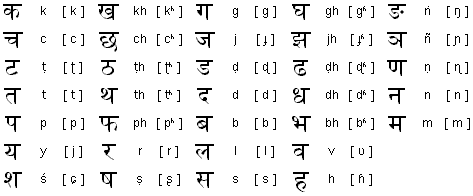
Consonents
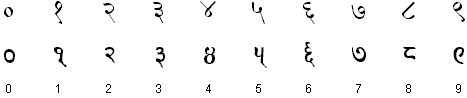
Numbers
The Nagari (lit. 'of the city') or Devana gari ('divine Nagari') alphabet descended from the Brahmi script sometime around the 11th century AD. It was originally developed to write Sanksrit but was later adapted to write many other languages.
- Some scholars use the term alphasyllabary to describe Devanagari, while others call it an abugida.
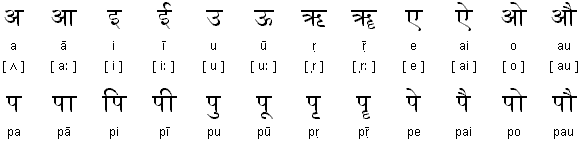
- Consonant letters carry an inherent vowel which can be altered or muted by means of diacritics.
- Vowels can be written as independent letters, or by using a variety of diacritical marks which are written above, below, before or after the consonant they belong to. This feature is common to most of the alphabets of South and South East Asia.
- When consonants occur together in clusters, special conjunct letters are used.
- The order of the letters is based on articulatory phonetics.
Used to write:
Sanskrit, a classical Indian language and the parent of the Indo-Ayran languages. Sanskrit is still used as literary and liturgical language by about 200,000 people. Efforts are currently being made to revive it as a spoken language.
Hindi, an Indo-Aryan language with about 487 million speakers. Hindi is spoken in India, particularly in the north, and also in Bangladesh, Belize, Botswana, Germany, Kenya, Nepal, New Zealand, Philippines, Singapore, South Africa, Uganda, UAE, UK, USA, Yemen and Zambia. Hindi is closely related to Urdu, the main language of Pakistan, which is written with the Arabic script.
Marathi, an Indo-Aryan language spoken by about 71 million people mainly in the Indian state of Maharashtra and neighbouring states. Marathi is also spoken in Israel and Mauritius.
Nepali, an Indo-Aryan language with around 16 million speakers in Nepal, Bhutan, Brunei and India. Devanagari
Awadhi
Bagheli
Balti
Bateri
Bhili
Bhojpuri
Bihari
Braj bhasha
Chhattisgarhi
Garhwali
Gondi
Harauti
Ho
Kachchi
Kanauji
Kankan
Kashmiri
Konkan
Limbu
Marwari
Newari
Santali
Sherpa
Consonents
Numbers