Creation is linked to Dance - the movement of the Soul - as it blends sound, light, and color in rhythmic patters of geometry that opens our souls and allow us to flow into other places where we are the creators.
Dancing as a way of releasing, healing and connecting with each other and our divine source dates back tens of thousands of years, and can be found in thousands of cultures the world over.
We are energy beings. Our feelings and emotions are energy, and as energy they are meant to move. Dance is a perfect way to vibrate and move this emotional energy, thereby restoring the body to its natural order.
Dance to heal yourself and your community, and to expand your radiance, awareness, presence, aliveness and passion.
Dance is one of the oldest forms of self expression.
It is an expression / language of the soul that dates back since the beginnings of time.

The art of dance flows through the soul as it does through the universe creating a way for musical frequency to express itself.
In rituals dance can expression the essence of that which one desires.
The movements of the arms in many dances are similar to the arm motions of ancient civilizations. These are usually slow graceful sweeping motions used to move energy or to communicate.
Put on some music and dance!!
Dancing to the beat of a tribal drum.
The participants reach a level of excitement they call 'Ecstasy'. They feel primal energy.
Trance Dance is a healing tool with its roots in many ancient cultures. It is practiced by Shaman.
Musical dance is a journey in the Shamanic tradition of the Native American people, and their insight into the power and magic of the animal archetypes, the healing of others, and the healing of the Earth Mother.
The process of Trance Dance seems to fall into three stages;
Firstly a building of trust - getting to know the others in the group. We do this physically with movement and mirroring games and people start to reveal who and how they are to the group. Next to find a partner who will be with us during the dance, noticing what we need and keeping us safe
Then to the dance itself. Dancing one or two at a time with their eyes closed the dancers accept the safety provided by the rest of the group. As they let go deeper into the dance their bodies spontaneously express whatever needs releasing. The dancers partner and two or three others surround them, keeping them from collisions. The supporters use their intuition to decide what it is the dancer needs; perhaps more space or arms ready to catch them if they loose their balance, a hand to hold or voice to support the dancers own shouts.
The dancer often comes to 'points of resistance' when they loose their balance or energy, with help they push through these till they have gone as far as they want to.
The drummers meanwhile have a similar role. Matching the dancers energy. Not pushing with their drumming but watching closely for the shift or breakthrough in the dancers movement and following them. The energy forms a circuit between dancer, supporter and drummer, sometimes slow, sometimes a reaching a crescendo of passion. Following the flow to stillness.
In this way it seems a perfect embodiment of love and relationship through acceptance, support, intuition and energy exchange - the dance of holding and being held. The dancer has the safe space to show the parts of themselves they may have found difficult to express and so they move deeper into love of themselves.
The dance ends when the dancer has gone as far as they are able and at that point they are helped to a comfortable space by their partner who stays with them to nurture and support them, always listening to what the dancer needs and wants from them.
When everyone who wants to has danced we reach the final stage of the day. A quiet closeness as the group comes back together, perhaps holding each other in gentle contact. People find their place in the centre or on the outskirts of the group according to their needs.
At the sharing some have been moved by the feeling of being safely held by the group and others by the chance to follow their intuition in supporting others. A quiet time for integration and re-centring is then needed. Many people have moved energy that has been stagnant for a long time; this culture doesn't make many safe spaces for strong passion - whatever kind of emotion it contains. This often leads to blockage, unhappiness and illness.
We need to dance and drum as much as every other culture throughout history. We need times to be in our body instead of our heads and to feel the ecstasy of letting go. In Trance Dance we can learn to trust that our bodies know what we need to do. And we can learn to accept and love ourselves and others in the process.

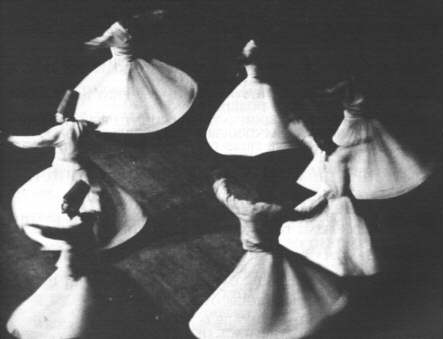
The Whirling Dervishes trace their origin to the 13th century Ottoman Empire. The Dervishes, also known as the Mevlevi Order, are Sufis, a spiritual offshoot of Islam. In 1972, Jelaluddin Loras, Sheikh of the Mevlevi Order of America, brought the religion from Turkey to the United States. On December 17, Whirling Dervishes across the world celebrate the birth of Jelaluddin Mevlana Rumi, a mystic poet, who founded the Mevlevi Order. Modern day Whirling Dervishes' are members of the Mevlevi Order (named for their founder Mevlana) lived in what we might call coisters or monasteries - what to them was a Mevlevihane.
The Life and Spiritual Milieu of Mevlana Jalaluddin Rumi
In the last decades of the Twentieth Century the spiritual influence of Mevlana Jalaluddin Rumiis being strongly felt by people of diverse beliefs throughout the Western world. He is being recognized here in the West, as he has been for seven centuries in the Middle East and Western Asia, as one of the greatest literary and spiritual figures of all time. Different qualities of Rumi have been brought forth by a variety of new translations that have appeared during the nineteen-eighties. He has been presented as both refined and sensual, sober and ecstatic, deeply serious and extremely funny, rarefied and accessible. It is a sign of his profound universality that he has been so many things to so many people.
Rumi's Life
Jalaluddîn Rumi was born in 1207 in Balkh in what is today Afghanistan. At an early age his family left Balkh because of the danger of the invading Mongols and settled in Konya, Turkey, which was then the capital of the Seljuk Empire.His father Bahauddin was a great religious teacher who received a position at the university in Konya.
Mevlana's early spiritual education was under the tutelage of his father Bahauddin and later under his father's close friend Sayyid Burhaneddin of Balkh. The circumstances surrounding Sayyid's undertaking of the education of his friend's son are interesting: Sayyid had been in Balkh, Afghanistan when he felt the death of his friend Bahauddin and realized that he must go to Konya to take over Jalaluddîn's spiritual education. He came to Konya when Mevlâna was about twenty-four years old, and for nine years instructed him in "the science of the prophets and states," beginning with a strict forty day retreat and continuing with various disciplines of meditation and fasting. During this time Jalâluddîn also spent more than four years in Aleppo and Damascus studying with some of the greatest religious minds of the time.
As the years passed, Mevlana grew both in knowledge and consciousness of God. Eventually Sayyid Burhaneddin felt that he had fulfilled his responsibility toward Jalaluddîn, and he wanted to live out the rest of his years in seclusion. He told Mevlana, "You are now ready, my son. You have no equal in any of the branches of learning. You have become a lion of knowledge. I am such a lion myself and we are not both needed here and that is why I want to go. Furthermore, a great friend will come to you, and you will be each other's mirror. He will lead you to the innermost parts of the spiritual world, just as you will lead him. Each of you will complete the other, and you will be the greatest friends in the entire world." And so Sayyid intimated the coming of Shams of Tabriz, the central event of Rumi's life.
At the age of thirty-seven Mevlana met the spiritual vagabond Shams. Much has already been written about their relationship. Prior to this encounter Rumi had been an eminent professor of religion and a highly attained mystic; after this he became an inspired poet and a great lover of humanity. Rumi's meeting with Shams can be compared to Abraham's meeting with Melchizedek. I owe to Murat Yagan this explanation: "A Melchizedek and a Shams are messengers from the Source. They do nothing themselves but carry enlightenment to someone who can receive, someone who is either too full or too empty. Mevlâna was one who was too full. After receiving it, he could apply this message for the benefit of humanity." Shams was burning and Rumi caught fire. Shams' companionship with Rumi was brief. Despite the fact that each was a perfect mirror for the other Shams disappeared, not once but twice. The first time, Rumi's son Sultan Veled searched for and discovered him in Damascus. The second disappearance, however, proved to be final, and it is believed that he may have been murdered by people who resented his influence over Mevlana.
Rumi was a man of knowledge and sanctity before meeting Shams, but only after the alchemy of this relationship was he able to fulfill Sayyid Burhaneddin's prediction that he would "drown men's souls in a fresh life and in the immeasurable abundance of God... and bring to life the dead of this false world with... meaning and love."
For more than ten years after meeting Shams, Mevlana had been spontaneously composing odes, or ghazals, and these had been collected in a large volume called the Divan-i Kabir. Meanwhile Mevlana had developed a deep spiritual friendship with Husameddin Chelebi. The two of them were wandering through the Meram vineyards outside of Konya one day when Husameddin described an idea he had to Mevlâna: "If you were to write a book like the Ilahiname of Sanai or the Mantik'ut-Tayr'i of Fariduddin Attar it would become the companion of many troubadours. They would fill their hearts form you work and compose music to accompany it."
Mevlana smiled and took from inside the folds of his turban a piece of paper on which were written the opening eighteen lines of his Mathnawi, beginning with:
Listen to the reed and the tale it tells, how it sings of separation...
Husameddin wept for joy and implored Mevlâna to write volumes more. Mevlana replied, "Chelebi, if you consent to write for me, I will recite." And so it happened that Mevlana in his early fifties began the dictation of this monumental work. As Husameddin described the process: "He never took a pen in his hand while composing the Mathnawi. Wherever he happened to be, whether in the school, at the Ilgin hot springs, in the Konya baths, or in the Meram vineyards, I would write down what he recited. Often I could barely keep up with his pace, sometimes, night and day for several days. At other times he would not compose for months, and once for two years there was nothing. At the completion of each book I would read it back to him, so that he could correct what had been written."
The Mathnawi can justifiably be considered the greatest spiritual masterpiece ever written by a human being. It's content includes the full spectrum of life on earth, every kind of human activity: religious, cultural, political, sexual, domestic; every kind of human character form the vulgar to the refined; as well as copious and specific details of the natural world, history and geography. It is also a book that presents the vertical dimension of life -- from this mundane world of desire, work, and things, to the most sublime levels of metaphysics and cosmic awareness. It is its completeness that enchants us.
His Spiritual Milieu What do we need to know to receive the knowledge that Rumi offers us? First of all, it needs to be understood that Rumi's tradition is not an "Eastern" tradition. It is neither of the East nor of the West, but something in between. Rumi's mother-tongue was Persian, an Indo-European language strongly influenced by Semitic (Arabic) vocabulary, something like French with a smattering of Hebrew.
Furthermore, the Islamic tradition, which shaped him, acknowledges that only one religion has been given to mankind through countless prophets, or messengers, who have come to every people on Earth bearing this knowledge of Spirit. God is the subtle source of all life, Whose essence cannot be described or compared to anything, but who can be known through the spiritual qualities that are manifest in the world and in the human heart. It is a deeply mystical tradition, on the one hand, with a strong and clear emphasis on human dignity and social justice, on the other.
Islam is understood as a continuation of the Judeo-Christian or Abrahamic tradition, honoring the Hebrew prophets, as well as Jesus and Mary. Muslims, however, are very sensitive to the issue of attributing divinity to a human being, which they see as the primary error of Christianity. although Jesus is called the in the Qur'an "the Spirit of God," it would be thought a blasphemy to identify any human being exclusively as God. Muhammad is viewed as the last of those human prophets who brought the message of God's love.
In Rumi's world, the Islamic way of life had established a high level of spiritual awareness among the general population. The average person would be someone who performed regular ablutions and prayed five times a day, fasted from food and drink during the daylight hours for at least one month a year, and closely followed a code which emphasized the continual remembrance of God, intention, integrity, generosity, and respect for all life. Although the Mathnawi can appeal to us on many levels, it assumes a rather high level of spiritual awareness as a starting point and extends to the very highest levels of spiritual understanding.
The unenlightened human state is one of "faithlessness" in which an individual lives in slavery to the false self and the desires of the materials world. The spiritual practices which Rumi would have known were aimed at transforming the compulsiveness of the false self and attaining Islam or "Submission" to a higher order of reality. Without this submission the real self is enslaved to the ego and lives in a state of internal conflict due to the contradictory impulses of the ego. The enslaved ego is cut off from the heart, the chief organ for perceiving reality, and cannot receive the spiritual guidance and nourishment which the heart provides. Overcoming this enslavement and false separation leads to the realization and development of our true humanity. spiritual maturity is the realization that the self is a reflection of the Divine. God is the Beloved or Friend, the transpersonal identity. Love of God leads to the lover forgetting himself in the love of the Beloved.
Dance is the hidden language
of the soul
of the body.
~ Martha Graham ~

CRYSTALINKS MAILING LIST, NEWSLETTER, UPDATES