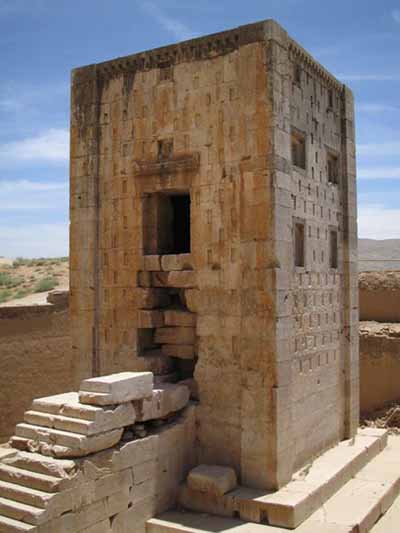
The Ka'ba-i Zartosht meaning the "Cube of Zoroaster", is a 5th century BCE Achaemenid-era edifice at Naqsh-e Rustam, an archaeological site just northwest of Persepolis, Iran. The name Ka'ba-ye Zartosht probably dates to the 14th century, when many pre-Islamic sites were identified with figures and events of the Qur'an or the Shahname. The structure is not actually a Zoroastrian shrine, nor are there reports of it ever having been a pilgrimage site.
The structure, which is a copy of a sister building at Pasargadae, was built either by Darius I (r. 521-486 BCE) when he moved to Persepolis, or by Artaxerxes II (r. 404-358 BCE) or Artaxerxes III (r. 358-338 BCE). From a reference to fire altars in a Sassanid-era inscription on the building it has been inferred that the structure was once a fire altar, or perhaps as an eternal-flame memorial to the emperors whose tombs are located a few meters away. This is however highly unlikely since the lack of cross-ventilation would have soon choked the flame.
Today, most scholars consider the structure to be an Achaemenid royal tomb, and it has been observed by F. Weissbach and A. Demandt that both the Ka'ba-ye Zartosht and its sister building at Pasargadae "more closely correspond to the description of Cyrus the Great's tomb by Arrian (6.29) and Strabo (15.3.7) than does the monument in Pasargadae which is commonly attributed to this king."
The structure was built in the Achaemenid era. There is no information of the name of the structure in that era. It was called Bon-Khanak in the Sassanian era; the local name of the structure was Naggarekhaneh which means house (khaneh) keep/hold (Naggar). The phrase Ka'ba-ye Zartosht has been used for the structure from the fourteenth century into the contemporary era.
Various views and interpretations have been proposed for the purpose of the chamber, but none of them can be accepted with certainty. Some consider the tower a fire temple and a fireplace, and believe that it was used for igniting and worshiping the holy fire.
Another theory is that it is the mausoleum of one of the Achaemenid shahs or grandees, due to its similarity to the Tomb of Cyrus and some mausoleums of Lycia and Caria. Other Iranian scholars believe the stone chamber to be a structure for the safekeeping of royal documents and holy or religious books, but the chamber of Ka'ba-ye Zartosht is too small for this purpose. Other less noticed theories, such as its being a temple for the goddess Anahita or a solar calendar, have also been mentioned.
In the Sassanian era, three inscriptions were written in the three languages Sassanian Middle Persian, Arsacid Middle Persian and Greek on the northern, southern and eastern walls of the tower. One of them belongs to Shapur I the Sassanian, and another to the priest Kartir. According to Walter Henning, "These inscriptions are the most important historical documents from the Sassanian era."
The Ka'ba-ye Zartosht is a beautiful structure: its proportions, lines and external beauty are based on well-executed architectural principles. Currently, the structure is part of the Naqsh-e Rustam compound and owned by the Cultural Heritage, Handicrafts and Tourism Organization of Iran.
Ka'ba-ye Zartosht is cuboid in shape, and has only one entrance door, which leads inside its chamber by means of a stone stairway. There are four blind windows on each of its sides.
The stone used is white marbly limestone, and there are dentate shelves of black stone on its walls. The limestone blocks were brought from Mount Sivand, where they were quarried in a place called Na'l Shekan ("horseshoe breaker"), to Naqsh-e Rustam to build the Ka'ba.
These blocks were chiseled into large, mostly rectangular pieces and are put in place atop each other without using mortar; in some places, such as the rooftop, the stones are connected to each other by dovetail joints.
The size of the stones varies from 2.90 by 2.10 by 0.48 metres (9 ft 6 in by 6 ft 11 in by 1 ft 7 in) to 1.10 by 1.08 by 0.56 metres (3 ft 7 in by 3 ft 7 in by 1 ft 10 in); however in the west wall, there is a flat stone that is 4.40 metres (14 ft 5 in) long.
Four large rectangular pieces of stone form the ceiling/roof, placed along an east–west axis. Each of those stones are 7.30 metres (24.0 ft) long, connected to each other by dovetail joints, and the chipping method used to form them has given the roof the shape of a short pyramid.
The anathyrosis style is used here in placing the stones atop each other, but no accurate order is retained in the 'ranking' of the stones. In some places, 20 rows, and in others 22 rows of stones are placed, and this continues to the ceiling. Wherever the original builders discovered any flaw in the main stone, the flawed area was removed and filled in with delicate joints, some of which still remain.
To prevent the finished building from becoming too simple or monochrome, its creators added two architectural diversities: firstly, forming double-edged shelves from one or two flat plates of grey-black stone and placing them on the walls; secondly, carving small rectangular pits into the upper and middle sections of the outer walls that give a more delicate appearance to the tower's faces. The black stones were probably brought from Mount Mehr in Persepolis, and installed on the walls in three rows:
Three metres (9.8 ft) below the ceiling, two large square shelves on three sides and one small rectangular shelf on the northern side
Six metres (20 ft) below the ceiling, two medium-sized rectangular shelves on three sides and one large rectangular on the northern side
Read more: Ka'ba-i Zartosht - The "Cube of Zoroaster" Wikipedia