The 2007 crop circle season is widely remembered for its record-breaking scale and highly intricate, woven floor patterns. Farmland across Wiltshire, England, became the stage for massive formations that capitalized on a rain-heavy summer, allowing artists or unknown forces to construct elaborate geometric designs over vast areas of damp, easily pliable crops.
The summer yielded several legendary formations that remain highly celebrated among enthusiasts.
What truly set 2007 apart was the sheer quality of the ground-level detail, often referred to as "floor work." Researchers entering the East Field and Sugar Hill formations documented unprecedented multi-tiered basket weaves.
Crop stalks were not simply pushed down; they were interlaced in complex directional flows, with multiple layers crossing over and under one another without breaking the plants. This intricate styling fueled fierce debates over whether human teams could realistically achieve such woven perfection during short, dark, and wet summer nights.
Standout Formations of 2007
The East Field "Mega-Glyph": Materializing over the course of July 7, this colossal formation is considered one of the largest crop circles in history. Sprawling over an astonishing 1,000 feet in length, it featured over 150 individual circles, intricate geometric walkways, and blocky, mechanical-looking glyphs that covered multiple acres of wheat.
The Sugar Hill Butterfly: Discovered on August 1 near Aldbourne, this breathtaking design departed from traditional abstracts to depict a stylized, highly intricate butterfly. It marked a massive leap forward in biomimicry, paving the way for the insect-themed mega-designs that followed in subsequent years.
The West Kennett Long Barrow "Aura": Appearing on June 28 near an ancient burial site, this elegant formation featured a central circle surrounded by hundreds of thin, radiating needle-like spikes, mimicking a massive magnetic field or an explosive aura pattern.
The Stanton St. Bernard Cuboctahedron: Discovered in mid-July, this design showcased brilliant three-dimensional shading. By systematically flattening specific quadrants of wheat, the creators constructed a highly convincing optical illusion of a floating, translucent 3D geometric solid.
2007 brought more exciting formation that piqued the imagination and baffled researchers.
The first appeared at West Kennet Longbarrow and was named 'The Temple' - another circle to use one point projection. The circle showed a columned hall, with a checkerboard floor, moving into a unseen distance. The design seemed to invite the visitor to contemplate that unseen place, perhaps to think of the world unseen, beyond the veil. It was a profound statement.
Another of the years stunning formations was affectionally known as the 'Sugar Cubes' at Sugar Hill, Aldbourne, Wiltshire. A magnificent design, four iterations of a thirty-six pointed star, and in the centre eighteen cubes (made from hexagons) around a flattened hexagram in the centre.
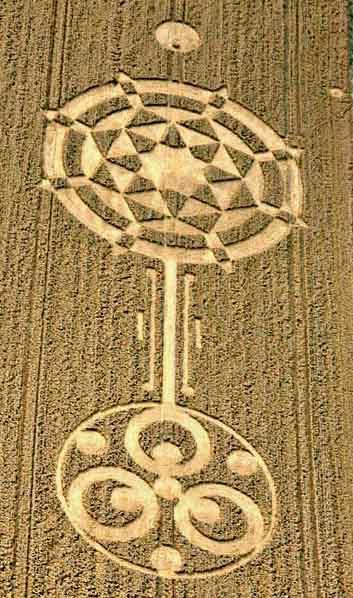
Woodborough Hill - August 22, 2007
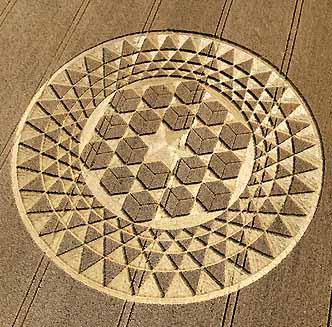
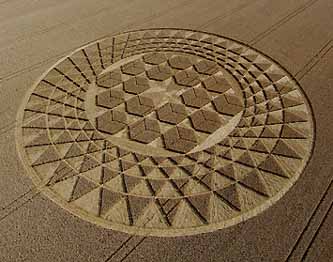
Sugar Hill, nr Upper Upham, Wiltshire - August 1, 2007
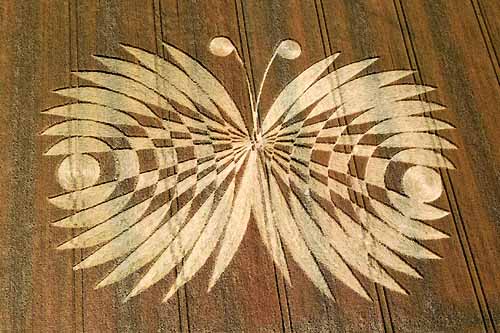
The Butterfly Crop Circle
Hailey Wood, Nr Ashbury, Oxfordshire - July 16, 2007
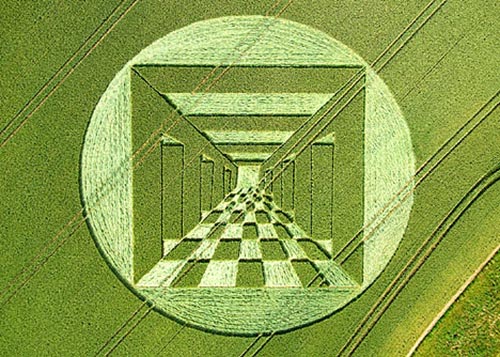

West Kennett Long Barrow, Nr Avebury, Wiltshire - June 28, 2007

Crop Circles and A.I.