The 1996 crop circle season is universally recognized as the year the phenomenon underwent a radical quantum leap in architectural complexity. Farmland in Wiltshire, England, became the stage for massive, mathematically pure fractal configurations that completely shattered the idea that crop circles were merely simple geometric glyphs or crude pranks.The summer produced what are considered two of the most legendary, mind-bending formations of all time.
In 1996, crop circle activity surged, with a notable formation appearing near Stonehenge, England. This "Julia Set" formation, featuring a complex fractal pattern of 151 circles along a spiral, was particularly famous. It appeared in broad daylight and was remarkably large, measuring 915 feet long. While some argued for extraterrestrial origins, the formation was later revealed to have been created by humans in a few hours, though it was not noticed until the next day.
Following the shock of the Stonehenge formation, an even larger mega-fractal appeared on July 29 at Windmill Hill. Spanning an astonishing 1,000 feet across a massive wheat field, it featured a central starburst with three sprawling arms looping outward, comprising a staggering 194 individual circles. The mathematical precision required to scale these circles down symmetrically across uneven hills left topologists and computer surveyors completely stunned.
The sheer scale of the 1996 season fundamentally changed how the public viewed the phenomenon. While master landscape artist collectives were beginning to demonstrate how they could map out complex designs using CAD software, surveyor tape, and wooden boards, the tight time constraints of 1996 kept the supernatural vs. advanced human engineering debate fiercely alive.

The Julia Set crop formation appeared July 1996 near Stonehenge in Wiltshire, England. Unlike earlier simple circles, this design displayed a complex fractal pattern composed of hundreds of precisely placed circular.

Stonehenge, Wiltshire - July 7, 1996


Windmill, Wiltshire - July 29, 1996
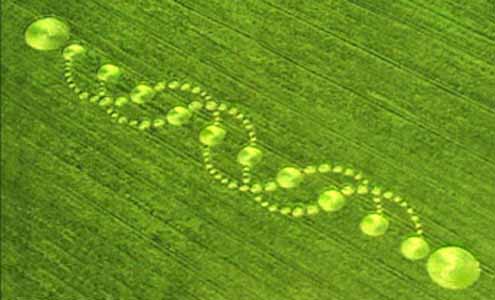
Double Helix DNA

Linddington Castle, Wiltshire - August 2, 1996

East Oakley Hampshire, July 7, 1996

Olivers Castle Wiltshire - August 11, 1996

Crop Circles and A.I.